Safe isolation of electrical
installations
The safest way of working on an electrical circuit
is to make sure that the circuit is ‘dead’.
A ‘dead’ circuit is a circuit which cannot cause
harm.
NEVER ASSUME THAT A CIRCUIT IS ‘DEAD’.
ALWAYS CHECK THE CIRCUIT YOURSELF!
Safe isolation means:
SWITCH OFF
This means the supply to the circuit is switched
off.
ISOLATION
This means the disconnection of the supply
cables, or using an isolating switch.
POST WARNING NOTICES
Warning notices must be shown on any
isolator that has been switched off. The reason
is that you do not want anyone re-energising a
circuit whilst you are working on that circuit.
POSTING WARNING NOTICES
Warning notices also need to be posted on the
approaches to the site of work. They must
make it clear to anyone that they must stay
away from the area where the work is being
carried out.
LOCKING OFF
Many electricians believe that ‘locking off’ a
circuit is a case of overkill when warning
notices have been posted on isolators. But,
‘locking off’ stops accidents happening to
people who ignore the notices or people who
cannot read.
LOCKING OFF
Isolators must be able
to be ‘locked off’. This
is done with a padlock
and key.
Or the handle can be
made removable in the
OFF position and the
person can take it with
them once the circuit is
switched off.
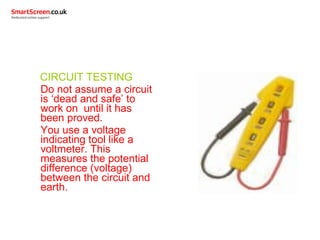
CIRCUIT TESTING
Do not assume a circuit
is ‘dead and safe’ to
work on until it has
been proved.
You use a voltage
indicating tool like a
voltmeter. This
measures the potential
difference (voltage)
between the circuit and
earth.
CIRCUIT TESTING
Any test instrument
used must be proved to
be in good working
order and safe to use.
The instrument and its
associated test leads
must comply with the
health and safety
guidance note GS38.
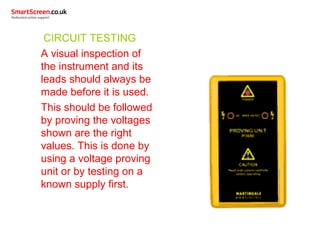
CIRCUIT TESTING
A visual inspection of
the instrument and its
leads should always be
made before it is used.
This should be followed
by proving the voltages
shown are the right
values. This is done by
using a voltage proving
unit or by testing on a
known supply first.
CIRCUIT TESTING
Once the instrument has
been checked as safe to
use you can test the circuit
for the presence of a
voltage.
Having tested the circuit
and confirmed that it is
‘DEAD’ you should retest
your instrument with the
proving unit (or the known
supply) to check it has not
been damaged while being
used.
Now it is safe to work on

Unit 103 power_point_6_safe_isolation

  • 1.
    Safe isolation ofelectrical installations
  • 2.
    The safest wayof working on an electrical circuit is to make sure that the circuit is ‘dead’. A ‘dead’ circuit is a circuit which cannot cause harm. NEVER ASSUME THAT A CIRCUIT IS ‘DEAD’. ALWAYS CHECK THE CIRCUIT YOURSELF!
  • 3.
    Safe isolation means: SWITCHOFF This means the supply to the circuit is switched off. ISOLATION This means the disconnection of the supply cables, or using an isolating switch.
  • 4.
    POST WARNING NOTICES Warningnotices must be shown on any isolator that has been switched off. The reason is that you do not want anyone re-energising a circuit whilst you are working on that circuit.
  • 5.
    POSTING WARNING NOTICES Warningnotices also need to be posted on the approaches to the site of work. They must make it clear to anyone that they must stay away from the area where the work is being carried out.
  • 6.
    LOCKING OFF Many electriciansbelieve that ‘locking off’ a circuit is a case of overkill when warning notices have been posted on isolators. But, ‘locking off’ stops accidents happening to people who ignore the notices or people who cannot read.
  • 7.
    LOCKING OFF Isolators mustbe able to be ‘locked off’. This is done with a padlock and key. Or the handle can be made removable in the OFF position and the person can take it with them once the circuit is switched off.
  • 8.
    CIRCUIT TESTING Do notassume a circuit is ‘dead and safe’ to work on until it has been proved. You use a voltage indicating tool like a voltmeter. This measures the potential difference (voltage) between the circuit and earth.
  • 9.
    CIRCUIT TESTING Any testinstrument used must be proved to be in good working order and safe to use. The instrument and its associated test leads must comply with the health and safety guidance note GS38.
  • 10.
    CIRCUIT TESTING A visualinspection of the instrument and its leads should always be made before it is used. This should be followed by proving the voltages shown are the right values. This is done by using a voltage proving unit or by testing on a known supply first.
  • 11.
    CIRCUIT TESTING Once theinstrument has been checked as safe to use you can test the circuit for the presence of a voltage. Having tested the circuit and confirmed that it is ‘DEAD’ you should retest your instrument with the proving unit (or the known supply) to check it has not been damaged while being used.
  • 12.
    Now it issafe to work on