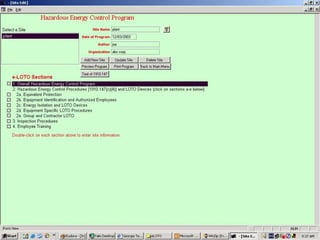
Energy Control
Procedures
Lockout/Tagout
29 CFR 1910.147
Georgia Tech Research Institute
Standard & Subpart: 1910.

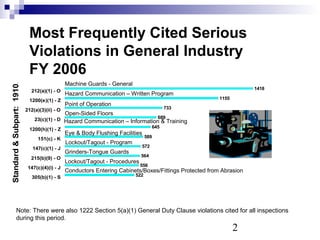
Most Frequently Cited Serious
Violations in General Industry
FY 2006
Machine Guards - General
212(a)(1) - O
1200(e)(1) - Z
212(a)(3)(ii) - O

Hazard Communication – Written Program
Point of Operation

1418
1155

733

Open-Sided Floors
689
23(c)(1) - D Hazard Communication – Information & Training

1200(h)(1) - Z
151(c) - K
147(c)(1) - J
215(b)(9) - O
147(c)(4)(i) - J
305(b)(1) - S

645

Eye & Body Flushing Facilities
Lockout/Tagout - Program

589

572

Grinders-Tongue Guards
Lockout/Tagout - Procedures

564
556

Conductors Entering Cabinets/Boxes/Fittings Protected from Abrasion
522

Note: There were also 1222 Section 5(a)(1) General Duty Clause violations cited for all inspections
during this period.

2
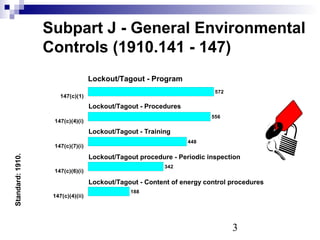
Subpart J - General Environmental
Controls (1910.141 - 147)
Lockout/Tagout - Program
572

147(c)(1)

Lockout/Tagout - Procedures
556

147(c)(4)(i)

Lockout/Tagout - Training
448

Standard: 1910.

147(c)(7)(i)

Lockout/Tagout procedure - Periodic inspection
342

147(c)(6)(i)

Lockout/Tagout - Content of energy control procedures
147(c)(4)(ii)

188

3
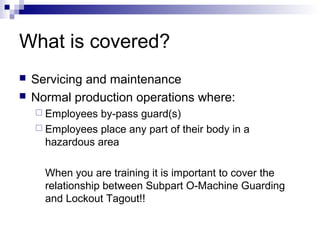
What is covered?



Servicing and maintenance
Normal production operations where:
 Employees

by-pass guard(s)
 Employees place any part of their body in a
hazardous area
When you are training it is important to cover the
relationship between Subpart O-Machine Guarding
and Lockout Tagout!!
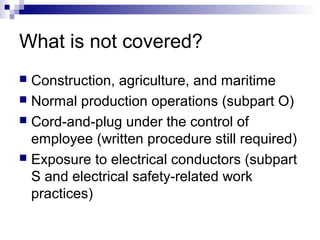
What is not covered?
Construction, agriculture, and maritime
 Normal production operations (subpart O)
 Cord-and-plug under the control of
employee (written procedure still required)
 Exposure to electrical conductors (subpart
S and electrical safety-related work
practices)

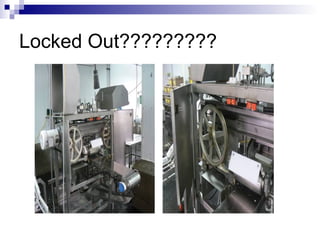
Locked Out?????????
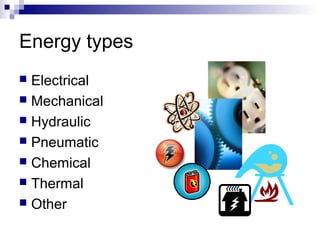
Energy types
Electrical
 Mechanical
 Hydraulic
 Pneumatic
 Chemical
 Thermal
 Other

Lockout vs. Tagout


If capable of being locked out:
 Prefer

lockout
 Tags allowed, if employer can demonstrate
FULL EMPLOYEE PROTECTION


Machine Modifications
 If

you alter a machine you must make the
machine capable of accepting a lock.
Full employee protection?
Tags attached at the same location as
locks
 Full compliance with all tagout provisions
in 29 CFR 1910.147
 Additional means when necessary (e.g.
removal of a valve handle)

Definitions
Affected employee
 Authorized employee
 Capable of being locked out
 Energy isolating device
 Servicing and/or maintenance

Servicing and maintenance
includes:
Setting up
 Adjusting
 Inspecting
 Modifying
 Installing

Lockout/tagout requirements
Written program which includes specific
written procedures
 Training of employees (not just
maintenance!)
 Periodic review of procedures

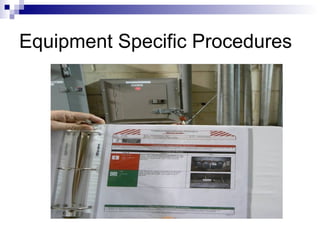
Written lockout/tagout
procedure
(Equipment Specific Procedures)


Clearly and specifically outline
 Scope
 Purpose
 Authorization
 Rules,

techniques for control of energy
Lockout procedure (cont.)


Clearly and specifically outline:
 Means

to enforce compliance including:

Intended use of procedure
 Specific procedural steps
 Specific testing requirements

Documentation exceptions:
Machine has no potential for stored
energy
 Machine has a single energy source
 Isolation of that source will completely deenergize
 Machine is isolated and locked out during
maintenance

Documentation exceptions
(cont.)
A single lockout device will achieve
locked-out condition
 Lockout device under exclusive control of
employee
 Maintenance does not create hazard to
others
 No previous accidents involving
unexpected energization on this
equipment

Energy control procedure









Notification of employees
Preparation for shutdown
Machine or equipment shutdown
Machine or equipment isolation
Lockout/tagout device application
Stored energy
Verification of isolation
Release from lockout/tagout
Equipment Specific Procedures
Lockout procedure – Step 1


NOTIFICATION OF EMPLOYEES
 Before

controls are applied, and before they
are removed
Lockout procedure – Step 2


PREPARATION FOR SHUTDOWN
 Knowledge

of the type and magnitude of
energy and methods to control energy
Lockout procedure – Step 3


MACHINE OR EQUIPMENT SHUTDOWN
 Orderly

shutdown to avoid increased hazard
Lockout procedure – Step 4


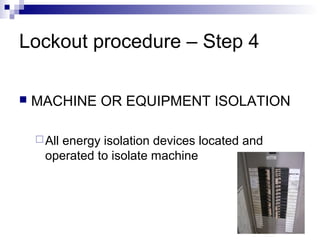
MACHINE OR EQUIPMENT ISOLATION
 All

energy isolation devices located and
operated to isolate machine
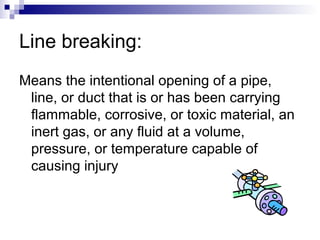
Line breaking:
Means the intentional opening of a pipe,
line, or duct that is or has been carrying
flammable, corrosive, or toxic material, an
inert gas, or any fluid at a volume,
pressure, or temperature capable of
causing injury
Line blanking or blinding:
Means the absolute closure of a pipe, line,
or duct by fastening of a solid plate that
completely covers the bore and that is
capable of withstanding the maximum
pressure of the pipe, line, or duct with no
leakage beyond the plate.
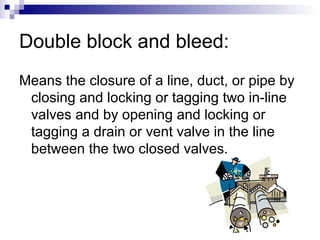
Double block and bleed:
Means the closure of a line, duct, or pipe by
closing and locking or tagging two in-line
valves and by opening and locking or
tagging a drain or vent valve in the line
between the two closed valves.
Lockout procedure – Step 5


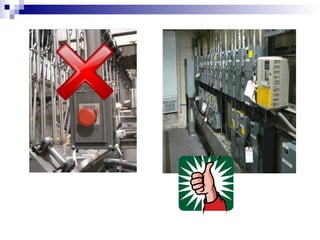
LOCKOUT OR TAGOUT DEVICE
APPLICATION
 Affixed

by authorized employee holding
energy isolating device in the safe or off
position
Lockout procedure – Step 6


STORED ENERGY
 Relieve

all stored energy and continue to
verify if there is a chance of re-accumulation
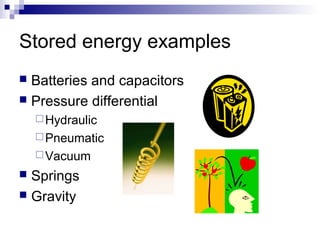
Stored energy examples
Batteries and capacitors
 Pressure differential


 Hydraulic
 Pneumatic
 Vacuum

Springs
 Gravity

Lockout procedure – Step 7


VERIFICATION OF ISOLATION
 Prior

to servicing or maintenance, authorized
employee must verify machine has been deenergized
Lockout procedure – Step 8


RELEASE FROM LOCKOUT OR TAGOUT
 Inspect

work area to ensure removal of nonessentials
 Employees safely positioned and notified
 Lockout/tagout removal (by employee who applied)
Lock/tag removal if authorized
employee is not available?




Verify that authorized employee is not at facility
Make reasonable efforts to inform him or her
Ensure that he/she knows of removal upon reentering
MUST INCLUDE THIS PROCEDURE IN
WRITTEN PROGRAM
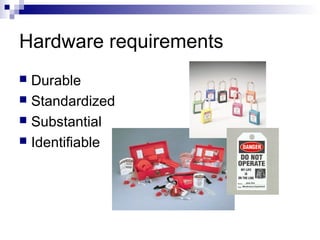
Hardware requirements
Durable
 Standardized
 Substantial
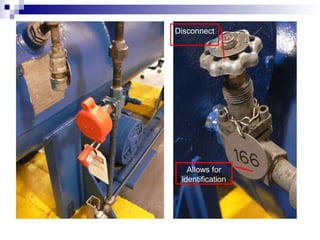
 Identifiable

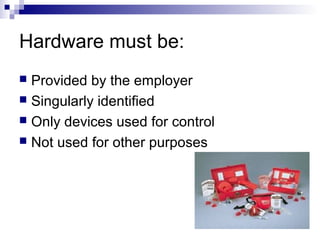
Hardware must be:
Provided by the employer
 Singularly identified
 Only devices used for control
 Not used for other purposes

Hardware must be (cont.):
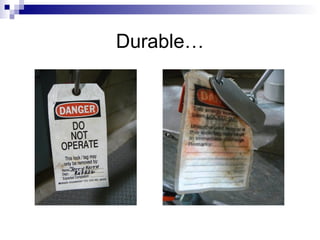
Durable – be able to withstand
environment
 Standardized – color, size, etc.


 Tags



: print and format

Substantial – no accidental removal
 Tag

attachment means:

Withstand at least 50 pounds of force
 Not re-usable
 Self locking
 Attachable by hand

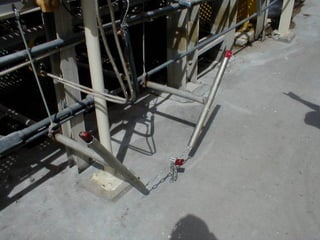
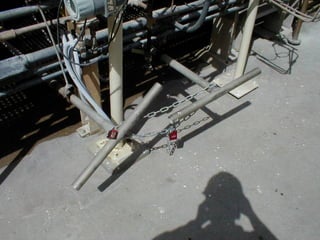
Durable…
Hardware must be (cont.):


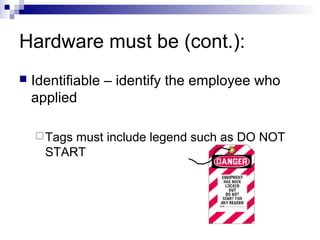
Identifiable – identify the employee who
applied
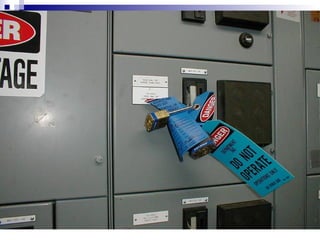
 Tags

must include legend such as DO NOT
START
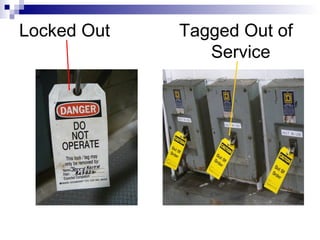
Locked Out

Tagged Out of
Service
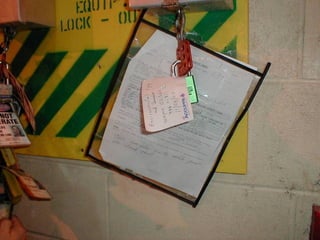
Hmmm?
Disconnect

Allows for
identification
Periodic Inspection







Performed at least annually
Lockout – include review with authorized
employees
Tagout – include review with authorized and
affected employees
Certification record kept:
 Identify

machine or equipment
 Date of inspection
 Employees performing and included in inspection
Training and re-training


Authorized employees
 Recognition

of hazardous energy
 Type and magnitude of hazardous energy
 Methods of isolating energy
 How to verify isolation

Affected – Purpose and use of procedure
 Other – Procedure and Prohibition from
tampering
 Tagout provisions

Re-training is required when:
Change in job assignment
 Change in machine or process
 Change in lockout/tagout procedure
 Inadequacies revealed in periodic review

Training certification


Certify that the training has been
conducted and kept up to date:
 Employee

names
 Date(s) of training
Other requirements
Contractors?
 Personnel or shift changes?

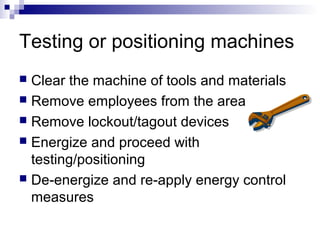
Testing or positioning machines
Clear the machine of tools and materials
 Remove employees from the area
 Remove lockout/tagout devices
 Energize and proceed with
testing/positioning
 De-energize and re-apply energy control
measures

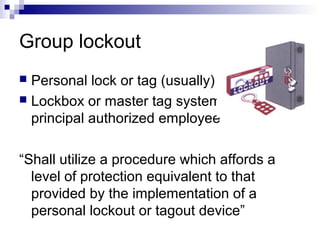
Group lockout
Personal lock or tag (usually)
 Lockbox or master tag system with
principal authorized employee


“Shall utilize a procedure which affords a
level of protection equivalent to that
provided by the implementation of a
personal lockout or tagout device”
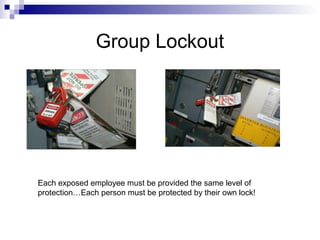
Group Lockout

Each exposed employee must be provided the same level of
protection…Each person must be protected by their own lock!
TRAINING


General
 Operation
 Steps

to:

Change
 Set up
 Clean


Second Nature
 Feedback from Employees

Training (cont.)


Inspections
 Hazard

Assessment (Training of Operators)
 Incorrect Procedures (Training of Supervisors)


Documentation
 Training
 Retraining
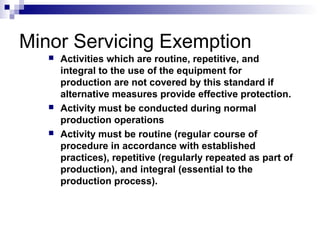
Minor Servicing Exemption






Activities which are routine, repetitive, and
integral to the use of the equipment for
production are not covered by this standard if
alternative measures provide effective protection.
Activity must be conducted during normal
production operations
Activity must be routine (regular course of
procedure in accordance with established
practices), repetitive (regularly repeated as part of
production), and integral (essential to the
production process).
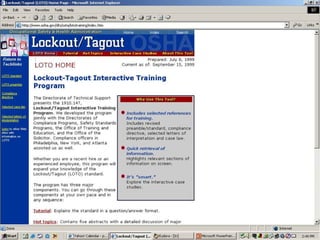
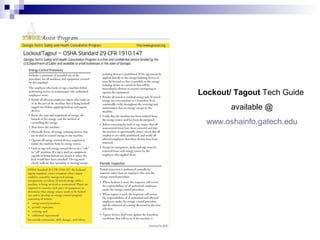
Lockout/ Tagout Tech Guide
available @
www.oshainfo.gatech.edu
SUMMARY
Written program including written
procedures for each machine
 Training of employees
 Periodic review of program
 ENFORCEMENT


Loto.ppt

  • 1.
    Energy Control Procedures Lockout/Tagout 29 CFR1910.147 Georgia Tech Research Institute
  • 2.
    Standard & Subpart:1910. Most Frequently Cited Serious Violations in General Industry FY 2006 Machine Guards - General 212(a)(1) - O 1200(e)(1) - Z 212(a)(3)(ii) - O Hazard Communication – Written Program Point of Operation 1418 1155 733 Open-Sided Floors 689 23(c)(1) - D Hazard Communication – Information & Training 1200(h)(1) - Z 151(c) - K 147(c)(1) - J 215(b)(9) - O 147(c)(4)(i) - J 305(b)(1) - S 645 Eye & Body Flushing Facilities Lockout/Tagout - Program 589 572 Grinders-Tongue Guards Lockout/Tagout - Procedures 564 556 Conductors Entering Cabinets/Boxes/Fittings Protected from Abrasion 522 Note: There were also 1222 Section 5(a)(1) General Duty Clause violations cited for all inspections during this period. 2
  • 3.
    Subpart J -General Environmental Controls (1910.141 - 147) Lockout/Tagout - Program 572 147(c)(1) Lockout/Tagout - Procedures 556 147(c)(4)(i) Lockout/Tagout - Training 448 Standard: 1910. 147(c)(7)(i) Lockout/Tagout procedure - Periodic inspection 342 147(c)(6)(i) Lockout/Tagout - Content of energy control procedures 147(c)(4)(ii) 188 3
  • 4.
    What is covered?   Servicingand maintenance Normal production operations where:  Employees by-pass guard(s)  Employees place any part of their body in a hazardous area When you are training it is important to cover the relationship between Subpart O-Machine Guarding and Lockout Tagout!!
  • 5.
    What is notcovered? Construction, agriculture, and maritime  Normal production operations (subpart O)  Cord-and-plug under the control of employee (written procedure still required)  Exposure to electrical conductors (subpart S and electrical safety-related work practices) 
  • 6.
  • 7.
    Energy types Electrical  Mechanical Hydraulic  Pneumatic  Chemical  Thermal  Other 
  • 8.
    Lockout vs. Tagout  Ifcapable of being locked out:  Prefer lockout  Tags allowed, if employer can demonstrate FULL EMPLOYEE PROTECTION  Machine Modifications  If you alter a machine you must make the machine capable of accepting a lock.
  • 9.
    Full employee protection? Tagsattached at the same location as locks  Full compliance with all tagout provisions in 29 CFR 1910.147  Additional means when necessary (e.g. removal of a valve handle) 
  • 10.
    Definitions Affected employee  Authorizedemployee  Capable of being locked out  Energy isolating device  Servicing and/or maintenance 
  • 11.
    Servicing and maintenance includes: Settingup  Adjusting  Inspecting  Modifying  Installing 
  • 12.
    Lockout/tagout requirements Written programwhich includes specific written procedures  Training of employees (not just maintenance!)  Periodic review of procedures 
  • 13.
    Written lockout/tagout procedure (Equipment SpecificProcedures)  Clearly and specifically outline  Scope  Purpose  Authorization  Rules, techniques for control of energy
  • 14.
    Lockout procedure (cont.)  Clearlyand specifically outline:  Means to enforce compliance including: Intended use of procedure  Specific procedural steps  Specific testing requirements 
  • 15.
    Documentation exceptions: Machine hasno potential for stored energy  Machine has a single energy source  Isolation of that source will completely deenergize  Machine is isolated and locked out during maintenance 
  • 16.
    Documentation exceptions (cont.) A singlelockout device will achieve locked-out condition  Lockout device under exclusive control of employee  Maintenance does not create hazard to others  No previous accidents involving unexpected energization on this equipment 
  • 17.
    Energy control procedure         Notificationof employees Preparation for shutdown Machine or equipment shutdown Machine or equipment isolation Lockout/tagout device application Stored energy Verification of isolation Release from lockout/tagout
  • 18.
  • 19.
    Lockout procedure –Step 1  NOTIFICATION OF EMPLOYEES  Before controls are applied, and before they are removed
  • 20.
    Lockout procedure –Step 2  PREPARATION FOR SHUTDOWN  Knowledge of the type and magnitude of energy and methods to control energy
  • 21.
    Lockout procedure –Step 3  MACHINE OR EQUIPMENT SHUTDOWN  Orderly shutdown to avoid increased hazard
  • 22.
    Lockout procedure –Step 4  MACHINE OR EQUIPMENT ISOLATION  All energy isolation devices located and operated to isolate machine
  • 23.
    Line breaking: Means theintentional opening of a pipe, line, or duct that is or has been carrying flammable, corrosive, or toxic material, an inert gas, or any fluid at a volume, pressure, or temperature capable of causing injury
  • 24.
    Line blanking orblinding: Means the absolute closure of a pipe, line, or duct by fastening of a solid plate that completely covers the bore and that is capable of withstanding the maximum pressure of the pipe, line, or duct with no leakage beyond the plate.
  • 25.
    Double block andbleed: Means the closure of a line, duct, or pipe by closing and locking or tagging two in-line valves and by opening and locking or tagging a drain or vent valve in the line between the two closed valves.
  • 26.
    Lockout procedure –Step 5  LOCKOUT OR TAGOUT DEVICE APPLICATION  Affixed by authorized employee holding energy isolating device in the safe or off position
  • 28.
    Lockout procedure –Step 6  STORED ENERGY  Relieve all stored energy and continue to verify if there is a chance of re-accumulation
  • 29.
    Stored energy examples Batteriesand capacitors  Pressure differential   Hydraulic  Pneumatic  Vacuum Springs  Gravity 
  • 30.
    Lockout procedure –Step 7  VERIFICATION OF ISOLATION  Prior to servicing or maintenance, authorized employee must verify machine has been deenergized
  • 31.
    Lockout procedure –Step 8  RELEASE FROM LOCKOUT OR TAGOUT  Inspect work area to ensure removal of nonessentials  Employees safely positioned and notified  Lockout/tagout removal (by employee who applied)
  • 32.
    Lock/tag removal ifauthorized employee is not available?    Verify that authorized employee is not at facility Make reasonable efforts to inform him or her Ensure that he/she knows of removal upon reentering MUST INCLUDE THIS PROCEDURE IN WRITTEN PROGRAM
  • 33.
  • 34.
    Hardware must be: Providedby the employer  Singularly identified  Only devices used for control  Not used for other purposes 
  • 35.
    Hardware must be(cont.): Durable – be able to withstand environment  Standardized – color, size, etc.   Tags  : print and format Substantial – no accidental removal  Tag attachment means: Withstand at least 50 pounds of force  Not re-usable  Self locking  Attachable by hand 
  • 36.
  • 37.
    Hardware must be(cont.):  Identifiable – identify the employee who applied  Tags must include legend such as DO NOT START
  • 38.
  • 40.
  • 41.
  • 44.
    Periodic Inspection     Performed atleast annually Lockout – include review with authorized employees Tagout – include review with authorized and affected employees Certification record kept:  Identify machine or equipment  Date of inspection  Employees performing and included in inspection
  • 45.
    Training and re-training  Authorizedemployees  Recognition of hazardous energy  Type and magnitude of hazardous energy  Methods of isolating energy  How to verify isolation Affected – Purpose and use of procedure  Other – Procedure and Prohibition from tampering  Tagout provisions 
  • 46.
    Re-training is requiredwhen: Change in job assignment  Change in machine or process  Change in lockout/tagout procedure  Inadequacies revealed in periodic review 
  • 47.
    Training certification  Certify thatthe training has been conducted and kept up to date:  Employee names  Date(s) of training
  • 48.
  • 49.
    Testing or positioningmachines Clear the machine of tools and materials  Remove employees from the area  Remove lockout/tagout devices  Energize and proceed with testing/positioning  De-energize and re-apply energy control measures 
  • 50.
    Group lockout Personal lockor tag (usually)  Lockbox or master tag system with principal authorized employee  “Shall utilize a procedure which affords a level of protection equivalent to that provided by the implementation of a personal lockout or tagout device”
  • 51.
    Group Lockout Each exposedemployee must be provided the same level of protection…Each person must be protected by their own lock!
  • 52.
    TRAINING  General  Operation  Steps to: Change Set up  Clean  Second Nature  Feedback from Employees 
  • 53.
    Training (cont.)  Inspections  Hazard Assessment(Training of Operators)  Incorrect Procedures (Training of Supervisors)  Documentation  Training  Retraining
  • 54.
    Minor Servicing Exemption    Activitieswhich are routine, repetitive, and integral to the use of the equipment for production are not covered by this standard if alternative measures provide effective protection. Activity must be conducted during normal production operations Activity must be routine (regular course of procedure in accordance with established practices), repetitive (regularly repeated as part of production), and integral (essential to the production process).
  • 58.
    Lockout/ Tagout TechGuide available @ www.oshainfo.gatech.edu
  • 59.
    SUMMARY Written program includingwritten procedures for each machine  Training of employees  Periodic review of program  ENFORCEMENT 