© 2015 City and Guilds of London Institute. All rights reserved. Page 1 of 5
Level 3 Diploma in Electrical Installations
(Buildings and Structures)
Unit 301 Handout 6
Unit 301: Understand the fundamental principles and
requirements of environmental technology systems
Handout 6: Micro wind
Learning outcome
The learner will:
1. Know the fundamental working principles of micro-renewable energy and water
conservation technologies.
2. Know the fundamental requirements of building location/building features for the potential to
install micro-renewable energy and water conservation systems to exist.
3. Know the fundamental regulatory requirements relating to micro-renewable energy and
water conservation technologies.
4. Know the typical advantages and disadvantages associated with micro-renewable energy
and water conservation technologies.
Assessment Criteria
The learner can:
1.1 Identify the fundamental working principles for each of the following heat producing micro-
renewable energy technologies: micro wind.
2.6 Clarify the fundamental requirements for the potential to install a micro wind system to exist.
3.1 Confirm what would be typically classified as ‘permitted development’ under town and
country planning regulations in relation to the deployment of the following technologies:
micro wind.
3.2 Confirm which sections of the current building regulations/building standards apply in
relation to the deployment of the following technologies: micro wind.
4.1 Identify typical advantages associated with each of the following technologies: micro wind.
4.2 Identify typical disadvantages associated with each of the following technologies: micro
wind.
Micro wind
Wind turbines harness the power of the wind and use it to generate
electricity.
Forty percent of all the wind energy in Europe blows over the UK,
making it an ideal country for domestic turbines (known as 'micro
wind' or 'small-wind' turbines).
A typical system in an exposed site could easily generate more
power than your lights and electrical appliances use.
Wind turbines use large blades to catch the wind. When the wind
blows, the blades are forced round, driving a turbine which
generates electricity. The stronger the wind, the more electricity
produced.
© 2015 City and Guilds of London Institute. All rights reserved. Page 2 of 5
Level 3 Diploma in Electrical Installations
(Buildings and Structures)
Unit 301 Handout 6
There are two types of domestic-sized wind turbine:
• Pole mounted: these are free standing and are erected in a suitably exposed position,
often around 5kW to 6kW.
• Building mounted: these are smaller than mast mounted systems and can be installed on
the roof or wall of a home where there is a suitable wind resource. Often these are around
1kW to 2kW in size.
How wind turbines work
Most wind turbines use blades that are shaped similar to aircraft wings to harness the energy in
the wind.
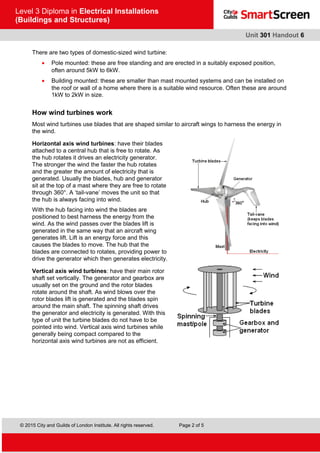
Horizontal axis wind turbines: have their blades
attached to a central hub that is free to rotate. As
the hub rotates it drives an electricity generator.
The stronger the wind the faster the hub rotates
and the greater the amount of electricity that is
generated. Usually the blades, hub and generator
sit at the top of a mast where they are free to rotate
through 360°. A ‘tail-vane’ moves the unit so that
the hub is always facing into wind.
With the hub facing into wind the blades are
positioned to best harness the energy from the
wind. As the wind passes over the blades lift is
generated in the same way that an aircraft wing
generates lift. Lift is an energy force and this
causes the blades to move. The hub that the
blades are connected to rotates, providing power to
drive the generator which then generates electricity.
Vertical axis wind turbines: have their main rotor
shaft set vertically. The generator and gearbox are
usually set on the ground and the rotor blades
rotate around the shaft. As wind blows over the
rotor blades lift is generated and the blades spin
around the main shaft. The spinning shaft drives
the generator and electricity is generated. With this
type of unit the turbine blades do not have to be
pointed into wind. Vertical axis wind turbines while
generally being compact compared to the
horizontal axis wind turbines are not as efficient.
© 2015 City and Guilds of London Institute. All rights reserved. Page 3 of 5
Level 3 Diploma in Electrical Installations
(Buildings and Structures)
Unit 301 Handout 6
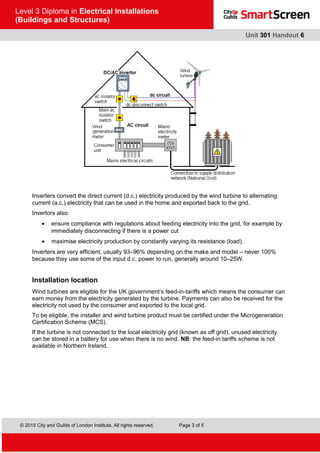
Inverters convert the direct current (d.c.) electricity produced by the wind turbine to alternating
current (a.c.) electricity that can be used in the home and exported back to the grid.
Invertors also:
• ensure compliance with regulations about feeding electricity into the grid, for example by
immediately disconnecting if there is a power cut
• maximise electricity production by constantly varying its resistance (load).
Inverters are very efficient, usually 93–96% depending on the make and model – never 100%
because they use some of the input d.c. power to run, generally around 10–25W.
Installation location
Wind turbines are eligible for the UK government’s feed-in-tariffs which means the consumer can
earn money from the electricity generated by the turbine. Payments can also be received for the
electricity not used by the consumer and exported to the local grid.
To be eligible, the installer and wind turbine product must be certified under the Microgeneration
Certification Scheme (MCS).
If the turbine is not connected to the local electricity grid (known as off grid), unused electricity
can be stored in a battery for use when there is no wind. NB: the feed-in tariffs scheme is not
available in Northern Ireland.
© 2015 City and Guilds of London Institute. All rights reserved. Page 4 of 5
Level 3 Diploma in Electrical Installations
(Buildings and Structures)
Unit 301 Handout 6
Planning requirements
Planning permission is required to install a wind turbine in Wales or Northern Ireland. Contact
your local authority for details.
In England and Scotland, a domestic wind turbine may be classified as Permitted Development,
in which case planning permission will not be needed. However, the criteria are complex, and
very different in England and Scotland, so we recommend that you contact your local planning
office at an early stage to check whether planning is required.
For building-mounted turbines, the criteria include:
• the house is detached
• the top of the turbine blades is no more than three metres above the top of the house,
or 15 metres above the ground
• all of the turbine is at least five metres from the edge of the householder's property.
For pole-mounted turbines, the criteria include:
• the top of the turbine is no more than 11.1 metres above ground
• all of the turbine is at least 1.1 times the height of the turbine away from the edge of the
householder's property.
And for both types of turbine:
• there is no other wind turbine and no air source heat pump on the site
• the bottom of the blades is at least five metres above ground
• the turbine's swept area is no more than 3.8m2
• the site is not on land safeguarded for aviation or defence purpose.
Building Regulations requirements
If the wind turbine is attached to the building it needs to comply with Building Regulations
including Part A on Structural Safety.
© 2015 City and Guilds of London Institute. All rights reserved. Page 5 of 5
Level 3 Diploma in Electrical Installations
(Buildings and Structures)
Unit 301 Handout 6
Advantages of micro wind
• The wind is free and genuinely renewable and with
modern technology it can be captured efficiently.
• Benefit from the Governments feed-in tariff ,which
pays a set rate per kWh of electricity generated and
an additional rate for any exported back to the
national grid.
• The feed-in tariff is guaranteed by the Government
for 20 years.
• Producing your own power protects against rising
energy prices.
• Once the wind turbine is built the energy it
produces does not cause green house gases or
other pollutants.
• Although wind turbines can be very tall each takes
up only a small plot of land.
• Remote areas that are not connected to the
electricity power grid can use wind turbines to
produce their own supply.
Disadvantages of micro wind
• The strength of the wind is not constant and it
varies from zero to storm force. This means that
wind turbines do not produce the same amount of
electricity all the time. There will be times when
they produce no electricity at all.
• Wind turbines can be noisy and building mounted
ones can cause vibration.
• When wind turbines are being manufactured some
pollution is produced. Therefore wind power does
produce some pollution.
• It may be beneficial to replace the inverter after
10 years to optimise power generation, although
this is not essential.
© 2015 City and Guilds of London Institute. All rights reserved. Page 5 of 5
Level 3 Diploma in Electrical Installations
(Buildings and Structures)
Unit 301 Handout 6
Advantages of micro wind
• The wind is free and genuinely renewable and with
modern technology it can be captured efficiently.
• Benefit from the Governments feed-in tariff ,which
pays a set rate per kWh of electricity generated and
an additional rate for any exported back to the
national grid.
• The feed-in tariff is guaranteed by the Government
for 20 years.
• Producing your own power protects against rising
energy prices.
• Once the wind turbine is built the energy it
produces does not cause green house gases or
other pollutants.
• Although wind turbines can be very tall each takes
up only a small plot of land.
• Remote areas that are not connected to the
electricity power grid can use wind turbines to
produce their own supply.
Disadvantages of micro wind
• The strength of the wind is not constant and it
varies from zero to storm force. This means that
wind turbines do not produce the same amount of
electricity all the time. There will be times when
they produce no electricity at all.
• Wind turbines can be noisy and building mounted
ones can cause vibration.
• When wind turbines are being manufactured some
pollution is produced. Therefore wind power does
produce some pollution.
• It may be beneficial to replace the inverter after
10 years to optimise power generation, although
this is not essential.

Wind Turbines

  • 1.
    © 2015 Cityand Guilds of London Institute. All rights reserved. Page 1 of 5 Level 3 Diploma in Electrical Installations (Buildings and Structures) Unit 301 Handout 6 Unit 301: Understand the fundamental principles and requirements of environmental technology systems Handout 6: Micro wind Learning outcome The learner will: 1. Know the fundamental working principles of micro-renewable energy and water conservation technologies. 2. Know the fundamental requirements of building location/building features for the potential to install micro-renewable energy and water conservation systems to exist. 3. Know the fundamental regulatory requirements relating to micro-renewable energy and water conservation technologies. 4. Know the typical advantages and disadvantages associated with micro-renewable energy and water conservation technologies. Assessment Criteria The learner can: 1.1 Identify the fundamental working principles for each of the following heat producing micro- renewable energy technologies: micro wind. 2.6 Clarify the fundamental requirements for the potential to install a micro wind system to exist. 3.1 Confirm what would be typically classified as ‘permitted development’ under town and country planning regulations in relation to the deployment of the following technologies: micro wind. 3.2 Confirm which sections of the current building regulations/building standards apply in relation to the deployment of the following technologies: micro wind. 4.1 Identify typical advantages associated with each of the following technologies: micro wind. 4.2 Identify typical disadvantages associated with each of the following technologies: micro wind. Micro wind Wind turbines harness the power of the wind and use it to generate electricity. Forty percent of all the wind energy in Europe blows over the UK, making it an ideal country for domestic turbines (known as 'micro wind' or 'small-wind' turbines). A typical system in an exposed site could easily generate more power than your lights and electrical appliances use. Wind turbines use large blades to catch the wind. When the wind blows, the blades are forced round, driving a turbine which generates electricity. The stronger the wind, the more electricity produced.
  • 2.
    © 2015 Cityand Guilds of London Institute. All rights reserved. Page 2 of 5 Level 3 Diploma in Electrical Installations (Buildings and Structures) Unit 301 Handout 6 There are two types of domestic-sized wind turbine: • Pole mounted: these are free standing and are erected in a suitably exposed position, often around 5kW to 6kW. • Building mounted: these are smaller than mast mounted systems and can be installed on the roof or wall of a home where there is a suitable wind resource. Often these are around 1kW to 2kW in size. How wind turbines work Most wind turbines use blades that are shaped similar to aircraft wings to harness the energy in the wind. Horizontal axis wind turbines: have their blades attached to a central hub that is free to rotate. As the hub rotates it drives an electricity generator. The stronger the wind the faster the hub rotates and the greater the amount of electricity that is generated. Usually the blades, hub and generator sit at the top of a mast where they are free to rotate through 360°. A ‘tail-vane’ moves the unit so that the hub is always facing into wind. With the hub facing into wind the blades are positioned to best harness the energy from the wind. As the wind passes over the blades lift is generated in the same way that an aircraft wing generates lift. Lift is an energy force and this causes the blades to move. The hub that the blades are connected to rotates, providing power to drive the generator which then generates electricity. Vertical axis wind turbines: have their main rotor shaft set vertically. The generator and gearbox are usually set on the ground and the rotor blades rotate around the shaft. As wind blows over the rotor blades lift is generated and the blades spin around the main shaft. The spinning shaft drives the generator and electricity is generated. With this type of unit the turbine blades do not have to be pointed into wind. Vertical axis wind turbines while generally being compact compared to the horizontal axis wind turbines are not as efficient.
  • 3.
    © 2015 Cityand Guilds of London Institute. All rights reserved. Page 3 of 5 Level 3 Diploma in Electrical Installations (Buildings and Structures) Unit 301 Handout 6 Inverters convert the direct current (d.c.) electricity produced by the wind turbine to alternating current (a.c.) electricity that can be used in the home and exported back to the grid. Invertors also: • ensure compliance with regulations about feeding electricity into the grid, for example by immediately disconnecting if there is a power cut • maximise electricity production by constantly varying its resistance (load). Inverters are very efficient, usually 93–96% depending on the make and model – never 100% because they use some of the input d.c. power to run, generally around 10–25W. Installation location Wind turbines are eligible for the UK government’s feed-in-tariffs which means the consumer can earn money from the electricity generated by the turbine. Payments can also be received for the electricity not used by the consumer and exported to the local grid. To be eligible, the installer and wind turbine product must be certified under the Microgeneration Certification Scheme (MCS). If the turbine is not connected to the local electricity grid (known as off grid), unused electricity can be stored in a battery for use when there is no wind. NB: the feed-in tariffs scheme is not available in Northern Ireland.
  • 4.
    © 2015 Cityand Guilds of London Institute. All rights reserved. Page 4 of 5 Level 3 Diploma in Electrical Installations (Buildings and Structures) Unit 301 Handout 6 Planning requirements Planning permission is required to install a wind turbine in Wales or Northern Ireland. Contact your local authority for details. In England and Scotland, a domestic wind turbine may be classified as Permitted Development, in which case planning permission will not be needed. However, the criteria are complex, and very different in England and Scotland, so we recommend that you contact your local planning office at an early stage to check whether planning is required. For building-mounted turbines, the criteria include: • the house is detached • the top of the turbine blades is no more than three metres above the top of the house, or 15 metres above the ground • all of the turbine is at least five metres from the edge of the householder's property. For pole-mounted turbines, the criteria include: • the top of the turbine is no more than 11.1 metres above ground • all of the turbine is at least 1.1 times the height of the turbine away from the edge of the householder's property. And for both types of turbine: • there is no other wind turbine and no air source heat pump on the site • the bottom of the blades is at least five metres above ground • the turbine's swept area is no more than 3.8m2 • the site is not on land safeguarded for aviation or defence purpose. Building Regulations requirements If the wind turbine is attached to the building it needs to comply with Building Regulations including Part A on Structural Safety.
  • 5.
    © 2015 Cityand Guilds of London Institute. All rights reserved. Page 5 of 5 Level 3 Diploma in Electrical Installations (Buildings and Structures) Unit 301 Handout 6 Advantages of micro wind • The wind is free and genuinely renewable and with modern technology it can be captured efficiently. • Benefit from the Governments feed-in tariff ,which pays a set rate per kWh of electricity generated and an additional rate for any exported back to the national grid. • The feed-in tariff is guaranteed by the Government for 20 years. • Producing your own power protects against rising energy prices. • Once the wind turbine is built the energy it produces does not cause green house gases or other pollutants. • Although wind turbines can be very tall each takes up only a small plot of land. • Remote areas that are not connected to the electricity power grid can use wind turbines to produce their own supply. Disadvantages of micro wind • The strength of the wind is not constant and it varies from zero to storm force. This means that wind turbines do not produce the same amount of electricity all the time. There will be times when they produce no electricity at all. • Wind turbines can be noisy and building mounted ones can cause vibration. • When wind turbines are being manufactured some pollution is produced. Therefore wind power does produce some pollution. • It may be beneficial to replace the inverter after 10 years to optimise power generation, although this is not essential.
  • 6.
    © 2015 Cityand Guilds of London Institute. All rights reserved. Page 5 of 5 Level 3 Diploma in Electrical Installations (Buildings and Structures) Unit 301 Handout 6 Advantages of micro wind • The wind is free and genuinely renewable and with modern technology it can be captured efficiently. • Benefit from the Governments feed-in tariff ,which pays a set rate per kWh of electricity generated and an additional rate for any exported back to the national grid. • The feed-in tariff is guaranteed by the Government for 20 years. • Producing your own power protects against rising energy prices. • Once the wind turbine is built the energy it produces does not cause green house gases or other pollutants. • Although wind turbines can be very tall each takes up only a small plot of land. • Remote areas that are not connected to the electricity power grid can use wind turbines to produce their own supply. Disadvantages of micro wind • The strength of the wind is not constant and it varies from zero to storm force. This means that wind turbines do not produce the same amount of electricity all the time. There will be times when they produce no electricity at all. • Wind turbines can be noisy and building mounted ones can cause vibration. • When wind turbines are being manufactured some pollution is produced. Therefore wind power does produce some pollution. • It may be beneficial to replace the inverter after 10 years to optimise power generation, although this is not essential.