Corrective
Maintenance
Word
document
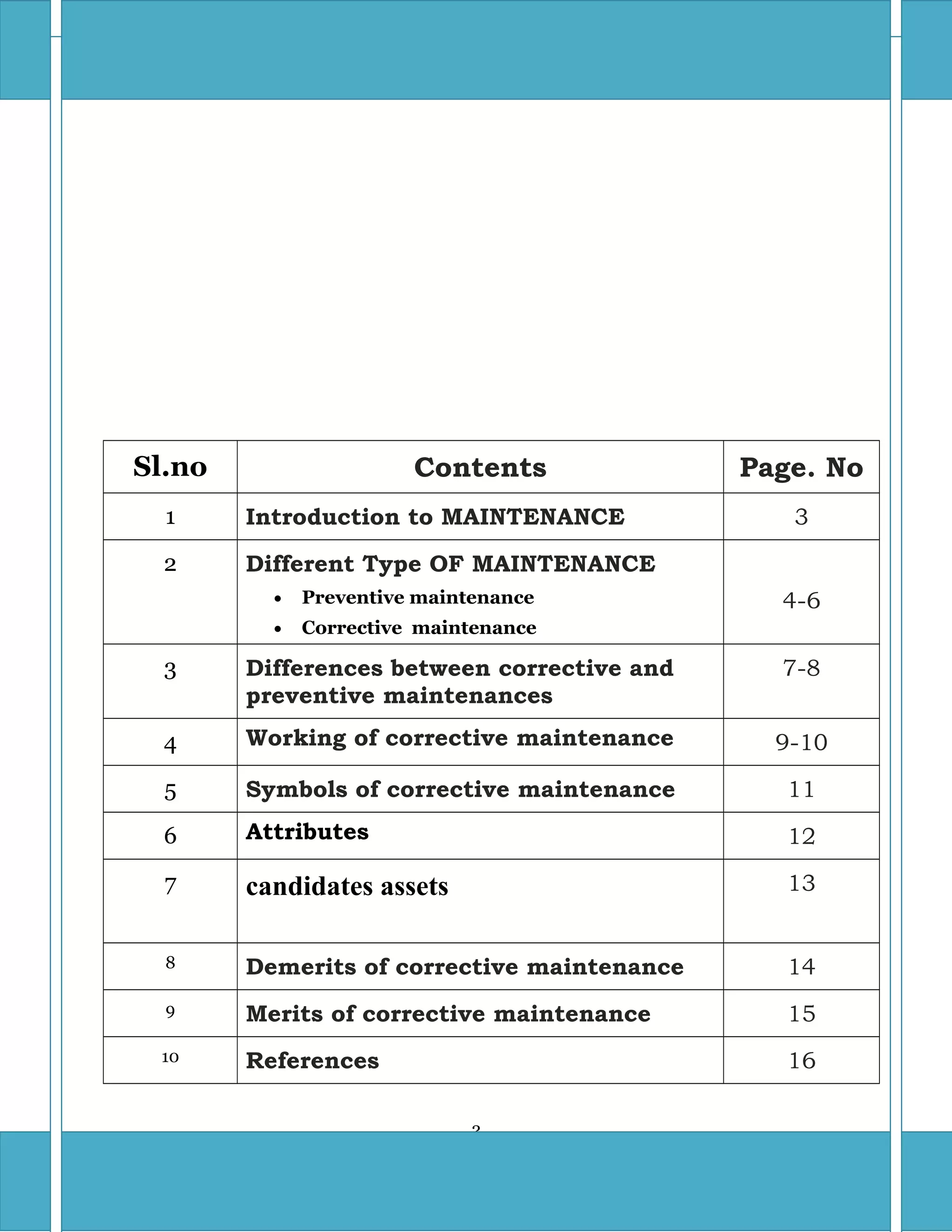
Sl.no Contents Page. No
1 Introduction to MAINTENANCE 3
2 Different Type OF MAINTENANCE
• Preventive maintenance
• Corrective maintenance
4-6
3 Differences between corrective and
preventive maintenances
7-8
4 Working of corrective maintenance 9-10
5 Symbols of corrective maintenance 11
6 Attributes 12
7 candidates assets 13
8 Demerits of corrective maintenance 14
9 Merits of corrective maintenance 15
10 References 16
2
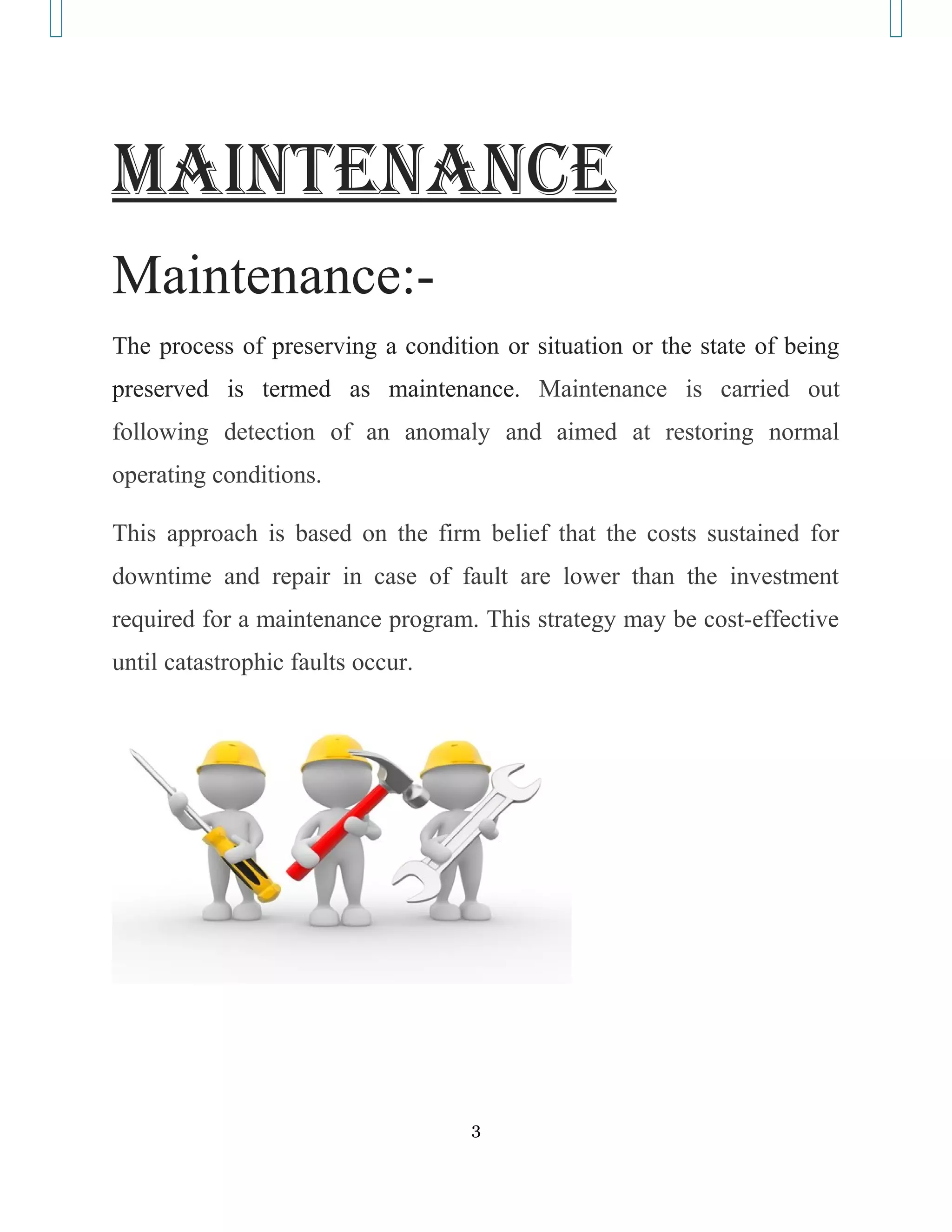
Maintenance
Maintenance:-
The process of preserving a condition or situation or the state of being
preserved is termed as maintenance. Maintenance is carried out
following detection of an anomaly and aimed at restoring normal
operating conditions.
This approach is based on the firm belief that the costs sustained for
downtime and repair in case of fault are lower than the investment
required for a maintenance program. This strategy may be cost-effective
until catastrophic faults occur.
3
Different types of
maintenance:-
There are two major types of maintenance they are:
• Preventive maintenance
• Corrective maintenance
Preventive maintenance:-
• Preventive maintenance is maintenance that is regularly
performed on a piece of equipment to lessen the likelihood of it
failing. Preventative maintenances performed while the
equipment is still working, so that it does not break down
unexpectedly.
Preventive maintenance (PM) has the
following meanings:
4
• The care and servicing by personnel for the purpose of maintaining
equipment and facilities in satisfactory operating condition by
providing for systematic inspection ,detection and correction of
incipient failures either before they occur or before they develop
into major defects.
• Maintenance, including tests, measurements, adjustments, and
parts replacement, performed specifically to prevent faults from
occurring.
The primary goal of maintenance is to avoid or mitigate the
consequences of failure of equipment.
• This may be by preventing the failure before it actually occurs
which Planned Maintenance and Condition Based Maintenance
help to achieve.
• It is designed to preserve and restore equipment reliability by
replacing worn components before they actually fail.
• Preventive maintenance activities include partial or complete
overhauls at specified periods, oil changes, lubrication, minor
adjustments, and so on.
5
CORRECTIVE MAINTAINENCE:-
Corrective maintenance is a maintenance task performed to identify,
isolate, and rectify a fault so that the failed equipment, machine, or
system can be restored to an operational condition within the tolerances
or limits established for in-service operations
French official norm defines "corrective maintenance" as maintenance
which is carried out after failure detection and is aimed at restoring an
asset to a condition in which it can perform its intended function
Corrective maintenance can be subdivided into
6
• “immediate corrective maintenance" (in which work starts
immediately after a failure)
• "Deferred corrective maintenance" (in which work is delayed in
conformance to a given set of maintenance rules).
• Break down maintenance
• Shut down maintenance
Difference between corrective
and preventive maintenances:-
The set of tasks is destined to correct the defects to be found in the
different equipment and that are communicated to the maintenance
department by users of the same equipment.
While preventive maintenance is generally considered to be
worthwhile, there are risks such as equipment failure or human
error involved when performing preventive maintenance, just as in
any maintenance operation.
7
• Preventive maintenance as scheduled overhaul or scheduled
replacement provides two of the three proactive failure
management policies available to the maintenance engineer
Simply
• Corrective maintenance is done after problem while preventive is
before problem.
• Corrective maintenance is done randomly while preventive is done
frequently.
8
• Preventive maintenance will minimize the need of corrective,
while corrective will maximize the preventive actions.
.
9
Working of corrective
maintenance:-
10
Corrective maintenance services:-
11
Symbols of corrective
maintenance:-
12
Attributes
Listed below are some of the key attributes of a corrective
maintenance program
• To restore an asset after failure has occurred
• In some cases, a conscious decision is made to neglect an
asset until it fails or until some type of problem emerges.
Where this occurs, this maintenance strategy is therefore also
referred to as “Run to Failure” (RTF) or “Fit and Forget”
(F&F).
• Many owners do not intentionally allow their assets to run
to failure. While they may find that they are neglecting some
13
of their assets, this is not a conscious decision but rather an
unfortunate consequence of other factors such as inadequate
maintenance budgets, poor planning or ignorance.
• There is a subtle, but very important, distinction that must
be made between Corrective Maintenance (CM) and Reactive
Maintenance (RM).
Candidates Assets:-
Included below is a list of the criteria to be used in determining
which assets may be acceptable candidates for a corrective
maintenance program
• Assets that is not maintainable.
• Assets that is disposable and cheaper to
replace than to fix.
14
• Small assets without significant financial
value.
• Assets whose downtime is non-critical - that
is, the consequence of failure (Cove) are not
significant.
• Assets that are not subject to wear and tear.
• Assets that is unlikely to fail during the life of
the building.
De merits of corrective
maintenance:-
15
Listed below are some of the disadvantages of the
corrective maintenance approach.
• Costs - Increased long-term costs due
to unplanned equipment downtime
• Collateral Damage - Possible
secondary equipment or process
damage.
• Decreased Reliability - Neglect of
assets may lead to
decreased reliability reflected in
downtime.
• Risk - greater risk
16
Merits of corrective
maintenance:-
The advantages of corrective maintenance can be viewed as a
double-edged sword and therefore skill and care is required
when determining which assets should be allowed to run to
failure.
Listed below are some of the merits and advantages of the
corrective maintenance approach.
• Costs - Lower short-term costs.
• Staffing - Requires less staff since less work is being done.
17
References:-
• http://www.assetinsights.net/Glossary/G_Cor
rective_Maintenance.html
• http://www.bayt.com/en/specialties/q/75127/w
hat-is-the-difference-between-corrective-and-
preventive-maintenance/
• https://en.wikipedia.org/wiki/Maintenance
• http://www.mantenimientopetroquimica.com/
en/typesofmaintenance.html
• https://www.google.co.in/search?
q=symbols+of+corrective+maintenance&biw
=1366&bih=643&source=lnms&tbm=isch&sa
18
=X&ved=0CAYQ_AUoAWoVChMIg5-
ciJCfyAIVThmOCh24tgQ5
The
end
19
.
20

Corrective maintenance

  • 1.
  • 2.
    Sl.no Contents Page.No 1 Introduction to MAINTENANCE 3 2 Different Type OF MAINTENANCE • Preventive maintenance • Corrective maintenance 4-6 3 Differences between corrective and preventive maintenances 7-8 4 Working of corrective maintenance 9-10 5 Symbols of corrective maintenance 11 6 Attributes 12 7 candidates assets 13 8 Demerits of corrective maintenance 14 9 Merits of corrective maintenance 15 10 References 16 2
  • 3.
    Maintenance Maintenance:- The process ofpreserving a condition or situation or the state of being preserved is termed as maintenance. Maintenance is carried out following detection of an anomaly and aimed at restoring normal operating conditions. This approach is based on the firm belief that the costs sustained for downtime and repair in case of fault are lower than the investment required for a maintenance program. This strategy may be cost-effective until catastrophic faults occur. 3
  • 4.
    Different types of maintenance:- Thereare two major types of maintenance they are: • Preventive maintenance • Corrective maintenance Preventive maintenance:- • Preventive maintenance is maintenance that is regularly performed on a piece of equipment to lessen the likelihood of it failing. Preventative maintenances performed while the equipment is still working, so that it does not break down unexpectedly. Preventive maintenance (PM) has the following meanings: 4
  • 5.
    • The careand servicing by personnel for the purpose of maintaining equipment and facilities in satisfactory operating condition by providing for systematic inspection ,detection and correction of incipient failures either before they occur or before they develop into major defects. • Maintenance, including tests, measurements, adjustments, and parts replacement, performed specifically to prevent faults from occurring. The primary goal of maintenance is to avoid or mitigate the consequences of failure of equipment. • This may be by preventing the failure before it actually occurs which Planned Maintenance and Condition Based Maintenance help to achieve. • It is designed to preserve and restore equipment reliability by replacing worn components before they actually fail. • Preventive maintenance activities include partial or complete overhauls at specified periods, oil changes, lubrication, minor adjustments, and so on. 5
  • 6.
    CORRECTIVE MAINTAINENCE:- Corrective maintenanceis a maintenance task performed to identify, isolate, and rectify a fault so that the failed equipment, machine, or system can be restored to an operational condition within the tolerances or limits established for in-service operations French official norm defines "corrective maintenance" as maintenance which is carried out after failure detection and is aimed at restoring an asset to a condition in which it can perform its intended function Corrective maintenance can be subdivided into 6
  • 7.
    • “immediate correctivemaintenance" (in which work starts immediately after a failure) • "Deferred corrective maintenance" (in which work is delayed in conformance to a given set of maintenance rules). • Break down maintenance • Shut down maintenance Difference between corrective and preventive maintenances:- The set of tasks is destined to correct the defects to be found in the different equipment and that are communicated to the maintenance department by users of the same equipment. While preventive maintenance is generally considered to be worthwhile, there are risks such as equipment failure or human error involved when performing preventive maintenance, just as in any maintenance operation. 7
  • 8.
    • Preventive maintenanceas scheduled overhaul or scheduled replacement provides two of the three proactive failure management policies available to the maintenance engineer Simply • Corrective maintenance is done after problem while preventive is before problem. • Corrective maintenance is done randomly while preventive is done frequently. 8
  • 9.
    • Preventive maintenancewill minimize the need of corrective, while corrective will maximize the preventive actions. . 9
  • 10.
  • 11.
  • 12.
  • 13.
    Attributes Listed below aresome of the key attributes of a corrective maintenance program • To restore an asset after failure has occurred • In some cases, a conscious decision is made to neglect an asset until it fails or until some type of problem emerges. Where this occurs, this maintenance strategy is therefore also referred to as “Run to Failure” (RTF) or “Fit and Forget” (F&F). • Many owners do not intentionally allow their assets to run to failure. While they may find that they are neglecting some 13
  • 14.
    of their assets,this is not a conscious decision but rather an unfortunate consequence of other factors such as inadequate maintenance budgets, poor planning or ignorance. • There is a subtle, but very important, distinction that must be made between Corrective Maintenance (CM) and Reactive Maintenance (RM). Candidates Assets:- Included below is a list of the criteria to be used in determining which assets may be acceptable candidates for a corrective maintenance program • Assets that is not maintainable. • Assets that is disposable and cheaper to replace than to fix. 14
  • 15.
    • Small assetswithout significant financial value. • Assets whose downtime is non-critical - that is, the consequence of failure (Cove) are not significant. • Assets that are not subject to wear and tear. • Assets that is unlikely to fail during the life of the building. De merits of corrective maintenance:- 15
  • 16.
    Listed below aresome of the disadvantages of the corrective maintenance approach. • Costs - Increased long-term costs due to unplanned equipment downtime • Collateral Damage - Possible secondary equipment or process damage. • Decreased Reliability - Neglect of assets may lead to decreased reliability reflected in downtime. • Risk - greater risk 16
  • 17.
    Merits of corrective maintenance:- Theadvantages of corrective maintenance can be viewed as a double-edged sword and therefore skill and care is required when determining which assets should be allowed to run to failure. Listed below are some of the merits and advantages of the corrective maintenance approach. • Costs - Lower short-term costs. • Staffing - Requires less staff since less work is being done. 17
  • 18.
    References:- • http://www.assetinsights.net/Glossary/G_Cor rective_Maintenance.html • http://www.bayt.com/en/specialties/q/75127/w hat-is-the-difference-between-corrective-and- preventive-maintenance/ •https://en.wikipedia.org/wiki/Maintenance • http://www.mantenimientopetroquimica.com/ en/typesofmaintenance.html • https://www.google.co.in/search? q=symbols+of+corrective+maintenance&biw =1366&bih=643&source=lnms&tbm=isch&sa 18
  • 19.
  • 20.