The leaders in
visual safety.


Tips for Safety
   Signage:
8 Steps to Ensure
 Proper Lockout /
     Tagouts
Lockout / Tagout             (LOTO)


Refers to shutting off dangerous
equipment that may be:
• Emitting hazardous energy levels
• Requiring maintenance before using
• Is unsafe until it has been serviced
and LOTO

In order to protect employees from
injury, OHSA has outlined the proper
safety guidelines for LOTO procedures
to ensure safe & proper lockout tagout
practice within your facility.
8 Tips To LOTO Success

 The following 8 Tips will
help make the job easier
when you need to enforce
          LOTO.
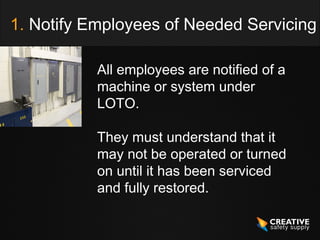
1. Notify Employees of Needed Servicing

           All employees are notified of a
           machine or system under
           LOTO.

           They must understand that it
           may not be operated or turned
           on until it has been serviced
           and fully restored.
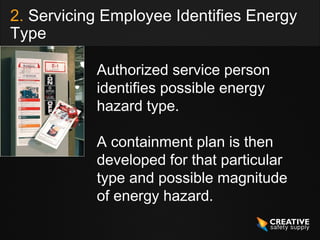
2. Servicing Employee Identifies Energy
Type

           Authorized service person
           identifies possible energy
           hazard type.

           A containment plan is then
           developed for that particular
           type and possible magnitude
           of energy hazard.
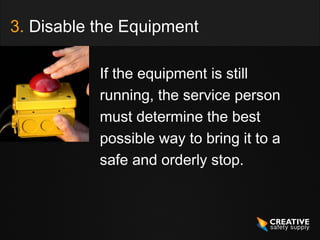
3. Disable the Equipment

           If the equipment is still
           running, the service person
           must determine the best
           possible way to bring it to a
           safe and orderly stop.
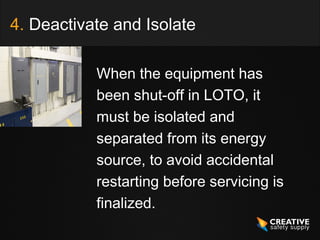
4. Deactivate and Isolate

           When the equipment has
           been shut-off in LOTO, it
           must be isolated and
           separated from its energy
           source, to avoid accidental
           restarting before servicing is
           finalized.
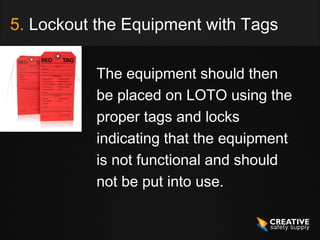
5. Lockout the Equipment with Tags

          The equipment should then
          be placed on LOTO using the
          proper tags and locks
          indicating that the equipment
          is not functional and should
          not be put into use.
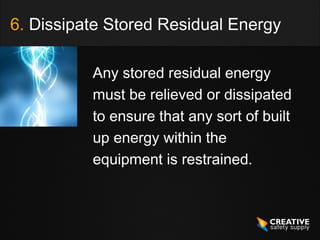
6. Dissipate Stored Residual Energy

          Any stored residual energy
          must be relieved or dissipated
          to ensure that any sort of built
          up energy within the
          equipment is restrained.
6. Dissipate Energy... (cont.)

            The unintended release of
            stored energy could severely
            injure employees and needs
            to be treated as a serious
            step within the LOTO
            procedure.
6. Dissipate Energy... (cont.)

            Stored energy may include
            energy in springs, capacitors,
            hydraulic systems, flywheels
            and even be in the form of air,
            gas, water pressure, or
            steam.
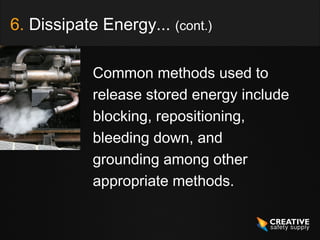
6. Dissipate Energy... (cont.)

            Common methods used to
            release stored energy include
            blocking, repositioning,
            bleeding down, and
            grounding among other
            appropriate methods.
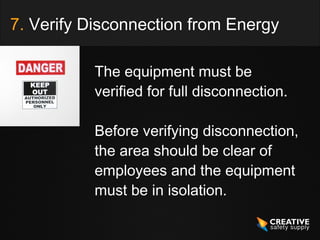
7. Verify Disconnection from Energy

          The equipment must be
          verified for full disconnection.

          Before verifying disconnection,
          the area should be clear of
          employees and the equipment
          must be in isolation.
7. Verify Disconnection... (cont.)

            The authorized employee
            should verify that the LOTO
            equipment has indeed been
            disconnected, by attempting to
            turn on the equipment.
7. Verify Disconnection... (cont.)

            If the equipment does not
            power on, it is properly
            prepared for service.

            Return equipment back to “off”
            position after verifying that
            there is no power.
8. Lockout Accomplished

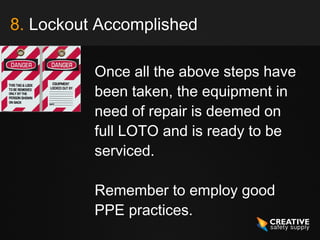
          Once all the above steps have
          been taken, the equipment in
          need of repair is deemed on
          full LOTO and is ready to be
          serviced.

          Remember to employ good
          PPE practices.
Looking for LOTO items?
   We’ve got you covered.
We here at Creative Safety Supply work with
companies both large and small to help with
their Lockout Tagout needs.
                 We also carry a host of other safety
                 tools and products, so be sure to
                 check out our website for more
                 information -
                 CreativeSafetySupply.com.
We’re here to help.
       call us toll-free:

   1-866-777-1360
     or visit us online at:

creativesafetysupply.com
The leaders in visual safety.

8 steps-to-ensure-proper-lockout-tagout

  • 1.
    The leaders in visualsafety. Tips for Safety Signage: 8 Steps to Ensure Proper Lockout / Tagouts
  • 2.
    Lockout / Tagout (LOTO) Refers to shutting off dangerous equipment that may be: • Emitting hazardous energy levels • Requiring maintenance before using • Is unsafe until it has been serviced
  • 3.
    and LOTO In orderto protect employees from injury, OHSA has outlined the proper safety guidelines for LOTO procedures to ensure safe & proper lockout tagout practice within your facility.
  • 4.
    8 Tips ToLOTO Success The following 8 Tips will help make the job easier when you need to enforce LOTO.
  • 5.
    1. Notify Employeesof Needed Servicing All employees are notified of a machine or system under LOTO. They must understand that it may not be operated or turned on until it has been serviced and fully restored.
  • 6.
    2. Servicing EmployeeIdentifies Energy Type Authorized service person identifies possible energy hazard type. A containment plan is then developed for that particular type and possible magnitude of energy hazard.
  • 7.
    3. Disable theEquipment If the equipment is still running, the service person must determine the best possible way to bring it to a safe and orderly stop.
  • 8.
    4. Deactivate andIsolate When the equipment has been shut-off in LOTO, it must be isolated and separated from its energy source, to avoid accidental restarting before servicing is finalized.
  • 9.
    5. Lockout theEquipment with Tags The equipment should then be placed on LOTO using the proper tags and locks indicating that the equipment is not functional and should not be put into use.
  • 10.
    6. Dissipate StoredResidual Energy Any stored residual energy must be relieved or dissipated to ensure that any sort of built up energy within the equipment is restrained.
  • 11.
    6. Dissipate Energy...(cont.) The unintended release of stored energy could severely injure employees and needs to be treated as a serious step within the LOTO procedure.
  • 12.
    6. Dissipate Energy...(cont.) Stored energy may include energy in springs, capacitors, hydraulic systems, flywheels and even be in the form of air, gas, water pressure, or steam.
  • 13.
    6. Dissipate Energy...(cont.) Common methods used to release stored energy include blocking, repositioning, bleeding down, and grounding among other appropriate methods.
  • 14.
    7. Verify Disconnectionfrom Energy The equipment must be verified for full disconnection. Before verifying disconnection, the area should be clear of employees and the equipment must be in isolation.
  • 15.
    7. Verify Disconnection...(cont.) The authorized employee should verify that the LOTO equipment has indeed been disconnected, by attempting to turn on the equipment.
  • 16.
    7. Verify Disconnection...(cont.) If the equipment does not power on, it is properly prepared for service. Return equipment back to “off” position after verifying that there is no power.
  • 17.
    8. Lockout Accomplished Once all the above steps have been taken, the equipment in need of repair is deemed on full LOTO and is ready to be serviced. Remember to employ good PPE practices.
  • 18.
    Looking for LOTOitems? We’ve got you covered. We here at Creative Safety Supply work with companies both large and small to help with their Lockout Tagout needs. We also carry a host of other safety tools and products, so be sure to check out our website for more information - CreativeSafetySupply.com.
  • 19.
    We’re here tohelp. call us toll-free: 1-866-777-1360 or visit us online at: creativesafetysupply.com
  • 20.
    The leaders invisual safety.