Level 3 Diploma in Electrical Installations (Buildings and Structures)
© 2013 City and Guilds of London Institute. All rights reserved. 1 of 9
PowerPointpresentation
Ground source heat pump
Unit 301: Understand the fundamental principles
and requirements of environmental technology
systems
Level 3 Diploma in Electrical Installations (Buildings and Structures)
© 2013 City and Guilds of London Institute. All rights reserved. 2 of 9
Ground source heat pumps
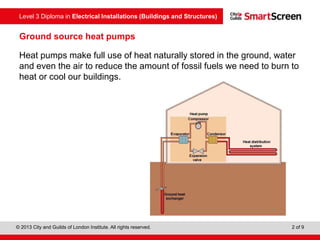
Heat pumps make full use of heat naturally stored in the ground, water
and even the air to reduce the amount of fossil fuels we need to burn to
heat or cool our buildings.
Level 3 Diploma in Electrical Installations (Buildings and Structures)
© 2013 City and Guilds of London Institute. All rights reserved. 3 of 9
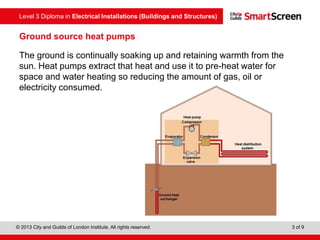
The ground is continually soaking up and retaining warmth from the
sun. Heat pumps extract that heat and use it to pre-heat water for
space and water heating so reducing the amount of gas, oil or
electricity consumed.
Ground source heat pumps
Level 3 Diploma in Electrical Installations (Buildings and Structures)
© 2013 City and Guilds of London Institute. All rights reserved. 4 of 9
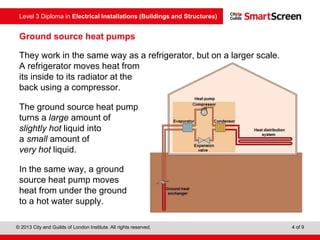
They work in the same way as a refrigerator, but on a larger scale.
A refrigerator moves heat from
its inside to its radiator at the
back using a compressor.
The ground source heat pump
turns a large amount of
slightly hot liquid into
a small amount of
very hot liquid.
In the same way, a ground
source heat pump moves
heat from under the ground
to a hot water supply.
Ground source heat pumps
Level 3 Diploma in Electrical Installations (Buildings and Structures)
© 2013 City and Guilds of London Institute. All rights reserved. 5 of 9
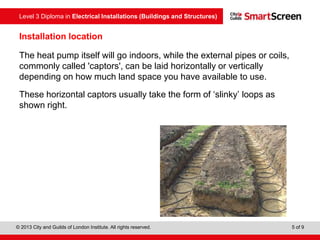
The heat pump itself will go indoors, while the external pipes or coils,
commonly called 'captors', can be laid horizontally or vertically
depending on how much land space you have available to use.
These horizontal captors usually take the form of ‘slinky’ loops as
shown right.
Installation location
Level 3 Diploma in Electrical Installations (Buildings and Structures)
© 2013 City and Guilds of London Institute. All rights reserved. 6 of 9
Planning requirements
• Most householders can carry out small extensions or additions to
their homes without the need for planning permission. This is
known as ‘permitted development’.
• Fitting a ground source heat pump in a house or a block of flats is
classed as permitted development.
• While planning permission is unlikely to be needed for excavations
or drilling, provided the ground coil is installed under your own
land, in sensitive areas such as Areas of Outstanding Natural
Beauty (AONBs), planning permission may be required for the
excavation works to lay the coils.
Level 3 Diploma in Electrical Installations (Buildings and Structures)
© 2013 City and Guilds of London Institute. All rights reserved. 7 of 9
Advantages of ground source heat pumps
• Quick capital recovery.
• Reduced running costs.
• Environmentally clean.
• Renewable energy source.
• Reduced CO2 emissions from the
production of primary electrical energy
(electricity can be obtained from renewable
sources such as solar or hydro).
• Inversion-cycle for summer cooling.
Level 3 Diploma in Electrical Installations (Buildings and Structures)
© 2013 City and Guilds of London Institute. All rights reserved. 8 of 9
Disadvantages of ground source heat pumps
• Ground source heat pumps are more expensive to install.
• Problems arise with ground source heat pumps if the installation is
poorly designed or not matched to the heating needs of the
building.
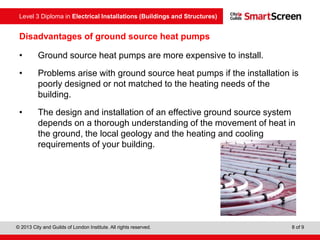
• The design and installation of an effective ground source system
depends on a thorough understanding of the movement of heat in
the ground, the local geology and the heating and cooling
requirements of your building.
Level 3 Diploma in Electrical Installations (Buildings and Structures)
© 2013 City and Guilds of London Institute. All rights reserved. 9 of 9
Any questions?

Ground_Source Heat Pumps

  • 1.
    Level 3 Diplomain Electrical Installations (Buildings and Structures) © 2013 City and Guilds of London Institute. All rights reserved. 1 of 9 PowerPointpresentation Ground source heat pump Unit 301: Understand the fundamental principles and requirements of environmental technology systems
  • 2.
    Level 3 Diplomain Electrical Installations (Buildings and Structures) © 2013 City and Guilds of London Institute. All rights reserved. 2 of 9 Ground source heat pumps Heat pumps make full use of heat naturally stored in the ground, water and even the air to reduce the amount of fossil fuels we need to burn to heat or cool our buildings.
  • 3.
    Level 3 Diplomain Electrical Installations (Buildings and Structures) © 2013 City and Guilds of London Institute. All rights reserved. 3 of 9 The ground is continually soaking up and retaining warmth from the sun. Heat pumps extract that heat and use it to pre-heat water for space and water heating so reducing the amount of gas, oil or electricity consumed. Ground source heat pumps
  • 4.
    Level 3 Diplomain Electrical Installations (Buildings and Structures) © 2013 City and Guilds of London Institute. All rights reserved. 4 of 9 They work in the same way as a refrigerator, but on a larger scale. A refrigerator moves heat from its inside to its radiator at the back using a compressor. The ground source heat pump turns a large amount of slightly hot liquid into a small amount of very hot liquid. In the same way, a ground source heat pump moves heat from under the ground to a hot water supply. Ground source heat pumps
  • 5.
    Level 3 Diplomain Electrical Installations (Buildings and Structures) © 2013 City and Guilds of London Institute. All rights reserved. 5 of 9 The heat pump itself will go indoors, while the external pipes or coils, commonly called 'captors', can be laid horizontally or vertically depending on how much land space you have available to use. These horizontal captors usually take the form of ‘slinky’ loops as shown right. Installation location
  • 6.
    Level 3 Diplomain Electrical Installations (Buildings and Structures) © 2013 City and Guilds of London Institute. All rights reserved. 6 of 9 Planning requirements • Most householders can carry out small extensions or additions to their homes without the need for planning permission. This is known as ‘permitted development’. • Fitting a ground source heat pump in a house or a block of flats is classed as permitted development. • While planning permission is unlikely to be needed for excavations or drilling, provided the ground coil is installed under your own land, in sensitive areas such as Areas of Outstanding Natural Beauty (AONBs), planning permission may be required for the excavation works to lay the coils.
  • 7.
    Level 3 Diplomain Electrical Installations (Buildings and Structures) © 2013 City and Guilds of London Institute. All rights reserved. 7 of 9 Advantages of ground source heat pumps • Quick capital recovery. • Reduced running costs. • Environmentally clean. • Renewable energy source. • Reduced CO2 emissions from the production of primary electrical energy (electricity can be obtained from renewable sources such as solar or hydro). • Inversion-cycle for summer cooling.
  • 8.
    Level 3 Diplomain Electrical Installations (Buildings and Structures) © 2013 City and Guilds of London Institute. All rights reserved. 8 of 9 Disadvantages of ground source heat pumps • Ground source heat pumps are more expensive to install. • Problems arise with ground source heat pumps if the installation is poorly designed or not matched to the heating needs of the building. • The design and installation of an effective ground source system depends on a thorough understanding of the movement of heat in the ground, the local geology and the heating and cooling requirements of your building.
  • 9.
    Level 3 Diplomain Electrical Installations (Buildings and Structures) © 2013 City and Guilds of London Institute. All rights reserved. 9 of 9 Any questions?