1
Thank you for purchasing LS Variable Frequency Drive!
SAFETY INSTRUCTIONS
Always follow safety instructions to prevent accidents and potential hazards from occurring.
In this manual, safety messages are classified as follows:
WARNING
CAUTION
Throughout this manual we use the following two illustrations to make you aware of safety
considerations:
Identifies potential hazards under certain conditions.
Read the message and follow the instructions carefully.
Identifies shock hazards under certain conditions.
Particular attention should be directed because dangerous voltage may exist.
Keep operating instructions handy for quick reference.
Read this manual carefully to maximize the performance of SV-iH series inverter and ensure
its safe use.
WARNING
Do not remove the cover while power is applied or the unit is in operation.
Otherwise, electric shock could occur.
Do not run the inverter with the front cover removed.
Otherwise, you may get an electric shock due to high voltage terminals or charged capacitor
exposure.
Do not remove the cover except for periodic inspections or wiring, even if
the input power is not applied.
Otherwise, you may access the charged circuits and get an electric shock.
Wiring and periodic inspections should be performed at least 10 minutes
after disconnecting the input power and after checking the DC link
voltage is discharged with a meter (below DC 30V).
Otherwise, you may get an electric shock.
Improper operation may result in slight to medium personal injury
or property damage.
Improper operation may result in serious personal injury or death.
2
Operate the switches with dry hands.
Otherwise, you may get an electric shock.
Do not use the cable when its insulating tube is damaged.
Otherwise, you may get an electric shock.
Do not subject the cables to scratches, excessive stress, heavy loads or
pinching.
Otherwise, you may get an electric shock.
CAUTION
Install the inverter on a non-flammable surface. Do not place flammable
material nearby.
Otherwise, fire could occur.
Disconnect the input power if the inverter gets damaged.
Otherwise, it could result in a secondary accident and fire.
Do not connect the braking resistor directly to the DC terminals between
P1 (P2) and N or P1 and P2.
Otherwise, fire could occur.
After the input power is applied or removed, the inverter will remain hot
for a couple of minutes.
Otherwise, you may get bodily injuries such as skin-burn or damage.
Do not apply power to a damaged inverter or to an inverter with parts
missing even if the installation is complete.
Otherwise, electric shock could occur.
Do not allow lint, paper, wood chips, dust, metallic chips or other foreign
matter into the drive.
Otherwise, fire or accident could occur.
Use hoist or crane for moving and installing iH inverters.
Otherwise, it may cause bodily injury due to its heavy weight.
3
OPERATING PRECAUTIONS
(1) Handling and installation
Handle according to the weight of the product.
Do not stack the inverter boxes higher than the number recommended.
Install according to instructions specified in this manual.
Do not open the cover during delivery.
Do not place heavy items on the inverter.
Check the inverter mounting orientation is correct.
Do not drop the inverter, or subject it to impact.
For grounding, grounding impedance is 100ohm or less for 200V class and 10 ohm or
less for 400 V class inverter.
Take protective measures against ESD (Electrostatic Discharge) before touching the
pcb for inspection or installation.
(2) Wiring
Do not connect a power factor correction capacitor, surge suppressor, or RFI filter to
the output of the inverter.
The connection orientation of the output cables U, V, W to the motor will affect the
direction of rotation of the motor.
Incorrect terminal wiring could result in the equipment damage.
Reversing the polarity (+/-) of the terminals could damage the inverter.
Only authorized personnel familiar with LS inverter should perform wiring and
inspections.
Always install the inverter before wiring. Otherwise, you may get an electric shock or
have bodily injury.
(3) Trial run
Check all parameters during operation. Changing parameter values might be required
depending on the load.
Always apply permissible range of voltage to the each terminal as indicated in this
manual. Otherwise, it could lead to inverter damage.
(4) Operation precautions
When the Auto restart function is selected, stay away from the equipment as a motor
will restart suddenly after an alarm stop.
The Stop key on the keypad is valid only when the appropriate function setting has
been made. Prepare an emergency stop switch separately.
If an alarm reset is made with the reference signal present, a sudden start will occur.
Check that the reference signal is turned off in advance. Otherwise an accident could
occur.
Do not modify or alter anything inside the inverter.
Motor might not be protected by electronic thermal function of inverter.
4
Do not use a magnetic contactor on the inverter input for frequent starting/stopping of
the inverter.
Use a noise filter to reduce the effect of electromagnetic interference. Otherwise
nearby electronic equipment may be affected.
In case of input voltage unbalance, install AC reactor. Power Factor capacitors and
generators may become overheated and damaged due to potential high frequency
noise transmitted from inverter.
Use an insulation-rectified motor or take measures to suppress the micro surge voltage
when driving 400V class motor with inverter. A micro surge voltage attributable to
wiring constant is generated at motor terminals, and may deteriorate insulation and
damage motor.
Before operating unit and prior to user programming, reset user parameters to default
settings.
Inverter can easily be set to high-speed operations, Verify capability of motor or
machinery prior to operating unit.
Stopping torque is not produced when using the DC-Break function. Install separate
equipment when stopping torque is needed.
(5) Fault prevention precautions
Provide a safety backup such as an emergency brake which will prevent the machine
and equipment from hazardous conditions if the inverter fails.
(6) Maintenance, inspection and parts replacement
Do not conduct a megger (insulation resistance) test on the control circuit of the
inverter.
Refer to Chapter 6 for periodic inspection (parts replacement).
(7) Disposal
Handle the inverter as an industrial waste when disposing of it.
(8) General instructions
Many of the diagrams and drawings in this instruction manual show the inverter without
a circuit breaker, a cover or partially open. Never run the inverter like this. Always place
the cover with circuit breakers and follow this instruction manual when operating the
inverter.
5
Table of Contents
USER SELECTION GUIDE (iH SPECIFICATIONS) ...................................................................... 6
CHAPTER 1 - INSTALLATION..................................................................................................... 9
1.1 Inspection.......................................................................................................................... 9
1.2 Environmental Conditions................................................................................................. 9
1.3 Mounting ........................................................................................................................... 9
1.4 Other Precautions........................................................................................................... 10
1.5 Dimensions ..................................................................................................................... 11
1.6 Basic Wiring.................................................................................................................... 14
1.7 Power Terminals............................................................................................................. 15
1.8 Control Terminals............................................................................................................ 20
CHAPTER 2 - OPERATION........................................................................................................ 22
2.1 Parameter Groups .......................................................................................................... 22
2.2 Display ............................................................................................................................ 23
2.3 Alpha-numerical Display ................................................................................................. 23
2.4 Procedure of Setting Data............................................................................................... 24
2.5 Parameter Navigation ..................................................................................................... 25
2.6 Operation Method ........................................................................................................... 26
CHAPTER 3 - QUICK- START PROCEDURES ......................................................................... 27
3.1 Operation Using Keypad................................................................................................. 28
3.2 Operation Using Control Terminal – External Start, Stop and Speed Reference ........... 30
3.3 Operation Using Both Keypad and Control Terminals .................................................... 32
CHAPTER 4 - PARAMETER LIST.............................................................................................. 35
4.1 Drive Group..................................................................................................................... 35
4.2 Function Group ............................................................................................................... 35
4.3 I/O Group ........................................................................................................................ 39
CHAPTER 5 - PARAMETER DESCRIPTION............................................................................. 43
5.1 Drive Group [DRV].......................................................................................................... 43
5.2 Function Group ............................................................................................................... 45
5.3 I/O Group ........................................................................................................................ 65
CHAPTER 6 - TROUBLESHOOTING & MAINTENANCE ......................................................... 79
6.1 Fault Display ................................................................................................................... 79
6.2 Fault Remedy.................................................................................................................. 80
6.3 Troubleshooting .............................................................................................................. 81
6.4 How to Check Power Components................................................................................. 86
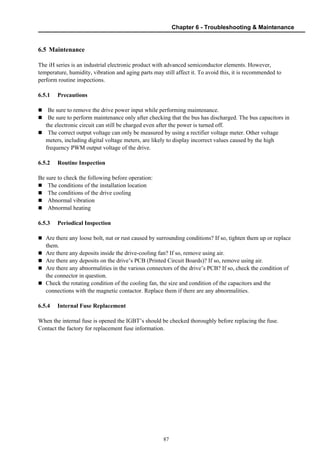
6.5 Maintenance ................................................................................................................... 87
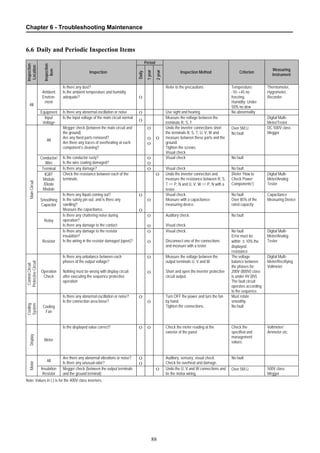
6.6 Daily and Periodic Inspection Items................................................................................ 88
APPENDIX A - FUNCTIONS BASED ON USE............................................................................ 89
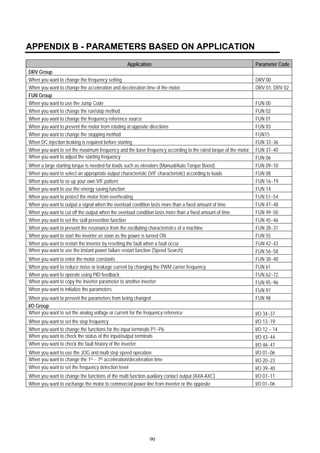
APPENDIX B - PARAMETERS BASED ON APPLICATION....................................................... 90
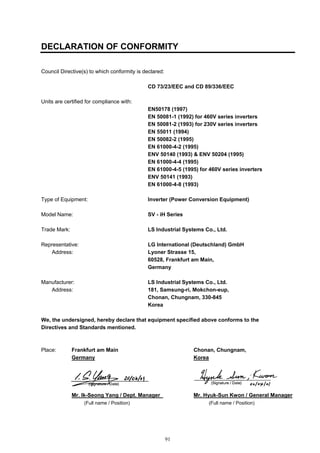
DECLARATION OF CONFORMITY ............................................................................................. 91
6
USER SELECTION GUIDE (iH SPECIFICATIONS)
200~230V Class (40 - 75HP)
Model Number SV030iH-2U SV037iH-2U SV045iH-2U SV055iH-2U
Constant Torque [HP] 40 50 60 75Motor
Rating1 Constant Torque [kW] 30 37 45 55
Constant Torque [kVA]2 46 55 68 83Output
Ratings Constant Torque FLA [A] 122 146 180 220
Input Voltage 3 Phase, 200 to 230 V (± 10%)Input
Ratings Input Frequency 50 to 60 Hz (± 5%)
Weight [kg (lbs)] 42 (93) 42 (93) 56 (123) 56 (123)
380~400V Class (40 - 100HP)
Model Number SV030iH-4U SV037iH-4U SV045iH-4U SV055iH-4U SV075iH-4U
Constant Torque [HP] 40 50 60 75 100
Constant Torque [kW] 30 37 45 55 75
Variable Torque [HP] 50 60 75 100 125
Motor
Rating1
Variable Torque [kW] 37 45 55 75 90
Constant Torque FLA [A] 61 75 91 110 152
Constant Torque [kVA]3 40 50 60 70 100
Variable Torque FLA [A] 80 96 115 125 160
Output
Ratings
Variable Torque [kVA] 3 52 62 74 80 103
Input Voltage 3 Phase, 380 to 400 V (± 10%)Input
Ratings Input Frequency 50 to 60 Hz (± 5%)
Weight [kg (lbs)] 45 (99) 45 (99) 63 (139) 63 (139) 68 (150)
380~400V Class (125 - 300HP)
Model Number SV090iH-4U SV110iH-4U SV132iH-4U SV160iH-4U SV220iH-4U
Constant Torque [HP] 125 150 175 215 300
Constant Torque [kW] 90 110 132 160 220
Variable Torque [HP] 150 175 215 250 350
Motor
Rating1
Variable Torque [kW] 110 132 160 185 280
Constant Torque FLA [A] 183 223 264 325 432
Constant Torque [kVA] 3 120 145 170 200 280
Variable Torque FLA [A] 228 264 330 361 477
Output
Ratings
Variable Torque [kVA] 3 147 170 213 233 307
Input Voltage 3 Phase, 380 to 400 V (± 10%)Input
Ratings Input Frequency 50 to 60 Hz (± 5%)
Weight [kg (lbs)] 98 (216) 98 (216) 122 (269) 122 (269) 175 (386)
1 Indicates the maximum applicable capacity when using a 4 Pole motor.
2 Rated kVA (√3*V*I) listed is based on 220VAC operation.
3 Rated kVA (√3*V*I) listed is based on 380VAC operation.
7
440~460V Class (40 - 100HP)
Model Number SV030iH-4U SV037iH-4U SV045iH-4U SV055iH-4U SV075iH-4U
Constant Torque [HP] 40 50 60 75 100
Constant Torque [kW] 30 37 45 55 75
Variable Torque [HP] 50 60 75 100 125
Motor
Rating4
Variable Torque [kW] 37 45 55 75 90
Constant Torque FLA [A] 61 75 91 110 152
Constant Torque [kVA]5 45 56 68 82 113
Variable Torque FLA [A] 80 96 115 125 160
Output
Ratings
Variable Torque [kVA] 5 60 70 86 93 120
Input Voltage 3 Phase, 440 to 460 V (± 10%)Input
Ratings Input Frequency 50 to 60 Hz (± 5%)
Weight [kg (lbs)] 45 (99) 45 (99) 63 (139) 63 (139) 68 (150)
440~460V Class (125 - 300HP)
Model Number SV090iH-4U SV110iH-4U SV132iH-4U SV160iH-4U SV220iH-4U
Constant Torque [HP] 125 150 200 250 300
Constant Torque [kW] 90 110 132 160 220
Variable Torque [HP] 150 200 250 300 350
Motor
Rating4
Variable Torque [kW] 110 132 185 220 280
Constant Torque FLA [A] 183 223 264 325 432
Constant Torque [kVA] 5 136 166 197 242 322
Variable Torque FLA [A] 228 264 330 361 477
Output
Ratings
Variable Torque [kVA] 5 170 200 246 270 356
Input Voltage 3 Phase, 440 to 460 V (± 10%)Input
Ratings Input Frequency 50 to 60 Hz (± 5%)
Weight [kg (lbs)] 98 (216) 98 (216) 122 (269) 122 (269) 175 (386)
4 Indicates the maximum applicable capacity when using a 4 Pole motor.
5 Rated kVA (√3*V*I) listed is based on 440VAC operation.
8
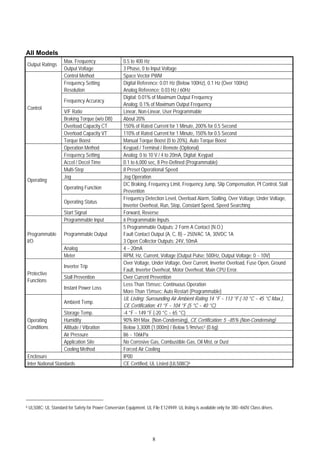
All Models
Max. Frequency 0.5 to 400 Hz
Output Ratings
Output Voltage 3 Phase, 0 to Input Voltage
Control Method Space Vector PWM
Frequency Setting
Resolution
Digital Reference: 0.01 Hz (Below 100Hz), 0.1 Hz (Over 100Hz)
Analog Reference: 0.03 Hz / 60Hz
Frequency Accuracy
Digital: 0.01% of Maximum Output Frequency
Analog: 0.1% of Maximum Output Frequency
V/F Ratio Linear, Non-Linear, User Programmable
Braking Torque (w/o DB) About 20%
Overload Capacity CT 150% of Rated Current for 1 Minute, 200% for 0.5 Second
Overload Capacity VT 110% of Rated Current for 1 Minute, 150% for 0.5 Second
Control
Torque Boost Manual Torque Boost (0 to 20%), Auto Torque Boost
Operation Method Keypad / Terminal / Remote (Optional)
Frequency Setting Analog: 0 to 10 V / 4 to 20mA, Digital: Keypad
Accel / Decel Time 0.1 to 6,000 sec, 8 Pre-Defined (Programmable)
Multi-Step 8 Preset Operational Speed
Jog Jog Operation
Operating Function
DC Braking, Frequency Limit, Frequency Jump, Slip Compensation, PI Control, Stall
Prevention
Operating Status
Frequency Detection Level, Overload Alarm, Stalling, Over Voltage, Under Voltage,
Inverter Overheat, Run, Stop, Constant Speed, Speed Searching
Operating
Start Signal Forward, Reverse
Programmable Input 6 Programmable Inputs
Programmable Output
5 Programmable Outputs: 2 Form A Contact (N.O.)
Fault Contact Output (A, C, B) – 250VAC 1A, 30VDC 1A
3 Open Collector Outputs: 24V, 50mA
Analog 4 ~ 20mA
Programmable
I/O
Meter RPM, Hz, Current, Voltage (Output Pulse: 500Hz, Output Voltage: 0 ~ 10V)
Inverter Trip
Over Voltage, Under Voltage, Over Current, Inverter Overload, Fuse Open, Ground
Fault, Inverter Overheat, Motor Overheat, Main CPU Error.
Stall Prevention Over Current Prevention
Protective
Functions
Instant Power Loss
Less Than 15msec: Continuous Operation
More Than 15msec: Auto Restart (Programmable)
Ambient Temp.
UL Listing: Surrounding Air Ambient Rating 14 °F ~ 113 °F (-10 °C ~ 45 °C Max.),
CE Certification: 41 °F ~ 104 °F (5 °C ~ 40 °C)
Storage Temp. -4 °F ~ 149 °F (-20 °C ~ 65 °C)
Humidity 90% RH Max. (Non-Condensing), CE Certification: 5 ~85% (Non-Condensing)
Altitude / Vibration Below 3,300ft (1,000m) / Below 5.9m/sec2 (0.6g)
Air Pressure 86 ~ 106kPa
Application Site No Corrosive Gas, Combustible Gas, Oil Mist, or Dust
Operating
Conditions
Cooling Method Forced Air Cooling
Enclosure IP00
Inter National Standards CE Certified, UL Listed (UL508C)6
6 UL508C: UL Standard for Safety for Power Conversion Equipment. UL File E124949. UL listing is available only for 380~460V Class drives.
9
CHAPTER 1 - INSTALLATION
1.1 Inspection
Inspect the inverter for any damage that may have occurred during shipping.
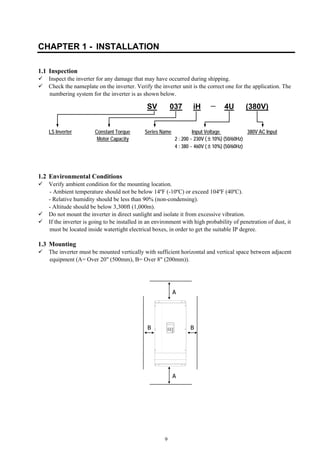
Check the nameplate on the inverter. Verify the inverter unit is the correct one for the application. The
numbering system for the inverter is as shown below.
LS Inverter Constant Torque Series Name Input Voltage 380V AC Input
Motor Capacity 2 : 200 ~ 230V (±10%) (50/60Hz)
4 : 380 ~ 460V (±10%) (50/60Hz)
1.2 Environmental Conditions
Verify ambient condition for the mounting location.
- Ambient temperature should not be below 14ºF (-10ºC) or exceed 104ºF (40ºC).
- Relative humidity should be less than 90% (non-condensing).
- Altitude should be below 3,300ft (1,000m).
Do not mount the inverter in direct sunlight and isolate it from excessive vibration.
If the inverter is going to be installed in an environment with high probability of penetration of dust, it
must be located inside watertight electrical boxes, in order to get the suitable IP degree.
1.3 Mounting
The inverter must be mounted vertically with sufficient horizontal and vertical space between adjacent
equipment (A= Over 20" (500mm), B= Over 8" (200mm)).
A
A
BB
037SV iH 4U (380V)
Chapter 1 - Installation
10
1.4 Other Precautions
Do not carry the inverter by the front cover.
Do not install the inverter in a location where excessive vibration is present. Be cautious when
installing on presses or moving equipment.
The life span of the inverter is greatly affected by the ambient temperature. Install in a location where
temperature are within permissible limits (- 10 ~ 40 ℃).
The inverter operates at high-temperatures - install on a non-combustible surface.
Do not install the inverter in high-temperature or high-humidity locations.
Do not install the inverter in a location where oil mist, combustible gas, or dust is present. Install the
inverter in a clean location or in an enclosed panel, free of foreign substance.
When installing the inverter inside a panel with multiple inverters or a ventilation fan, use caution.
If installed incorrectly, the ambient temperature may exceed specified limits.
Install the inverter using screws or bolts to insure the inverter is firmly fastened.
Inverter
GOOD (O) BAD (X)
Inverter
Cooling fan
Panel Panel
Inverter
Inverter
[When installing several inverters in a panel]
Ventilating fan
GOOD (O) BAD (X)
[When installing a ventilating fan in a panel]
Chapter 1 - Installation
11
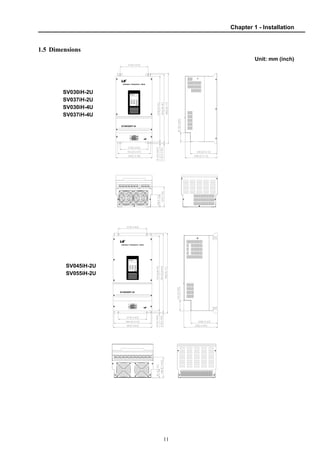
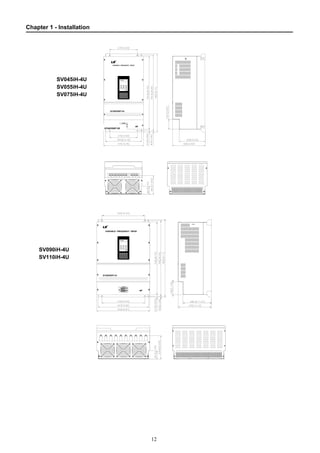
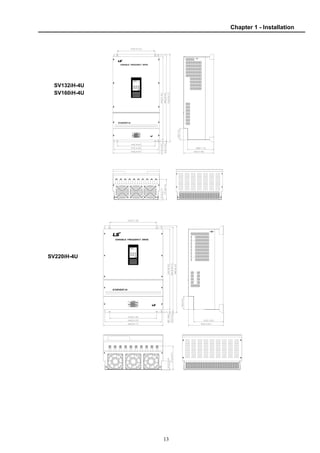
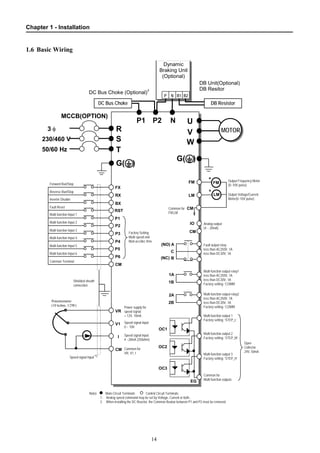
1.5 Dimensions
Unit: mm (inch)
STARVERT-iH
VARIABLE FREQUENCY DRIVE
STARVERT-iH
SV030iH-2U
SV037iH-2U
SV030iH-4U
SV037iH-4U
SV045iH-2U
SV055iH-2U
Chapter 1 - Installation
12
VARIABLE FREQUENCY DRIVE
STARVERT-iH
VARIABLE FREQUENCY DRIVE
STARVERT-iH
STARVERT-IH
SV045iH-4U
SV055iH-4U
SV075iH-4U
SV090iH-4U
SV110iH-4U
Chapter 1 - Installation
13
VARIABLE FREQUENCY DRIVE
STARVERT-iH
STARVERT-iH
VARIABLE FREQUENCY DRIVE
SV132iH-4U
SV160iH-4U
SV220iH-4U
Chapter 1 - Installation
14
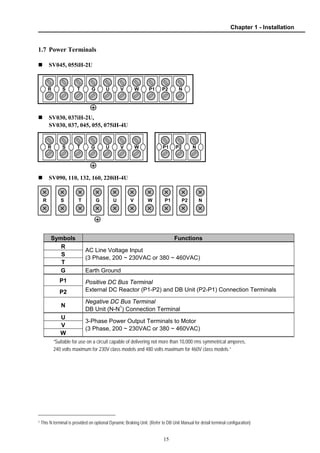
1.6 Basic Wiring
230/460 V
50/60 Hz
U
V
W
R
S
T
φ3
MCCB(OPTION)
FX
RX
BX
RST
P1
P3
P4
P5
P6
CM
VR
V1
I
CM
LM
+
+
FM
CM
LM
A
B
C
1A
1B
Output Frequency Meter
(0~10V pulse)
OC1
OC2
OC3
EG
P2
MOTOR
Shielded sheath
connection
Potentiometer
(10 kohm, 1/2W)
Speed signal Input*2
Common for
FM,LM
Forward Run/Stop
2A
2B
IO
CM
Analog output
(4 ~ 20mA)
Reverse Run/Stop
Inverter Disable
Fault Reset
Multi-function Input 1
Multi-function Input 2
Multi-function Input 3
Multi-function Input 4
Multi-function Input 5
Multi-function Input 6
Common Terminal
Factory Setting:
Multi-speed and
Muti-acc/dec time
Power supply for
speed signal:
+ 12V, 10mA
Speed signal input:
0 ~ 10V
Speed signal input:
4 ~20mA (250ohm)
Common for
VR, V1, I
Output Voltage/Current
Meter(0~10V pulse)
Fault output relay
less than AC250V, 1A
less than DC30V, 1A
Multi-function output relay1
less than AC250V, 1A
less than DC30V, 1A
Factory setting: ‘COMM’
Multi-function output relay2
less than AC250V, 1A
less than DC30V, 1A
Factory setting: ‘COMM’
Multi-function output 1
Factory setting: ‘STEP_L’
Multi-function output 2
Factory setting: ‘STEP_M’
Multi-function output 3
Factory setting: ‘STEP_H’
Common for
Multi-function outputs
Open
Collector
24V, 50mA
FM
N
DB Unit(Optional)
DB Resitor
P2P1
DC Bus Choke (Optional)
3
Dynamic
Braking Unit
(Optional)
P N B1 B2
DC Bus Choke DB Resistor
Note) Main Circuit Terminals Control Circuit Terminals.
1. Analog speed command may be set by Voltage, Current or both..
2. When installing the DC Reactor, the Common Busbar between P1 and P2 must be removed.
G( )
G( )
(NO)
(NC)
Chapter 1 - Installation
15
1.7 Power Terminals
SV045, 055iH-2U
SV030, 037iH-2U,
SV030, 037, 045, 055, 075iH-4U
SV090, 110, 132, 160, 220iH-4U
Symbols Functions
R
S
T
AC Line Voltage Input
(3 Phase, 200 ~ 230VAC or 380 ~ 460VAC)
G Earth Ground
P1
P2
Positive DC Bus Terminal
External DC Reactor (P1-P2) and DB Unit (P2-P1) Connection Terminals
N
Negative DC Bus Terminal
DB Unit (N-N1
) Connection Terminal
U
V
W
3-Phase Power Output Terminals to Motor
(3 Phase, 200 ~ 230VAC or 380 ~ 460VAC)
“Suitable for use on a circuit capable of delivering not more than 10,000 rms symmetrical amperes,
240 volts maximum for 230V class models and 480 volts maximum for 460V class models.”
1 This N terminal is provided on optional Dynamic Braking Unit. (Refer to DB Unit Manual for detail terminal configuration)
R S T G U V W P1 P2 N
Chapter 1 - Installation
16
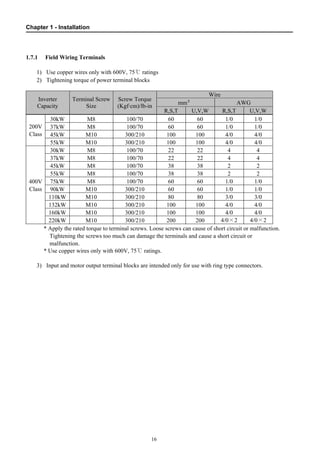
1.7.1 Field Wiring Terminals
1) Use copper wires only with 600V, 75℃ ratings
2) Tightening torque of power terminal blocks
Wire
mm² AWG
Inverter
Capacity
Terminal Screw
Size
Screw Torque
(Kgf·cm)/lb-in
R,S,T U,V,W R,S,T U,V,W
30kW M8 100/70 60 60 1/0 1/0
37kW M8 100/70 60 60 1/0 1/0
45kW M10 300/210 100 100 4/0 4/0
200V
Class
55kW M10 300/210 100 100 4/0 4/0
30kW M8 100/70 22 22 4 4
37kW M8 100/70 22 22 4 4
45kW M8 100/70 38 38 2 2
55kW M8 100/70 38 38 2 2
75kW M8 100/70 60 60 1/0 1/0
90kW M10 300/210 60 60 1/0 1/0
110kW M10 300/210 80 80 3/0 3/0
132kW M10 300/210 100 100 4/0 4/0
160kW M10 300/210 100 100 4/0 4/0
400V
Class
220kW M10 300/210 200 200 4/0×2 4/0×2
* Apply the rated torque to terminal screws. Loose screws can cause of short circuit or malfunction.
Tightening the screws too much can damage the terminals and cause a short circuit or
malfunction.
* Use copper wires only with 600V, 75℃ ratings.
3) Input and motor output terminal blocks are intended only for use with ring type connectors.
Chapter 1 - Installation
17
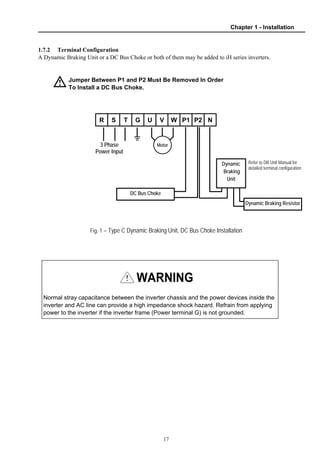
1.7.2 Terminal Configuration
A Dynamic Braking Unit or a DC Bus Choke or both of them may be added to iH series inverters.
Jumper Between P1 and P2 Must Be Removed In Order
To Install a DC Bus Choke.
R S T G U V W P1 P2 N
Fig. 1 – Type C Dynamic Braking Unit, DC Bus Choke Installation
WARNING
Normal stray capacitance between the inverter chassis and the power devices inside the
inverter and AC line can provide a high impedance shock hazard. Refrain from applying
power to the inverter if the inverter frame (Power terminal G) is not grounded.
!
Motor3 Phase
Power Input
Dynamic
Braking
Unit
Dynamic Braking Resistor
DC Bus Choke
Refer to DB Unit Manual for
detailed terminal configuration
Chapter 1 - Installation
18
1.7.3 Wiring Power Terminals
Wiring Precautions
The internal circuits of the inverter will be damaged if the incoming power is connected and applied to
output terminals (U, V, W).
Use ring terminals with insulated caps when wiring the input power and motor wiring.
Do not leave wire fragments inside the inverter. Wire fragments can cause faults, breakdowns, and
malfunctions.
For input and output, use wires with sufficient size to ensure voltage drop of less than 2%.
Motor torque may drop of operating at low frequencies and a long wire run between inverter and motor.
Do not use a 3-wire cable for long distances. Due to increased leakage capacitance between wires,
over-current protective feature may operate or equipment connected to the output side may
malfunction.
Never short between B1 and B2 terminals of the inverter.
The main circuit of the inverter contains high frequency noise, and can hinder communication
equipment near the inverter. To reduce noise, install line noise filters on the input side of the inverter.
Do not use power factor capacitor, surge killers, or RFI filters on the output side of the inverter. Doing
so may damage these components.
Always check whether the LCD and the charge lamp for the power terminal are OFF before wiring
terminals. The charge capacitor may hold high-voltage even after the power is disconnected. Use
caution to prevent the possibility of personal injury.
Grounding
The inverter is a high switching device, and leakage current may flow. Ground the inverter to avoid
electrical shock. Use caution to prevent the possibility of personal injury.
Connect only to the dedicated ground terminal of the inverter. Do not use the case or the chassis screw
for grounding.
The protective earth conductor must be the first one in being connected and the last one in being
disconnected.
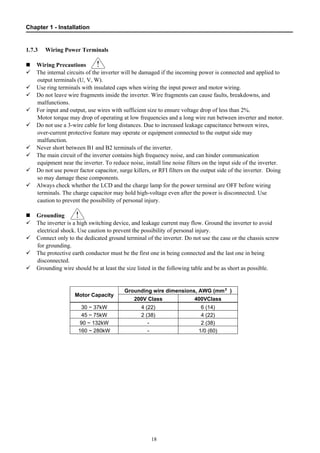
Grounding wire should be at least the size listed in the following table and be as short as possible.
Grounding wire dimensions, AWG (mm²)
Motor Capacity
200V Class 400VClass
30 ~ 37kW 4 (22) 6 (14)
45 ~ 75kW 2 (38) 4 (22)
90 ~ 132kW - 2 (38)
160 ~ 280kW - 1/0 (60)
Chapter 1 - Installation
19
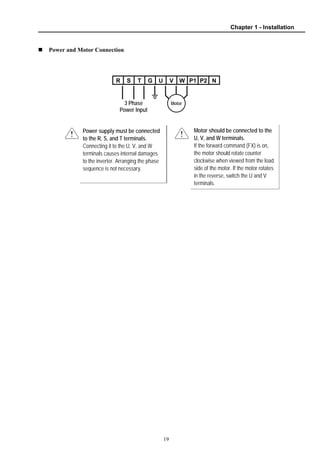
Power and Motor Connection
R S T G U V W P1 P2 N
Motor3 Phase
Power Input
Power supply must be connected
to the R, S, and T terminals.
Connecting it to the U, V, and W
terminals causes internal damages
to the inverter. Arranging the phase
sequence is not necessary.
Motor should be connected to the
U, V, and W terminals.
If the forward command (FX) is on,
the motor should rotate counter
clockwise when viewed from the load
side of the motor. If the motor rotates
in the reverse, switch the U and V
terminals.
Chapter 1 - Installation
20
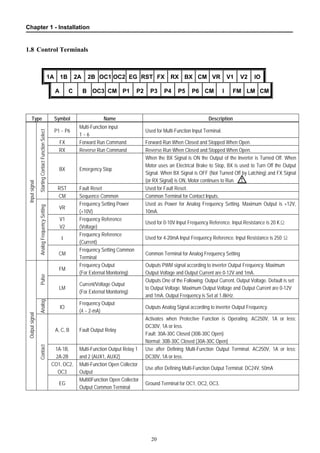
1.8 Control Terminals
1A 1B 2A 2B OC1 OC2 EG RST FX RX BX CM VR V1 V2 IO
A C B OC3 CM P1 P2 P3 P4 P5 P6 CM I FM LM CM
Type Symbol Name Description
P1 ~ P6
Multi-Function input
1 ~ 6
Used for Multi-Function Input Terminal.
FX Forward Run Command Forward Run When Closed and Stopped When Open.
RX Reverse Run Command Reverse Run When Closed and Stopped When Open.
BX Emergency Stop
When the BX Signal is ON the Output of the Inverter is Turned Off. When
Motor uses an Electrical Brake to Stop, BX is used to Turn Off the Output
Signal. When BX Signal is OFF (Not Turned Off by Latching) and FX Signal
(or RX Signal) is ON, Motor continues to Run.
RST Fault Reset Used for Fault Reset.
StartingContactFunctionSelect
CM Sequence Common Common Terminal for Contact Inputs.
VR
Frequency Setting Power
(+10V)
Used as Power for Analog Frequency Setting. Maximum Output is +12V,
10mA.
V1
V2
Frequency Reference
(Voltage)
Used for 0-10V Input Frequency Reference. Input Resistance is 20 KΩ
I
Frequency Reference
(Current)
Used for 4-20mA Input Frequency Reference. Input Resistance is 250 Ω
Inputsignal
AnalogFrequencySetting
CM
Frequency Setting Common
Terminal
Common Terminal for Analog Frequency Setting
FM
Frequency Output
(For External Monitoring)
Outputs PWM signal according to inverter Output Frequency. Maximum
Output Voltage and Output Current are 0-12V and 1mA.
Pulse
LM
Current/Voltage Output
(For External Monitoring)
Outputs One of the Following: Output Current, Output Voltage. Default is set
to Output Voltage. Maximum Output Voltage and Output Current are 0-12V
and 1mA. Output Frequency is Set at 1.8kHz.
Analog
IO
Frequency Output
(4 ~ 2-mA)
Outputs Analog Signal according to inverter Output Frequency.
A, C, B Fault Output Relay
Activates when Protective Function is Operating. AC250V, 1A or less;
DC30V, 1A or less.
Fault: 30A-30C Closed (30B-30C Open)
Normal: 30B-30C Closed (30A-30C Open)
1A-1B,
2A-2B
Multi-Function Output Relay 1
and 2 (AUX1, AUX2)
Use after Defining Multi-Function Output Terminal. AC250V, 1A or less;
DC30V, 1A or less.
CO1, OC2,
OC3
Multi-Function Open Collector
Output
Use after Defining Multi-Function Output Terminal. DC24V, 50mA
Outputsignal
Contact
EG
Multi0Function Open Collector
Output Common Terminal
Ground Terminal for OC1, OC2, OC3.
!
Chapter 1 - Installation
21
1.8.1 Wiring Control Terminals
Wiring Precautions
CM and EG terminals are insulated to each other. Do not connect these terminals with each other and
do not connect these terminals to the power ground.
Use shielded wires or twisted wires for control circuit wiring, and separate these wires from the main
power circuits and other high voltage circuits.
Use 1.25mm²(22AWG) stranded cables for control terminal connection.
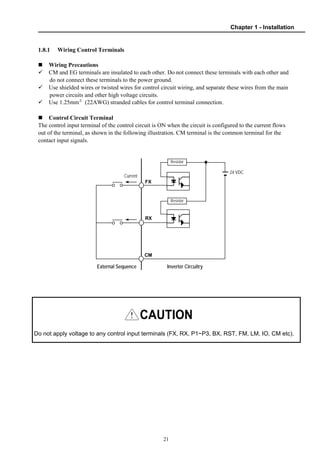
Control Circuit Terminal
The control input terminal of the control circuit is ON when the circuit is configured to the current flows
out of the terminal, as shown in the following illustration. CM terminal is the common terminal for the
contact input signals.
CAUTION
Do not apply voltage to any control input terminals (FX, RX, P1~P3, BX, RST, FM, LM, IO, CM etc).
24 VDC
FX
RX
CM
Current
Inverter Circuitry
Resistor
Resistor
External Sequence
22
CHAPTER 2 - OPERATION
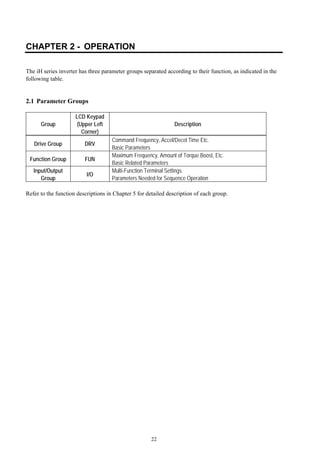
The iH series inverter has three parameter groups separated according to their function, as indicated in the
following table.
2.1 Parameter Groups
Group
LCD Keypad
(Upper Left
Corner)
Description
Drive Group DRV
Command Frequency, Accel/Decel Time Etc.
Basic Parameters
Function Group FUN
Maximum Frequency, Amount of Torque Boost, Etc.
Basic Related Parameters
Input/Output
Group
I/O
Multi-Function Terminal Settings.
Parameters Needed for Sequence Operation
Refer to the function descriptions in Chapter 5 for detailed description of each group.
Chapter 2 - Operation
23
2.2 Display
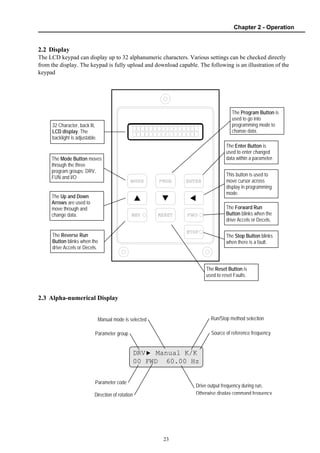
The LCD keypad can display up to 32 alphanumeric characters. Various settings can be checked directly
from the display. The keypad is fully upload and download capable. The following is an illustration of the
keypad
2.3 Alpha-numerical Display
DRV▶ Manual K/K
00 FWD 60.00 Hz
32 Character, back lit,
LCD display. The
backlight is adjustable.
The Mode Button moves
through the three
program groups: DRV,
FUN and I/O
The Up and Down
Arrows are used to
move through and
change data.
The Reverse Run
Button blinks when the
drive Accels or Decels.
The Program Button is
used to go into
programming mode to
change data.
The Enter Button is
used to enter changed
data within a parameter.
This button is used to
move cursor across
display in programming
mode.
The Forward Run
Button blinks when the
drive Accels or Decels.
The Stop Button blinks
when there is a fault.
The Reset Button is
used to reset Faults.
Manual mode is selected Run/Stop method selection
Source of reference frequency
Drive output frequency during run,
Otherwise display command frequencyDirection of rotation
Parameter code
Parameter group
Chapter 2 - Operation
24
DRV▶ Manual K/K
00 REV 30.00 Hz
PROG
0
DRV▶ Manual K/K
00 REV 30.00 Hz0
DRV▶ Manual K/K
00 REV 30.50 Hz5
DRV▶ Manual K/K
00 REV 30.50 Hz0
DRV▶ Manual K/K
00 REV 35.50 Hz5
DRV▶ Manual K/K
00 REV 35.50 Hz3
DRV▶ Manual K/K
00 REV 45.50 Hz4
DRV▶ Manual K/K
00 REV 45.50 Hz
ENTER
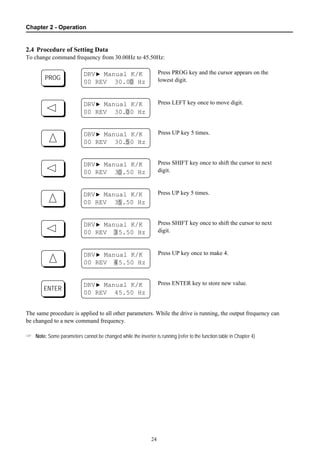
2.4 Procedure of Setting Data
To change command frequency from 30.00Hz to 45.50Hz:
Press PROG key and the cursor appears on the
lowest digit.
Press LEFT key once to move digit.
Press UP key 5 times.
Press SHIFT key once to shift the cursor to next
digit.
Press UP key 5 times.
Press SHIFT key once to shift the cursor to next
digit.
Press UP key once to make 4.
Press ENTER key to store new value.
The same procedure is applied to all other parameters. While the drive is running, the output frequency can
be changed to a new command frequency.
☞ Note: Some parameters cannot be changed while the inverter is running (refer to the function table in Chapter 4)
Chapter 2 - Operation
25
2.5 Parameter Navigation
In any of the parameter groups, users may jump to a specific parameter code by following these steps:
Select a parameter group that requires a change.
At the beginning of each program group the menu will read [Jump Code]. Press the [PROG] key. Enter
the code number of the parameter needing to be changed, then press [ENTER] key. There is no jump
code for [Drive Group].
DRV▶ Manual K/K
00 FWD 60.00 Hz
FUN▶ Jump Code
00 41
I/O▶ Jump Code
00 1
MODE MODE
MODE
DRV▶ Acc. time
01 30.0 sec
DRV▶ Dec. time
02 30.0 sec
DRV▶ Current
03 x.x A
DRV▶ Speed
04 xxxrpm
DRV▶ Power
05 57.5kW
MODE
MODE
MODE
MODE
MODE
FUN▶ Freq. set
01 Key
FUN▶Run/stop set
02 Key
FUN▶Run prohibit
03 None
FUN▶ Freq. max
04 60.00 Hz
FUN▶ Freq. base
05 60.00 Hz
MODE
MODE
MODE
MODE
MODE
I/O▶ P1 input
01 SPD_L
I/O▶ P2 input
02 SPD_M
I/O▶ P3 input
03 SPD_H
I/O▶ P4 input
04 ACCT_L
I/O▶ P5 input
5 ACCT_M
MODE
MODE
MODE
MODE
MODE
FUN▶ Para. lock
98 0
MODE
I/O▶DN: In Inst
65 Instance 70
MODE
MODE
DRV▶ Fault
06 No fault
▼ ▲
▼ ▲
▼ ▲
▼ ▲
▼ ▲
▼ ▲
▼ ▲
▼ ▲
▼ ▲
▼ ▲
▼ ▲
▼ ▲ ▼ ▲
▼ ▲
▼ ▲
▼ ▲
▼ ▲
▼ ▲
Drive Group Function Group I/O Group
Chapter 2 - Operation
26
2.6 Operation Method
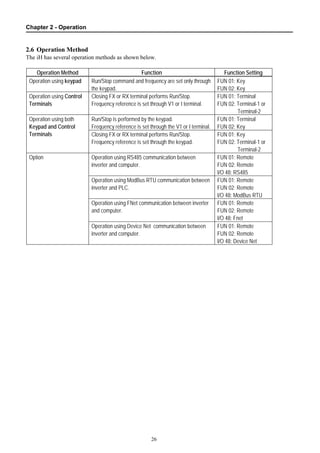
The iH has several operation methods as shown below.
Operation Method Function Function Setting
Operation using keypad Run/Stop command and frequency are set only through
the keypad.
FUN 01: Key
FUN 02: Key
Operation using Control
Terminals
Closing FX or RX terminal performs Run/Stop.
Frequency reference is set through V1 or I terminal.
FUN 01: Terminal
FUN 02: Terminal-1 or
Terminal-2
Run/Stop is performed by the keypad.
Frequency reference is set through the V1 or I terminal.
FUN 01: Terminal
FUN 02: Key
Operation using both
Keypad and Control
Terminals Closing FX or RX terminal performs Run/Stop.
Frequency reference is set through the keypad.
FUN 01: Key
FUN 02: Terminal-1 or
Terminal-2
Operation using RS485 communication between
inverter and computer.
FUN 01: Remote
FUN 02: Remote
I/O 48: RS485
Operation using ModBus RTU communication between
inverter and PLC.
FUN 01: Remote
FUN 02: Remote
I/O 48: ModBus RTU
Operation using FNet communication between inverter
and computer.
FUN 01: Remote
FUN 02: Remote
I/O 48: Fnet
Option
Operation using Device Net communication between
inverter and computer.
FUN 01: Remote
FUN 02: Remote
I/O 48: Device Net
27
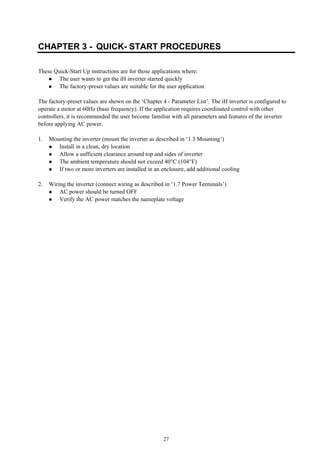
CHAPTER 3 - QUICK- START PROCEDURES
These Quick-Start Up instructions are for those applications where:
The user wants to get the iH inverter started quickly
The factory-preset values are suitable for the user application
The factory-preset values are shown on the ‘Chapter 4 - Parameter List’. The iH inverter is configured to
operate a motor at 60Hz (base frequency). If the application requires coordinated control with other
controllers, it is recommended the user become familiar with all parameters and features of the inverter
before applying AC power.
1. Mounting the inverter (mount the inverter as described in ‘1.3 Mounting’)
Install in a clean, dry location
Allow a sufficient clearance around top and sides of inverter
The ambient temperature should not exceed 40°C (104°F)
If two or more inverters are installed in an enclosure, add additional cooling
2. Wiring the inverter (connect wiring as described in ‘1.7 Power Terminals’)
AC power should be turned OFF
Verify the AC power matches the nameplate voltage
Chapter 3 – Quick-Start Procedures
28
3.1 Operation Using Keypad
1. Apply AC power.
2. If the message of DRV 00 is ‘Manual K/K’, go to step 11.
3. Press the [PROG] key to display function group.
4. Press the UP-arrow key to display FUN 01.
5. Press the [PROG] key to enter into the program mode.
6. Using arrow keys, select ‘Key”, then press the [ENTER] key.
7. Press UP-arrow key to display FUN 02.
8. Press [PROG] key to enter into the program mode.
9. Using arrow keys, select ‘Key’, then press the [ENTER] key.
10.Press the [MODE] key repeatedly until DRV 00 is displayed.
DRV▶ Manual K/K
00 FWD 0.00 Hz
MODE FUN▶ Jump code
00 41
FUN▶ Freq. set
01 Terminal
PROG FUN▶ Freq. set
01 Terminal
FUN▶ Freq. set
01 Key
FUN▶Run/stop set
02 Terminal-1
PROG
FUN▶Run/stop set
02 Terminal-1
FUN▶Run/stop set
02 Key
ENTER
MODE
ENTER
DRV▶ Manual K/K
00 FWD 0.00 Hz
Chapter 3 – Quick-Start Procedures
29
11.Set the frequency reference by pressing the [PROG] key. Using
arrow keys, change the data to 5.00 Hz. Press the [ENTER] key.
12.Press UP-arrow key to display DRV 01. Change the acceleration
time by pressing the [PROG], arrow and [ENTER] keys.
13.Press the UP-arrow key to display DRV 02. Change the
Deceleration time by pressing the [PROG], arrow and
[ENTER] keys.
14.Press the [FWD] key to run motor in the forward direction.
15.Press the [REV] key to run motor in the reverse direction.
16.Press the [STOP] key to stop motor.
PROG
DRV▶ Manual K/K
00 FWD 0.00 Hz5
DRV▶ Acc. time
01 30.0sec
ENTER
PROG ENTER
DRV▶ Dec. time
02 30.0sec
PROG ENTER
FWD The FWD LED starts blinking.
REV The REV LED starts blinking.
STOP The STOP LED starts blinking.
Chapter 3 – Quick-Start Procedures
30
3.2 Operation Using Control Terminal – External Start, Stop and Speed Reference
1. Confirm ‘Manual T/T’ in DRV 00.
2. If different, as in section 3.1 of this chapter, select
‘Terminal’ in FUN 01 and ‘Terminal-1’ or Terminal-2’
in FUN 02.
3. Install a potentiometer on terminals V1, VR and CM
as shown right below. Select ‘V1’ in FUN 20 to control the
speed by potentiometer alone.
4. Set a frequency reference using the potentiometer.
Make sure to observe the set value in DRV 00.
5. When a ‘4 - 20mA’ current source is used as the
frequency reference, use terminal I and CM.
Select ‘I’ in FUN 20 to control the speed by the
current source alone.
6. To run the motor in the forward direction, close
the [FX] terminal to the [CM] terminal.
7. To run the motor in the reverse direction, close
the [RX] terminal to the [CM] terminal.
DRV▶ Manual T/T
00 FWD 60.00 Hz
FUN▶ Freq. set
01 Terminal
FUN▶Run/stop set
02 Terminal-1
FUN▶ V-I mode
20 V
10 ㏀, 1/2 W
EG RST FX RX
P2 P3 P4 P5
BX CM VR V1
P6 CM I FM
V2 IO
LM CM
FUN▶ V-I mode
20 I
EG RST FX RX
P2 P3 P4 P5
BX CM VR V1
P6 CM I FM
V2 IO
LM CM
4 - 20mA
Chapter 3 – Quick-Start Procedures
31
[FUN 02 - ‘Terminal-1’ Operation] [FUN 02 - ‘Terminal-2’ Operation]
Time
FX-CM
Output Frequency
Time
ON
Time
RX-CM ON
Time
FX-CM
Output Frequency
Time
Time
RX-CM ON
ON
Chapter 3 – Quick-Start Procedures
32
3.3 Operation Using Both Keypad and Control Terminals
3.3.1 Frequency Set by External Source and Run/Stop Set by Keypad
1. Confirm ‘Manual K/T’ in DRV 00.
2. If different, as in section 3.1 of this chapter, select
‘Terminal’ in FUN 01 and ‘Key’ in FUN 02.
3. Install a potentiometer to terminals V1, VR and CM.
Select ‘V1’ in FUN 20 to control the speed by the
potentiometer alone.
4. Set a frequency reference using the potentiometer.
Make sure to observe the set value in DRV 00.
5. When a ‘4 - 20mA’ current source is used as the
frequency reference, use terminals I and CM.
Select ‘I’ in FUN 20 to control the speed by the
current source alone.
6. To run the motor in the forward direction, press
the [FWD] key.
7. To run the motor in the reverse direction, press
the [REV] key.
8. To stop the motor, press the [STOP] key.
DRV▶ Manual K/T
00 FWD 60.00 Hz
FUN▶ Freq. set
01 Terminal
FUN▶Run/stop set
02 Key
FUN▶ V-I mode
20 V1
10 ㏀, 1/2 W
EG RST FX RX
P2 P3 P4 P5
BX CM VR V1
P6 CM I FM
V2 IO
LM CM
FUN▶ V-I mode
20 I
EG RST FX RX
P2 P3 P4 P5
BX CM VR V1
P6 CM I FM
V2 IO
LM CM
4 - 20mA
Chapter 3 – Quick-Start Procedures
33
3.3.2 Frequency Set by Keypad and Run/Stop by External Source
1. Confirm ‘Manual T/K’ in DRV 00.
2. If different, as in section 3.1 of this chapter, select
‘Key’ in FUN 01 and ‘Terminal-1’ or Terminal-2’
in FUN 02.
3. Set a frequency reference in DRV 00.
4. To run the motor in the forward direction, close
the [FX] terminal to the [CM] terminal.
5. To run the motor in the forward direction, close
the [RX] terminal to the [CM] terminal.
DRV▶ Manual T/K
00 FWD 60.00 Hz
FUN▶ Freq. set
01 Key
FUN▶Run/stop set
02 Terminal-1
EG RST FX RX
P2 P3 P4 P5
BX CM VR V1
P6 CM I FM
V2 IO
LM CM
PROG ENTER
DRV▶ Manual T/K
00 FWD 60.00 Hz
Chapter 3 – Quick-Start Procedures
34
Blank Page
35
CHAPTER 4 - PARAMETER LIST
4.1 Drive Group
Code
[DRV]
Description
Drive Group
Keypad Display Setting Range Units
Factory
Default
Adj.
During
Run
Page
00
Output Frequency (During Run) or
Reference Frequency (During Stop)
Cmd. Freq 0 to FUN 04 0.01 0.00 [Hz] Yes 43
01 Acceleration Time Acc. time 0 to 6000 [sec] 0.1 30 [sec] Yes 43
02 Deceleration Time Dec. time 0 to 6000 [sec] 0.1 60 [sec] Yes 43
03 Output Current Current The Load Current in RMS - - [A] - 43
04 Output Speed Speed The Motor Speed in RPM - - [rpm] - 43
05 Output Power Display Power Inverter Output Power - - [kW] - 43
06 Fault Display Fault - - - - 43
4.2 Function Group
Code
[FUN]
Description
Function Group
Keypad Display Setting Range Units
Factory
Default
Adj.
During
Run
Page
00 Jump to Desired Code # Jump Code 1 to 98 1 41 Yes 45
01 Frequency Setting Mode Freq. set
Key,
Terminal,
Remote
- Key No 45
02 Run / Stop Mode Selection Run/stop set
Key,
Terminal-1,
Terminal-2,
Remote
- Key No 45
03 Run Prevention Run prohibit
None,
FWD disable,
REV disable
- None No 46
04
Maximum Frequency Output
Set Point
Freq. max 40 to 400 [Hz] 0.01 60 [Hz] No 46
05 Base Frequency Freq. base 40 to FUN 04 0.01 60 [Hz] No 46
06 Starting Frequency Freq. start 0.5 to 5[Hz] 0.01 0.5 [Hz] No 46
07 Starting Frequency Hold Time Hold time 0 to 10 [sec] 0.1 0.0 [sec] Yes 47
08 Volts / Hz Pattern V/F pattern
Linear,
2.0 (Squared),
User,
Auto
- Linear No 47
09 Torque Boost in Forward Direction Fwd boost 0 to 20 [%] 1 2 [%] No 48
10 Torque Boost in Reverse Direction Rev boost 0 to 20 [%] 1 2 [%] No 48
11 Acceleration Pattern Acc. pattern
Linear,
S-Curve,
U-curve
- Linear No 49
12 Deceleration Pattern Dec. pattern
Linear,
S-Curve,
U-Curve
- Linear No 49
13 Output Voltage Adjustment Volt control 40 to 110 [%] 1 100 [%] No 49
Chapter 4 - Parameter List
36
Code
[FUN]
Description
Function Group
Keypad Display Setting Range Units
Factory
Default
Adj.
During
Run
Page
14 Energy Savings Level Energy save 70 to 100 [%] 1 100 [%] Yes 50
15 Stop Mode Selection Stop mode
Decel,
DCBR,
Free Run
- Decel No 50
16 User V/F - Frequency 1 User-1f 0 to 30 [Hz] 0.01 10.00 [Hz] No 51
17 User V/F - Voltage 1 User-1v 0 to 50 [%] 1 15 [%] No 51
18 User V/F - Frequency 2 User-2f
FUN 16 to
FUN 04
1 30.00 [Hz] No 51
19 User V/F - Voltage 2 User-2v FUN 17 to 100 [%] 1 50 [%] No 51
20 Analog Speed Input Selection V-I mode
V1,
I,
V1 + I,
V2
- V1 No 51
21 Analog Speed Input Filter Gain Filter gain 1 to 100 [%] 1 25 [%] Yes 52
22 Analog Speed Input Gain Analog gain 50 to 250 [%] 0.1 100.0 [%] Yes 52
23 Analog Speed Input Bias Analog bias 0 to 200 [%] 0.1 100.0 [%] Yes 52
24 Analog Speed Input Direction Analog dir
Direct,
Invert
- Direct Yes 52
25 Frequency Limit Selection Freq. limit
No,
Yes
- No No 54
26 Frequency High Limit Selection F-limit high 0 to FUN 04 0.01 60.00 [Hz] No 54
27 Frequency Low Limit Selection F-limit low 0 to FUN 26 0.01 0.00 [Hz] No 54
28 Jump Frequency Selection Freq. jump
No,
Yes
- No No 54
29 Jump Frequency 1 Freq-jump 1f 0 to FUN 04 0.01 10.00 [Hz] No 54
30 Jump Frequency 2 Freq-jump 2f 0 to FUN 04 0.01 20.00 [Hz] No 54
31 Jump Frequency 3 Freq-jump 3f 0 to FUN 04 0.01 30.00 [Hz] No 54
32 Jump Frequency Bandwidth Freq. band 0 to 30 [Hz] 0.01 5.00 [Hz] No 54
33 DC Injection Braking Frequency DC-br freq 0 to 60 [Hz] 0.01 0.50 [Hz] No 55
34
DC Injection Braking On-Delay
Time
DC-br block 0.5 to 5 [sec] 0.1 2 [sec] No 55
35 DC Injection Braking Time DC-br time 0.1 to 25 [sec] 0.1 0.5 [sec] No 55
36 DC Injection Braking Voltage DC-br value 1 to 20 [%] 1 1 [%] No 55
37 Slip Compensation Slip compen.
No,
Yes
- No No 56
38 Rated Motor Slip Rated slip 0 to 5 [Hz] 0.01 0.00 [Hz] No 56
39 Rated Motor Current (RMS) M-rated cur. 0.1 to 999 [A] 0.1 103.0 [A]1 No 56
40 No Load Motor Current in RMS No-load cur. 0.1 to 300 [A] 0.1 0.1 [A] No 56
41 Inverter Capacity Inv Capacity
SV030iH-2U
SV037iH-2U
···
···
SV315iH-4U
- SV030iH-22 No 56
1 Default value will depend on the inverter capacity.
2 FUN 41 is set at its inverter capacity before shipping outside. However, inverter loses its capacity after parameter initialization in FUN 97. If the
parameters are initialized, be sure to re-set the inverter capacity to the right capacity.
Chapter 4 - Parameter List
37
Code
[FUN]
Description
Function Group
Keypad Display Setting Range Units
Factory
Default
Adj.
During
Run
Page
SV375iH-4U
42 Number of Auto Restart attempt Retry number 0 to 10 1 0 Yes 56
43 Delay Time Before Auto Restart Retry time 0 to 10 [sec] 1 1 [sec] Yes 56
44 Fault Output Relay (A, C, B) Relay mode
Retry 0,
All Trips,
LV + Retry 0,
LV + All Trips
- Retry 0 Yes 57
45 Stall Prevention Mode Stall mode
None,
Acc,
Steady,
Acc + Steady,
Dec,
Acc + Dec,
Dec + Steady,
Acc + Dec+
Steady
- None Yes 57
CT: 30 to 150 [%] 1 150 [%] Yes
46 Stall Prevention Level Stall level
VT: 30 to 110 [%] 1 110 [%] Yes
57
CT: 30 to 150 [%] 1 150 [%] Yes
47 Overload Warning Level OL level
VT: 30 to 110 [%] 1 110 [%] Yes
58
48 Overload Warning Hold Time OL time 1 to 30 [sec] 1 10 [sec] Yes 58
CT: 30 to 200 [sec] 1 160 [%] Yes
49 Over Current Trip Limit Level OC lim level
VT: 30 to 150 [sec] 1 110 [%] Yes
59
50 Over Current Limit Time OC lim. Time 0 to 60 [sec] 0.1 60 [sec] Yes 59
51 Electronic Thermal Selection ETH select No, Yes - No Yes 59
52 Electronic Thermal Level ETH level 110 to 150 [%] 1 150 [%] Yes 59
53
Electronic Thermal Characteristic
(Motor Type) Selection
Motor type
General,
Special
- General Yes 59
54 Number of Motor Poles Pole number 2 to 12 1 4 Yes 60
55
IPF (Instant Power Failure)
Restart Selection
IPF select
No,
Yes
- No Yes 61
56 Speed Search Acceleration Time SS acc. time 0.1 to 600 [sec] 0.1 5 [sec] Yes 61
57 Speed Search Deceleration Time SS dec. Time 0.1 to 600 [sec] 0.1 10 [sec] Yes 61
58 Speed Search Gain SS gain 0 to 200 [%] 1 100 [%] Yes 61
59 Restart after Fault Reset Selection RST-restart
No,
Yes
- No Yes 61
60 Restart after Power-On Selection Power on st
No,
Yes
- No Yes 62
61 Carrier Frequency Carrier Freq 2 to 10 [kHz] 1 6 [kHz]3 No 62
3 Carrier Frequency according to the Inverter Capacity (The Carrier Frequency is set to 3kHz for VT Rating)
Inverter Setting
Range
Factory
Default
Inverter Setting
Range
Factory
Default
SV030iH-2U 2 to 10 6kHz SV075iH-4U 2 to 7 6kHz
SV037iH-2U 2 to 10 6kHz SV090iH-4U 2 to 6 6kHz
SV045iH-2U 2 to 8 6kHz SV110iH-4U 2 to 6 6kHz
Chapter 4 - Parameter List
38
Code
[FUN]
Description
Function Group
Keypad Display Setting Range Units
Factory
Default
Adj.
During
Run
Page
62 PI Control Selection PI-control
No,
Yes
- No No 63
63 PI Proportional Gain P-gain 1 to 30000 1 10 Yes 63
64 PI Integral Gain I-gain 1 to 30000 1 50 Yes 63
65 PI Feedback Selection PI-fb select I, V1, V2 - I No 63
66 PI Feedback Filter Gain PI-fb filt. G 1 to 100 [%] 1 25 [%] Yes 63
67 PI Feedback Gain PI-fb gain 50 to 250 [%] 0.1 100.0 [%] Yes 63
68 PI Feedback Bias PI-fb bias 0 to 200 [%] 0.1 100.0 [%] Yes 63
69 PI Feedback Direction PI-fb dir
Direct,
Invert
- Direct No 63
70 PI I Gain Scale I_term scale 1 to 100 [%] 1 100 [%] Yes 63
71 PI Controller Error Direction PI error dir
Direct,
Invert
- Direct No 63
72 PI Control Bypass Regul bypass No, Yes - No No 63
944 CT/VT Selection CT/VT
Constant Trq,
Variable Trq
-
Constant
Trq
No 64
95
Read Parameters into Keypad
from Drive
Para. Read
No,
Yes
- No No 64
96
Write Parameters to Drive
from Keypad
Para. Write
No,
Yes
- No No 64
97
Initialize Parameters to Factory
Default Settings
Para. Init
No,
Yes
- No No 64
98 Parameter Write Protection Para. Lock 0 to 255 1 0 Yes 64
SV055iH-2U 2 to 8 6kHz SV132iH-4U 2 to 5 5kHz
SV030iH-4U 2 to 10 6kHz SV160iH-4U 2 to 4 4kHz
SV037iH-4U 2 to 10 6kHz SV220iH-4U 2 to 4 4kHz
SV045iH-4U 2 to 8 6kHz SV315iH-4U 2 to 4 4kHz
SV055iH-4U 2 to 8 6kHz SV375iH-4U 2 to 4 4kHz
4 VT is available only for 400V class inverter.
Chapter 4 - Parameter List
39
4.3 I/O Group
Code
[I/O]
Description
Function Group
Keypad Display Setting Range Units
Factory
Default
Adj.
During
Run
Page
00 Jump to Desired Code # Jump Code 1 to 65 1 1 Yes 65
01 Multi-function Input 1 (P1 terminal) P1 Input - SPD_L No 65
02 Multi-function Input 2 (P2 terminal) P2 Input - SPD_M No 65
03 Multi-function Input 3 (P3 terminal) P3 Input - SPD_H No 65
04 Multi-function Input 4 (P4 terminal) P4 Input - ACCT_L No 65
05 Multi-function Input 5 (P5 terminal) P5 Input - ACCT_M No 65
06 Multi-function Input 6 (P6 terminal) P6 Input
SPD_L,
SPD_M,
SPD_H,
JOG,
ACCT_L,
ACCT_M,
ACCT_H,
UP,
DOWN,
HOLD,
DIS_OPT,
COMM_CONN,
EXT_DCBR,
EXT_TRIP - ACCT_H No 65
07 Multi-function Output 1 (OC1 terminal) OC1 Output - STEP_L No 68
08 Multi-function Output 2 (OC2 terminal) OC2 Output - STEP_M No 68
09 Multi-function Output 3 (OC3 terminal) OC3 Output - STEP_H No 68
10
Multi-function Output 4
(Aux.1 Relay term.)
AUX1 output - COMM No 68
11
Multi-function Output 5
(Aux. 2 Relay term.)
AUX2 output
FST_LO,
FST_HI,
FDT_HI,
FDT_PULSE,
FDT_BAND,
OL,
STALL,
LV,
RUN,
COMM,
STEP_L,
STEP_M,
STEP_H
- COMM No 68
12 Jog Frequency Jog freq. 0 to FUN 04 0.01 30.00 [Hz] Yes 72
13 Step Speed 1 Step freq-1 0 to FUN 04 0.01 10.00 [Hz] Yes 72
14 Step Speed 2 Step freq-2 0 to FUN 04 0.01 20.00 [Hz] Yes 72
15 Step Speed 3 Step freq-3 0 to FUN 04 0.01 30.00 [Hz] Yes 72
16 Step Speed 4 Step freq-4 0 to FUN 04 0.01 40.00 [Hz] Yes 72
17 Step Speed 5 Step freq-5 0 to FUN 04 0.01 50.00 [Hz] Yes 72
18 Step Speed 6 Step freq-6 0 to FUN 04 0.01 46.00 [Hz] Yes 72
19 Step Speed 7 Step freq-7 0 to FUN 04 0.01 37.00 [Hz] Yes 72
20 Acceleration Time 1 Acc time-1 0 to 6000 [sec] 0.1 1.0 [sec] Yes 72
21 Deceleration Time 1 Dec time-1 0 to 6000 [sec] 0.1 1.0 [sec] Yes 72
22 Acceleration Time 2 Acc time-2 0 to 6000 [sec] 0.1 2.0 [sec] Yes 72
23 Deceleration Time 2 Dec time-2 0 to 6000 [sec] 0.1 2.0 [sec] Yes 72
24 Acceleration Time 3 Acc time-3 0 to 6000 [sec] 0.1 3.0 [sec] Yes 72
25 Deceleration Time 3 Dec time-3 0 to 6000 [sec] 0.1 3.0 [sec] Yes 72
26 Acceleration Time 4 Acc time-4 0 to 6000 [sec] 0.1 4.0 [sec] Yes 72
27 Deceleration Time 4 Dec time-4 0 to 6000 [sec] 0.1 4.0 [sec] Yes 72
Chapter 4 - Parameter List
40
Code
[I/O]
Description
Function Group
Keypad Display Setting Range Units
Factory
Default
Adj.
During
Run
Page
28 Acceleration Time 5 Acc time-5 0 to 6000 [sec] 0.1 5.0 [sec] Yes 72
29 Deceleration Time 5 Dec time-5 0 to 6000 [sec] 0.1 5.0 [sec] Yes 72
30 Acceleration Time 6 Acc time-6 0 to 6000 [sec] 0.1 6.0 [sec] Yes 72
31 Deceleration Time 6 Dec time-6 0 to 6000 [sec] 0.1 6.0 [sec] Yes 72
32 Acceleration Time 7 Acc time-7 0 to 6000 [sec] 0.1 7.0 [sec] Yes 72
33 Deceleration Time 7 Dec time-7 0 to 6000 [sec] 0.1 7.0 [sec] Yes 72
34
Output Voltage / Current Meter
(LM Meter) Selection
LM meter
Voltage,
Current
- Voltage Yes 72
35
Output Voltage / Current Meter
(LM Meter) Adjustment (15V Pulse)
LM adj. 0 to 120 [%] 1 100 [%] Yes 72
36
FM Meter Output Adjustment
(15V Pulse)
FM adj. 0 to 120 [%] 1 100 [%] Yes 73
37
IO Meter Output Adjustment
(4 to 20mA)
IO adj. 0 to 120 [%] 1 100 [%] Yes 73
38 Frequency Steady Level FST-freq. 0 to FUN 04 0.01 0.50 [Hz] No 73
39 Frequency Detection Level FDT-freq. 0 to FUN 04 0.01 60.00 [Hz] No 73
40 Frequency Detection Bandwidth FDT-band 0 to 30 [Hz] 0.01 1.00 [Hz] No 73
41
Multiplier Constant for Speed
Display in ‘DRV 04’
Mul. Factor 0 to 999 1 100 Yes 74
42
Divider Constant for Speed
Display in ‘DRV 04’
Div. factor 1 to 999 1 100 Yes 74
43 Status of Input Terminals Ter. Input - - - - 74
44 Status of Output Terminals Ter. Output - - - - 74
45 Software Version S/W version - - 2.xx - 74
46 Fault History 1 Last fault 1 - - Yes 74
47 Fault History 2 Last fault 2
Fault Status,
Freq. at Fault
Current at Fault - - Yes 74
48 Option 1 Selection Option 1
None , RS485,
ModBus RTU,
Fnet,
Device Net
- None No 75
49 Option 2 Selection Option 2 None, MMC - None No 75
505 Inverter number for Option Inv. Number 1 to 31 1 1 Yes 75
51 Baud rate for Option Baud-rate
1200,
2400,
4800,
9600,
19200
- 9600 BPS Yes 75
52 Communication Timeout Comm. Timeout 0 to 60 [sec] 0.1 10.0 [sec] Yes 75
53 PG Slip Frequency for PG Option PG Slip Freq 0 to 10 [Hz] 0.01 5.00 [Hz] No 76
54 PG-P Gain for PG Option PG. P-Gain 0 to 225 1 1 Yes 76
55 PG-I Gain for PG Option PG. I-Gain 0 to 225 1 1 Yes 76
56 PG-Filter Gain for PG Option PG. F-Gain 0 to 225 1 100 Yes 76
57 Encoder Selection for PG Option Enc pulse 100, - 512 Pulse Yes 76
5 Option related parameters (FUN 50 ~ FUN 61) - Please refer to specific option manual.
Chapter 4 - Parameter List
41
Code
[I/O]
Description
Function Group
Keypad Display Setting Range Units
Factory
Default
Adj.
During
Run
Page
500,
512,
1000,
1024,
2000,
2048,
4000
58 Digital Input for DI/DA Option DI Mode
None,
Freq. 1,
Freq. 2
- Freq.1 Yes 76
59 Analog Output for DI/DA Option DA Mode
Freq.,
Voltage,
Current
- Freq. Yes 76
60 Analog Output Adjustment DA adj. 80 to 120 [%] 1 100 [%] Yes 76
61 Inverter Number for FNet FN: St.ID 1 to 63 1 1 No 77
62 Device Net ID DN: MAC ID 0 to 63 1 0 Yes 77
63 Device Net Communication Speed DN: Baud Rate
125 kBPS
250 kBPS
500 kBPS
- 125 kBPS Yes
77
64 Device Net Output Instance DN: Out Inst
20
21
100
101
- 20 No
77
65 Device Net Input Instance DN: In Inst
70
71
110
111
- 70 No
77
Chapter 4 - Parameter List
42
Blank Page
43
CHAPTER 5 - PARAMETER DESCRIPTION
5.1 Drive Group [DRV]
DRV 00: Output Frequency / Reference
Frequency
DRV▶ Manual K/K
00 FWD 60.00 Hz
Setting Range: 0 to FUN 04 [Freq. max]
Factory Default: 0.00 Hz
When the inverter is stopped, the LCD display will
read “Reference Frequency”. This is the Target Set
Frequency. While the inverter is running, the LCD
display will read “Output Frequency”.
The Output Frequency may be controlled by the
digital Keypad or analog input (Speed pot) or (4 ~
20mA). The factory default is [Keypad] mode. To
change the output frequency from Keypad to
Terminal, go to [FUN 01].
DRV 01: Acceleration Time
DRV 02: Deceleration Time
DRV▶ Acc. Time
01 30.0 sec
DRV▶ Dec. Time
02 60.0 sec
Setting Range: 0 to 6000 sec
Factory Default: 5.0 sec
The inverter targets [FUN 04] when accelerating or
decelerating. When [FUN 04] is set to ‘Maximum
Frequency’, the acceleration time is the time taken
by the motor to reach [FUN 04] from 0 Hz. The
deceleration time is the time taken by the motor to
reach 0 Hz from [FUN 04] (Maximum Frequency).
The acceleration and deceleration time can be
changed to a preset transient time via multi-
function inputs. By setting the multi-function
inputs (P1~P6) to ‘ACCT_L’, ACCT_M’,
‘ACCT_H’ respectively, the Accel and Decel time
set in [I/O 01] to [I/O 06] are supplied according to
preset speeds assigned in [I/O 20] to [I/O 33].
[Accel/Decel Operation]
DRV 03: Output Current
DRV▶ Current
03 10.0 A
Displays RMS value of the output current when the
drive is running.
DRV 04: Output Speed
DRV▶ Speed
04 1800 rpm
Displays the speed of the motor in RPM. Line
speed of the motor (m/min.) can be calculated by
the number of motor poles [FUN 54] and the
“Multiplier and Divider Factor” [I/O 41], [I/O 42].
Output Frequency
Max. Freq.
Time
Acc. time Dec. time
Chapter 5 - Parameter Description (Drive Group)
44
DRV 05: Output Power Display
DRV▶ Power
05 47.8kW
Displays inverter output power (kW) when the
drive is running.
DRV 06: Fault Display
DRV▶ Fault
05 No Fault
Displays the status of a fault. The output of the
inverter is turned off when a fault condition occurs.
The condition at the time of the fault can be
examined (Motor Current and Output Frequency).
The Stop LED blinks when a fault has occurred.
The following table shows the fault item.
Display Fault Remark
OC Trip Over Current Latch
OV Trip Over Voltage Latch
EXT Trip External Trip Latch
BX Inverter Disable Unlatch
LV Trip Low Voltage Unlatch
Fuse Open Fuse Blown Latch
GF Trip Ground Fault Latch
Over Heat Cooling Problem Latch
ETH Electronic Thermal Protected Latch
OC Limit Over Current Latch
M/C Fail Magnetic Contactor Problem Unlatch
Inv OLT Inverter Overload Latch
SC Trip1 Short Through Trip Latch
Note: A latched fault must be released by the [RESET]
key or reset (RST) terminal. Unlatched faults are released
upon condition or command.
1 Available for models over 220kW. To reset this fault, the main input
power should be disconnected.
Chapter 5 - Parameter Description (Function Group)
45
5.2 Function Group
FUN 00: Jump to Desired Code #
FUN▶ Jump Code
00 41
Setting Range: 0 to 98
Factory Default: 41
Any program code may be jumped to directly by
entering the desired program code number.
Press the [PROG] key, scroll with the [▲ ▼] keys
to the desired program code, the press the
[ENTER] key to move to a desired program code.
FUN 01: Frequency Setting Mode
FUN▶ Freq. set
01 Key
Setting Range: Key, Terminal, Remote
Factory Default: Key
Key: The target frequency is controlled and
established using the Keypad in [DRV 00].
Terminal: The target frequency is controlled and
established using the Terminal with an analog
speed pot (10V DC) or a (4 ~ 20mA) current signal.
Remote: The target frequency is controlled and
established using Option Board.
Note: Analog input may be fine tuned when controlling the
target frequency through the Terminal. (See FUN 20~22)
FUN 02: Run/Stop Mode Selection
FUN▶Run/stop set
02 Key
Setting Range: Key, Terminal-1, Terminal-2, Remote
Factory Default: Key
This function selects Keypad, Terminal-1,
Terminal-2 or Remote (Option Board) as the
source for the Run/Stop command.
Key: Run/Stop is controlled by Keypad.
Terminal-1: Control terminals FX, RX and CM
control Run/Stop.
FX-CM: Forward Run and Stop Control
RX-CM: Reverse Run and Stop Control
Terminal-2: Control terminals FX, RX and CM
control Run/Stop.
FX-CM: Run/Stop control.
RX-CM: Forward and Reverse Control (Toggle)
Remote: Communication Option controls Run/stop.
[Run/Stop: Terminal-1 Operation]
Output frequency
FX-CM
Time
ON
RX-CM ON
Forward
Reverse
Chapter 5 - Parameter Description (Function Group)
46
[Run/Stop: Terminal-2 Operation]
FUN 03: Run Prevention
FUN▶Run prohibit
03 None
Setting Range: None, FWD disable, REV disable
Factory Default: None
This function prevents reverse operation of the
motor. This function may be used for loads that
rotate only in one direction such as fans and pumps.
Setting Range Description
None Forward and Reverse run is available.
FWD disable Forward run is prevented.
REV disable Reverse run is prevented.
FUN 04: Maximum Frequency Set Point
FUN▶ Freq. max
04 60.00 Hz
Setting Range: 40 ~ 400 Hz
Factory Default: 60.00 Hz
This function selects the maximum frequency
output of the inverter. Caution should be exercised
when increasing the motor’s command speed
beyond its nameplate RPM. Please check with the
motor manufacturer before exceeding the base
speed of the motor.
FUN 05: Base Frequency Set Point
FUN▶ Freq. base
05 60.00 Hz
Setting Range: 40 to FUN 04 [Freq. max]
Factory Default: 60.00 Hz
This function selects the output frequency of the
inverter when operating at rated output voltage.
Base frequency cannot be set above the maximum
frequency. [FUN 04] establishes the frequency for
maximum output voltage. This parameter is
normally set to 60Hz. This allows constant torque
operation of the motor up to its base speed. If base
frequency is set to 60Hz and maximum frequency
is set to 120Hz, the motor will run in the constant
torque range up to the motor’s base frequency, and
in the constant horse power range from the motor’s
base frequency to twice the motor’s base frequency.
FUN 06: Start Frequency Set Point
FUN▶ Freq. start
06 0.50 Hz
Setting Range: 0.5 to 5Hz
Factory Default: 0.50 Hz
This function selects the start frequency when the
inverter starts to output voltage.
Output frequency
FX-CM
Time
ON
RX-CM ON
Forward
Reverse
Chapter 5 - Parameter Description (Function Group)
47
Note: If maximum frequency is decrease, all frequency
parameters are adjusted to the maximum frequency set
point.
FUN 07: Hold Time
FUN▶ Hold time
07 0.0sec
Setting Range: 0 to 10 sec
Factory Default: 0.0 sec
This function selects the amount of time to hold the
starting frequency before accelerating.
FUN 08: Volts/Hz Pattern
FUN▶ V/F pattern
08 Linear
Setting Range: Linear, 2.0, User, Auto
Factory Default: Linear
This is the pattern of voltage/frequency ratio.
Select the proper V/F pattern according to the load.
The motor torque is dependent on this V/F pattern.
[Linear] pattern is used where constant torque is
required. It maintains a linear volts/hertz ratio from
zero to base frequency. This pattern is appropriate
for conveyer, parking facility etc.
[2.0] pattern is used where variable torque is
required. It maintains squared and cube powered
ratio characteristics for the volts/hertz ratio. This
pattern is appropriate for fans, pumps etc.
[User] pattern is used for special applications.
Users can adjust the volts/hertz ratio according to
the application. This is accomplished by setting the
voltage and frequency, respectively, at two (2)
points between starting frequency and base
frequency. The two (2) points of voltage and
frequency are set in [FUN 16] through [FUN 19].
Output voltage
Rated
Voltage
Output
Frequency
FUN 06 FUN 05
FUN 04
Output Frequency
Time
Hold Time
FUN 06
Output Voltage
Output
Frequency
Freq. Base
100%
Output Voltage
Output
Frequency
Freq. Base
100%
Chapter 5 - Parameter Description (Function Group)
48
[Auto Boost] pattern is used where high starting
torque is applications. This pattern will
automatically boost the torque by sensing load
current. It has a high torque characteristic at low
speed. [Auto] pattern cannot be used when
operating several motors with one inverter.
FUN 09: Manual Torque Boost – Forward
FUN 10: Manual Torque Boost - Reverse
FUN▶ Fwd boost
09 2 %
Setting Range: 0 to 20 %
Factory Default: 2 %
FUN▶ Fwd boost
10 2 %
Setting Range: 0 to 20 %
Factory Default: 2 %
[FUN 09] and [FUN 10] establish the level of
torque boost in the Forward and Reverse direction.
These functions are used to increase the output
voltage to the motor at low speeds for a higher V/F
ratio loads that require higher than normal starting
torque.
Note: If the torque boost is set higher than needed, it is
possible to over-flux or saturate the motor. This can result
in the motor overheating.
Note: The manual torque boost value can be added to
“Linear” or “2.0” V/F pattern, but not to “User” or “Auto
Boost” V/F pattern.
[Linear V/F Pattern: ‘Torque Boost’]
[2.0 V/F Pattern: ‘Torque Boost’]
[Auto Boost Pattern: ‘Torque Boost’]
Output Voltage
Output
Frequency
Freq. Base
100%
User-2v
User-1v
User-1f
User-2f
Output Voltage
Output
Frequency
Freq. Base
100%
Manual
boost
value
Output Voltage
Output
Frequency
Freq. Base
100%
Manual
boost
value
Output Voltage
Output
Frequency
Freq. Base
100%
Manual
boost value
Auto
boost value
Output Voltage
Output
Frequency
Freq. base
100%
Manual
Boost value
Auto
Boost value
Auto Boost
FUN 08 [V/F Pattern]
Manual Boost FUN 09, FUN 10
Chapter 5 - Parameter Description (Function Group)
49
FUN 11: Acceleration pattern
FUN 12: Deceleration pattern
FUN▶Acc. pattern
11 Linear
FUN▶Dec. pattern
12 Linear
Setting Range: Linear, S-Curve, U-Curve
Factory Default: Linear
[FUN 11] and [FUN 12] selects different
combinations of acceleration and deceleration
patterns.
Linear: This is the general acceleration and
deceleration pattern for constant torque
applications.
[Acc./Dec. Pattern: ‘Linear’]
S-Curve: This pattern allows the motor to
accelerate and decelerat smoothly. At this time, the
actual acceleration and deceleration time are longer
about 10% than the acceleration and deceleration
time set in DRV 01-02.
[Acc./Dec. Pattern: ‘S-Curve’]
U-Curve: This pattern provides more efficient
control of acceleration and deceleration in the
application like winding machines.
[Acc./Dec. Pattern: ‘U-Curve’]
FUN 13: Output Voltage Adjustment
FUN▶Volt control
13 100 %
Setting Range: 40 to 110%
Factory Default: 100%
This function is used to adjust the output voltage of
the inverter. This is useful when using a motor with
a lower rated voltage than the main input voltage.
When this is set at 100%, the inverter outputs its
rated voltage.
[Output Voltage Adjustment]
Output Frequency
Time
Acc. Pattern Dec. Pattern
Output Frequency
Time
Acc. Pattern Dec. Pattern
Output Frequency
Time
Acc. Pattern Dec. Pattern
Output Voltage
Output
Frequency
Freq. Base
100%
50%
When set at 50%
Chapter 5 - Parameter Description (Function Group)
50
FUN 14: Energy Savings Level
FUN▶ Energy save
14 100 %
Setting Range: 70 to 100%
Factory Default: 100%
This function is used to reduce the output voltage
in applications that do not require high torque and
current at its steady speed. The inverter reduces its
output voltage after accelerating to the reference
frequency (steady speed) if the energy save level is
set at 80%. This function may cause over-current
trip due to the lack of output torque in a fluctuating
load.
This function does not work with a 100% set point
value.
[When Energy Save Level is set at 80%]
FUN 15: Stop Mode Selection
FUN▶ Stop mode
15 Decel
Setting Range: Decel, DCBR, Free Run
Factory Default: Decel
This function is used to select stopping mode of the
motor.
Decel: [Deceleration]
Inverter stops be the deceleration pattern selected
in FUN 12 [Dec. pattern].
DCBR: [DC Injection Braking]
Inverter stops with DC injection braking. Inverter
outputs DC voltage when the frequency reaches the
DC injection braking frequency set in FUN 33
during deceleration.
Free Run: [Coast to Stop]
Inverter cuts off its output immediately when the
stop signal is commanded.
[Stop Mode: ‘Decel’]
[Stop Mode: ‘DCBR’]
Output Voltage
Output
Frequency
Reference Frequency
(Steady Speed)
100%
80%
Output Frequency
Time
FX-CM ON
Output Voltage
Time
Time
Stop Command
Output Frequency
Time
FX-CM ON
Output voltage
Time
Time
Stop Command
FUN 33
[DC-br freq]
FUN 36
[DC-br value]
t1 t2
t1: FUN 34
t2: FUN 35
Chapter 5 - Parameter Description (Function Group)
51
[Stop Mode: ‘Free Run’]
FUN 16 ~ FUN 19: User V/F Pattern
FUN▶ User-1f
16 10.00 Hz
Setting Range: 0 to 30Hz
Factory Default: 10Hz
FUN▶ User-1v
17 15%
Setting Range: 0 to 50%
Factory Default: 15%
FUN▶ User-2f
18 30.00 Hz
Setting Range: FUN 16 to FUN 04
Factory Default: 30Hz
FUN▶ User-2v
19 50%
Setting Range: FUN 17 to 100%
Factory Default: 50%
These functions are available only when ‘User
V/F’ is selected in FUN 08 [V/F pattern]. Users
can make the custom V/F pattern by setting two (2)
points between [FUN 06] (Starting Frequency) and
[FUN 05] (Base Frequency
[V/F Pattern: ‘User V/F’]
FUN 20: Analog Speed Ref. Selection
FUN▶ V-I mode
20 V1
Setting Range: V1, I, V1+I, V2
Factory Default: V1
This function is used to set the analog speed
command. Use this function when operating from
the terminal strip. When using 0~10VDC, 4~20mA
input signal or PI control, be sure that [FUN 01] is
set for terminal control.
V1: [Voltage 1]
A 0 to 10V DC signal is used for analog speed
reference. When using a speed pot, connect it to
VR, V1 and CM terminals.
I: [Current]
A 4 to 20mA signal is used for analog speed
reference. Connect the current source to I and CM
terminals.
V1+I: [Voltage 1+Current]
A 0 to 10V DC and a 4 to 20mA signals are used
for analog speed reference at the same time. One
signal overrides the other signal.
V2: [Voltage 2]
V2 has the same function as V1.
Output Frequency
Time
FX-CM ON
Output Voltage
Time
Time
Stop Command
Output Cutoff
Output Cutoff
Output Voltage
Output
Frequency
Freq. Base
100%
User-2v
User-1v
User-1f User-2fFreq. Start
Chapter 5 - Parameter Description (Function Group)
52
[V-I Mode: ‘V1’ (Voltage 1)]
[V-I Mode: ‘I’ (Current)]
[V-I Mode: ‘V1+I’ (Voltage 1+Current)]
Note: If the PI control [FUN 62] is selected, the value in
[FUN 01] will be ignored. The main speed command is
automatically selected as 0~10V with the feedback
command being 4~20mA.
FUN 21: Analog Speed Input Filter Gain
FUN 22: Analog Speed Input Gain
FUN 23: Analog Speed Input Bias
FUN 24: Analog Speed Input Direction
FUN▶ Filter gain
21 50 %
Setting Range: 1 to 100%
Factory Default: 50%
This function establishes the response value of the
analog speed reference. For a faster response, set
the gain lower and vice versa
FUN▶ Analog gain
22 100.0 %
Setting Range: 50.0 to 250.0%
Factory Default: 100.0%
This function is used to determine the analog input
scale from a speed potentiometer, 0~10V signal or
4~20mA signal. When this value is set at 50.0%,
the inverter outputs maximum frequency at 5V DC
or 12mA.
[Analog Gain: ‘100.0%’]
Output Frequency
Analog Signal
Input
Freq. Max
0V 10V
Reference freq. range
Output Frequency
Output Frequency
Freq. Max
4mA 20mA
Reference freq. range
Analog Signal
Input
Freq. Max
0V+4mA
Reference freq. range
10V+20mA
Analog Signal
Input
Output Frequency
Freq. Max
0V or
4mA
10V or
20mA
Analog Signal
Input
Chapter 5 - Parameter Description (Function Group)
53
[Analog Gain: ’50.0%’]
FUN? Analog bias
23 100.0 %
Setting Range: 0.0 to 200.0%
Factory Default: 100.0%
This function is used to give a minimum output
signal with a zero analog signal from a manual
potentiometer, 0~10V signal or 4~20mA signal.
[Analog Bias: ‘150.0%’]
[Analog Bias: ‘200.0%’]
FUN▶ Analog dir
24 Direct
Setting Range: Direct, Invert
Factory Default: Direct
This function creates either a linear relationship
between the analog input reference and the analog
speed command, or creates an inverted linear
relationship between the analog input reference and
the analog speed command 0~10V signal or
4~20mA signal.
Direct: The output frequency is directly
proportional to the analog signal input.
[Analog dir: ‘Direct’]
Invert: The output frequency is inversely
proportional to the analog signal input.
[Analog dir: ‘Invert’]
Output Frequency
Freq. Max
0V or
4mA
5V or
12mA
10V or
20mA
Analog Signal
Input
Output Frequency
Freq. Max
0V or
4mA
10V or
20mA
50% of
Freq. Max
Analog Signal
Input
Output Frequency
Freq. Max
0V or
4mA
10V or
20mA
Analog Signal
Input
Output Frequency
Freq. Max
0V or
4mA
10V or
20mA
Analog Signal
Input
Output Frequency
Freq. Max
0V or
4mA
10V or
20mA
Analog Signal
Input
Chapter 5 - Parameter Description (Function Group)
54
FUN 25: Frequency Limit Selection
FUN 26: High Limit Frequency
FUN 27: Low Limit Frequency
FUN▶ Freq. limit
25 --- No ---
Setting Range: No, Yes
Factory Default: No
FUN▶F-limit high
26 60.00 Hz
Setting Range: 0 to FUN 04 [Freq. max]
Factory Default: 0%
FUN▶ F-limit low
27 0.00 Hz
Setting Range: 0 to FUN 26 [F-limit high]
Factory Default: 0%
[FUN 25] selects the limits for the inverter
operating frequency. If [FUN 24] is set to ‘Yes’,
the inverter operates within the upper and lower
limit setting. The inverter operates at the upper or
the lower limit when the frequency reference is
outside the frequency limit range.
[Freq. limit: ‘Yes’]
Note: When setting the frequency below the low limit or
above the high limit, the drive will automatically ramp
inside the limited setting.
Note: When accelerating or decelerating, the output
frequency follows the normal acceleration and
deceleration rates.
FUN 28: Frequency Jump Selection
FUN 29: Frequency Jump 1
FUN 30: Frequency Jump 2
FUN 31: Frequency Jump 3
FUN 32: Frequency Jump Bandwidth
FUN▶ Freq. jump
28 --- No ---
Setting Range: No, Yes
Factory Default: No
FUN▶Freq-jump 1f
29 10.00 Hz
Setting Range: 0 to FUN 04 [Freq. max]
Factory Default: 10Hz
FUN▶Freq-jump 2f
30 20.00 Hz
Setting Range: 0 to FUN 04 [Freq. max]
Factory Default: 20Hz
FUN▶Freq-jump 3f
31 30.00 Hz
Setting Range: 0 to FUN 04 [Freq. max]
Factory Default: 30Hz
FUN▶ Freq. band
32 5.00 Hz
Setting Range: 0 to 30Hz
Factory Default: 5Hz
To prevent undesirable resonance and vibration on
the structure of the machine, this function locks out
the resonance frequency from occurring.
Each jump frequency also has a bandwidth. This is
a span of the particular jump frequency selected.
Three different jump frequencies can be set.
However, there is only one bandwidth frequency
available. This jumping of frequencies does not
occur during accelerating or decelerating. It only
occurs during continuous operation. To use just
one jump frequency, both Frequency jump 1 and
Output Frequency
Freq. Max
Time
FUN 25
FUN 26
Reference Frequency Curve
Output Frequency Curve
Chapter 5 - Parameter Description (Function Group)
55
Frequency jump 2 should be set 0 Hz. To use two
jump frequencies, Frequency jump 3 should be set
0 Hz.
Note: When the reference frequency is set inside the jump
frequency, the output frequency goes to the frequency
marked by “n” symbol.
[Frequency Jump]
FUN 33: DC Injection Braking Frequency
FUN 34: DC Injection Braking On-Delay Time
FUN 35: DC Injection Braking Time
FUN 36: DC Injection Braking Voltage
FUN▶ DC-br freq
33 0.5 Hz
Setting Range: 0 to 60Hz
Factory Default: 0.5Hz
FUN▶ DC-br block
34 2.0 sec
Setting Range: 0.5 to 5 sec
Factory Default: 2.0sec
FUN▶ DC-br time
35 0.5 sec
Setting Range: 0.1 to 25 sec
Factory Default: 0.5sec
FUN▶ DC-br value
36 1 %
Setting Range: 1 to 20 %
Factory Default: 1%
The DC injection braking function is enabled in
FUN 15 [Stop mode]. By introducing a DC voltage
to the motor windings, this function stops the
motor immediately.
[DC Injection Braking with ’Stop mode: DCBR’]
Note: The on-delay time must be set according to the DC
injection braking frequency and the magnitude of the load.
If the on-delay time is set 0 sec, the drive may trip on over
current. This is because the DC voltage flows before the
motor’s magnetic field and voltage have decayed.
[FUN 33] (DC Injection Braking Frequency) is the
frequency at which the inverter starts to output DC
voltage during deceleration.
[FUN 34] (DC Injection Braking On-Delay Time)
is the inverter output blocking time before DC
injection braking.
Output Frequency
Freq. Max
Reference
Frequency10Hz 30Hz 50Hz
FUN 32
Output Frequency
Time
FX-CM ON
Output Voltage
Time
Time
Stop Command
FUN 33
[DC-br freq]
FUN 36
[DC-br value]
t1 t2
t1: FUN 34 [DC-br block]
t2: FUN 35 [DC-br time]
Output Current
Time
FUN 31
FUN 32
FUN 30
FUN 32
FUN 29
Chapter 5 - Parameter Description (Function Group)
56
[FUN 35] (DC Injection Braking Time) is the time
the DC current is applied to the motor.
[FUN 36] (DC Injection Braking Voltage) is the
DC voltage applied to the motor and is based upon
rated inverter output voltage.
FUN 37: Slip Compensation
FUN 38: Rated Slip of Motor
FUN 39: Rated Current of Motor
FUN 40: No Load Current of Motor
FUN▶Slip compen.
37 --- No ---
Setting Range: No, Yes
Factory Default: No
FUN▶ Rated slip
38 0.00 Hz
Setting Range: 0 to 5Hz
Factory Default: 0Hz
FUN▶M-rated cur.
39 122.0 A
Setting Range: 0.1 to 999A
Factory Default: depend on [FUN 41]
FUN▶No-load cur.
40 0.1 A
Setting Range: 0.1 to 300A
Factory Default: 4.0A
This function is used to maintain the motor speed
constantly. To keep the motor speed constant, the
output frequency varies within the limit of slip
frequency-FUN 38 [Rated slip] according to the
load current. For example, when the motor speed
decreases below the reference speed (frequency)
due to a heavy load, the inverter increases the
output frequency higher than the reference
frequency to increase the motor speed. The inverter
increases or decreases the output by delta
frequency shown below.
Output frequency = Reference freq. + Delta freq.
FUN 41: Inverter Capacity
FUN▶Inv Capacity
41 SV030iH-2U
Setting Range: SV030iH-2U ~ SV375iH-4U
Factory Default: depend on model number
Description:
[FUN 41] selects the inverter capacity. Inverter
capacity must be set correctly for proper current
calculation and protective functions.
FUN 42: Auto Restart
FUN 43: Restart On-Delay Time
FUN▶Retry number
42 0
Setting Range: 0 to 10
Factory Default: 0
FUN▶ Retry time
43 1.0sec
Setting Range: 0 to 10 sec
Factory Default: 1sec
[FUN 41] establishes the number of times the
inverter will try to restart itself after an over
current, over voltage, ground fault, or over current
limit occurs. This function uses the Speed Search
function. See [FUN 56] through [FUN 58].
[FUN 42] establishes the amount of wait time
between Auto-Restart attempts.
When an under voltage fault, M/C Fail or inverter
disable (BX) occurs, the drive does not restart
automatically.
Delta
Freq.
=
Output Current – No-load Current
Rated Current – No-load Current
Rated
Slip
×
Chapter 5 - Parameter Description (Function Group)
57
[Auto-Restart]
Note: Inverter decreases the retry number by
ones as a fault occurs. When restarted without a
fault during 30 seconds, the inverter increases
the retry number by ones.
FUN 44: Fault Output Relay (A, B, C)
FUN▶ Relay mode
44 Retry 0
Setting Range: Retry 0, All Trips, LV+Retry 0, LV+All Trips
Factory Default: Retry 0
[FUN 44] determines the operation of the fault
relay after a fault has occurred. The output relay
terminals are A, B, C on control terminal strip.
Retry 0: The output relay operates when the retry
number decreases to 0 by faults. When the retry
number is set to 0 by default, the relay operates at
any faults except at under voltage, M/C Fail and
BX (inverter disable) fault.
All Trips: The output relay operates on all faults
except under voltage, M/C Fail and BX (inverter
disable) fault. The output relay operates regardless
of the retry number.
LV+Retry 0: In case of an under voltage fault,
M/C Fail or a 0 restart count, the output relay
operates. For a BX (inverter disable) input, the
relay does NOT operate.
LV+All Trips: When a fault including under
voltage or M/C Fail occurs, the output relay
operates. In BX (inverter disable), the relay does
NOT operate. The output relay operates regardless
of the retry number.
FUN 45: Stall Prevention
FUN 46: Stall Prevention Level
FUN▶ Stall mode
45 None
Setting Range: None, Acc, Steady, Acc+Steady, Dec,
Acc+Dec, Dec+Steady, Acc+Dec+Std
Factory Default: None
FUN▶ Stall level
46 150 %
Setting Range: CT : 30 to 150% VT : 30 to 110%
Factory Default: 150% 110%
[FUN 45] is used to prevent the motor from
stalling by reducing the inverter output frequency
until the motor current decreases below the stall
prevention level.
[FUN 46] assigns the stall prevention level in
percent of motor FLA.
Acc: During acceleration, when the output current
of the inverter reaches the stall prevention level,
the drive reduces its output frequency. When the
current reduces below the stall prevention level, the
drive will begin to accelerate again.
Steady: During steady state, when the output
current of the inverter reaches the stall prevention
level, the drive reduces its output frequency. When
the current is reduced below the stall prevention
level, the drive returns to its command frequency.
Dec: During deceleration, when the output current
of the inverter reaches the stall prevention level,
the drive reduces its output frequency. When the
current reduces below the stall prevention level, the
drive will begin to decelerate again.
Output Frequency
Time
First
Fault
Restart with
Speed Search
Restart with
Speed Search
t t
t: FUN 43
Second
Fault
Chapter 5 - Parameter Description (Function Group)
58
Acc+Steady: Stall prevention is active during
acceleration and steady state operation.
Acc+Dec: Stall prevention is active during
acceleration and deceleration.
Dec+Steady: Stall prevention is active during
deceleration and steady state operation.
Acc+Dec+Std: Stall prevention is active during
acceleration, deceleration and steady state
operation.
[Stall Prevention during ‘Acceleration’]
[Stall Prevention during ‘Steady’]
[Stall Prevention during ‘Deceleration’]
FUN 47: Overload Warning Level
FUN 48: Overload Warning On-Delay Time
FUN▶ OL level
47 150 %
Setting Range: CT : 30 to 150% VT : 30 to 110%
Factory Default: 150% 110%
FUN▶ OL time
48 10.0sec
Setting Range: 1 to 30 sec
Factory Default: 10sec
[FUN 47] is used to provide motor overload
detection. When the output current of the inverter
has reached the “Overload Warning Level” and
Output Current
Time
Output Frequency
Time
FUN 46
[Stall level]
FUN 46
[Stall level]
Output Current
Time
Output Frequency
Time
FUN 46
[Stall level]
FUN 46
[Stall level]
Output Current
Time
Output Frequency
Time
FUN 46
[Stall level]
FUN 46
[Stall level]
Chapter 5 - Parameter Description (Function Group)
59
after the [FUN 48] on-delay time has been reached,
a multi-output signal may be turned on.
For example, define multi-output OC1 in [I/O 07 ~
09] (OC1 Output) to OL. The multi-output is open
collector (24V DC, 50mA).
[Overload Warning]
FUN 49: Over Current-Limit Trip Level
FUN 50: Over Current-Limit Trip Time
FUN▶OC lim level
49 160 %
Setting Range: CT: 30 to 200% VT: 30 to 150%
Factory Default: 160% 110%
FUN▶OC lim. time
50 60.0sec
Setting Range: 0 to 60sec
Factory Default: 60sec
[FUN 49] and [FUN 50] turn off the output current
or the inverter when the motor reaches Over
Current-Limit Trip Level and has timed out. These
functions protect against abnormal load conditions.
[Over Current-Limit Trip]
FUN 51: Electronic Thermal (ETH) Selection
FUN 52: Electronic Thermal Level
FUN 53: Motor Type
FUN▶ ETH select
51 --- No ---
Setting Range: No, Yes
Factory Default: No
FUN▶ ETH level
52 150 %
Setting Range: 30 to 150%
Factory Default: 150%
FUN▶ Motor type
53 General
Setting Range: General, Special
Factory Default: General
These functions are to protect the motor from
overheating without using additional thermal
overload relay. Inverter calculates the temperature
rising of the motor using several parameters and
determines whether or not the motor is overheated.
OC1OC2OC3 EG
Open Collector Outputs
(24VDC, 50mA)
OL
24V DC
Supply
Relay
+
Output Current
Time
Time
FUN 47
[OL level]
FUN 47
[OL level]
OC1-EXTG ON
t1 t2
t1: Overload warning time - FUN 48 [OL time]
t2: Overload warning time / 2
Output Current
Time
Time
FUN 49
[OC lim. level]
FUN 49
[OC lim level]
Output Frequency
FUN 50 [OC lim. time]
OC limit trip
Chapter 5 - Parameter Description (Function Group)
60
Inverter will turn off its output and display a trip
message when the electronic thermal feature is
activated.
[FUN 51] activates the ETH parameters by setting
‘Yes’.
[FUN 52] establishes the reference current when
the inverter determines the motor has overheated. It
trips in one minute when 150% of rated motor
current established in [FUN 39] flows for one
minute.
[FUN 53] makes the ETH function (Motor i2
t)
work correctly. The motor cooling method must be
selected correctly according to the motor. The
selections are either ‘General’ or ‘Special’.
A ‘General’ motor is a motor that has a cooling fan connected
directly to the shaft of the motor. Cooling effects of a self-
cooled motor decrease when a motor is running at low speeds.
The motor current is derated as the motor speed decreases.
A ‘Special’ motor is a motor that uses a separate motor to
power a cooling fan. As the motor speed changes, the cooling
effects do not change.
ETH Trip Time Formula :
Derating factor formula :
When Ref. Freq. is 20Hz and above:
( 0.125 × Output Freq. + 92.5 ) ÷ 100
When Ref. Freq. is 20Hz and below:
( 1.5 × Output Freq. + 65 ) ÷ 100
[Load Current Derating Curve]
[Motor i2t Characteristic Curve]
FUN 54: Number of motor poles
FUN▶ Pole number
54 4
Setting Range: 2 to 12
Factory Default: 4
This parameter selects the number of poles on the
motor. Used to display speed.
100%
95%
65%
Output Current
20Hz 60Hz
Self-Cool
‘General’
Forced-Cool ‘Special’
Load Current [%]
Trip Time
FUN 52
1 Minute
100%
2
[FUN 39] × Derating Factor
Inverter Output Current
- 1
100%
[FUN 52]
2
- 1
× 60
Chapter 5 - Parameter Description (Function Group)
61
FUN 55: IPF Restart Selection
FUN 56: Speed Search Acceleration Time
FUN 57: Speed Search Deceleration Time
FUN 58: Speed Search Gain
FUN▶ IPF select
55 --- No ---
Setting Range: No, Yes
Factory Default: No
FUN▶ss acc. time
56 5.0sec
Setting Range: 0.1 to 600sec
Factory Default: 5sec
FUN▶ss dec. time
57 10.0sec
Setting Range: 0.1 to 600sec
Factory Default: 10sec
FUN▶ ss gain
58 100 %
Setting Range: 0 to 200%
Factory Default: 100%
These functions are used to permit automatic
restarting after Instantaneous Power Failure
without waiting for the motor to stop.
[FUN 55] selects the ‘IPF Restart’ function
[FUN 56] determines the acceleration time during
speed search.
[FUN 57] determines the acceleration time during
speed search.
[FUN 58] determines the gain during speed search.
The speed search gain and Acc/Dec time should be set
after considering the inertia moment (GD2) and magnitude
of the load.
[IPF Restart and Speed Search]
FUN 59: Restart After Fault Reset Selection
FUN▶ RST-restart
59 --- No ---
Setting Range: No, Yes
Factory Default: No
If [FUN 59] is set to ‘Yes’, inverter will restart
after the RST (reset) terminal has been reset. If
[FUN 59] is set to ‘No’, restart the inverter by
cycling the FX terminal to CM terminal after the
fault has been reset. If the motor is rotating at the
time power is restored. The inverter may trip. To
avoid this trip, use ‘Speed Search’ function.
Input Power
Time
Motor Speed
Time
t1 t2
Output Frequency
Output Voltage
Time
Time
Input power loss
t1: FUN 56 [ss acc. time]
t2: FUN 57 [ss dec. time]
Chapter 5 - Parameter Description (Function Group)
62
Note: When selecting ‘Reset Restart’ to ‘Yes’, make
sure to utilize appropriate warning notice to minimize
the potential for injury or equipment damage.
[Reset Restart: ‘No’]
[Reset Restart: ‘Yes’]
FUN 60: Restart After Power-On Selection
FUN▶ Power on st
60 --- No ---
Setting Range: No, Yes
Factory Default: No
If [FUN 60] is set to ‘Yes’, inverter will restart
after input power has been restored. If [FUN 60] is
set to ‘No’, restart the inverter by cycling the FX
terminal after the fault has been reset. If the motor
is rotating at the time power is restored. The
inverter may trip. To avoid this trip, use ‘Speed
Search’ function.
[Power On Start: ‘No’]
[Power On Start: ‘Yes’]
Note: When selecting ‘Power-On Start’ to ‘Yes’, make
sure to utilize appropriate warning notice to minimize
the potential for injury or equipment damage.
FUN 61: Carrier frequency
FUN▶Carrier Freq
61 6 kHz
Setting Range: See [FUN 61] in ‘Parameter List’
Factory Default: 6kHz
This parameter affects the audible sound of the
motor, emission from the inverter, inverter
temperature, and leakage current. If the ambient
temperature where the inverter installed is high or
other equipment may be affected by potential
inverter noise, set this value lower.
Output Frequency
Time
FX-CM ON
Time
RST-CM ON
Time
ON
NO Effect Start
Tripped
Output Frequency
Time
FX-CM ON
Time
RST-CM ON
Time
Start
Tripped
Input Power
Time
FX-CM ON
Time
ON
NO Effect Start
Power On
Output Frequency
Time
Input Power
Time
FX-CM ON
Time
Start
Power On
Output Frequency
Time
Chapter 5 - Parameter Description (Function Group)
63
This is also used to avoid induced resonance in the
machine or motor.
FUN 62: PI Control Selection
FUN 63: Proportional Gain
FUN 64: Integral Gain
FUN 65: PI Feedback Signal Selection
FUN 66: PI Feedback Filtering Gain
FUN 67: PI Feedback Gain
FUN 68: PI Feedback Bias
FUN 69: PI Feedback Direction
FUN 70: I-Term Scale
FUN 71: PI Error Direction
FUN 72: PI Control Bypass
For HVAC or Pump applications, the PID control
can be used to adjust the actual output by
comparing a feedback with a ‘Set-point’ given to
the inverter. This ‘Set-point’ can be in the form of
Speed, Temperature, Pressure, Flow level, etc. The
‘Set-point’ and the feedback signals are provided
externally to the inverter analog input terminals V1,
V2 or I. The inverter compares the signals in
calculating ‘total-error’ which is reflected in the
inverter output.
FUN▶ PI-control
62 --- No ---
Setting Range: No, Yes
Factory Default: No
This parameter selects PI control.
FUN▶ P-gain
63 10
Setting Range: 1 to 30,000
Factory Default: 10
Sets the proportional gain for PI control.
FUN▶ I-gain
64 50
Setting Range: 1 to 30,000
Factory Default: 50
Sets the integral gain for PI control.
FUN▶PI-FB select
65 I
Setting Range: I, V1, V2
Factory Default: I
Selects the feedback signal for PI control.
FUN▶PI-FB fit.G
66 25%
Setting Range: 1 to 100%
Factory Default: 25%
Selects the filtering gain for feedback signal.
FUN▶PI-FB gain
67 100%
Setting Range: 50 to 250%
Factory Default: 100%
Selects the gain for feedback signal.
FUN▶PI-FB bias
68 100%
Setting Range: 0 to 200%
Factory Default: 100%
Selects the bias for feedback signal.
FUN▶PI-FB dir
69 Direct
Setting Range: Direct, Invert
Factory Default: Direct
Selects the direction of feedback signal.
FUN▶I_term scale
70 100%
Setting Range: 0 to 100%
Factory Default: 100%
Used to scale [FUN 64].
FUN▶PI error dir
71 Direct
Setting Range: Direct, Invert
Factory Default: Direct
Chapter 5 - Parameter Description (Function Group)
64
Used to change the polarity of error (command –
feedback).
FUN▶Regul bypass
72 --- No ---
Setting Range: No, Yes
Factory Default: No
PI bypass function is activated when Optional
MMC card is installed. When selected to ‘Yes’,
inverter bypasses PI control and operates with
frequency reference of feedback.
FUN 94: CT/VT Mode Selection
FUN▶ CT/VT
94 Contant Trq
Setting Range: Constant Trq, Variable Trq
Factory Default: Constant Trq
This parameter selects ‘Constant Torque’ or
‘Variable Torque’. If ‘Variable Torque’ is selected,
All current related parameters are changed to VT
rating. (Overload Capacity, Carrier Frequency,
Stall Prevention Level, Overload Warning Level,
and Over Current-Limit Trip Level).
Note: [FUN 94] must be changed only qualified
personnel by LSIS.
FUN 95: Parameter Upload to Keypad
FUN▶ Para. read
95 --- No ---
Setting Range: No, Yes
Factory Default: No
This parameter is used to copy all parameters from
the inverter to the keypad.
FUN 96: Parameter Download to Inverter
FUN▶ Para. write
96 --- No ---
Setting Range: No, Yes
Factory Default: No
This parameter is used to copy all parameters from
the keypad to the inverter.
FUN 97: Initialize Parameters to Factory Setting
FUN▶ Para. init
97 --- No ---
Setting Range: No, Yes
Factory Default: No
This parameter returns all of the inverter
parameters to their original settings.
Note: Initializing the parameters to factory default
settings also initializes the Inverter Capacity
parameter [FUN 41]. Once the parameters are
initialized to their factory defaults, [FUN 41] must be
set to its proper model number.
FUN 98: Parameter Lockout
FUN▶ Para. lock
98 0
Setting Range: 0 to 255
Factory Default: 0
This function will prevent changes from being
made to the parameters set in the drive. When the
parameters are locked, the display arrow changes
from solid to dashed line. The lock and unlock
code is ‘12’.
Chapter 5 - Parameter Description (I/O Group)
65
5.3 I/O Group
I/O 00: Jump to Desired Code #
I/O▶ Jump Code
00 1
Setting Range: 1 to 65
Factory Default: 1
Jumping directly to any program code can be
accomplished by entering the desired code number.
I/O 01 - 06: Multi-Function Inputs
(Terminals P1 ~ P6)
I/O▶ P1 Input
01 SPD_L
Factory Default: SPD_L
I/O▶ P2 Input
02 SPD_M
Factory Default: SPD_M
I/O▶ P3 Input
03 SPD_H
Factory Default: SPD_H
I/O▶ P4 Input
04 ACCT_L
Factory Default: ACCT_L
I/O▶ P5 Input
05 ACCT_M
Factory Default: ACCT_M
I/O▶ P6 Input
06 ACCT_H
Factory Default: ACCT_H
Multi-function input terminals can be defined for
many different applications. The following table
shows various definitions for them.
Setting Range Description
SPD_L
SPD_M
SPD_H
Multi-Step Speed via P1~P6
JOG Jog
ACCT_L
ACCT_M
ACCT_H
Multi-Accel/Decel Time Select
UP Increase Drive Output Frequency
DOWN Decrease Drive Output Frequency
HOLD Hold Drive Output Frequency
DIS_OPT Disable Option Control
COMM_CONN Connect Motor to Commercial Line
EXT_DCBR Initiate Dynamic Braking Mode
EXT_TRIP Initiate External Fault
INTERLOCK Used for MMC Option
SPD_L, SPD_M, SPD_H: [Multi-Step Speed]
By setting P1, P2 and P3 terminals to ‘SPD_L’,
‘SPD_M’, and ‘SPD_H’ respectively, the inverter
can operate at the preset frequency set in [I/O 13]
through [I/O 19].
The preset frequencies are determined by the
combination of P1, P2 and P3 terminals as shown
in the following table.
Multi-Step Speed Selection Table
Speed
0
Speed
1
Speed
2
Speed
3
Speed
4
Speed
5
Speed
6
Speed
7
SPD_L 0 1 0 1 0 1 0 1
SPD_M 0 0 1 1 0 0 1 1
SPD_H 0 0 0 0 1 1 1 1
0: OFF, 1: ON
Chapter 5 - Parameter Description (I/O Group)
66
[Multi-Step Speed Operation]
Note: [I/O 12] (Jog Frequency) can be used as one of the
step frequencies.
Note: If the ‘Jog’ terminal is ON, inverter operates at the
Jog frequency regardless of other terminal inputs.
JOG:
Jog Frequency can be used as one of the step
frequencies. Jog frequency is set in I/O 12.
ACCT_L, ACCT_M, ACCT_H:
[Multi-Step Acceleration/Deceleration Time]
By setting multi-function input terminals to
‘ACCT_L’, ‘ACCT_M’ and ‘ACCT_H’
respectively, up to 7 different Accel and Decel
times can be used. The Accel/Decel time is set in
[I/O 20] through [I/O 33]
The Accel/Decel time is determined by the
combination of multi-function input terminals as
shown in the following table.
Multi-Step Accel/Decel Time Selection Table
Time
0
Time
1
Time
2
Time
3
Time
4
Time
5
Time
6
Time
7
ACCT_L 0 1 0 1 0 1 0 1
ACCT_M 0 0 1 1 0 0 1 1
ACCT_H 0 0 0 0 1 1 1 1
0: OFF, 1: ON
The Time 0 Accel/Decel time is configured by
DRV 01-02 and selected when no Accel/Decel
input terminals are active.
Example:
If P4 is configured as ACC_L, P5 as ACCT_M and P6 as
ACCT_H, then P4, P5 and P6 terminals can select the
transition time.
[Multi-Accel/Decel Time Operation]
UP, DOWN:
By using the Up and Down function, the drive can
accelerate to a steady speed and decelerate down to
a desired speed by using only two input terminals.
Example:
If P1 is configured as ‘UP’ and P2 as ‘DOWN’, then Up/Down
operation can be achieved using P1 and P2 terminals.
P1-CM ON ON
Output Frequency
Time
Time
P2-CM ON ON
Time
P3-CM ON
Time
P4-CM ON
Time
FX-CM ON
Time
RX-CM ON
Time
ON ON
Speed
0
Speed
1
Speed
2
Speed
3
Speed
4
Speed
5
Speed
6
Speed
7
Jog
P4-CM ON
Output Frequency
Time
Time
P5-CM ON
Time
P6-CM ON
Time
FX-CM ON
Time
ON ON ON
ON
Ref.
Freq.
Time 0 Time 1 Time 2 Time 3 Time 4 Time 5 Time 6 Time 7
Chapter 5 - Parameter Description (I/O Group)
67
[Up/Down drive]
HOLD:
This function is for 3-wire start/stop control.
This parameter is mainly used as a momentary
push button to hold the current frequency output
during acceleration or deceleration.
Example:
When P2 is configured as ‘HOLD’.
[Wiring for 3-Wire Operation]
[‘HOLD’ drive]
DIS_OPT: This function is used to exchange
control mode from Option Board to Inverter.
COMM_CONN:
This function is used to bypass the motor from the
inverter to commercial power, or the opposite. To
bypass the motor to commercial line, set [FUN 01]
to either ‘Key’ or ‘Terminal’. Set the Run and Stop
method to ‘Terminal-1’in [FUN 02]. Configure P5
as ‘COMM_CONN’ in [I/O 10]. To bypass the
motor input from the inverter, close the P5 terminal
to CM.
230/460V
50/60 Hz
U
V
W
G
G
R
S
T
φ3
FX
RX
BX
RST
P1
P3
P4
P5
P6
CM
E
VR
V1
I
CM
LM
+
+
FM
CM
LM
A
B
C
1A
1B
Output Frequency Meter
(0~10V pulse)*2
OC1
OC2
OC3
EG
P2
MOTOR
Shielded sheath
connection
Potentiometer
(10 kohm)
Speed signal Input*3
Common for
FM,LM
Forward Run/Stop
2A
2B
IO
CM
Analog output
(4 ~ 20mA)
COMM_CON
Common Terminal
Factory Setting:
Multi-speed and
Muti-acc/dec time
Power supply for
speed signal:
+ 11V, 10mA
Speed signal input:
0 ~ 10V
Speed signal input:
4 ~20mA (250ohm)
Common for
VR, V1, I
Output Voltage/Current
Meter(0~10V pulse)
Multi-function output relay2
less than AC250V, 1A
less than DC30V, 1A
Factory setting: ‘COMM’
Multi-function output 1
Factory setting: ‘STEP_L’
Multi-function output 2
Factory setting: ‘STEP_M’
Multi-function output 3
Factory setting: ‘STEP_H’
Common for
Multi-function outputs
Open
Collector
24V, 50mA
FM
M1
M2
AC220V Line
MCCB
M1
M2
M1
[Wiring for ‘COMM_CONN’]
P1-CM ON
Output Frequency
Time
Time
P2-CM ON
Time
FX-CM ON
Time
Freq.
Max.
FX RX P2 CM
P2-CM ON
Output Frequency
Time
Time
FX-CM ON
Time
RX-CM ON
Time
Freq.
Max.
Freq.
Max.
Chapter 5 - Parameter Description (I/O Group)
68
[‘COMM_CONN’ Sequence]
EXT_DCBR:
DC Injection Braking can be activated, while the
inverter is stopped, by configuring one of the
multi-function input terminals to ‘EXT_DCBR’.
To activate the DC Injection Braking, close the
contact on the assigned terminal while the inverter
is stopped.
Example:
If P4 is configured as EXT_DCBR, then DC injection braking is
achieved on stop by using P4 input terminal.
[External DC-braking in stop]
EXT_TRIP:
This is a normally closed contact input. When an
input terminal is set to ‘EXT_TRIP’ and the
contact input opens, the inverter displays the fault
and cuts off its output. This can be used as an
external latch trip. The inverter will decelerate as
configured in [FUN 15]. The inverter must be
RESET and the RUN command must be re-
initiated to restart the drive.
I/O 07 - 11: Multi-function Outputs
(OC1, OC2, OC3, AUX1, AUX2)
I/O▶ OC1 output
07 STEP_L
Factory Default: STEP_L
I/O▶ OC2 output
08 STEP_M
Factory Default: STEP_M
P4-CM ON
Output Frequency
Time
Time
FX-CM ON
Time
Output Voltage
Time
FUN 36
DC injection braking voltage
FX-CM ON
Output Frequency
Time
Time
P5-CM ON
Time
AUX1
(1A-1B) ON
Time
M1 ON
Time
M2 ON
Time
ON
t1 t2
Inverter
Drive
Inverter
Drive
Commercial
Line Drive
t1, t2: 50msec (interlock time)
Speed Search
Chapter 5 - Parameter Description (I/O Group)
69
I/O▶ OC3 output
09 STEP_H
Factory Default: STEP_H
I/O▶ AUX1 output
10 COMM
Factory Default: COMM
I/O▶ AUX2 output
11 COMM
Factory Default: COMM
Setting Range: FST_LO
FST_HI
FDT_HI
FDT_PULSE
FDT_BAND
OL
STALL
LV
RUN
COMM
STEP_L
STEP_M
STEP_H
Multi-Function outputs OC1, OC2 and OC3 are
open collector outputs and can be defined by the
user. AUX1 and AUX2 are auxiliary relay outputs.
[Multi-Function Output Terminal Configuration]
FST_LO:
During acceleration, deceleration, and constant
speed conditions, the inverter can generate an
output signal via the multi-function output
terminals whenever its output frequency is below
the value in [I/O 38].
[OC1 Configured as ‘FST-LO’]
FST_HI:
The inverter can generate an output signal via the
multi-function output terminals whenever its
output frequency is above the value in [I/O 38].
[OC1 Configured as ‘FST-HI’]
FDT_HI:
The inverter can generate an output signal via the
multi-function output terminals whenever its
output frequency is above the Frequency Detection
Level set in [I/O 39]. The output is turned off when
the output frequency goes below the Frequency
Detection Level frequency minus the Frequency
Detection Bandwidth [I/O 40].
OC1-EG ON
Output Frequency
Time
Time
ON
I/O 38
[FST-freq]
OC1-EG ON
Output Frequency
Time
Time
I/O 38
[FST-freq]
OC1
24V DC, 50mA
Supply+
OC2 OC3 EG 1A 1B 2A 2B
R1 R2 R3
–
AUX2AUX1
Relay
Chapter 5 - Parameter Description (I/O Group)
70
[OC1 Configured as ‘FDT-HI’]
FDT_PULSE:
The inverter can generate a pulsed output signal for
100ms via the multi-function output terminals
when its output frequency is above the Frequency
Detection Level set in [I/O 39]. The output is
pulsed again when the output frequency goes
below the Frequency Detection Level frequency
minus the Frequency Detection Bandwidth [I/O 40].
[OC1 Configured as ‘FDT-PULSE’]
FDT_BAND:
The inverter can generate an output signal via the
multifunction output terminals whenever its output
frequency falls within its programmed bandwidth
[I/O 40]. The output is turned off when the output
frequency goes outside the Frequency Detection
Bandwidth centered on the Frequency Detection
Level frequency.
[OC1 Configured as ‘FDT-BAND’]
OL: [Overload Signal]
When the output current is above the overload
warning level set in FUN 47 [OL level] for
overload duration time set in FUN 48 [OL time],
the inverter can generate an output signal via the
multi-function output terminals. The output signal
will turn off once the current output level falls
below the value of [FUN 47] and hold for more
than half of the time set in [FUN 48].
[OC1 Configured as ‘OL’]
STALL:
Whenever the inverter stalls, the inverter can
generate an output signal via the multi-function
output terminals. This is true throughout
acceleration, deceleration and steady state
conditions.
OC1-EG ON
Output Frequency
Time
Time
I/O 39
[FDT-freq]
Frequency Detection Level
I/O 40 [FDT-
band]
OC1-EG ON
Output Frequency
Time
Time
I/O 39
[FDT-freq]
Frequency Detection Level
I/O 40 [FDT-
band]
ON
10ms 10ms
OC1-EG ON
Output Frequency
Time
Time
I/O 39
[FDT-freq]
Frequency Detection Level
I/O 40 [FDT-
band]
ON
Output Current
Time
Time
FUN 47
[OL level]
FUN 47
[OL level]
OC1-EG ON
t1 t2
t1: Overload warning time - FUN 48 [OL time]
t2: Overload warning time / 2
Chapter 5 - Parameter Description (I/O Group)
71
[OC1 Configured as ‘STALL’]
LV: [Low voltage]
Whenever the inverter’s DC Link Voltage falls
below the under voltage of the drive, the inverter
can generate an output signal via the multi-function
output terminals.
[OC1 Configured as ‘LV’]
RUN: [On Running]
Whenever the inverter is in the Run Mode, the
inverter can generate an output signal via the multi-
function input terminals.
[OC1 Configured as ‘RUN’]
COMM:
Whenever the inverter is in a Bypass Mode, the
inverter can generate an output signal via the multi-
function output terminals.
STEP_L, STEP_M, STEP_H:
The inverter can generate an output signal via the
multi-function output terminals for monitoring
STEP commands. The output signal is in binary
format as set by input terminals [I/O 01] through
[I/O 06] via the OC1, OC2 and OC3 terminals.
[OC1 Configured as ‘STEP_L’,
OC2 Configured as ‘STEP_M’,
OC3 Configured as ‘STEP_H’]
Output Current
Time
Time
FUN 46
[Stall level]
FUN 46
[Stall level]
OC1-EG ON
OC1-EG ON
DC Link Voltage
Time
Time
LV level (200V DC or 400V DC)
OC1-EG ON
Output Frequency
Time
Time
OC1-EG ON ON
Output Frequency
Time
Time
OC2-EG ON ON
Time
OC3-EG ON
Time
ON ON
Speed
0
Speed
1
Speed
2
Speed
3
Speed
4
Speed
5
Speed
6
Speed
7
Jog
Chapter 5 - Parameter Description (I/O Group)
72
I/O 12: Jog Frequency
I/O▶ Jog freq.
12 30.00 Hz
Setting Range: 0 to FUN 04
Factory Default: 30Hz
The Jog Frequency can be used to inch the drive
Forward or Reverse.
[P4 Configured as ‘Jog’]
I/O 13 - 19: Multi-Step Frequency
I/O▶ Step freq-1
13 10.00 Hz
■
■
■
I/O▶ Step freq-7
19 37.00 Hz
Setting Range: 0 to 400Hz (FUN 04)
Up to 7 preset Step Frequencies may be selected in
[I/O 13] through [I/O 19]. See multi-function input
terminal selection for more detail.
I/O 20 - 33: Multi-Step Accel/Decel Time
I/O▶ Acc time-1
20 1.0sec
I/O▶ Dec time-1
21 1.0sec
■
■
I/O▶ Acc time-7
32 7.0sec
I/O▶ Dec time-7
33 7.0sec
Setting Range: 0 to 6000sec
Up to 7 preset Accel/Decel times may be selected
in [I/O 20] through [I/O 33]. See multi-function
input terminal selection for more detail.
I/O 34: Load Meter (LM) Selection
I/O 35: Load Meter (LM) Adjustment (15V Pulse)
I/O▶ LM meter
34 Voltage
Setting Range: Voltage, Current
Factory Default: Voltage
I/O▶ LM adj.
35 100 %
Setting Range: 0 to 120%
Factory Default: 100%
[I/O 34] selects either voltage or current to be
displayed on the inverter’s load meter. Output for
the meter is a pulsed 0~10VDC. This output
voltage may be adjusted in [I/O 35].
P4-CM ON
Time
Time
FX-CM ON
Time
RX-CM ON
Time
Output Frequency
ON
5Hz
5Hz
Jog Frequency
Chapter 5 - Parameter Description (I/O Group)
73
[Load Meter (LM-CM Terminal) Output]
Load Meter Frequency (1/t) = 1.8kHz
Duty (%) = (Output Voltage / Maximum Output Voltage) * 2/3
Or = (Output Current / Rated Current * 1.5) * 2/3
Load Meter Voltage = (Output Voltage / Maximum Output
Voltage) * 10V
Or = (Output Current / Rated Current * 1.5) * 10V
I/O 36: Frequency Meter (FM) Adjustment
(15V Pulse)
I/O▶ FM adj.
36 100 %
Setting Range: 0 to 120%
Factory Default: 100%
[I/O 36] adjust 0~10VDC pulsed frequency meter
display signal on the FM terminal.
[Frequency Meter (FM-CM Terminal) Output]
Frequency meter frequency (1/t) = (Output Frequency /
Maximum Output Frequency) * 1.8kHz
Duty (%) = (Output Voltage / Maximum Output Voltage) * 2/3
Frequency Meter Voltage = (Output Voltage / Maximum
Output Voltage) * 10V
I/O 37: IO Meter Adjustment (4~20mA)
I/O▶ IO adj.
37 100 %
Setting Range: 0 to 120%
Factory Default: 100%
IO meter displays the inverter’s output frequency
as a current signal on the IO terminal. The current
signal is 4~20mA. To adjust the current signal
value, change [I/O 37] to the proper setting. The
following equation may be used to determine the
proper output.
IO Meter Current = 4mA + (Output Frequency / Maximum
Frequency) * 16mA
I/O 38: Frequency Steady Level
I/O 39: Frequency Detection Level
I/O 40: Frequency Detection Bandwidth
I/O▶ FST-freq.
38 0.05 Hz
Setting Range: 0.5 to 400Hz (FUN 04)
Factory Default: 0.05Hz
I/O▶ FDT-freq.
39 60.00 Hz
Setting Range: 0.5 to 400Hz (FUN 04)
Factory Default: 60Hz
I/O▶ FDT-freq.
40 1.00 Hz
Setting Range: 0.5 to 30 Hz
Factory Default: 1Hz
[I/O 38] through [I/O 40] are used in connection
with multi-function output [I/O 07] through [I/O
11].
Load Meter Voltage
Time
15Vpeak
Avg. 0~10V
t
Frequency Meter Voltage
Time
15Vpeak
Avg. 0~10V
t
Chapter 5 - Parameter Description (I/O Group)
74
I/O 41: Speed Display Multiplier Factor
I/O 40: Speed Display Divider Factor
I/O▶ Mul factor
41 100
Setting Range: 0 to 999
Factory Default: 100
I/O▶ Div factor
42 100
Setting Range: 1 to 999
Factory Default: 100
[I/O 41] and [I/O 42] are used to translate [DRV
04] into line or process speed. Motor poles are
defined in [FUN 54]. The following equation may
be used to determine the proper output.
I/O 43: Input Terminal Status
I/O 44: Output Terminal Status
I/O▶ Ter. input
43 1000000001
I/O▶ Ter. output
44 10001
[I/O 43] and [I/O 44] displays the status of FX, RX,
P1 – P6 input terminals and OC1, OC2, OC3,
AUX1 (1A, 1B) and AUX2 (2A, 2B) output
terminals.
Input Terminal Status
P6 P5 P4 P3 P2 P1 X X RX FX
1 0 0 0 0 0 0 0 0 1
0: OFF, 1: ON
Output Terminal Status
AUX2 AUX1 OC3 OC2 OC1
1 0 0 0 1
0: OFF, 1: ON
I/O 45: Software Version
I/O▶S/W version
45 2.04
[I/O 45] displays the software version of the
inverter.
I/O 46: Fault History 1
I/O 47: Fault History 2
I/O▶Last fault 1
46 OV Trip
I/O▶Last fault 2
47 OC Trip
[I/O 46] and [I/O 47] review trip information. By
using keypad, trip information (Over Current, Over
Voltage and Frequency) may be displayed.
Example:
By using the PROG, UP and DOWN arrow key, old trip
information (which contains current, frequency and trip) can be
viewed.
I/O▶Last fault 1
46 OV Trip
I/O▶Last fault 1
46 35.60 Hz
I/O▶Last fault 1
46 16.5 A
I/O▶Last fault 2
47 OC Trip
I/O▶Last fault 2
47 60.00 Hz
Line Speed =
Multiplier Factor
Divide Factor
×
120 * Output Frequency
P (Number of Poles)
Chapter 5 - Parameter Description (I/O Group)
75
I/O▶Last fault 2
47 50.6 A
I/O 48: Option 1 Selection
I/O 49: Option 2 Selection
I/O▶ Option 1
48 None
I/O▶ Option 2
49 None
Setting Range: None
RS485
Modbus RTU
F-Net
Device Net
[I/O 48] and [I/O 49] allows the selection of
available option cards for the inverter.
None:
This option indicates NO option cards are used in
the inverter.
RS485:
This option card allows communication between
the inverter and a computer using the inverter’s
software protocol. For more detailed information,
see RS485 option manual.
Modbus RTU:
This option card allows communication between
the inverter and a computer using Mocbus RTU
protocol. For more detailed information, see
Modbus RTU option manual.
Fnet:
This option card allows communication between
the inverter and LS GLOFA PLC using exclusive
protocol. For more detailed information, see Fnet
option manual.
MMC:
This option card allows for multi-motors control
with one inverter. For more detailed information,
see MMC option manual.
Device Net:
This option card allows communication between
the inverter and a computer using Device Net
protocol. For more detailed information, see
Device Net option manual.
I/O 50: Inverter ID Number
I/O▶ Inv. number
50 1
Setting Range: 1 to 31
Factory Default: 1
[I/O 50] defines the inverter’s unique ID number.
This function is used when the RS485/Modbus
RTU option card is selected.
I/O 51: Baud Rate
I/O▶ Baud-rate
51 9600 BPS
Setting Range: 1200, 2400, 4800, 9600, 19200
Factory Default: 9600
[I/O 51] selects the baud rate used in inverter
communication. This function is used when the
RS485/Modbus RTU/Fnet option card is selected.
I/O 52: Communication Timeout
I/O▶Comm.Timeout
52 10.0sec
Setting Range: 0 to 60sec
Factory Default: 10sec
[I/O 52] selects the time by which the inverter
determines communication error between the
inverter and option card. This function is used
when the RS485/Modbus RTU/Fnet option card is
selected.
Chapter 5 - Parameter Description (I/O Group)
76
I/O 53: PG Slip Frequency
I/O▶PG Slip Freq
53 5.00 Hz
Setting Range: 0 to 10Hz
Factory Default: 5Hz
[I/O 53] selects the slip frequency when using the
‘PG’ option card.
I/O 54: PG P-Gain
I/O▶ PG. P-Gain
54 10
Setting Range: 0 to 255
Factory Default: 10
[I/O 54] establishes the proportional gain when
using the ‘PG’ option card.
I/O 55: PG I-Gain
I/O▶ PG. I-Gain
55 30
Setting Range: 0 to 255
Factory Default: 30
[I/O 55] establishes the integral gain when using
the ‘PG’ option card.
I/O 56: PG Filter Gain
I/O▶ PG. F-Gain
56 100
Setting Range: 0 to 255
Factory Default: 100
[I/O 56] establishes the filter gain when using the
‘PG’ option card.
I/O 57: Encoder Pulse Selection
I/O▶ Enc pulse
57 512 Pulse
Setting Range: 100, 500, 512, 1000, 1024, 2000, 2048, 4000
pulse
Factory Default: 512 Pulse
[I/O 57] establishes the number of encoder pulses
per revolution when using the ‘PG’ option card.
I/O 58: Digital Input Selection
I/O▶ DI Mode
58 None
Setting Range: None, Freq. 1, Freq. 2
Factory Default: None
[I/O 58] selects the type of 12-bit digital input
when using the ‘DI_DA’ option card.
I/O 59: Analog Output Selection
I/O▶ DA Mode
59 Freq.
Setting Range: Freq., Voltage, Current
Factory Default: Freq.
[I/O 59] selects Frequency, Voltage of Current for
the inverter output signal when using the ‘DI_DA’
option card.
I/O 60: Analog Output Adjustment
I/O▶ DA adj.
60 100 %
Setting Range: 80 to 120%
Factory Default: 100%
[I/O 60] calibrates the 4~20mA output signal when
using ‘DI_DA’ option card.
Chapter 5 - Parameter Description (I/O Group)
77
I/O 61: Inverter Number for Fnet
I/O▶ FN:St. ID
61 1
Setting Range: 1 to 63
Factory Default: 1
[I/O 61] defines the inverter’s unique ID number.
This function is used when the Fnet option card is
selected.
I/O 62: Inverter Number for Device Net
I/O▶DN: MAC ID
62 0
Setting Range: 0 to 63
Factory Default: 0
[I/O 62] defines the inverter’s unique ID number.
This function is used when the Device Net option
card is selected.
I/O 63: Baud Rate for Device Net
I/O▶DN:BaudRate
63 125 kBPS
Setting Range: 125, 250, 500 kBPS
Factory Default: 125 kBPS
[I/O 63] selects the baud rate used in inverter
communication. This function is used when the
Device Net option card is selected.
I/O 64: Device Net Output Instance
I/O▶DN:Out Inst
64 Instance 20
Setting Range: 20, 21, 100, 101
Factory Default: 20
[I/O 64] selects the output instance used in inverter
communication. This function is used when the
Device Net option card is selected.
I/O 65: Device Net Input Instance
I/O▶DN: In Inst
65 Instance 70
Setting Range: 70, 71, 110, 111
Factory Default: 70
[I/O 65] selects the input instance used in inverter
communication. This function is used when the
Device Net option card is selected.
Chapter 5 - Parameter Description (I/O Group)
78
Blank Page
79
CHAPTER 6 - TROUBLESHOOTING & MAINTENANCE
6.1 Fault Display
When a fault occurs, the inverter turns off its output and displays the fault status in [DRV 05]. The last 2
faults are saved in [I/O 46] and [I/O 47] with the operation status at the instance of fault.
Keypad Display
Protective
Function
Description
OC Tip
Over Current
Protection
The inverter turns off its output when the output current of the inverter flows more than
200% of the inverter rated current.
GF Trip
Ground Fault
Protection
The inverter turns off its output when a ground fault occurs and the ground fault current
is more than the internal setting value of the inverter. Over current trip function may
protect the inverter when a ground fault occurs due to a low ground fault resistance.
OV Trip
Over Voltage
protection
The inverter turns off its output if the DC voltage of the main circuit increases higher
than the rated value when the motor decelerates or when regenerative energy flows
back to the inverter due to a regenerative load. This fault can also occur due to a surge
voltage generated at the power supply system.
OC Limit
Current Limit
Protection
(Overload
Protection)
The inverter turns off its output if the output current of the exceeds the value set in [FUN
49] over the time set in [FUN 50]
Fuse Open Fuse Open
The inverter turns off its output by opening the fuse when something is wrong with the
main circuit IGBT to protect the wiring from being damaged from short currents.
Over Heat
Heat Sink
Over Heat
The inverter turns off its output if the heat sink over heats due to a damaged cooling fan
or an alien substance in the cooling fan by detecting the temperature of the heat sink.
ETH Electronic Thermal
The internal electronic thermal of the inverter determines the over heating of the motor.
If the motor is overloaded the inverter turns off the output. The inverter cannot protect
the motor when driving a multi-pole motor or when driving multiple motors, so consider
thermal relays or other thermal protective devices for each motor.
Overload capacity: Value set in [FUN 52]
EXT Trip External Fault Multi-function input configured as ‘EXT_TRIP’ has opened.
LV Trip
Low Voltage
Protection
The inverter turns off its output if the DC voltage is below the detection level because
insufficient torque or over heating of the motor can occurs when the input voltage of the
inverter drops.
SC Trip IGBT Short The inverter turns off the output if an IGBT short through or an output short occurs.
BX
BX Protection
(Instant Cut Off)
Used for the emergency stop of the inverter. The inverter instantly turns off the output
when the BX terminal is turned ON, and returns to regular operation when the BX
terminal is turned OFF. Take caution when using this function.
Inv. OLT Inverter Overload
The inverter turns off its output when the output current of the inverter flows more than
the rated level (150% for 1 minute, 200% for 0.5 seconds).
M/C Fail
Magnetic
Contactor Fail
The inverter turns off its output if the magnetic contactor does not work or CVT fuse has
opened.
To reset fault, Press RESET key, Close RST-CM terminals or connect input power.
If a problem persists, please contact the factory or your local distributor.
Chapter 6 - Troubleshooting Maintenance
80
6.2 Fault Remedy
Protective
Function
Cause Remedy
Over Current
Protection
1) Acceleration/Deceleration time is too short compared to
the GD²of the load
2) Load is larger than the inverter rating
3) Inverter turns output on when the motor is free running.
4) Output short or ground fault has occurred
5) Mechanical brake of the motor is operating too fast
6) Components of the main circuit have overheated due
to a faulty cooling fan
1) Increase Accel/Decel time
2) Increase inverter capacity.
3) Operate after motor has stopped
4) Check output wiring
5) Check mechanical brake operation
6) Check cooling fan
(Caution) Operating inverter prior to correcting fault
may damage the IGBT
Ground Current
Protection
1) Ground fault has occurred at the output wiring of inverter.
2) The insulation of the motor is damaged due to heat.
1) Investigate the output wiring of inverter
2) Exchange motor
Over Voltage
Protection
1) Acceleration time is too short compared to the GD²of
load
2) Regenerative load at the output
3) Line voltage high
1) Increase deceleration time
2) Use regenerative resistor option
3) Check line voltage
Current Limit
Protection
(Overload
Protection)
1) Load is larger than the inverter rating
2) Selected incorrect inverter capacity
3) Set incorrect V/F pattern
1) Increase capacity of motor and inverter
2) Select correct inverter capacity
3) Select correct V/F pattern
Fuse Damage
1) Damage due to repeated over current protection
2) Damage due to instant deceleration when motor is at an
excessive excitation status.
Exchange the fuse
(Caution) The IGBT receives damages on many
occasions when Fuse Open Trip occurs
Heat Sink
Overheat
1) Cooling fan damaged or an alien substance inserted
2) Cooling system has faults
3) Ambient temperature high
1) Exchange cooling fans and/or eliminate alien
substance
2) Check for alien substances in the heat sink
3) Keep ambient temperature under 45 ℃
Electronic
Thermal
1) Motor has overheated
2) Load is larger than inverter rating
3) ETH level too low
4) Selected incorrect inverter capacity
5) Set incorrect V/F pattern
6) Operated too long at low speeds
1) Reduce load and/or running duty
2) Increase inverter capacity
3) Adjust ETH level to an appropriate level
4) Select correct inverter capacity
5) Select correct V/F pattern
6) Install a cooling fan with a separate power supply
External Fault External fault has occurred
Eliminate fault at circuit connected to external fault
terminal or cause of external fault input
Low Voltage
Protection
1) Line voltage low
2) Load larger than line capacity is connected to line
(welding machine, motor with high starting current
connected to the commercial line)
3) Faulty magnetic switch at the input side of the inverter
1) Check line voltage
2) Increase line capacity
3) Exchange magnetic switch
IGBT Short
1) Short has occurred between the upper and lower IGBT.
2) Short has occurred at the output of the inverter
3) Acceleration/Deceleration time is too short compared to
the GD²of load
1) Check IGBT
2) Check output wiring of inverter
3) Increase acceleration time
Inverter
Overload
1) Load is larger than inverter rating
2) Selected incorrect inverter capacity
1) Increase motor and/or inverter capacity
2) Select correct inverter capacity
Magnetic
Contactor Fail
1) The magnetic contactor does not work.
2) The CVT fuse has opened.
1) Replace the magnetic contactor
2) Replace the CVT fuse
Chapter 6 - Troubleshooting & Maintenance
81
6.3 Troubleshooting
Condition Check Point
The Motor Does Not
Rotate
1) Main circuit inspection:
☞ Is the input (line) voltage normal? (Is the LED in the inverter is lit?)
☞ Is the motor connected correctly?
2) Input signal inspection:
☞ Check the operating signal input to the inverter.
☞ Check the forward and the reverse signal input simultaneously to the inverter?
☞ Check the command frequency signal input to the inverter.
3) Parameter setting inspection:
☞ Is the reverse prevention (FUN 03) function set?
☞ Is the operation mode (FU1N 02) set correctly?
☞ Is the command frequency set to 0?
4) Load inspection:
☞ Is the load too large or is the motor jammed? (Mechanical brake)
5) Other:
☞ Is the alarm displayed on the keypad or is the alarm LED lit? (STOP LED blinks)
The Motor Rotates
in Opposite
Directions
☞ Is the phase sequence of the output terminal U, V, W correct?
☞ Is the starting signal (forward/reverse) connected correctly?
The Difference
Between the
Rotating Speed and
the Reference is
Too Large
☞ Is the frequency reference signal correct? (Check the level of the input signal)
☞ Is the following parameter setting is correct?
Lower Limit Frequency (FUN 27), Upper Limit Frequency (FUN 26), Analog Frequency Gain (FUN
20~23)
☞ Is the input signal line influenced by external noise? (Use a shielded wire)
The Inverter Does
Not Accelerate or
Decelerate
Smoothly
☞ Is the acceleration/deceleration time is set too short a period of time?
☞ Is the load too large?
☞ Is the Torque Boost (FUN 09~10) value is too high that the current limit function and the stall prevention
function do not operate?
The Motor Current
is Too High
☞ Is the load too large?
☞ Is the Torque Boost Value (manual) too high?
The Rotating Speed
Does Not Increase
☞ Is the Upper Limit Frequency (FUN 26) value correct?
☞ Is the load too large?
☞ Is the Torque Boost (FUN 09~10) value too high that the stall prevention function (FUN 45~46) does not
operate?
The Rotating Speed
Oscillates When the
Inverter is
Operating.
1) Load inspection:
☞ Is the load oscillating?
2) Input signal inspection:
☞ Is the frequency reference signal oscillating?
3) Other:
☞ Is the wiring too long when the inverter is using V/F control? (Over 500m)
CAUTION
Risk of Electric Shock – More than one disconnect switch may be required to de-energize
the equipment before servicing.
Chapter 6 - Troubleshooting Maintenance
82
6.3.1 Motor Does Not RUN
NoCharge LED ON?
Yes
Inverter TroubleYesInput Power ON?
RST or BX
Terminal OFF?
Check RST, BX
Terminal Input
No
FUN 02
Set to 'Key'?
Yes
FUN 02 set to
'Terminal 1' or 2?
No
FUN 01
Set to 'Key'?
Check FX, RX
Terminal Input
Yes
FUN 01
Set to 'Terminal'?
No
Freq. Set
in DRV 00?
Yes
Voltage Output
at U,V,W?
Yes
Check Output Wiring
and Motor
Yes
Command freq. Higher
than FUN06?
Yes
Analog Signal
V1-5G or I-5G?
Yes
Yes Set Commnad freq.
higher than Starting
freq. [FUN 06]
No
Iverter Trouble
Yes
* Please check if the Run
Prevetion is set correctly in
FUN 03
No
Chapter 6 - Troubleshooting & Maintenance
83
6.3.2 Motor Speed NOT EQUAL to the Command Frequency
Freq. limit selected in
FUN 25?
No
Set High and Low
Freq. limit correctly in
FUN 26, 27
Yes
Jump Freq. selected in
FUN 28 ?
Change Jump Freq.
and Bandwidth in
FUN 28 ~ 32
FUN 01 Set to 'Key'?
No
FUN 01 Set to
'Terminal''?
No
Yes
Acc./ Dec. Time Long?
Stall Prevention
Selected in FUN 45?
Yes
Inverter Trouble
Yes
Stall Prevention Level
correct?
Analog Signal
V1-5G or I-5G?
Yes
Potentionmeter or
Current Source Trouble
Change Acc./Dec.
Time according to Load
Yes
Command Freq.within
Jump Freq. ?
YesYes
No
No
Yes
Yes
Change Stall
Prevention Level
according to Load
No
Yes
Chapter 6 - Troubleshooting Maintenance
84
6.3.3 Motor Does Not Run Smoothly
Acc/Dec Time
Short in DRV01, 02?
No
Increase Acc/Dec
Time.
Yes
Starting Frequency
High FUN 06?
Lower Starting
Frequency.
Analog Input
Noise?
No
Yes
U,V,W Volatge
Balanced?
No
Inverter Trouble
Check Motor and LoadYes
Yes
No
Check Analog
Input Terminal
Chapter 6 - Troubleshooting & Maintenance
85
6.3.4 Motor Overheats
V/F Pattern
Correct? FUN08
No
Change V/F PatternYes
Does Motor Run at
Low Speed?
Use External Cooling
Load Too Heavy?
No
Yes
Ouput Voltage/Current
Balanced?
No
Inverter Trouble
Check Motor and LoadYes
Yes
No
Increase Motor
Capacity
Chapter 6 - Troubleshooting Maintenance
86
6.4 How to Check Power Components
Before checking the power components, be sure to disconnect AC Input supply and wait until the Main
Electrolytic Capacitors (DCP-DCN) discharge.
Diode Module Check
Check Point Resistance
R, S, T – P1 50 k ohms or more
R, S, T – N 50 k ohms or more
Charge Resistor Check
Check Point Resistance
Contactor terminals Resistance depending on models
DB(Dynamic Braking) IGBT (Option)
Check Point Resistance
B2 - N 50 k ohms or more
G - N A few kilo ohms
IGBT Module Check
Check Point Resistance
B2 - N 50 k ohms or more
G - N A few kilo ohms
R
G
E
G
E
G
E
G
E
G
E
G
E
S
T
U
V
WG
E
P1 P2
P/B1
N
Dynamic Braking Unit (Option)N
Charge resistor
Contactor
+
Electrolytic
capacitors
B2
Chapter 6 - Troubleshooting & Maintenance
87
6.5 Maintenance
The iH series is an industrial electronic product with advanced semiconductor elements. However,
temperature, humidity, vibration and aging parts may still affect it. To avoid this, it is recommended to
perform routine inspections.
6.5.1 Precautions
Be sure to remove the drive power input while performing maintenance.
Be sure to perform maintenance only after checking that the bus has discharged. The bus capacitors in
the electronic circuit can still be charged even after the power is turned off.
The correct output voltage can only be measured by using a rectifier voltage meter. Other voltage
meters, including digital voltage meters, are likely to display incorrect values caused by the high
frequency PWM output voltage of the drive.
6.5.2 Routine Inspection
Be sure to check the following before operation:
The conditions of the installation location
The conditions of the drive cooling
Abnormal vibration
Abnormal heating
6.5.3 Periodical Inspection
Are there any loose bolt, nut or rust caused by surrounding conditions? If so, tighten them up or replace
them.
Are there any deposits inside the drive-cooling fan? If so, remove using air.
Are there any deposits on the drive’s PCB (Printed Circuit Boards)? If so, remove using air.
Are there any abnormalities in the various connectors of the drive’s PCB? If so, check the condition of
the connector in question.
Check the rotating condition of the cooling fan, the size and condition of the capacitors and the
connections with the magnetic contactor. Replace them if there are any abnormalities.
6.5.4 Internal Fuse Replacement
When the internal fuse is opened the IGBT’s should be checked thoroughly before replacing the fuse.
Contact the factory for replacement fuse information.
Chapter 6 - Troubleshooting Maintenance
88
6.6 Daily and Periodic Inspection Items
Period
Inspection
Location
Inspection
Item
Inspection
Daily
1year
2year
Inspection Method Criterion
Measuring
Instrument
Ambient
Environ-
ment
Is there any dust?
Is the ambient temperature and humidity
adequate? Ο
Refer to the precautions Temperature:
-10~+45 no
freezing.
Humidity: Under
50% no dew
Thermometer,
Hygrometer,
Recorder
Equipment Is there any abnormal oscillation or noise Ο Use sight and hearing No abnormality
All
Input
Voltage
Is the input voltage of the main circuit normal
Ο
Measure the voltage between the
terminals R, S, T
Digital Multi-
Meter/Tester
All
Megger check (between the main circuit and
the ground)
Are any fixed parts removed?
Are there any traces of overheating at each
component’s cleaning?
Ο
Ο
Ο
Ο
Undo the inverter connections short
the terminals R, S, T, U, V, W and
measure between these parts and the
ground.
Tighten the screws.
Visual check.
Over 5MΩ
No fault
DC 500V class
Megger
Conductor/
Wire
Is the conductor rusty?
Is the wire coating damaged?
Ο
Ο
Visual check No fault
Terminal Is there any damage? Ο Visual check No fault
IGBT
Module
/Diode
Module
Check the resistance between each of the
terminals.
Ο Undo the inverter connection and
measure the resistance between R, S,
T ⇔ P, N and U, V, W ⇔ P, N with a
tester.
(Refer ‘How to
Check Power
Components”)
Digital Multi-
Meter/Analog
Tester
Smoothing
Capacitor
Is there any liquid coming out?
Is the safety pin out, and is there any
swelling?
Measure the capacitance.
Ο
Ο
Ο
Visual check.
Measure with a capacitance-
measuring device.
No fault
Over 85% of the
rated capacity
Capacitance
Measuring Device
Relay
Is there any chattering noise during
operation?
Is there any damage to the contact
Ο
Ο
Auditory check.
Visual check.
No fault
MainCircuit
Resistor
Is there any damage to the resistor
insulation?
Is the wiring in the resistor damaged (open)?
Ο
Ο
Visual check.
Disconnect one of the connections
and measure with a tester.
No fault
Error must be
within ±10% the
displayed
resistance
Digital Multi-
Meter/Analog
Tester
ControlCircuit
ProtectiveCircuit
Operation
Check
Is there any unbalance between each
phases of the output voltage?
Nothing must be wrong with display circuit
after executing the sequence protective
operation
Ο
Ο
Measure the voltage between the
output terminals U, V and W.
Short and open the inverter protective
circuit output.
The voltage
balance between
the phases for
200V (800V) class
is under 4V (8V).
The fault circuit
operates according
to the sequence.
Digital Multi-
Meter/Rectifying
Voltmeter
Cooling
System
Cooling
Fan
Is there any abnormal oscillation or noise?
Is the connection area loose?
Ο
Ο
Turn OFF the power and turn the fan
by hand.
Tighten the connections.
Must rotate
smoothly.
No fault
Display
Meter
Is the displayed value correct? Ο Ο Check the meter reading at the
exterior of the panel
Check the
specified and
management
values.
Voltmeter/
Ammeter etc.
All
Are there any abnormal vibrations or noise?
Is there any unusual odor?
Ο
Ο
Auditory, sensory, visual check.
Check for overheat and damage.
No fault
Motor
Insulation
Resistor
Megger check (between the output terminals
and the ground terminal)
Ο Undo the U, V and W connections and
tie the motor wiring.
Over 5MΩ 500V class
Megger
Note: Values in ( ) is for the 400V class inverters.
89
APPENDIX A - FUNCTIONS BASED ON USE
Set the function properly according to the load and operating conditions. Application and related functions
are listed in the following table.
Use Related Parameter Code
Accel/Decel Time, Pattern Adjustment
DRV-01 [Acceleration Time], DRV-02 [Deceleration Time],
FUN 11 [Acceleration Pattern], FUN 12 [Deceleration Pattern]
Reverse Rotation Prevention FUN 03 [Forward, Reverse Prevention]
Minimum Accel/Decel Time FUN 11 [Acceleration Pattern], FUN 12 [Deceleration Pattern]
Accel/Decel at Continuous Rating Range FUN 11 [Acceleration Pattern], FUN 12 [Deceleration Pattern]
Braking Operation Adjustment FUN 15 [Stop Method], FUN 33~36 [DC Braking],
Operations for Frequencies Over 60 Hz
FUN 04 [Maximum Frequency],
FUN 25~26 [Frequency Limit]
Selecting an Appropriate Output
Characteristics for the Load
FUN 03 [Maximum Frequency],
FUN 05 [Base Frequency]
Motor Output Torque Adjustment
FUN 05 [Starting Frequency],
FUN 09~10 [Torque Boost],
FUN 45~46 [Stall Prevention],
FUN 39~40 [Rated Motor]
Output Frequency Limit
FUN 25~27 [Frequency Upper/Lower Limit],
I/O 20~24 [Analog Frequency Setting]
Motor Overheat Protection FUN 51~53 [Electronic Thermal], FUN 38~40 [Rated Motor]
Multi Step Operation
I/O 01~06 [Define the Multi Function Input Terminals],
I/O 12~19 [Jog, Multi Step Frequency],
FUN 25~27 [Frequency Upper/Lower Limit]
Jog Operation I/O 12 [Jog Frequency]
Frequency Jump Operation FUN 28~32 [Frequency Jump]
Timing the Electronic Brake Operation
I/O 39~40 [Frequency Detection Level],
I/O 07~11 [Multi Function Output]
Displaying the Rotating Speed
DRV 04 [Motor Speed],
FUN 41~42 [Motor RPM Display Gain]
Function Alteration Prevention FUN 98 [Parameter Lock]
Energy Saving FUN 14 [Energy Saving]
Auto Restart Operation After Alarm Stop FUN 42~43 [Auto Retry]
PID Feedback Operation FUN 62~72 [PID Operation]
Frequency Reference Signal and Output
Adjusting
FUN 20~24 [Analog Frequency Setting]
Define the Multi-Function Input Terminals I/O 01~06 [Define the Multi-Function Input Terminals]
Define the Multi-Function Input Terminals I/O 07~11 [Multi Function Auxiliary Contact Output Setting]
Commercial Line ⇔ inverter Switchover
Operation
I/O 01~06 [Define the Multi-Function Input Terminals],
I/O 07~11 [Multi-Function Auxiliary Contact Output Setting]
Frequency Meter Calibration I/O 34~37 [FM Output]
Operate by Communicating with a Computer
I/O 50 [Inverter No.],
I/O 51 [communication Speed]
I/O 52 [communication Timeout]
90
APPENDIX B - PARAMETERS BASED ON APPLICATION
Application Parameter Code
DRV Group
When you want to change the frequency setting DRV 00
When you want to change the acceleration and deceleration time of the motor DRV 01, DRV 02
FUN Group
When you want to use the Jump Code FUN 00
When you want to change the run/stop method FUN 02
When you want to change the frequency reference source FUN 01
When you want to prevent the motor from rotating at opposite directions FUN 03
When you want to change the stopping method FUN15
When DC injection braking is required before starting FUN 33~36
When you want to set the maximum frequency and the base frequency according to the rated torque of the motor FUN 37~40
When you want to adjust the starting frequency FUN 06
When a large starting torque is needed for loads such as elevators (Manual/Auto Torque Boost) FUN 09~10
When you want to select an appropriate output characteristic (V/F characteristic) according to loads FUN 08
When you want to se up your own V/F pattern FUN 16~19
When you want to use the energy saving function FUN 14
When you want to protect the motor from overheating FUN 51~54
When you want to output a signal when the overload condition lasts more than a fixed amount of time FUN 47~48
When you want to cut off the output when the overload condition lasts more than a fixed amount of time FUN 49~50
When you want to set the stall prevention function FUN 45~46
When you want to prevent the resonance from the oscillating characteristics of a machine FUN 28~31
When you want to start the inverter as soon as the power is turned ON FUN 55
When you want to restart the inverter by resetting the fault when a fault occur FUN 42~43
When you want to use the instant power failure restart function (Speed Search) FUN 56~58
When you want to enter the motor constants FUN 38~40
When you want to reduce noise or leakage current by changing the PWM carrier frequency FUN 61
When you want to operate using PID feedback FUN 62~72
When you want to copy the inverter parameter to another inverter FUN 95~96
When you want to initialize the parameters FUN 97
When you want to prevent the parameters from being changed FUN 98
I/O Group
When you want to set the analog voltage or current for the frequency reference I/O 34~37
When you want to set the step frequency I/O 13~19
When you want to change the functions for the input terminals P1~P6 I/O 12 ~ 14
When you want to check the status of the input/output terminals I/O 43~44
When you want to check the fault history of the inverter I/O 46~47
When you want to use the JOG and multi step speed operation I/O 01~06
When you want to change the 1st ~ 7th acceleration/deceleration time I/O 20~23
When you want to set the frequency detection level I/O 39~40
When you want to change the functions of the multi function auxiliary contact output (AXA-AXC) I/O 07~11
When you want to exchange the motor to commercial power line from inverter or the opposite I/O 01~06
91
DECLARATION OF CONFORMITY
Council Directive(s) to which conformity is declared:
CD 73/23/EEC and CD 89/336/EEC
Units are certified for compliance with:
EN50178 (1997)
EN 50081-1 (1992) for 460V series inverters
EN 50081-2 (1993) for 230V series inverters
EN 55011 (1994)
EN 50082-2 (1995)
EN 61000-4-2 (1995)
ENV 50140 (1993) & ENV 50204 (1995)
EN 61000-4-4 (1995)
EN 61000-4-5 (1995) for 460V series inverters
ENV 50141 (1993)
EN 61000-4-8 (1993)
Type of Equipment: Inverter (Power Conversion Equipment)
Model Name: SV - iH Series
Trade Mark: LS Industrial Systems Co., Ltd.
Representative: LG International (Deutschland) GmbH
Address: Lyoner Strasse 15,
60528, Frankfurt am Main,
Germany
Manufacturer: LS Industrial Systems Co., Ltd.
Address: 181, Samsung-ri, Mokchon-eup,
Chonan, Chungnam, 330-845
Korea
We, the undersigned, hereby declare that equipment specified above conforms to the
Directives and Standards mentioned.
Place: Frankfurt am Main Chonan, Chungnam,
Germany Korea
Mr. Ik-Seong Yang / Dept. Manager Mr. Hyuk-Sun Kwon / General Manager
(Full name / Position) (Full name / Position)
92
TECHNICAL STANDARDS APPLIED
The standards applied in order to comply with the essential requirements of the Directives
73/23/CEE "Electrical material intended to be used with certain limits of voltage" and
89/336/CEE "Electromagnetic Compatibility" are the following ones:
• EN 50178 (1997) “Safety of information technology equipment”.
• EN 50081-1 (1992) “Electromagnetic compatibility. Generic emission standard. Part 1:
Residential, commercial and light industry.”
• EN 50081-2 (1993) “Electromagnetic compatibility. Generic emission standard. Part 2:
Industrial environment.”
• EN 55011 (1994) “Limits and methods of measurements of radio disturbance
characteristics of industrial, scientific and medical (ISM) radio
frequency equipment.”
• EN 50082-2 (1995) “Electromagnetic compatibility. Generic immunity standard. Part 2:
Industrial environment.”
• EN 61000-4-2 (1995) “Electromagnetic compatibility (EMC). Part 4: Testing and
measurement techniques. Section 2: Electrostatic discharge immunity
test. Basic EMC Publication (IEC 1000-4-2: 1995).”
• ENV 50140 (1993) “Electromagnetic compatibility - Basic immunity standard - Radiated
radio- frequency electro magnetic field - Immunity test.”
• ENV 50204 (1995) “Radio electromagnetic field from digital radio telephones.”
• EN 61000-4-4 (1995) “Electromagnetic compatibility (EMC). Part 4: Testing and
measurement techniques. Section 4: Electrical fast transients / burst
immunity test. Basic EMC Publication (IEC 1000-4-4: 1995).”
• EN 61000-4-5: 1995 “Electromagnetic compatibility (EMC). Part 4: Testing and
measurement techniques. Section 5: Surge immunity test. Basic EMC
Publication (IEC 1000-4-5: 1995).”
• ENV 50141 (1993) “Electromagnetic compatibility. Basic immunity standard. Conducted
disturbances induced by radio-frequency fields.”
• EN 61000-4-8 (1993) “Electromagnetic compatibility (EMC). Part 4: Testing and
measurement techniques. Section 8: Power frequency magnetic field
immunity test - Basic EMC Publication (IEC 1000-4-8: 1993).”
93
RFI FILTERS
THE L.G. RANGE OF POWER LINE FILTERS FF (Footprint) – FE (Standard) SERIES, HAVE BEEN SPECIFICALLY
DESIGNED WITH HIGH FREQUENCY LS INVERTERS, THE USE L.G. FILTERS, WITH THE INSTALLATION
ADVICE OVERLEAF HELP TO ENSURE TROUBLE FREE USE ALONG SIDE SENSITIVE DEVICES AND
COMPLIANCE TO CONDUCTED EMISSION AND IMMUNITY STANDARDS TO EN50081
CAUTION
IN CASE OF A LEAKAGE CURRENT PROTECTIVE DEVICES IS USED ON POWER SUPPLY, IT MAY BE FAULT
AT POWER-ON OR OFF.
IN AVOID THIS CASE, THE SENSE CURRENT OF PROTECTIVE DEVICE SHOULD BE LARGER THAN VALUE OF
LAKAGE CURRENT AT WORST CASE IN THE BELOW TABLE.
RECOMMENDED INSTALLATION INSTRUCTIONS
To conform to the EMC directive, it is necessary that these instructions be followed as closely as possible.
Follow the usual safety procedures when working with electrical equipment. All electrical connections to the
filter, inverter and motor must be made by a qualified electrical technician.
1-) Check the filter rating label to ensure that the current, voltage rating and part number are correct.
2-) For best results the filter should be fitted as closely as possible to the incoming mains supply of the
wiring enclousure, usually directly after the enclousures circuit breaker or supply switch.
3-) The back panel of the wiring cabinet of board should be prepared for the mounting dimensions of the
filter. Care should be taken to remove any paint etc. from the mounting holes and face area of the panel to
ensure the best possible earthing of the filter.
4-) Mount the filter securely.
5-) Connect the mains supply to the filter terminals marked LINE, connect any earth cables to the earth
stud provided. Connect the filter terminals marked LOAD to the mains input of the inverter using short
lengths of appropriate gauge cable.
6-) Connect the motor and fit the ferrite core (output chokes) as close to the inverter as possible. Armoured
or screened cable should be used with the 3 phase conductors only threaded twice through the center of
the ferrite core. The earth conductor should be securely earthed at both inverter and motor ends. The
screen should be connected to the enclousure body via and earthed cable gland.
7-) Connect any control cables as instructed in the inverter instructions manual.
IT IS IMPORTANT THAT ALL LEAD LENGHTS ARE KEPT AS SHORT AS POSSIBLE AND THAT
INCOMING MAINS AND OUTGOING MOTOR CABLES ARE KEPT WELL SEPARATED.
94
RFI Filters (Footprint - Standard) for iH SERIES
iH series / Filtros Estándar / Standard Filters
VARIADOR
INVERTER
POT.
POWER
CODIGO
CODE
INTENS.
CURRENT
TENSION
VOLTAGE
CORRIENTE
DE FUGAS
LEAKAGE
CURRENT
DIMENSIONES
DIMENSIONS
L W H
MONTAJE
MOUNTING
Y X
PESO
WEIGHT
TORNILLOS
DE FIJACION
MOUNT
CHOQUES
DE SALIDA
OUTPUT
CHOKES
TRIFASICOS THREE PHASE NOM. MAX.
SV030iH-2U 30kW FE-T150-2 150A 250VAC 1.3A 150A 480 x 200 x 160 468 x 166 --- FS – 3
SV037iH-2U 37kW FE-T170-2 170A 250VAC 1.3A 150A 480 x 200 x 160 468 x 166 --- FS – 3
SV045iH-2U 45kW FE-T230-2 230A 250VAC 1.3A 150A 580 x 250 x 205 560 x 170 --- FS – 4
SV055iH-2U 55kW FE-T280-2 280A 250VAC 1.3A 150A 580 x 250 x 205 560 x 170 --- FS – 4
SV030iH-4U 30kW FE-T070-2 70A 380VAC 1.3A 150A 350 x 180 x 90 338 x 146 --- FS – 3
SV037iH-4U 37kW FE-T100-2 100A 380VAC 1.3A 150A 425 x 200 x 130 408 x 166 --- FS – 3
SV045iH-4U 45kW
SV055iH-4U 55kW
FE-T120-2 120A 380VAC 1.3A 150A 425 x 200 x 130 408 x 166 --- FS – 3
SV075iH-4U 75kW FE-T170-2 170A 380VAC 1.3A 150A 480 x 200 x 160 468 x 166 --- FS – 3
SV090iH-4U 90kW FE-T230-2 230A 380VAC 1.3A 150A 580 x 250 x 205 560 x 170 --- FS – 4
SV110iH-4U 110kW
SV132iH-4U 132kW
FE-T280-2 280A 380VAC 1.3A 150A 580 x 250 x 205 560 x 170 --- FS – 4
SV160iH-4U 160kW FE-T400-2 400A 380VAC 1.3A 150A 700 x 370 x 250 640 x 300 --- FS – 4
SV220iH-4U 220kW FE-T480-2 480A 380VAC 1.3A 150A 700 x 370 x 250 640 x 300 --- FS – 4
95
DIMENSIONS
Polígono Industrial de Palou
08400 Granollers ( Barcelona )
SPAIN / ESPAÑA
Tel: +34 93 861 14 60
Fax: +34 93 879 26 64
E-mail: info@lifasa.com
vsd@lifasa.es
http://www.lifasa.com
T IP O D W H X O
F S – 1 2 1 8 5 4 6 7 0 5
F S – 2 2 8 .5 1 0 5 6 2 9 0 5
F S – 3 4 8 1 5 0 1 1 0 1 2 5 x 3 0 5
F S – 4 5 8 2 0 0 1 7 0 1 8 0 x 4 5 5
96
UL MARKING
1. Short Circuit Rating
“Suitable For Use On A Circuit Capable Of Delivering Not More Than Table1 RMS Symmetrical Amperes,
240V for rated 240V drives, 480V for rated 480V drives Volts Maximum,” or equivalent.
Table 1. RMS Symmetrical Amperes for iH series.
Model Rating
SV030iH-4U, SV037iH-4U 5,000A
SV045iH-4U, SV055iH-4U, SV075iH-4U, SV090iH-4U, SV110iH-4U, SV132iH-4U 10,000A
SV160iH-4U, SV220iH-4U 18,000A
2. SHORT CIRCUIT FUSE/BREAKER MARKING
Use Class H or K5 UL Listed Input Fuse and UL Listed Breaker Only. See the table below for the Voltage
and Current rating of the fuses and the breakers.
External Fuse Breaker Internal Fuse
Input
Voltage
Motor
[kW]
Inverter Current
[A]
Voltage
[V]
Current
[A]
Voltage
[V]
Current
[A]
Voltage
[V]
Manufacturer Model Number
30 SV030iH-4U 100 500 100 460 125 600 Hinode Elec. 600FH-125S
37 SV037iH-4U 100 500 225 460 150 600 Hinode Elec. 600FH-150S
45 SV045iH-4U 100 500 225 460 200 600 Hinode Elec. 600FH-200S
55 SV055iH-4U 150 500 225 460 200 600 Hinode Elec. 600FH-200S
75 SV075iH-4U 200 500 225 460 125 600 Hinode Elec. 600FH-125S
90 SV090iH-4U 250 500 400 460 200 600 Hinode Elec. 600FH-200S
110 SV110iH-4U 300 500 400 460 200 600 Hinode Elec. 600FH-200S
132 SV132IH-4U 400 500 400 460 300 600 Hinode Elec. 600FH-300S
160 SV160iH-4U 400 500 400 460 300 600 Hinode Elec. 600FH-300S
400V
CLASS
220 SV220iH-4U - - 600 460 600 600 Hinode Elec. 600SPF-600UL
3. OVERLOAD PROTECTION
OC Limit : Inverter shuts off its output when inverter output current exceeds its overload trip level (FUN-
49 OC lim. Level)for overload trip time. (FUN-50 OC lim.time)
4. OVER SPEED PROTECTION
“Not Provided With Overspeed Protection”.
Sv i h

Sv i h

  • 2.
    1 Thank you forpurchasing LS Variable Frequency Drive! SAFETY INSTRUCTIONS Always follow safety instructions to prevent accidents and potential hazards from occurring. In this manual, safety messages are classified as follows: WARNING CAUTION Throughout this manual we use the following two illustrations to make you aware of safety considerations: Identifies potential hazards under certain conditions. Read the message and follow the instructions carefully. Identifies shock hazards under certain conditions. Particular attention should be directed because dangerous voltage may exist. Keep operating instructions handy for quick reference. Read this manual carefully to maximize the performance of SV-iH series inverter and ensure its safe use. WARNING Do not remove the cover while power is applied or the unit is in operation. Otherwise, electric shock could occur. Do not run the inverter with the front cover removed. Otherwise, you may get an electric shock due to high voltage terminals or charged capacitor exposure. Do not remove the cover except for periodic inspections or wiring, even if the input power is not applied. Otherwise, you may access the charged circuits and get an electric shock. Wiring and periodic inspections should be performed at least 10 minutes after disconnecting the input power and after checking the DC link voltage is discharged with a meter (below DC 30V). Otherwise, you may get an electric shock. Improper operation may result in slight to medium personal injury or property damage. Improper operation may result in serious personal injury or death.
  • 3.
    2 Operate the switcheswith dry hands. Otherwise, you may get an electric shock. Do not use the cable when its insulating tube is damaged. Otherwise, you may get an electric shock. Do not subject the cables to scratches, excessive stress, heavy loads or pinching. Otherwise, you may get an electric shock. CAUTION Install the inverter on a non-flammable surface. Do not place flammable material nearby. Otherwise, fire could occur. Disconnect the input power if the inverter gets damaged. Otherwise, it could result in a secondary accident and fire. Do not connect the braking resistor directly to the DC terminals between P1 (P2) and N or P1 and P2. Otherwise, fire could occur. After the input power is applied or removed, the inverter will remain hot for a couple of minutes. Otherwise, you may get bodily injuries such as skin-burn or damage. Do not apply power to a damaged inverter or to an inverter with parts missing even if the installation is complete. Otherwise, electric shock could occur. Do not allow lint, paper, wood chips, dust, metallic chips or other foreign matter into the drive. Otherwise, fire or accident could occur. Use hoist or crane for moving and installing iH inverters. Otherwise, it may cause bodily injury due to its heavy weight.
  • 4.
    3 OPERATING PRECAUTIONS (1) Handlingand installation Handle according to the weight of the product. Do not stack the inverter boxes higher than the number recommended. Install according to instructions specified in this manual. Do not open the cover during delivery. Do not place heavy items on the inverter. Check the inverter mounting orientation is correct. Do not drop the inverter, or subject it to impact. For grounding, grounding impedance is 100ohm or less for 200V class and 10 ohm or less for 400 V class inverter. Take protective measures against ESD (Electrostatic Discharge) before touching the pcb for inspection or installation. (2) Wiring Do not connect a power factor correction capacitor, surge suppressor, or RFI filter to the output of the inverter. The connection orientation of the output cables U, V, W to the motor will affect the direction of rotation of the motor. Incorrect terminal wiring could result in the equipment damage. Reversing the polarity (+/-) of the terminals could damage the inverter. Only authorized personnel familiar with LS inverter should perform wiring and inspections. Always install the inverter before wiring. Otherwise, you may get an electric shock or have bodily injury. (3) Trial run Check all parameters during operation. Changing parameter values might be required depending on the load. Always apply permissible range of voltage to the each terminal as indicated in this manual. Otherwise, it could lead to inverter damage. (4) Operation precautions When the Auto restart function is selected, stay away from the equipment as a motor will restart suddenly after an alarm stop. The Stop key on the keypad is valid only when the appropriate function setting has been made. Prepare an emergency stop switch separately. If an alarm reset is made with the reference signal present, a sudden start will occur. Check that the reference signal is turned off in advance. Otherwise an accident could occur. Do not modify or alter anything inside the inverter. Motor might not be protected by electronic thermal function of inverter.
  • 5.
    4 Do not usea magnetic contactor on the inverter input for frequent starting/stopping of the inverter. Use a noise filter to reduce the effect of electromagnetic interference. Otherwise nearby electronic equipment may be affected. In case of input voltage unbalance, install AC reactor. Power Factor capacitors and generators may become overheated and damaged due to potential high frequency noise transmitted from inverter. Use an insulation-rectified motor or take measures to suppress the micro surge voltage when driving 400V class motor with inverter. A micro surge voltage attributable to wiring constant is generated at motor terminals, and may deteriorate insulation and damage motor. Before operating unit and prior to user programming, reset user parameters to default settings. Inverter can easily be set to high-speed operations, Verify capability of motor or machinery prior to operating unit. Stopping torque is not produced when using the DC-Break function. Install separate equipment when stopping torque is needed. (5) Fault prevention precautions Provide a safety backup such as an emergency brake which will prevent the machine and equipment from hazardous conditions if the inverter fails. (6) Maintenance, inspection and parts replacement Do not conduct a megger (insulation resistance) test on the control circuit of the inverter. Refer to Chapter 6 for periodic inspection (parts replacement). (7) Disposal Handle the inverter as an industrial waste when disposing of it. (8) General instructions Many of the diagrams and drawings in this instruction manual show the inverter without a circuit breaker, a cover or partially open. Never run the inverter like this. Always place the cover with circuit breakers and follow this instruction manual when operating the inverter.
  • 6.
    5 Table of Contents USERSELECTION GUIDE (iH SPECIFICATIONS) ...................................................................... 6 CHAPTER 1 - INSTALLATION..................................................................................................... 9 1.1 Inspection.......................................................................................................................... 9 1.2 Environmental Conditions................................................................................................. 9 1.3 Mounting ........................................................................................................................... 9 1.4 Other Precautions........................................................................................................... 10 1.5 Dimensions ..................................................................................................................... 11 1.6 Basic Wiring.................................................................................................................... 14 1.7 Power Terminals............................................................................................................. 15 1.8 Control Terminals............................................................................................................ 20 CHAPTER 2 - OPERATION........................................................................................................ 22 2.1 Parameter Groups .......................................................................................................... 22 2.2 Display ............................................................................................................................ 23 2.3 Alpha-numerical Display ................................................................................................. 23 2.4 Procedure of Setting Data............................................................................................... 24 2.5 Parameter Navigation ..................................................................................................... 25 2.6 Operation Method ........................................................................................................... 26 CHAPTER 3 - QUICK- START PROCEDURES ......................................................................... 27 3.1 Operation Using Keypad................................................................................................. 28 3.2 Operation Using Control Terminal – External Start, Stop and Speed Reference ........... 30 3.3 Operation Using Both Keypad and Control Terminals .................................................... 32 CHAPTER 4 - PARAMETER LIST.............................................................................................. 35 4.1 Drive Group..................................................................................................................... 35 4.2 Function Group ............................................................................................................... 35 4.3 I/O Group ........................................................................................................................ 39 CHAPTER 5 - PARAMETER DESCRIPTION............................................................................. 43 5.1 Drive Group [DRV].......................................................................................................... 43 5.2 Function Group ............................................................................................................... 45 5.3 I/O Group ........................................................................................................................ 65 CHAPTER 6 - TROUBLESHOOTING & MAINTENANCE ......................................................... 79 6.1 Fault Display ................................................................................................................... 79 6.2 Fault Remedy.................................................................................................................. 80 6.3 Troubleshooting .............................................................................................................. 81 6.4 How to Check Power Components................................................................................. 86 6.5 Maintenance ................................................................................................................... 87 6.6 Daily and Periodic Inspection Items................................................................................ 88 APPENDIX A - FUNCTIONS BASED ON USE............................................................................ 89 APPENDIX B - PARAMETERS BASED ON APPLICATION....................................................... 90 DECLARATION OF CONFORMITY ............................................................................................. 91
  • 7.
    6 USER SELECTION GUIDE(iH SPECIFICATIONS) 200~230V Class (40 - 75HP) Model Number SV030iH-2U SV037iH-2U SV045iH-2U SV055iH-2U Constant Torque [HP] 40 50 60 75Motor Rating1 Constant Torque [kW] 30 37 45 55 Constant Torque [kVA]2 46 55 68 83Output Ratings Constant Torque FLA [A] 122 146 180 220 Input Voltage 3 Phase, 200 to 230 V (± 10%)Input Ratings Input Frequency 50 to 60 Hz (± 5%) Weight [kg (lbs)] 42 (93) 42 (93) 56 (123) 56 (123) 380~400V Class (40 - 100HP) Model Number SV030iH-4U SV037iH-4U SV045iH-4U SV055iH-4U SV075iH-4U Constant Torque [HP] 40 50 60 75 100 Constant Torque [kW] 30 37 45 55 75 Variable Torque [HP] 50 60 75 100 125 Motor Rating1 Variable Torque [kW] 37 45 55 75 90 Constant Torque FLA [A] 61 75 91 110 152 Constant Torque [kVA]3 40 50 60 70 100 Variable Torque FLA [A] 80 96 115 125 160 Output Ratings Variable Torque [kVA] 3 52 62 74 80 103 Input Voltage 3 Phase, 380 to 400 V (± 10%)Input Ratings Input Frequency 50 to 60 Hz (± 5%) Weight [kg (lbs)] 45 (99) 45 (99) 63 (139) 63 (139) 68 (150) 380~400V Class (125 - 300HP) Model Number SV090iH-4U SV110iH-4U SV132iH-4U SV160iH-4U SV220iH-4U Constant Torque [HP] 125 150 175 215 300 Constant Torque [kW] 90 110 132 160 220 Variable Torque [HP] 150 175 215 250 350 Motor Rating1 Variable Torque [kW] 110 132 160 185 280 Constant Torque FLA [A] 183 223 264 325 432 Constant Torque [kVA] 3 120 145 170 200 280 Variable Torque FLA [A] 228 264 330 361 477 Output Ratings Variable Torque [kVA] 3 147 170 213 233 307 Input Voltage 3 Phase, 380 to 400 V (± 10%)Input Ratings Input Frequency 50 to 60 Hz (± 5%) Weight [kg (lbs)] 98 (216) 98 (216) 122 (269) 122 (269) 175 (386) 1 Indicates the maximum applicable capacity when using a 4 Pole motor. 2 Rated kVA (√3*V*I) listed is based on 220VAC operation. 3 Rated kVA (√3*V*I) listed is based on 380VAC operation.
  • 8.
    7 440~460V Class (40- 100HP) Model Number SV030iH-4U SV037iH-4U SV045iH-4U SV055iH-4U SV075iH-4U Constant Torque [HP] 40 50 60 75 100 Constant Torque [kW] 30 37 45 55 75 Variable Torque [HP] 50 60 75 100 125 Motor Rating4 Variable Torque [kW] 37 45 55 75 90 Constant Torque FLA [A] 61 75 91 110 152 Constant Torque [kVA]5 45 56 68 82 113 Variable Torque FLA [A] 80 96 115 125 160 Output Ratings Variable Torque [kVA] 5 60 70 86 93 120 Input Voltage 3 Phase, 440 to 460 V (± 10%)Input Ratings Input Frequency 50 to 60 Hz (± 5%) Weight [kg (lbs)] 45 (99) 45 (99) 63 (139) 63 (139) 68 (150) 440~460V Class (125 - 300HP) Model Number SV090iH-4U SV110iH-4U SV132iH-4U SV160iH-4U SV220iH-4U Constant Torque [HP] 125 150 200 250 300 Constant Torque [kW] 90 110 132 160 220 Variable Torque [HP] 150 200 250 300 350 Motor Rating4 Variable Torque [kW] 110 132 185 220 280 Constant Torque FLA [A] 183 223 264 325 432 Constant Torque [kVA] 5 136 166 197 242 322 Variable Torque FLA [A] 228 264 330 361 477 Output Ratings Variable Torque [kVA] 5 170 200 246 270 356 Input Voltage 3 Phase, 440 to 460 V (± 10%)Input Ratings Input Frequency 50 to 60 Hz (± 5%) Weight [kg (lbs)] 98 (216) 98 (216) 122 (269) 122 (269) 175 (386) 4 Indicates the maximum applicable capacity when using a 4 Pole motor. 5 Rated kVA (√3*V*I) listed is based on 440VAC operation.
  • 9.
    8 All Models Max. Frequency0.5 to 400 Hz Output Ratings Output Voltage 3 Phase, 0 to Input Voltage Control Method Space Vector PWM Frequency Setting Resolution Digital Reference: 0.01 Hz (Below 100Hz), 0.1 Hz (Over 100Hz) Analog Reference: 0.03 Hz / 60Hz Frequency Accuracy Digital: 0.01% of Maximum Output Frequency Analog: 0.1% of Maximum Output Frequency V/F Ratio Linear, Non-Linear, User Programmable Braking Torque (w/o DB) About 20% Overload Capacity CT 150% of Rated Current for 1 Minute, 200% for 0.5 Second Overload Capacity VT 110% of Rated Current for 1 Minute, 150% for 0.5 Second Control Torque Boost Manual Torque Boost (0 to 20%), Auto Torque Boost Operation Method Keypad / Terminal / Remote (Optional) Frequency Setting Analog: 0 to 10 V / 4 to 20mA, Digital: Keypad Accel / Decel Time 0.1 to 6,000 sec, 8 Pre-Defined (Programmable) Multi-Step 8 Preset Operational Speed Jog Jog Operation Operating Function DC Braking, Frequency Limit, Frequency Jump, Slip Compensation, PI Control, Stall Prevention Operating Status Frequency Detection Level, Overload Alarm, Stalling, Over Voltage, Under Voltage, Inverter Overheat, Run, Stop, Constant Speed, Speed Searching Operating Start Signal Forward, Reverse Programmable Input 6 Programmable Inputs Programmable Output 5 Programmable Outputs: 2 Form A Contact (N.O.) Fault Contact Output (A, C, B) – 250VAC 1A, 30VDC 1A 3 Open Collector Outputs: 24V, 50mA Analog 4 ~ 20mA Programmable I/O Meter RPM, Hz, Current, Voltage (Output Pulse: 500Hz, Output Voltage: 0 ~ 10V) Inverter Trip Over Voltage, Under Voltage, Over Current, Inverter Overload, Fuse Open, Ground Fault, Inverter Overheat, Motor Overheat, Main CPU Error. Stall Prevention Over Current Prevention Protective Functions Instant Power Loss Less Than 15msec: Continuous Operation More Than 15msec: Auto Restart (Programmable) Ambient Temp. UL Listing: Surrounding Air Ambient Rating 14 °F ~ 113 °F (-10 °C ~ 45 °C Max.), CE Certification: 41 °F ~ 104 °F (5 °C ~ 40 °C) Storage Temp. -4 °F ~ 149 °F (-20 °C ~ 65 °C) Humidity 90% RH Max. (Non-Condensing), CE Certification: 5 ~85% (Non-Condensing) Altitude / Vibration Below 3,300ft (1,000m) / Below 5.9m/sec2 (0.6g) Air Pressure 86 ~ 106kPa Application Site No Corrosive Gas, Combustible Gas, Oil Mist, or Dust Operating Conditions Cooling Method Forced Air Cooling Enclosure IP00 Inter National Standards CE Certified, UL Listed (UL508C)6 6 UL508C: UL Standard for Safety for Power Conversion Equipment. UL File E124949. UL listing is available only for 380~460V Class drives.
  • 10.
    9 CHAPTER 1 -INSTALLATION 1.1 Inspection Inspect the inverter for any damage that may have occurred during shipping. Check the nameplate on the inverter. Verify the inverter unit is the correct one for the application. The numbering system for the inverter is as shown below. LS Inverter Constant Torque Series Name Input Voltage 380V AC Input Motor Capacity 2 : 200 ~ 230V (±10%) (50/60Hz) 4 : 380 ~ 460V (±10%) (50/60Hz) 1.2 Environmental Conditions Verify ambient condition for the mounting location. - Ambient temperature should not be below 14ºF (-10ºC) or exceed 104ºF (40ºC). - Relative humidity should be less than 90% (non-condensing). - Altitude should be below 3,300ft (1,000m). Do not mount the inverter in direct sunlight and isolate it from excessive vibration. If the inverter is going to be installed in an environment with high probability of penetration of dust, it must be located inside watertight electrical boxes, in order to get the suitable IP degree. 1.3 Mounting The inverter must be mounted vertically with sufficient horizontal and vertical space between adjacent equipment (A= Over 20" (500mm), B= Over 8" (200mm)). A A BB 037SV iH 4U (380V)
  • 11.
    Chapter 1 -Installation 10 1.4 Other Precautions Do not carry the inverter by the front cover. Do not install the inverter in a location where excessive vibration is present. Be cautious when installing on presses or moving equipment. The life span of the inverter is greatly affected by the ambient temperature. Install in a location where temperature are within permissible limits (- 10 ~ 40 ℃). The inverter operates at high-temperatures - install on a non-combustible surface. Do not install the inverter in high-temperature or high-humidity locations. Do not install the inverter in a location where oil mist, combustible gas, or dust is present. Install the inverter in a clean location or in an enclosed panel, free of foreign substance. When installing the inverter inside a panel with multiple inverters or a ventilation fan, use caution. If installed incorrectly, the ambient temperature may exceed specified limits. Install the inverter using screws or bolts to insure the inverter is firmly fastened. Inverter GOOD (O) BAD (X) Inverter Cooling fan Panel Panel Inverter Inverter [When installing several inverters in a panel] Ventilating fan GOOD (O) BAD (X) [When installing a ventilating fan in a panel]
  • 12.
    Chapter 1 -Installation 11 1.5 Dimensions Unit: mm (inch) STARVERT-iH VARIABLE FREQUENCY DRIVE VARIABLE FREQUENCY DRIVE STARVERT-iH SV030iH-2U SV037iH-2U SV030iH-4U SV037iH-4U SV045iH-2U SV055iH-2U
  • 13.
    Chapter 1 -Installation 12 VARIABLE FREQUENCY DRIVE STARVERT-iH VARIABLE FREQUENCY DRIVE STARVERT-iH STARVERT-IH SV045iH-4U SV055iH-4U SV075iH-4U SV090iH-4U SV110iH-4U
  • 14.
    Chapter 1 -Installation 13 VARIABLE FREQUENCY DRIVE STARVERT-iH STARVERT-iH VARIABLE FREQUENCY DRIVE SV132iH-4U SV160iH-4U SV220iH-4U
  • 15.
    Chapter 1 -Installation 14 1.6 Basic Wiring 230/460 V 50/60 Hz U V W R S T φ3 MCCB(OPTION) FX RX BX RST P1 P3 P4 P5 P6 CM VR V1 I CM LM + + FM CM LM A B C 1A 1B Output Frequency Meter (0~10V pulse) OC1 OC2 OC3 EG P2 MOTOR Shielded sheath connection Potentiometer (10 kohm, 1/2W) Speed signal Input*2 Common for FM,LM Forward Run/Stop 2A 2B IO CM Analog output (4 ~ 20mA) Reverse Run/Stop Inverter Disable Fault Reset Multi-function Input 1 Multi-function Input 2 Multi-function Input 3 Multi-function Input 4 Multi-function Input 5 Multi-function Input 6 Common Terminal Factory Setting: Multi-speed and Muti-acc/dec time Power supply for speed signal: + 12V, 10mA Speed signal input: 0 ~ 10V Speed signal input: 4 ~20mA (250ohm) Common for VR, V1, I Output Voltage/Current Meter(0~10V pulse) Fault output relay less than AC250V, 1A less than DC30V, 1A Multi-function output relay1 less than AC250V, 1A less than DC30V, 1A Factory setting: ‘COMM’ Multi-function output relay2 less than AC250V, 1A less than DC30V, 1A Factory setting: ‘COMM’ Multi-function output 1 Factory setting: ‘STEP_L’ Multi-function output 2 Factory setting: ‘STEP_M’ Multi-function output 3 Factory setting: ‘STEP_H’ Common for Multi-function outputs Open Collector 24V, 50mA FM N DB Unit(Optional) DB Resitor P2P1 DC Bus Choke (Optional) 3 Dynamic Braking Unit (Optional) P N B1 B2 DC Bus Choke DB Resistor Note) Main Circuit Terminals Control Circuit Terminals. 1. Analog speed command may be set by Voltage, Current or both.. 2. When installing the DC Reactor, the Common Busbar between P1 and P2 must be removed. G( ) G( ) (NO) (NC)
  • 16.
    Chapter 1 -Installation 15 1.7 Power Terminals SV045, 055iH-2U SV030, 037iH-2U, SV030, 037, 045, 055, 075iH-4U SV090, 110, 132, 160, 220iH-4U Symbols Functions R S T AC Line Voltage Input (3 Phase, 200 ~ 230VAC or 380 ~ 460VAC) G Earth Ground P1 P2 Positive DC Bus Terminal External DC Reactor (P1-P2) and DB Unit (P2-P1) Connection Terminals N Negative DC Bus Terminal DB Unit (N-N1 ) Connection Terminal U V W 3-Phase Power Output Terminals to Motor (3 Phase, 200 ~ 230VAC or 380 ~ 460VAC) “Suitable for use on a circuit capable of delivering not more than 10,000 rms symmetrical amperes, 240 volts maximum for 230V class models and 480 volts maximum for 460V class models.” 1 This N terminal is provided on optional Dynamic Braking Unit. (Refer to DB Unit Manual for detail terminal configuration) R S T G U V W P1 P2 N R S T G U V W P1 P2 N R S T G U V W P1 P2 N
  • 17.
    Chapter 1 -Installation 16 1.7.1 Field Wiring Terminals 1) Use copper wires only with 600V, 75℃ ratings 2) Tightening torque of power terminal blocks Wire mm² AWG Inverter Capacity Terminal Screw Size Screw Torque (Kgf·cm)/lb-in R,S,T U,V,W R,S,T U,V,W 30kW M8 100/70 60 60 1/0 1/0 37kW M8 100/70 60 60 1/0 1/0 45kW M10 300/210 100 100 4/0 4/0 200V Class 55kW M10 300/210 100 100 4/0 4/0 30kW M8 100/70 22 22 4 4 37kW M8 100/70 22 22 4 4 45kW M8 100/70 38 38 2 2 55kW M8 100/70 38 38 2 2 75kW M8 100/70 60 60 1/0 1/0 90kW M10 300/210 60 60 1/0 1/0 110kW M10 300/210 80 80 3/0 3/0 132kW M10 300/210 100 100 4/0 4/0 160kW M10 300/210 100 100 4/0 4/0 400V Class 220kW M10 300/210 200 200 4/0×2 4/0×2 * Apply the rated torque to terminal screws. Loose screws can cause of short circuit or malfunction. Tightening the screws too much can damage the terminals and cause a short circuit or malfunction. * Use copper wires only with 600V, 75℃ ratings. 3) Input and motor output terminal blocks are intended only for use with ring type connectors.
  • 18.
    Chapter 1 -Installation 17 1.7.2 Terminal Configuration A Dynamic Braking Unit or a DC Bus Choke or both of them may be added to iH series inverters. Jumper Between P1 and P2 Must Be Removed In Order To Install a DC Bus Choke. R S T G U V W P1 P2 N Fig. 1 – Type C Dynamic Braking Unit, DC Bus Choke Installation WARNING Normal stray capacitance between the inverter chassis and the power devices inside the inverter and AC line can provide a high impedance shock hazard. Refrain from applying power to the inverter if the inverter frame (Power terminal G) is not grounded. ! Motor3 Phase Power Input Dynamic Braking Unit Dynamic Braking Resistor DC Bus Choke Refer to DB Unit Manual for detailed terminal configuration
  • 19.
    Chapter 1 -Installation 18 1.7.3 Wiring Power Terminals Wiring Precautions The internal circuits of the inverter will be damaged if the incoming power is connected and applied to output terminals (U, V, W). Use ring terminals with insulated caps when wiring the input power and motor wiring. Do not leave wire fragments inside the inverter. Wire fragments can cause faults, breakdowns, and malfunctions. For input and output, use wires with sufficient size to ensure voltage drop of less than 2%. Motor torque may drop of operating at low frequencies and a long wire run between inverter and motor. Do not use a 3-wire cable for long distances. Due to increased leakage capacitance between wires, over-current protective feature may operate or equipment connected to the output side may malfunction. Never short between B1 and B2 terminals of the inverter. The main circuit of the inverter contains high frequency noise, and can hinder communication equipment near the inverter. To reduce noise, install line noise filters on the input side of the inverter. Do not use power factor capacitor, surge killers, or RFI filters on the output side of the inverter. Doing so may damage these components. Always check whether the LCD and the charge lamp for the power terminal are OFF before wiring terminals. The charge capacitor may hold high-voltage even after the power is disconnected. Use caution to prevent the possibility of personal injury. Grounding The inverter is a high switching device, and leakage current may flow. Ground the inverter to avoid electrical shock. Use caution to prevent the possibility of personal injury. Connect only to the dedicated ground terminal of the inverter. Do not use the case or the chassis screw for grounding. The protective earth conductor must be the first one in being connected and the last one in being disconnected. Grounding wire should be at least the size listed in the following table and be as short as possible. Grounding wire dimensions, AWG (mm²) Motor Capacity 200V Class 400VClass 30 ~ 37kW 4 (22) 6 (14) 45 ~ 75kW 2 (38) 4 (22) 90 ~ 132kW - 2 (38) 160 ~ 280kW - 1/0 (60)
  • 20.
    Chapter 1 -Installation 19 Power and Motor Connection R S T G U V W P1 P2 N Motor3 Phase Power Input Power supply must be connected to the R, S, and T terminals. Connecting it to the U, V, and W terminals causes internal damages to the inverter. Arranging the phase sequence is not necessary. Motor should be connected to the U, V, and W terminals. If the forward command (FX) is on, the motor should rotate counter clockwise when viewed from the load side of the motor. If the motor rotates in the reverse, switch the U and V terminals.
  • 21.
    Chapter 1 -Installation 20 1.8 Control Terminals 1A 1B 2A 2B OC1 OC2 EG RST FX RX BX CM VR V1 V2 IO A C B OC3 CM P1 P2 P3 P4 P5 P6 CM I FM LM CM Type Symbol Name Description P1 ~ P6 Multi-Function input 1 ~ 6 Used for Multi-Function Input Terminal. FX Forward Run Command Forward Run When Closed and Stopped When Open. RX Reverse Run Command Reverse Run When Closed and Stopped When Open. BX Emergency Stop When the BX Signal is ON the Output of the Inverter is Turned Off. When Motor uses an Electrical Brake to Stop, BX is used to Turn Off the Output Signal. When BX Signal is OFF (Not Turned Off by Latching) and FX Signal (or RX Signal) is ON, Motor continues to Run. RST Fault Reset Used for Fault Reset. StartingContactFunctionSelect CM Sequence Common Common Terminal for Contact Inputs. VR Frequency Setting Power (+10V) Used as Power for Analog Frequency Setting. Maximum Output is +12V, 10mA. V1 V2 Frequency Reference (Voltage) Used for 0-10V Input Frequency Reference. Input Resistance is 20 KΩ I Frequency Reference (Current) Used for 4-20mA Input Frequency Reference. Input Resistance is 250 Ω Inputsignal AnalogFrequencySetting CM Frequency Setting Common Terminal Common Terminal for Analog Frequency Setting FM Frequency Output (For External Monitoring) Outputs PWM signal according to inverter Output Frequency. Maximum Output Voltage and Output Current are 0-12V and 1mA. Pulse LM Current/Voltage Output (For External Monitoring) Outputs One of the Following: Output Current, Output Voltage. Default is set to Output Voltage. Maximum Output Voltage and Output Current are 0-12V and 1mA. Output Frequency is Set at 1.8kHz. Analog IO Frequency Output (4 ~ 2-mA) Outputs Analog Signal according to inverter Output Frequency. A, C, B Fault Output Relay Activates when Protective Function is Operating. AC250V, 1A or less; DC30V, 1A or less. Fault: 30A-30C Closed (30B-30C Open) Normal: 30B-30C Closed (30A-30C Open) 1A-1B, 2A-2B Multi-Function Output Relay 1 and 2 (AUX1, AUX2) Use after Defining Multi-Function Output Terminal. AC250V, 1A or less; DC30V, 1A or less. CO1, OC2, OC3 Multi-Function Open Collector Output Use after Defining Multi-Function Output Terminal. DC24V, 50mA Outputsignal Contact EG Multi0Function Open Collector Output Common Terminal Ground Terminal for OC1, OC2, OC3. !
  • 22.
    Chapter 1 -Installation 21 1.8.1 Wiring Control Terminals Wiring Precautions CM and EG terminals are insulated to each other. Do not connect these terminals with each other and do not connect these terminals to the power ground. Use shielded wires or twisted wires for control circuit wiring, and separate these wires from the main power circuits and other high voltage circuits. Use 1.25mm²(22AWG) stranded cables for control terminal connection. Control Circuit Terminal The control input terminal of the control circuit is ON when the circuit is configured to the current flows out of the terminal, as shown in the following illustration. CM terminal is the common terminal for the contact input signals. CAUTION Do not apply voltage to any control input terminals (FX, RX, P1~P3, BX, RST, FM, LM, IO, CM etc). 24 VDC FX RX CM Current Inverter Circuitry Resistor Resistor External Sequence
  • 23.
    22 CHAPTER 2 -OPERATION The iH series inverter has three parameter groups separated according to their function, as indicated in the following table. 2.1 Parameter Groups Group LCD Keypad (Upper Left Corner) Description Drive Group DRV Command Frequency, Accel/Decel Time Etc. Basic Parameters Function Group FUN Maximum Frequency, Amount of Torque Boost, Etc. Basic Related Parameters Input/Output Group I/O Multi-Function Terminal Settings. Parameters Needed for Sequence Operation Refer to the function descriptions in Chapter 5 for detailed description of each group.
  • 24.
    Chapter 2 -Operation 23 2.2 Display The LCD keypad can display up to 32 alphanumeric characters. Various settings can be checked directly from the display. The keypad is fully upload and download capable. The following is an illustration of the keypad 2.3 Alpha-numerical Display DRV▶ Manual K/K 00 FWD 60.00 Hz 32 Character, back lit, LCD display. The backlight is adjustable. The Mode Button moves through the three program groups: DRV, FUN and I/O The Up and Down Arrows are used to move through and change data. The Reverse Run Button blinks when the drive Accels or Decels. The Program Button is used to go into programming mode to change data. The Enter Button is used to enter changed data within a parameter. This button is used to move cursor across display in programming mode. The Forward Run Button blinks when the drive Accels or Decels. The Stop Button blinks when there is a fault. The Reset Button is used to reset Faults. Manual mode is selected Run/Stop method selection Source of reference frequency Drive output frequency during run, Otherwise display command frequencyDirection of rotation Parameter code Parameter group
  • 25.
    Chapter 2 -Operation 24 DRV▶ Manual K/K 00 REV 30.00 Hz PROG 0 DRV▶ Manual K/K 00 REV 30.00 Hz0 DRV▶ Manual K/K 00 REV 30.50 Hz5 DRV▶ Manual K/K 00 REV 30.50 Hz0 DRV▶ Manual K/K 00 REV 35.50 Hz5 DRV▶ Manual K/K 00 REV 35.50 Hz3 DRV▶ Manual K/K 00 REV 45.50 Hz4 DRV▶ Manual K/K 00 REV 45.50 Hz ENTER 2.4 Procedure of Setting Data To change command frequency from 30.00Hz to 45.50Hz: Press PROG key and the cursor appears on the lowest digit. Press LEFT key once to move digit. Press UP key 5 times. Press SHIFT key once to shift the cursor to next digit. Press UP key 5 times. Press SHIFT key once to shift the cursor to next digit. Press UP key once to make 4. Press ENTER key to store new value. The same procedure is applied to all other parameters. While the drive is running, the output frequency can be changed to a new command frequency. ☞ Note: Some parameters cannot be changed while the inverter is running (refer to the function table in Chapter 4)
  • 26.
    Chapter 2 -Operation 25 2.5 Parameter Navigation In any of the parameter groups, users may jump to a specific parameter code by following these steps: Select a parameter group that requires a change. At the beginning of each program group the menu will read [Jump Code]. Press the [PROG] key. Enter the code number of the parameter needing to be changed, then press [ENTER] key. There is no jump code for [Drive Group]. DRV▶ Manual K/K 00 FWD 60.00 Hz FUN▶ Jump Code 00 41 I/O▶ Jump Code 00 1 MODE MODE MODE DRV▶ Acc. time 01 30.0 sec DRV▶ Dec. time 02 30.0 sec DRV▶ Current 03 x.x A DRV▶ Speed 04 xxxrpm DRV▶ Power 05 57.5kW MODE MODE MODE MODE MODE FUN▶ Freq. set 01 Key FUN▶Run/stop set 02 Key FUN▶Run prohibit 03 None FUN▶ Freq. max 04 60.00 Hz FUN▶ Freq. base 05 60.00 Hz MODE MODE MODE MODE MODE I/O▶ P1 input 01 SPD_L I/O▶ P2 input 02 SPD_M I/O▶ P3 input 03 SPD_H I/O▶ P4 input 04 ACCT_L I/O▶ P5 input 5 ACCT_M MODE MODE MODE MODE MODE FUN▶ Para. lock 98 0 MODE I/O▶DN: In Inst 65 Instance 70 MODE MODE DRV▶ Fault 06 No fault ▼ ▲ ▼ ▲ ▼ ▲ ▼ ▲ ▼ ▲ ▼ ▲ ▼ ▲ ▼ ▲ ▼ ▲ ▼ ▲ ▼ ▲ ▼ ▲ ▼ ▲ ▼ ▲ ▼ ▲ ▼ ▲ ▼ ▲ ▼ ▲ Drive Group Function Group I/O Group
  • 27.
    Chapter 2 -Operation 26 2.6 Operation Method The iH has several operation methods as shown below. Operation Method Function Function Setting Operation using keypad Run/Stop command and frequency are set only through the keypad. FUN 01: Key FUN 02: Key Operation using Control Terminals Closing FX or RX terminal performs Run/Stop. Frequency reference is set through V1 or I terminal. FUN 01: Terminal FUN 02: Terminal-1 or Terminal-2 Run/Stop is performed by the keypad. Frequency reference is set through the V1 or I terminal. FUN 01: Terminal FUN 02: Key Operation using both Keypad and Control Terminals Closing FX or RX terminal performs Run/Stop. Frequency reference is set through the keypad. FUN 01: Key FUN 02: Terminal-1 or Terminal-2 Operation using RS485 communication between inverter and computer. FUN 01: Remote FUN 02: Remote I/O 48: RS485 Operation using ModBus RTU communication between inverter and PLC. FUN 01: Remote FUN 02: Remote I/O 48: ModBus RTU Operation using FNet communication between inverter and computer. FUN 01: Remote FUN 02: Remote I/O 48: Fnet Option Operation using Device Net communication between inverter and computer. FUN 01: Remote FUN 02: Remote I/O 48: Device Net
  • 28.
    27 CHAPTER 3 -QUICK- START PROCEDURES These Quick-Start Up instructions are for those applications where: The user wants to get the iH inverter started quickly The factory-preset values are suitable for the user application The factory-preset values are shown on the ‘Chapter 4 - Parameter List’. The iH inverter is configured to operate a motor at 60Hz (base frequency). If the application requires coordinated control with other controllers, it is recommended the user become familiar with all parameters and features of the inverter before applying AC power. 1. Mounting the inverter (mount the inverter as described in ‘1.3 Mounting’) Install in a clean, dry location Allow a sufficient clearance around top and sides of inverter The ambient temperature should not exceed 40°C (104°F) If two or more inverters are installed in an enclosure, add additional cooling 2. Wiring the inverter (connect wiring as described in ‘1.7 Power Terminals’) AC power should be turned OFF Verify the AC power matches the nameplate voltage
  • 29.
    Chapter 3 –Quick-Start Procedures 28 3.1 Operation Using Keypad 1. Apply AC power. 2. If the message of DRV 00 is ‘Manual K/K’, go to step 11. 3. Press the [PROG] key to display function group. 4. Press the UP-arrow key to display FUN 01. 5. Press the [PROG] key to enter into the program mode. 6. Using arrow keys, select ‘Key”, then press the [ENTER] key. 7. Press UP-arrow key to display FUN 02. 8. Press [PROG] key to enter into the program mode. 9. Using arrow keys, select ‘Key’, then press the [ENTER] key. 10.Press the [MODE] key repeatedly until DRV 00 is displayed. DRV▶ Manual K/K 00 FWD 0.00 Hz MODE FUN▶ Jump code 00 41 FUN▶ Freq. set 01 Terminal PROG FUN▶ Freq. set 01 Terminal FUN▶ Freq. set 01 Key FUN▶Run/stop set 02 Terminal-1 PROG FUN▶Run/stop set 02 Terminal-1 FUN▶Run/stop set 02 Key ENTER MODE ENTER DRV▶ Manual K/K 00 FWD 0.00 Hz
  • 30.
    Chapter 3 –Quick-Start Procedures 29 11.Set the frequency reference by pressing the [PROG] key. Using arrow keys, change the data to 5.00 Hz. Press the [ENTER] key. 12.Press UP-arrow key to display DRV 01. Change the acceleration time by pressing the [PROG], arrow and [ENTER] keys. 13.Press the UP-arrow key to display DRV 02. Change the Deceleration time by pressing the [PROG], arrow and [ENTER] keys. 14.Press the [FWD] key to run motor in the forward direction. 15.Press the [REV] key to run motor in the reverse direction. 16.Press the [STOP] key to stop motor. PROG DRV▶ Manual K/K 00 FWD 0.00 Hz5 DRV▶ Acc. time 01 30.0sec ENTER PROG ENTER DRV▶ Dec. time 02 30.0sec PROG ENTER FWD The FWD LED starts blinking. REV The REV LED starts blinking. STOP The STOP LED starts blinking.
  • 31.
    Chapter 3 –Quick-Start Procedures 30 3.2 Operation Using Control Terminal – External Start, Stop and Speed Reference 1. Confirm ‘Manual T/T’ in DRV 00. 2. If different, as in section 3.1 of this chapter, select ‘Terminal’ in FUN 01 and ‘Terminal-1’ or Terminal-2’ in FUN 02. 3. Install a potentiometer on terminals V1, VR and CM as shown right below. Select ‘V1’ in FUN 20 to control the speed by potentiometer alone. 4. Set a frequency reference using the potentiometer. Make sure to observe the set value in DRV 00. 5. When a ‘4 - 20mA’ current source is used as the frequency reference, use terminal I and CM. Select ‘I’ in FUN 20 to control the speed by the current source alone. 6. To run the motor in the forward direction, close the [FX] terminal to the [CM] terminal. 7. To run the motor in the reverse direction, close the [RX] terminal to the [CM] terminal. DRV▶ Manual T/T 00 FWD 60.00 Hz FUN▶ Freq. set 01 Terminal FUN▶Run/stop set 02 Terminal-1 FUN▶ V-I mode 20 V 10 ㏀, 1/2 W EG RST FX RX P2 P3 P4 P5 BX CM VR V1 P6 CM I FM V2 IO LM CM FUN▶ V-I mode 20 I EG RST FX RX P2 P3 P4 P5 BX CM VR V1 P6 CM I FM V2 IO LM CM 4 - 20mA
  • 32.
    Chapter 3 –Quick-Start Procedures 31 [FUN 02 - ‘Terminal-1’ Operation] [FUN 02 - ‘Terminal-2’ Operation] Time FX-CM Output Frequency Time ON Time RX-CM ON Time FX-CM Output Frequency Time Time RX-CM ON ON
  • 33.
    Chapter 3 –Quick-Start Procedures 32 3.3 Operation Using Both Keypad and Control Terminals 3.3.1 Frequency Set by External Source and Run/Stop Set by Keypad 1. Confirm ‘Manual K/T’ in DRV 00. 2. If different, as in section 3.1 of this chapter, select ‘Terminal’ in FUN 01 and ‘Key’ in FUN 02. 3. Install a potentiometer to terminals V1, VR and CM. Select ‘V1’ in FUN 20 to control the speed by the potentiometer alone. 4. Set a frequency reference using the potentiometer. Make sure to observe the set value in DRV 00. 5. When a ‘4 - 20mA’ current source is used as the frequency reference, use terminals I and CM. Select ‘I’ in FUN 20 to control the speed by the current source alone. 6. To run the motor in the forward direction, press the [FWD] key. 7. To run the motor in the reverse direction, press the [REV] key. 8. To stop the motor, press the [STOP] key. DRV▶ Manual K/T 00 FWD 60.00 Hz FUN▶ Freq. set 01 Terminal FUN▶Run/stop set 02 Key FUN▶ V-I mode 20 V1 10 ㏀, 1/2 W EG RST FX RX P2 P3 P4 P5 BX CM VR V1 P6 CM I FM V2 IO LM CM FUN▶ V-I mode 20 I EG RST FX RX P2 P3 P4 P5 BX CM VR V1 P6 CM I FM V2 IO LM CM 4 - 20mA
  • 34.
    Chapter 3 –Quick-Start Procedures 33 3.3.2 Frequency Set by Keypad and Run/Stop by External Source 1. Confirm ‘Manual T/K’ in DRV 00. 2. If different, as in section 3.1 of this chapter, select ‘Key’ in FUN 01 and ‘Terminal-1’ or Terminal-2’ in FUN 02. 3. Set a frequency reference in DRV 00. 4. To run the motor in the forward direction, close the [FX] terminal to the [CM] terminal. 5. To run the motor in the forward direction, close the [RX] terminal to the [CM] terminal. DRV▶ Manual T/K 00 FWD 60.00 Hz FUN▶ Freq. set 01 Key FUN▶Run/stop set 02 Terminal-1 EG RST FX RX P2 P3 P4 P5 BX CM VR V1 P6 CM I FM V2 IO LM CM PROG ENTER DRV▶ Manual T/K 00 FWD 60.00 Hz
  • 35.
    Chapter 3 –Quick-Start Procedures 34 Blank Page
  • 36.
    35 CHAPTER 4 -PARAMETER LIST 4.1 Drive Group Code [DRV] Description Drive Group Keypad Display Setting Range Units Factory Default Adj. During Run Page 00 Output Frequency (During Run) or Reference Frequency (During Stop) Cmd. Freq 0 to FUN 04 0.01 0.00 [Hz] Yes 43 01 Acceleration Time Acc. time 0 to 6000 [sec] 0.1 30 [sec] Yes 43 02 Deceleration Time Dec. time 0 to 6000 [sec] 0.1 60 [sec] Yes 43 03 Output Current Current The Load Current in RMS - - [A] - 43 04 Output Speed Speed The Motor Speed in RPM - - [rpm] - 43 05 Output Power Display Power Inverter Output Power - - [kW] - 43 06 Fault Display Fault - - - - 43 4.2 Function Group Code [FUN] Description Function Group Keypad Display Setting Range Units Factory Default Adj. During Run Page 00 Jump to Desired Code # Jump Code 1 to 98 1 41 Yes 45 01 Frequency Setting Mode Freq. set Key, Terminal, Remote - Key No 45 02 Run / Stop Mode Selection Run/stop set Key, Terminal-1, Terminal-2, Remote - Key No 45 03 Run Prevention Run prohibit None, FWD disable, REV disable - None No 46 04 Maximum Frequency Output Set Point Freq. max 40 to 400 [Hz] 0.01 60 [Hz] No 46 05 Base Frequency Freq. base 40 to FUN 04 0.01 60 [Hz] No 46 06 Starting Frequency Freq. start 0.5 to 5[Hz] 0.01 0.5 [Hz] No 46 07 Starting Frequency Hold Time Hold time 0 to 10 [sec] 0.1 0.0 [sec] Yes 47 08 Volts / Hz Pattern V/F pattern Linear, 2.0 (Squared), User, Auto - Linear No 47 09 Torque Boost in Forward Direction Fwd boost 0 to 20 [%] 1 2 [%] No 48 10 Torque Boost in Reverse Direction Rev boost 0 to 20 [%] 1 2 [%] No 48 11 Acceleration Pattern Acc. pattern Linear, S-Curve, U-curve - Linear No 49 12 Deceleration Pattern Dec. pattern Linear, S-Curve, U-Curve - Linear No 49 13 Output Voltage Adjustment Volt control 40 to 110 [%] 1 100 [%] No 49
  • 37.
    Chapter 4 -Parameter List 36 Code [FUN] Description Function Group Keypad Display Setting Range Units Factory Default Adj. During Run Page 14 Energy Savings Level Energy save 70 to 100 [%] 1 100 [%] Yes 50 15 Stop Mode Selection Stop mode Decel, DCBR, Free Run - Decel No 50 16 User V/F - Frequency 1 User-1f 0 to 30 [Hz] 0.01 10.00 [Hz] No 51 17 User V/F - Voltage 1 User-1v 0 to 50 [%] 1 15 [%] No 51 18 User V/F - Frequency 2 User-2f FUN 16 to FUN 04 1 30.00 [Hz] No 51 19 User V/F - Voltage 2 User-2v FUN 17 to 100 [%] 1 50 [%] No 51 20 Analog Speed Input Selection V-I mode V1, I, V1 + I, V2 - V1 No 51 21 Analog Speed Input Filter Gain Filter gain 1 to 100 [%] 1 25 [%] Yes 52 22 Analog Speed Input Gain Analog gain 50 to 250 [%] 0.1 100.0 [%] Yes 52 23 Analog Speed Input Bias Analog bias 0 to 200 [%] 0.1 100.0 [%] Yes 52 24 Analog Speed Input Direction Analog dir Direct, Invert - Direct Yes 52 25 Frequency Limit Selection Freq. limit No, Yes - No No 54 26 Frequency High Limit Selection F-limit high 0 to FUN 04 0.01 60.00 [Hz] No 54 27 Frequency Low Limit Selection F-limit low 0 to FUN 26 0.01 0.00 [Hz] No 54 28 Jump Frequency Selection Freq. jump No, Yes - No No 54 29 Jump Frequency 1 Freq-jump 1f 0 to FUN 04 0.01 10.00 [Hz] No 54 30 Jump Frequency 2 Freq-jump 2f 0 to FUN 04 0.01 20.00 [Hz] No 54 31 Jump Frequency 3 Freq-jump 3f 0 to FUN 04 0.01 30.00 [Hz] No 54 32 Jump Frequency Bandwidth Freq. band 0 to 30 [Hz] 0.01 5.00 [Hz] No 54 33 DC Injection Braking Frequency DC-br freq 0 to 60 [Hz] 0.01 0.50 [Hz] No 55 34 DC Injection Braking On-Delay Time DC-br block 0.5 to 5 [sec] 0.1 2 [sec] No 55 35 DC Injection Braking Time DC-br time 0.1 to 25 [sec] 0.1 0.5 [sec] No 55 36 DC Injection Braking Voltage DC-br value 1 to 20 [%] 1 1 [%] No 55 37 Slip Compensation Slip compen. No, Yes - No No 56 38 Rated Motor Slip Rated slip 0 to 5 [Hz] 0.01 0.00 [Hz] No 56 39 Rated Motor Current (RMS) M-rated cur. 0.1 to 999 [A] 0.1 103.0 [A]1 No 56 40 No Load Motor Current in RMS No-load cur. 0.1 to 300 [A] 0.1 0.1 [A] No 56 41 Inverter Capacity Inv Capacity SV030iH-2U SV037iH-2U ··· ··· SV315iH-4U - SV030iH-22 No 56 1 Default value will depend on the inverter capacity. 2 FUN 41 is set at its inverter capacity before shipping outside. However, inverter loses its capacity after parameter initialization in FUN 97. If the parameters are initialized, be sure to re-set the inverter capacity to the right capacity.
  • 38.
    Chapter 4 -Parameter List 37 Code [FUN] Description Function Group Keypad Display Setting Range Units Factory Default Adj. During Run Page SV375iH-4U 42 Number of Auto Restart attempt Retry number 0 to 10 1 0 Yes 56 43 Delay Time Before Auto Restart Retry time 0 to 10 [sec] 1 1 [sec] Yes 56 44 Fault Output Relay (A, C, B) Relay mode Retry 0, All Trips, LV + Retry 0, LV + All Trips - Retry 0 Yes 57 45 Stall Prevention Mode Stall mode None, Acc, Steady, Acc + Steady, Dec, Acc + Dec, Dec + Steady, Acc + Dec+ Steady - None Yes 57 CT: 30 to 150 [%] 1 150 [%] Yes 46 Stall Prevention Level Stall level VT: 30 to 110 [%] 1 110 [%] Yes 57 CT: 30 to 150 [%] 1 150 [%] Yes 47 Overload Warning Level OL level VT: 30 to 110 [%] 1 110 [%] Yes 58 48 Overload Warning Hold Time OL time 1 to 30 [sec] 1 10 [sec] Yes 58 CT: 30 to 200 [sec] 1 160 [%] Yes 49 Over Current Trip Limit Level OC lim level VT: 30 to 150 [sec] 1 110 [%] Yes 59 50 Over Current Limit Time OC lim. Time 0 to 60 [sec] 0.1 60 [sec] Yes 59 51 Electronic Thermal Selection ETH select No, Yes - No Yes 59 52 Electronic Thermal Level ETH level 110 to 150 [%] 1 150 [%] Yes 59 53 Electronic Thermal Characteristic (Motor Type) Selection Motor type General, Special - General Yes 59 54 Number of Motor Poles Pole number 2 to 12 1 4 Yes 60 55 IPF (Instant Power Failure) Restart Selection IPF select No, Yes - No Yes 61 56 Speed Search Acceleration Time SS acc. time 0.1 to 600 [sec] 0.1 5 [sec] Yes 61 57 Speed Search Deceleration Time SS dec. Time 0.1 to 600 [sec] 0.1 10 [sec] Yes 61 58 Speed Search Gain SS gain 0 to 200 [%] 1 100 [%] Yes 61 59 Restart after Fault Reset Selection RST-restart No, Yes - No Yes 61 60 Restart after Power-On Selection Power on st No, Yes - No Yes 62 61 Carrier Frequency Carrier Freq 2 to 10 [kHz] 1 6 [kHz]3 No 62 3 Carrier Frequency according to the Inverter Capacity (The Carrier Frequency is set to 3kHz for VT Rating) Inverter Setting Range Factory Default Inverter Setting Range Factory Default SV030iH-2U 2 to 10 6kHz SV075iH-4U 2 to 7 6kHz SV037iH-2U 2 to 10 6kHz SV090iH-4U 2 to 6 6kHz SV045iH-2U 2 to 8 6kHz SV110iH-4U 2 to 6 6kHz
  • 39.
    Chapter 4 -Parameter List 38 Code [FUN] Description Function Group Keypad Display Setting Range Units Factory Default Adj. During Run Page 62 PI Control Selection PI-control No, Yes - No No 63 63 PI Proportional Gain P-gain 1 to 30000 1 10 Yes 63 64 PI Integral Gain I-gain 1 to 30000 1 50 Yes 63 65 PI Feedback Selection PI-fb select I, V1, V2 - I No 63 66 PI Feedback Filter Gain PI-fb filt. G 1 to 100 [%] 1 25 [%] Yes 63 67 PI Feedback Gain PI-fb gain 50 to 250 [%] 0.1 100.0 [%] Yes 63 68 PI Feedback Bias PI-fb bias 0 to 200 [%] 0.1 100.0 [%] Yes 63 69 PI Feedback Direction PI-fb dir Direct, Invert - Direct No 63 70 PI I Gain Scale I_term scale 1 to 100 [%] 1 100 [%] Yes 63 71 PI Controller Error Direction PI error dir Direct, Invert - Direct No 63 72 PI Control Bypass Regul bypass No, Yes - No No 63 944 CT/VT Selection CT/VT Constant Trq, Variable Trq - Constant Trq No 64 95 Read Parameters into Keypad from Drive Para. Read No, Yes - No No 64 96 Write Parameters to Drive from Keypad Para. Write No, Yes - No No 64 97 Initialize Parameters to Factory Default Settings Para. Init No, Yes - No No 64 98 Parameter Write Protection Para. Lock 0 to 255 1 0 Yes 64 SV055iH-2U 2 to 8 6kHz SV132iH-4U 2 to 5 5kHz SV030iH-4U 2 to 10 6kHz SV160iH-4U 2 to 4 4kHz SV037iH-4U 2 to 10 6kHz SV220iH-4U 2 to 4 4kHz SV045iH-4U 2 to 8 6kHz SV315iH-4U 2 to 4 4kHz SV055iH-4U 2 to 8 6kHz SV375iH-4U 2 to 4 4kHz 4 VT is available only for 400V class inverter.
  • 40.
    Chapter 4 -Parameter List 39 4.3 I/O Group Code [I/O] Description Function Group Keypad Display Setting Range Units Factory Default Adj. During Run Page 00 Jump to Desired Code # Jump Code 1 to 65 1 1 Yes 65 01 Multi-function Input 1 (P1 terminal) P1 Input - SPD_L No 65 02 Multi-function Input 2 (P2 terminal) P2 Input - SPD_M No 65 03 Multi-function Input 3 (P3 terminal) P3 Input - SPD_H No 65 04 Multi-function Input 4 (P4 terminal) P4 Input - ACCT_L No 65 05 Multi-function Input 5 (P5 terminal) P5 Input - ACCT_M No 65 06 Multi-function Input 6 (P6 terminal) P6 Input SPD_L, SPD_M, SPD_H, JOG, ACCT_L, ACCT_M, ACCT_H, UP, DOWN, HOLD, DIS_OPT, COMM_CONN, EXT_DCBR, EXT_TRIP - ACCT_H No 65 07 Multi-function Output 1 (OC1 terminal) OC1 Output - STEP_L No 68 08 Multi-function Output 2 (OC2 terminal) OC2 Output - STEP_M No 68 09 Multi-function Output 3 (OC3 terminal) OC3 Output - STEP_H No 68 10 Multi-function Output 4 (Aux.1 Relay term.) AUX1 output - COMM No 68 11 Multi-function Output 5 (Aux. 2 Relay term.) AUX2 output FST_LO, FST_HI, FDT_HI, FDT_PULSE, FDT_BAND, OL, STALL, LV, RUN, COMM, STEP_L, STEP_M, STEP_H - COMM No 68 12 Jog Frequency Jog freq. 0 to FUN 04 0.01 30.00 [Hz] Yes 72 13 Step Speed 1 Step freq-1 0 to FUN 04 0.01 10.00 [Hz] Yes 72 14 Step Speed 2 Step freq-2 0 to FUN 04 0.01 20.00 [Hz] Yes 72 15 Step Speed 3 Step freq-3 0 to FUN 04 0.01 30.00 [Hz] Yes 72 16 Step Speed 4 Step freq-4 0 to FUN 04 0.01 40.00 [Hz] Yes 72 17 Step Speed 5 Step freq-5 0 to FUN 04 0.01 50.00 [Hz] Yes 72 18 Step Speed 6 Step freq-6 0 to FUN 04 0.01 46.00 [Hz] Yes 72 19 Step Speed 7 Step freq-7 0 to FUN 04 0.01 37.00 [Hz] Yes 72 20 Acceleration Time 1 Acc time-1 0 to 6000 [sec] 0.1 1.0 [sec] Yes 72 21 Deceleration Time 1 Dec time-1 0 to 6000 [sec] 0.1 1.0 [sec] Yes 72 22 Acceleration Time 2 Acc time-2 0 to 6000 [sec] 0.1 2.0 [sec] Yes 72 23 Deceleration Time 2 Dec time-2 0 to 6000 [sec] 0.1 2.0 [sec] Yes 72 24 Acceleration Time 3 Acc time-3 0 to 6000 [sec] 0.1 3.0 [sec] Yes 72 25 Deceleration Time 3 Dec time-3 0 to 6000 [sec] 0.1 3.0 [sec] Yes 72 26 Acceleration Time 4 Acc time-4 0 to 6000 [sec] 0.1 4.0 [sec] Yes 72 27 Deceleration Time 4 Dec time-4 0 to 6000 [sec] 0.1 4.0 [sec] Yes 72
  • 41.
    Chapter 4 -Parameter List 40 Code [I/O] Description Function Group Keypad Display Setting Range Units Factory Default Adj. During Run Page 28 Acceleration Time 5 Acc time-5 0 to 6000 [sec] 0.1 5.0 [sec] Yes 72 29 Deceleration Time 5 Dec time-5 0 to 6000 [sec] 0.1 5.0 [sec] Yes 72 30 Acceleration Time 6 Acc time-6 0 to 6000 [sec] 0.1 6.0 [sec] Yes 72 31 Deceleration Time 6 Dec time-6 0 to 6000 [sec] 0.1 6.0 [sec] Yes 72 32 Acceleration Time 7 Acc time-7 0 to 6000 [sec] 0.1 7.0 [sec] Yes 72 33 Deceleration Time 7 Dec time-7 0 to 6000 [sec] 0.1 7.0 [sec] Yes 72 34 Output Voltage / Current Meter (LM Meter) Selection LM meter Voltage, Current - Voltage Yes 72 35 Output Voltage / Current Meter (LM Meter) Adjustment (15V Pulse) LM adj. 0 to 120 [%] 1 100 [%] Yes 72 36 FM Meter Output Adjustment (15V Pulse) FM adj. 0 to 120 [%] 1 100 [%] Yes 73 37 IO Meter Output Adjustment (4 to 20mA) IO adj. 0 to 120 [%] 1 100 [%] Yes 73 38 Frequency Steady Level FST-freq. 0 to FUN 04 0.01 0.50 [Hz] No 73 39 Frequency Detection Level FDT-freq. 0 to FUN 04 0.01 60.00 [Hz] No 73 40 Frequency Detection Bandwidth FDT-band 0 to 30 [Hz] 0.01 1.00 [Hz] No 73 41 Multiplier Constant for Speed Display in ‘DRV 04’ Mul. Factor 0 to 999 1 100 Yes 74 42 Divider Constant for Speed Display in ‘DRV 04’ Div. factor 1 to 999 1 100 Yes 74 43 Status of Input Terminals Ter. Input - - - - 74 44 Status of Output Terminals Ter. Output - - - - 74 45 Software Version S/W version - - 2.xx - 74 46 Fault History 1 Last fault 1 - - Yes 74 47 Fault History 2 Last fault 2 Fault Status, Freq. at Fault Current at Fault - - Yes 74 48 Option 1 Selection Option 1 None , RS485, ModBus RTU, Fnet, Device Net - None No 75 49 Option 2 Selection Option 2 None, MMC - None No 75 505 Inverter number for Option Inv. Number 1 to 31 1 1 Yes 75 51 Baud rate for Option Baud-rate 1200, 2400, 4800, 9600, 19200 - 9600 BPS Yes 75 52 Communication Timeout Comm. Timeout 0 to 60 [sec] 0.1 10.0 [sec] Yes 75 53 PG Slip Frequency for PG Option PG Slip Freq 0 to 10 [Hz] 0.01 5.00 [Hz] No 76 54 PG-P Gain for PG Option PG. P-Gain 0 to 225 1 1 Yes 76 55 PG-I Gain for PG Option PG. I-Gain 0 to 225 1 1 Yes 76 56 PG-Filter Gain for PG Option PG. F-Gain 0 to 225 1 100 Yes 76 57 Encoder Selection for PG Option Enc pulse 100, - 512 Pulse Yes 76 5 Option related parameters (FUN 50 ~ FUN 61) - Please refer to specific option manual.
  • 42.
    Chapter 4 -Parameter List 41 Code [I/O] Description Function Group Keypad Display Setting Range Units Factory Default Adj. During Run Page 500, 512, 1000, 1024, 2000, 2048, 4000 58 Digital Input for DI/DA Option DI Mode None, Freq. 1, Freq. 2 - Freq.1 Yes 76 59 Analog Output for DI/DA Option DA Mode Freq., Voltage, Current - Freq. Yes 76 60 Analog Output Adjustment DA adj. 80 to 120 [%] 1 100 [%] Yes 76 61 Inverter Number for FNet FN: St.ID 1 to 63 1 1 No 77 62 Device Net ID DN: MAC ID 0 to 63 1 0 Yes 77 63 Device Net Communication Speed DN: Baud Rate 125 kBPS 250 kBPS 500 kBPS - 125 kBPS Yes 77 64 Device Net Output Instance DN: Out Inst 20 21 100 101 - 20 No 77 65 Device Net Input Instance DN: In Inst 70 71 110 111 - 70 No 77
  • 43.
    Chapter 4 -Parameter List 42 Blank Page
  • 44.
    43 CHAPTER 5 -PARAMETER DESCRIPTION 5.1 Drive Group [DRV] DRV 00: Output Frequency / Reference Frequency DRV▶ Manual K/K 00 FWD 60.00 Hz Setting Range: 0 to FUN 04 [Freq. max] Factory Default: 0.00 Hz When the inverter is stopped, the LCD display will read “Reference Frequency”. This is the Target Set Frequency. While the inverter is running, the LCD display will read “Output Frequency”. The Output Frequency may be controlled by the digital Keypad or analog input (Speed pot) or (4 ~ 20mA). The factory default is [Keypad] mode. To change the output frequency from Keypad to Terminal, go to [FUN 01]. DRV 01: Acceleration Time DRV 02: Deceleration Time DRV▶ Acc. Time 01 30.0 sec DRV▶ Dec. Time 02 60.0 sec Setting Range: 0 to 6000 sec Factory Default: 5.0 sec The inverter targets [FUN 04] when accelerating or decelerating. When [FUN 04] is set to ‘Maximum Frequency’, the acceleration time is the time taken by the motor to reach [FUN 04] from 0 Hz. The deceleration time is the time taken by the motor to reach 0 Hz from [FUN 04] (Maximum Frequency). The acceleration and deceleration time can be changed to a preset transient time via multi- function inputs. By setting the multi-function inputs (P1~P6) to ‘ACCT_L’, ACCT_M’, ‘ACCT_H’ respectively, the Accel and Decel time set in [I/O 01] to [I/O 06] are supplied according to preset speeds assigned in [I/O 20] to [I/O 33]. [Accel/Decel Operation] DRV 03: Output Current DRV▶ Current 03 10.0 A Displays RMS value of the output current when the drive is running. DRV 04: Output Speed DRV▶ Speed 04 1800 rpm Displays the speed of the motor in RPM. Line speed of the motor (m/min.) can be calculated by the number of motor poles [FUN 54] and the “Multiplier and Divider Factor” [I/O 41], [I/O 42]. Output Frequency Max. Freq. Time Acc. time Dec. time
  • 45.
    Chapter 5 -Parameter Description (Drive Group) 44 DRV 05: Output Power Display DRV▶ Power 05 47.8kW Displays inverter output power (kW) when the drive is running. DRV 06: Fault Display DRV▶ Fault 05 No Fault Displays the status of a fault. The output of the inverter is turned off when a fault condition occurs. The condition at the time of the fault can be examined (Motor Current and Output Frequency). The Stop LED blinks when a fault has occurred. The following table shows the fault item. Display Fault Remark OC Trip Over Current Latch OV Trip Over Voltage Latch EXT Trip External Trip Latch BX Inverter Disable Unlatch LV Trip Low Voltage Unlatch Fuse Open Fuse Blown Latch GF Trip Ground Fault Latch Over Heat Cooling Problem Latch ETH Electronic Thermal Protected Latch OC Limit Over Current Latch M/C Fail Magnetic Contactor Problem Unlatch Inv OLT Inverter Overload Latch SC Trip1 Short Through Trip Latch Note: A latched fault must be released by the [RESET] key or reset (RST) terminal. Unlatched faults are released upon condition or command. 1 Available for models over 220kW. To reset this fault, the main input power should be disconnected.
  • 46.
    Chapter 5 -Parameter Description (Function Group) 45 5.2 Function Group FUN 00: Jump to Desired Code # FUN▶ Jump Code 00 41 Setting Range: 0 to 98 Factory Default: 41 Any program code may be jumped to directly by entering the desired program code number. Press the [PROG] key, scroll with the [▲ ▼] keys to the desired program code, the press the [ENTER] key to move to a desired program code. FUN 01: Frequency Setting Mode FUN▶ Freq. set 01 Key Setting Range: Key, Terminal, Remote Factory Default: Key Key: The target frequency is controlled and established using the Keypad in [DRV 00]. Terminal: The target frequency is controlled and established using the Terminal with an analog speed pot (10V DC) or a (4 ~ 20mA) current signal. Remote: The target frequency is controlled and established using Option Board. Note: Analog input may be fine tuned when controlling the target frequency through the Terminal. (See FUN 20~22) FUN 02: Run/Stop Mode Selection FUN▶Run/stop set 02 Key Setting Range: Key, Terminal-1, Terminal-2, Remote Factory Default: Key This function selects Keypad, Terminal-1, Terminal-2 or Remote (Option Board) as the source for the Run/Stop command. Key: Run/Stop is controlled by Keypad. Terminal-1: Control terminals FX, RX and CM control Run/Stop. FX-CM: Forward Run and Stop Control RX-CM: Reverse Run and Stop Control Terminal-2: Control terminals FX, RX and CM control Run/Stop. FX-CM: Run/Stop control. RX-CM: Forward and Reverse Control (Toggle) Remote: Communication Option controls Run/stop. [Run/Stop: Terminal-1 Operation] Output frequency FX-CM Time ON RX-CM ON Forward Reverse
  • 47.
    Chapter 5 -Parameter Description (Function Group) 46 [Run/Stop: Terminal-2 Operation] FUN 03: Run Prevention FUN▶Run prohibit 03 None Setting Range: None, FWD disable, REV disable Factory Default: None This function prevents reverse operation of the motor. This function may be used for loads that rotate only in one direction such as fans and pumps. Setting Range Description None Forward and Reverse run is available. FWD disable Forward run is prevented. REV disable Reverse run is prevented. FUN 04: Maximum Frequency Set Point FUN▶ Freq. max 04 60.00 Hz Setting Range: 40 ~ 400 Hz Factory Default: 60.00 Hz This function selects the maximum frequency output of the inverter. Caution should be exercised when increasing the motor’s command speed beyond its nameplate RPM. Please check with the motor manufacturer before exceeding the base speed of the motor. FUN 05: Base Frequency Set Point FUN▶ Freq. base 05 60.00 Hz Setting Range: 40 to FUN 04 [Freq. max] Factory Default: 60.00 Hz This function selects the output frequency of the inverter when operating at rated output voltage. Base frequency cannot be set above the maximum frequency. [FUN 04] establishes the frequency for maximum output voltage. This parameter is normally set to 60Hz. This allows constant torque operation of the motor up to its base speed. If base frequency is set to 60Hz and maximum frequency is set to 120Hz, the motor will run in the constant torque range up to the motor’s base frequency, and in the constant horse power range from the motor’s base frequency to twice the motor’s base frequency. FUN 06: Start Frequency Set Point FUN▶ Freq. start 06 0.50 Hz Setting Range: 0.5 to 5Hz Factory Default: 0.50 Hz This function selects the start frequency when the inverter starts to output voltage. Output frequency FX-CM Time ON RX-CM ON Forward Reverse
  • 48.
    Chapter 5 -Parameter Description (Function Group) 47 Note: If maximum frequency is decrease, all frequency parameters are adjusted to the maximum frequency set point. FUN 07: Hold Time FUN▶ Hold time 07 0.0sec Setting Range: 0 to 10 sec Factory Default: 0.0 sec This function selects the amount of time to hold the starting frequency before accelerating. FUN 08: Volts/Hz Pattern FUN▶ V/F pattern 08 Linear Setting Range: Linear, 2.0, User, Auto Factory Default: Linear This is the pattern of voltage/frequency ratio. Select the proper V/F pattern according to the load. The motor torque is dependent on this V/F pattern. [Linear] pattern is used where constant torque is required. It maintains a linear volts/hertz ratio from zero to base frequency. This pattern is appropriate for conveyer, parking facility etc. [2.0] pattern is used where variable torque is required. It maintains squared and cube powered ratio characteristics for the volts/hertz ratio. This pattern is appropriate for fans, pumps etc. [User] pattern is used for special applications. Users can adjust the volts/hertz ratio according to the application. This is accomplished by setting the voltage and frequency, respectively, at two (2) points between starting frequency and base frequency. The two (2) points of voltage and frequency are set in [FUN 16] through [FUN 19]. Output voltage Rated Voltage Output Frequency FUN 06 FUN 05 FUN 04 Output Frequency Time Hold Time FUN 06 Output Voltage Output Frequency Freq. Base 100% Output Voltage Output Frequency Freq. Base 100%
  • 49.
    Chapter 5 -Parameter Description (Function Group) 48 [Auto Boost] pattern is used where high starting torque is applications. This pattern will automatically boost the torque by sensing load current. It has a high torque characteristic at low speed. [Auto] pattern cannot be used when operating several motors with one inverter. FUN 09: Manual Torque Boost – Forward FUN 10: Manual Torque Boost - Reverse FUN▶ Fwd boost 09 2 % Setting Range: 0 to 20 % Factory Default: 2 % FUN▶ Fwd boost 10 2 % Setting Range: 0 to 20 % Factory Default: 2 % [FUN 09] and [FUN 10] establish the level of torque boost in the Forward and Reverse direction. These functions are used to increase the output voltage to the motor at low speeds for a higher V/F ratio loads that require higher than normal starting torque. Note: If the torque boost is set higher than needed, it is possible to over-flux or saturate the motor. This can result in the motor overheating. Note: The manual torque boost value can be added to “Linear” or “2.0” V/F pattern, but not to “User” or “Auto Boost” V/F pattern. [Linear V/F Pattern: ‘Torque Boost’] [2.0 V/F Pattern: ‘Torque Boost’] [Auto Boost Pattern: ‘Torque Boost’] Output Voltage Output Frequency Freq. Base 100% User-2v User-1v User-1f User-2f Output Voltage Output Frequency Freq. Base 100% Manual boost value Output Voltage Output Frequency Freq. Base 100% Manual boost value Output Voltage Output Frequency Freq. Base 100% Manual boost value Auto boost value Output Voltage Output Frequency Freq. base 100% Manual Boost value Auto Boost value Auto Boost FUN 08 [V/F Pattern] Manual Boost FUN 09, FUN 10
  • 50.
    Chapter 5 -Parameter Description (Function Group) 49 FUN 11: Acceleration pattern FUN 12: Deceleration pattern FUN▶Acc. pattern 11 Linear FUN▶Dec. pattern 12 Linear Setting Range: Linear, S-Curve, U-Curve Factory Default: Linear [FUN 11] and [FUN 12] selects different combinations of acceleration and deceleration patterns. Linear: This is the general acceleration and deceleration pattern for constant torque applications. [Acc./Dec. Pattern: ‘Linear’] S-Curve: This pattern allows the motor to accelerate and decelerat smoothly. At this time, the actual acceleration and deceleration time are longer about 10% than the acceleration and deceleration time set in DRV 01-02. [Acc./Dec. Pattern: ‘S-Curve’] U-Curve: This pattern provides more efficient control of acceleration and deceleration in the application like winding machines. [Acc./Dec. Pattern: ‘U-Curve’] FUN 13: Output Voltage Adjustment FUN▶Volt control 13 100 % Setting Range: 40 to 110% Factory Default: 100% This function is used to adjust the output voltage of the inverter. This is useful when using a motor with a lower rated voltage than the main input voltage. When this is set at 100%, the inverter outputs its rated voltage. [Output Voltage Adjustment] Output Frequency Time Acc. Pattern Dec. Pattern Output Frequency Time Acc. Pattern Dec. Pattern Output Frequency Time Acc. Pattern Dec. Pattern Output Voltage Output Frequency Freq. Base 100% 50% When set at 50%
  • 51.
    Chapter 5 -Parameter Description (Function Group) 50 FUN 14: Energy Savings Level FUN▶ Energy save 14 100 % Setting Range: 70 to 100% Factory Default: 100% This function is used to reduce the output voltage in applications that do not require high torque and current at its steady speed. The inverter reduces its output voltage after accelerating to the reference frequency (steady speed) if the energy save level is set at 80%. This function may cause over-current trip due to the lack of output torque in a fluctuating load. This function does not work with a 100% set point value. [When Energy Save Level is set at 80%] FUN 15: Stop Mode Selection FUN▶ Stop mode 15 Decel Setting Range: Decel, DCBR, Free Run Factory Default: Decel This function is used to select stopping mode of the motor. Decel: [Deceleration] Inverter stops be the deceleration pattern selected in FUN 12 [Dec. pattern]. DCBR: [DC Injection Braking] Inverter stops with DC injection braking. Inverter outputs DC voltage when the frequency reaches the DC injection braking frequency set in FUN 33 during deceleration. Free Run: [Coast to Stop] Inverter cuts off its output immediately when the stop signal is commanded. [Stop Mode: ‘Decel’] [Stop Mode: ‘DCBR’] Output Voltage Output Frequency Reference Frequency (Steady Speed) 100% 80% Output Frequency Time FX-CM ON Output Voltage Time Time Stop Command Output Frequency Time FX-CM ON Output voltage Time Time Stop Command FUN 33 [DC-br freq] FUN 36 [DC-br value] t1 t2 t1: FUN 34 t2: FUN 35
  • 52.
    Chapter 5 -Parameter Description (Function Group) 51 [Stop Mode: ‘Free Run’] FUN 16 ~ FUN 19: User V/F Pattern FUN▶ User-1f 16 10.00 Hz Setting Range: 0 to 30Hz Factory Default: 10Hz FUN▶ User-1v 17 15% Setting Range: 0 to 50% Factory Default: 15% FUN▶ User-2f 18 30.00 Hz Setting Range: FUN 16 to FUN 04 Factory Default: 30Hz FUN▶ User-2v 19 50% Setting Range: FUN 17 to 100% Factory Default: 50% These functions are available only when ‘User V/F’ is selected in FUN 08 [V/F pattern]. Users can make the custom V/F pattern by setting two (2) points between [FUN 06] (Starting Frequency) and [FUN 05] (Base Frequency [V/F Pattern: ‘User V/F’] FUN 20: Analog Speed Ref. Selection FUN▶ V-I mode 20 V1 Setting Range: V1, I, V1+I, V2 Factory Default: V1 This function is used to set the analog speed command. Use this function when operating from the terminal strip. When using 0~10VDC, 4~20mA input signal or PI control, be sure that [FUN 01] is set for terminal control. V1: [Voltage 1] A 0 to 10V DC signal is used for analog speed reference. When using a speed pot, connect it to VR, V1 and CM terminals. I: [Current] A 4 to 20mA signal is used for analog speed reference. Connect the current source to I and CM terminals. V1+I: [Voltage 1+Current] A 0 to 10V DC and a 4 to 20mA signals are used for analog speed reference at the same time. One signal overrides the other signal. V2: [Voltage 2] V2 has the same function as V1. Output Frequency Time FX-CM ON Output Voltage Time Time Stop Command Output Cutoff Output Cutoff Output Voltage Output Frequency Freq. Base 100% User-2v User-1v User-1f User-2fFreq. Start
  • 53.
    Chapter 5 -Parameter Description (Function Group) 52 [V-I Mode: ‘V1’ (Voltage 1)] [V-I Mode: ‘I’ (Current)] [V-I Mode: ‘V1+I’ (Voltage 1+Current)] Note: If the PI control [FUN 62] is selected, the value in [FUN 01] will be ignored. The main speed command is automatically selected as 0~10V with the feedback command being 4~20mA. FUN 21: Analog Speed Input Filter Gain FUN 22: Analog Speed Input Gain FUN 23: Analog Speed Input Bias FUN 24: Analog Speed Input Direction FUN▶ Filter gain 21 50 % Setting Range: 1 to 100% Factory Default: 50% This function establishes the response value of the analog speed reference. For a faster response, set the gain lower and vice versa FUN▶ Analog gain 22 100.0 % Setting Range: 50.0 to 250.0% Factory Default: 100.0% This function is used to determine the analog input scale from a speed potentiometer, 0~10V signal or 4~20mA signal. When this value is set at 50.0%, the inverter outputs maximum frequency at 5V DC or 12mA. [Analog Gain: ‘100.0%’] Output Frequency Analog Signal Input Freq. Max 0V 10V Reference freq. range Output Frequency Output Frequency Freq. Max 4mA 20mA Reference freq. range Analog Signal Input Freq. Max 0V+4mA Reference freq. range 10V+20mA Analog Signal Input Output Frequency Freq. Max 0V or 4mA 10V or 20mA Analog Signal Input
  • 54.
    Chapter 5 -Parameter Description (Function Group) 53 [Analog Gain: ’50.0%’] FUN? Analog bias 23 100.0 % Setting Range: 0.0 to 200.0% Factory Default: 100.0% This function is used to give a minimum output signal with a zero analog signal from a manual potentiometer, 0~10V signal or 4~20mA signal. [Analog Bias: ‘150.0%’] [Analog Bias: ‘200.0%’] FUN▶ Analog dir 24 Direct Setting Range: Direct, Invert Factory Default: Direct This function creates either a linear relationship between the analog input reference and the analog speed command, or creates an inverted linear relationship between the analog input reference and the analog speed command 0~10V signal or 4~20mA signal. Direct: The output frequency is directly proportional to the analog signal input. [Analog dir: ‘Direct’] Invert: The output frequency is inversely proportional to the analog signal input. [Analog dir: ‘Invert’] Output Frequency Freq. Max 0V or 4mA 5V or 12mA 10V or 20mA Analog Signal Input Output Frequency Freq. Max 0V or 4mA 10V or 20mA 50% of Freq. Max Analog Signal Input Output Frequency Freq. Max 0V or 4mA 10V or 20mA Analog Signal Input Output Frequency Freq. Max 0V or 4mA 10V or 20mA Analog Signal Input Output Frequency Freq. Max 0V or 4mA 10V or 20mA Analog Signal Input
  • 55.
    Chapter 5 -Parameter Description (Function Group) 54 FUN 25: Frequency Limit Selection FUN 26: High Limit Frequency FUN 27: Low Limit Frequency FUN▶ Freq. limit 25 --- No --- Setting Range: No, Yes Factory Default: No FUN▶F-limit high 26 60.00 Hz Setting Range: 0 to FUN 04 [Freq. max] Factory Default: 0% FUN▶ F-limit low 27 0.00 Hz Setting Range: 0 to FUN 26 [F-limit high] Factory Default: 0% [FUN 25] selects the limits for the inverter operating frequency. If [FUN 24] is set to ‘Yes’, the inverter operates within the upper and lower limit setting. The inverter operates at the upper or the lower limit when the frequency reference is outside the frequency limit range. [Freq. limit: ‘Yes’] Note: When setting the frequency below the low limit or above the high limit, the drive will automatically ramp inside the limited setting. Note: When accelerating or decelerating, the output frequency follows the normal acceleration and deceleration rates. FUN 28: Frequency Jump Selection FUN 29: Frequency Jump 1 FUN 30: Frequency Jump 2 FUN 31: Frequency Jump 3 FUN 32: Frequency Jump Bandwidth FUN▶ Freq. jump 28 --- No --- Setting Range: No, Yes Factory Default: No FUN▶Freq-jump 1f 29 10.00 Hz Setting Range: 0 to FUN 04 [Freq. max] Factory Default: 10Hz FUN▶Freq-jump 2f 30 20.00 Hz Setting Range: 0 to FUN 04 [Freq. max] Factory Default: 20Hz FUN▶Freq-jump 3f 31 30.00 Hz Setting Range: 0 to FUN 04 [Freq. max] Factory Default: 30Hz FUN▶ Freq. band 32 5.00 Hz Setting Range: 0 to 30Hz Factory Default: 5Hz To prevent undesirable resonance and vibration on the structure of the machine, this function locks out the resonance frequency from occurring. Each jump frequency also has a bandwidth. This is a span of the particular jump frequency selected. Three different jump frequencies can be set. However, there is only one bandwidth frequency available. This jumping of frequencies does not occur during accelerating or decelerating. It only occurs during continuous operation. To use just one jump frequency, both Frequency jump 1 and Output Frequency Freq. Max Time FUN 25 FUN 26 Reference Frequency Curve Output Frequency Curve
  • 56.
    Chapter 5 -Parameter Description (Function Group) 55 Frequency jump 2 should be set 0 Hz. To use two jump frequencies, Frequency jump 3 should be set 0 Hz. Note: When the reference frequency is set inside the jump frequency, the output frequency goes to the frequency marked by “n” symbol. [Frequency Jump] FUN 33: DC Injection Braking Frequency FUN 34: DC Injection Braking On-Delay Time FUN 35: DC Injection Braking Time FUN 36: DC Injection Braking Voltage FUN▶ DC-br freq 33 0.5 Hz Setting Range: 0 to 60Hz Factory Default: 0.5Hz FUN▶ DC-br block 34 2.0 sec Setting Range: 0.5 to 5 sec Factory Default: 2.0sec FUN▶ DC-br time 35 0.5 sec Setting Range: 0.1 to 25 sec Factory Default: 0.5sec FUN▶ DC-br value 36 1 % Setting Range: 1 to 20 % Factory Default: 1% The DC injection braking function is enabled in FUN 15 [Stop mode]. By introducing a DC voltage to the motor windings, this function stops the motor immediately. [DC Injection Braking with ’Stop mode: DCBR’] Note: The on-delay time must be set according to the DC injection braking frequency and the magnitude of the load. If the on-delay time is set 0 sec, the drive may trip on over current. This is because the DC voltage flows before the motor’s magnetic field and voltage have decayed. [FUN 33] (DC Injection Braking Frequency) is the frequency at which the inverter starts to output DC voltage during deceleration. [FUN 34] (DC Injection Braking On-Delay Time) is the inverter output blocking time before DC injection braking. Output Frequency Freq. Max Reference Frequency10Hz 30Hz 50Hz FUN 32 Output Frequency Time FX-CM ON Output Voltage Time Time Stop Command FUN 33 [DC-br freq] FUN 36 [DC-br value] t1 t2 t1: FUN 34 [DC-br block] t2: FUN 35 [DC-br time] Output Current Time FUN 31 FUN 32 FUN 30 FUN 32 FUN 29
  • 57.
    Chapter 5 -Parameter Description (Function Group) 56 [FUN 35] (DC Injection Braking Time) is the time the DC current is applied to the motor. [FUN 36] (DC Injection Braking Voltage) is the DC voltage applied to the motor and is based upon rated inverter output voltage. FUN 37: Slip Compensation FUN 38: Rated Slip of Motor FUN 39: Rated Current of Motor FUN 40: No Load Current of Motor FUN▶Slip compen. 37 --- No --- Setting Range: No, Yes Factory Default: No FUN▶ Rated slip 38 0.00 Hz Setting Range: 0 to 5Hz Factory Default: 0Hz FUN▶M-rated cur. 39 122.0 A Setting Range: 0.1 to 999A Factory Default: depend on [FUN 41] FUN▶No-load cur. 40 0.1 A Setting Range: 0.1 to 300A Factory Default: 4.0A This function is used to maintain the motor speed constantly. To keep the motor speed constant, the output frequency varies within the limit of slip frequency-FUN 38 [Rated slip] according to the load current. For example, when the motor speed decreases below the reference speed (frequency) due to a heavy load, the inverter increases the output frequency higher than the reference frequency to increase the motor speed. The inverter increases or decreases the output by delta frequency shown below. Output frequency = Reference freq. + Delta freq. FUN 41: Inverter Capacity FUN▶Inv Capacity 41 SV030iH-2U Setting Range: SV030iH-2U ~ SV375iH-4U Factory Default: depend on model number Description: [FUN 41] selects the inverter capacity. Inverter capacity must be set correctly for proper current calculation and protective functions. FUN 42: Auto Restart FUN 43: Restart On-Delay Time FUN▶Retry number 42 0 Setting Range: 0 to 10 Factory Default: 0 FUN▶ Retry time 43 1.0sec Setting Range: 0 to 10 sec Factory Default: 1sec [FUN 41] establishes the number of times the inverter will try to restart itself after an over current, over voltage, ground fault, or over current limit occurs. This function uses the Speed Search function. See [FUN 56] through [FUN 58]. [FUN 42] establishes the amount of wait time between Auto-Restart attempts. When an under voltage fault, M/C Fail or inverter disable (BX) occurs, the drive does not restart automatically. Delta Freq. = Output Current – No-load Current Rated Current – No-load Current Rated Slip ×
  • 58.
    Chapter 5 -Parameter Description (Function Group) 57 [Auto-Restart] Note: Inverter decreases the retry number by ones as a fault occurs. When restarted without a fault during 30 seconds, the inverter increases the retry number by ones. FUN 44: Fault Output Relay (A, B, C) FUN▶ Relay mode 44 Retry 0 Setting Range: Retry 0, All Trips, LV+Retry 0, LV+All Trips Factory Default: Retry 0 [FUN 44] determines the operation of the fault relay after a fault has occurred. The output relay terminals are A, B, C on control terminal strip. Retry 0: The output relay operates when the retry number decreases to 0 by faults. When the retry number is set to 0 by default, the relay operates at any faults except at under voltage, M/C Fail and BX (inverter disable) fault. All Trips: The output relay operates on all faults except under voltage, M/C Fail and BX (inverter disable) fault. The output relay operates regardless of the retry number. LV+Retry 0: In case of an under voltage fault, M/C Fail or a 0 restart count, the output relay operates. For a BX (inverter disable) input, the relay does NOT operate. LV+All Trips: When a fault including under voltage or M/C Fail occurs, the output relay operates. In BX (inverter disable), the relay does NOT operate. The output relay operates regardless of the retry number. FUN 45: Stall Prevention FUN 46: Stall Prevention Level FUN▶ Stall mode 45 None Setting Range: None, Acc, Steady, Acc+Steady, Dec, Acc+Dec, Dec+Steady, Acc+Dec+Std Factory Default: None FUN▶ Stall level 46 150 % Setting Range: CT : 30 to 150% VT : 30 to 110% Factory Default: 150% 110% [FUN 45] is used to prevent the motor from stalling by reducing the inverter output frequency until the motor current decreases below the stall prevention level. [FUN 46] assigns the stall prevention level in percent of motor FLA. Acc: During acceleration, when the output current of the inverter reaches the stall prevention level, the drive reduces its output frequency. When the current reduces below the stall prevention level, the drive will begin to accelerate again. Steady: During steady state, when the output current of the inverter reaches the stall prevention level, the drive reduces its output frequency. When the current is reduced below the stall prevention level, the drive returns to its command frequency. Dec: During deceleration, when the output current of the inverter reaches the stall prevention level, the drive reduces its output frequency. When the current reduces below the stall prevention level, the drive will begin to decelerate again. Output Frequency Time First Fault Restart with Speed Search Restart with Speed Search t t t: FUN 43 Second Fault
  • 59.
    Chapter 5 -Parameter Description (Function Group) 58 Acc+Steady: Stall prevention is active during acceleration and steady state operation. Acc+Dec: Stall prevention is active during acceleration and deceleration. Dec+Steady: Stall prevention is active during deceleration and steady state operation. Acc+Dec+Std: Stall prevention is active during acceleration, deceleration and steady state operation. [Stall Prevention during ‘Acceleration’] [Stall Prevention during ‘Steady’] [Stall Prevention during ‘Deceleration’] FUN 47: Overload Warning Level FUN 48: Overload Warning On-Delay Time FUN▶ OL level 47 150 % Setting Range: CT : 30 to 150% VT : 30 to 110% Factory Default: 150% 110% FUN▶ OL time 48 10.0sec Setting Range: 1 to 30 sec Factory Default: 10sec [FUN 47] is used to provide motor overload detection. When the output current of the inverter has reached the “Overload Warning Level” and Output Current Time Output Frequency Time FUN 46 [Stall level] FUN 46 [Stall level] Output Current Time Output Frequency Time FUN 46 [Stall level] FUN 46 [Stall level] Output Current Time Output Frequency Time FUN 46 [Stall level] FUN 46 [Stall level]
  • 60.
    Chapter 5 -Parameter Description (Function Group) 59 after the [FUN 48] on-delay time has been reached, a multi-output signal may be turned on. For example, define multi-output OC1 in [I/O 07 ~ 09] (OC1 Output) to OL. The multi-output is open collector (24V DC, 50mA). [Overload Warning] FUN 49: Over Current-Limit Trip Level FUN 50: Over Current-Limit Trip Time FUN▶OC lim level 49 160 % Setting Range: CT: 30 to 200% VT: 30 to 150% Factory Default: 160% 110% FUN▶OC lim. time 50 60.0sec Setting Range: 0 to 60sec Factory Default: 60sec [FUN 49] and [FUN 50] turn off the output current or the inverter when the motor reaches Over Current-Limit Trip Level and has timed out. These functions protect against abnormal load conditions. [Over Current-Limit Trip] FUN 51: Electronic Thermal (ETH) Selection FUN 52: Electronic Thermal Level FUN 53: Motor Type FUN▶ ETH select 51 --- No --- Setting Range: No, Yes Factory Default: No FUN▶ ETH level 52 150 % Setting Range: 30 to 150% Factory Default: 150% FUN▶ Motor type 53 General Setting Range: General, Special Factory Default: General These functions are to protect the motor from overheating without using additional thermal overload relay. Inverter calculates the temperature rising of the motor using several parameters and determines whether or not the motor is overheated. OC1OC2OC3 EG Open Collector Outputs (24VDC, 50mA) OL 24V DC Supply Relay + Output Current Time Time FUN 47 [OL level] FUN 47 [OL level] OC1-EXTG ON t1 t2 t1: Overload warning time - FUN 48 [OL time] t2: Overload warning time / 2 Output Current Time Time FUN 49 [OC lim. level] FUN 49 [OC lim level] Output Frequency FUN 50 [OC lim. time] OC limit trip
  • 61.
    Chapter 5 -Parameter Description (Function Group) 60 Inverter will turn off its output and display a trip message when the electronic thermal feature is activated. [FUN 51] activates the ETH parameters by setting ‘Yes’. [FUN 52] establishes the reference current when the inverter determines the motor has overheated. It trips in one minute when 150% of rated motor current established in [FUN 39] flows for one minute. [FUN 53] makes the ETH function (Motor i2 t) work correctly. The motor cooling method must be selected correctly according to the motor. The selections are either ‘General’ or ‘Special’. A ‘General’ motor is a motor that has a cooling fan connected directly to the shaft of the motor. Cooling effects of a self- cooled motor decrease when a motor is running at low speeds. The motor current is derated as the motor speed decreases. A ‘Special’ motor is a motor that uses a separate motor to power a cooling fan. As the motor speed changes, the cooling effects do not change. ETH Trip Time Formula : Derating factor formula : When Ref. Freq. is 20Hz and above: ( 0.125 × Output Freq. + 92.5 ) ÷ 100 When Ref. Freq. is 20Hz and below: ( 1.5 × Output Freq. + 65 ) ÷ 100 [Load Current Derating Curve] [Motor i2t Characteristic Curve] FUN 54: Number of motor poles FUN▶ Pole number 54 4 Setting Range: 2 to 12 Factory Default: 4 This parameter selects the number of poles on the motor. Used to display speed. 100% 95% 65% Output Current 20Hz 60Hz Self-Cool ‘General’ Forced-Cool ‘Special’ Load Current [%] Trip Time FUN 52 1 Minute 100% 2 [FUN 39] × Derating Factor Inverter Output Current - 1 100% [FUN 52] 2 - 1 × 60
  • 62.
    Chapter 5 -Parameter Description (Function Group) 61 FUN 55: IPF Restart Selection FUN 56: Speed Search Acceleration Time FUN 57: Speed Search Deceleration Time FUN 58: Speed Search Gain FUN▶ IPF select 55 --- No --- Setting Range: No, Yes Factory Default: No FUN▶ss acc. time 56 5.0sec Setting Range: 0.1 to 600sec Factory Default: 5sec FUN▶ss dec. time 57 10.0sec Setting Range: 0.1 to 600sec Factory Default: 10sec FUN▶ ss gain 58 100 % Setting Range: 0 to 200% Factory Default: 100% These functions are used to permit automatic restarting after Instantaneous Power Failure without waiting for the motor to stop. [FUN 55] selects the ‘IPF Restart’ function [FUN 56] determines the acceleration time during speed search. [FUN 57] determines the acceleration time during speed search. [FUN 58] determines the gain during speed search. The speed search gain and Acc/Dec time should be set after considering the inertia moment (GD2) and magnitude of the load. [IPF Restart and Speed Search] FUN 59: Restart After Fault Reset Selection FUN▶ RST-restart 59 --- No --- Setting Range: No, Yes Factory Default: No If [FUN 59] is set to ‘Yes’, inverter will restart after the RST (reset) terminal has been reset. If [FUN 59] is set to ‘No’, restart the inverter by cycling the FX terminal to CM terminal after the fault has been reset. If the motor is rotating at the time power is restored. The inverter may trip. To avoid this trip, use ‘Speed Search’ function. Input Power Time Motor Speed Time t1 t2 Output Frequency Output Voltage Time Time Input power loss t1: FUN 56 [ss acc. time] t2: FUN 57 [ss dec. time]
  • 63.
    Chapter 5 -Parameter Description (Function Group) 62 Note: When selecting ‘Reset Restart’ to ‘Yes’, make sure to utilize appropriate warning notice to minimize the potential for injury or equipment damage. [Reset Restart: ‘No’] [Reset Restart: ‘Yes’] FUN 60: Restart After Power-On Selection FUN▶ Power on st 60 --- No --- Setting Range: No, Yes Factory Default: No If [FUN 60] is set to ‘Yes’, inverter will restart after input power has been restored. If [FUN 60] is set to ‘No’, restart the inverter by cycling the FX terminal after the fault has been reset. If the motor is rotating at the time power is restored. The inverter may trip. To avoid this trip, use ‘Speed Search’ function. [Power On Start: ‘No’] [Power On Start: ‘Yes’] Note: When selecting ‘Power-On Start’ to ‘Yes’, make sure to utilize appropriate warning notice to minimize the potential for injury or equipment damage. FUN 61: Carrier frequency FUN▶Carrier Freq 61 6 kHz Setting Range: See [FUN 61] in ‘Parameter List’ Factory Default: 6kHz This parameter affects the audible sound of the motor, emission from the inverter, inverter temperature, and leakage current. If the ambient temperature where the inverter installed is high or other equipment may be affected by potential inverter noise, set this value lower. Output Frequency Time FX-CM ON Time RST-CM ON Time ON NO Effect Start Tripped Output Frequency Time FX-CM ON Time RST-CM ON Time Start Tripped Input Power Time FX-CM ON Time ON NO Effect Start Power On Output Frequency Time Input Power Time FX-CM ON Time Start Power On Output Frequency Time
  • 64.
    Chapter 5 -Parameter Description (Function Group) 63 This is also used to avoid induced resonance in the machine or motor. FUN 62: PI Control Selection FUN 63: Proportional Gain FUN 64: Integral Gain FUN 65: PI Feedback Signal Selection FUN 66: PI Feedback Filtering Gain FUN 67: PI Feedback Gain FUN 68: PI Feedback Bias FUN 69: PI Feedback Direction FUN 70: I-Term Scale FUN 71: PI Error Direction FUN 72: PI Control Bypass For HVAC or Pump applications, the PID control can be used to adjust the actual output by comparing a feedback with a ‘Set-point’ given to the inverter. This ‘Set-point’ can be in the form of Speed, Temperature, Pressure, Flow level, etc. The ‘Set-point’ and the feedback signals are provided externally to the inverter analog input terminals V1, V2 or I. The inverter compares the signals in calculating ‘total-error’ which is reflected in the inverter output. FUN▶ PI-control 62 --- No --- Setting Range: No, Yes Factory Default: No This parameter selects PI control. FUN▶ P-gain 63 10 Setting Range: 1 to 30,000 Factory Default: 10 Sets the proportional gain for PI control. FUN▶ I-gain 64 50 Setting Range: 1 to 30,000 Factory Default: 50 Sets the integral gain for PI control. FUN▶PI-FB select 65 I Setting Range: I, V1, V2 Factory Default: I Selects the feedback signal for PI control. FUN▶PI-FB fit.G 66 25% Setting Range: 1 to 100% Factory Default: 25% Selects the filtering gain for feedback signal. FUN▶PI-FB gain 67 100% Setting Range: 50 to 250% Factory Default: 100% Selects the gain for feedback signal. FUN▶PI-FB bias 68 100% Setting Range: 0 to 200% Factory Default: 100% Selects the bias for feedback signal. FUN▶PI-FB dir 69 Direct Setting Range: Direct, Invert Factory Default: Direct Selects the direction of feedback signal. FUN▶I_term scale 70 100% Setting Range: 0 to 100% Factory Default: 100% Used to scale [FUN 64]. FUN▶PI error dir 71 Direct Setting Range: Direct, Invert Factory Default: Direct
  • 65.
    Chapter 5 -Parameter Description (Function Group) 64 Used to change the polarity of error (command – feedback). FUN▶Regul bypass 72 --- No --- Setting Range: No, Yes Factory Default: No PI bypass function is activated when Optional MMC card is installed. When selected to ‘Yes’, inverter bypasses PI control and operates with frequency reference of feedback. FUN 94: CT/VT Mode Selection FUN▶ CT/VT 94 Contant Trq Setting Range: Constant Trq, Variable Trq Factory Default: Constant Trq This parameter selects ‘Constant Torque’ or ‘Variable Torque’. If ‘Variable Torque’ is selected, All current related parameters are changed to VT rating. (Overload Capacity, Carrier Frequency, Stall Prevention Level, Overload Warning Level, and Over Current-Limit Trip Level). Note: [FUN 94] must be changed only qualified personnel by LSIS. FUN 95: Parameter Upload to Keypad FUN▶ Para. read 95 --- No --- Setting Range: No, Yes Factory Default: No This parameter is used to copy all parameters from the inverter to the keypad. FUN 96: Parameter Download to Inverter FUN▶ Para. write 96 --- No --- Setting Range: No, Yes Factory Default: No This parameter is used to copy all parameters from the keypad to the inverter. FUN 97: Initialize Parameters to Factory Setting FUN▶ Para. init 97 --- No --- Setting Range: No, Yes Factory Default: No This parameter returns all of the inverter parameters to their original settings. Note: Initializing the parameters to factory default settings also initializes the Inverter Capacity parameter [FUN 41]. Once the parameters are initialized to their factory defaults, [FUN 41] must be set to its proper model number. FUN 98: Parameter Lockout FUN▶ Para. lock 98 0 Setting Range: 0 to 255 Factory Default: 0 This function will prevent changes from being made to the parameters set in the drive. When the parameters are locked, the display arrow changes from solid to dashed line. The lock and unlock code is ‘12’.
  • 66.
    Chapter 5 -Parameter Description (I/O Group) 65 5.3 I/O Group I/O 00: Jump to Desired Code # I/O▶ Jump Code 00 1 Setting Range: 1 to 65 Factory Default: 1 Jumping directly to any program code can be accomplished by entering the desired code number. I/O 01 - 06: Multi-Function Inputs (Terminals P1 ~ P6) I/O▶ P1 Input 01 SPD_L Factory Default: SPD_L I/O▶ P2 Input 02 SPD_M Factory Default: SPD_M I/O▶ P3 Input 03 SPD_H Factory Default: SPD_H I/O▶ P4 Input 04 ACCT_L Factory Default: ACCT_L I/O▶ P5 Input 05 ACCT_M Factory Default: ACCT_M I/O▶ P6 Input 06 ACCT_H Factory Default: ACCT_H Multi-function input terminals can be defined for many different applications. The following table shows various definitions for them. Setting Range Description SPD_L SPD_M SPD_H Multi-Step Speed via P1~P6 JOG Jog ACCT_L ACCT_M ACCT_H Multi-Accel/Decel Time Select UP Increase Drive Output Frequency DOWN Decrease Drive Output Frequency HOLD Hold Drive Output Frequency DIS_OPT Disable Option Control COMM_CONN Connect Motor to Commercial Line EXT_DCBR Initiate Dynamic Braking Mode EXT_TRIP Initiate External Fault INTERLOCK Used for MMC Option SPD_L, SPD_M, SPD_H: [Multi-Step Speed] By setting P1, P2 and P3 terminals to ‘SPD_L’, ‘SPD_M’, and ‘SPD_H’ respectively, the inverter can operate at the preset frequency set in [I/O 13] through [I/O 19]. The preset frequencies are determined by the combination of P1, P2 and P3 terminals as shown in the following table. Multi-Step Speed Selection Table Speed 0 Speed 1 Speed 2 Speed 3 Speed 4 Speed 5 Speed 6 Speed 7 SPD_L 0 1 0 1 0 1 0 1 SPD_M 0 0 1 1 0 0 1 1 SPD_H 0 0 0 0 1 1 1 1 0: OFF, 1: ON
  • 67.
    Chapter 5 -Parameter Description (I/O Group) 66 [Multi-Step Speed Operation] Note: [I/O 12] (Jog Frequency) can be used as one of the step frequencies. Note: If the ‘Jog’ terminal is ON, inverter operates at the Jog frequency regardless of other terminal inputs. JOG: Jog Frequency can be used as one of the step frequencies. Jog frequency is set in I/O 12. ACCT_L, ACCT_M, ACCT_H: [Multi-Step Acceleration/Deceleration Time] By setting multi-function input terminals to ‘ACCT_L’, ‘ACCT_M’ and ‘ACCT_H’ respectively, up to 7 different Accel and Decel times can be used. The Accel/Decel time is set in [I/O 20] through [I/O 33] The Accel/Decel time is determined by the combination of multi-function input terminals as shown in the following table. Multi-Step Accel/Decel Time Selection Table Time 0 Time 1 Time 2 Time 3 Time 4 Time 5 Time 6 Time 7 ACCT_L 0 1 0 1 0 1 0 1 ACCT_M 0 0 1 1 0 0 1 1 ACCT_H 0 0 0 0 1 1 1 1 0: OFF, 1: ON The Time 0 Accel/Decel time is configured by DRV 01-02 and selected when no Accel/Decel input terminals are active. Example: If P4 is configured as ACC_L, P5 as ACCT_M and P6 as ACCT_H, then P4, P5 and P6 terminals can select the transition time. [Multi-Accel/Decel Time Operation] UP, DOWN: By using the Up and Down function, the drive can accelerate to a steady speed and decelerate down to a desired speed by using only two input terminals. Example: If P1 is configured as ‘UP’ and P2 as ‘DOWN’, then Up/Down operation can be achieved using P1 and P2 terminals. P1-CM ON ON Output Frequency Time Time P2-CM ON ON Time P3-CM ON Time P4-CM ON Time FX-CM ON Time RX-CM ON Time ON ON Speed 0 Speed 1 Speed 2 Speed 3 Speed 4 Speed 5 Speed 6 Speed 7 Jog P4-CM ON Output Frequency Time Time P5-CM ON Time P6-CM ON Time FX-CM ON Time ON ON ON ON Ref. Freq. Time 0 Time 1 Time 2 Time 3 Time 4 Time 5 Time 6 Time 7
  • 68.
    Chapter 5 -Parameter Description (I/O Group) 67 [Up/Down drive] HOLD: This function is for 3-wire start/stop control. This parameter is mainly used as a momentary push button to hold the current frequency output during acceleration or deceleration. Example: When P2 is configured as ‘HOLD’. [Wiring for 3-Wire Operation] [‘HOLD’ drive] DIS_OPT: This function is used to exchange control mode from Option Board to Inverter. COMM_CONN: This function is used to bypass the motor from the inverter to commercial power, or the opposite. To bypass the motor to commercial line, set [FUN 01] to either ‘Key’ or ‘Terminal’. Set the Run and Stop method to ‘Terminal-1’in [FUN 02]. Configure P5 as ‘COMM_CONN’ in [I/O 10]. To bypass the motor input from the inverter, close the P5 terminal to CM. 230/460V 50/60 Hz U V W G G R S T φ3 FX RX BX RST P1 P3 P4 P5 P6 CM E VR V1 I CM LM + + FM CM LM A B C 1A 1B Output Frequency Meter (0~10V pulse)*2 OC1 OC2 OC3 EG P2 MOTOR Shielded sheath connection Potentiometer (10 kohm) Speed signal Input*3 Common for FM,LM Forward Run/Stop 2A 2B IO CM Analog output (4 ~ 20mA) COMM_CON Common Terminal Factory Setting: Multi-speed and Muti-acc/dec time Power supply for speed signal: + 11V, 10mA Speed signal input: 0 ~ 10V Speed signal input: 4 ~20mA (250ohm) Common for VR, V1, I Output Voltage/Current Meter(0~10V pulse) Multi-function output relay2 less than AC250V, 1A less than DC30V, 1A Factory setting: ‘COMM’ Multi-function output 1 Factory setting: ‘STEP_L’ Multi-function output 2 Factory setting: ‘STEP_M’ Multi-function output 3 Factory setting: ‘STEP_H’ Common for Multi-function outputs Open Collector 24V, 50mA FM M1 M2 AC220V Line MCCB M1 M2 M1 [Wiring for ‘COMM_CONN’] P1-CM ON Output Frequency Time Time P2-CM ON Time FX-CM ON Time Freq. Max. FX RX P2 CM P2-CM ON Output Frequency Time Time FX-CM ON Time RX-CM ON Time Freq. Max. Freq. Max.
  • 69.
    Chapter 5 -Parameter Description (I/O Group) 68 [‘COMM_CONN’ Sequence] EXT_DCBR: DC Injection Braking can be activated, while the inverter is stopped, by configuring one of the multi-function input terminals to ‘EXT_DCBR’. To activate the DC Injection Braking, close the contact on the assigned terminal while the inverter is stopped. Example: If P4 is configured as EXT_DCBR, then DC injection braking is achieved on stop by using P4 input terminal. [External DC-braking in stop] EXT_TRIP: This is a normally closed contact input. When an input terminal is set to ‘EXT_TRIP’ and the contact input opens, the inverter displays the fault and cuts off its output. This can be used as an external latch trip. The inverter will decelerate as configured in [FUN 15]. The inverter must be RESET and the RUN command must be re- initiated to restart the drive. I/O 07 - 11: Multi-function Outputs (OC1, OC2, OC3, AUX1, AUX2) I/O▶ OC1 output 07 STEP_L Factory Default: STEP_L I/O▶ OC2 output 08 STEP_M Factory Default: STEP_M P4-CM ON Output Frequency Time Time FX-CM ON Time Output Voltage Time FUN 36 DC injection braking voltage FX-CM ON Output Frequency Time Time P5-CM ON Time AUX1 (1A-1B) ON Time M1 ON Time M2 ON Time ON t1 t2 Inverter Drive Inverter Drive Commercial Line Drive t1, t2: 50msec (interlock time) Speed Search
  • 70.
    Chapter 5 -Parameter Description (I/O Group) 69 I/O▶ OC3 output 09 STEP_H Factory Default: STEP_H I/O▶ AUX1 output 10 COMM Factory Default: COMM I/O▶ AUX2 output 11 COMM Factory Default: COMM Setting Range: FST_LO FST_HI FDT_HI FDT_PULSE FDT_BAND OL STALL LV RUN COMM STEP_L STEP_M STEP_H Multi-Function outputs OC1, OC2 and OC3 are open collector outputs and can be defined by the user. AUX1 and AUX2 are auxiliary relay outputs. [Multi-Function Output Terminal Configuration] FST_LO: During acceleration, deceleration, and constant speed conditions, the inverter can generate an output signal via the multi-function output terminals whenever its output frequency is below the value in [I/O 38]. [OC1 Configured as ‘FST-LO’] FST_HI: The inverter can generate an output signal via the multi-function output terminals whenever its output frequency is above the value in [I/O 38]. [OC1 Configured as ‘FST-HI’] FDT_HI: The inverter can generate an output signal via the multi-function output terminals whenever its output frequency is above the Frequency Detection Level set in [I/O 39]. The output is turned off when the output frequency goes below the Frequency Detection Level frequency minus the Frequency Detection Bandwidth [I/O 40]. OC1-EG ON Output Frequency Time Time ON I/O 38 [FST-freq] OC1-EG ON Output Frequency Time Time I/O 38 [FST-freq] OC1 24V DC, 50mA Supply+ OC2 OC3 EG 1A 1B 2A 2B R1 R2 R3 – AUX2AUX1 Relay
  • 71.
    Chapter 5 -Parameter Description (I/O Group) 70 [OC1 Configured as ‘FDT-HI’] FDT_PULSE: The inverter can generate a pulsed output signal for 100ms via the multi-function output terminals when its output frequency is above the Frequency Detection Level set in [I/O 39]. The output is pulsed again when the output frequency goes below the Frequency Detection Level frequency minus the Frequency Detection Bandwidth [I/O 40]. [OC1 Configured as ‘FDT-PULSE’] FDT_BAND: The inverter can generate an output signal via the multifunction output terminals whenever its output frequency falls within its programmed bandwidth [I/O 40]. The output is turned off when the output frequency goes outside the Frequency Detection Bandwidth centered on the Frequency Detection Level frequency. [OC1 Configured as ‘FDT-BAND’] OL: [Overload Signal] When the output current is above the overload warning level set in FUN 47 [OL level] for overload duration time set in FUN 48 [OL time], the inverter can generate an output signal via the multi-function output terminals. The output signal will turn off once the current output level falls below the value of [FUN 47] and hold for more than half of the time set in [FUN 48]. [OC1 Configured as ‘OL’] STALL: Whenever the inverter stalls, the inverter can generate an output signal via the multi-function output terminals. This is true throughout acceleration, deceleration and steady state conditions. OC1-EG ON Output Frequency Time Time I/O 39 [FDT-freq] Frequency Detection Level I/O 40 [FDT- band] OC1-EG ON Output Frequency Time Time I/O 39 [FDT-freq] Frequency Detection Level I/O 40 [FDT- band] ON 10ms 10ms OC1-EG ON Output Frequency Time Time I/O 39 [FDT-freq] Frequency Detection Level I/O 40 [FDT- band] ON Output Current Time Time FUN 47 [OL level] FUN 47 [OL level] OC1-EG ON t1 t2 t1: Overload warning time - FUN 48 [OL time] t2: Overload warning time / 2
  • 72.
    Chapter 5 -Parameter Description (I/O Group) 71 [OC1 Configured as ‘STALL’] LV: [Low voltage] Whenever the inverter’s DC Link Voltage falls below the under voltage of the drive, the inverter can generate an output signal via the multi-function output terminals. [OC1 Configured as ‘LV’] RUN: [On Running] Whenever the inverter is in the Run Mode, the inverter can generate an output signal via the multi- function input terminals. [OC1 Configured as ‘RUN’] COMM: Whenever the inverter is in a Bypass Mode, the inverter can generate an output signal via the multi- function output terminals. STEP_L, STEP_M, STEP_H: The inverter can generate an output signal via the multi-function output terminals for monitoring STEP commands. The output signal is in binary format as set by input terminals [I/O 01] through [I/O 06] via the OC1, OC2 and OC3 terminals. [OC1 Configured as ‘STEP_L’, OC2 Configured as ‘STEP_M’, OC3 Configured as ‘STEP_H’] Output Current Time Time FUN 46 [Stall level] FUN 46 [Stall level] OC1-EG ON OC1-EG ON DC Link Voltage Time Time LV level (200V DC or 400V DC) OC1-EG ON Output Frequency Time Time OC1-EG ON ON Output Frequency Time Time OC2-EG ON ON Time OC3-EG ON Time ON ON Speed 0 Speed 1 Speed 2 Speed 3 Speed 4 Speed 5 Speed 6 Speed 7 Jog
  • 73.
    Chapter 5 -Parameter Description (I/O Group) 72 I/O 12: Jog Frequency I/O▶ Jog freq. 12 30.00 Hz Setting Range: 0 to FUN 04 Factory Default: 30Hz The Jog Frequency can be used to inch the drive Forward or Reverse. [P4 Configured as ‘Jog’] I/O 13 - 19: Multi-Step Frequency I/O▶ Step freq-1 13 10.00 Hz ■ ■ ■ I/O▶ Step freq-7 19 37.00 Hz Setting Range: 0 to 400Hz (FUN 04) Up to 7 preset Step Frequencies may be selected in [I/O 13] through [I/O 19]. See multi-function input terminal selection for more detail. I/O 20 - 33: Multi-Step Accel/Decel Time I/O▶ Acc time-1 20 1.0sec I/O▶ Dec time-1 21 1.0sec ■ ■ I/O▶ Acc time-7 32 7.0sec I/O▶ Dec time-7 33 7.0sec Setting Range: 0 to 6000sec Up to 7 preset Accel/Decel times may be selected in [I/O 20] through [I/O 33]. See multi-function input terminal selection for more detail. I/O 34: Load Meter (LM) Selection I/O 35: Load Meter (LM) Adjustment (15V Pulse) I/O▶ LM meter 34 Voltage Setting Range: Voltage, Current Factory Default: Voltage I/O▶ LM adj. 35 100 % Setting Range: 0 to 120% Factory Default: 100% [I/O 34] selects either voltage or current to be displayed on the inverter’s load meter. Output for the meter is a pulsed 0~10VDC. This output voltage may be adjusted in [I/O 35]. P4-CM ON Time Time FX-CM ON Time RX-CM ON Time Output Frequency ON 5Hz 5Hz Jog Frequency
  • 74.
    Chapter 5 -Parameter Description (I/O Group) 73 [Load Meter (LM-CM Terminal) Output] Load Meter Frequency (1/t) = 1.8kHz Duty (%) = (Output Voltage / Maximum Output Voltage) * 2/3 Or = (Output Current / Rated Current * 1.5) * 2/3 Load Meter Voltage = (Output Voltage / Maximum Output Voltage) * 10V Or = (Output Current / Rated Current * 1.5) * 10V I/O 36: Frequency Meter (FM) Adjustment (15V Pulse) I/O▶ FM adj. 36 100 % Setting Range: 0 to 120% Factory Default: 100% [I/O 36] adjust 0~10VDC pulsed frequency meter display signal on the FM terminal. [Frequency Meter (FM-CM Terminal) Output] Frequency meter frequency (1/t) = (Output Frequency / Maximum Output Frequency) * 1.8kHz Duty (%) = (Output Voltage / Maximum Output Voltage) * 2/3 Frequency Meter Voltage = (Output Voltage / Maximum Output Voltage) * 10V I/O 37: IO Meter Adjustment (4~20mA) I/O▶ IO adj. 37 100 % Setting Range: 0 to 120% Factory Default: 100% IO meter displays the inverter’s output frequency as a current signal on the IO terminal. The current signal is 4~20mA. To adjust the current signal value, change [I/O 37] to the proper setting. The following equation may be used to determine the proper output. IO Meter Current = 4mA + (Output Frequency / Maximum Frequency) * 16mA I/O 38: Frequency Steady Level I/O 39: Frequency Detection Level I/O 40: Frequency Detection Bandwidth I/O▶ FST-freq. 38 0.05 Hz Setting Range: 0.5 to 400Hz (FUN 04) Factory Default: 0.05Hz I/O▶ FDT-freq. 39 60.00 Hz Setting Range: 0.5 to 400Hz (FUN 04) Factory Default: 60Hz I/O▶ FDT-freq. 40 1.00 Hz Setting Range: 0.5 to 30 Hz Factory Default: 1Hz [I/O 38] through [I/O 40] are used in connection with multi-function output [I/O 07] through [I/O 11]. Load Meter Voltage Time 15Vpeak Avg. 0~10V t Frequency Meter Voltage Time 15Vpeak Avg. 0~10V t
  • 75.
    Chapter 5 -Parameter Description (I/O Group) 74 I/O 41: Speed Display Multiplier Factor I/O 40: Speed Display Divider Factor I/O▶ Mul factor 41 100 Setting Range: 0 to 999 Factory Default: 100 I/O▶ Div factor 42 100 Setting Range: 1 to 999 Factory Default: 100 [I/O 41] and [I/O 42] are used to translate [DRV 04] into line or process speed. Motor poles are defined in [FUN 54]. The following equation may be used to determine the proper output. I/O 43: Input Terminal Status I/O 44: Output Terminal Status I/O▶ Ter. input 43 1000000001 I/O▶ Ter. output 44 10001 [I/O 43] and [I/O 44] displays the status of FX, RX, P1 – P6 input terminals and OC1, OC2, OC3, AUX1 (1A, 1B) and AUX2 (2A, 2B) output terminals. Input Terminal Status P6 P5 P4 P3 P2 P1 X X RX FX 1 0 0 0 0 0 0 0 0 1 0: OFF, 1: ON Output Terminal Status AUX2 AUX1 OC3 OC2 OC1 1 0 0 0 1 0: OFF, 1: ON I/O 45: Software Version I/O▶S/W version 45 2.04 [I/O 45] displays the software version of the inverter. I/O 46: Fault History 1 I/O 47: Fault History 2 I/O▶Last fault 1 46 OV Trip I/O▶Last fault 2 47 OC Trip [I/O 46] and [I/O 47] review trip information. By using keypad, trip information (Over Current, Over Voltage and Frequency) may be displayed. Example: By using the PROG, UP and DOWN arrow key, old trip information (which contains current, frequency and trip) can be viewed. I/O▶Last fault 1 46 OV Trip I/O▶Last fault 1 46 35.60 Hz I/O▶Last fault 1 46 16.5 A I/O▶Last fault 2 47 OC Trip I/O▶Last fault 2 47 60.00 Hz Line Speed = Multiplier Factor Divide Factor × 120 * Output Frequency P (Number of Poles)
  • 76.
    Chapter 5 -Parameter Description (I/O Group) 75 I/O▶Last fault 2 47 50.6 A I/O 48: Option 1 Selection I/O 49: Option 2 Selection I/O▶ Option 1 48 None I/O▶ Option 2 49 None Setting Range: None RS485 Modbus RTU F-Net Device Net [I/O 48] and [I/O 49] allows the selection of available option cards for the inverter. None: This option indicates NO option cards are used in the inverter. RS485: This option card allows communication between the inverter and a computer using the inverter’s software protocol. For more detailed information, see RS485 option manual. Modbus RTU: This option card allows communication between the inverter and a computer using Mocbus RTU protocol. For more detailed information, see Modbus RTU option manual. Fnet: This option card allows communication between the inverter and LS GLOFA PLC using exclusive protocol. For more detailed information, see Fnet option manual. MMC: This option card allows for multi-motors control with one inverter. For more detailed information, see MMC option manual. Device Net: This option card allows communication between the inverter and a computer using Device Net protocol. For more detailed information, see Device Net option manual. I/O 50: Inverter ID Number I/O▶ Inv. number 50 1 Setting Range: 1 to 31 Factory Default: 1 [I/O 50] defines the inverter’s unique ID number. This function is used when the RS485/Modbus RTU option card is selected. I/O 51: Baud Rate I/O▶ Baud-rate 51 9600 BPS Setting Range: 1200, 2400, 4800, 9600, 19200 Factory Default: 9600 [I/O 51] selects the baud rate used in inverter communication. This function is used when the RS485/Modbus RTU/Fnet option card is selected. I/O 52: Communication Timeout I/O▶Comm.Timeout 52 10.0sec Setting Range: 0 to 60sec Factory Default: 10sec [I/O 52] selects the time by which the inverter determines communication error between the inverter and option card. This function is used when the RS485/Modbus RTU/Fnet option card is selected.
  • 77.
    Chapter 5 -Parameter Description (I/O Group) 76 I/O 53: PG Slip Frequency I/O▶PG Slip Freq 53 5.00 Hz Setting Range: 0 to 10Hz Factory Default: 5Hz [I/O 53] selects the slip frequency when using the ‘PG’ option card. I/O 54: PG P-Gain I/O▶ PG. P-Gain 54 10 Setting Range: 0 to 255 Factory Default: 10 [I/O 54] establishes the proportional gain when using the ‘PG’ option card. I/O 55: PG I-Gain I/O▶ PG. I-Gain 55 30 Setting Range: 0 to 255 Factory Default: 30 [I/O 55] establishes the integral gain when using the ‘PG’ option card. I/O 56: PG Filter Gain I/O▶ PG. F-Gain 56 100 Setting Range: 0 to 255 Factory Default: 100 [I/O 56] establishes the filter gain when using the ‘PG’ option card. I/O 57: Encoder Pulse Selection I/O▶ Enc pulse 57 512 Pulse Setting Range: 100, 500, 512, 1000, 1024, 2000, 2048, 4000 pulse Factory Default: 512 Pulse [I/O 57] establishes the number of encoder pulses per revolution when using the ‘PG’ option card. I/O 58: Digital Input Selection I/O▶ DI Mode 58 None Setting Range: None, Freq. 1, Freq. 2 Factory Default: None [I/O 58] selects the type of 12-bit digital input when using the ‘DI_DA’ option card. I/O 59: Analog Output Selection I/O▶ DA Mode 59 Freq. Setting Range: Freq., Voltage, Current Factory Default: Freq. [I/O 59] selects Frequency, Voltage of Current for the inverter output signal when using the ‘DI_DA’ option card. I/O 60: Analog Output Adjustment I/O▶ DA adj. 60 100 % Setting Range: 80 to 120% Factory Default: 100% [I/O 60] calibrates the 4~20mA output signal when using ‘DI_DA’ option card.
  • 78.
    Chapter 5 -Parameter Description (I/O Group) 77 I/O 61: Inverter Number for Fnet I/O▶ FN:St. ID 61 1 Setting Range: 1 to 63 Factory Default: 1 [I/O 61] defines the inverter’s unique ID number. This function is used when the Fnet option card is selected. I/O 62: Inverter Number for Device Net I/O▶DN: MAC ID 62 0 Setting Range: 0 to 63 Factory Default: 0 [I/O 62] defines the inverter’s unique ID number. This function is used when the Device Net option card is selected. I/O 63: Baud Rate for Device Net I/O▶DN:BaudRate 63 125 kBPS Setting Range: 125, 250, 500 kBPS Factory Default: 125 kBPS [I/O 63] selects the baud rate used in inverter communication. This function is used when the Device Net option card is selected. I/O 64: Device Net Output Instance I/O▶DN:Out Inst 64 Instance 20 Setting Range: 20, 21, 100, 101 Factory Default: 20 [I/O 64] selects the output instance used in inverter communication. This function is used when the Device Net option card is selected. I/O 65: Device Net Input Instance I/O▶DN: In Inst 65 Instance 70 Setting Range: 70, 71, 110, 111 Factory Default: 70 [I/O 65] selects the input instance used in inverter communication. This function is used when the Device Net option card is selected.
  • 79.
    Chapter 5 -Parameter Description (I/O Group) 78 Blank Page
  • 80.
    79 CHAPTER 6 -TROUBLESHOOTING & MAINTENANCE 6.1 Fault Display When a fault occurs, the inverter turns off its output and displays the fault status in [DRV 05]. The last 2 faults are saved in [I/O 46] and [I/O 47] with the operation status at the instance of fault. Keypad Display Protective Function Description OC Tip Over Current Protection The inverter turns off its output when the output current of the inverter flows more than 200% of the inverter rated current. GF Trip Ground Fault Protection The inverter turns off its output when a ground fault occurs and the ground fault current is more than the internal setting value of the inverter. Over current trip function may protect the inverter when a ground fault occurs due to a low ground fault resistance. OV Trip Over Voltage protection The inverter turns off its output if the DC voltage of the main circuit increases higher than the rated value when the motor decelerates or when regenerative energy flows back to the inverter due to a regenerative load. This fault can also occur due to a surge voltage generated at the power supply system. OC Limit Current Limit Protection (Overload Protection) The inverter turns off its output if the output current of the exceeds the value set in [FUN 49] over the time set in [FUN 50] Fuse Open Fuse Open The inverter turns off its output by opening the fuse when something is wrong with the main circuit IGBT to protect the wiring from being damaged from short currents. Over Heat Heat Sink Over Heat The inverter turns off its output if the heat sink over heats due to a damaged cooling fan or an alien substance in the cooling fan by detecting the temperature of the heat sink. ETH Electronic Thermal The internal electronic thermal of the inverter determines the over heating of the motor. If the motor is overloaded the inverter turns off the output. The inverter cannot protect the motor when driving a multi-pole motor or when driving multiple motors, so consider thermal relays or other thermal protective devices for each motor. Overload capacity: Value set in [FUN 52] EXT Trip External Fault Multi-function input configured as ‘EXT_TRIP’ has opened. LV Trip Low Voltage Protection The inverter turns off its output if the DC voltage is below the detection level because insufficient torque or over heating of the motor can occurs when the input voltage of the inverter drops. SC Trip IGBT Short The inverter turns off the output if an IGBT short through or an output short occurs. BX BX Protection (Instant Cut Off) Used for the emergency stop of the inverter. The inverter instantly turns off the output when the BX terminal is turned ON, and returns to regular operation when the BX terminal is turned OFF. Take caution when using this function. Inv. OLT Inverter Overload The inverter turns off its output when the output current of the inverter flows more than the rated level (150% for 1 minute, 200% for 0.5 seconds). M/C Fail Magnetic Contactor Fail The inverter turns off its output if the magnetic contactor does not work or CVT fuse has opened. To reset fault, Press RESET key, Close RST-CM terminals or connect input power. If a problem persists, please contact the factory or your local distributor.
  • 81.
    Chapter 6 -Troubleshooting Maintenance 80 6.2 Fault Remedy Protective Function Cause Remedy Over Current Protection 1) Acceleration/Deceleration time is too short compared to the GD²of the load 2) Load is larger than the inverter rating 3) Inverter turns output on when the motor is free running. 4) Output short or ground fault has occurred 5) Mechanical brake of the motor is operating too fast 6) Components of the main circuit have overheated due to a faulty cooling fan 1) Increase Accel/Decel time 2) Increase inverter capacity. 3) Operate after motor has stopped 4) Check output wiring 5) Check mechanical brake operation 6) Check cooling fan (Caution) Operating inverter prior to correcting fault may damage the IGBT Ground Current Protection 1) Ground fault has occurred at the output wiring of inverter. 2) The insulation of the motor is damaged due to heat. 1) Investigate the output wiring of inverter 2) Exchange motor Over Voltage Protection 1) Acceleration time is too short compared to the GD²of load 2) Regenerative load at the output 3) Line voltage high 1) Increase deceleration time 2) Use regenerative resistor option 3) Check line voltage Current Limit Protection (Overload Protection) 1) Load is larger than the inverter rating 2) Selected incorrect inverter capacity 3) Set incorrect V/F pattern 1) Increase capacity of motor and inverter 2) Select correct inverter capacity 3) Select correct V/F pattern Fuse Damage 1) Damage due to repeated over current protection 2) Damage due to instant deceleration when motor is at an excessive excitation status. Exchange the fuse (Caution) The IGBT receives damages on many occasions when Fuse Open Trip occurs Heat Sink Overheat 1) Cooling fan damaged or an alien substance inserted 2) Cooling system has faults 3) Ambient temperature high 1) Exchange cooling fans and/or eliminate alien substance 2) Check for alien substances in the heat sink 3) Keep ambient temperature under 45 ℃ Electronic Thermal 1) Motor has overheated 2) Load is larger than inverter rating 3) ETH level too low 4) Selected incorrect inverter capacity 5) Set incorrect V/F pattern 6) Operated too long at low speeds 1) Reduce load and/or running duty 2) Increase inverter capacity 3) Adjust ETH level to an appropriate level 4) Select correct inverter capacity 5) Select correct V/F pattern 6) Install a cooling fan with a separate power supply External Fault External fault has occurred Eliminate fault at circuit connected to external fault terminal or cause of external fault input Low Voltage Protection 1) Line voltage low 2) Load larger than line capacity is connected to line (welding machine, motor with high starting current connected to the commercial line) 3) Faulty magnetic switch at the input side of the inverter 1) Check line voltage 2) Increase line capacity 3) Exchange magnetic switch IGBT Short 1) Short has occurred between the upper and lower IGBT. 2) Short has occurred at the output of the inverter 3) Acceleration/Deceleration time is too short compared to the GD²of load 1) Check IGBT 2) Check output wiring of inverter 3) Increase acceleration time Inverter Overload 1) Load is larger than inverter rating 2) Selected incorrect inverter capacity 1) Increase motor and/or inverter capacity 2) Select correct inverter capacity Magnetic Contactor Fail 1) The magnetic contactor does not work. 2) The CVT fuse has opened. 1) Replace the magnetic contactor 2) Replace the CVT fuse
  • 82.
    Chapter 6 -Troubleshooting & Maintenance 81 6.3 Troubleshooting Condition Check Point The Motor Does Not Rotate 1) Main circuit inspection: ☞ Is the input (line) voltage normal? (Is the LED in the inverter is lit?) ☞ Is the motor connected correctly? 2) Input signal inspection: ☞ Check the operating signal input to the inverter. ☞ Check the forward and the reverse signal input simultaneously to the inverter? ☞ Check the command frequency signal input to the inverter. 3) Parameter setting inspection: ☞ Is the reverse prevention (FUN 03) function set? ☞ Is the operation mode (FU1N 02) set correctly? ☞ Is the command frequency set to 0? 4) Load inspection: ☞ Is the load too large or is the motor jammed? (Mechanical brake) 5) Other: ☞ Is the alarm displayed on the keypad or is the alarm LED lit? (STOP LED blinks) The Motor Rotates in Opposite Directions ☞ Is the phase sequence of the output terminal U, V, W correct? ☞ Is the starting signal (forward/reverse) connected correctly? The Difference Between the Rotating Speed and the Reference is Too Large ☞ Is the frequency reference signal correct? (Check the level of the input signal) ☞ Is the following parameter setting is correct? Lower Limit Frequency (FUN 27), Upper Limit Frequency (FUN 26), Analog Frequency Gain (FUN 20~23) ☞ Is the input signal line influenced by external noise? (Use a shielded wire) The Inverter Does Not Accelerate or Decelerate Smoothly ☞ Is the acceleration/deceleration time is set too short a period of time? ☞ Is the load too large? ☞ Is the Torque Boost (FUN 09~10) value is too high that the current limit function and the stall prevention function do not operate? The Motor Current is Too High ☞ Is the load too large? ☞ Is the Torque Boost Value (manual) too high? The Rotating Speed Does Not Increase ☞ Is the Upper Limit Frequency (FUN 26) value correct? ☞ Is the load too large? ☞ Is the Torque Boost (FUN 09~10) value too high that the stall prevention function (FUN 45~46) does not operate? The Rotating Speed Oscillates When the Inverter is Operating. 1) Load inspection: ☞ Is the load oscillating? 2) Input signal inspection: ☞ Is the frequency reference signal oscillating? 3) Other: ☞ Is the wiring too long when the inverter is using V/F control? (Over 500m) CAUTION Risk of Electric Shock – More than one disconnect switch may be required to de-energize the equipment before servicing.
  • 83.
    Chapter 6 -Troubleshooting Maintenance 82 6.3.1 Motor Does Not RUN NoCharge LED ON? Yes Inverter TroubleYesInput Power ON? RST or BX Terminal OFF? Check RST, BX Terminal Input No FUN 02 Set to 'Key'? Yes FUN 02 set to 'Terminal 1' or 2? No FUN 01 Set to 'Key'? Check FX, RX Terminal Input Yes FUN 01 Set to 'Terminal'? No Freq. Set in DRV 00? Yes Voltage Output at U,V,W? Yes Check Output Wiring and Motor Yes Command freq. Higher than FUN06? Yes Analog Signal V1-5G or I-5G? Yes Yes Set Commnad freq. higher than Starting freq. [FUN 06] No Iverter Trouble Yes * Please check if the Run Prevetion is set correctly in FUN 03 No
  • 84.
    Chapter 6 -Troubleshooting & Maintenance 83 6.3.2 Motor Speed NOT EQUAL to the Command Frequency Freq. limit selected in FUN 25? No Set High and Low Freq. limit correctly in FUN 26, 27 Yes Jump Freq. selected in FUN 28 ? Change Jump Freq. and Bandwidth in FUN 28 ~ 32 FUN 01 Set to 'Key'? No FUN 01 Set to 'Terminal''? No Yes Acc./ Dec. Time Long? Stall Prevention Selected in FUN 45? Yes Inverter Trouble Yes Stall Prevention Level correct? Analog Signal V1-5G or I-5G? Yes Potentionmeter or Current Source Trouble Change Acc./Dec. Time according to Load Yes Command Freq.within Jump Freq. ? YesYes No No Yes Yes Change Stall Prevention Level according to Load No Yes
  • 85.
    Chapter 6 -Troubleshooting Maintenance 84 6.3.3 Motor Does Not Run Smoothly Acc/Dec Time Short in DRV01, 02? No Increase Acc/Dec Time. Yes Starting Frequency High FUN 06? Lower Starting Frequency. Analog Input Noise? No Yes U,V,W Volatge Balanced? No Inverter Trouble Check Motor and LoadYes Yes No Check Analog Input Terminal
  • 86.
    Chapter 6 -Troubleshooting & Maintenance 85 6.3.4 Motor Overheats V/F Pattern Correct? FUN08 No Change V/F PatternYes Does Motor Run at Low Speed? Use External Cooling Load Too Heavy? No Yes Ouput Voltage/Current Balanced? No Inverter Trouble Check Motor and LoadYes Yes No Increase Motor Capacity
  • 87.
    Chapter 6 -Troubleshooting Maintenance 86 6.4 How to Check Power Components Before checking the power components, be sure to disconnect AC Input supply and wait until the Main Electrolytic Capacitors (DCP-DCN) discharge. Diode Module Check Check Point Resistance R, S, T – P1 50 k ohms or more R, S, T – N 50 k ohms or more Charge Resistor Check Check Point Resistance Contactor terminals Resistance depending on models DB(Dynamic Braking) IGBT (Option) Check Point Resistance B2 - N 50 k ohms or more G - N A few kilo ohms IGBT Module Check Check Point Resistance B2 - N 50 k ohms or more G - N A few kilo ohms R G E G E G E G E G E G E S T U V WG E P1 P2 P/B1 N Dynamic Braking Unit (Option)N Charge resistor Contactor + Electrolytic capacitors B2
  • 88.
    Chapter 6 -Troubleshooting & Maintenance 87 6.5 Maintenance The iH series is an industrial electronic product with advanced semiconductor elements. However, temperature, humidity, vibration and aging parts may still affect it. To avoid this, it is recommended to perform routine inspections. 6.5.1 Precautions Be sure to remove the drive power input while performing maintenance. Be sure to perform maintenance only after checking that the bus has discharged. The bus capacitors in the electronic circuit can still be charged even after the power is turned off. The correct output voltage can only be measured by using a rectifier voltage meter. Other voltage meters, including digital voltage meters, are likely to display incorrect values caused by the high frequency PWM output voltage of the drive. 6.5.2 Routine Inspection Be sure to check the following before operation: The conditions of the installation location The conditions of the drive cooling Abnormal vibration Abnormal heating 6.5.3 Periodical Inspection Are there any loose bolt, nut or rust caused by surrounding conditions? If so, tighten them up or replace them. Are there any deposits inside the drive-cooling fan? If so, remove using air. Are there any deposits on the drive’s PCB (Printed Circuit Boards)? If so, remove using air. Are there any abnormalities in the various connectors of the drive’s PCB? If so, check the condition of the connector in question. Check the rotating condition of the cooling fan, the size and condition of the capacitors and the connections with the magnetic contactor. Replace them if there are any abnormalities. 6.5.4 Internal Fuse Replacement When the internal fuse is opened the IGBT’s should be checked thoroughly before replacing the fuse. Contact the factory for replacement fuse information.
  • 89.
    Chapter 6 -Troubleshooting Maintenance 88 6.6 Daily and Periodic Inspection Items Period Inspection Location Inspection Item Inspection Daily 1year 2year Inspection Method Criterion Measuring Instrument Ambient Environ- ment Is there any dust? Is the ambient temperature and humidity adequate? Ο Refer to the precautions Temperature: -10~+45 no freezing. Humidity: Under 50% no dew Thermometer, Hygrometer, Recorder Equipment Is there any abnormal oscillation or noise Ο Use sight and hearing No abnormality All Input Voltage Is the input voltage of the main circuit normal Ο Measure the voltage between the terminals R, S, T Digital Multi- Meter/Tester All Megger check (between the main circuit and the ground) Are any fixed parts removed? Are there any traces of overheating at each component’s cleaning? Ο Ο Ο Ο Undo the inverter connections short the terminals R, S, T, U, V, W and measure between these parts and the ground. Tighten the screws. Visual check. Over 5MΩ No fault DC 500V class Megger Conductor/ Wire Is the conductor rusty? Is the wire coating damaged? Ο Ο Visual check No fault Terminal Is there any damage? Ο Visual check No fault IGBT Module /Diode Module Check the resistance between each of the terminals. Ο Undo the inverter connection and measure the resistance between R, S, T ⇔ P, N and U, V, W ⇔ P, N with a tester. (Refer ‘How to Check Power Components”) Digital Multi- Meter/Analog Tester Smoothing Capacitor Is there any liquid coming out? Is the safety pin out, and is there any swelling? Measure the capacitance. Ο Ο Ο Visual check. Measure with a capacitance- measuring device. No fault Over 85% of the rated capacity Capacitance Measuring Device Relay Is there any chattering noise during operation? Is there any damage to the contact Ο Ο Auditory check. Visual check. No fault MainCircuit Resistor Is there any damage to the resistor insulation? Is the wiring in the resistor damaged (open)? Ο Ο Visual check. Disconnect one of the connections and measure with a tester. No fault Error must be within ±10% the displayed resistance Digital Multi- Meter/Analog Tester ControlCircuit ProtectiveCircuit Operation Check Is there any unbalance between each phases of the output voltage? Nothing must be wrong with display circuit after executing the sequence protective operation Ο Ο Measure the voltage between the output terminals U, V and W. Short and open the inverter protective circuit output. The voltage balance between the phases for 200V (800V) class is under 4V (8V). The fault circuit operates according to the sequence. Digital Multi- Meter/Rectifying Voltmeter Cooling System Cooling Fan Is there any abnormal oscillation or noise? Is the connection area loose? Ο Ο Turn OFF the power and turn the fan by hand. Tighten the connections. Must rotate smoothly. No fault Display Meter Is the displayed value correct? Ο Ο Check the meter reading at the exterior of the panel Check the specified and management values. Voltmeter/ Ammeter etc. All Are there any abnormal vibrations or noise? Is there any unusual odor? Ο Ο Auditory, sensory, visual check. Check for overheat and damage. No fault Motor Insulation Resistor Megger check (between the output terminals and the ground terminal) Ο Undo the U, V and W connections and tie the motor wiring. Over 5MΩ 500V class Megger Note: Values in ( ) is for the 400V class inverters.
  • 90.
    89 APPENDIX A -FUNCTIONS BASED ON USE Set the function properly according to the load and operating conditions. Application and related functions are listed in the following table. Use Related Parameter Code Accel/Decel Time, Pattern Adjustment DRV-01 [Acceleration Time], DRV-02 [Deceleration Time], FUN 11 [Acceleration Pattern], FUN 12 [Deceleration Pattern] Reverse Rotation Prevention FUN 03 [Forward, Reverse Prevention] Minimum Accel/Decel Time FUN 11 [Acceleration Pattern], FUN 12 [Deceleration Pattern] Accel/Decel at Continuous Rating Range FUN 11 [Acceleration Pattern], FUN 12 [Deceleration Pattern] Braking Operation Adjustment FUN 15 [Stop Method], FUN 33~36 [DC Braking], Operations for Frequencies Over 60 Hz FUN 04 [Maximum Frequency], FUN 25~26 [Frequency Limit] Selecting an Appropriate Output Characteristics for the Load FUN 03 [Maximum Frequency], FUN 05 [Base Frequency] Motor Output Torque Adjustment FUN 05 [Starting Frequency], FUN 09~10 [Torque Boost], FUN 45~46 [Stall Prevention], FUN 39~40 [Rated Motor] Output Frequency Limit FUN 25~27 [Frequency Upper/Lower Limit], I/O 20~24 [Analog Frequency Setting] Motor Overheat Protection FUN 51~53 [Electronic Thermal], FUN 38~40 [Rated Motor] Multi Step Operation I/O 01~06 [Define the Multi Function Input Terminals], I/O 12~19 [Jog, Multi Step Frequency], FUN 25~27 [Frequency Upper/Lower Limit] Jog Operation I/O 12 [Jog Frequency] Frequency Jump Operation FUN 28~32 [Frequency Jump] Timing the Electronic Brake Operation I/O 39~40 [Frequency Detection Level], I/O 07~11 [Multi Function Output] Displaying the Rotating Speed DRV 04 [Motor Speed], FUN 41~42 [Motor RPM Display Gain] Function Alteration Prevention FUN 98 [Parameter Lock] Energy Saving FUN 14 [Energy Saving] Auto Restart Operation After Alarm Stop FUN 42~43 [Auto Retry] PID Feedback Operation FUN 62~72 [PID Operation] Frequency Reference Signal and Output Adjusting FUN 20~24 [Analog Frequency Setting] Define the Multi-Function Input Terminals I/O 01~06 [Define the Multi-Function Input Terminals] Define the Multi-Function Input Terminals I/O 07~11 [Multi Function Auxiliary Contact Output Setting] Commercial Line ⇔ inverter Switchover Operation I/O 01~06 [Define the Multi-Function Input Terminals], I/O 07~11 [Multi-Function Auxiliary Contact Output Setting] Frequency Meter Calibration I/O 34~37 [FM Output] Operate by Communicating with a Computer I/O 50 [Inverter No.], I/O 51 [communication Speed] I/O 52 [communication Timeout]
  • 91.
    90 APPENDIX B -PARAMETERS BASED ON APPLICATION Application Parameter Code DRV Group When you want to change the frequency setting DRV 00 When you want to change the acceleration and deceleration time of the motor DRV 01, DRV 02 FUN Group When you want to use the Jump Code FUN 00 When you want to change the run/stop method FUN 02 When you want to change the frequency reference source FUN 01 When you want to prevent the motor from rotating at opposite directions FUN 03 When you want to change the stopping method FUN15 When DC injection braking is required before starting FUN 33~36 When you want to set the maximum frequency and the base frequency according to the rated torque of the motor FUN 37~40 When you want to adjust the starting frequency FUN 06 When a large starting torque is needed for loads such as elevators (Manual/Auto Torque Boost) FUN 09~10 When you want to select an appropriate output characteristic (V/F characteristic) according to loads FUN 08 When you want to se up your own V/F pattern FUN 16~19 When you want to use the energy saving function FUN 14 When you want to protect the motor from overheating FUN 51~54 When you want to output a signal when the overload condition lasts more than a fixed amount of time FUN 47~48 When you want to cut off the output when the overload condition lasts more than a fixed amount of time FUN 49~50 When you want to set the stall prevention function FUN 45~46 When you want to prevent the resonance from the oscillating characteristics of a machine FUN 28~31 When you want to start the inverter as soon as the power is turned ON FUN 55 When you want to restart the inverter by resetting the fault when a fault occur FUN 42~43 When you want to use the instant power failure restart function (Speed Search) FUN 56~58 When you want to enter the motor constants FUN 38~40 When you want to reduce noise or leakage current by changing the PWM carrier frequency FUN 61 When you want to operate using PID feedback FUN 62~72 When you want to copy the inverter parameter to another inverter FUN 95~96 When you want to initialize the parameters FUN 97 When you want to prevent the parameters from being changed FUN 98 I/O Group When you want to set the analog voltage or current for the frequency reference I/O 34~37 When you want to set the step frequency I/O 13~19 When you want to change the functions for the input terminals P1~P6 I/O 12 ~ 14 When you want to check the status of the input/output terminals I/O 43~44 When you want to check the fault history of the inverter I/O 46~47 When you want to use the JOG and multi step speed operation I/O 01~06 When you want to change the 1st ~ 7th acceleration/deceleration time I/O 20~23 When you want to set the frequency detection level I/O 39~40 When you want to change the functions of the multi function auxiliary contact output (AXA-AXC) I/O 07~11 When you want to exchange the motor to commercial power line from inverter or the opposite I/O 01~06
  • 92.
    91 DECLARATION OF CONFORMITY CouncilDirective(s) to which conformity is declared: CD 73/23/EEC and CD 89/336/EEC Units are certified for compliance with: EN50178 (1997) EN 50081-1 (1992) for 460V series inverters EN 50081-2 (1993) for 230V series inverters EN 55011 (1994) EN 50082-2 (1995) EN 61000-4-2 (1995) ENV 50140 (1993) & ENV 50204 (1995) EN 61000-4-4 (1995) EN 61000-4-5 (1995) for 460V series inverters ENV 50141 (1993) EN 61000-4-8 (1993) Type of Equipment: Inverter (Power Conversion Equipment) Model Name: SV - iH Series Trade Mark: LS Industrial Systems Co., Ltd. Representative: LG International (Deutschland) GmbH Address: Lyoner Strasse 15, 60528, Frankfurt am Main, Germany Manufacturer: LS Industrial Systems Co., Ltd. Address: 181, Samsung-ri, Mokchon-eup, Chonan, Chungnam, 330-845 Korea We, the undersigned, hereby declare that equipment specified above conforms to the Directives and Standards mentioned. Place: Frankfurt am Main Chonan, Chungnam, Germany Korea Mr. Ik-Seong Yang / Dept. Manager Mr. Hyuk-Sun Kwon / General Manager (Full name / Position) (Full name / Position)
  • 93.
    92 TECHNICAL STANDARDS APPLIED Thestandards applied in order to comply with the essential requirements of the Directives 73/23/CEE "Electrical material intended to be used with certain limits of voltage" and 89/336/CEE "Electromagnetic Compatibility" are the following ones: • EN 50178 (1997) “Safety of information technology equipment”. • EN 50081-1 (1992) “Electromagnetic compatibility. Generic emission standard. Part 1: Residential, commercial and light industry.” • EN 50081-2 (1993) “Electromagnetic compatibility. Generic emission standard. Part 2: Industrial environment.” • EN 55011 (1994) “Limits and methods of measurements of radio disturbance characteristics of industrial, scientific and medical (ISM) radio frequency equipment.” • EN 50082-2 (1995) “Electromagnetic compatibility. Generic immunity standard. Part 2: Industrial environment.” • EN 61000-4-2 (1995) “Electromagnetic compatibility (EMC). Part 4: Testing and measurement techniques. Section 2: Electrostatic discharge immunity test. Basic EMC Publication (IEC 1000-4-2: 1995).” • ENV 50140 (1993) “Electromagnetic compatibility - Basic immunity standard - Radiated radio- frequency electro magnetic field - Immunity test.” • ENV 50204 (1995) “Radio electromagnetic field from digital radio telephones.” • EN 61000-4-4 (1995) “Electromagnetic compatibility (EMC). Part 4: Testing and measurement techniques. Section 4: Electrical fast transients / burst immunity test. Basic EMC Publication (IEC 1000-4-4: 1995).” • EN 61000-4-5: 1995 “Electromagnetic compatibility (EMC). Part 4: Testing and measurement techniques. Section 5: Surge immunity test. Basic EMC Publication (IEC 1000-4-5: 1995).” • ENV 50141 (1993) “Electromagnetic compatibility. Basic immunity standard. Conducted disturbances induced by radio-frequency fields.” • EN 61000-4-8 (1993) “Electromagnetic compatibility (EMC). Part 4: Testing and measurement techniques. Section 8: Power frequency magnetic field immunity test - Basic EMC Publication (IEC 1000-4-8: 1993).”
  • 94.
    93 RFI FILTERS THE L.G.RANGE OF POWER LINE FILTERS FF (Footprint) – FE (Standard) SERIES, HAVE BEEN SPECIFICALLY DESIGNED WITH HIGH FREQUENCY LS INVERTERS, THE USE L.G. FILTERS, WITH THE INSTALLATION ADVICE OVERLEAF HELP TO ENSURE TROUBLE FREE USE ALONG SIDE SENSITIVE DEVICES AND COMPLIANCE TO CONDUCTED EMISSION AND IMMUNITY STANDARDS TO EN50081 CAUTION IN CASE OF A LEAKAGE CURRENT PROTECTIVE DEVICES IS USED ON POWER SUPPLY, IT MAY BE FAULT AT POWER-ON OR OFF. IN AVOID THIS CASE, THE SENSE CURRENT OF PROTECTIVE DEVICE SHOULD BE LARGER THAN VALUE OF LAKAGE CURRENT AT WORST CASE IN THE BELOW TABLE. RECOMMENDED INSTALLATION INSTRUCTIONS To conform to the EMC directive, it is necessary that these instructions be followed as closely as possible. Follow the usual safety procedures when working with electrical equipment. All electrical connections to the filter, inverter and motor must be made by a qualified electrical technician. 1-) Check the filter rating label to ensure that the current, voltage rating and part number are correct. 2-) For best results the filter should be fitted as closely as possible to the incoming mains supply of the wiring enclousure, usually directly after the enclousures circuit breaker or supply switch. 3-) The back panel of the wiring cabinet of board should be prepared for the mounting dimensions of the filter. Care should be taken to remove any paint etc. from the mounting holes and face area of the panel to ensure the best possible earthing of the filter. 4-) Mount the filter securely. 5-) Connect the mains supply to the filter terminals marked LINE, connect any earth cables to the earth stud provided. Connect the filter terminals marked LOAD to the mains input of the inverter using short lengths of appropriate gauge cable. 6-) Connect the motor and fit the ferrite core (output chokes) as close to the inverter as possible. Armoured or screened cable should be used with the 3 phase conductors only threaded twice through the center of the ferrite core. The earth conductor should be securely earthed at both inverter and motor ends. The screen should be connected to the enclousure body via and earthed cable gland. 7-) Connect any control cables as instructed in the inverter instructions manual. IT IS IMPORTANT THAT ALL LEAD LENGHTS ARE KEPT AS SHORT AS POSSIBLE AND THAT INCOMING MAINS AND OUTGOING MOTOR CABLES ARE KEPT WELL SEPARATED.
  • 95.
    94 RFI Filters (Footprint- Standard) for iH SERIES iH series / Filtros Estándar / Standard Filters VARIADOR INVERTER POT. POWER CODIGO CODE INTENS. CURRENT TENSION VOLTAGE CORRIENTE DE FUGAS LEAKAGE CURRENT DIMENSIONES DIMENSIONS L W H MONTAJE MOUNTING Y X PESO WEIGHT TORNILLOS DE FIJACION MOUNT CHOQUES DE SALIDA OUTPUT CHOKES TRIFASICOS THREE PHASE NOM. MAX. SV030iH-2U 30kW FE-T150-2 150A 250VAC 1.3A 150A 480 x 200 x 160 468 x 166 --- FS – 3 SV037iH-2U 37kW FE-T170-2 170A 250VAC 1.3A 150A 480 x 200 x 160 468 x 166 --- FS – 3 SV045iH-2U 45kW FE-T230-2 230A 250VAC 1.3A 150A 580 x 250 x 205 560 x 170 --- FS – 4 SV055iH-2U 55kW FE-T280-2 280A 250VAC 1.3A 150A 580 x 250 x 205 560 x 170 --- FS – 4 SV030iH-4U 30kW FE-T070-2 70A 380VAC 1.3A 150A 350 x 180 x 90 338 x 146 --- FS – 3 SV037iH-4U 37kW FE-T100-2 100A 380VAC 1.3A 150A 425 x 200 x 130 408 x 166 --- FS – 3 SV045iH-4U 45kW SV055iH-4U 55kW FE-T120-2 120A 380VAC 1.3A 150A 425 x 200 x 130 408 x 166 --- FS – 3 SV075iH-4U 75kW FE-T170-2 170A 380VAC 1.3A 150A 480 x 200 x 160 468 x 166 --- FS – 3 SV090iH-4U 90kW FE-T230-2 230A 380VAC 1.3A 150A 580 x 250 x 205 560 x 170 --- FS – 4 SV110iH-4U 110kW SV132iH-4U 132kW FE-T280-2 280A 380VAC 1.3A 150A 580 x 250 x 205 560 x 170 --- FS – 4 SV160iH-4U 160kW FE-T400-2 400A 380VAC 1.3A 150A 700 x 370 x 250 640 x 300 --- FS – 4 SV220iH-4U 220kW FE-T480-2 480A 380VAC 1.3A 150A 700 x 370 x 250 640 x 300 --- FS – 4
  • 96.
    95 DIMENSIONS Polígono Industrial dePalou 08400 Granollers ( Barcelona ) SPAIN / ESPAÑA Tel: +34 93 861 14 60 Fax: +34 93 879 26 64 E-mail: info@lifasa.com vsd@lifasa.es http://www.lifasa.com T IP O D W H X O F S – 1 2 1 8 5 4 6 7 0 5 F S – 2 2 8 .5 1 0 5 6 2 9 0 5 F S – 3 4 8 1 5 0 1 1 0 1 2 5 x 3 0 5 F S – 4 5 8 2 0 0 1 7 0 1 8 0 x 4 5 5
  • 97.
    96 UL MARKING 1. ShortCircuit Rating “Suitable For Use On A Circuit Capable Of Delivering Not More Than Table1 RMS Symmetrical Amperes, 240V for rated 240V drives, 480V for rated 480V drives Volts Maximum,” or equivalent. Table 1. RMS Symmetrical Amperes for iH series. Model Rating SV030iH-4U, SV037iH-4U 5,000A SV045iH-4U, SV055iH-4U, SV075iH-4U, SV090iH-4U, SV110iH-4U, SV132iH-4U 10,000A SV160iH-4U, SV220iH-4U 18,000A 2. SHORT CIRCUIT FUSE/BREAKER MARKING Use Class H or K5 UL Listed Input Fuse and UL Listed Breaker Only. See the table below for the Voltage and Current rating of the fuses and the breakers. External Fuse Breaker Internal Fuse Input Voltage Motor [kW] Inverter Current [A] Voltage [V] Current [A] Voltage [V] Current [A] Voltage [V] Manufacturer Model Number 30 SV030iH-4U 100 500 100 460 125 600 Hinode Elec. 600FH-125S 37 SV037iH-4U 100 500 225 460 150 600 Hinode Elec. 600FH-150S 45 SV045iH-4U 100 500 225 460 200 600 Hinode Elec. 600FH-200S 55 SV055iH-4U 150 500 225 460 200 600 Hinode Elec. 600FH-200S 75 SV075iH-4U 200 500 225 460 125 600 Hinode Elec. 600FH-125S 90 SV090iH-4U 250 500 400 460 200 600 Hinode Elec. 600FH-200S 110 SV110iH-4U 300 500 400 460 200 600 Hinode Elec. 600FH-200S 132 SV132IH-4U 400 500 400 460 300 600 Hinode Elec. 600FH-300S 160 SV160iH-4U 400 500 400 460 300 600 Hinode Elec. 600FH-300S 400V CLASS 220 SV220iH-4U - - 600 460 600 600 Hinode Elec. 600SPF-600UL 3. OVERLOAD PROTECTION OC Limit : Inverter shuts off its output when inverter output current exceeds its overload trip level (FUN- 49 OC lim. Level)for overload trip time. (FUN-50 OC lim.time) 4. OVER SPEED PROTECTION “Not Provided With Overspeed Protection”.