Lockout/Tagout
1910.147(a)(1) Scope
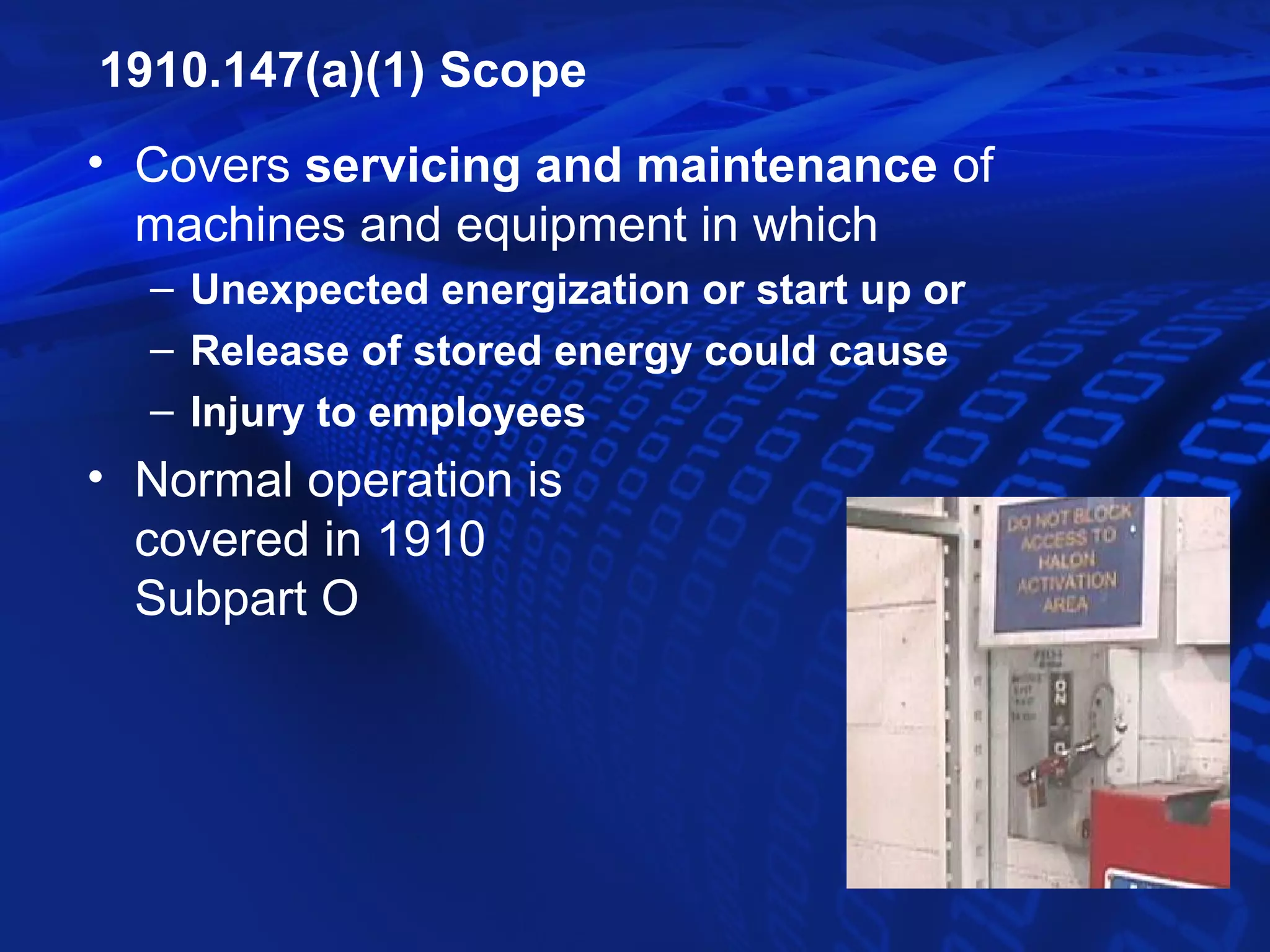
• Covers servicing and maintenance of
  machines and equipment in which
  – Unexpected energization or start up or
  – Release of stored energy could cause
  – Injury to employees
• Normal operation is
  covered in 1910
  Subpart O
1910.147(a)(1)(ii) Exemptions
• Construction, agriculture and maritime
  employment;
• Electrical Utilities;
• Electrical equipment (covered by Subpart S)
• Oil and gas well drilling and servicing
• So why comply?
Control of Hazardous Energy
• Why use lockout/tagout?
  – Protects maintenance personnel
    from power being reapplied by
    mistake
  – Recommended by API RP 54 for
    electrical systems in drilling and
    servicing operations
  – Recognized hazard
1910.147(a)(2) Application
• Service and maintenance:
  – Employee required to remove or bypass a guard
    or safety device
  – Employee required to place part of body into
    area that would be a danger zone during
    machine operation cycle
1910.147(a)(2) Application
• Exception: Minor adjustments and servicing
  activities during normal production if
  – Routine
  – Repetitive
  – Integral to production
• Provided that alternative measures provide
  effective protection
1910.147(a)(2) Application

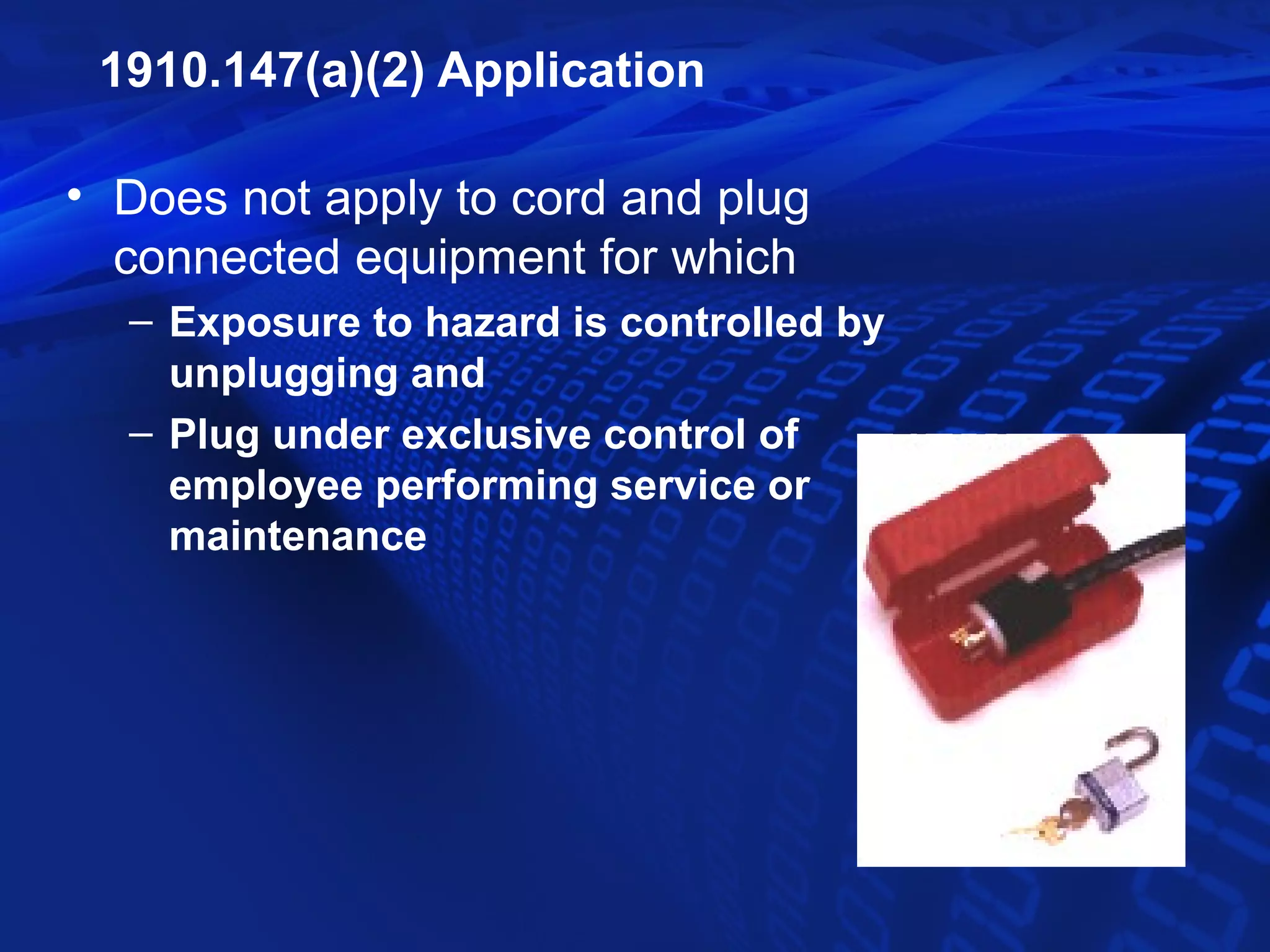
• Does not apply to cord and plug
  connected equipment for which
  – Exposure to hazard is controlled by
    unplugging and
  – Plug under exclusive control of
    employee performing service or
    maintenance
1910.147(a)(2) Application
• Does not apply to hot tap operations in
  transmission and distribution operations in
  pressurized pipelines provided that:
  – Continuity of service is essential,
  – Shutdown of system is impractical, and
  – Documented procedures and special equipment
    provide proven effective protection for
    employees
1910.147(a)(3) Purpose
• Establish a program and utilize procedures
  for affixing appropriate lockout devices or
  tagout devices to energy isolating devices
• Prevent unexpected energization, start up or
  release of stored energy in order to prevent
  injury to employees
• Training and procedural requirements for other
  sections’ LO/TO requirements
Affected employee
• Job requires employee to
  – operate or use a machine or equipment on
    which servicing or maintenance is being
    performed under lockout or tagout, or
  – work in an area in which such servicing or
    maintenance is being performed
Authorized employee
• Locks out or tags out machines or equipment
  in order to perform servicing or maintenance
  on that machine or equipment
• Affected employee whose duties include
  servicing or maintenance under this section
Energized
• Connected to an energy source OR
• Containing residual or stored energy
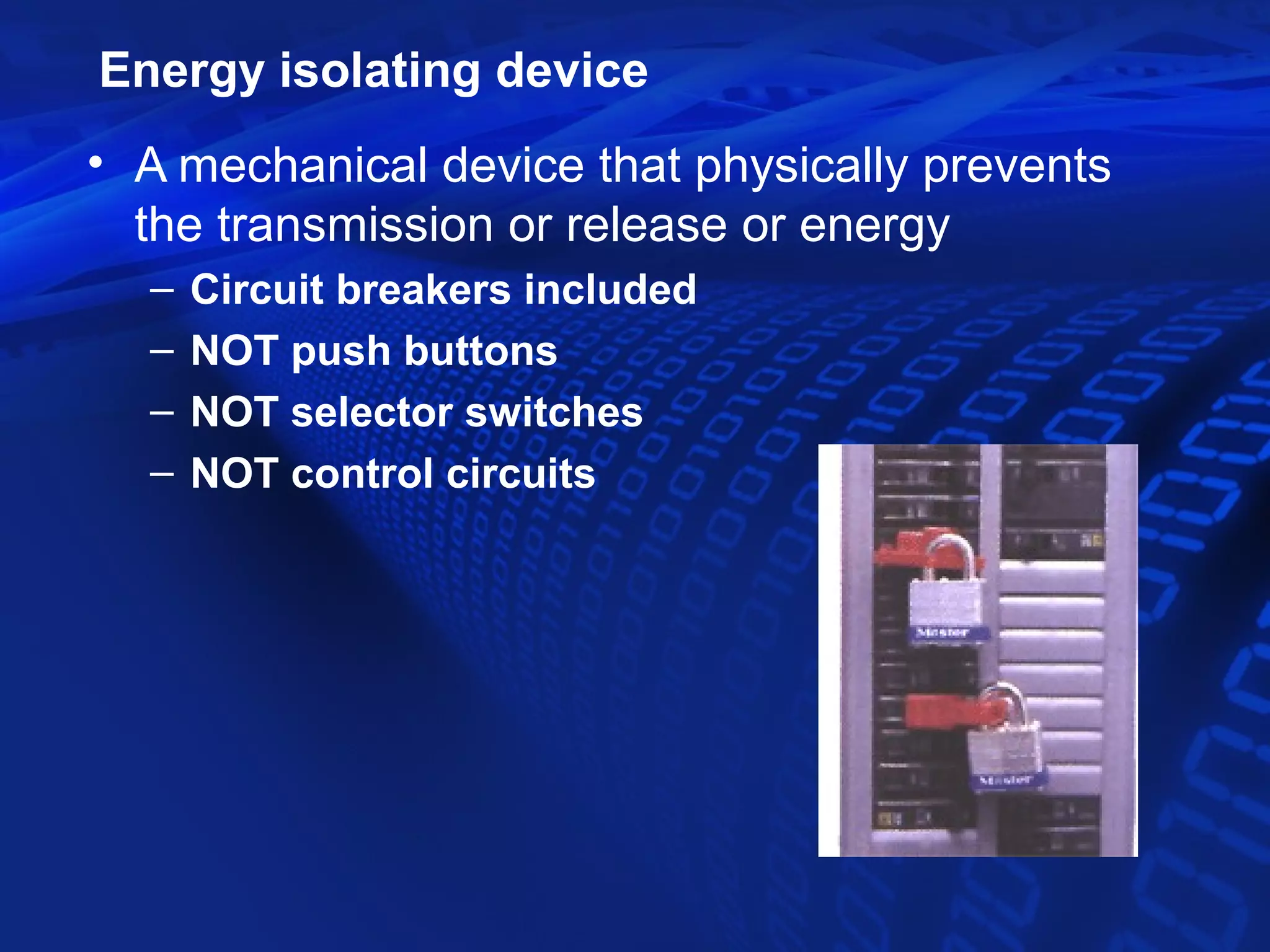
Energy isolating device
• A mechanical device that physically prevents
  the transmission or release or energy
  –   Circuit breakers included
  –   NOT push buttons
  –   NOT selector switches
  –   NOT control circuits
Energy source
• Any source of:
  –   Electrical,
  –   Mechanical,
  –   Hydraulic,
  –   Pneumatic,
  –   Chemical,
  –   Thermal, or
  –   Other energy

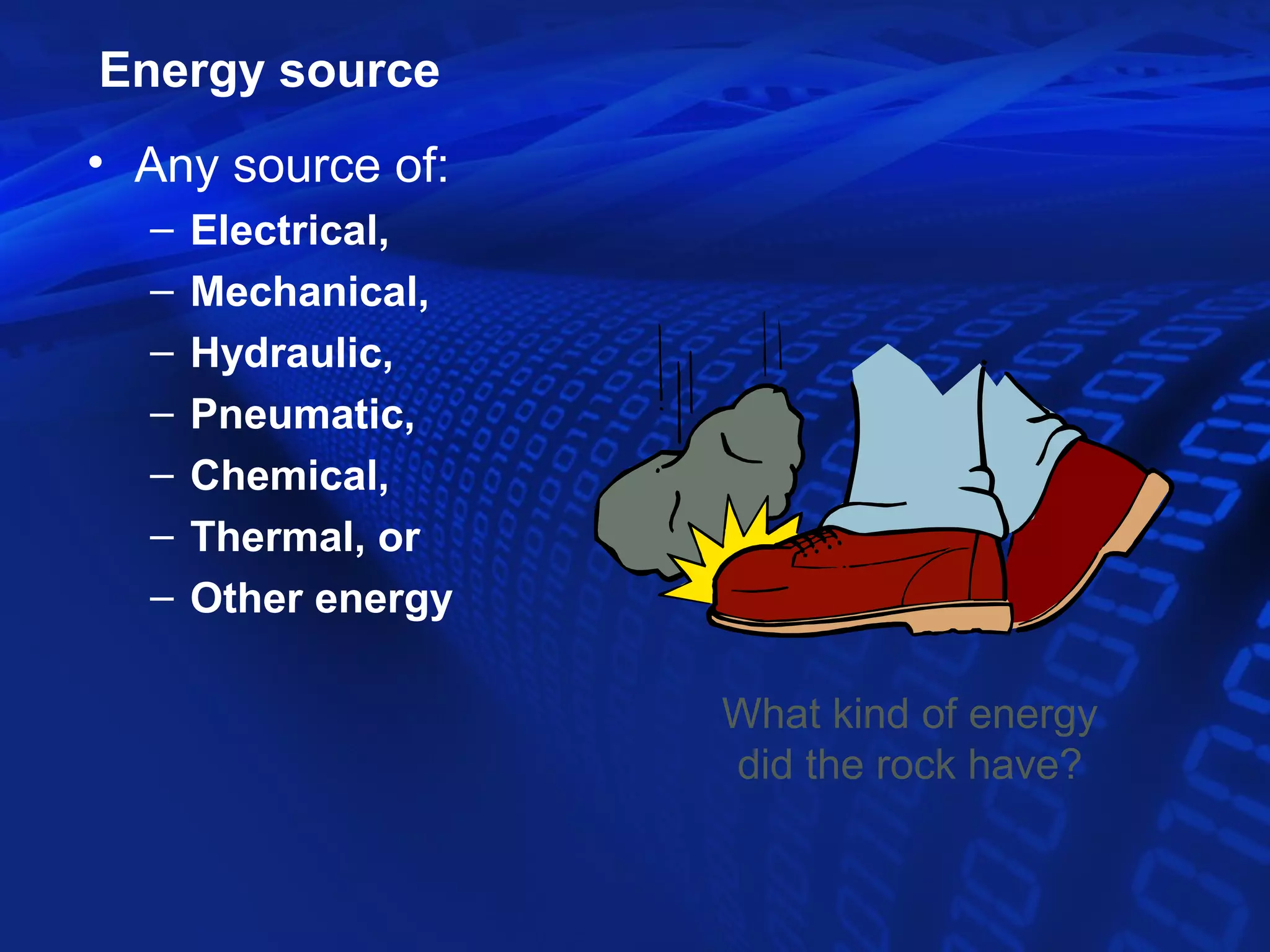
                     What kind of energy
                     did the rock have?
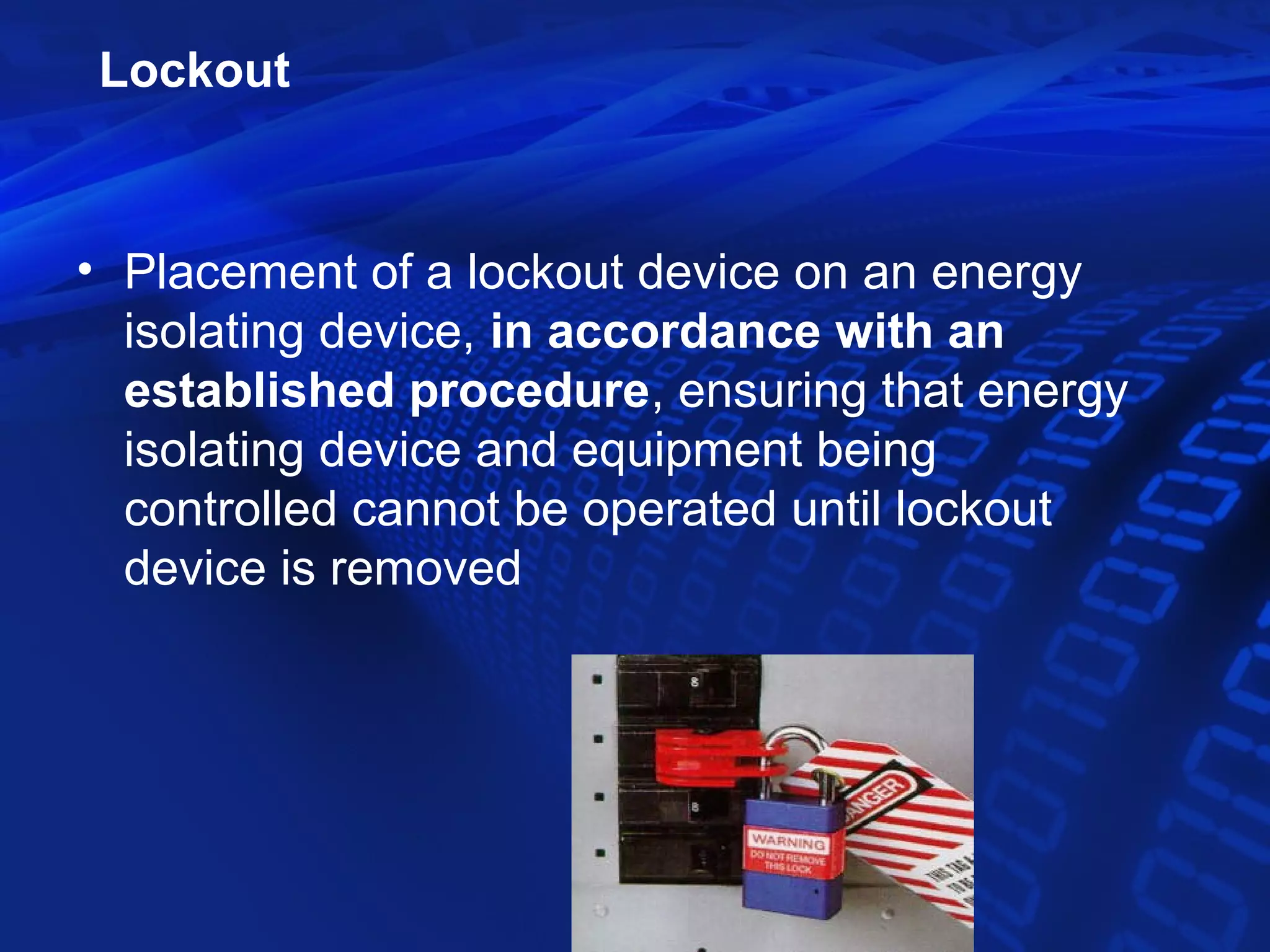
Lockout


• Placement of a lockout device on an energy
  isolating device, in accordance with an
  established procedure, ensuring that energy
  isolating device and equipment being
  controlled cannot be operated until lockout
  device is removed
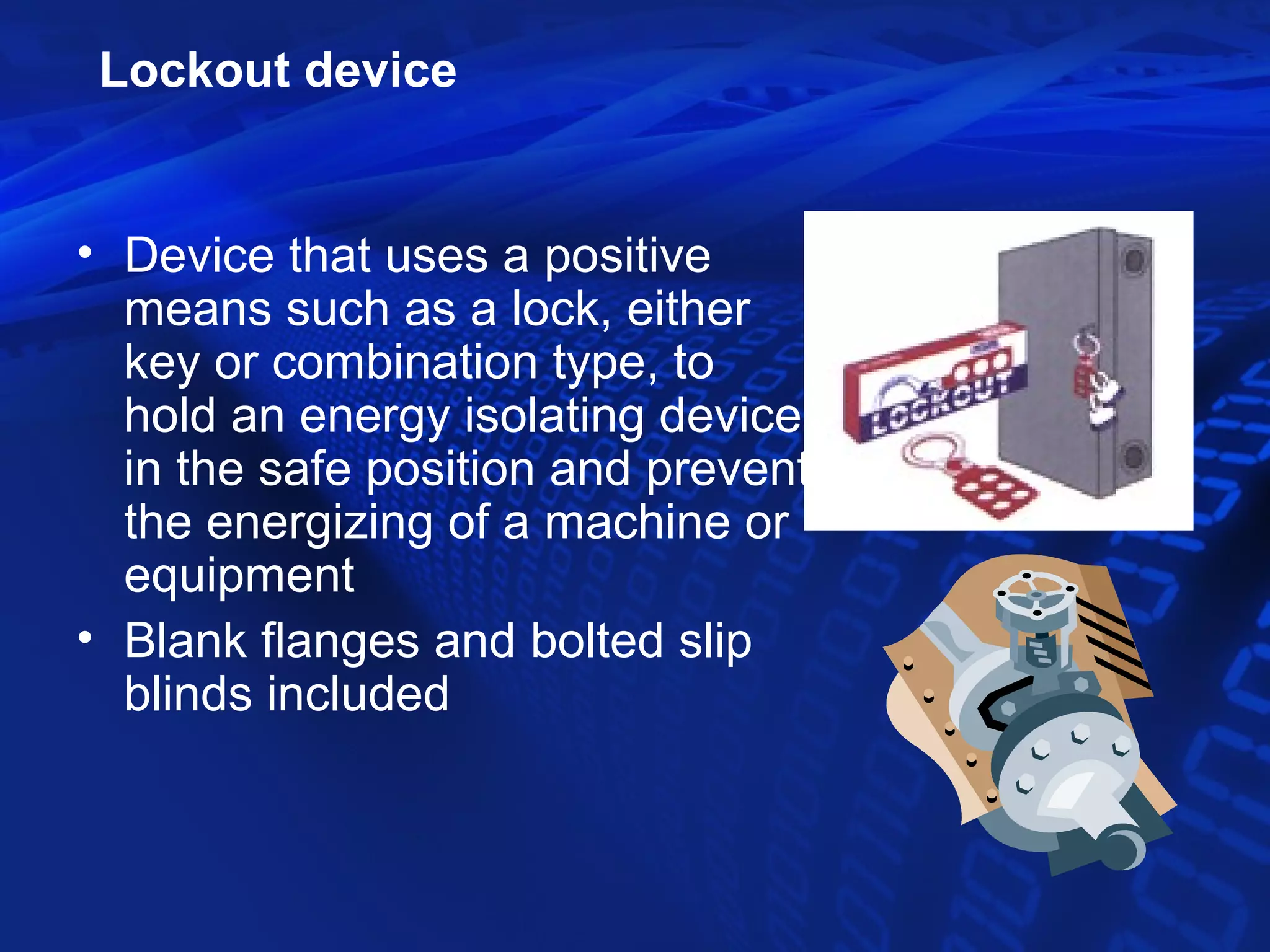
Lockout device


• Device that uses a positive
  means such as a lock, either
  key or combination type, to
  hold an energy isolating device
  in the safe position and prevent
  the energizing of a machine or
  equipment
• Blank flanges and bolted slip
  blinds included
Servicing and/or maintenance
• Workplace activities such as:
  –   Constructing,
  –   Installing,
  –   Setting up,
  –   Adjusting,
  –   Inspecting,
  –   Modifying, and
  –   Maintaining and/or servicing machines or
      equipment
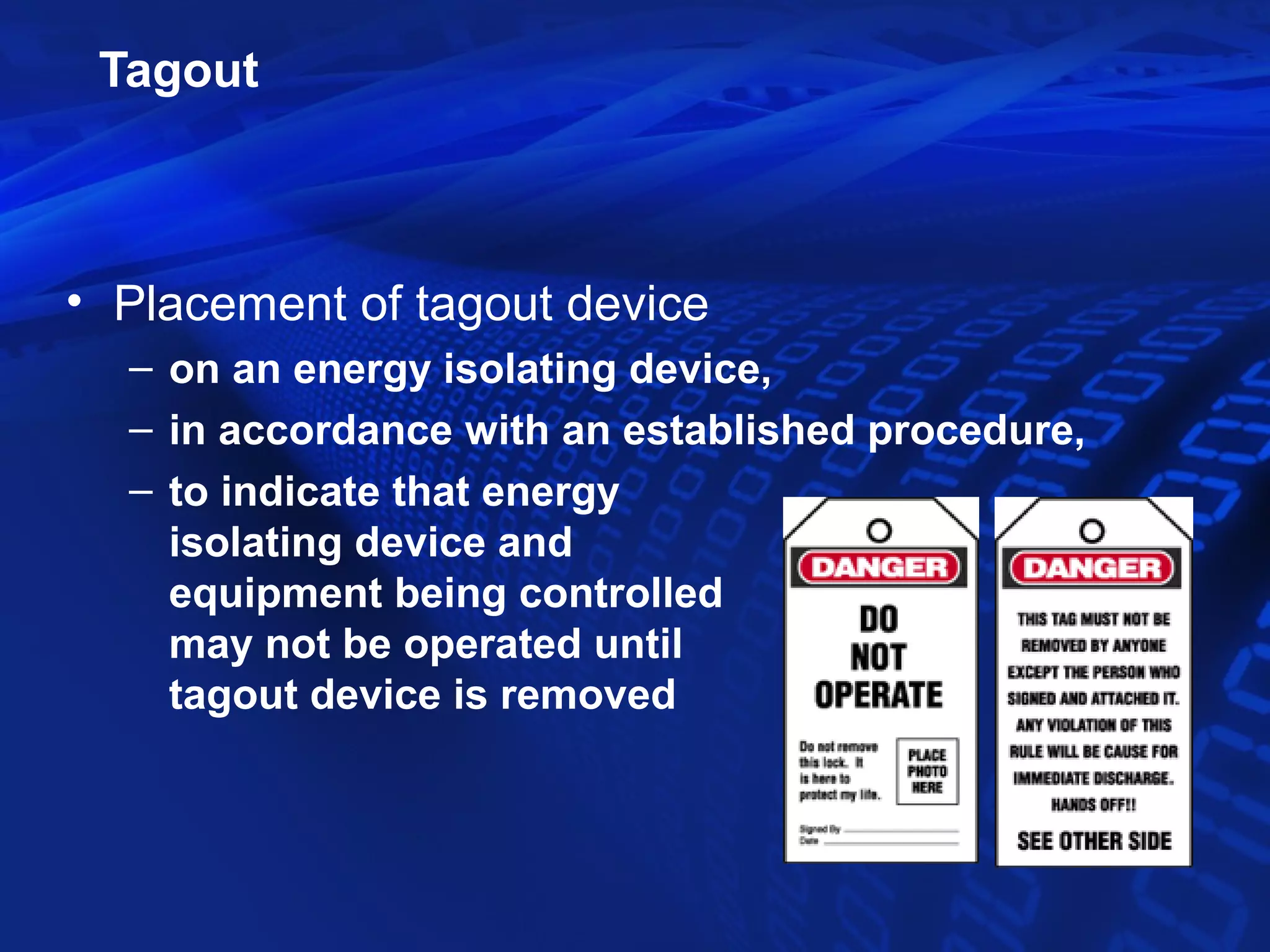
Tagout


• Placement of tagout device
  – on an energy isolating device,
  – in accordance with an established procedure,
  – to indicate that energy
    isolating device and
    equipment being controlled
    may not be operated until
    tagout device is removed
General Requirements

1910.147(c)
Energy control program
•   Energy control procedures
•   Employee training
•   Periodic inspections
•   Any employee who services/maintains any
    equipment where unexpected energizing or
    stored energy release could cause injury
    isolates and renders it inoperative first.
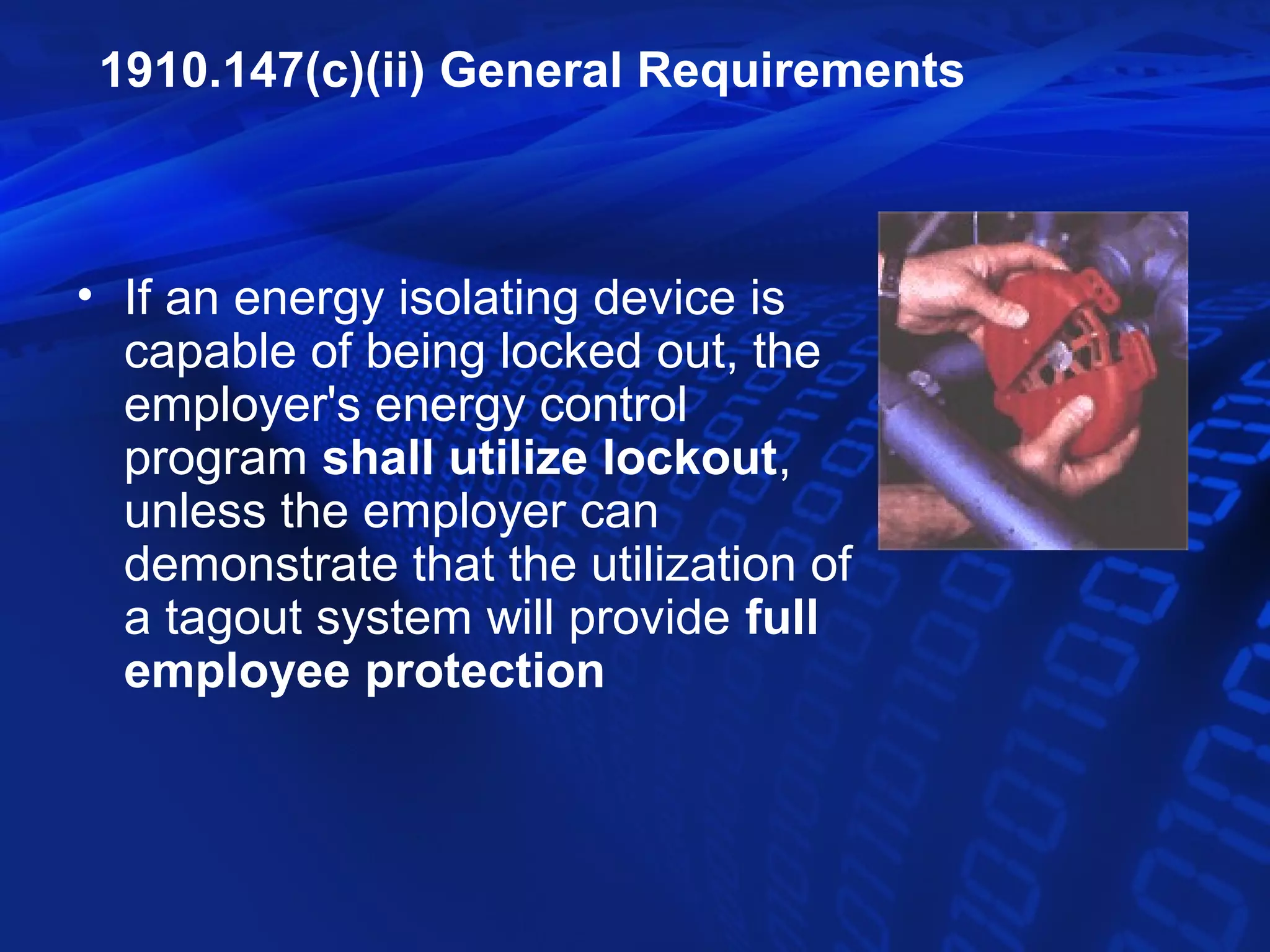
1910.147(c)(ii) General Requirements


• If an energy isolating device is
  capable of being locked out, the
  employer's energy control
  program shall utilize lockout,
  unless the employer can
  demonstrate that the utilization of
  a tagout system will provide full
  employee protection
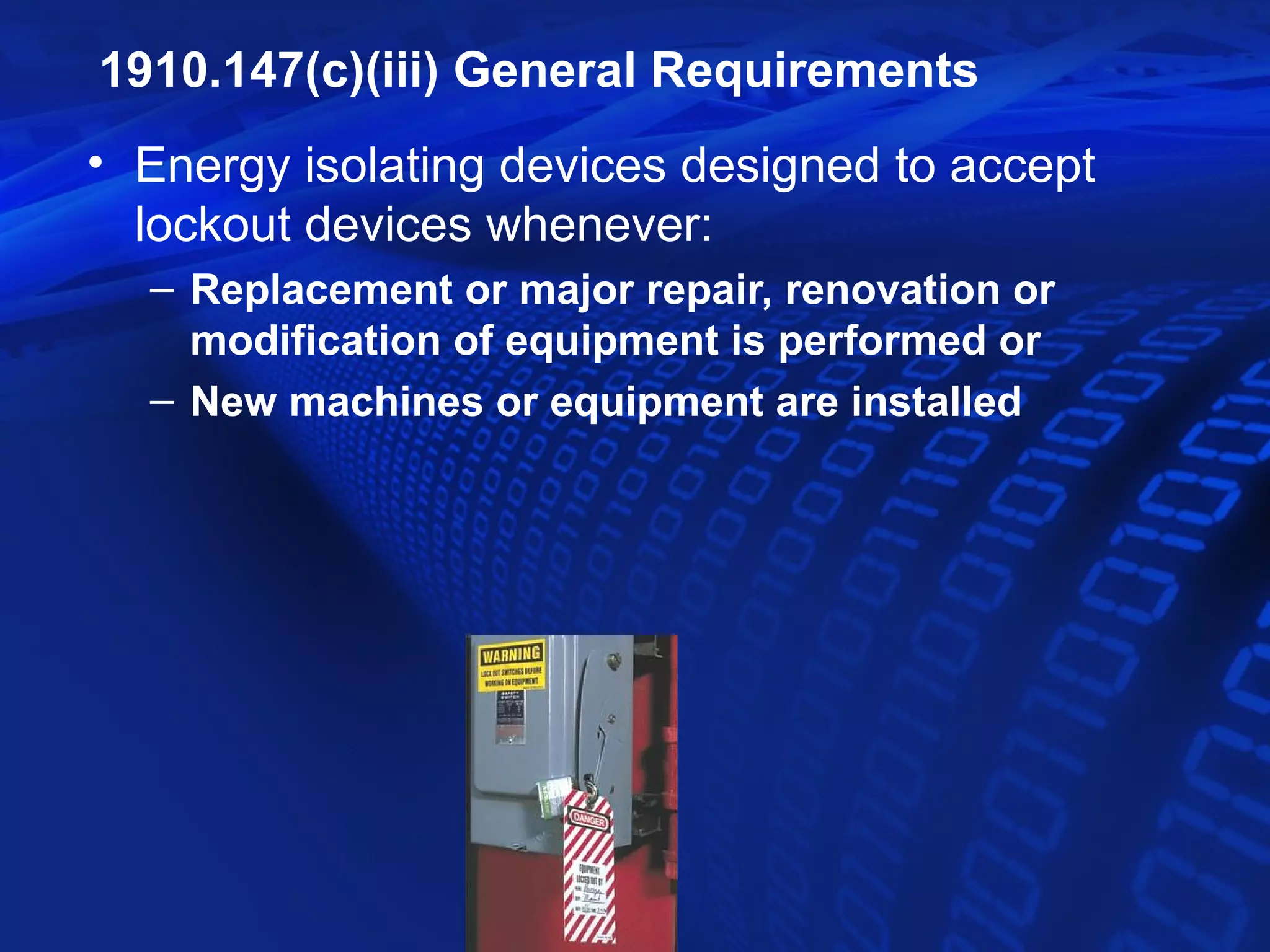
1910.147(c)(iii) General Requirements
• Energy isolating devices designed to accept
  lockout devices whenever:
  – Replacement or major repair, renovation or
    modification of equipment is performed or
  – New machines or equipment are installed
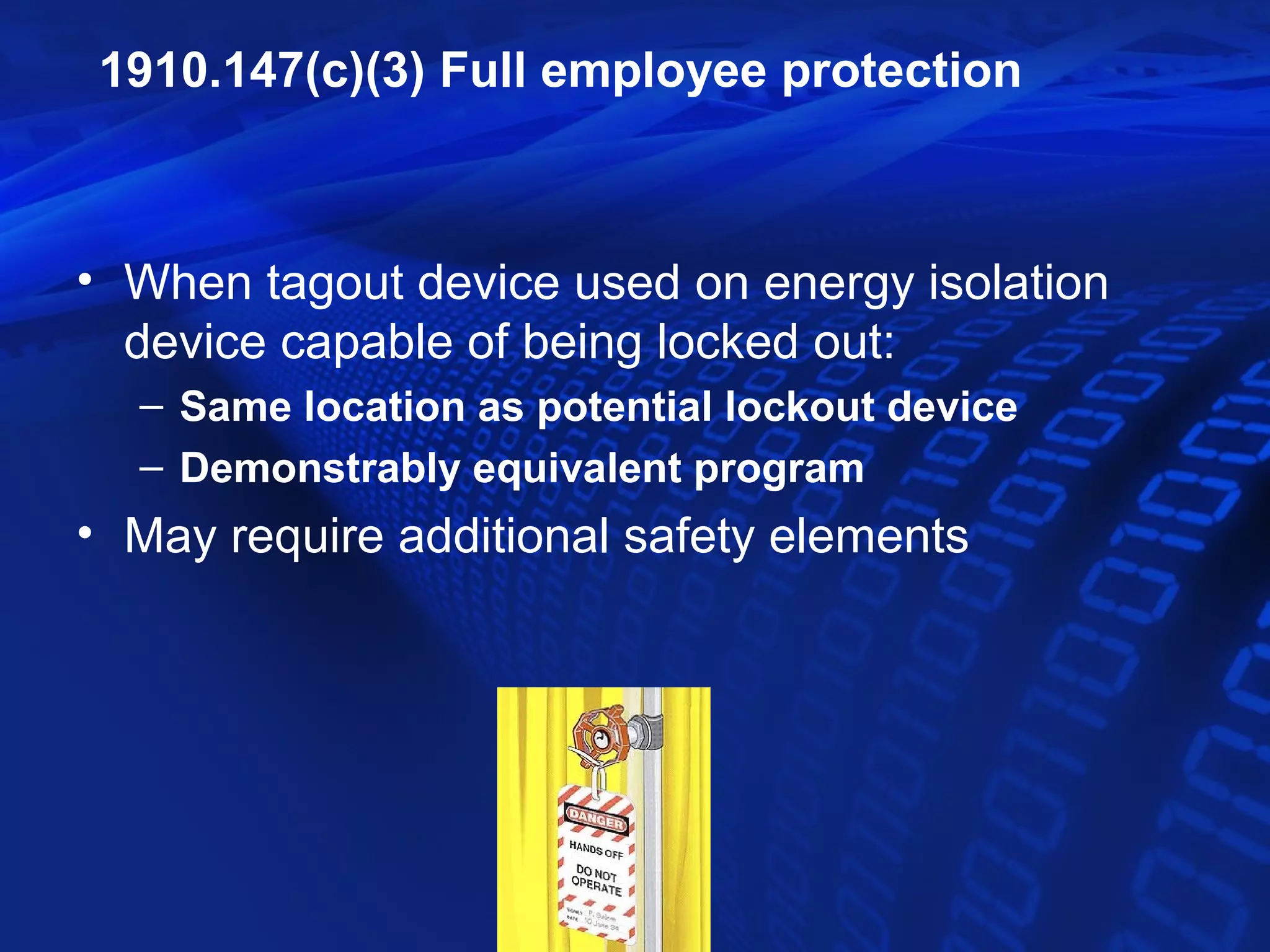
1910.147(c)(3) Full employee protection


• When tagout device used on energy isolation
  device capable of being locked out:
  – Same location as potential lockout device
  – Demonstrably equivalent program
• May require additional safety elements
1910.147(c)(4) Energy control
 procedure
• Procedures shall be developed, documented
  and utilized for the control of potentially
  hazardous energy when employees are
  engaged in the activities covered by this
  section.
  – Exception with all 8 elements listed in standard
1910.147(c)(4) Energy control
 procedure
• Outline scope, purpose, authorization, rules,
  techniques for control of hazardous energy,
  including:
  – Specific intended use of the procedure;
  – Specific steps for shutting down, isolating,
    blocking and securing equipment
  – Specific steps for placement, removal, transfer
    of lockout/tagout devices and responsibility for
    them
  – Specific requirements for testing equipment to
    verify effectiveness of lockout devices, tagout
    devices, and other energy control measures
1910.147(c)(5) Protective materials and
 hardware
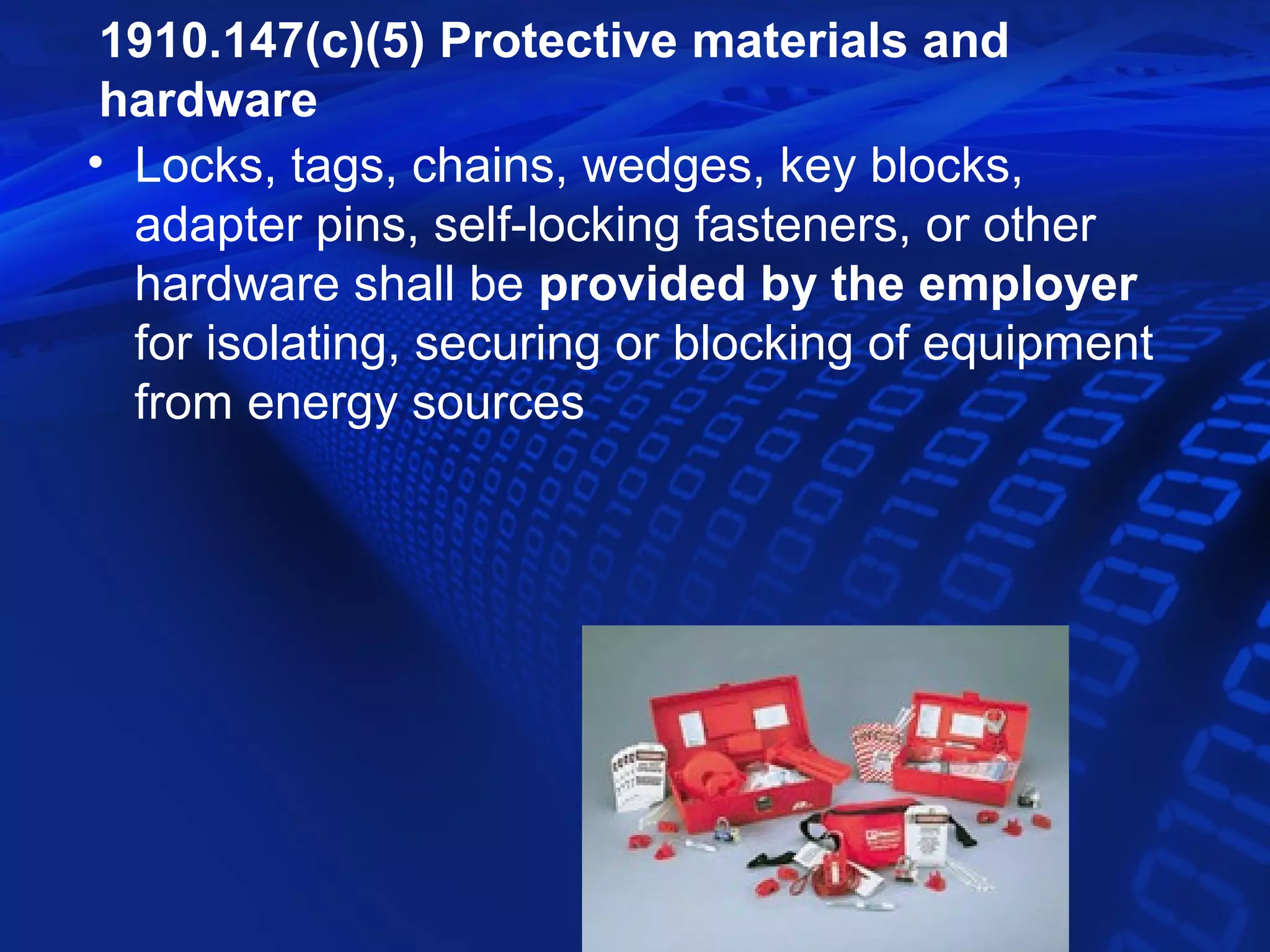
• Locks, tags, chains, wedges, key blocks,
  adapter pins, self-locking fasteners, or other
  hardware shall be provided by the employer
  for isolating, securing or blocking of equipment
  from energy sources
1910.147(c)(5) Protective materials and
 hardware
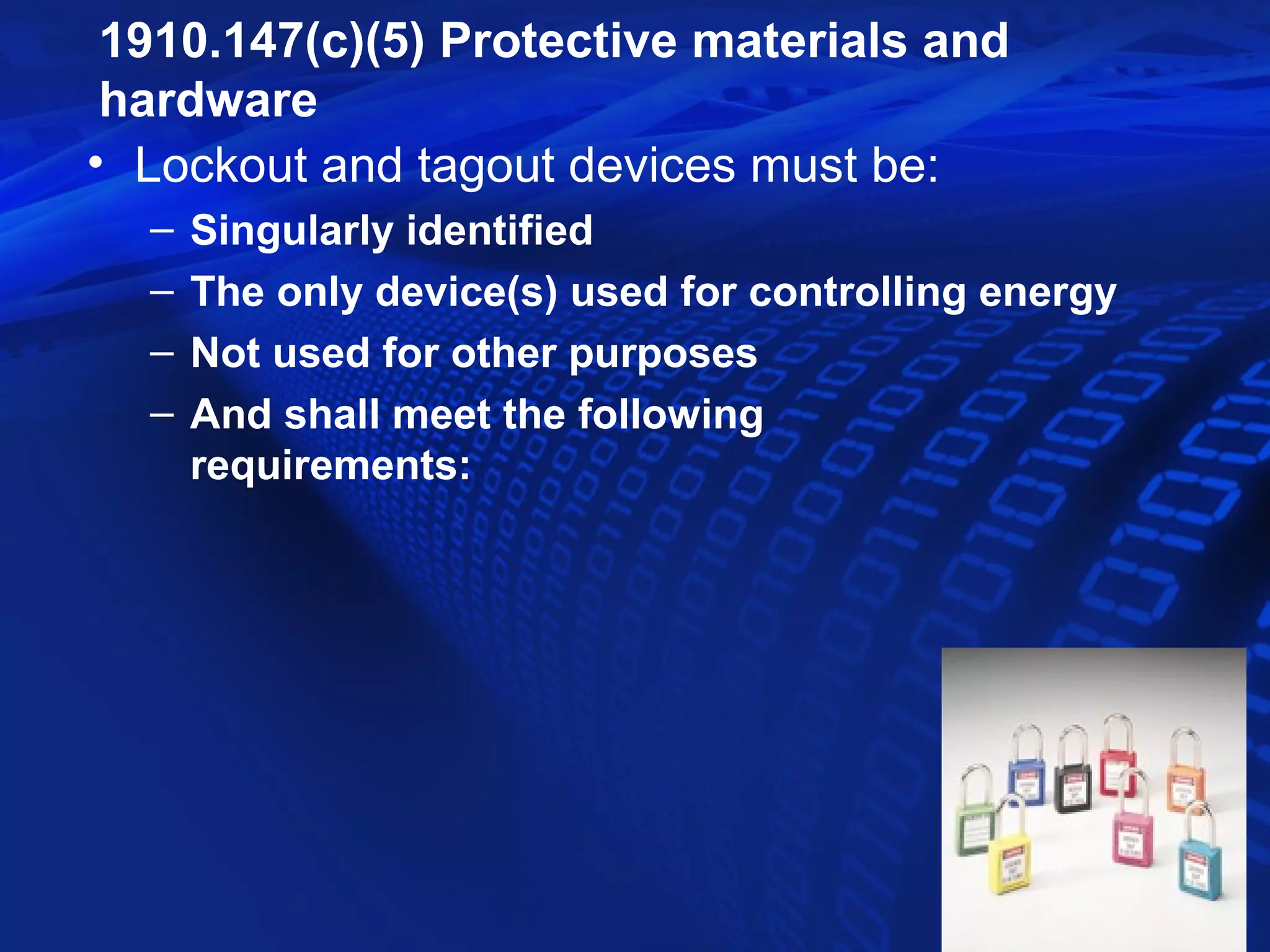
• Lockout and tagout devices must be:
  –   Singularly identified
  –   The only device(s) used for controlling energy
  –   Not used for other purposes
  –   And shall meet the following
      requirements:
1910.147(c)(5) Protective materials and
 hardware
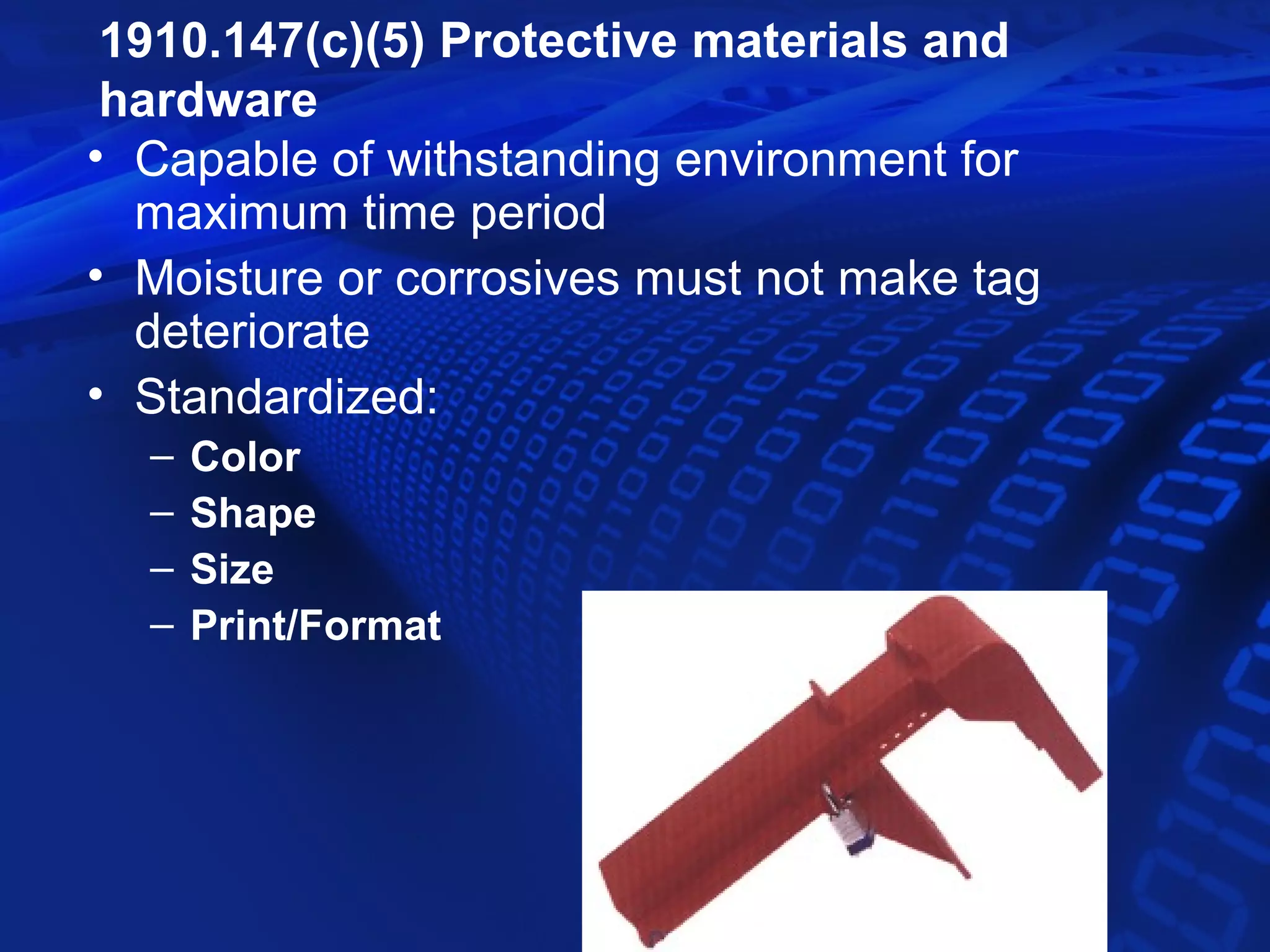
• Capable of withstanding environment for
  maximum time period
• Moisture or corrosives must not make tag
  deteriorate
• Standardized:
  –   Color
  –   Shape
  –   Size
  –   Print/Format
1910.147(c)(5) Protective materials and
 hardware
• Lockout devices:
  – Substantial enough to prevent removal without
    excessive force or unusual techniques such as
    bolt cutters
• Tagout devices:
  – Substantial enough to prevent inadvertent or
    accidental removal
  – Non-reusable attachment means
  – Attachable by hand, self-lockable
  – At least equivalent to nylon cable tie
1910.147(c)(5) Protective materials and
 hardware
• Lockout and tagout devices indicate identity of
  employee applying devices
1910.147(c)(6) Periodic Inspection
• Energy control procedure inspected at least
  annually:
  – By authorized employee not using the procedure
    being inspected
  – Correct any deviations
  – Review employee responsibilities with:
     • each authorized employee – lockout
     • each affected or authorized employee – tagout
1910.147 (c)(7) Training and
 communication
• Ensure employees understand purpose and
  function of energy control program
• Ensure employees acquire skills required for
  safe application, usage, removal of energy
  controls
Employee Training Requirements
• Authorized employee:
  – Recognition of hazardous energy sources
  – Type and amount of energy in workplace
  – Methods and means for energy isolation
• Affected employee:
  – Purpose and use of procedure
• Other employees in area:
  – Procedure and prohibition on restarting
Employee Training Requirements for
 Tagout
• Train on limitations of tags:
  – Warning devices do not provide physical
    restraint that a lock would
  – Tag not to be removed without owner’s
    authorization, bypassed, ignored, defeated
  – Must be legible / understandable to work
  – Must withstand environmental conditions
  – False sense of security
  – Attach securely: avoid accidental removal
Employee Retraining
• For all authorized or affected employees when:
  –   Job assignment changes
  –   Equipment or processes present new hazard
  –   Energy control procedure changes
  –   Knowledge / use of program is inadequate
• Certify employee training up to date
1910.147(c)(8) Energy Isolation
• Only the authorized employees performing the
  servicing or maintenance may apply
  lockout/tagout
1910.147(c)(9) Notification of
 Employees
• Affected employees must be notified
  – By employer or authorized employee
  – Of application and removal of lockout and
    tagout devices
  – Before controls are applied
  – After controls are removed
Order of Operation for Application of
Control
1. Preparation for shutdown
2. Equipment shutdown – orderly
3. Equipment isolation
4. Lockout or tagout device application
5. Stored energy relieved; continue while
   reaccumulating
6. Verification of isolation
  –   Test and return to “off” position
1910.147(e) Release from Lockout
• Before lockout or tagout devices removed and
  energy restored, ensure:
• Machine or equipment:
  – Inspect area; remove nonessential items
  – Ensure equipment components intact
• Employees:
  – Ensure all employees safe or removed
  – Before restart, notify affected employees of
    removal
1910.147(e) Release from Lockout
• Each lockout/tagout device removed by
  employee who applied the device
  – If not available, removed under employer
    direction
  – Specific procedures and training from energy
    control program must be in use!
      • Verify that applying employee is not at facility
      • Make all reasonable efforts to contact/notify
      • Ensure authorized employee knows of removal
        before resuming work at facility
1910.147(f)(1) Testing or Positioning
• Temporary removal of lockout/tagout devices
  for testing/positioning:
  –   Clear tools and materials
  –   Remove employees from equipment area
  –   Remove lockout/tagout devices (as in (e))
  –   Energize and test or position
  –   Deenergize systems and reapply energy control
      measures to continue servicing
1910.147(f)(2) Outside Personnel
• Contractors and other outside personnel:
  – On-site employer and outside employer inform
    each other of lockout/tagout procedures
  – On-site employer complies with outside
    employer’s energy control program
1910.147(f)(3) Group Lockout or Tagout
• Procedure must provide protection equivalent
  to personal lockout/tagout device
• Primary responsibility is vested in an
  authorized employee for a set number of
  employees working under the protection of a
  group lockout or tagout device (such as an
  operations lock);
1910.147(f)(3) Group Lockout or Tagout
• When more than one crew, craft, department,
  etc. is involved:
  – Designated authorized employee takes
    lockout/tagout control responsibility
  – Coordinates affected work forces
  – Ensures continuity of protection
1910.147(f)(3) Group Lockout or Tagout
• Each authorized employee affixes personal
  lockout/tagout device to group lockout device
  when beginning work
• Each removes personal device when stopping
  work on this equipment
1910.147(f)(4) Shift or Personnel
 Changes
• Specific procedures in energy control plan
• Ensure continuity of lockout/tagout protection
• Orderly transfer of lockout/tagout device
  protection between shifts
• Minimize exposure to hazards from
  unexpected energization or release

Lockout tagout

  • 1.
  • 2.
    1910.147(a)(1) Scope • Coversservicing and maintenance of machines and equipment in which – Unexpected energization or start up or – Release of stored energy could cause – Injury to employees • Normal operation is covered in 1910 Subpart O
  • 3.
    1910.147(a)(1)(ii) Exemptions • Construction,agriculture and maritime employment; • Electrical Utilities; • Electrical equipment (covered by Subpart S) • Oil and gas well drilling and servicing • So why comply?
  • 4.
    Control of HazardousEnergy • Why use lockout/tagout? – Protects maintenance personnel from power being reapplied by mistake – Recommended by API RP 54 for electrical systems in drilling and servicing operations – Recognized hazard
  • 5.
    1910.147(a)(2) Application • Serviceand maintenance: – Employee required to remove or bypass a guard or safety device – Employee required to place part of body into area that would be a danger zone during machine operation cycle
  • 6.
    1910.147(a)(2) Application • Exception:Minor adjustments and servicing activities during normal production if – Routine – Repetitive – Integral to production • Provided that alternative measures provide effective protection
  • 7.
    1910.147(a)(2) Application • Doesnot apply to cord and plug connected equipment for which – Exposure to hazard is controlled by unplugging and – Plug under exclusive control of employee performing service or maintenance
  • 8.
    1910.147(a)(2) Application • Doesnot apply to hot tap operations in transmission and distribution operations in pressurized pipelines provided that: – Continuity of service is essential, – Shutdown of system is impractical, and – Documented procedures and special equipment provide proven effective protection for employees
  • 9.
    1910.147(a)(3) Purpose • Establisha program and utilize procedures for affixing appropriate lockout devices or tagout devices to energy isolating devices • Prevent unexpected energization, start up or release of stored energy in order to prevent injury to employees • Training and procedural requirements for other sections’ LO/TO requirements
  • 10.
    Affected employee • Jobrequires employee to – operate or use a machine or equipment on which servicing or maintenance is being performed under lockout or tagout, or – work in an area in which such servicing or maintenance is being performed
  • 11.
    Authorized employee • Locksout or tags out machines or equipment in order to perform servicing or maintenance on that machine or equipment • Affected employee whose duties include servicing or maintenance under this section
  • 12.
    Energized • Connected toan energy source OR • Containing residual or stored energy
  • 13.
    Energy isolating device •A mechanical device that physically prevents the transmission or release or energy – Circuit breakers included – NOT push buttons – NOT selector switches – NOT control circuits
  • 14.
    Energy source • Anysource of: – Electrical, – Mechanical, – Hydraulic, – Pneumatic, – Chemical, – Thermal, or – Other energy What kind of energy did the rock have?
  • 15.
    Lockout • Placement ofa lockout device on an energy isolating device, in accordance with an established procedure, ensuring that energy isolating device and equipment being controlled cannot be operated until lockout device is removed
  • 16.
    Lockout device • Devicethat uses a positive means such as a lock, either key or combination type, to hold an energy isolating device in the safe position and prevent the energizing of a machine or equipment • Blank flanges and bolted slip blinds included
  • 17.
    Servicing and/or maintenance •Workplace activities such as: – Constructing, – Installing, – Setting up, – Adjusting, – Inspecting, – Modifying, and – Maintaining and/or servicing machines or equipment
  • 18.
    Tagout • Placement oftagout device – on an energy isolating device, – in accordance with an established procedure, – to indicate that energy isolating device and equipment being controlled may not be operated until tagout device is removed
  • 19.
  • 20.
    Energy control program • Energy control procedures • Employee training • Periodic inspections • Any employee who services/maintains any equipment where unexpected energizing or stored energy release could cause injury isolates and renders it inoperative first.
  • 21.
    1910.147(c)(ii) General Requirements •If an energy isolating device is capable of being locked out, the employer's energy control program shall utilize lockout, unless the employer can demonstrate that the utilization of a tagout system will provide full employee protection
  • 22.
    1910.147(c)(iii) General Requirements •Energy isolating devices designed to accept lockout devices whenever: – Replacement or major repair, renovation or modification of equipment is performed or – New machines or equipment are installed
  • 23.
    1910.147(c)(3) Full employeeprotection • When tagout device used on energy isolation device capable of being locked out: – Same location as potential lockout device – Demonstrably equivalent program • May require additional safety elements
  • 24.
    1910.147(c)(4) Energy control procedure • Procedures shall be developed, documented and utilized for the control of potentially hazardous energy when employees are engaged in the activities covered by this section. – Exception with all 8 elements listed in standard
  • 25.
    1910.147(c)(4) Energy control procedure • Outline scope, purpose, authorization, rules, techniques for control of hazardous energy, including: – Specific intended use of the procedure; – Specific steps for shutting down, isolating, blocking and securing equipment – Specific steps for placement, removal, transfer of lockout/tagout devices and responsibility for them – Specific requirements for testing equipment to verify effectiveness of lockout devices, tagout devices, and other energy control measures
  • 26.
    1910.147(c)(5) Protective materialsand hardware • Locks, tags, chains, wedges, key blocks, adapter pins, self-locking fasteners, or other hardware shall be provided by the employer for isolating, securing or blocking of equipment from energy sources
  • 27.
    1910.147(c)(5) Protective materialsand hardware • Lockout and tagout devices must be: – Singularly identified – The only device(s) used for controlling energy – Not used for other purposes – And shall meet the following requirements:
  • 28.
    1910.147(c)(5) Protective materialsand hardware • Capable of withstanding environment for maximum time period • Moisture or corrosives must not make tag deteriorate • Standardized: – Color – Shape – Size – Print/Format
  • 29.
    1910.147(c)(5) Protective materialsand hardware • Lockout devices: – Substantial enough to prevent removal without excessive force or unusual techniques such as bolt cutters • Tagout devices: – Substantial enough to prevent inadvertent or accidental removal – Non-reusable attachment means – Attachable by hand, self-lockable – At least equivalent to nylon cable tie
  • 30.
    1910.147(c)(5) Protective materialsand hardware • Lockout and tagout devices indicate identity of employee applying devices
  • 31.
    1910.147(c)(6) Periodic Inspection •Energy control procedure inspected at least annually: – By authorized employee not using the procedure being inspected – Correct any deviations – Review employee responsibilities with: • each authorized employee – lockout • each affected or authorized employee – tagout
  • 32.
    1910.147 (c)(7) Trainingand communication • Ensure employees understand purpose and function of energy control program • Ensure employees acquire skills required for safe application, usage, removal of energy controls
  • 33.
    Employee Training Requirements •Authorized employee: – Recognition of hazardous energy sources – Type and amount of energy in workplace – Methods and means for energy isolation • Affected employee: – Purpose and use of procedure • Other employees in area: – Procedure and prohibition on restarting
  • 34.
    Employee Training Requirementsfor Tagout • Train on limitations of tags: – Warning devices do not provide physical restraint that a lock would – Tag not to be removed without owner’s authorization, bypassed, ignored, defeated – Must be legible / understandable to work – Must withstand environmental conditions – False sense of security – Attach securely: avoid accidental removal
  • 35.
    Employee Retraining • Forall authorized or affected employees when: – Job assignment changes – Equipment or processes present new hazard – Energy control procedure changes – Knowledge / use of program is inadequate • Certify employee training up to date
  • 36.
    1910.147(c)(8) Energy Isolation •Only the authorized employees performing the servicing or maintenance may apply lockout/tagout
  • 37.
    1910.147(c)(9) Notification of Employees • Affected employees must be notified – By employer or authorized employee – Of application and removal of lockout and tagout devices – Before controls are applied – After controls are removed
  • 38.
    Order of Operationfor Application of Control 1. Preparation for shutdown 2. Equipment shutdown – orderly 3. Equipment isolation 4. Lockout or tagout device application 5. Stored energy relieved; continue while reaccumulating 6. Verification of isolation – Test and return to “off” position
  • 39.
    1910.147(e) Release fromLockout • Before lockout or tagout devices removed and energy restored, ensure: • Machine or equipment: – Inspect area; remove nonessential items – Ensure equipment components intact • Employees: – Ensure all employees safe or removed – Before restart, notify affected employees of removal
  • 40.
    1910.147(e) Release fromLockout • Each lockout/tagout device removed by employee who applied the device – If not available, removed under employer direction – Specific procedures and training from energy control program must be in use! • Verify that applying employee is not at facility • Make all reasonable efforts to contact/notify • Ensure authorized employee knows of removal before resuming work at facility
  • 41.
    1910.147(f)(1) Testing orPositioning • Temporary removal of lockout/tagout devices for testing/positioning: – Clear tools and materials – Remove employees from equipment area – Remove lockout/tagout devices (as in (e)) – Energize and test or position – Deenergize systems and reapply energy control measures to continue servicing
  • 42.
    1910.147(f)(2) Outside Personnel •Contractors and other outside personnel: – On-site employer and outside employer inform each other of lockout/tagout procedures – On-site employer complies with outside employer’s energy control program
  • 43.
    1910.147(f)(3) Group Lockoutor Tagout • Procedure must provide protection equivalent to personal lockout/tagout device • Primary responsibility is vested in an authorized employee for a set number of employees working under the protection of a group lockout or tagout device (such as an operations lock);
  • 44.
    1910.147(f)(3) Group Lockoutor Tagout • When more than one crew, craft, department, etc. is involved: – Designated authorized employee takes lockout/tagout control responsibility – Coordinates affected work forces – Ensures continuity of protection
  • 45.
    1910.147(f)(3) Group Lockoutor Tagout • Each authorized employee affixes personal lockout/tagout device to group lockout device when beginning work • Each removes personal device when stopping work on this equipment
  • 46.
    1910.147(f)(4) Shift orPersonnel Changes • Specific procedures in energy control plan • Ensure continuity of lockout/tagout protection • Orderly transfer of lockout/tagout device protection between shifts • Minimize exposure to hazards from unexpected energization or release