Level 3 Diploma in Electrical Installations (Buildings and Structures)
© 2013 City and Guilds of London Institute. All rights reserved. 1 of 13
PowerPointpresentation
Micro-hydro
Unit 301: Understand the fundamental principles
and requirements of environmental technology
systems
Level 3 Diploma in Electrical Installations (Buildings and Structures)
© 2013 City and Guilds of London Institute. All rights reserved. 2 of 13
Micro-hydro
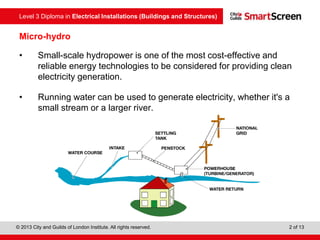
• Small-scale hydropower is one of the most cost-effective and
reliable energy technologies to be considered for providing clean
electricity generation.
• Running water can be used to generate electricity, whether it's a
small stream or a larger river.
Level 3 Diploma in Electrical Installations (Buildings and Structures)
© 2013 City and Guilds of London Institute. All rights reserved. 3 of 13
Micro-hydro
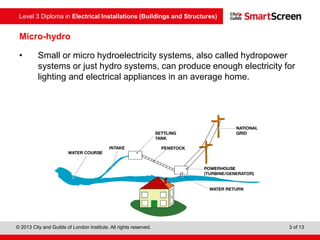
• Small or micro hydroelectricity systems, also called hydropower
systems or just hydro systems, can produce enough electricity for
lighting and electrical appliances in an average home.
Level 3 Diploma in Electrical Installations (Buildings and Structures)
© 2013 City and Guilds of London Institute. All rights reserved. 4 of 13
Micro-hydro
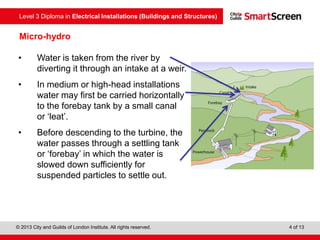
• Water is taken from the river by
diverting it through an intake at a weir.
• In medium or high-head installations
water may first be carried horizontally
to the forebay tank by a small canal
or ‘leat’.
• Before descending to the turbine, the
water passes through a settling tank
or ‘forebay’ in which the water is
slowed down sufficiently for
suspended particles to settle out.
Level 3 Diploma in Electrical Installations (Buildings and Structures)
© 2013 City and Guilds of London Institute. All rights reserved. 5 of 13
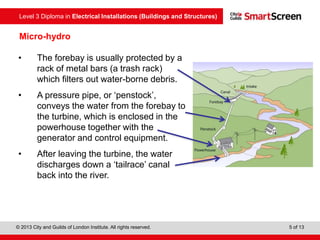
Micro-hydro
• The forebay is usually protected by a
rack of metal bars (a trash rack)
which filters out water-borne debris.
• A pressure pipe, or ‘penstock’,
conveys the water from the forebay to
the turbine, which is enclosed in the
powerhouse together with the
generator and control equipment.
• After leaving the turbine, the water
discharges down a ‘tailrace’ canal
back into the river.
Level 3 Diploma in Electrical Installations (Buildings and Structures)
© 2013 City and Guilds of London Institute. All rights reserved. 6 of 13
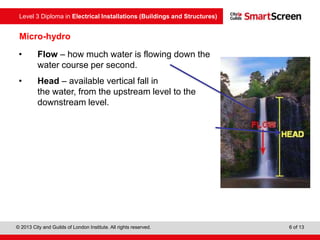
Micro-hydro
• Flow – how much water is flowing down the
water course per second.
• Head – available vertical fall in
the water, from the upstream level to the
downstream level.
Level 3 Diploma in Electrical Installations (Buildings and Structures)
© 2013 City and Guilds of London Institute. All rights reserved. 7 of 13
Micro-hydro
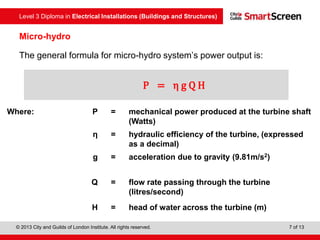
The general formula for micro-hydro system’s power output is:
Where: P = mechanical power produced at the turbine shaft
(Watts)
η = hydraulic efficiency of the turbine, (expressed
as a decimal)
g = acceleration due to gravity (9.81m/s2)
Q = flow rate passing through the turbine
(litres/second)
H = head of water across the turbine (m)
P = η g Q H
Level 3 Diploma in Electrical Installations (Buildings and Structures)
© 2013 City and Guilds of London Institute. All rights reserved. 8 of 13
Micro-hydro
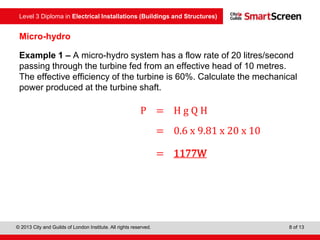
Example 1 – A micro-hydro system has a flow rate of 20 litres/second
passing through the turbine fed from an effective head of 10 metres.
The effective efficiency of the turbine is 60%. Calculate the mechanical
power produced at the turbine shaft.
P = Η g Q H
= 0.6 x 9.81 x 20 x 10
= 1177W
Level 3 Diploma in Electrical Installations (Buildings and Structures)
© 2013 City and Guilds of London Institute. All rights reserved. 9 of 13
Micro-hydro
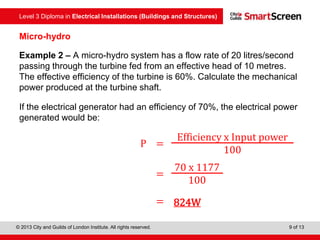
Example 2 – A micro-hydro system has a flow rate of 20 litres/second
passing through the turbine fed from an effective head of 10 metres.
The effective efficiency of the turbine is 60%. Calculate the mechanical
power produced at the turbine shaft.
If the electrical generator had an efficiency of 70%, the electrical power
generated would be:
P =
Efficiency x Input power
100
=
70 x 1177
100
= 824W
Level 3 Diploma in Electrical Installations (Buildings and Structures)
© 2013 City and Guilds of London Institute. All rights reserved. 10 of 13
Planning permission and Building Regulations
• Planning permission required.
• Environmental Agency will need consulting.
• Abstraction Licence also required from Environmental Agency.
• Building Regulations required for buildings constructed.
Level 3 Diploma in Electrical Installations (Buildings and Structures)
© 2013 City and Guilds of London Institute. All rights reserved. 11 of 13
Advantages of micro-hydro
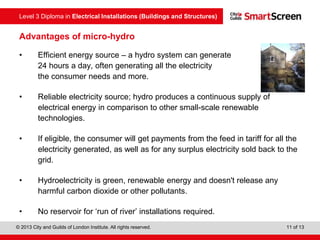
• Efficient energy source – a hydro system can generate
24 hours a day, often generating all the electricity
the consumer needs and more.
• Reliable electricity source; hydro produces a continuous supply of
electrical energy in comparison to other small-scale renewable
technologies.
• If eligible, the consumer will get payments from the feed in tariff for all the
electricity generated, as well as for any surplus electricity sold back to the
grid.
• Hydroelectricity is green, renewable energy and doesn't release any
harmful carbon dioxide or other pollutants.
• No reservoir for ‘run of river’ installations required.
Level 3 Diploma in Electrical Installations (Buildings and Structures)
© 2013 City and Guilds of London Institute. All rights reserved. 12 of 13
Disadvantages of micro-hydro
• Large initial capital outlay.
• Suitable site characteristics required.
• Energy expansion not possible; the size and flow of small streams
may restrict future site expansion as the power demand increases.
• Low-power in the summer months.
• Environmental impact.
Level 3 Diploma in Electrical Installations (Buildings and Structures)
© 2013 City and Guilds of London Institute. All rights reserved. 13 of 13
Any questions?

Hydro

  • 1.
    Level 3 Diplomain Electrical Installations (Buildings and Structures) © 2013 City and Guilds of London Institute. All rights reserved. 1 of 13 PowerPointpresentation Micro-hydro Unit 301: Understand the fundamental principles and requirements of environmental technology systems
  • 2.
    Level 3 Diplomain Electrical Installations (Buildings and Structures) © 2013 City and Guilds of London Institute. All rights reserved. 2 of 13 Micro-hydro • Small-scale hydropower is one of the most cost-effective and reliable energy technologies to be considered for providing clean electricity generation. • Running water can be used to generate electricity, whether it's a small stream or a larger river.
  • 3.
    Level 3 Diplomain Electrical Installations (Buildings and Structures) © 2013 City and Guilds of London Institute. All rights reserved. 3 of 13 Micro-hydro • Small or micro hydroelectricity systems, also called hydropower systems or just hydro systems, can produce enough electricity for lighting and electrical appliances in an average home.
  • 4.
    Level 3 Diplomain Electrical Installations (Buildings and Structures) © 2013 City and Guilds of London Institute. All rights reserved. 4 of 13 Micro-hydro • Water is taken from the river by diverting it through an intake at a weir. • In medium or high-head installations water may first be carried horizontally to the forebay tank by a small canal or ‘leat’. • Before descending to the turbine, the water passes through a settling tank or ‘forebay’ in which the water is slowed down sufficiently for suspended particles to settle out.
  • 5.
    Level 3 Diplomain Electrical Installations (Buildings and Structures) © 2013 City and Guilds of London Institute. All rights reserved. 5 of 13 Micro-hydro • The forebay is usually protected by a rack of metal bars (a trash rack) which filters out water-borne debris. • A pressure pipe, or ‘penstock’, conveys the water from the forebay to the turbine, which is enclosed in the powerhouse together with the generator and control equipment. • After leaving the turbine, the water discharges down a ‘tailrace’ canal back into the river.
  • 6.
    Level 3 Diplomain Electrical Installations (Buildings and Structures) © 2013 City and Guilds of London Institute. All rights reserved. 6 of 13 Micro-hydro • Flow – how much water is flowing down the water course per second. • Head – available vertical fall in the water, from the upstream level to the downstream level.
  • 7.
    Level 3 Diplomain Electrical Installations (Buildings and Structures) © 2013 City and Guilds of London Institute. All rights reserved. 7 of 13 Micro-hydro The general formula for micro-hydro system’s power output is: Where: P = mechanical power produced at the turbine shaft (Watts) η = hydraulic efficiency of the turbine, (expressed as a decimal) g = acceleration due to gravity (9.81m/s2) Q = flow rate passing through the turbine (litres/second) H = head of water across the turbine (m) P = η g Q H
  • 8.
    Level 3 Diplomain Electrical Installations (Buildings and Structures) © 2013 City and Guilds of London Institute. All rights reserved. 8 of 13 Micro-hydro Example 1 – A micro-hydro system has a flow rate of 20 litres/second passing through the turbine fed from an effective head of 10 metres. The effective efficiency of the turbine is 60%. Calculate the mechanical power produced at the turbine shaft. P = Η g Q H = 0.6 x 9.81 x 20 x 10 = 1177W
  • 9.
    Level 3 Diplomain Electrical Installations (Buildings and Structures) © 2013 City and Guilds of London Institute. All rights reserved. 9 of 13 Micro-hydro Example 2 – A micro-hydro system has a flow rate of 20 litres/second passing through the turbine fed from an effective head of 10 metres. The effective efficiency of the turbine is 60%. Calculate the mechanical power produced at the turbine shaft. If the electrical generator had an efficiency of 70%, the electrical power generated would be: P = Efficiency x Input power 100 = 70 x 1177 100 = 824W
  • 10.
    Level 3 Diplomain Electrical Installations (Buildings and Structures) © 2013 City and Guilds of London Institute. All rights reserved. 10 of 13 Planning permission and Building Regulations • Planning permission required. • Environmental Agency will need consulting. • Abstraction Licence also required from Environmental Agency. • Building Regulations required for buildings constructed.
  • 11.
    Level 3 Diplomain Electrical Installations (Buildings and Structures) © 2013 City and Guilds of London Institute. All rights reserved. 11 of 13 Advantages of micro-hydro • Efficient energy source – a hydro system can generate 24 hours a day, often generating all the electricity the consumer needs and more. • Reliable electricity source; hydro produces a continuous supply of electrical energy in comparison to other small-scale renewable technologies. • If eligible, the consumer will get payments from the feed in tariff for all the electricity generated, as well as for any surplus electricity sold back to the grid. • Hydroelectricity is green, renewable energy and doesn't release any harmful carbon dioxide or other pollutants. • No reservoir for ‘run of river’ installations required.
  • 12.
    Level 3 Diplomain Electrical Installations (Buildings and Structures) © 2013 City and Guilds of London Institute. All rights reserved. 12 of 13 Disadvantages of micro-hydro • Large initial capital outlay. • Suitable site characteristics required. • Energy expansion not possible; the size and flow of small streams may restrict future site expansion as the power demand increases. • Low-power in the summer months. • Environmental impact.
  • 13.
    Level 3 Diplomain Electrical Installations (Buildings and Structures) © 2013 City and Guilds of London Institute. All rights reserved. 13 of 13 Any questions?