Electrical Hazards
AND
PREVENTION
www.isei.ucsd.edu 2
Consensus Standards
• References
–OSHA 29 CFR 1926 Subpart K Electrical
–NFPA 70E
www.isei.ucsd.edu 3
Dangers of Electricity
• Electric shock or electrocution
• Skin burns
• Falls
• Fire from electrical shorts or
as an ignition source
• Improper operation of power
equipment
About 5 workers are electrocuted every week in the United States
Burn caused by electricity
www.isei.ucsd.edu 4
Electricity – How it Works
• Electricity is the flow of energy
from one place to another
• Requires a source of power:
usually a generating station
• A flow of electrons (current)
travels through a conductor
• Travels in a closed circuit
Source
Load
Conductor
Switch
www.isei.ucsd.edu 5
Electrical Terms
• Current
– Flow of electric charge in a medium
• measured in Amperes (A)
• Voltage
– Measure of “push” available to motivate electrons
• measured in Volts (V)
• Resistance
– Measure of opposition to electric current
• measured in Ohms (Ώ)
www.isei.ucsd.edu 6
Electrical Terms
• Conductors
– Materials that allow electricity to flow
• Insulators
– Materials with high resistance to electricity
• Grounding
– A conductive connection to the earth which acts as
a protective measure
www.isei.ucsd.edu 7
Conductors / Insulators
Conductors
• silver
• copper
• gold
• aluminum
• iron
• steel
• brass
• bronze
• mercury
• graphite
• dirty water (salty water)
Insulators
• glass
• rubber
• oil
• asphalt
• fiberglass
• porcelain
• ceramic
• (dry) paper
• (dry) wood
• plastic
• air
• pure water
www.isei.ucsd.edu 8
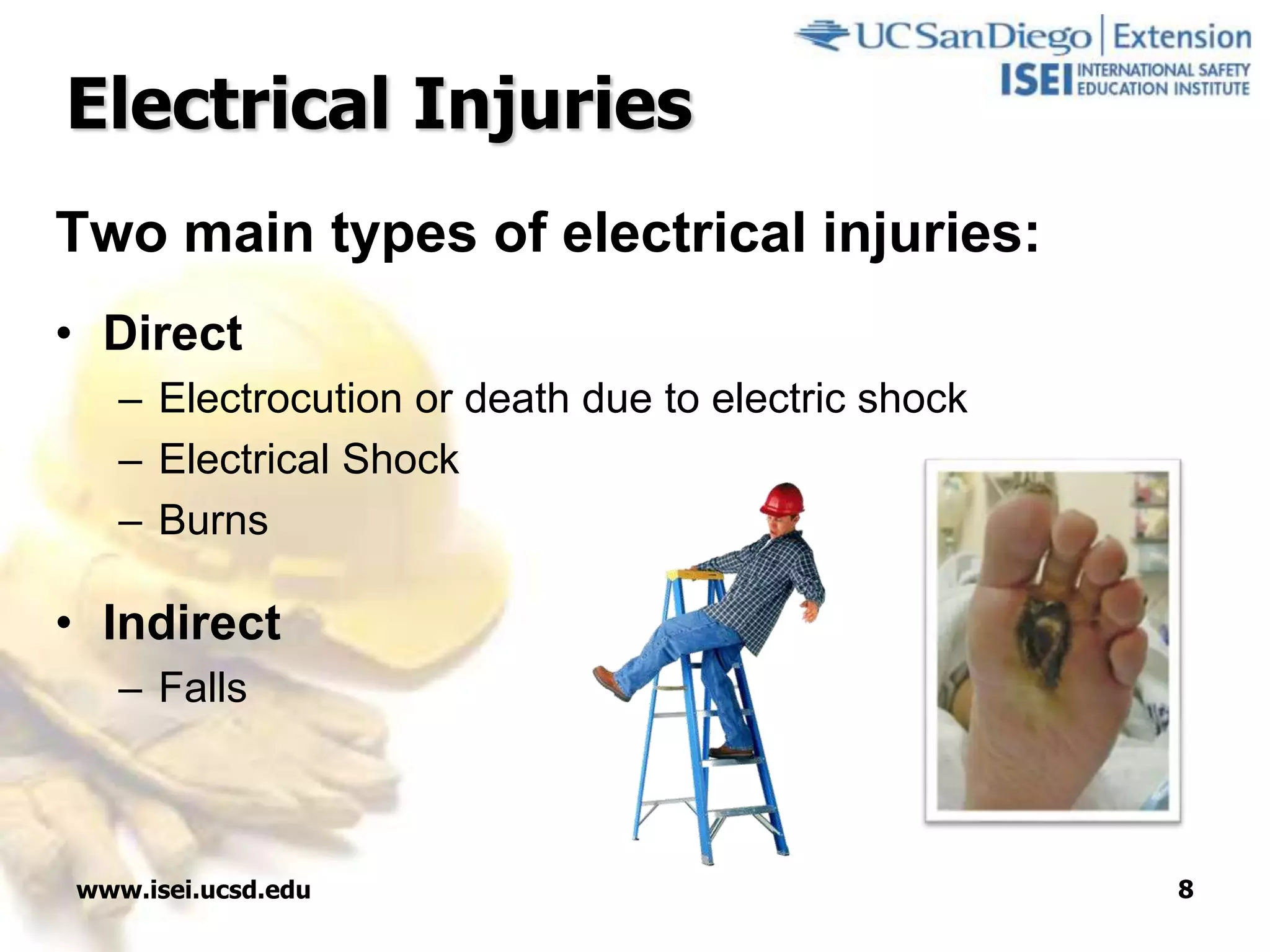
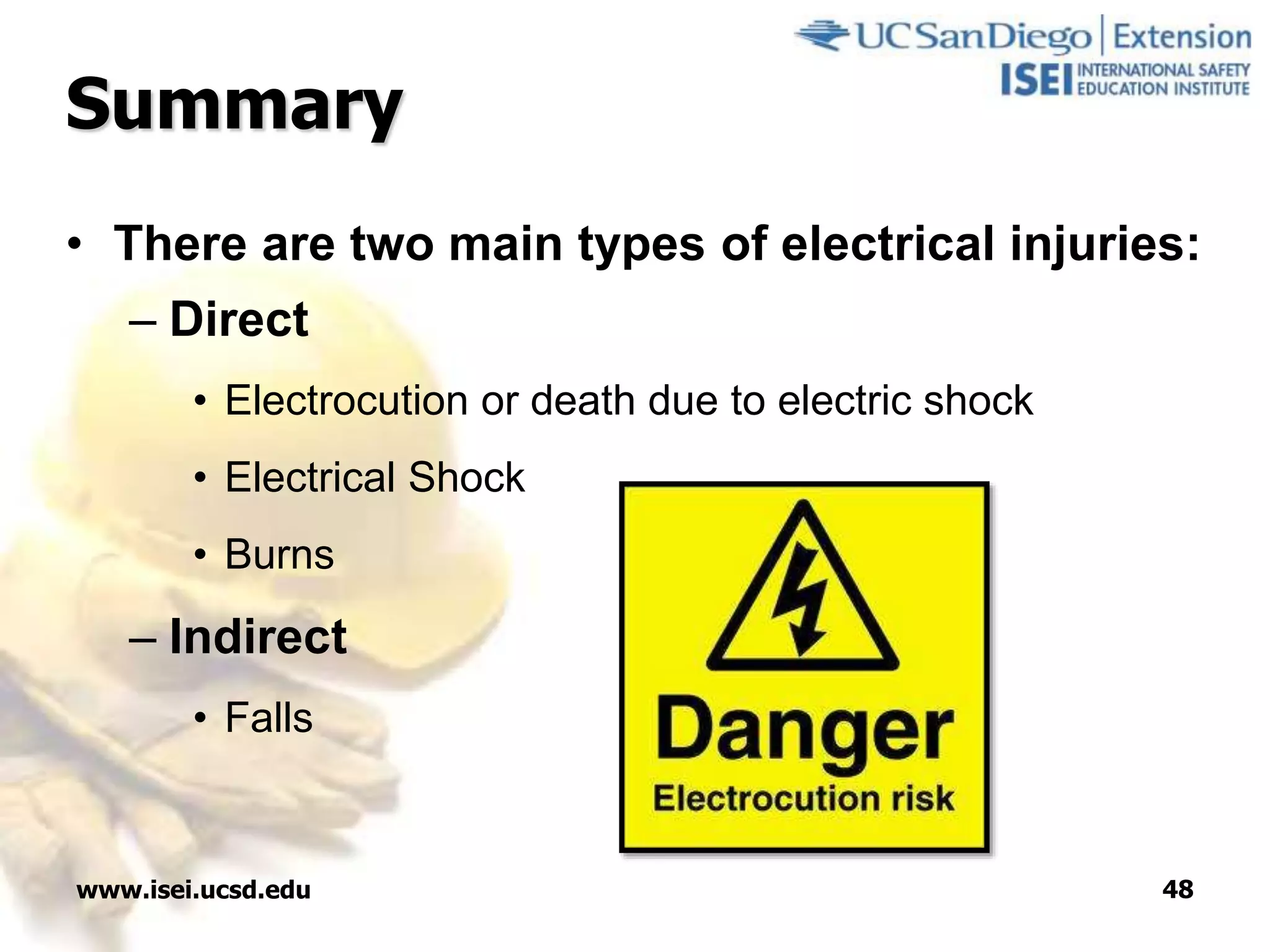
Electrical Injuries
Two main types of electrical injuries:
• Direct
– Electrocution or death due to electric shock
– Electrical Shock
– Burns
• Indirect
– Falls
www.isei.ucsd.edu 9
Rules of Electricity
• Electricity travels in a complete/closed circuit
• Electricity always travels in the path of
least resistance
• Electricity always tries to travel to ground
www.isei.ucsd.edu 10
Electricity and People
• A person usually offers a
lesser resistance
for the electricity
• The person forms a
completed circuit when
touching the ground
www.isei.ucsd.edu 11
Discussion
• Will a bird resting on a high voltage, high
tension wire be electrocuted?
www.isei.ucsd.edu 12
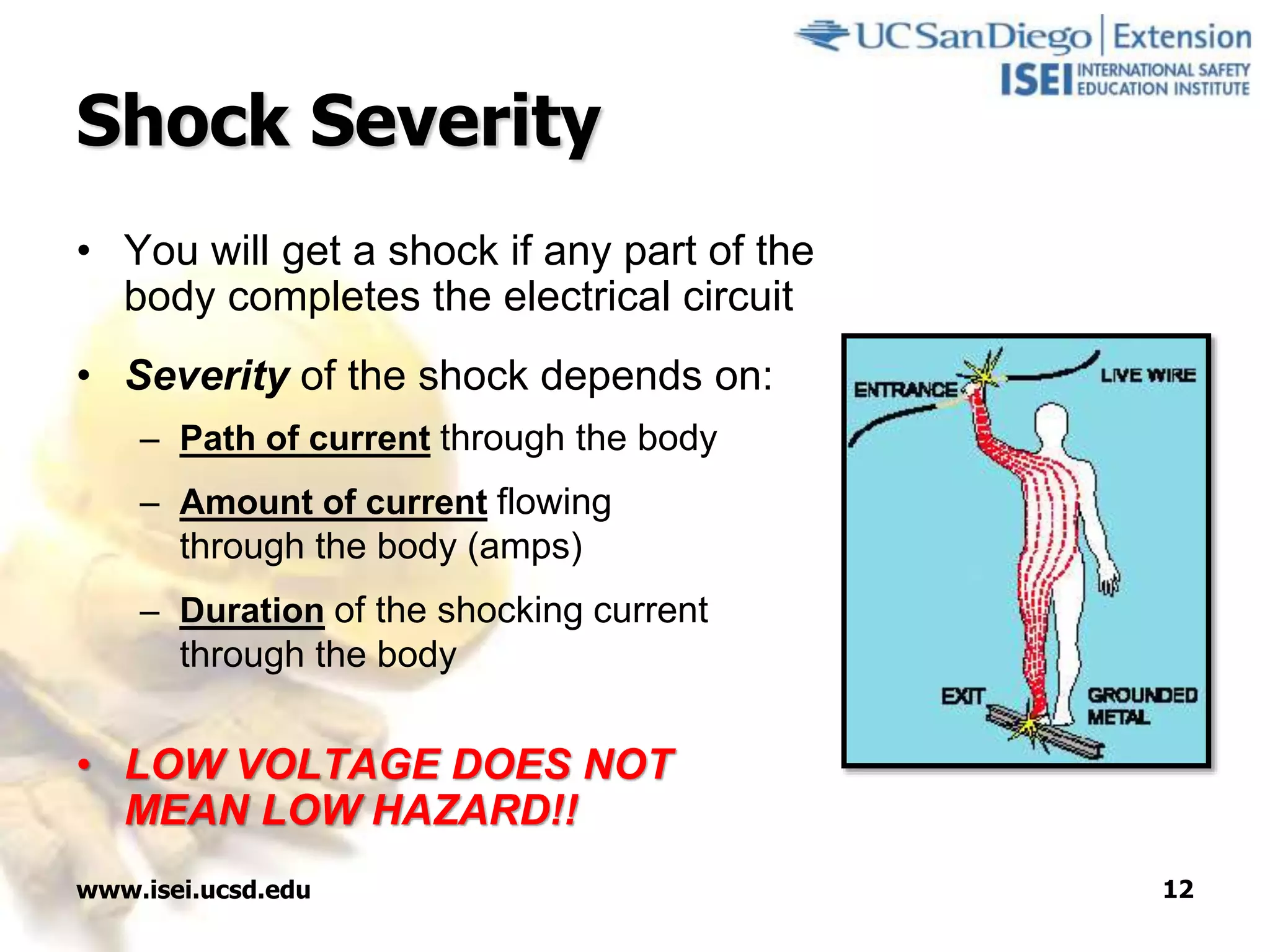
Shock Severity
• You will get a shock if any part of the
body completes the electrical circuit
• Severity of the shock depends on:
– Path of current through the body
– Amount of current flowing
through the body (amps)
– Duration of the shocking current
through the body
• LOW VOLTAGE DOES NOT
MEAN LOW HAZARD!!
www.isei.ucsd.edu 13
Electrical Harm
1mA Barely perceptible
16mA Maximum current an average man
can grasp and “let go”
20-30mA Paralysis if respiratory muscles
100mA Ventricular fibrillation threshold
2Amps Cardiac standstill and internal
organ damage
*mA = milliampere = 1/1,000 of an ampere
www.isei.ucsd.edu 14
Burns
• Most common shock-related injury
• Occurs when you touch
electrical wiring or equipment
improperly used or maintained
• Typically occurs on hands
• Very serious injury that
needs immediate attention
www.isei.ucsd.edu 15
Falls
• Electric shock can also cause
indirect injuries like falls
• Workers in elevated locations
who experience a shock may
fall due to involuntary
movement of the muscles,
resulting in serious injury or
death
www.isei.ucsd.edu 16
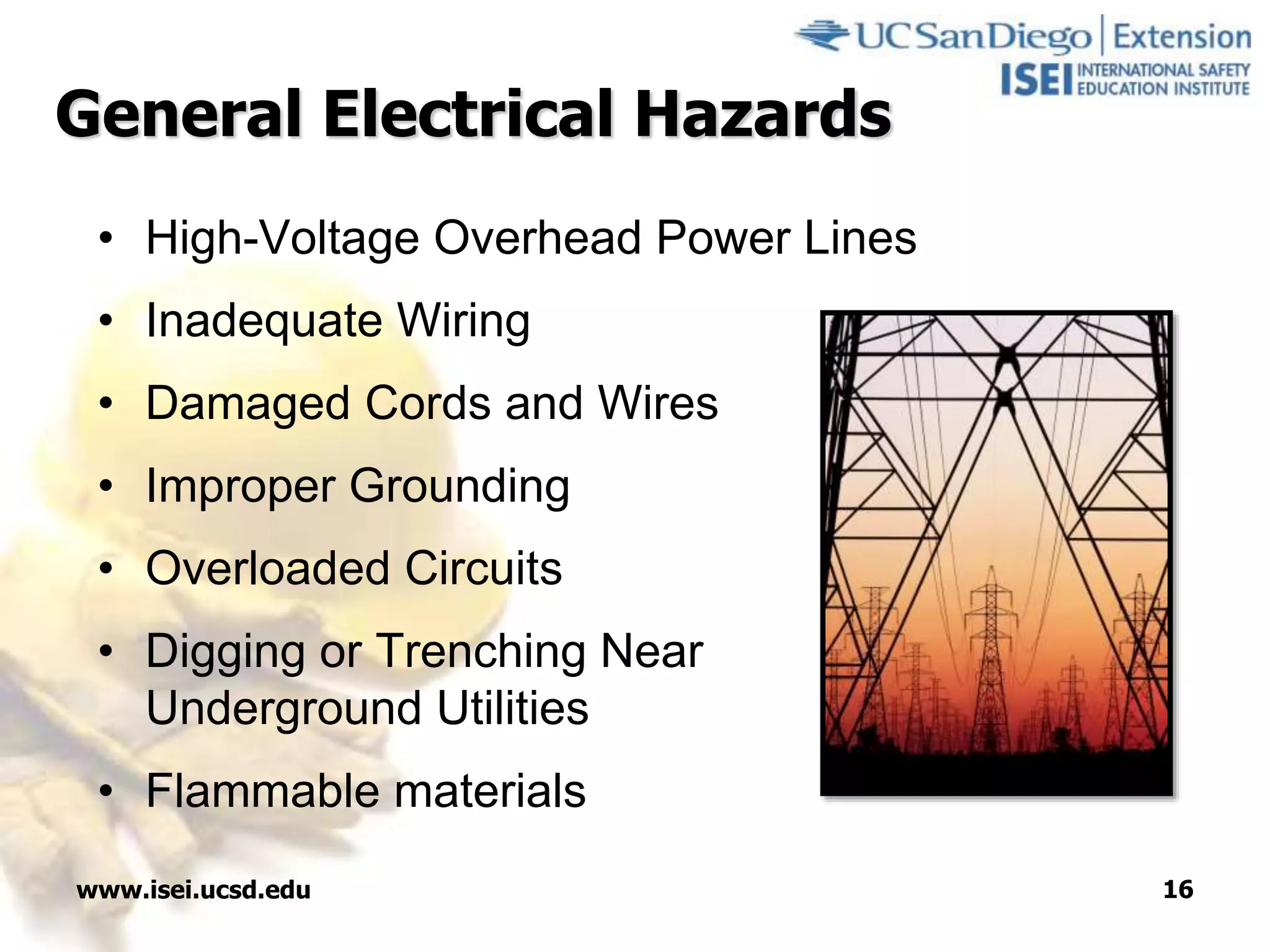
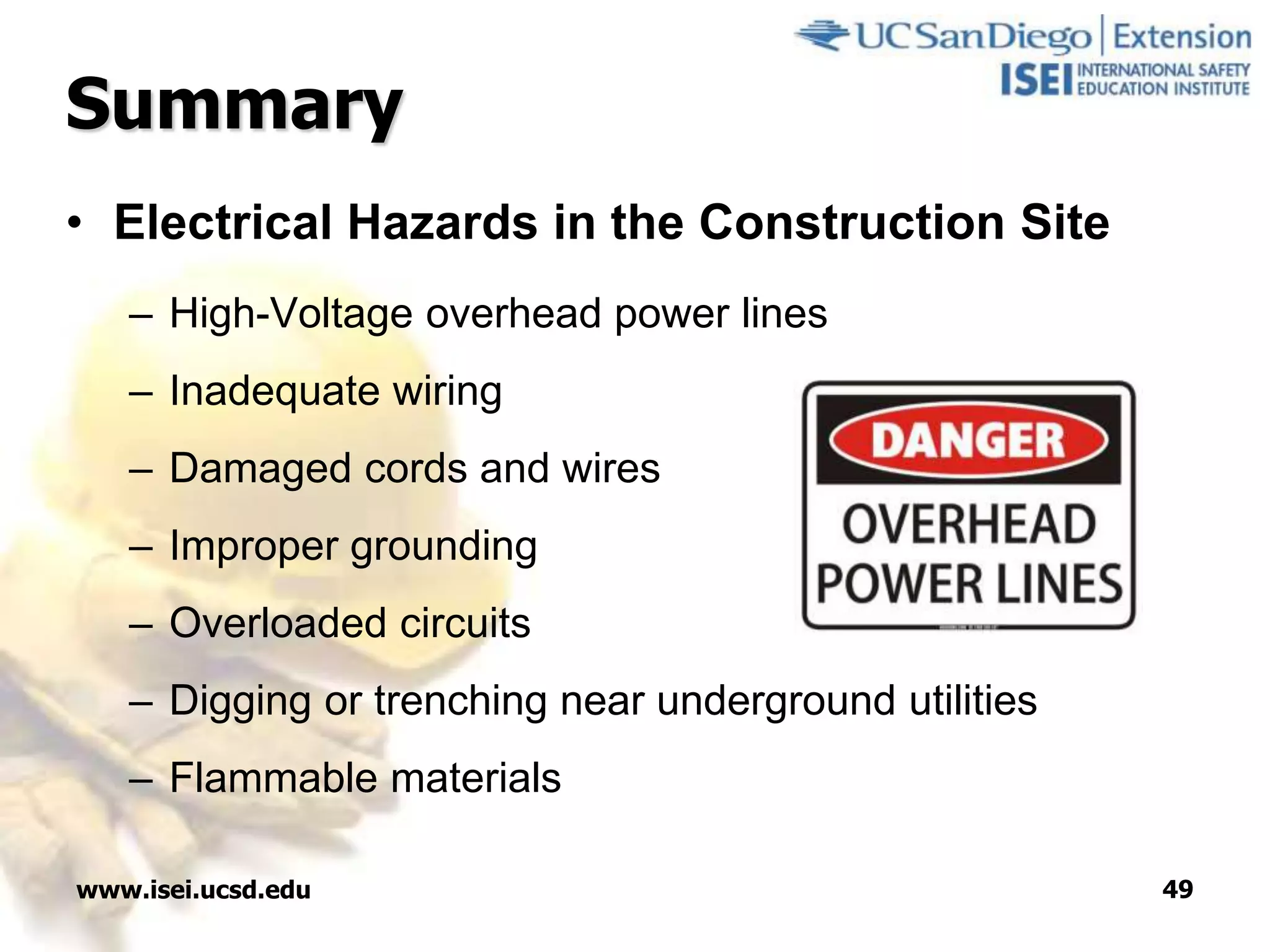
General Electrical Hazards
• High-Voltage Overhead Power Lines
• Inadequate Wiring
• Damaged Cords and Wires
• Improper Grounding
• Overloaded Circuits
• Digging or Trenching Near
Underground Utilities
• Flammable materials
www.isei.ucsd.edu 17
Controlling Electrical Hazards
Electrical systems are engineered to be safe!
• Injuries / accidents typically occur when:
– Procedures are inappropriate
– Procedures are not followed or ignored
– Safety systems are circumvented
– Unsafe work practices
– Unsafe equipment / installation
www.isei.ucsd.edu 18
Inadequate Wiring
• Hazard
– Wire too small
– Distance too far
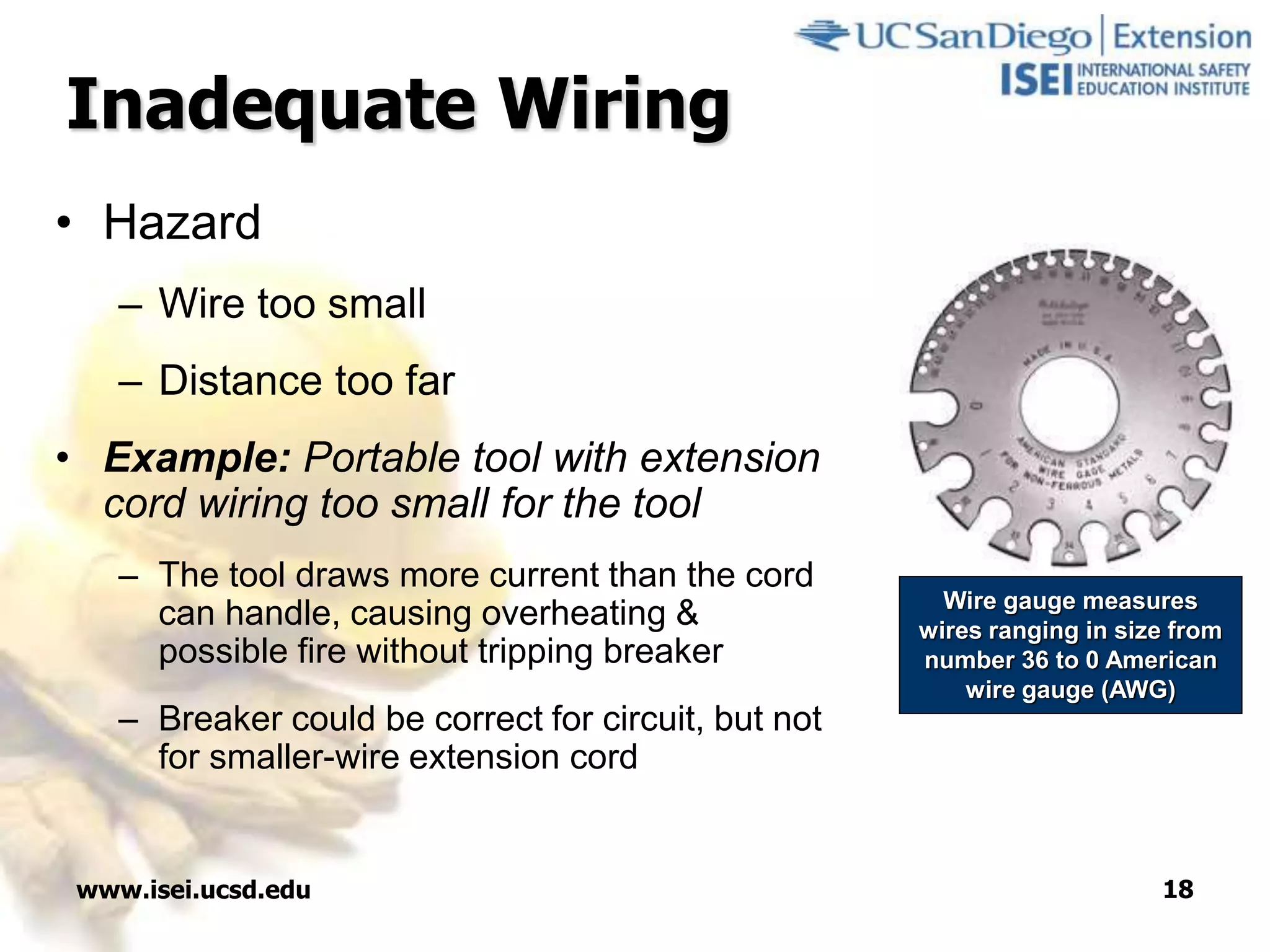
• Example: Portable tool with extension
cord wiring too small for the tool
– The tool draws more current than the cord
can handle, causing overheating &
possible fire without tripping breaker
– Breaker could be correct for circuit, but not
for smaller-wire extension cord
Wire gauge measures
wires ranging in size from
number 36 to 0 American
wire gauge (AWG)
www.isei.ucsd.edu 19
Use the Correct Wire
• Wire used depends on operation, building materials,
electrical load, and environmental factors
• Use fixed cords rather than flexible cords
• Use the correct extension cord (heavy duty)
www.isei.ucsd.edu 20
Defective Cords and Wires
• Worn / frayed cords must
be removed from service
www.isei.ucsd.edu 21
Damaged Cords
• Cords can be damaged by:
– Abrasion from adjacent materials
– Aging
– Door or window edges
– Staples or fastenings
– Sharp corners
– Hanging from nails
• Improper use can cause shocks,
burns or fire
www.isei.ucsd.edu 22
Cords and Wires
• Insulate live wires
• Inspect before use
• Use only 3-wire (grounded) type cords
• Use only cords marked for hard or extra-
hard usage
• Remove cords by pulling on the plugs
– not the cords
www.isei.ucsd.edu 23
Grounding
• Grounding creates
a low-resistance path
from a tool to the earth
to disperse unwanted current.
• When a short or lightning occurs,
energy flows to the ground,
protecting you from electrical
shock, injury and death.
www.isei.ucsd.edu 24
Improper Grounding
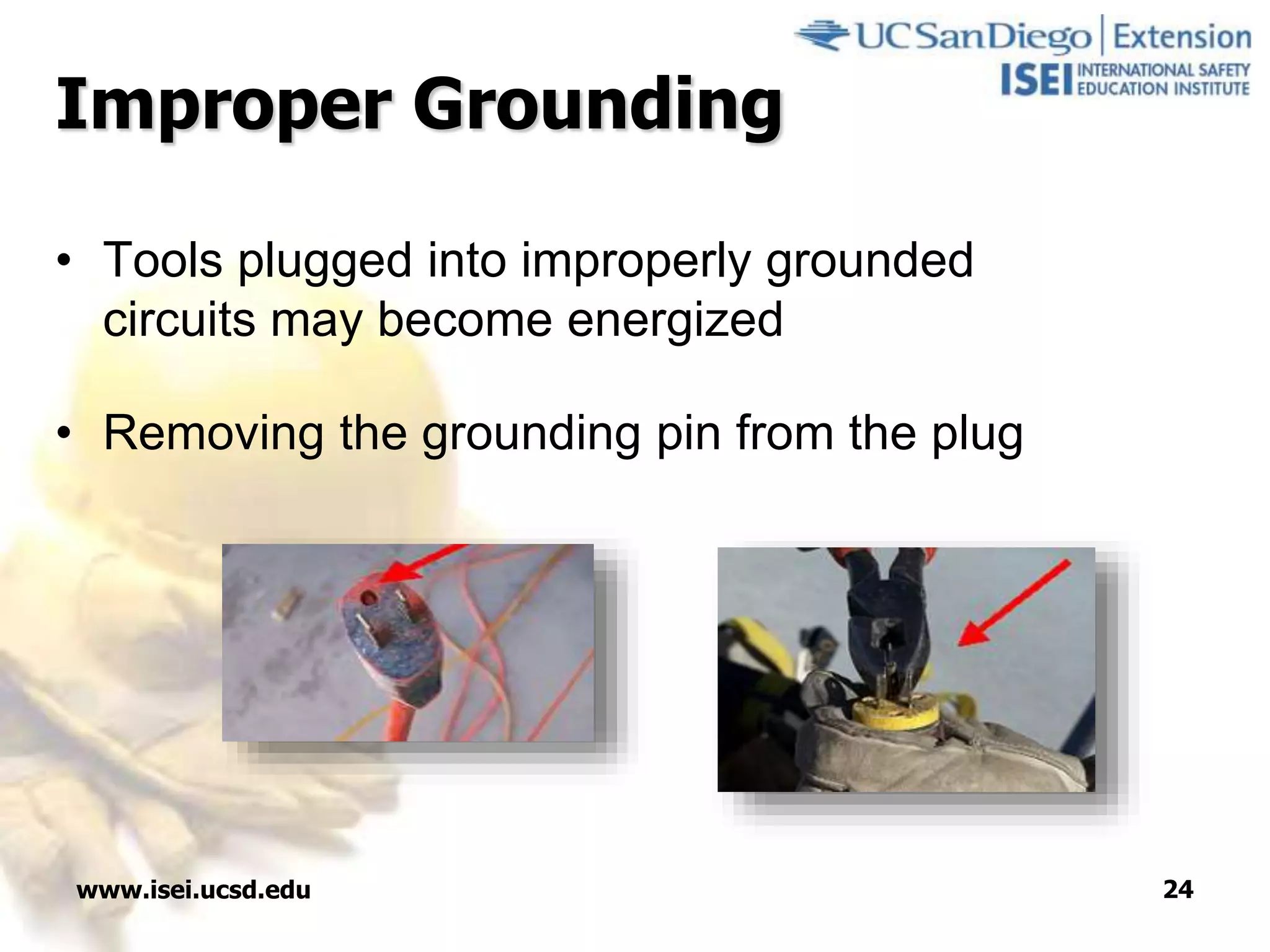
• Tools plugged into improperly grounded
circuits may become energized
• Removing the grounding pin from the plug
www.isei.ucsd.edu 25
Ground Tools & Equipment
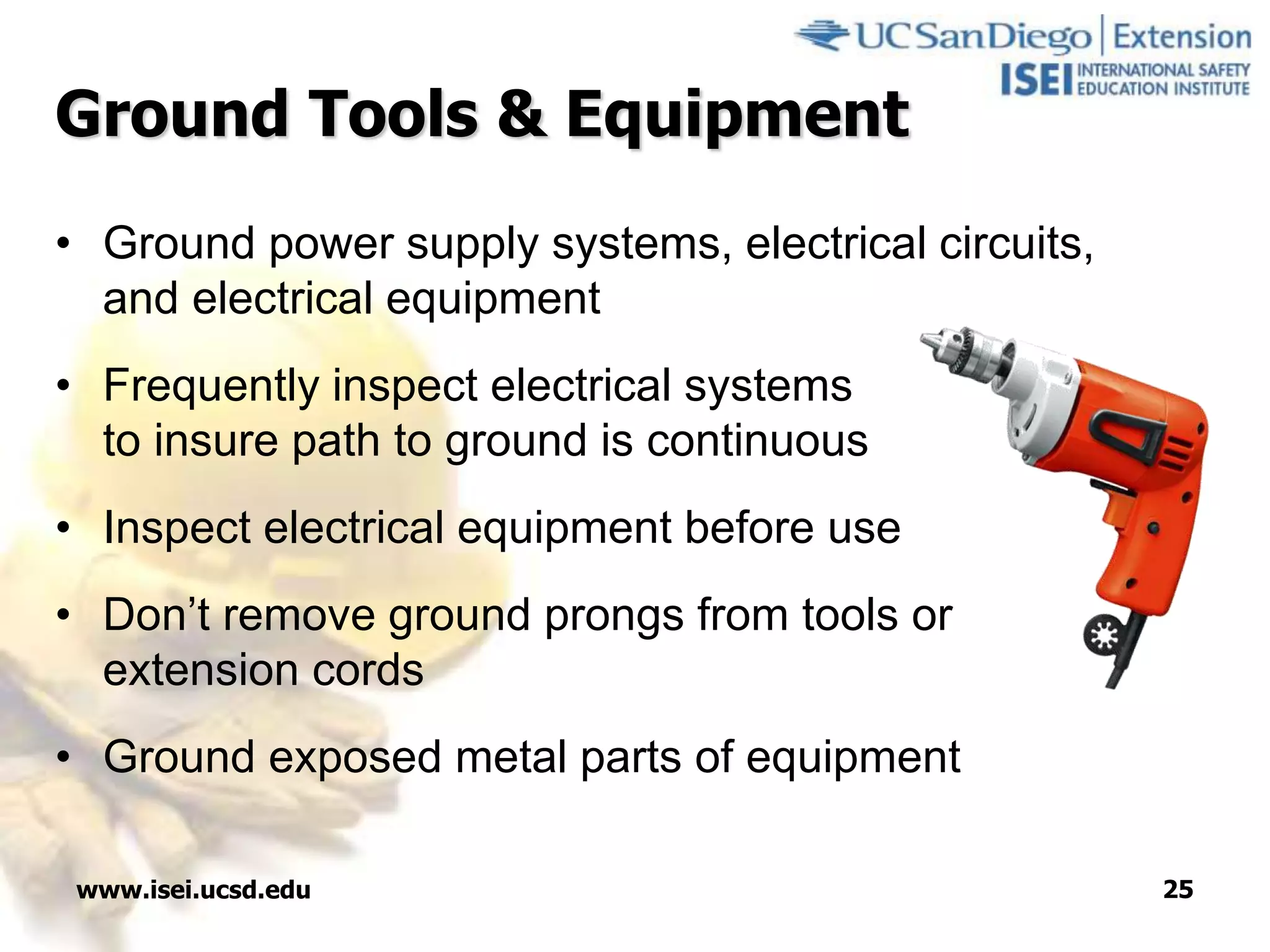
• Ground power supply systems, electrical circuits,
and electrical equipment
• Frequently inspect electrical systems
to insure path to ground is continuous
• Inspect electrical equipment before use
• Don’t remove ground prongs from tools or
extension cords
• Ground exposed metal parts of equipment
www.isei.ucsd.edu 26
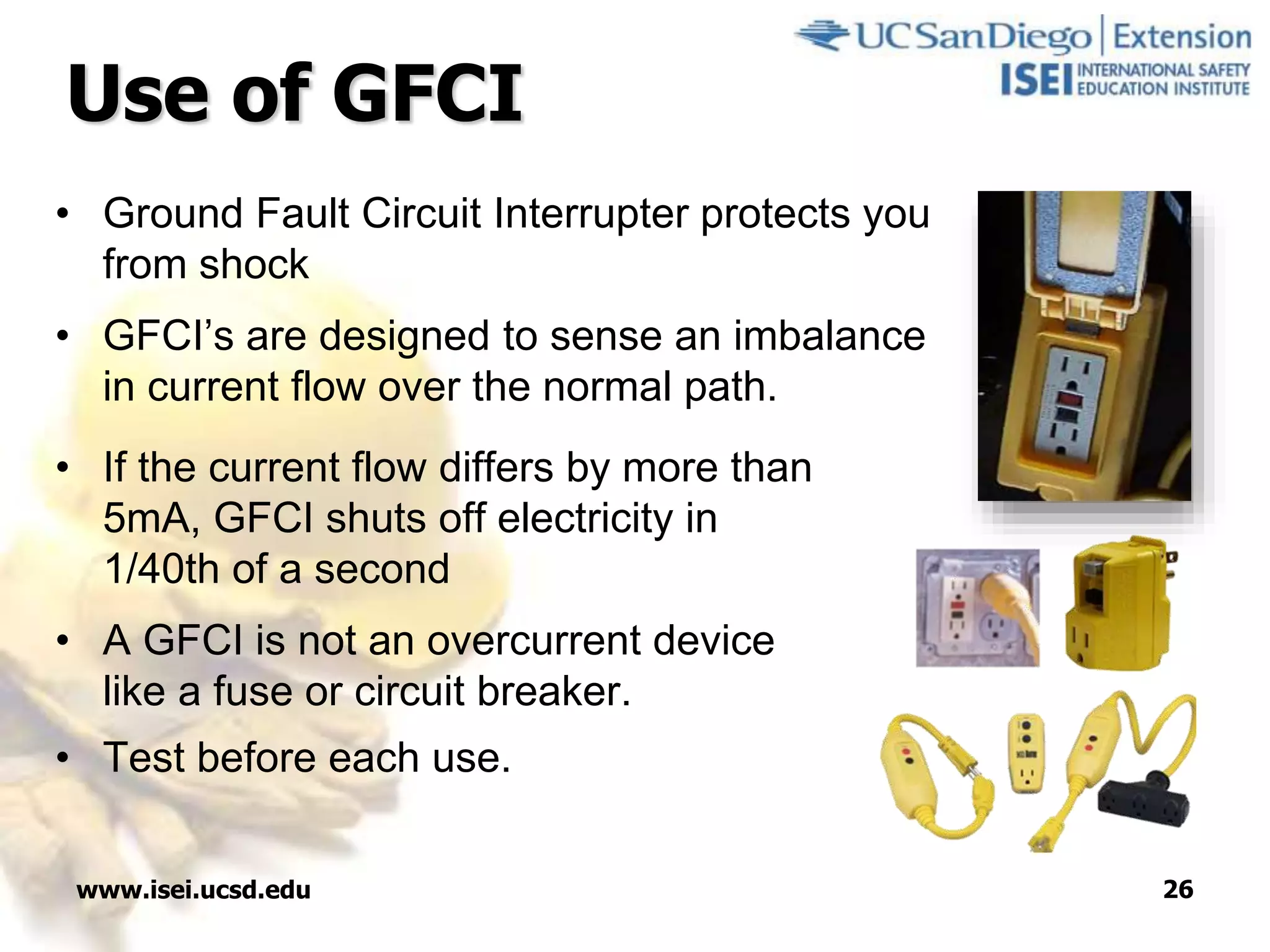
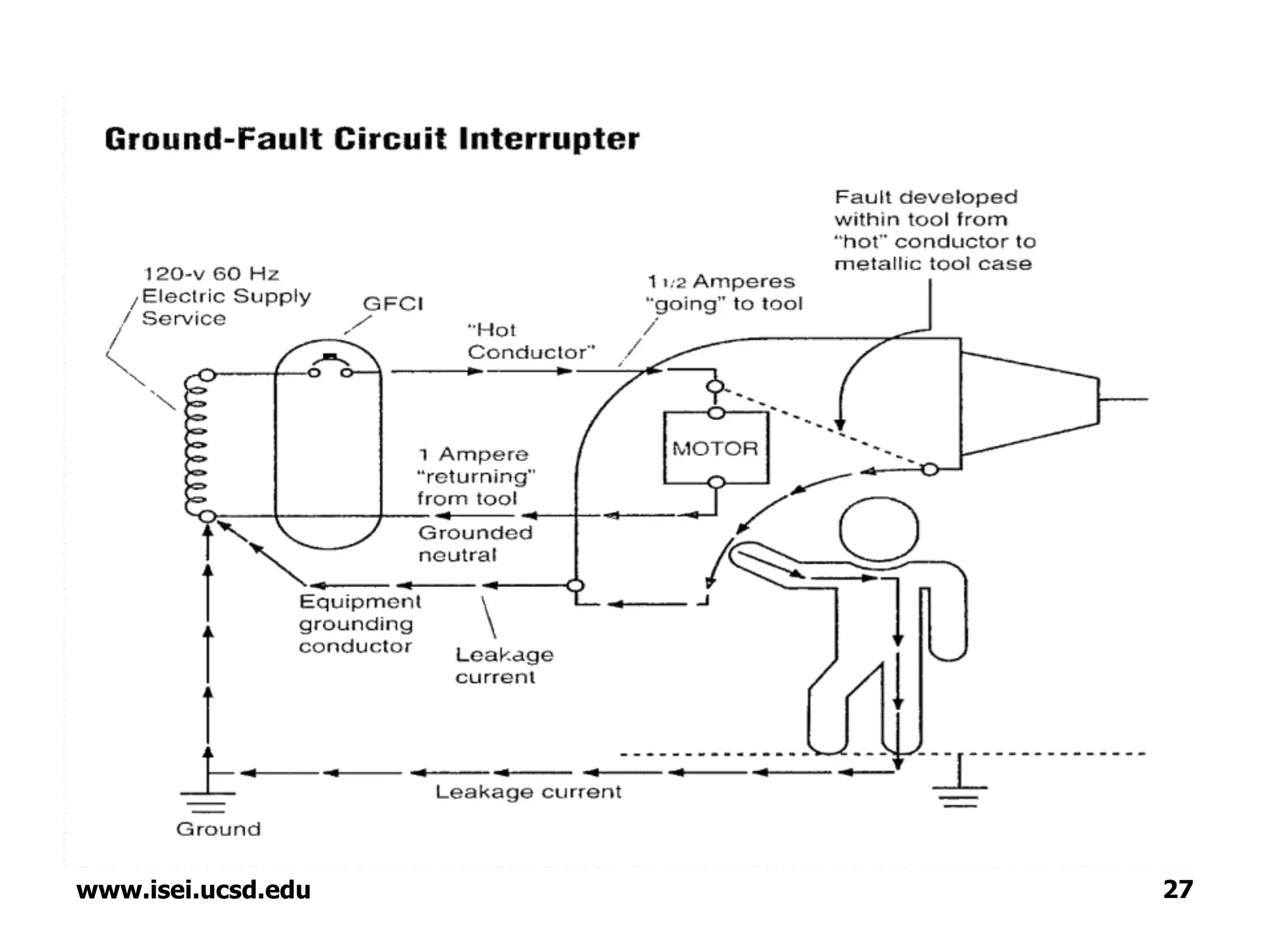
Use of GFCI
• Ground Fault Circuit Interrupter protects you
from shock
• GFCI’s are designed to sense an imbalance
in current flow over the normal path.
• If the current flow differs by more than
5mA, GFCI shuts off electricity in
1/40th of a second
• A GFCI is not an overcurrent device
like a fuse or circuit breaker.
• Test before each use.
www.isei.ucsd.edu 27
www.isei.ucsd.edu 28
Power Tool Requirements
Hand held power tools must:
• Have three-wire cord with ground
plugged into a grounded receptacle,
OR
• Be double insulated
OR
• Be powered by a low-voltage
isolation transformer
www.isei.ucsd.edu 29
Overloaded Circuits
• Too many devices plugged into a circuit, causing
heated wires & possibly a fire
• Damaged tools overheating
• Lack of over-current protection
• Wire insulation melting, which may
cause arcing & fire where the
overload exists, even inside a wall
www.isei.ucsd.edu 30
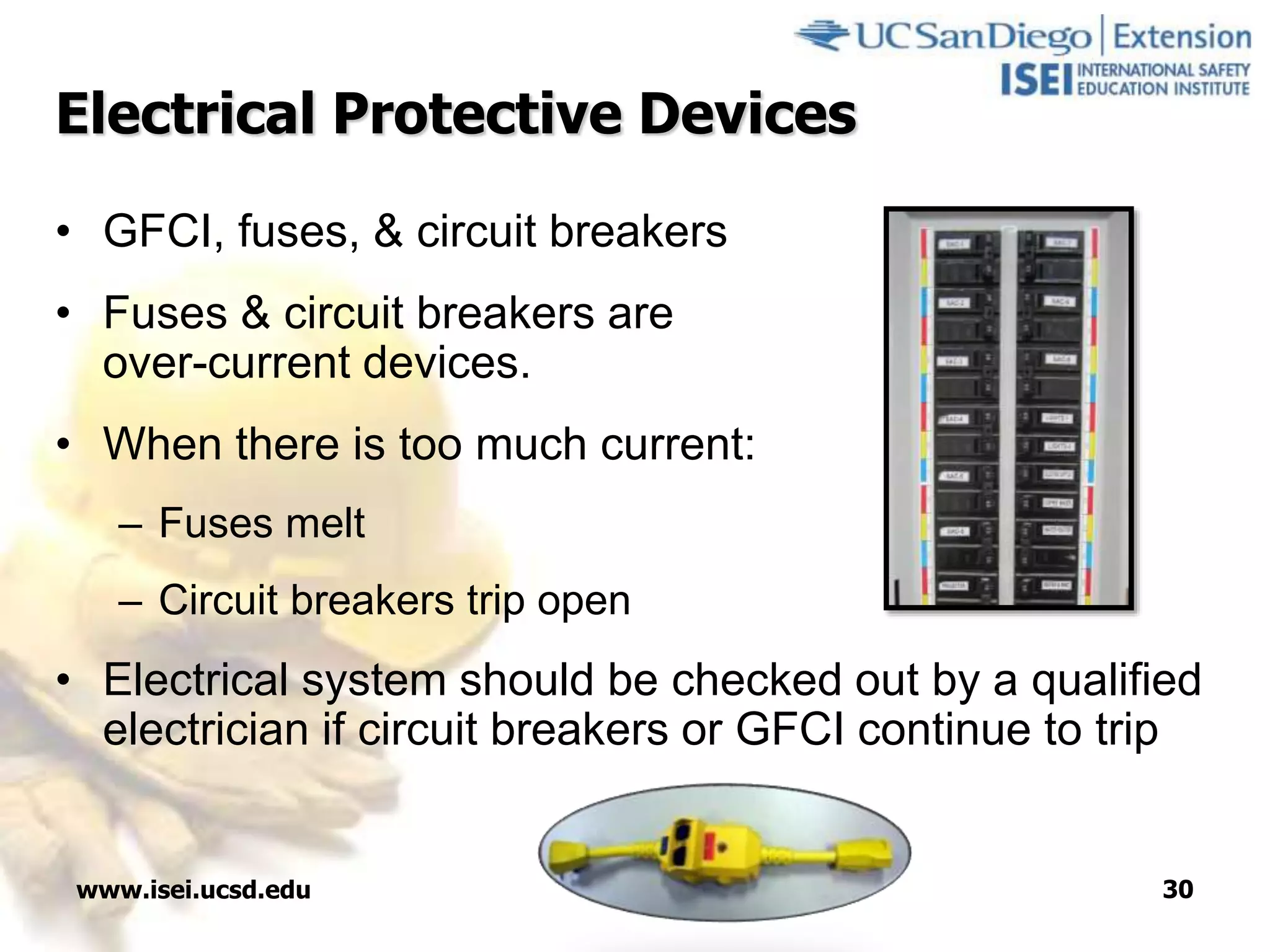
Electrical Protective Devices
• GFCI, fuses, & circuit breakers
• Fuses & circuit breakers are
over-current devices.
• When there is too much current:
– Fuses melt
– Circuit breakers trip open
• Electrical system should be checked out by a qualified
electrician if circuit breakers or GFCI continue to trip
www.isei.ucsd.edu 31
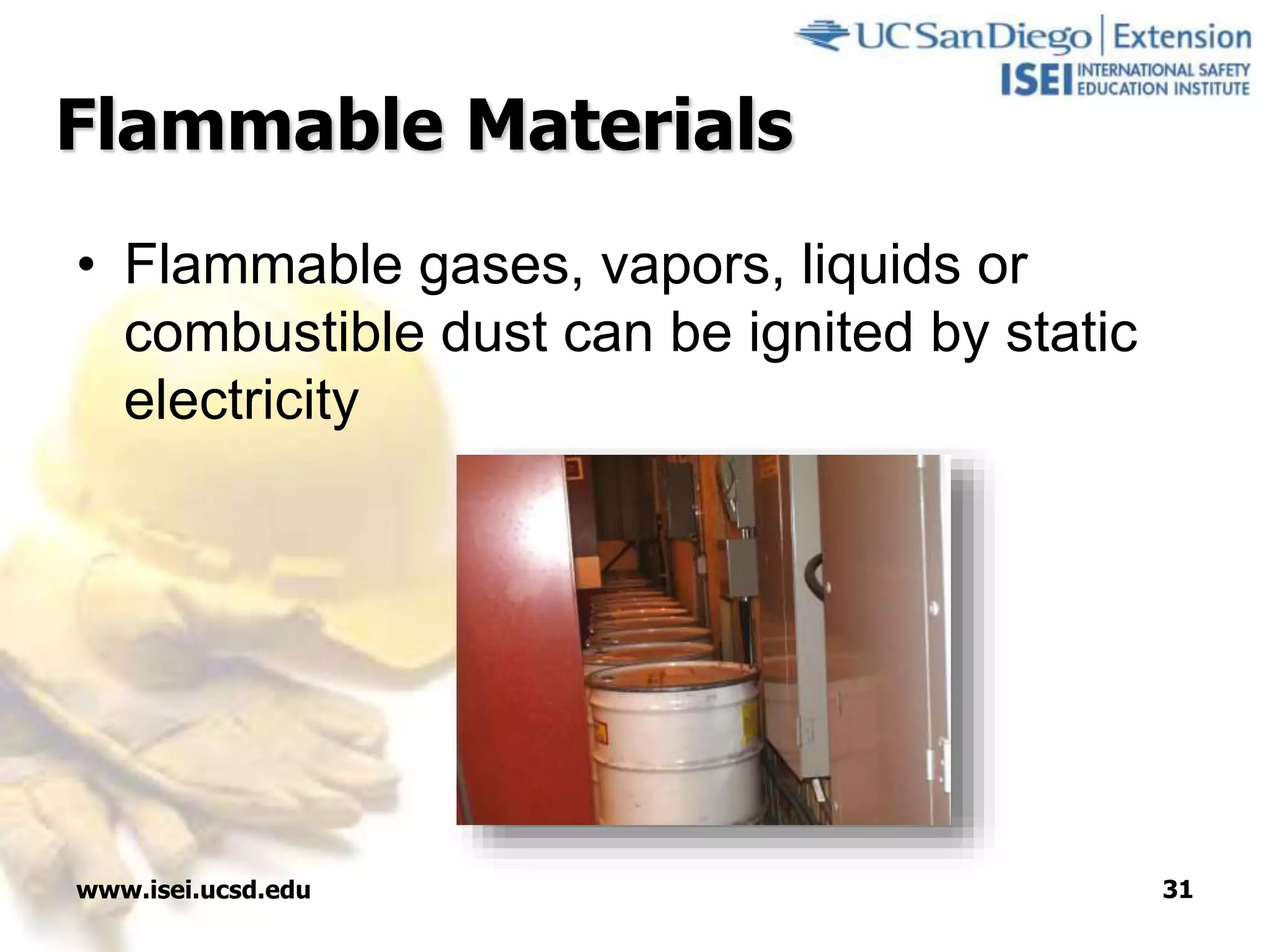
Flammable Materials
• Flammable gases, vapors, liquids or
combustible dust can be ignited by static
electricity
www.isei.ucsd.edu 32
Proper Storage
Require specially designed electrical equipment
• Use “hazard location” or intrinsically safe equipment
• Use spark arrestors
• If stored in metal container, provide
proper bonding and grounding to
discharge static electricity
Safe Work Practices
www.isei.ucsd.edu 34
Electrical Cabinets
• Free from recognized hazards
• Labeling or certification required
• Check mechanical strength
and durability
• Electric equipment firmly
secured to the surface on
which it is mounted
www.isei.ucsd.edu 35
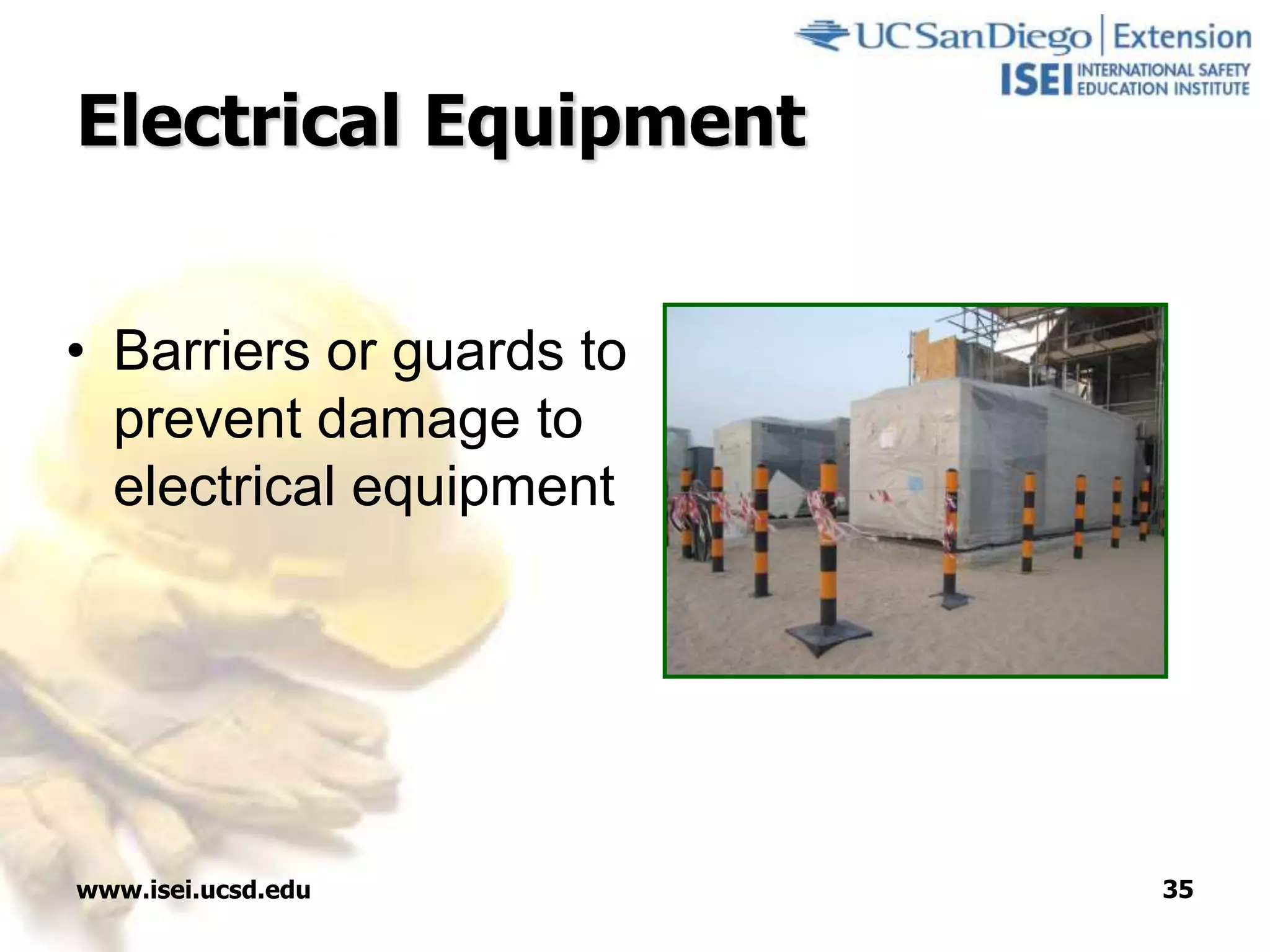
Electrical Equipment
• Barriers or guards to
prevent damage to
electrical equipment
www.isei.ucsd.edu 36
Panel Boards
• Electrical insulation
• Practical safeguarding
• Live parts by cabinets,
enclosures
www.isei.ucsd.edu 37
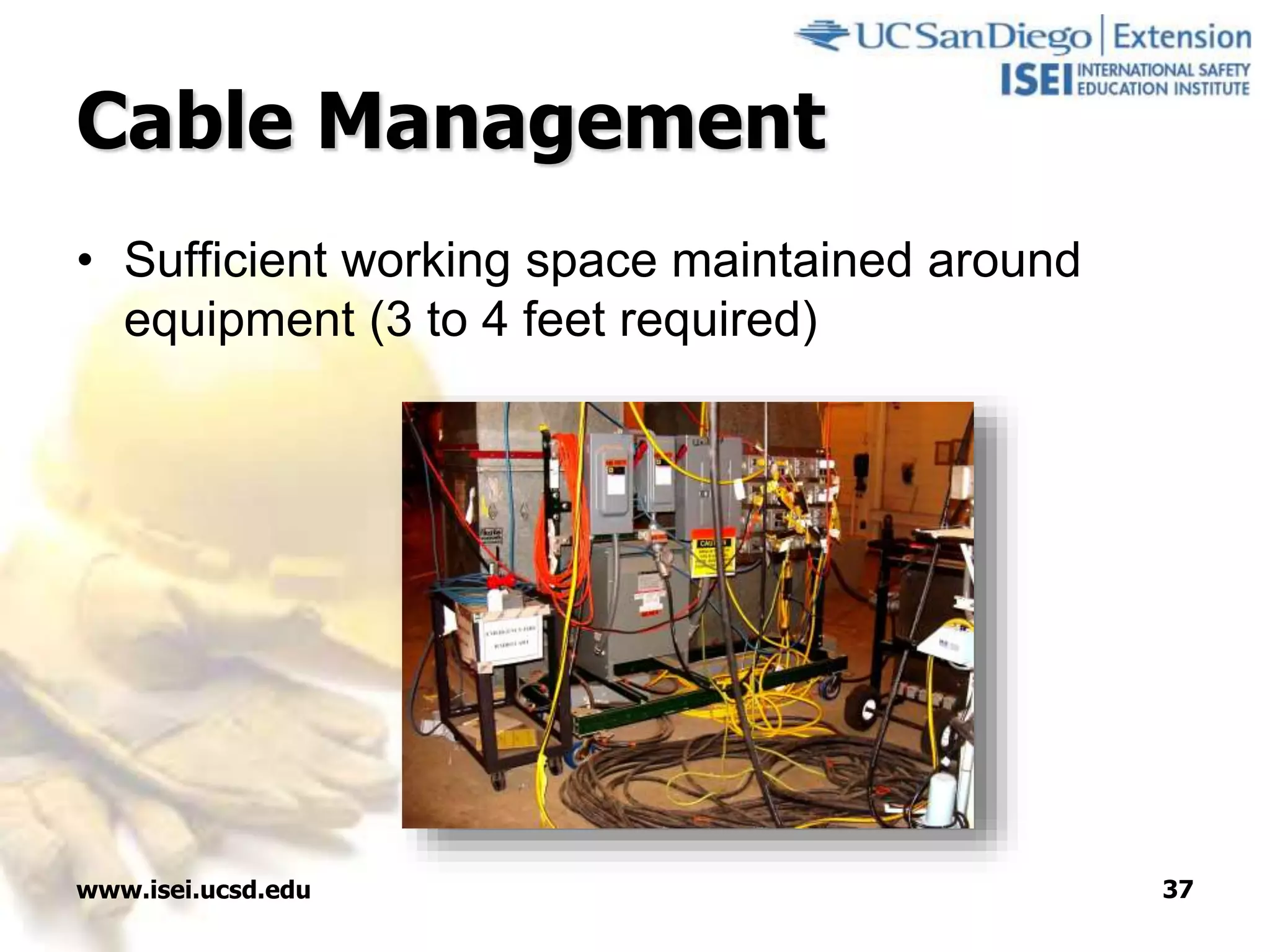
Cable Management
• Sufficient working space maintained around
equipment (3 to 4 feet required)
www.isei.ucsd.edu 38
Switches
• Disconnecting means identified
www.isei.ucsd.edu 39
Circuit Breakers
• Circuit breakers must clearly indicate open or
closed position
• Should identify what they control
www.isei.ucsd.edu 40
Isolation
Prevent unauthorized access with:
• warning signs
• secure location
• by location or elevation
– (7 feet / 2.1 meters)
www.isei.ucsd.edu 41
Extension Cords
• Must be used in continuous lengths with no splices
www.isei.ucsd.edu 42
Avoid Wet Conditions
• If you touch a live wire or other electrical component
while standing in water, you can get a shock
• Improperly grounded metal
switch plates & ceiling lights
are especially hazardous in
wet conditions
• Wet clothing, high humidity,
& perspiration increase your
chances of being electrocuted
www.isei.ucsd.edu 43
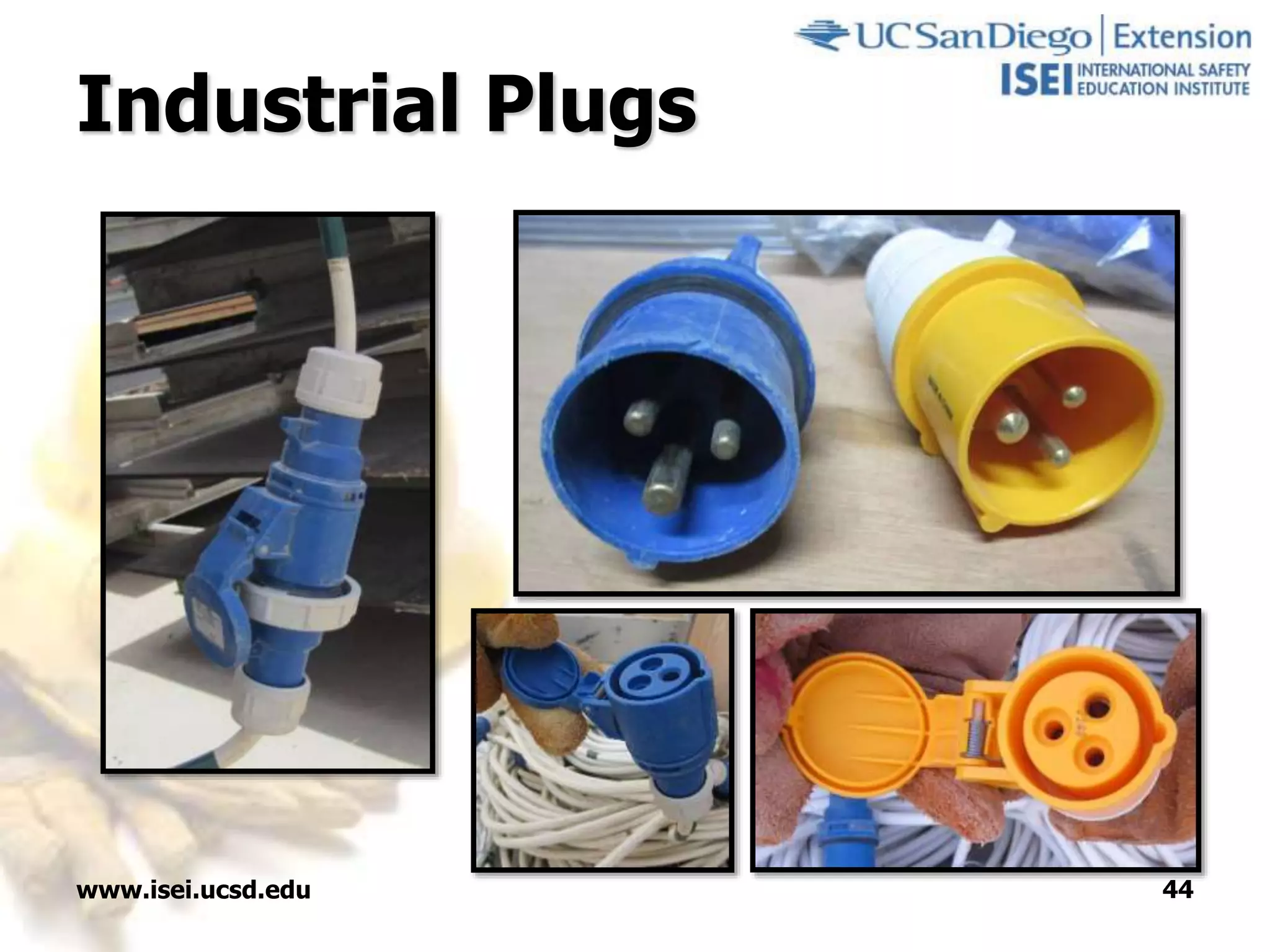
Industrial Plugs
• Provide a connection to the electrical mains rated at
higher voltages and currents than household plugs
and sockets.
• May have weatherproof covers, or may be interlocked
with a switch to prevent accidental disconnection of
an energized plug.
• Some types of connectors are approved for hazardous
areas where flammable gas may be present.
– such as coal mines or petrochemical plants
www.isei.ucsd.edu 44
Industrial Plugs
www.isei.ucsd.edu 45
Color Identification
www.isei.ucsd.edu 46
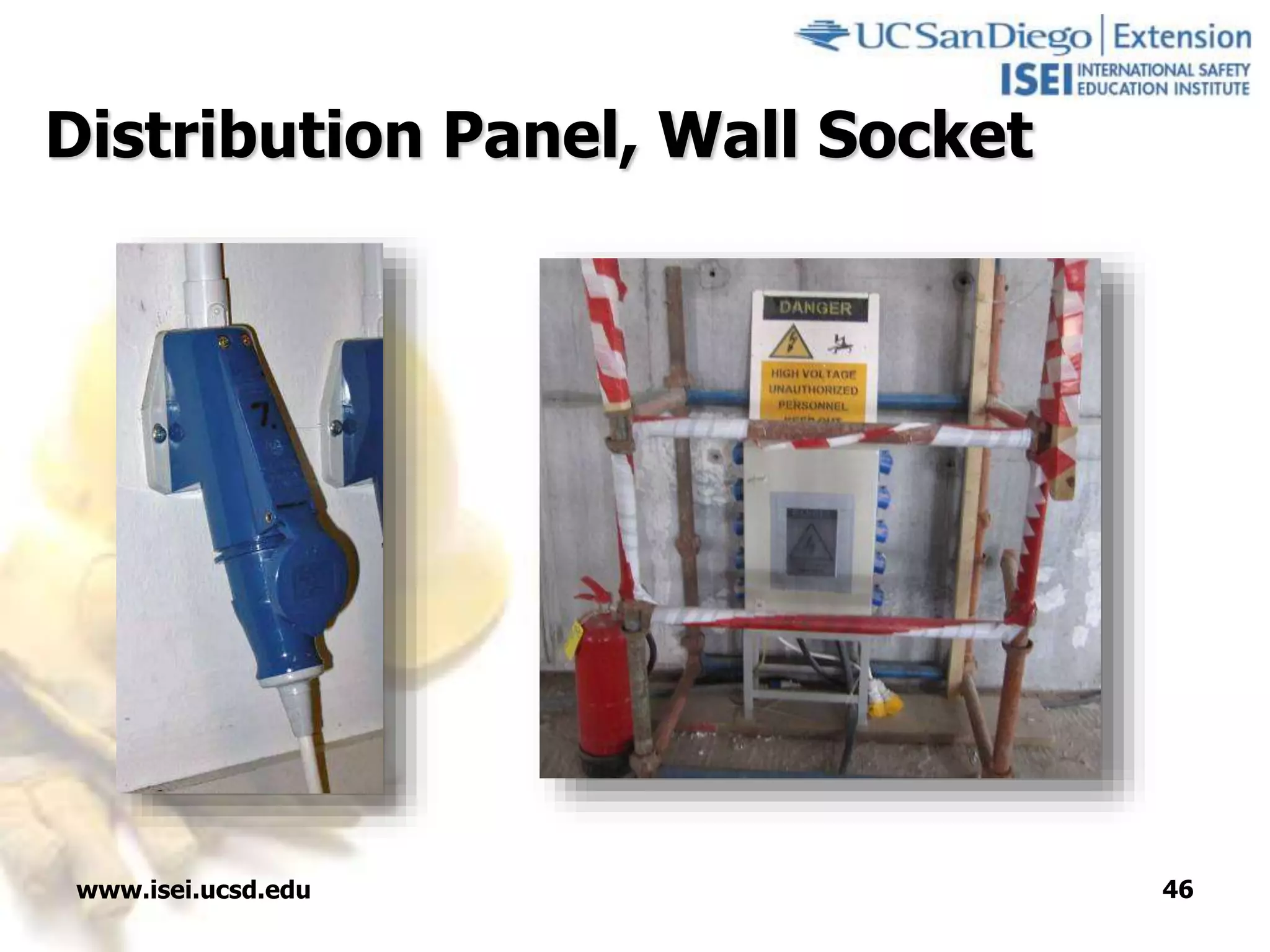
Distribution Panel, Wall Socket
www.isei.ucsd.edu 47
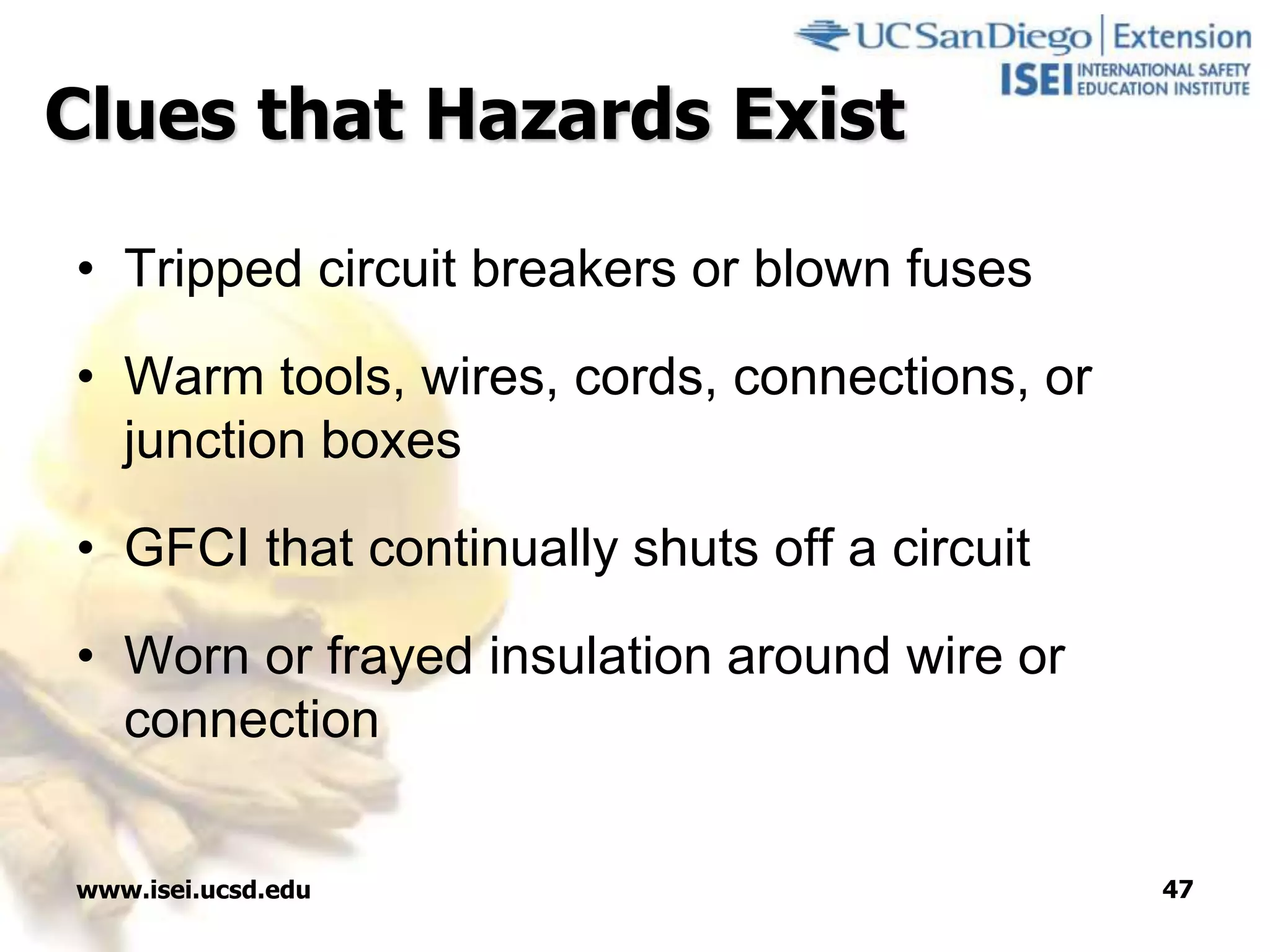
Clues that Hazards Exist
• Tripped circuit breakers or blown fuses
• Warm tools, wires, cords, connections, or
junction boxes
• GFCI that continually shuts off a circuit
• Worn or frayed insulation around wire or
connection
www.isei.ucsd.edu 48
Summary
• There are two main types of electrical injuries:
– Direct
• Electrocution or death due to electric shock
• Electrical Shock
• Burns
– Indirect
• Falls
www.isei.ucsd.edu 49
Summary
• Electrical Hazards in the Construction Site
– High-Voltage overhead power lines
– Inadequate wiring
– Damaged cords and wires
– Improper grounding
– Overloaded circuits
– Digging or trenching near underground utilities
– Flammable materials
www.isei.ucsd.edu 50
Summary
Methods of protection from electrical hazards
• Grounding
• Inspection
• Use of Signage
• Isolation
• Use of GFCI
• Use of overcurrent protective devices
Thank You

Electrical Hazards.pptx

  • 1.
  • 2.
    www.isei.ucsd.edu 2 Consensus Standards •References –OSHA 29 CFR 1926 Subpart K Electrical –NFPA 70E
  • 3.
    www.isei.ucsd.edu 3 Dangers ofElectricity • Electric shock or electrocution • Skin burns • Falls • Fire from electrical shorts or as an ignition source • Improper operation of power equipment About 5 workers are electrocuted every week in the United States Burn caused by electricity
  • 4.
    www.isei.ucsd.edu 4 Electricity –How it Works • Electricity is the flow of energy from one place to another • Requires a source of power: usually a generating station • A flow of electrons (current) travels through a conductor • Travels in a closed circuit Source Load Conductor Switch
  • 5.
    www.isei.ucsd.edu 5 Electrical Terms •Current – Flow of electric charge in a medium • measured in Amperes (A) • Voltage – Measure of “push” available to motivate electrons • measured in Volts (V) • Resistance – Measure of opposition to electric current • measured in Ohms (Ώ)
  • 6.
    www.isei.ucsd.edu 6 Electrical Terms •Conductors – Materials that allow electricity to flow • Insulators – Materials with high resistance to electricity • Grounding – A conductive connection to the earth which acts as a protective measure
  • 7.
    www.isei.ucsd.edu 7 Conductors /Insulators Conductors • silver • copper • gold • aluminum • iron • steel • brass • bronze • mercury • graphite • dirty water (salty water) Insulators • glass • rubber • oil • asphalt • fiberglass • porcelain • ceramic • (dry) paper • (dry) wood • plastic • air • pure water
  • 8.
    www.isei.ucsd.edu 8 Electrical Injuries Twomain types of electrical injuries: • Direct – Electrocution or death due to electric shock – Electrical Shock – Burns • Indirect – Falls
  • 9.
    www.isei.ucsd.edu 9 Rules ofElectricity • Electricity travels in a complete/closed circuit • Electricity always travels in the path of least resistance • Electricity always tries to travel to ground
  • 10.
    www.isei.ucsd.edu 10 Electricity andPeople • A person usually offers a lesser resistance for the electricity • The person forms a completed circuit when touching the ground
  • 11.
    www.isei.ucsd.edu 11 Discussion • Willa bird resting on a high voltage, high tension wire be electrocuted?
  • 12.
    www.isei.ucsd.edu 12 Shock Severity •You will get a shock if any part of the body completes the electrical circuit • Severity of the shock depends on: – Path of current through the body – Amount of current flowing through the body (amps) – Duration of the shocking current through the body • LOW VOLTAGE DOES NOT MEAN LOW HAZARD!!
  • 13.
    www.isei.ucsd.edu 13 Electrical Harm 1mABarely perceptible 16mA Maximum current an average man can grasp and “let go” 20-30mA Paralysis if respiratory muscles 100mA Ventricular fibrillation threshold 2Amps Cardiac standstill and internal organ damage *mA = milliampere = 1/1,000 of an ampere *mA = milliampere = 1/1,000 of an ampere
  • 14.
    www.isei.ucsd.edu 14 Burns • Mostcommon shock-related injury • Occurs when you touch electrical wiring or equipment improperly used or maintained • Typically occurs on hands • Very serious injury that needs immediate attention
  • 15.
    www.isei.ucsd.edu 15 Falls • Electricshock can also cause indirect injuries like falls • Workers in elevated locations who experience a shock may fall due to involuntary movement of the muscles, resulting in serious injury or death
  • 16.
    www.isei.ucsd.edu 16 General ElectricalHazards • High-Voltage Overhead Power Lines • Inadequate Wiring • Damaged Cords and Wires • Improper Grounding • Overloaded Circuits • Digging or Trenching Near Underground Utilities • Flammable materials
  • 17.
    www.isei.ucsd.edu 17 Controlling ElectricalHazards Electrical systems are engineered to be safe! • Injuries / accidents typically occur when: – Procedures are inappropriate – Procedures are not followed or ignored – Safety systems are circumvented – Unsafe work practices – Unsafe equipment / installation
  • 18.
    www.isei.ucsd.edu 18 Inadequate Wiring •Hazard – Wire too small – Distance too far • Example: Portable tool with extension cord wiring too small for the tool – The tool draws more current than the cord can handle, causing overheating & possible fire without tripping breaker – Breaker could be correct for circuit, but not for smaller-wire extension cord Wire gauge measures wires ranging in size from number 36 to 0 American wire gauge (AWG)
  • 19.
    www.isei.ucsd.edu 19 Use theCorrect Wire • Wire used depends on operation, building materials, electrical load, and environmental factors • Use fixed cords rather than flexible cords • Use the correct extension cord (heavy duty)
  • 20.
    www.isei.ucsd.edu 20 Defective Cordsand Wires • Worn / frayed cords must be removed from service
  • 21.
    www.isei.ucsd.edu 21 Damaged Cords •Cords can be damaged by: – Abrasion from adjacent materials – Aging – Door or window edges – Staples or fastenings – Sharp corners – Hanging from nails • Improper use can cause shocks, burns or fire
  • 22.
    www.isei.ucsd.edu 22 Cords andWires • Insulate live wires • Inspect before use • Use only 3-wire (grounded) type cords • Use only cords marked for hard or extra- hard usage • Remove cords by pulling on the plugs – not the cords
  • 23.
    www.isei.ucsd.edu 23 Grounding • Groundingcreates a low-resistance path from a tool to the earth to disperse unwanted current. • When a short or lightning occurs, energy flows to the ground, protecting you from electrical shock, injury and death.
  • 24.
    www.isei.ucsd.edu 24 Improper Grounding •Tools plugged into improperly grounded circuits may become energized • Removing the grounding pin from the plug
  • 25.
    www.isei.ucsd.edu 25 Ground Tools& Equipment • Ground power supply systems, electrical circuits, and electrical equipment • Frequently inspect electrical systems to insure path to ground is continuous • Inspect electrical equipment before use • Don’t remove ground prongs from tools or extension cords • Ground exposed metal parts of equipment
  • 26.
    www.isei.ucsd.edu 26 Use ofGFCI • Ground Fault Circuit Interrupter protects you from shock • GFCI’s are designed to sense an imbalance in current flow over the normal path. • If the current flow differs by more than 5mA, GFCI shuts off electricity in 1/40th of a second • A GFCI is not an overcurrent device like a fuse or circuit breaker. • Test before each use.
  • 27.
  • 28.
    www.isei.ucsd.edu 28 Power ToolRequirements Hand held power tools must: • Have three-wire cord with ground plugged into a grounded receptacle, OR • Be double insulated OR • Be powered by a low-voltage isolation transformer
  • 29.
    www.isei.ucsd.edu 29 Overloaded Circuits •Too many devices plugged into a circuit, causing heated wires & possibly a fire • Damaged tools overheating • Lack of over-current protection • Wire insulation melting, which may cause arcing & fire where the overload exists, even inside a wall
  • 30.
    www.isei.ucsd.edu 30 Electrical ProtectiveDevices • GFCI, fuses, & circuit breakers • Fuses & circuit breakers are over-current devices. • When there is too much current: – Fuses melt – Circuit breakers trip open • Electrical system should be checked out by a qualified electrician if circuit breakers or GFCI continue to trip
  • 31.
    www.isei.ucsd.edu 31 Flammable Materials •Flammable gases, vapors, liquids or combustible dust can be ignited by static electricity
  • 32.
    www.isei.ucsd.edu 32 Proper Storage Requirespecially designed electrical equipment • Use “hazard location” or intrinsically safe equipment • Use spark arrestors • If stored in metal container, provide proper bonding and grounding to discharge static electricity
  • 33.
  • 34.
    www.isei.ucsd.edu 34 Electrical Cabinets •Free from recognized hazards • Labeling or certification required • Check mechanical strength and durability • Electric equipment firmly secured to the surface on which it is mounted
  • 35.
    www.isei.ucsd.edu 35 Electrical Equipment •Barriers or guards to prevent damage to electrical equipment
  • 36.
    www.isei.ucsd.edu 36 Panel Boards •Electrical insulation • Practical safeguarding • Live parts by cabinets, enclosures
  • 37.
    www.isei.ucsd.edu 37 Cable Management •Sufficient working space maintained around equipment (3 to 4 feet required)
  • 38.
  • 39.
    www.isei.ucsd.edu 39 Circuit Breakers •Circuit breakers must clearly indicate open or closed position • Should identify what they control
  • 40.
    www.isei.ucsd.edu 40 Isolation Prevent unauthorizedaccess with: • warning signs • secure location • by location or elevation – (7 feet / 2.1 meters)
  • 41.
    www.isei.ucsd.edu 41 Extension Cords •Must be used in continuous lengths with no splices
  • 42.
    www.isei.ucsd.edu 42 Avoid WetConditions • If you touch a live wire or other electrical component while standing in water, you can get a shock • Improperly grounded metal switch plates & ceiling lights are especially hazardous in wet conditions • Wet clothing, high humidity, & perspiration increase your chances of being electrocuted
  • 43.
    www.isei.ucsd.edu 43 Industrial Plugs •Provide a connection to the electrical mains rated at higher voltages and currents than household plugs and sockets. • May have weatherproof covers, or may be interlocked with a switch to prevent accidental disconnection of an energized plug. • Some types of connectors are approved for hazardous areas where flammable gas may be present. – such as coal mines or petrochemical plants
  • 44.
  • 45.
  • 46.
  • 47.
    www.isei.ucsd.edu 47 Clues thatHazards Exist • Tripped circuit breakers or blown fuses • Warm tools, wires, cords, connections, or junction boxes • GFCI that continually shuts off a circuit • Worn or frayed insulation around wire or connection
  • 48.
    www.isei.ucsd.edu 48 Summary • Thereare two main types of electrical injuries: – Direct • Electrocution or death due to electric shock • Electrical Shock • Burns – Indirect • Falls
  • 49.
    www.isei.ucsd.edu 49 Summary • ElectricalHazards in the Construction Site – High-Voltage overhead power lines – Inadequate wiring – Damaged cords and wires – Improper grounding – Overloaded circuits – Digging or trenching near underground utilities – Flammable materials
  • 50.
    www.isei.ucsd.edu 50 Summary Methods ofprotection from electrical hazards • Grounding • Inspection • Use of Signage • Isolation • Use of GFCI • Use of overcurrent protective devices
  • 51.

Editor's Notes