Electrical
Safety
Objectives
• Be familiar with the fundamental
concepts of electricity.
• Be familiar with the effects of electricity
on the human body.
• Be able to recognize common electrical
hazards.
Electrical
Safety
Objectives
• Be familiar with electrical protective
devices.
Electrical
Safety
• To flow electricity must have a
complete path.
• Electricity flows through conductors
– water, metal, the human body
• Insulators are non-conductors
• The human body is a conductor.
Fundamentals of Electrical
Hazards
Electrical
Safety
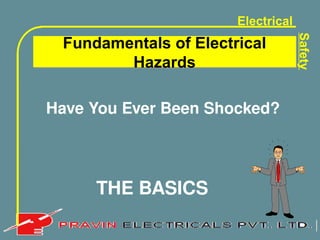
Have You Ever Been Shocked?
THE BASICS
Fundamentals of Electrical
Hazards
Electrical
Safety
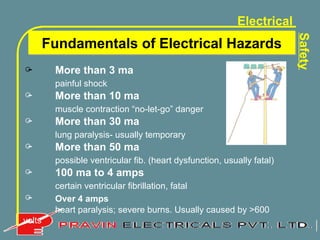
 More than 3 ma
painful shock
 More than 10 ma
muscle contraction “no-let-go” danger
 More than 30 ma
lung paralysis- usually temporary
 More than 50 ma
possible ventricular fib. (heart dysfunction, usually fatal)
 100 ma to 4 amps
certain ventricular fibrillation, fatal
 Over 4 amps
heart paralysis; severe burns. Usually caused by >600
volts
Fundamentals of Electrical Hazards
Electrical
Safety
• Hazards of Electricity
– Electrocution/Shock/Burns/Death
Fundamentals of Electrical Hazards
• Minimum distance from overhead lines 10
ft.
• Inspect all electrical tools and equipment
Frayed, cut, broken wires
grounding prong missing
Improper use of cube taps
improperly applied or missing strain relief
Electrical
Safety
Electrical Protection
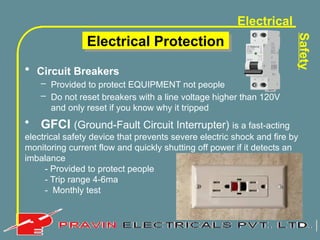
• Circuit Breakers
– Provided to protect EQUIPMENT not people
– Do not reset breakers with a line voltage higher than 120V
and only reset if you know why it tripped
• GFCI (Ground-Fault Circuit Interrupter) is a fast-acting
electrical safety device that prevents severe electric shock and fire by
monitoring current flow and quickly shutting off power if it detects an
imbalance
- Provided to protect people
- Trip range 4-6ma
- Monthly test
Electrical
Safety
Electrical Protection
• Distance
– If you sense the presence of an
electrical hazard or exposed conductors
that may be energized, keep your
distance and STAY AWAY
Electrical
Safety
Fundamentals of Electrical
Hazards
• Voltage
– electrical pressure (water pressure)
• Amperage
– electrical flow rate (gallons/min)
• Impedance
– restriction to electrical flow (pipe friction)
Electrical
Safety
• Circuit
– path of flow of electricity
• Circuit Element
– objects which are part of a circuit and
through which current flows.
• Fault
– current flow through an unintended path.
Fundamentals of
Electrical Hazards
Electrical
Safety
• What is Grounding?
– Protection from electric shock
• normally a secondary protection measure
• A ground is a conductive connection
– between electrical circuit or equipment and
earth or ground plane
– creates a low resistance to the earth.
Fundamentals of Electrical
Hazards
Electrical
Safety
Basic Rules of Electrical Action
• Electricity isn’t live until current flows
• Electrical current won’t flow until there is
a complete loop, out from and back to
the power source.
Electrical
Safety
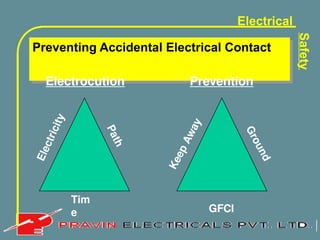
Preventing Accidental Electrical Contact
P
a
t
h
E
l
e
c
t
r
i
c
i
t
y
Tim
e
Electrocution Prevention
K
e
e
p
A
w
a
y
GFCI
G
r
o
u
n
d
Electrical
Safety
Do’s and Don'ts
• Do plug power equipment into wall DB with
power switches in the Off position.
• Do unplug electrical equipment by grasping
the plug and pulling. Do not pull or jerk the
cord to unplug the equipment.
• Do not drape power cords over hot pipes,
radiators or sharp objects.
Electrical
Safety
Do’s and Don'ts
• Do check the DB for missing or
damaged parts.
• Do not plug equipment into defective
DB.
• Do check for frayed, cracked, or
exposed wiring on equipment cords.
Electrical
Safety
• Do check for defective cords clamps at
locations where the power cord enters
the equipment or the attachment plug.
• Extension cords should not be used in
office areas. Generally, extension cords
should be limited to use by maintenance
personnel
Do’s and Don'ts
Electrical
Safety
Do’s and Don'ts
• “Cheater plugs”, extension cords with
junction box receptacle ends or other
jury-rigged equipment should not be
used.
Electrical
Safety
• Employees should know the location of
electrical circuit breaker panels that
control equipment and lighting in their
respective areas. Circuits and
equipment disconnects must be
identified
Do’s and Don'ts
Electrical
Safety
Do’s and Don'ts
• Temporary or permanent storage of any
materials must not be allowed within 3
feet of any electrical panel or electrical
equipment.
• Any electrical equipment causing
shocks or with high leakage potential
must be tagged with a Danger tag or
equivalent.
Electrical
Safety

Basic construction electrical safety training PPT

  • 1.
    Electrical Safety Objectives • Be familiarwith the fundamental concepts of electricity. • Be familiar with the effects of electricity on the human body. • Be able to recognize common electrical hazards.
  • 2.
    Electrical Safety Objectives • Be familiarwith electrical protective devices.
  • 3.
    Electrical Safety • To flowelectricity must have a complete path. • Electricity flows through conductors – water, metal, the human body • Insulators are non-conductors • The human body is a conductor. Fundamentals of Electrical Hazards
  • 4.
    Electrical Safety Have You EverBeen Shocked? THE BASICS Fundamentals of Electrical Hazards
  • 5.
    Electrical Safety  More than3 ma painful shock  More than 10 ma muscle contraction “no-let-go” danger  More than 30 ma lung paralysis- usually temporary  More than 50 ma possible ventricular fib. (heart dysfunction, usually fatal)  100 ma to 4 amps certain ventricular fibrillation, fatal  Over 4 amps heart paralysis; severe burns. Usually caused by >600 volts Fundamentals of Electrical Hazards
  • 6.
    Electrical Safety • Hazards ofElectricity – Electrocution/Shock/Burns/Death Fundamentals of Electrical Hazards • Minimum distance from overhead lines 10 ft. • Inspect all electrical tools and equipment Frayed, cut, broken wires grounding prong missing Improper use of cube taps improperly applied or missing strain relief
  • 7.
    Electrical Safety Electrical Protection • CircuitBreakers – Provided to protect EQUIPMENT not people – Do not reset breakers with a line voltage higher than 120V and only reset if you know why it tripped • GFCI (Ground-Fault Circuit Interrupter) is a fast-acting electrical safety device that prevents severe electric shock and fire by monitoring current flow and quickly shutting off power if it detects an imbalance - Provided to protect people - Trip range 4-6ma - Monthly test
  • 8.
    Electrical Safety Electrical Protection • Distance –If you sense the presence of an electrical hazard or exposed conductors that may be energized, keep your distance and STAY AWAY
  • 9.
    Electrical Safety Fundamentals of Electrical Hazards •Voltage – electrical pressure (water pressure) • Amperage – electrical flow rate (gallons/min) • Impedance – restriction to electrical flow (pipe friction)
  • 10.
    Electrical Safety • Circuit – pathof flow of electricity • Circuit Element – objects which are part of a circuit and through which current flows. • Fault – current flow through an unintended path. Fundamentals of Electrical Hazards
  • 11.
    Electrical Safety • What isGrounding? – Protection from electric shock • normally a secondary protection measure • A ground is a conductive connection – between electrical circuit or equipment and earth or ground plane – creates a low resistance to the earth. Fundamentals of Electrical Hazards
  • 12.
    Electrical Safety Basic Rules ofElectrical Action • Electricity isn’t live until current flows • Electrical current won’t flow until there is a complete loop, out from and back to the power source.
  • 13.
    Electrical Safety Preventing Accidental ElectricalContact P a t h E l e c t r i c i t y Tim e Electrocution Prevention K e e p A w a y GFCI G r o u n d
  • 14.
    Electrical Safety Do’s and Don'ts •Do plug power equipment into wall DB with power switches in the Off position. • Do unplug electrical equipment by grasping the plug and pulling. Do not pull or jerk the cord to unplug the equipment. • Do not drape power cords over hot pipes, radiators or sharp objects.
  • 15.
    Electrical Safety Do’s and Don'ts •Do check the DB for missing or damaged parts. • Do not plug equipment into defective DB. • Do check for frayed, cracked, or exposed wiring on equipment cords.
  • 16.
    Electrical Safety • Do checkfor defective cords clamps at locations where the power cord enters the equipment or the attachment plug. • Extension cords should not be used in office areas. Generally, extension cords should be limited to use by maintenance personnel Do’s and Don'ts
  • 17.
    Electrical Safety Do’s and Don'ts •“Cheater plugs”, extension cords with junction box receptacle ends or other jury-rigged equipment should not be used.
  • 18.
    Electrical Safety • Employees shouldknow the location of electrical circuit breaker panels that control equipment and lighting in their respective areas. Circuits and equipment disconnects must be identified Do’s and Don'ts
  • 19.
    Electrical Safety Do’s and Don'ts •Temporary or permanent storage of any materials must not be allowed within 3 feet of any electrical panel or electrical equipment. • Any electrical equipment causing shocks or with high leakage potential must be tagged with a Danger tag or equivalent.
  • 20.