Level 3 Diploma in Electrical Installations (Buildings and Structures)
© 2013 City and Guilds of London Institute. All rights reserved. 1 of 11
PowerPointpresentation
Solar thermal (hot water)
Unit 301: Understand the fundamental principles
and requirements of environmental technology
systems
Level 3 Diploma in Electrical Installations (Buildings and Structures)
© 2013 City and Guilds of London Institute. All rights reserved. 2 of 11
What is renewable energy?
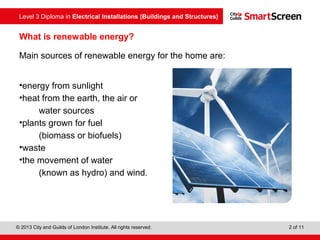
Main sources of renewable energy for the home are:
•energy from sunlight
•heat from the earth, the air or
water sources
•plants grown for fuel
(biomass or biofuels)
•waste
•the movement of water
(known as hydro) and wind.
Level 3 Diploma in Electrical Installations (Buildings and Structures)
© 2013 City and Guilds of London Institute. All rights reserved. 3 of 11
Why use renewables?
• making use of secure, local
resources
• reducing the dependence on
non-renewable energy
• helping to keep the air clean
• helping to reduce the production
of carbon dioxide and other
greenhouse gases
• creating new jobs in renewable
energy industries
• saving and even earning money.
Level 3 Diploma in Electrical Installations (Buildings and Structures)
© 2013 City and Guilds of London Institute. All rights reserved. 4 of 11
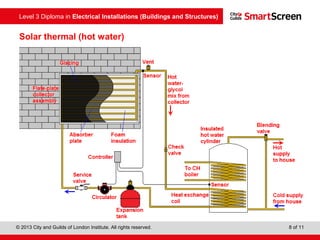
Solar thermal (hot water)
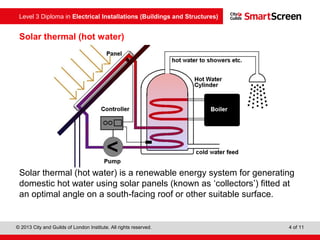
Solar thermal (hot water) is a renewable energy system for generating
domestic hot water using solar panels (known as ‘collectors’) fitted at
an optimal angle on a south facing roof or other suitable surface.‑
Level 3 Diploma in Electrical Installations (Buildings and Structures)
© 2013 City and Guilds of London Institute. All rights reserved. 5 of 11
Solar thermal (hot water)
Installation location
•Is there a suitable place for the panels?
•Face between south east and south west at an appropriate angle.
•If fitting them to a roof, then a check will need to be made to ensure
that it can support the panels' weight.
•Is there anything that will substantially shade the panels.
Level 3 Diploma in Electrical Installations (Buildings and Structures)
© 2013 City and Guilds of London Institute. All rights reserved. 6 of 11
Solar thermal (hot water)
Planning requirements
•Classed as ‘permitted development’ provided:
• panel coverage less than 9m2
• panels must not extend beyond the ridgeline
• panels must not project more than 200mm from the roof or
wall surface
• not fixed to a listed building
• not fixed to a building in a conservation area
• not fixed to a building in a World heritage area
• not fixed to a building close to a monument.
Level 3 Diploma in Electrical Installations (Buildings and Structures)
© 2013 City and Guilds of London Institute. All rights reserved. 7 of 11
Solar thermal (hot water)
Building Regulations requirements
In most cases it will be necessary to give notification of the proposed
works to the Council under the Building Regulations.
Level 3 Diploma in Electrical Installations (Buildings and Structures)
© 2013 City and Guilds of London Institute. All rights reserved. 8 of 11
Solar thermal (hot water)
Level 3 Diploma in Electrical Installations (Buildings and Structures)
© 2013 City and Guilds of London Institute. All rights reserved. 9 of 11
Solar thermal (hot water)
Advantages of solar thermal (hot water)
•Cut carbon footprint
•Cut bills
•Hot water all year round
Level 3 Diploma in Electrical Installations (Buildings and Structures)
© 2013 City and Guilds of London Institute. All rights reserved. 10 of 11
Solar thermal (hot water)
Disadvantages of solar thermal (hot water)
•Only available during daytime
•Subject to the effects of climatic changes
•Dependant on geographical location
•Energy conversion rates or efficiencies are low compared to other
energy sources
•High capital cost
Level 3 Diploma in Electrical Installations (Buildings and Structures)
© 2013 City and Guilds of London Institute. All rights reserved. 11 of 11
Any questions?

Solar_Thermal

  • 1.
    Level 3 Diplomain Electrical Installations (Buildings and Structures) © 2013 City and Guilds of London Institute. All rights reserved. 1 of 11 PowerPointpresentation Solar thermal (hot water) Unit 301: Understand the fundamental principles and requirements of environmental technology systems
  • 2.
    Level 3 Diplomain Electrical Installations (Buildings and Structures) © 2013 City and Guilds of London Institute. All rights reserved. 2 of 11 What is renewable energy? Main sources of renewable energy for the home are: •energy from sunlight •heat from the earth, the air or water sources •plants grown for fuel (biomass or biofuels) •waste •the movement of water (known as hydro) and wind.
  • 3.
    Level 3 Diplomain Electrical Installations (Buildings and Structures) © 2013 City and Guilds of London Institute. All rights reserved. 3 of 11 Why use renewables? • making use of secure, local resources • reducing the dependence on non-renewable energy • helping to keep the air clean • helping to reduce the production of carbon dioxide and other greenhouse gases • creating new jobs in renewable energy industries • saving and even earning money.
  • 4.
    Level 3 Diplomain Electrical Installations (Buildings and Structures) © 2013 City and Guilds of London Institute. All rights reserved. 4 of 11 Solar thermal (hot water) Solar thermal (hot water) is a renewable energy system for generating domestic hot water using solar panels (known as ‘collectors’) fitted at an optimal angle on a south facing roof or other suitable surface.‑
  • 5.
    Level 3 Diplomain Electrical Installations (Buildings and Structures) © 2013 City and Guilds of London Institute. All rights reserved. 5 of 11 Solar thermal (hot water) Installation location •Is there a suitable place for the panels? •Face between south east and south west at an appropriate angle. •If fitting them to a roof, then a check will need to be made to ensure that it can support the panels' weight. •Is there anything that will substantially shade the panels.
  • 6.
    Level 3 Diplomain Electrical Installations (Buildings and Structures) © 2013 City and Guilds of London Institute. All rights reserved. 6 of 11 Solar thermal (hot water) Planning requirements •Classed as ‘permitted development’ provided: • panel coverage less than 9m2 • panels must not extend beyond the ridgeline • panels must not project more than 200mm from the roof or wall surface • not fixed to a listed building • not fixed to a building in a conservation area • not fixed to a building in a World heritage area • not fixed to a building close to a monument.
  • 7.
    Level 3 Diplomain Electrical Installations (Buildings and Structures) © 2013 City and Guilds of London Institute. All rights reserved. 7 of 11 Solar thermal (hot water) Building Regulations requirements In most cases it will be necessary to give notification of the proposed works to the Council under the Building Regulations.
  • 8.
    Level 3 Diplomain Electrical Installations (Buildings and Structures) © 2013 City and Guilds of London Institute. All rights reserved. 8 of 11 Solar thermal (hot water)
  • 9.
    Level 3 Diplomain Electrical Installations (Buildings and Structures) © 2013 City and Guilds of London Institute. All rights reserved. 9 of 11 Solar thermal (hot water) Advantages of solar thermal (hot water) •Cut carbon footprint •Cut bills •Hot water all year round
  • 10.
    Level 3 Diplomain Electrical Installations (Buildings and Structures) © 2013 City and Guilds of London Institute. All rights reserved. 10 of 11 Solar thermal (hot water) Disadvantages of solar thermal (hot water) •Only available during daytime •Subject to the effects of climatic changes •Dependant on geographical location •Energy conversion rates or efficiencies are low compared to other energy sources •High capital cost
  • 11.
    Level 3 Diplomain Electrical Installations (Buildings and Structures) © 2013 City and Guilds of London Institute. All rights reserved. 11 of 11 Any questions?