CHALLENGES FOR EFFICIENT
COMMUNICATION IN
UNDERWATER ACOUSTIC SENSOR
NETWORK
Under guidance of
Dr. Basavaraj.Mathpati
Presented By: Smitha.Kulkarni
INTRODUCTION
DEFINITION
• Underwater Acoustic Sensor Networks (UW-ASN) consist of a
variable number of sensors and vehicles that are deployed to
perform collaborative monitoring tasks over a given area.
• Wireless Underwater Acoustic Networking is the enabling
technology for the applications of oceanographic data
collection, pollution monitoring, offshore exploration and
tactical surveillance applications.
challenges for efficient communication in
UW-ASN
2
UW-ASN ARCHITECTURE
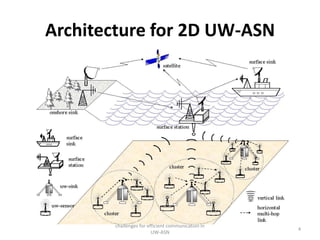
Two-dimensional Underwater Sensor Networks
 uw-sinks are equipped with two acoustic transceivers, namely a
horizontal and a vertical transceiver.
 Sensors can be connected to uw-sinks via direct links or through
multi-hop paths.
 Direct links are very likely to reduce the network throughput.
 In case of multi-hop paths the data produced by a source sensor is
relayed by intermediate sensors until it reaches the uw-sink.
challenges for efficient communication in
UW-ASN
3
Architecture for 2D UW-ASN
challenges for efficient communication in
UW-ASN
4
Contd….
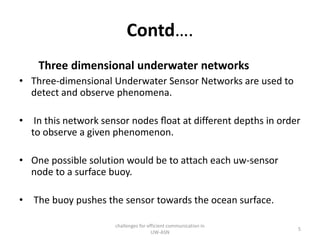
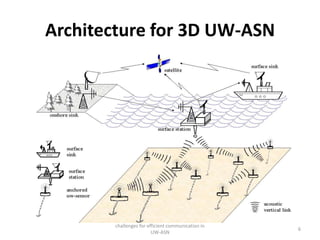
Three dimensional underwater networks
• Three-dimensional Underwater Sensor Networks are used to
detect and observe phenomena.
• In this network sensor nodes float at different depths in order
to observe a given phenomenon.
• One possible solution would be to attach each uw-sensor
node to a surface buoy.
• The buoy pushes the sensor towards the ocean surface.
challenges for efficient communication in
UW-ASN
5
Architecture for 3D UW-ASN
challenges for efficient communication in
UW-ASN
6
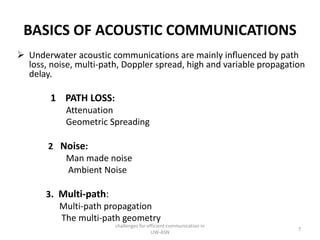
BASICS OF ACOUSTIC COMMUNICATIONS
 Underwater acoustic communications are mainly influenced by path
loss, noise, multi-path, Doppler spread, high and variable propagation
delay.
1 PATH LOSS:
Attenuation
Geometric Spreading
2 Noise:
Man made noise
Ambient Noise
3. Multi-path:
Multi-path propagation
The multi-path geometry
challenges for efficient communication in
UW-ASN
7
Contd…
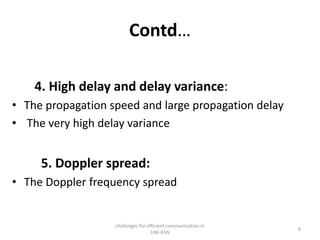
4. High delay and delay variance:
• The propagation speed and large propagation delay
• The very high delay variance
5. Doppler spread:
• The Doppler frequency spread
challenges for efficient communication in
UW-ASN
8
A PROTOCOL STACK FOR UW-AS
COMMUNICATIONS
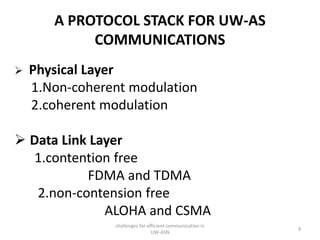
 Physical Layer
1.Non-coherent modulation
2.coherent modulation
 Data Link Layer
1.contention free
FDMA and TDMA
2.non-contension free
ALOHA and CSMA
challenges for efficient communication in
UW-ASN
9
Contd…...
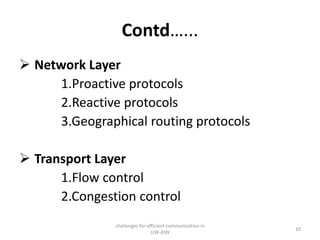
 Network Layer
1.Proactive protocols
2.Reactive protocols
3.Geographical routing protocols
 Transport Layer
1.Flow control
2.Congestion control
challenges for efficient communication in
UW-ASN
10
Major challenges in the design of
UW-ASN
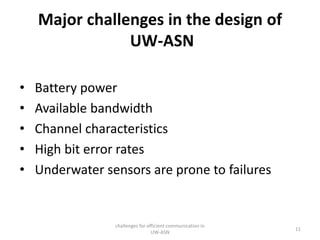
• Battery power
• Available bandwidth
• Channel characteristics
• High bit error rates
• Underwater sensors are prone to failures
challenges for efficient communication in
UW-ASN
11
Advantages and Disadvantages
• Advantages
1. Predict the disasters with the system and
provide efficient solutions
2. understand Impact to global environment
• Disadvantage
UWSNs are expensive
challenges for efficient communication in
UW-ASN
12
Conclusion
The ultimate objective of this study is to
encourage the development of new advanced
communications techniques for efficient
underwater communication and networking for
enhanced ocean monitoring and exploration
applications.
challenges for efficient communication in
UW-ASN
13
References
[1] M. Stojanovic, “Acoustic (underwater) communications,” in
Encyclopaedia of Telecommunications, J. G. Proakis, Ed. John Wiley and
Sons, 2003.
[2] J. Proakis, J. Rice, E. Sozer, and M. Stojanovic, “Shallow water acoustic
networks,” in Encyclopaedia of Telecommunications, J. G. Proakis, Ed. John
Wiley and Sons, 2003.
[3] J. G. Proakis, E. M. Sozer, J. A. Rice, and M. Stojanovic, “Shallow water
acoustic networks,” IEEE Communications Magazine, pp. 114– 119, Nov.
2001.
[4] L. Freitag and M. Stojanovic, “Acoustic communications for regional
undersea observatories,” in Proceedings of Oceanology International,
London, U.K., mar 2002.
[5] I. F. Akyildiz, W. Su, Y. Sankarasubramaniam, and E. Cayirci, “Wireless
sensor networks: A survey,” Computer Networks (Elsevier) Journal, vol.
38, no. 4, pp. 393–422, Mar. 2002.
challenges for efficient communication in
UW-ASN
14
challenges for efficient communication in
UW-ASN
15

Underwater acoustic sensor network

  • 1.
    CHALLENGES FOR EFFICIENT COMMUNICATIONIN UNDERWATER ACOUSTIC SENSOR NETWORK Under guidance of Dr. Basavaraj.Mathpati Presented By: Smitha.Kulkarni
  • 2.
    INTRODUCTION DEFINITION • Underwater AcousticSensor Networks (UW-ASN) consist of a variable number of sensors and vehicles that are deployed to perform collaborative monitoring tasks over a given area. • Wireless Underwater Acoustic Networking is the enabling technology for the applications of oceanographic data collection, pollution monitoring, offshore exploration and tactical surveillance applications. challenges for efficient communication in UW-ASN 2
  • 3.
    UW-ASN ARCHITECTURE Two-dimensional UnderwaterSensor Networks  uw-sinks are equipped with two acoustic transceivers, namely a horizontal and a vertical transceiver.  Sensors can be connected to uw-sinks via direct links or through multi-hop paths.  Direct links are very likely to reduce the network throughput.  In case of multi-hop paths the data produced by a source sensor is relayed by intermediate sensors until it reaches the uw-sink. challenges for efficient communication in UW-ASN 3
  • 4.
    Architecture for 2DUW-ASN challenges for efficient communication in UW-ASN 4
  • 5.
    Contd…. Three dimensional underwaternetworks • Three-dimensional Underwater Sensor Networks are used to detect and observe phenomena. • In this network sensor nodes float at different depths in order to observe a given phenomenon. • One possible solution would be to attach each uw-sensor node to a surface buoy. • The buoy pushes the sensor towards the ocean surface. challenges for efficient communication in UW-ASN 5
  • 6.
    Architecture for 3DUW-ASN challenges for efficient communication in UW-ASN 6
  • 7.
    BASICS OF ACOUSTICCOMMUNICATIONS  Underwater acoustic communications are mainly influenced by path loss, noise, multi-path, Doppler spread, high and variable propagation delay. 1 PATH LOSS: Attenuation Geometric Spreading 2 Noise: Man made noise Ambient Noise 3. Multi-path: Multi-path propagation The multi-path geometry challenges for efficient communication in UW-ASN 7
  • 8.
    Contd… 4. High delayand delay variance: • The propagation speed and large propagation delay • The very high delay variance 5. Doppler spread: • The Doppler frequency spread challenges for efficient communication in UW-ASN 8
  • 9.
    A PROTOCOL STACKFOR UW-AS COMMUNICATIONS  Physical Layer 1.Non-coherent modulation 2.coherent modulation  Data Link Layer 1.contention free FDMA and TDMA 2.non-contension free ALOHA and CSMA challenges for efficient communication in UW-ASN 9
  • 10.
    Contd…...  Network Layer 1.Proactiveprotocols 2.Reactive protocols 3.Geographical routing protocols  Transport Layer 1.Flow control 2.Congestion control challenges for efficient communication in UW-ASN 10
  • 11.
    Major challenges inthe design of UW-ASN • Battery power • Available bandwidth • Channel characteristics • High bit error rates • Underwater sensors are prone to failures challenges for efficient communication in UW-ASN 11
  • 12.
    Advantages and Disadvantages •Advantages 1. Predict the disasters with the system and provide efficient solutions 2. understand Impact to global environment • Disadvantage UWSNs are expensive challenges for efficient communication in UW-ASN 12
  • 13.
    Conclusion The ultimate objectiveof this study is to encourage the development of new advanced communications techniques for efficient underwater communication and networking for enhanced ocean monitoring and exploration applications. challenges for efficient communication in UW-ASN 13
  • 14.
    References [1] M. Stojanovic,“Acoustic (underwater) communications,” in Encyclopaedia of Telecommunications, J. G. Proakis, Ed. John Wiley and Sons, 2003. [2] J. Proakis, J. Rice, E. Sozer, and M. Stojanovic, “Shallow water acoustic networks,” in Encyclopaedia of Telecommunications, J. G. Proakis, Ed. John Wiley and Sons, 2003. [3] J. G. Proakis, E. M. Sozer, J. A. Rice, and M. Stojanovic, “Shallow water acoustic networks,” IEEE Communications Magazine, pp. 114– 119, Nov. 2001. [4] L. Freitag and M. Stojanovic, “Acoustic communications for regional undersea observatories,” in Proceedings of Oceanology International, London, U.K., mar 2002. [5] I. F. Akyildiz, W. Su, Y. Sankarasubramaniam, and E. Cayirci, “Wireless sensor networks: A survey,” Computer Networks (Elsevier) Journal, vol. 38, no. 4, pp. 393–422, Mar. 2002. challenges for efficient communication in UW-ASN 14
  • 15.
    challenges for efficientcommunication in UW-ASN 15