•   Introduction.
•   Modes.
•   Cordless / Wireless.
•   History.
•   Applications Of Wireless Technology:
-   Mobile Telephones.
-   Wireless Data Communications.
-   Wireless Energy Transfer.
• Wireless telecommunications is the transfer of
  information between two or more points that are not
  physically connected. Distances can be short, such as a
  few meters for television remote control, or as far as
  thousands or even millions of kilometers for deep-space
  radio communications. It encompasses various types of
  fixed, mobile, and portable two-way radios, cellular
  telephones, personal digital assistants (PDAs), and
  wireless networking. Other examples of wireless
  technology include GPS units, Garage door openers or
  garage doors, wireless computer mice, keyboards and
  Headset (audio), headphones, radio receivers, satellite
  television, broadcast television and cordless telephones.
• Wireless communications can be via:
• radio frequency communication,
• microwave communication, for example long-range line-
  of-sight via highly directional antennas, or short-range
  communication,
• infrared (IR) short-range communication, for example
  from consumer IR devices such as remote controls or via
  Infrared Data Association (IrDA).
• Applications may involve point-to-point communication,
  point-to-multipoint communication, broadcasting, cellular
  networks and other wireless networks.
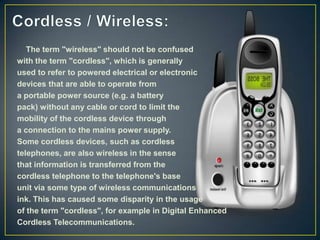
The term "wireless" should not be confused
with the term "cordless", which is generally
used to refer to powered electrical or electronic
devices that are able to operate from
a portable power source (e.g. a battery
pack) without any cable or cord to limit the
mobility of the cordless device through
a connection to the mains power supply.
Some cordless devices, such as cordless
telephones, are also wireless in the sense
that information is transferred from the
cordless telephone to the telephone's base
unit via some type of wireless communications
ink. This has caused some disparity in the usage
of the term "cordless", for example in Digital Enhanced
Cordless Telecommunications.
# Photophone
Bell and Tainter's photophone, of 1880.
The world's first wireless telephone
conversation occurred in 1880, when Alexander Graham Bell and
Charles Sumner Tainter invented and patented the photophone, a
telephone that conducted audio conversations wirelessly over
modulated light beams (which are narrow projections of
electromagnetic waves). In that distant era when utilities did not
yet exist to provide electricity, and lasers had not even been
conceived of in science fiction, there were no practical
applications for their invention, which was highly limited by the
availability of both sunlight and good weather. Similar to free
space optical communication, the photophone also required a
clear line of sight between its transmitter and its receiver. It would
be several decades before the photophone's principles found their
first practical applications in military communications and later in
fiber-optic communications.
# Early wireless work
• David E. Hughes transmitted radio signals over a few hundred yards by
   means of a clockwork keyed transmitter in 1879. As this was before
   Maxwell's work was understood, Hughes' contemporaries dismissed
   his achievement as mere "Induction". In 1885, Thomas Edison used a
   vibrator magnet for induction transmission. In 1888, Edison deployed a
   system of signaling on the Lehigh Valley Railroad. In 1891, Edison
   obtained the wireless patent for this method using inductance (U.S.
   Patent 465,971).
• In the history of wireless technology, the demonstration of the theory
   of electromagnetic waves by Heinrich Hertz in 1888 was important. The
   theory of electromagnetic waves was predicted from the research of
   James Clerk Maxwell and Michael Faraday. Hertz demonstrated that
   electromagnetic waves could be transmitted and caused to travel
   through space at straight lines and that they were able to be received
   by an experimental apparatus. The experiments were not followed up
   by Hertz. Jagadish Chandra Bose around this time developed an early
   wireless detection device and helped increase the knowledge of
   millimeter length electromagnetic waves. Practical applications of
   wireless radio communication and radio remote control technology
   were implemented by later inventors, such as Nikola Tesla.
# Radio
• Marconi did transmit the first radio signal across the
  Atlantic.
• The term "wireless" came into public use to refer to a
  radio receiver or transceiver (a dual purpose receiver and
  transmitter device), establishing its usage in the field of
  wireless telegraphy early on; now the term is used to
  describe modern wireless connections such as in cellular
  networks and wireless broadband Internet. It is also used
  in a general sense to refer to any type of operation that is
  implemented without the use of wires, such as "wireless
  remote control" or "wireless energy transfer", regardless
  of the specific technology (e.g. radio, infrared, ultrasonic)
  used. Guglielmo Marconi and Karl Ferdinand Braun were
  awarded the 1909 Nobel Prize for Physics for their
  contribution to wireless telegraphy.
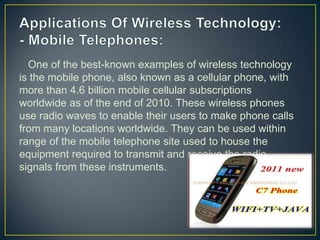
One of the best-known examples of wireless technology
is the mobile phone, also known as a cellular phone, with
more than 4.6 billion mobile cellular subscriptions
worldwide as of the end of 2010. These wireless phones
use radio waves to enable their users to make phone calls
from many locations worldwide. They can be used within
range of the mobile telephone site used to house the
equipment required to transmit and receive the radio
signals from these instruments.
Wireless data communications are an essential
component of mobile computing. The various availabletechnologies differ
in local availability, coverage range and performance, and in some
circumstances, users must be able to employ multiple connection types
and switch between them. To simplify the experience for the user,
connection manager software can be used, or a mobile VPN deployed to
handle the multiple connections as a secure, single virtual network.
Supporting technologies include:
Wi-Fi is a wireless local area network that enables portable computing
devices to connect easily to the Internet. Standardized as IEEE 802.11
a,b,g,n, Wi-Fi approaches speeds of some types of wired Ethernet. Wi-Fi
has become the de facto standard for access in private homes, within
offices, and at public hotspots. Some businesses charge customers a
monthly fee for service, while others have begun offering it for free in an
effort to increase the sales of their goods.
Cellular data service offers coverage within a range of 10-15 miles from
the nearest cell site. Speeds have increased as technologies have
evolved, from earlier technologies such as GSM, CDMA and GPRS, to 3G
networks such as W-CDMA, EDGE or CDMA2000.
Mobile Satellite Communications may be used where other wireless
connections are unavailable, such as in largely rural areas or remote
locations.[8] Satellite communications are especially important for
transportation, aviation, maritime and military use.
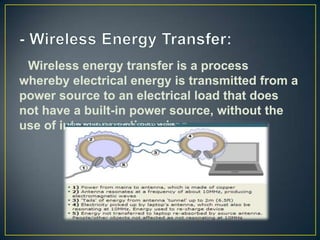
Wireless energy transfer is a process
whereby electrical energy is transmitted from a
power source to an electrical load that does
not have a built-in power source, without the
use of interconnecting wires.
I hope you Liked it
Done by: Esraa Ashraf Labib
      Second Grade.
     Dr. Dina Abo Zaid.

Wireless technology

  • 2.
    Introduction. • Modes. • Cordless / Wireless. • History. • Applications Of Wireless Technology: - Mobile Telephones. - Wireless Data Communications. - Wireless Energy Transfer.
  • 3.
    • Wireless telecommunicationsis the transfer of information between two or more points that are not physically connected. Distances can be short, such as a few meters for television remote control, or as far as thousands or even millions of kilometers for deep-space radio communications. It encompasses various types of fixed, mobile, and portable two-way radios, cellular telephones, personal digital assistants (PDAs), and wireless networking. Other examples of wireless technology include GPS units, Garage door openers or garage doors, wireless computer mice, keyboards and Headset (audio), headphones, radio receivers, satellite television, broadcast television and cordless telephones.
  • 4.
    • Wireless communicationscan be via: • radio frequency communication, • microwave communication, for example long-range line- of-sight via highly directional antennas, or short-range communication, • infrared (IR) short-range communication, for example from consumer IR devices such as remote controls or via Infrared Data Association (IrDA). • Applications may involve point-to-point communication, point-to-multipoint communication, broadcasting, cellular networks and other wireless networks.
  • 5.
    The term "wireless"should not be confused with the term "cordless", which is generally used to refer to powered electrical or electronic devices that are able to operate from a portable power source (e.g. a battery pack) without any cable or cord to limit the mobility of the cordless device through a connection to the mains power supply. Some cordless devices, such as cordless telephones, are also wireless in the sense that information is transferred from the cordless telephone to the telephone's base unit via some type of wireless communications ink. This has caused some disparity in the usage of the term "cordless", for example in Digital Enhanced Cordless Telecommunications.
  • 6.
    # Photophone Bell andTainter's photophone, of 1880. The world's first wireless telephone conversation occurred in 1880, when Alexander Graham Bell and Charles Sumner Tainter invented and patented the photophone, a telephone that conducted audio conversations wirelessly over modulated light beams (which are narrow projections of electromagnetic waves). In that distant era when utilities did not yet exist to provide electricity, and lasers had not even been conceived of in science fiction, there were no practical applications for their invention, which was highly limited by the availability of both sunlight and good weather. Similar to free space optical communication, the photophone also required a clear line of sight between its transmitter and its receiver. It would be several decades before the photophone's principles found their first practical applications in military communications and later in fiber-optic communications.
  • 7.
    # Early wirelesswork • David E. Hughes transmitted radio signals over a few hundred yards by means of a clockwork keyed transmitter in 1879. As this was before Maxwell's work was understood, Hughes' contemporaries dismissed his achievement as mere "Induction". In 1885, Thomas Edison used a vibrator magnet for induction transmission. In 1888, Edison deployed a system of signaling on the Lehigh Valley Railroad. In 1891, Edison obtained the wireless patent for this method using inductance (U.S. Patent 465,971). • In the history of wireless technology, the demonstration of the theory of electromagnetic waves by Heinrich Hertz in 1888 was important. The theory of electromagnetic waves was predicted from the research of James Clerk Maxwell and Michael Faraday. Hertz demonstrated that electromagnetic waves could be transmitted and caused to travel through space at straight lines and that they were able to be received by an experimental apparatus. The experiments were not followed up by Hertz. Jagadish Chandra Bose around this time developed an early wireless detection device and helped increase the knowledge of millimeter length electromagnetic waves. Practical applications of wireless radio communication and radio remote control technology were implemented by later inventors, such as Nikola Tesla.
  • 8.
    # Radio • Marconidid transmit the first radio signal across the Atlantic. • The term "wireless" came into public use to refer to a radio receiver or transceiver (a dual purpose receiver and transmitter device), establishing its usage in the field of wireless telegraphy early on; now the term is used to describe modern wireless connections such as in cellular networks and wireless broadband Internet. It is also used in a general sense to refer to any type of operation that is implemented without the use of wires, such as "wireless remote control" or "wireless energy transfer", regardless of the specific technology (e.g. radio, infrared, ultrasonic) used. Guglielmo Marconi and Karl Ferdinand Braun were awarded the 1909 Nobel Prize for Physics for their contribution to wireless telegraphy.
  • 9.
    One of thebest-known examples of wireless technology is the mobile phone, also known as a cellular phone, with more than 4.6 billion mobile cellular subscriptions worldwide as of the end of 2010. These wireless phones use radio waves to enable their users to make phone calls from many locations worldwide. They can be used within range of the mobile telephone site used to house the equipment required to transmit and receive the radio signals from these instruments.
  • 10.
    Wireless data communicationsare an essential component of mobile computing. The various availabletechnologies differ in local availability, coverage range and performance, and in some circumstances, users must be able to employ multiple connection types and switch between them. To simplify the experience for the user, connection manager software can be used, or a mobile VPN deployed to handle the multiple connections as a secure, single virtual network. Supporting technologies include: Wi-Fi is a wireless local area network that enables portable computing devices to connect easily to the Internet. Standardized as IEEE 802.11 a,b,g,n, Wi-Fi approaches speeds of some types of wired Ethernet. Wi-Fi has become the de facto standard for access in private homes, within offices, and at public hotspots. Some businesses charge customers a monthly fee for service, while others have begun offering it for free in an effort to increase the sales of their goods. Cellular data service offers coverage within a range of 10-15 miles from the nearest cell site. Speeds have increased as technologies have evolved, from earlier technologies such as GSM, CDMA and GPRS, to 3G networks such as W-CDMA, EDGE or CDMA2000. Mobile Satellite Communications may be used where other wireless connections are unavailable, such as in largely rural areas or remote locations.[8] Satellite communications are especially important for transportation, aviation, maritime and military use.
  • 11.
    Wireless energy transferis a process whereby electrical energy is transmitted from a power source to an electrical load that does not have a built-in power source, without the use of interconnecting wires.
  • 12.
    I hope youLiked it Done by: Esraa Ashraf Labib Second Grade. Dr. Dina Abo Zaid.