
VISVESVARAYA TECHNOLOGICAL UNIVERSITY
          Jnana Sangama, Belgaum, Karnataka-590 014.


                         A Seminar On
“Securing Underwater Wireless Communication Networks”

 By                                     Project Guide
 NAVEENA N (1BT08CS051)                 Mr. KESHAVA M
                                        (Lecturer of CSE department)


           B.T.L INSTITUTE OF TECHNOLOGY
         Department of Computer Science & Engineering
                          2010-11
AGENDA

oAbstract

oUnderwater Wireless Communication Networks

oExisting system

oProposed System

oDrawbacks

oApplications

oConclusion
ABSTRACT
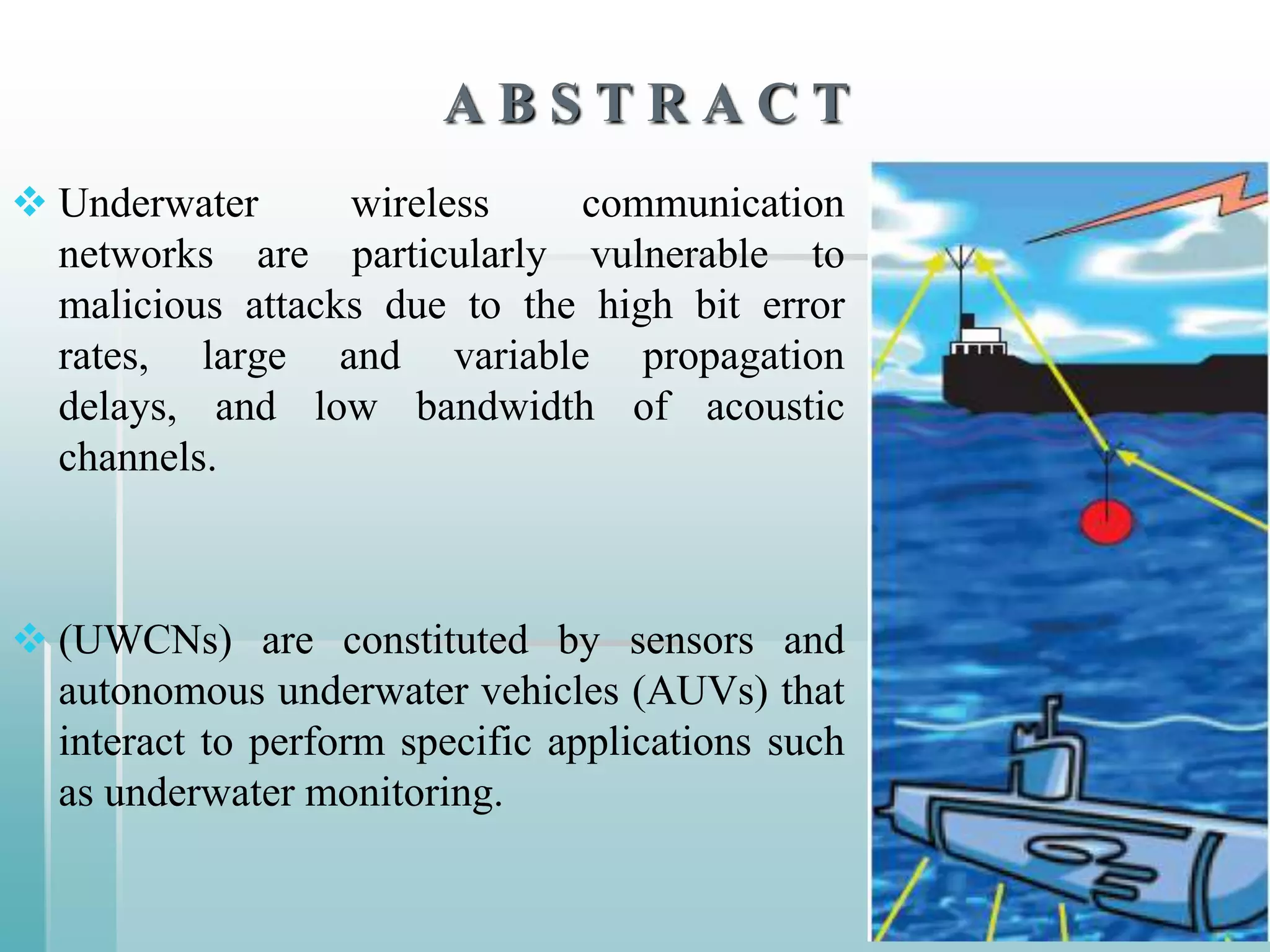
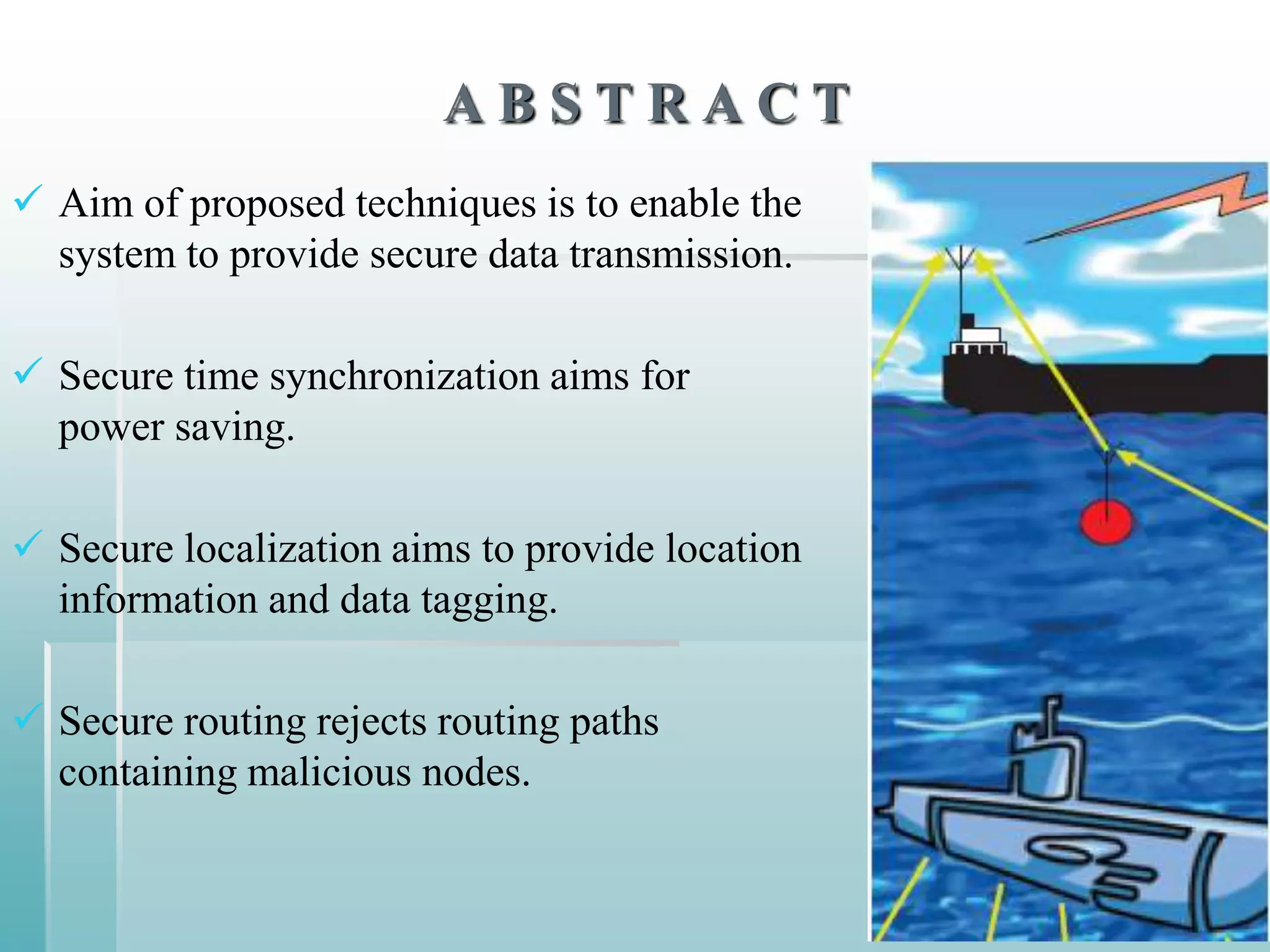
 Underwater      wireless    communication
  networks are particularly vulnerable to
  malicious attacks due to the high bit error
  rates, large and variable propagation
  delays, and low bandwidth of acoustic
  channels.


 (UWCNs) are constituted by sensors and
  autonomous underwater vehicles (AUVs) that
  interact to perform specific applications such
  as underwater monitoring.
ABSTRACT
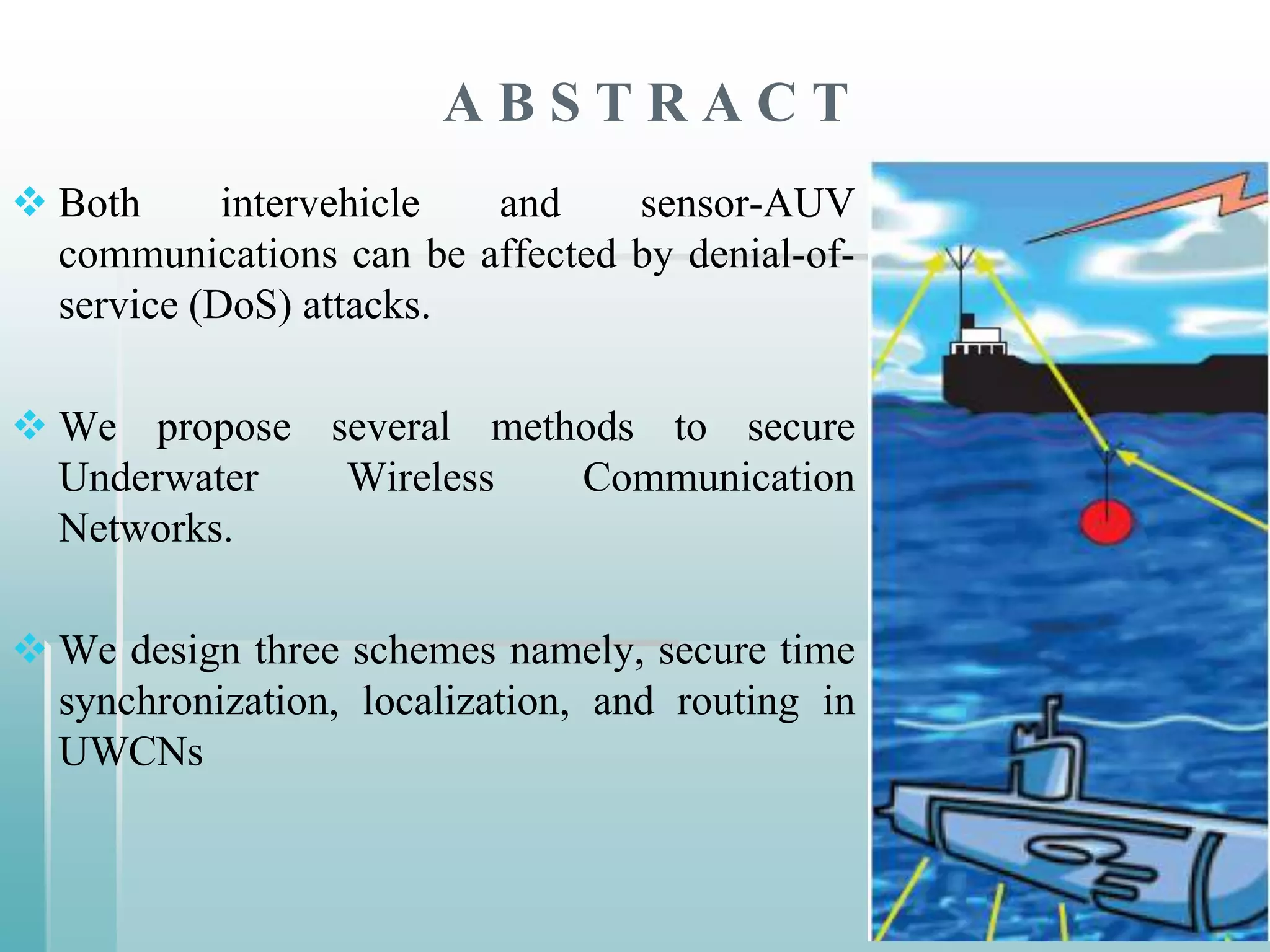
 Both      intervehicle and     sensor-AUV
  communications can be affected by denial-of-
  service (DoS) attacks.

 We propose several methods to secure
  Underwater  Wireless   Communication
  Networks.

 We design three schemes namely, secure time
  synchronization, localization, and routing in
  UWCNs
ABSTRACT
 Aim of proposed techniques is to enable the
  system to provide secure data transmission.

 Secure time synchronization aims for
  power saving.

 Secure localization aims to provide location
  information and data tagging.

 Secure routing rejects routing paths
  containing malicious nodes.
These techniques are based on following
                     mechanisms
 Secure Time Synchronization
     It is essential in many underwater applications such as
     coordinated sensing tasks. & scheduling algorithms such as
     timedivision multiple access (TDMA).
 SECURE LOCALIZATION
      Localization is a very important issue for data tagging.
      Localization schemes can be classified into two types:
     (i) Range-based schemes (using range or bearing
     information):
     (ii) Range-free schemes (not using range or bearing
     information):
 SECURE ROUTING
     Routing is essential for packet delivery in UWCNs.
Underwater Wireless Communication Networks
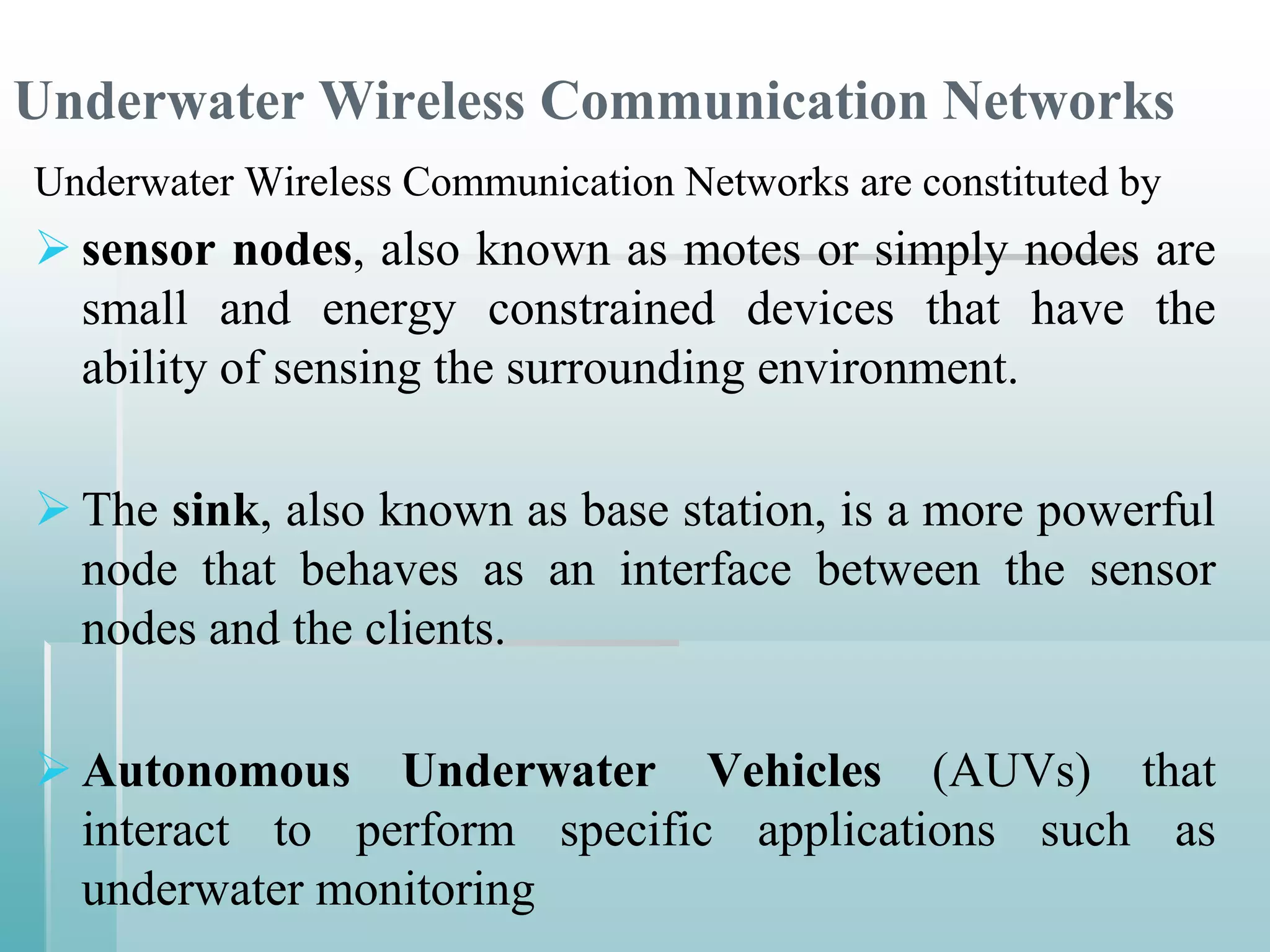
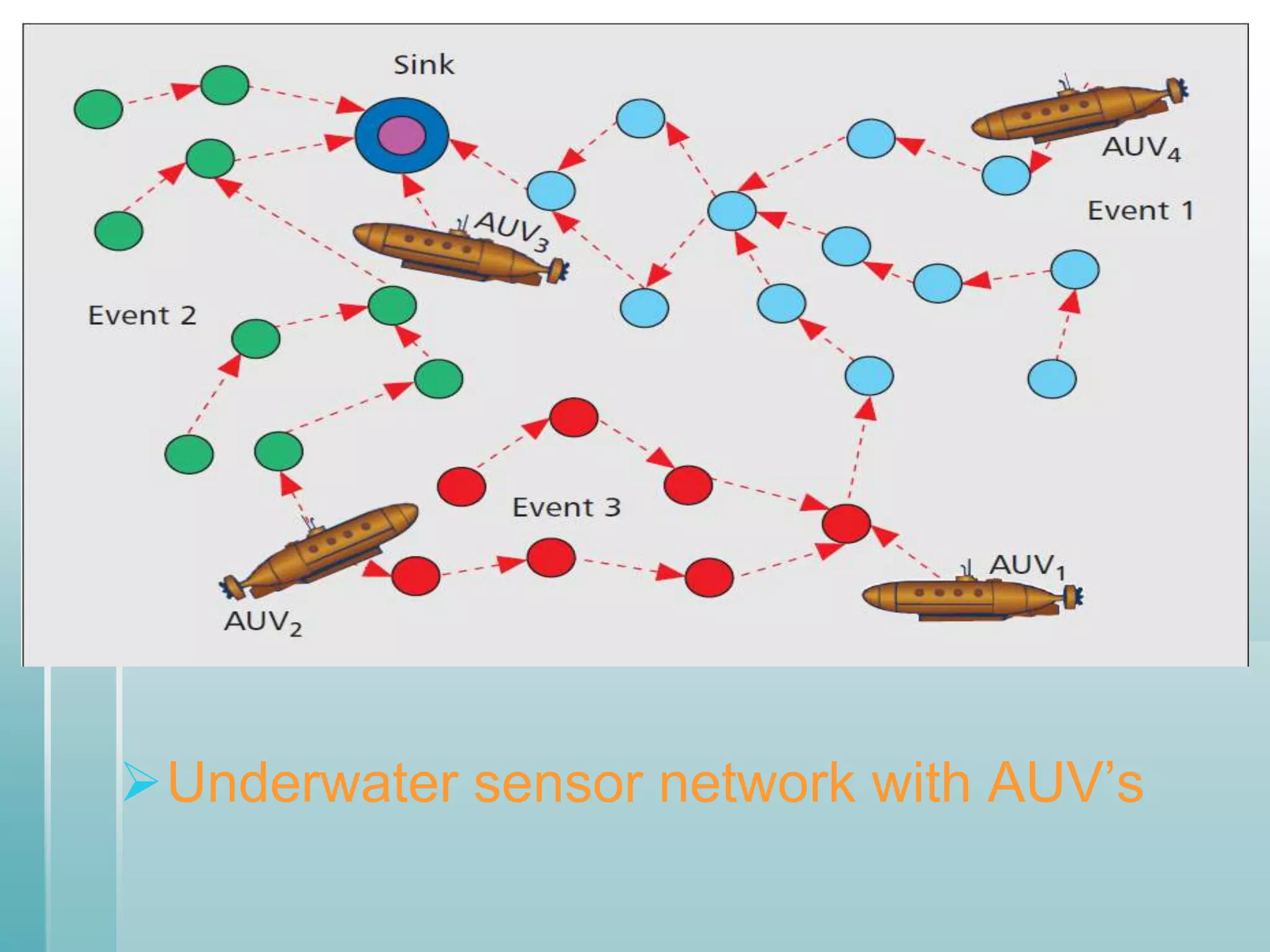
Underwater Wireless Communication Networks are constituted by
 sensor nodes, also known as motes or simply nodes are
  small and energy constrained devices that have the
  ability of sensing the surrounding environment.

 The sink, also known as base station, is a more powerful
  node that behaves as an interface between the sensor
  nodes and the clients.

 Autonomous Underwater Vehicles (AUVs) that
  interact to perform specific applications such as
  underwater monitoring
Underwater sensor network with AUV’s
Existing system

 Radio waves do not propagate well underwater due to the high energy
  absorption of water

 Therefore, underwater communications are based on acoustic links
  characterized by large propagation delays. The propagation speed of
  acoustic signals in water (typically 1500 m/s)

 Acoustic channels have low bandwidth As a result, the bit error rates
  of acoustic links are often high, and losses of connectivity arise

 It cannot rely on the Global Positioning System (GPS) because it uses
  radar waves in the 1.5 GHz band that do not propagate in water.
Existing system
 The above mentioned characteristics of UWCNs have several security
  implications.
 High bit error rates cause packet errors. Consequently, critical security
  packets can be lost. Wireless underwater channels can be
  eavesdropped on. Attackers may intercept the information transmitted
  and attempt to modify or drop packets.
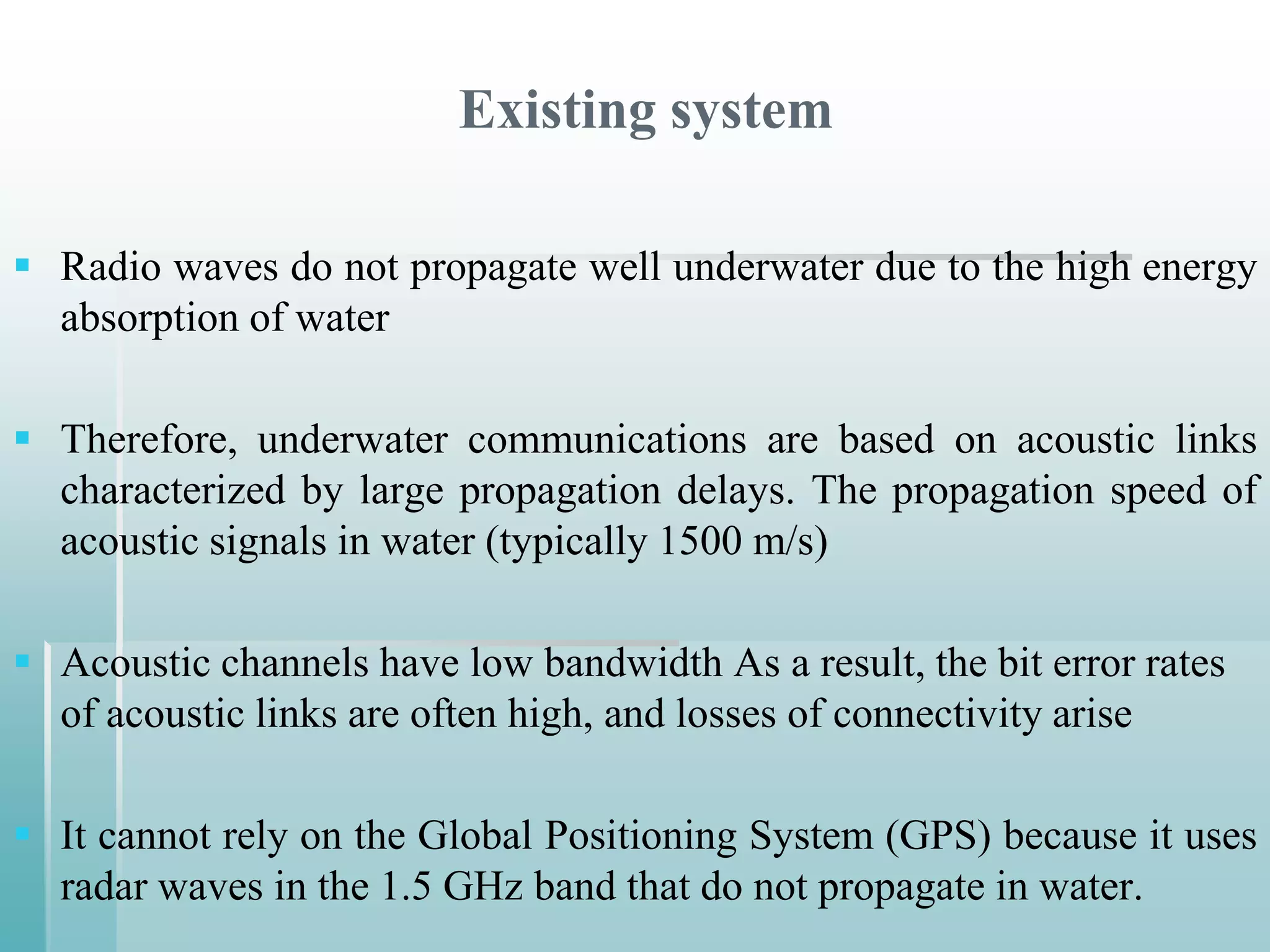
 Both intervehicle and sensor-AUV communications can be affected
  by denial-of-service (DoS) attacks. Several attacks are
 Jamming
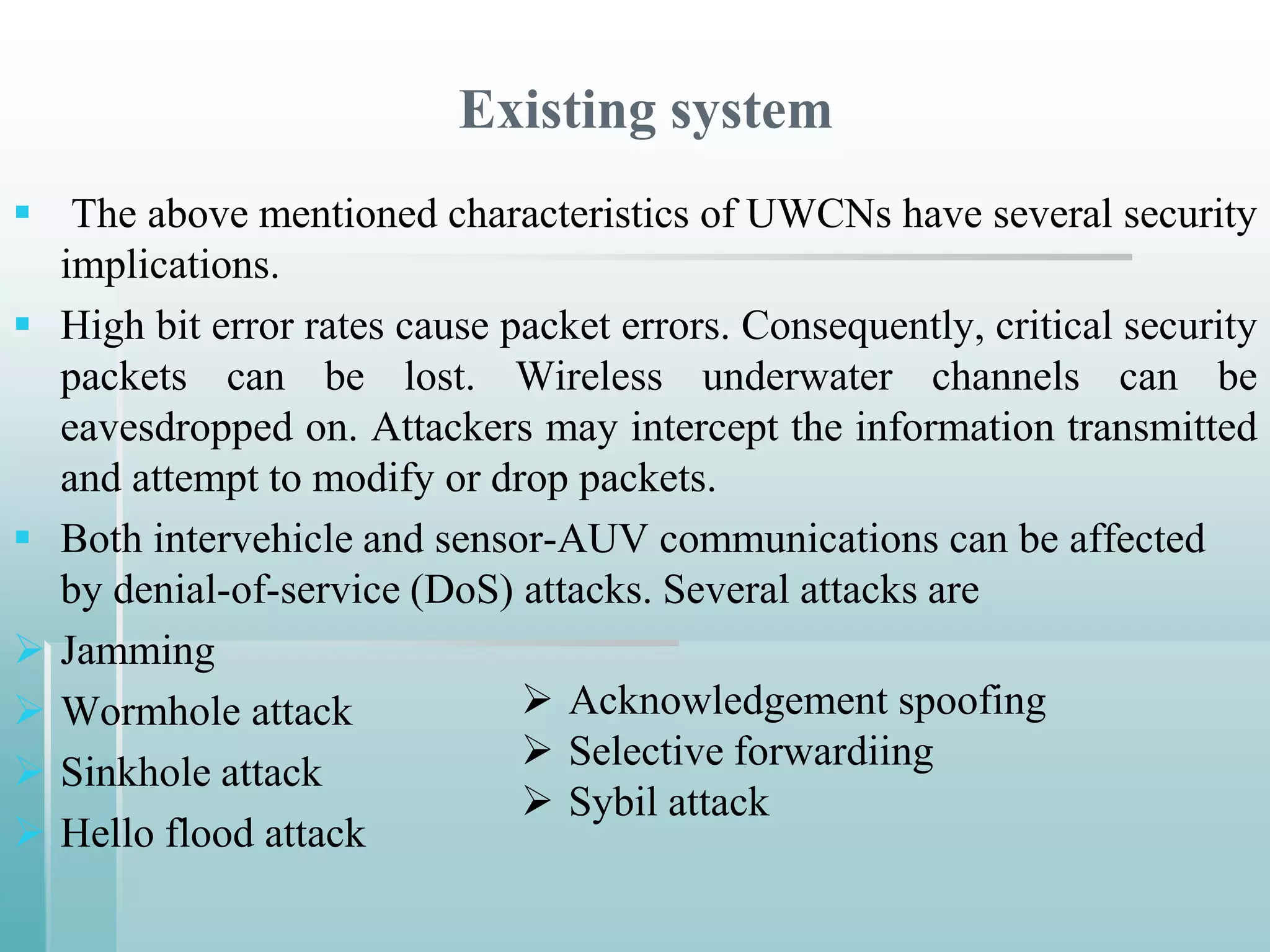
 Wormhole attack              Acknowledgement spoofing
 Sinkhole attack              Selective forwardiing
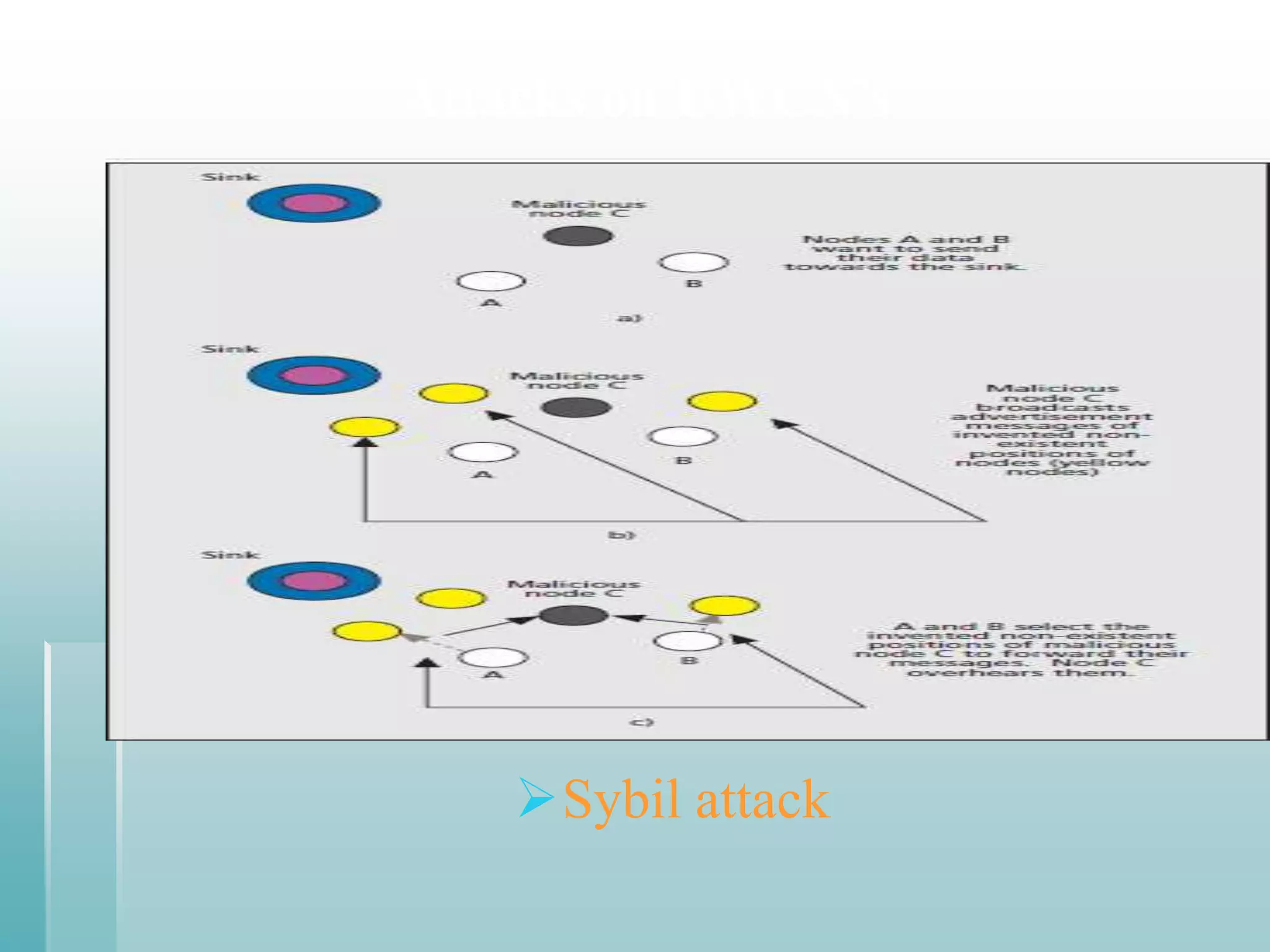
                               Sybil attack
 Hello flood attack
Attacks on UWCN’s


  Jamming attack
Attacks on UWCN’s


  Wormhole attack
Attacks on UWCN’s


   Sybil attack
Proposed system
 Secure time synchronization mechanism
Achieving precise time synchronization is especially difficult
in underwater environments due to the characteristics of
UWCNs. For this reason, the time synchronization
mechanisms proposed for ground-based sensor networks
cannot be applied, and new mechanisms have been proposed.
 Secure Localization
Proposed terrestrial localization schemes based on received
signal strength (RSS) are not recommended in UWCNs, since
non-uniform acoustic signal propagation causes signifiant
variations in the RSS. Time of arrival (ToA) and time
difference of arrival (TDoA)
Proposed system(contd)

 Secure routing
 Routing is essential for packet delivery in UWCNs. Proposed
  broadcast authentication methods would cause high communication
  overhead and latency in UWCNs. Multipath routing would cause high
  communication overhead as well.
Advantages

 It avoids data spoofing.

 It avoids privacy leakage.

 Minimize communication and computational cost.

 Maximizes the battery power by preserve the power of
  Underwater sensors.
Drawbacks


 Routing is specially challenging in UWCNs due to the large
  propagation delays, low bandwidth, difficulty of battery refills of
  underwater sensors, and dynamic topologies.


 Schemes is challenging because they do not work well in mobile
  environments.
APPLICATIONS


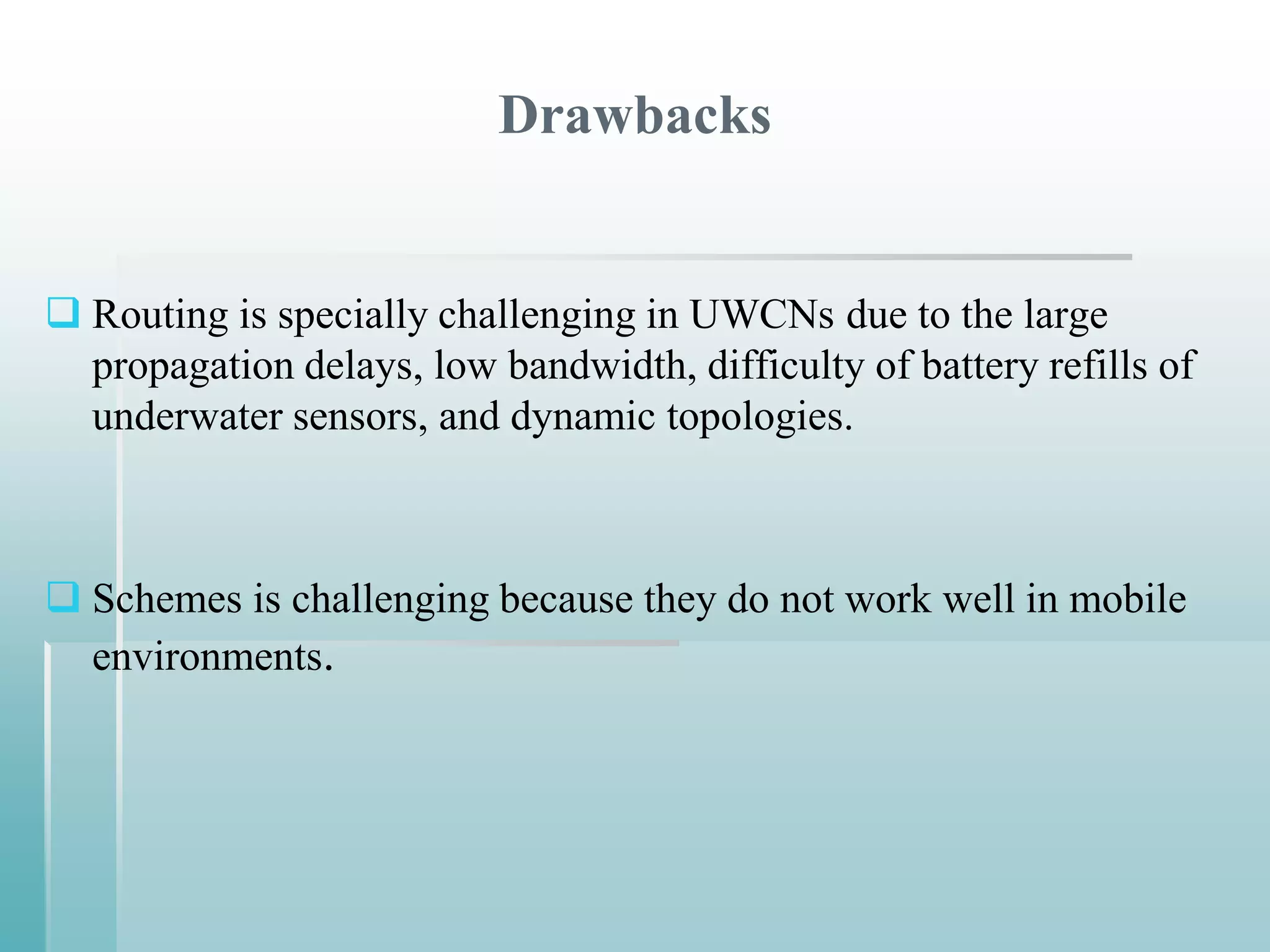
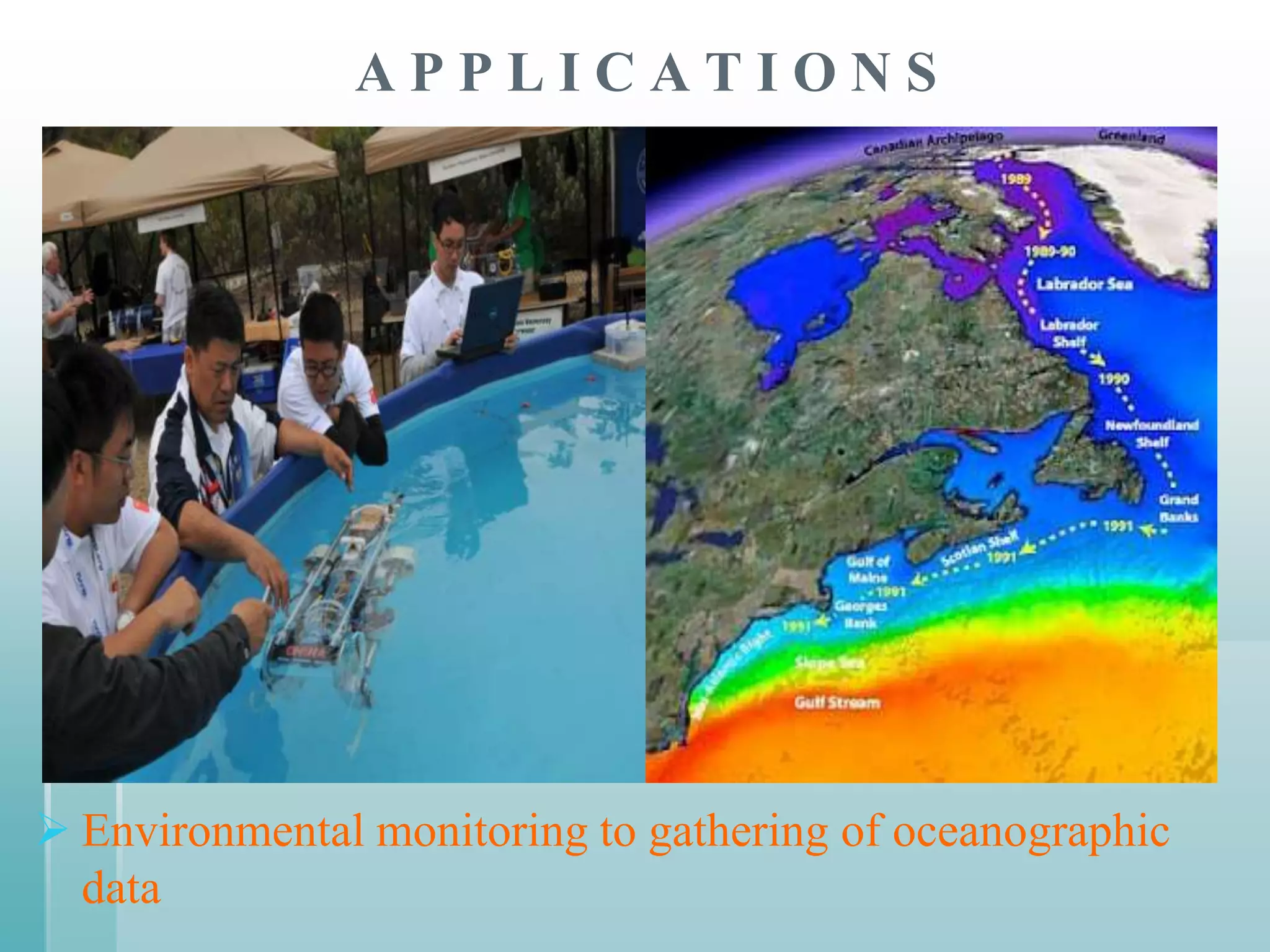
 Environmental monitoring to gathering of oceanographic
  data
APPLICATIONS


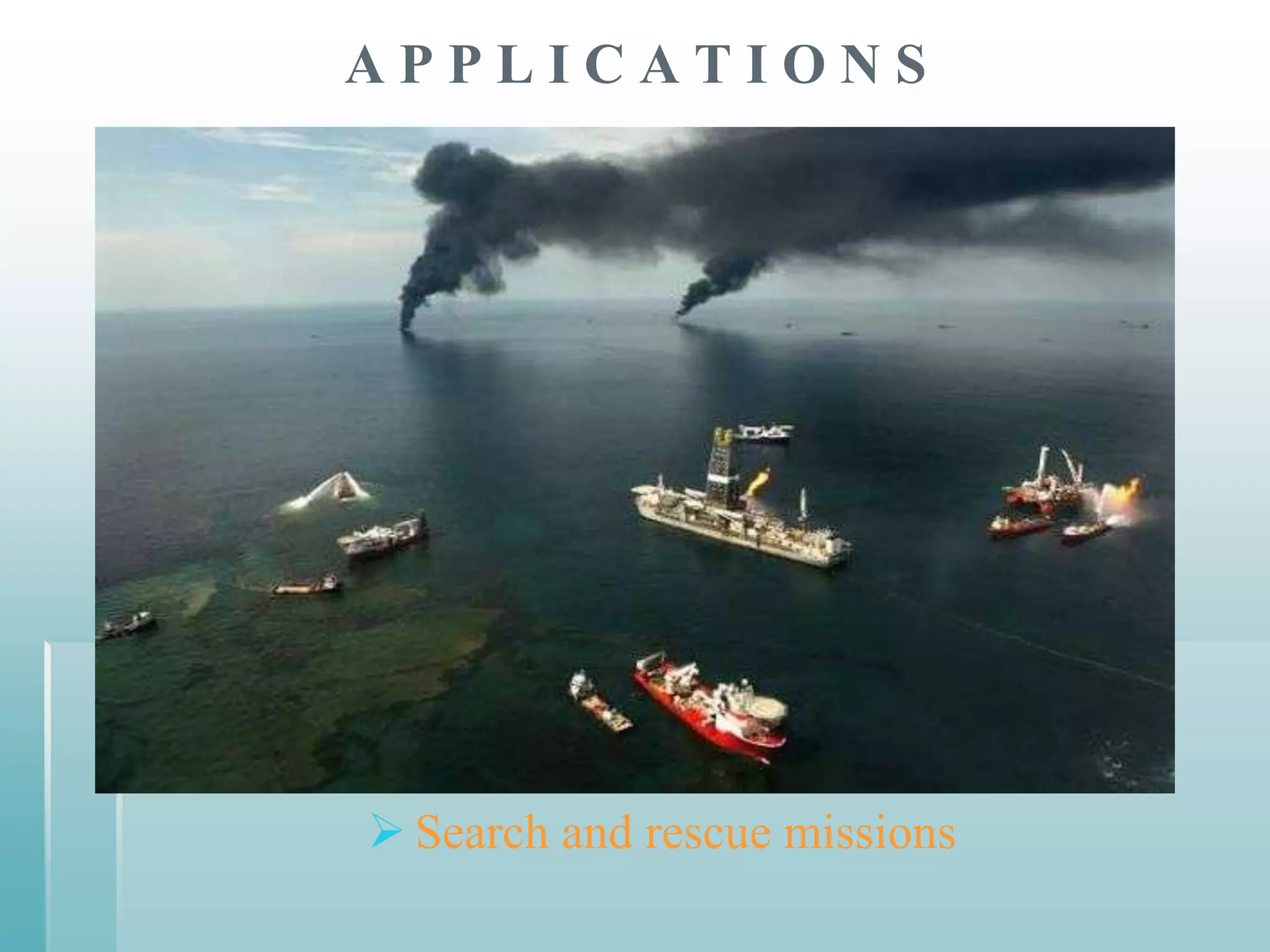
 Search and rescue missions
APPLICATIONS


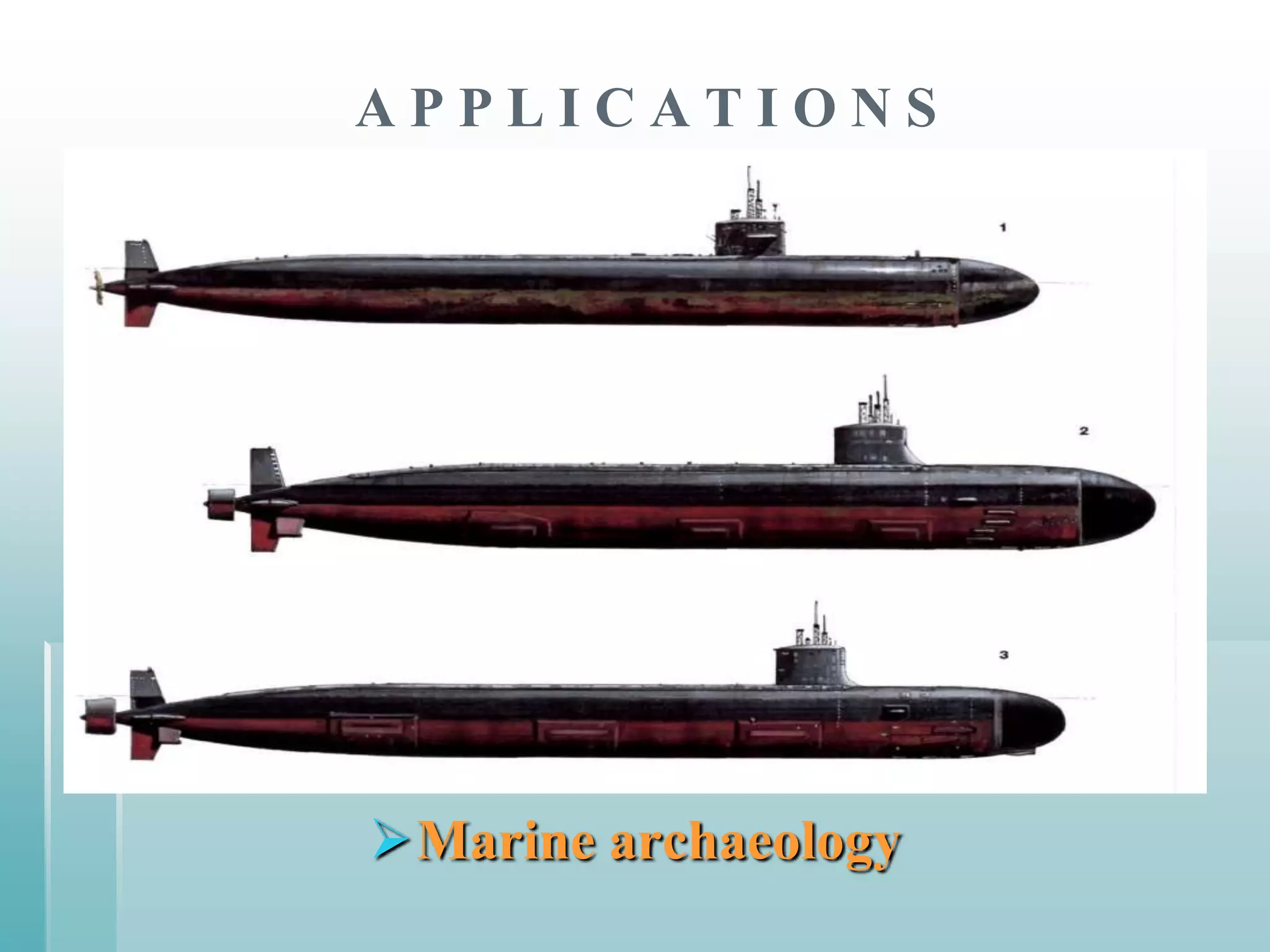
Marine archaeology
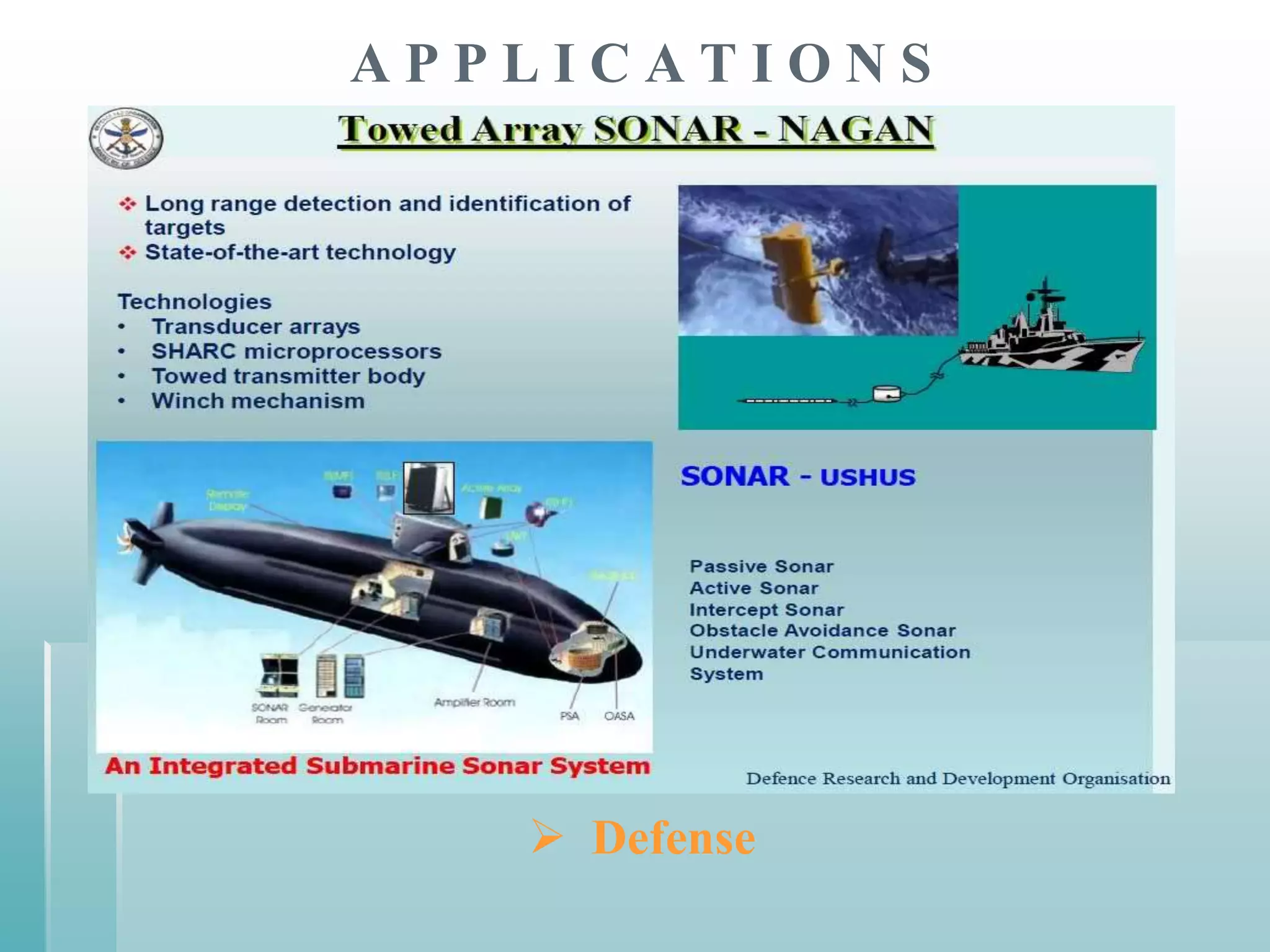
APPLICATIONS


    Defense
CONCLUSION

    Wireless technology will play a vital role in many
    application areas that are not possible in the past. Wireless
    Underwater communication would be one of them.

 The main challenges related to secure time
  synchronization, localization, and routing have been
  surveyed.

 Since the deployment of the proposed system is still in its
  development stage, an account of actual implementation has
  not been provided in this paper.
Thank you…!!!

“Securing underwater wireless communication networks” 2

  • 1.
    VISVESVARAYA TECHNOLOGICAL UNIVERSITY Jnana Sangama, Belgaum, Karnataka-590 014. A Seminar On “Securing Underwater Wireless Communication Networks” By Project Guide NAVEENA N (1BT08CS051) Mr. KESHAVA M (Lecturer of CSE department) B.T.L INSTITUTE OF TECHNOLOGY Department of Computer Science & Engineering 2010-11
  • 2.
    AGENDA oAbstract oUnderwater Wireless CommunicationNetworks oExisting system oProposed System oDrawbacks oApplications oConclusion
  • 3.
    ABSTRACT  Underwater wireless communication networks are particularly vulnerable to malicious attacks due to the high bit error rates, large and variable propagation delays, and low bandwidth of acoustic channels.  (UWCNs) are constituted by sensors and autonomous underwater vehicles (AUVs) that interact to perform specific applications such as underwater monitoring.
  • 4.
    ABSTRACT  Both intervehicle and sensor-AUV communications can be affected by denial-of- service (DoS) attacks.  We propose several methods to secure Underwater Wireless Communication Networks.  We design three schemes namely, secure time synchronization, localization, and routing in UWCNs
  • 5.
    ABSTRACT  Aim ofproposed techniques is to enable the system to provide secure data transmission.  Secure time synchronization aims for power saving.  Secure localization aims to provide location information and data tagging.  Secure routing rejects routing paths containing malicious nodes.
  • 6.
    These techniques arebased on following mechanisms  Secure Time Synchronization It is essential in many underwater applications such as coordinated sensing tasks. & scheduling algorithms such as timedivision multiple access (TDMA).  SECURE LOCALIZATION Localization is a very important issue for data tagging. Localization schemes can be classified into two types: (i) Range-based schemes (using range or bearing information): (ii) Range-free schemes (not using range or bearing information):  SECURE ROUTING Routing is essential for packet delivery in UWCNs.
  • 7.
    Underwater Wireless CommunicationNetworks Underwater Wireless Communication Networks are constituted by  sensor nodes, also known as motes or simply nodes are small and energy constrained devices that have the ability of sensing the surrounding environment.  The sink, also known as base station, is a more powerful node that behaves as an interface between the sensor nodes and the clients.  Autonomous Underwater Vehicles (AUVs) that interact to perform specific applications such as underwater monitoring
  • 8.
  • 9.
    Existing system  Radiowaves do not propagate well underwater due to the high energy absorption of water  Therefore, underwater communications are based on acoustic links characterized by large propagation delays. The propagation speed of acoustic signals in water (typically 1500 m/s)  Acoustic channels have low bandwidth As a result, the bit error rates of acoustic links are often high, and losses of connectivity arise  It cannot rely on the Global Positioning System (GPS) because it uses radar waves in the 1.5 GHz band that do not propagate in water.
  • 10.
    Existing system  Theabove mentioned characteristics of UWCNs have several security implications.  High bit error rates cause packet errors. Consequently, critical security packets can be lost. Wireless underwater channels can be eavesdropped on. Attackers may intercept the information transmitted and attempt to modify or drop packets.  Both intervehicle and sensor-AUV communications can be affected by denial-of-service (DoS) attacks. Several attacks are  Jamming  Wormhole attack  Acknowledgement spoofing  Sinkhole attack  Selective forwardiing  Sybil attack  Hello flood attack
  • 11.
    Attacks on UWCN’s  Jamming attack
  • 12.
    Attacks on UWCN’s Wormhole attack
  • 13.
    Attacks on UWCN’s Sybil attack
  • 14.
    Proposed system  Securetime synchronization mechanism Achieving precise time synchronization is especially difficult in underwater environments due to the characteristics of UWCNs. For this reason, the time synchronization mechanisms proposed for ground-based sensor networks cannot be applied, and new mechanisms have been proposed.  Secure Localization Proposed terrestrial localization schemes based on received signal strength (RSS) are not recommended in UWCNs, since non-uniform acoustic signal propagation causes signifiant variations in the RSS. Time of arrival (ToA) and time difference of arrival (TDoA)
  • 15.
    Proposed system(contd)  Securerouting  Routing is essential for packet delivery in UWCNs. Proposed broadcast authentication methods would cause high communication overhead and latency in UWCNs. Multipath routing would cause high communication overhead as well.
  • 16.
    Advantages  It avoidsdata spoofing.  It avoids privacy leakage.  Minimize communication and computational cost.  Maximizes the battery power by preserve the power of Underwater sensors.
  • 17.
    Drawbacks  Routing isspecially challenging in UWCNs due to the large propagation delays, low bandwidth, difficulty of battery refills of underwater sensors, and dynamic topologies.  Schemes is challenging because they do not work well in mobile environments.
  • 18.
    APPLICATIONS  Environmental monitoringto gathering of oceanographic data
  • 19.
  • 20.
  • 21.
    APPLICATIONS  Defense
  • 22.
    CONCLUSION  Wireless technology will play a vital role in many application areas that are not possible in the past. Wireless Underwater communication would be one of them.  The main challenges related to secure time synchronization, localization, and routing have been surveyed.  Since the deployment of the proposed system is still in its development stage, an account of actual implementation has not been provided in this paper.
  • 23.