www.studymafia.org
Submitted By:
www.studymafia.org www.studymafia.org
Seminar
On
Underwater Wireless
Communication
Content
 Introduction
 History
 Necessity of Underwater Wireless Communication
 Underwater Wireless Communication Technology
 Applications
 Advantages
 Disadvantages
 Conclusion
 Reference
Introduction
• Underwater wireless communication is the wireless
communication in which acoustic signals (waves) carry
digital information through an underwater channel.
• Technique of sending and receiving message under the
utilization of sound propagation in underwater
environment is known as acoustic communication.
• Among the types of waves, acoustic waves are used
as the primary carrier for underwater
wirelesscommunication systems due to the relatively low
absorption in underwater environments.
History
 The science of underwater acoustics began in 1490,
• when Leonardo Da Vinci, stated.
 In 1687 Isaac Newton wrote his Mathematical
Principles of Natural Philosophy which included the
first mathematical treatment of sound in water.
Necessity of Underwater Wireless
Communication
Wired underwater is not possible in all situations as
shown below-:
• Temporary experiments
• Breaking of wires
• Significant cost of deployment
• Experiment over long distances.
To cope up with above situations, we require
underwater wireless communication.
Underwater Wireless Communication
Technology
• Radio waves do not propagate well underwater due
to the high energy absorption of water.
• Therefore, underwater communication are based on
acoustic links characterized by large propagation
delays.
• Acoustic channels have low bandwidth.
Cont…
• The signal that are used to carry digital information
through an underwater channel are acoustic channel.
• The propagation speed of acoustic signals in water is
typically 1500 m/s.
• It cannot rely on the Global Positioning System (GPS).
Factors Influencing Acoustic
Communication
• Path loss: Due to attenuation and geometric
spreading.
• Noise: Man-made noise and ambient noise(due to
hydrodynamics)
• Multi-path propogation
• High propogation delay
• Doppler frequency spread.
Hardware Platform Interfaces
• Sensor Interface:
– Must develop common interface with different sensors (chemical,
optical, etc.) and communication elements (transducer) .
– Wide (constantly changing) variety of sensors, sampling strategies
• Communication Interface:
Amplifiers, Transducers
Signal modulation
Hardware:
 Software Defined Acoustic Modem (SDAM)
 Reconfigurable hardware known to provide, flexible, high
performance implementations for DSP applications
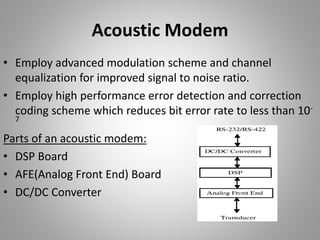
Acoustic Modem
• Employ advanced modulation scheme and channel
equalization for improved signal to noise ratio.
• Employ high performance error detection and correction
coding scheme which reduces bit error rate to less than 10-
7
Parts of an acoustic modem:
• DSP Board
• AFE(Analog Front End) Board
• DC/DC Converter
Data Transmission in Modem
When no data is being transmitted, the modem stays in
sleep mode, it periodically wakes up to receive possible
data being transmitted by far end modem. This results in
low power consumption. Similarly when the data is to be
transmitted , the modem receives data from its link in
sleep mode and then switches to transmit mode and
transmit the data.
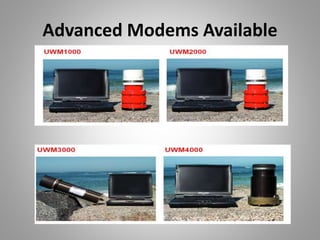
Advanced Modems Available
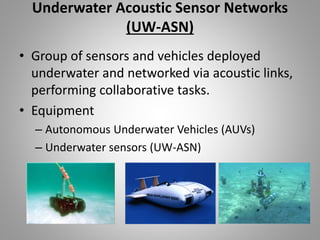
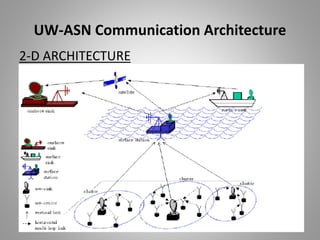
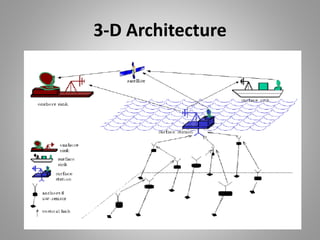
Underwater Acoustic Sensor Networks
(UW-ASN)
• Group of sensors and vehicles deployed
underwater and networked via acoustic links,
performing collaborative tasks.
• Equipment
– Autonomous Underwater Vehicles (AUVs)
– Underwater sensors (UW-ASN)
UW-ASN Communication Architecture
2-D ARCHITECTURE
3-D Architecture
Applications
• Seismic monitoring.
• Pollution monitoring
• Ocean currents monitoring
• Equipment monitoring and control
• Autonomous Underwater Vehicles (AUV)
• Remotely operated vehicle(ROV)
• Acoustic navigation technology for multiple AUVs.
• Solar Powered AUVs
Advantages
• Can be used to provide early warnings of
tsunamis generated by undersea earthquakes.
• It avoids data spoofing.
• It avoids privacy leakage.
• Pollution monitoring.
Disadvantages
• Battery power is limited and usually batteries cannot
be recharged also because solar energy cannot be
exploited .
•
• The available bandwidth is severely limited.
• Channel characteristics including long and variable
propagation delays.
• Multipath and fading problems.
• High bit error rate.
Conclusion
Despite much development in this area of the
underwater wireless communication, there is still an
immense scope so more research as major part of the
ocean bottom yet remains unexploded.
The main objective is to overcome the present limitations
and implement advanced technology for oceanographic
research and cope up with the environmental effects on
the noise performance of acoustic systems to compete
with the future challenges like effective transmission of
audio and video signals etc.
Reference
• www.google.com
• www.wikipedia.com
• www.studymafia.org
THANK YOU
QUERIES??

rajat Ppt mwc.pptx

  • 1.
  • 2.
    Content  Introduction  History Necessity of Underwater Wireless Communication  Underwater Wireless Communication Technology  Applications  Advantages  Disadvantages  Conclusion  Reference
  • 3.
    Introduction • Underwater wirelesscommunication is the wireless communication in which acoustic signals (waves) carry digital information through an underwater channel. • Technique of sending and receiving message under the utilization of sound propagation in underwater environment is known as acoustic communication. • Among the types of waves, acoustic waves are used as the primary carrier for underwater wirelesscommunication systems due to the relatively low absorption in underwater environments.
  • 4.
    History  The scienceof underwater acoustics began in 1490, • when Leonardo Da Vinci, stated.  In 1687 Isaac Newton wrote his Mathematical Principles of Natural Philosophy which included the first mathematical treatment of sound in water.
  • 5.
    Necessity of UnderwaterWireless Communication Wired underwater is not possible in all situations as shown below-: • Temporary experiments • Breaking of wires • Significant cost of deployment • Experiment over long distances. To cope up with above situations, we require underwater wireless communication.
  • 6.
    Underwater Wireless Communication Technology •Radio waves do not propagate well underwater due to the high energy absorption of water. • Therefore, underwater communication are based on acoustic links characterized by large propagation delays. • Acoustic channels have low bandwidth.
  • 7.
    Cont… • The signalthat are used to carry digital information through an underwater channel are acoustic channel. • The propagation speed of acoustic signals in water is typically 1500 m/s. • It cannot rely on the Global Positioning System (GPS).
  • 8.
    Factors Influencing Acoustic Communication •Path loss: Due to attenuation and geometric spreading. • Noise: Man-made noise and ambient noise(due to hydrodynamics) • Multi-path propogation • High propogation delay • Doppler frequency spread.
  • 9.
    Hardware Platform Interfaces •Sensor Interface: – Must develop common interface with different sensors (chemical, optical, etc.) and communication elements (transducer) . – Wide (constantly changing) variety of sensors, sampling strategies • Communication Interface: Amplifiers, Transducers Signal modulation Hardware:  Software Defined Acoustic Modem (SDAM)  Reconfigurable hardware known to provide, flexible, high performance implementations for DSP applications
  • 10.
    Acoustic Modem • Employadvanced modulation scheme and channel equalization for improved signal to noise ratio. • Employ high performance error detection and correction coding scheme which reduces bit error rate to less than 10- 7 Parts of an acoustic modem: • DSP Board • AFE(Analog Front End) Board • DC/DC Converter
  • 11.
    Data Transmission inModem When no data is being transmitted, the modem stays in sleep mode, it periodically wakes up to receive possible data being transmitted by far end modem. This results in low power consumption. Similarly when the data is to be transmitted , the modem receives data from its link in sleep mode and then switches to transmit mode and transmit the data.
  • 12.
  • 13.
    Underwater Acoustic SensorNetworks (UW-ASN) • Group of sensors and vehicles deployed underwater and networked via acoustic links, performing collaborative tasks. • Equipment – Autonomous Underwater Vehicles (AUVs) – Underwater sensors (UW-ASN)
  • 14.
  • 15.
  • 16.
    Applications • Seismic monitoring. •Pollution monitoring • Ocean currents monitoring • Equipment monitoring and control • Autonomous Underwater Vehicles (AUV) • Remotely operated vehicle(ROV) • Acoustic navigation technology for multiple AUVs. • Solar Powered AUVs
  • 17.
    Advantages • Can beused to provide early warnings of tsunamis generated by undersea earthquakes. • It avoids data spoofing. • It avoids privacy leakage. • Pollution monitoring.
  • 18.
    Disadvantages • Battery poweris limited and usually batteries cannot be recharged also because solar energy cannot be exploited . • • The available bandwidth is severely limited. • Channel characteristics including long and variable propagation delays. • Multipath and fading problems. • High bit error rate.
  • 19.
    Conclusion Despite much developmentin this area of the underwater wireless communication, there is still an immense scope so more research as major part of the ocean bottom yet remains unexploded. The main objective is to overcome the present limitations and implement advanced technology for oceanographic research and cope up with the environmental effects on the noise performance of acoustic systems to compete with the future challenges like effective transmission of audio and video signals etc.
  • 20.
  • 21.
  • 22.