SEMINAR PRESENTATION ON
UNDERWATER WIRELESS
COMMUNICATION TECHNOLOGY
GUIDED BY:
Prof. G.M.Dahane
SUBMITTED BY :
S.M.Shinde
4/2/2014 1
OUTLINE
• Introduction
• History
• Underwater Wireless Communication Tech.
• Attacks and counter measures
• Necessity of Underwater Wireless
Communication
• Conclusion
• References
4/2/2014 2
INTRODUCTION
• Underwater wireless communication is the
wireless communication in which acoustic signals
(waves) carry digital information through an
underwater channel.
• The signal that are used to carry digital
information through an underwater channel are
acoustic channel.
4/2/2014 3
 The science of underwater acoustics began in 1490,
when Leonardo Da Vinci, stated.
 In 1687 Isaac Newton wrote his Mathematical
Principles of Natural Philosophy which included the first
mathematical treatment of sound in water.
HISTORY
4/2/2014 4
Underwater Wireless Communication
Technology
• Radio waves do not propagate well underwater due
to the high energy absorption of water.
• Therefore, underwater communication are based on
acoustic links characterized by large propagation
delays.
• Acoustic channels have low bandwidth.
4/2/2014 5
Underwater Wireless Communication
Technology
• The signal that are used to carry digital information
through an underwater channel are acoustic channel.
• The propagation speed of acoustic signals in water is
typically 1500 m/s.
• It cannot rely on the Global Positioning System (GPS).
4/2/2014 6
WAVE PROPAGATION
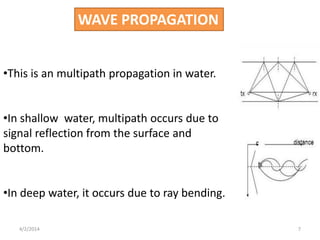
•This is an multipath propagation in water.
•In shallow water, multipath occurs due to
signal reflection from the surface and
bottom.
•In deep water, it occurs due to ray bending.
4/2/2014 7
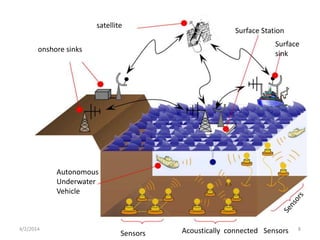
satellite
onshore sinks
Autonomous
Underwater
Vehicle
Surface
sink
Surface Station
Acoustically connected SensorsSensors
4/2/2014 8
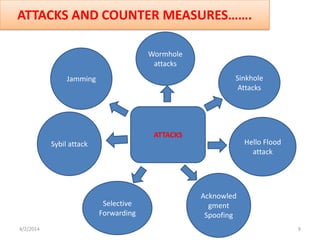
ATTACKS AND COUNTER MEASURES…….
Jamming
Wormhole
attacks
Sybil attack
Selective
Forwarding
Acknowled
gment
Spoofing
ATTACKS
Hello Flood
attack
Sinkhole
Attacks
4/2/2014 9
Jamming
Method of Attack
Countermeasures
•The transmission of data packets continuously so that
the wireless channel get completely blocked.
•Spread spectrum techniques.
•Sensors can switch to sleep mode
4/2/2014 10
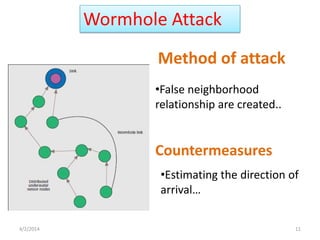
Wormhole Attack
Method of attack
•False neighborhood
relationship are created..
Countermeasures
•Estimating the direction of
arrival…
4/2/2014 11
Authentication
•Proof that data was sent by a legitimate user
Integrity
•Information is not altered.
4/2/2014 12
Confidentiality
•Information is not accessible to unauthorized
parties.
Availability
•Data should be available when needed by an
authorized user.
4/2/2014 13
HARDWARE PLATFORM INTERFACES
Sensor Interface:
Wide (constantly changing) variety of sensors,
sampling strategies.
Hardware:
Software Defined Acoustic Modem (SDAM)
Communication Interface:
Amplifiers, Transducer Signal modulation
4/2/2014 14
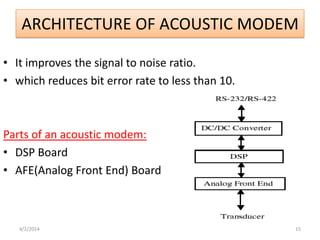
ARCHITECTURE OF ACOUSTIC MODEM
• It improves the signal to noise ratio.
• which reduces bit error rate to less than 10.
Parts of an acoustic modem:
• DSP Board
• AFE(Analog Front End) Board
4/2/2014 15
DATA TRANSMISSION IN MODEM
• When no data is being transmitted, the modem stays in
sleep mode.
• The modem receives data from its link in sleep mode and
then switches to transmit mode and transmit the data.
4/2/2014 16
NECESSITY OF UNDERWATER WIRELESS
COMMUNICATION
Wired underwater is not feasible in all situations as
shown below-:
• Temporary experiments
• Breaking of wires
• Significant cost of deployment
• Experiment over long distances.
To cope up with above situations, we require
underwater wireless communication.
4/2/2014 17
ADVANTAGES
•Can be used to provide early warnings of
tsunamis generated by undersea earthquakes.
•It avoids data spoofing.
•It avoids privacy leakage.
•Pollution monitoring.
4/2/2014 18
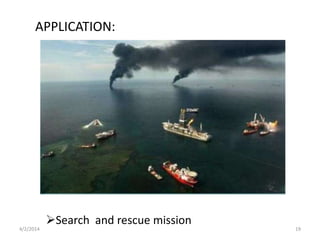
APPLICATION:
Search and rescue mission
4/2/2014 19
• Battery power is limited and usually batteries
cannot be recharged also because solar energy
cannot be exploited .
•The available bandwidth is severely limited.
• Channel characteristics including long and
variable propagation delays.
•Multipath and fading problems.
• High bit error rate.
DISADVANTAGES
4/2/2014 20
• The aim of this is to build a acoustic
communication.
• This is not only the way for
underwater communication.
• By using optical waves which offers
higher throughput (Mbps) over short
distances (up to about 100 m) .
CONCLUSION
4/2/2014 21
4/2/2014 22

underwater wireless communication by shyam shinde

  • 1.
    SEMINAR PRESENTATION ON UNDERWATERWIRELESS COMMUNICATION TECHNOLOGY GUIDED BY: Prof. G.M.Dahane SUBMITTED BY : S.M.Shinde 4/2/2014 1
  • 2.
    OUTLINE • Introduction • History •Underwater Wireless Communication Tech. • Attacks and counter measures • Necessity of Underwater Wireless Communication • Conclusion • References 4/2/2014 2
  • 3.
    INTRODUCTION • Underwater wirelesscommunication is the wireless communication in which acoustic signals (waves) carry digital information through an underwater channel. • The signal that are used to carry digital information through an underwater channel are acoustic channel. 4/2/2014 3
  • 4.
     The scienceof underwater acoustics began in 1490, when Leonardo Da Vinci, stated.  In 1687 Isaac Newton wrote his Mathematical Principles of Natural Philosophy which included the first mathematical treatment of sound in water. HISTORY 4/2/2014 4
  • 5.
    Underwater Wireless Communication Technology •Radio waves do not propagate well underwater due to the high energy absorption of water. • Therefore, underwater communication are based on acoustic links characterized by large propagation delays. • Acoustic channels have low bandwidth. 4/2/2014 5
  • 6.
    Underwater Wireless Communication Technology •The signal that are used to carry digital information through an underwater channel are acoustic channel. • The propagation speed of acoustic signals in water is typically 1500 m/s. • It cannot rely on the Global Positioning System (GPS). 4/2/2014 6
  • 7.
    WAVE PROPAGATION •This isan multipath propagation in water. •In shallow water, multipath occurs due to signal reflection from the surface and bottom. •In deep water, it occurs due to ray bending. 4/2/2014 7
  • 8.
  • 9.
    ATTACKS AND COUNTERMEASURES……. Jamming Wormhole attacks Sybil attack Selective Forwarding Acknowled gment Spoofing ATTACKS Hello Flood attack Sinkhole Attacks 4/2/2014 9
  • 10.
    Jamming Method of Attack Countermeasures •Thetransmission of data packets continuously so that the wireless channel get completely blocked. •Spread spectrum techniques. •Sensors can switch to sleep mode 4/2/2014 10
  • 11.
    Wormhole Attack Method ofattack •False neighborhood relationship are created.. Countermeasures •Estimating the direction of arrival… 4/2/2014 11
  • 12.
    Authentication •Proof that datawas sent by a legitimate user Integrity •Information is not altered. 4/2/2014 12
  • 13.
    Confidentiality •Information is notaccessible to unauthorized parties. Availability •Data should be available when needed by an authorized user. 4/2/2014 13
  • 14.
    HARDWARE PLATFORM INTERFACES SensorInterface: Wide (constantly changing) variety of sensors, sampling strategies. Hardware: Software Defined Acoustic Modem (SDAM) Communication Interface: Amplifiers, Transducer Signal modulation 4/2/2014 14
  • 15.
    ARCHITECTURE OF ACOUSTICMODEM • It improves the signal to noise ratio. • which reduces bit error rate to less than 10. Parts of an acoustic modem: • DSP Board • AFE(Analog Front End) Board 4/2/2014 15
  • 16.
    DATA TRANSMISSION INMODEM • When no data is being transmitted, the modem stays in sleep mode. • The modem receives data from its link in sleep mode and then switches to transmit mode and transmit the data. 4/2/2014 16
  • 17.
    NECESSITY OF UNDERWATERWIRELESS COMMUNICATION Wired underwater is not feasible in all situations as shown below-: • Temporary experiments • Breaking of wires • Significant cost of deployment • Experiment over long distances. To cope up with above situations, we require underwater wireless communication. 4/2/2014 17
  • 18.
    ADVANTAGES •Can be usedto provide early warnings of tsunamis generated by undersea earthquakes. •It avoids data spoofing. •It avoids privacy leakage. •Pollution monitoring. 4/2/2014 18
  • 19.
  • 20.
    • Battery poweris limited and usually batteries cannot be recharged also because solar energy cannot be exploited . •The available bandwidth is severely limited. • Channel characteristics including long and variable propagation delays. •Multipath and fading problems. • High bit error rate. DISADVANTAGES 4/2/2014 20
  • 21.
    • The aimof this is to build a acoustic communication. • This is not only the way for underwater communication. • By using optical waves which offers higher throughput (Mbps) over short distances (up to about 100 m) . CONCLUSION 4/2/2014 21
  • 22.