Understanding
Work Team
Kelompok 5 :
Kirano Soewondo
Fariz Hutama
Fakhrurroji
M Fadhil Parmato
Mega Nur Innama
WHAT’S MAKE A TEAM?
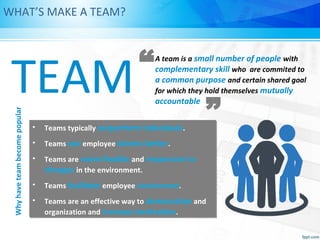
• Teams typically outperform individuals.
• Teams use employee talents better.
• Teams are more flexible and responsive to
changes in the environment.
• Teams facilitate employee involvement.
• Teams are an effective way to democratize and
organization and increase motivation.
• Teams typically outperform individuals.
• Teams use employee talents better.
• Teams are more flexible and responsive to
changes in the environment.
• Teams facilitate employee involvement.
• Teams are an effective way to democratize and
organization and increase motivation.
“
TEAM
A team is a small number of people with
complementary skill who are commited to
a common purpose and certain shared goal
for which they hold themselves mutually
accountable
“
Whyhaveteambecomepopular
TEAM VS GROUP
A group that interacts primarily to
share information and to make
decisions to help each group
member perform within his or her
area of responsibility.
Share Information
Neutral (sometimes negative)
Individual
Random and varied
Collective Performance
Positive
Individual and Mutual
Complementary
Goal
Synergy
Accountability
Skills
Work Group Work Team
A group whose individual efforts
result in a performance that is
greater than the sum of the
individual inputs.VS
TYPE OF TEAMS
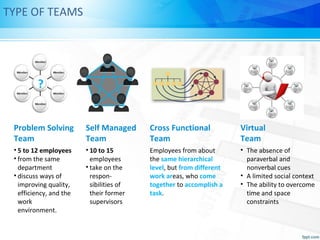
• 5 to 12 employees
• from the same
department
• discuss ways of
improving quality,
efficiency, and the
work
environment.
• 10 to 15
employees
• take on the
respon-
sibilities of
their former
supervisors
Employees from about
the same hierarchical
level, but from different
work areas, who come
together to accomplish a
task.
• The absence of
paraverbal and
nonverbal cues
• A limited social context
• The ability to overcome
time and space
constraints
Problem Solving
Team
?
Self Managed
Team
Cross Functional
Team
Virtual
Team
TEAM EFFECTIVENESS
CONTEXTCOMPOSITION
• Adequate resources
• Leadership and structure
• Climate of trust
• Performance evaluation
and rewards systems
• Abilities of members
• Personality
• Allocating roles
• Diversity
• Size of teams
• Member Flexibility
• Member preferences
PROCESS
• Common purpose
• Specific goals
• Team efficacy
• Conflict levels
• Social loafing
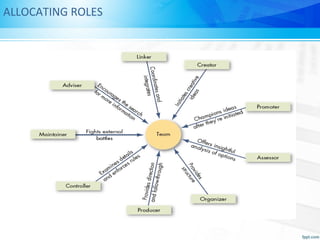
ALLOCATING ROLES
TURNING INDIVIDUALS INTO TEAM PLAYER
• Overcoming
individual resistance
to team membership.
• Countering the
influence of
individualistic
cultures.
• Introducing teams in
an organization that
has historically
valued individual
achievement
Teams aren’t always the answer
3CHALLENGE
!!

Understanding work team

  • 1.
    Understanding Work Team Kelompok 5: Kirano Soewondo Fariz Hutama Fakhrurroji M Fadhil Parmato Mega Nur Innama
  • 2.
    WHAT’S MAKE ATEAM? • Teams typically outperform individuals. • Teams use employee talents better. • Teams are more flexible and responsive to changes in the environment. • Teams facilitate employee involvement. • Teams are an effective way to democratize and organization and increase motivation. • Teams typically outperform individuals. • Teams use employee talents better. • Teams are more flexible and responsive to changes in the environment. • Teams facilitate employee involvement. • Teams are an effective way to democratize and organization and increase motivation. “ TEAM A team is a small number of people with complementary skill who are commited to a common purpose and certain shared goal for which they hold themselves mutually accountable “ Whyhaveteambecomepopular
  • 3.
    TEAM VS GROUP Agroup that interacts primarily to share information and to make decisions to help each group member perform within his or her area of responsibility. Share Information Neutral (sometimes negative) Individual Random and varied Collective Performance Positive Individual and Mutual Complementary Goal Synergy Accountability Skills Work Group Work Team A group whose individual efforts result in a performance that is greater than the sum of the individual inputs.VS
  • 4.
    TYPE OF TEAMS •5 to 12 employees • from the same department • discuss ways of improving quality, efficiency, and the work environment. • 10 to 15 employees • take on the respon- sibilities of their former supervisors Employees from about the same hierarchical level, but from different work areas, who come together to accomplish a task. • The absence of paraverbal and nonverbal cues • A limited social context • The ability to overcome time and space constraints Problem Solving Team ? Self Managed Team Cross Functional Team Virtual Team
  • 5.
    TEAM EFFECTIVENESS CONTEXTCOMPOSITION • Adequateresources • Leadership and structure • Climate of trust • Performance evaluation and rewards systems • Abilities of members • Personality • Allocating roles • Diversity • Size of teams • Member Flexibility • Member preferences PROCESS • Common purpose • Specific goals • Team efficacy • Conflict levels • Social loafing
  • 6.
  • 7.
    TURNING INDIVIDUALS INTOTEAM PLAYER • Overcoming individual resistance to team membership. • Countering the influence of individualistic cultures. • Introducing teams in an organization that has historically valued individual achievement Teams aren’t always the answer 3CHALLENGE !!