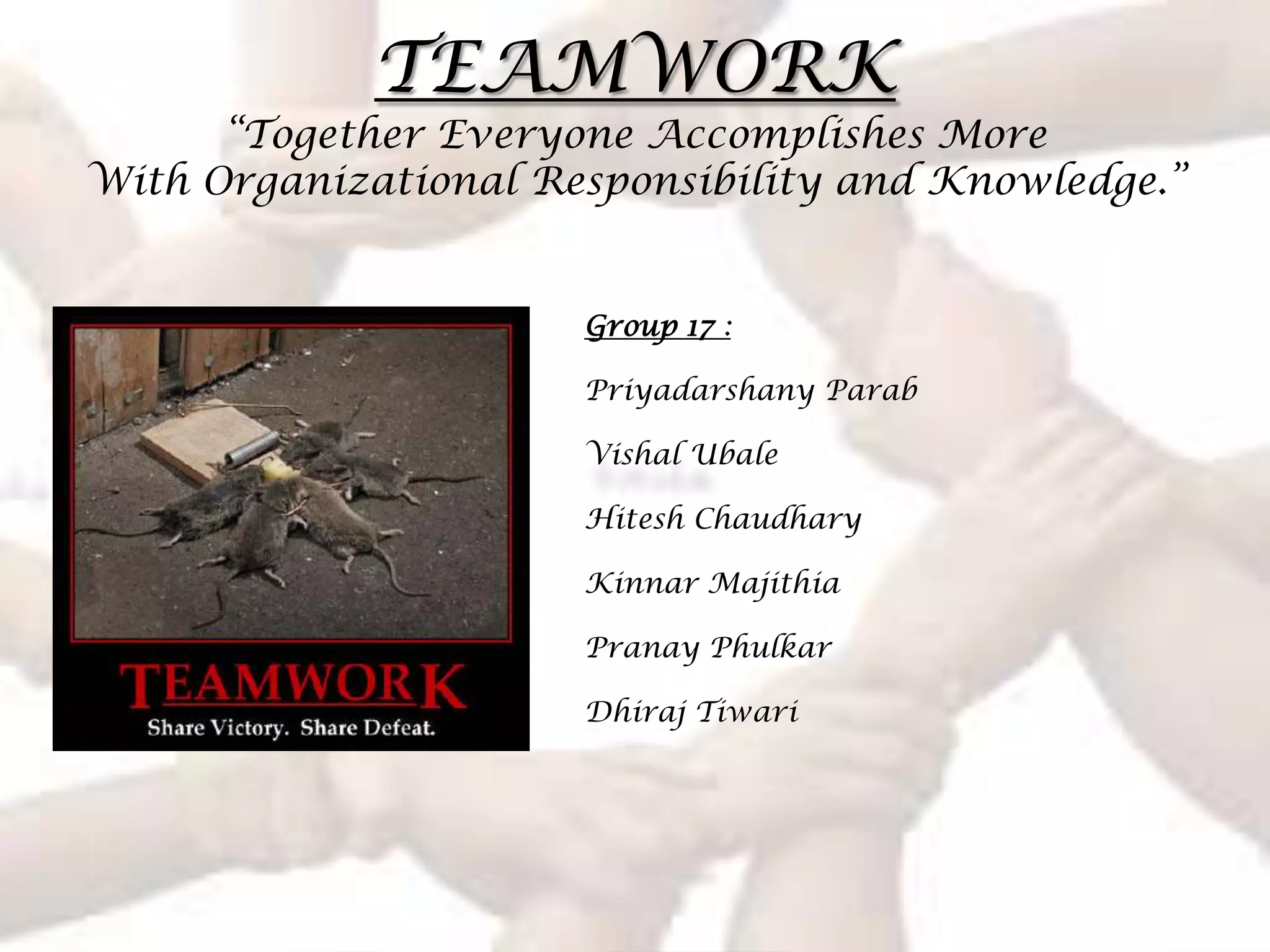
TEAMWORK
      “Together Everyone Accomplishes More
With Organizational Responsibility and Knowledge.”


                      Group 17 :

                      Priyadarshany Parab

                      Vishal Ubale

                      Hitesh Chaudhary

                      Kinnar Majithia

                      Pranay Phulkar

                      Dhiraj Tiwari
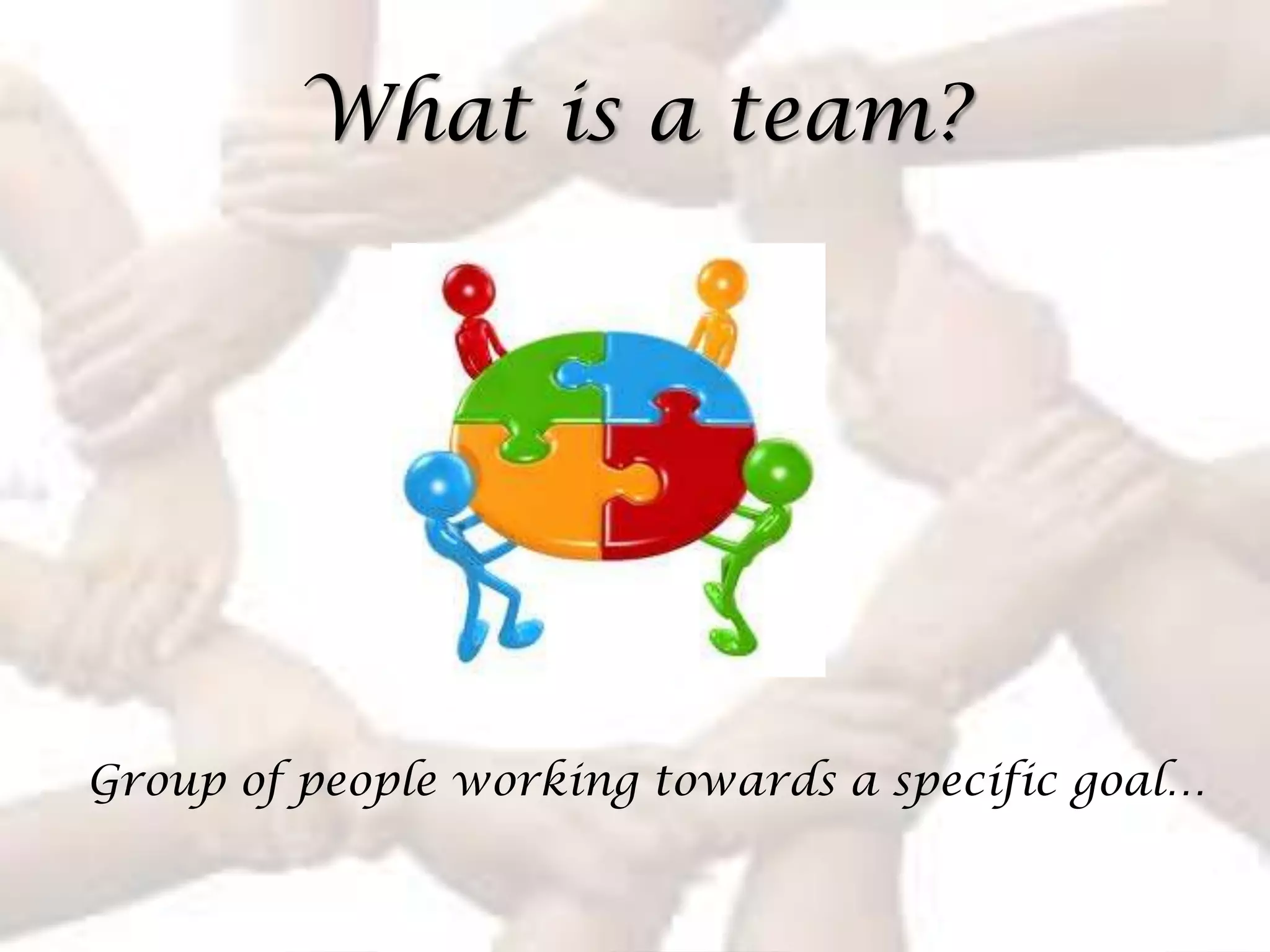
What is a team?


Group of people working towards a specific goal…
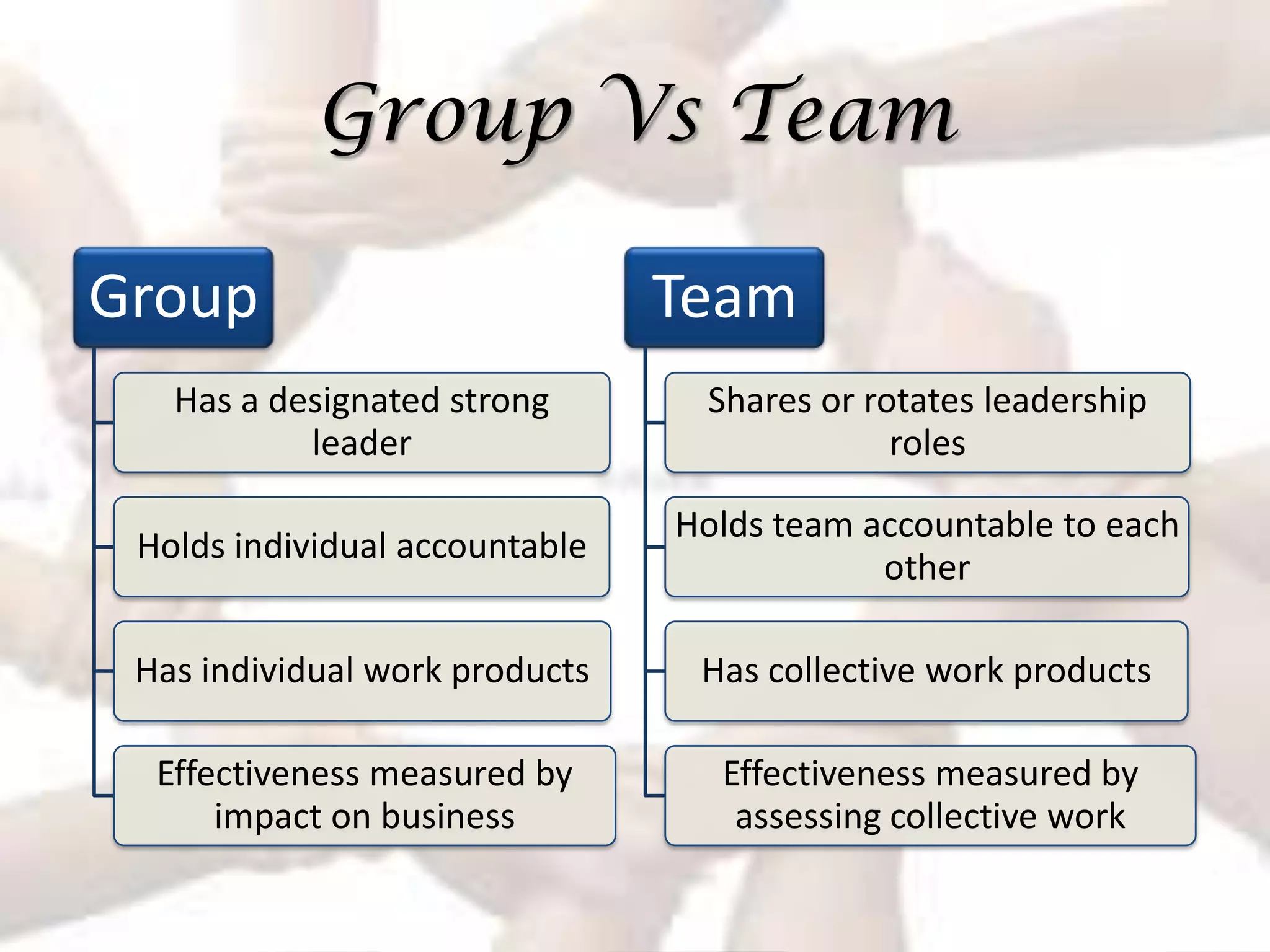
Group Vs Team

Group                           Team
   Has a designated strong       Shares or rotates leadership
           leader                            roles

                                Holds team accountable to each
 Holds individual accountable
                                            other

 Has individual work products    Has collective work products

  Effectiveness measured by       Effectiveness measured by
      impact on business           assessing collective work
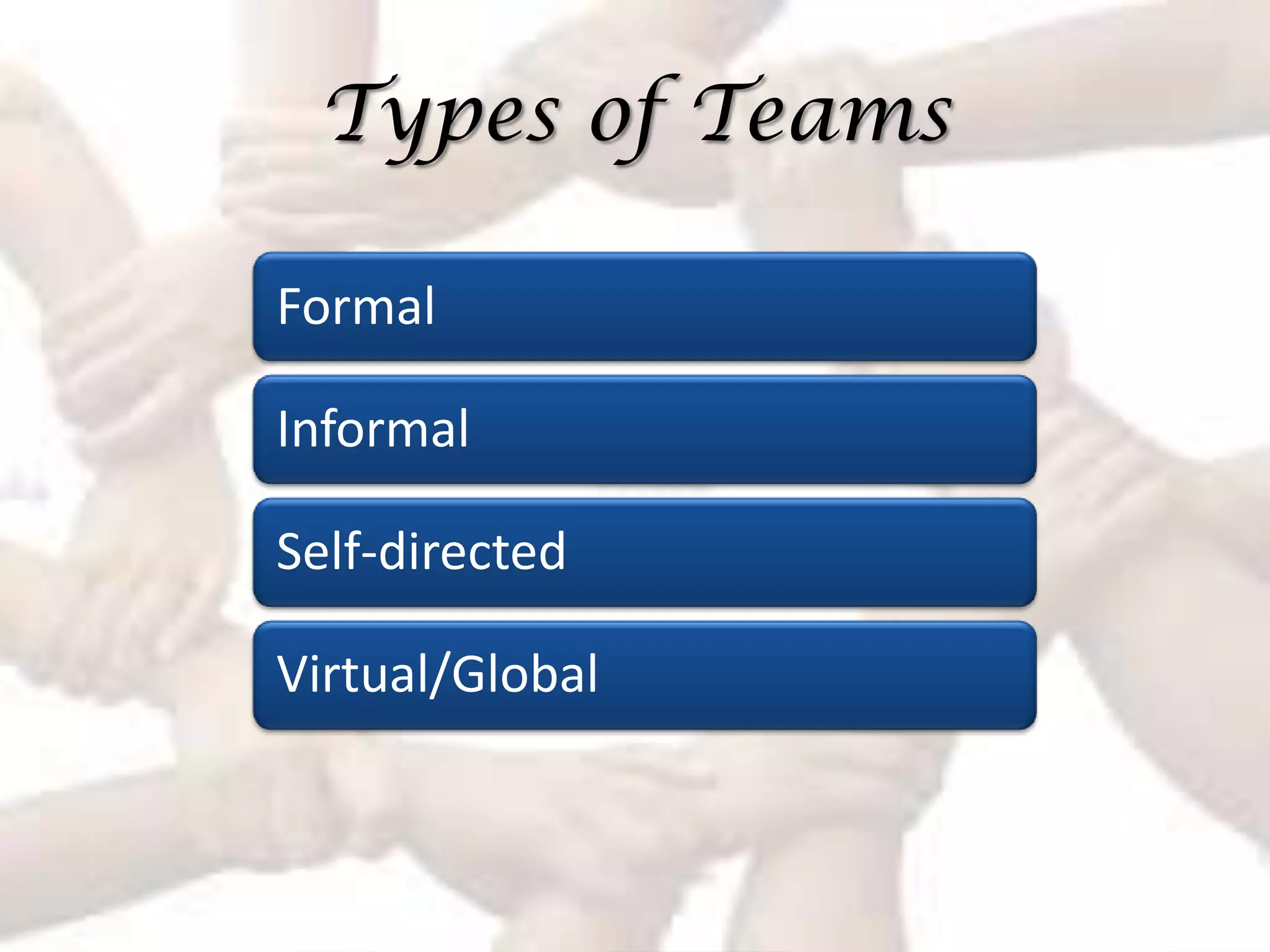
Types of Teams

Formal

Informal

Self-directed

Virtual/Global
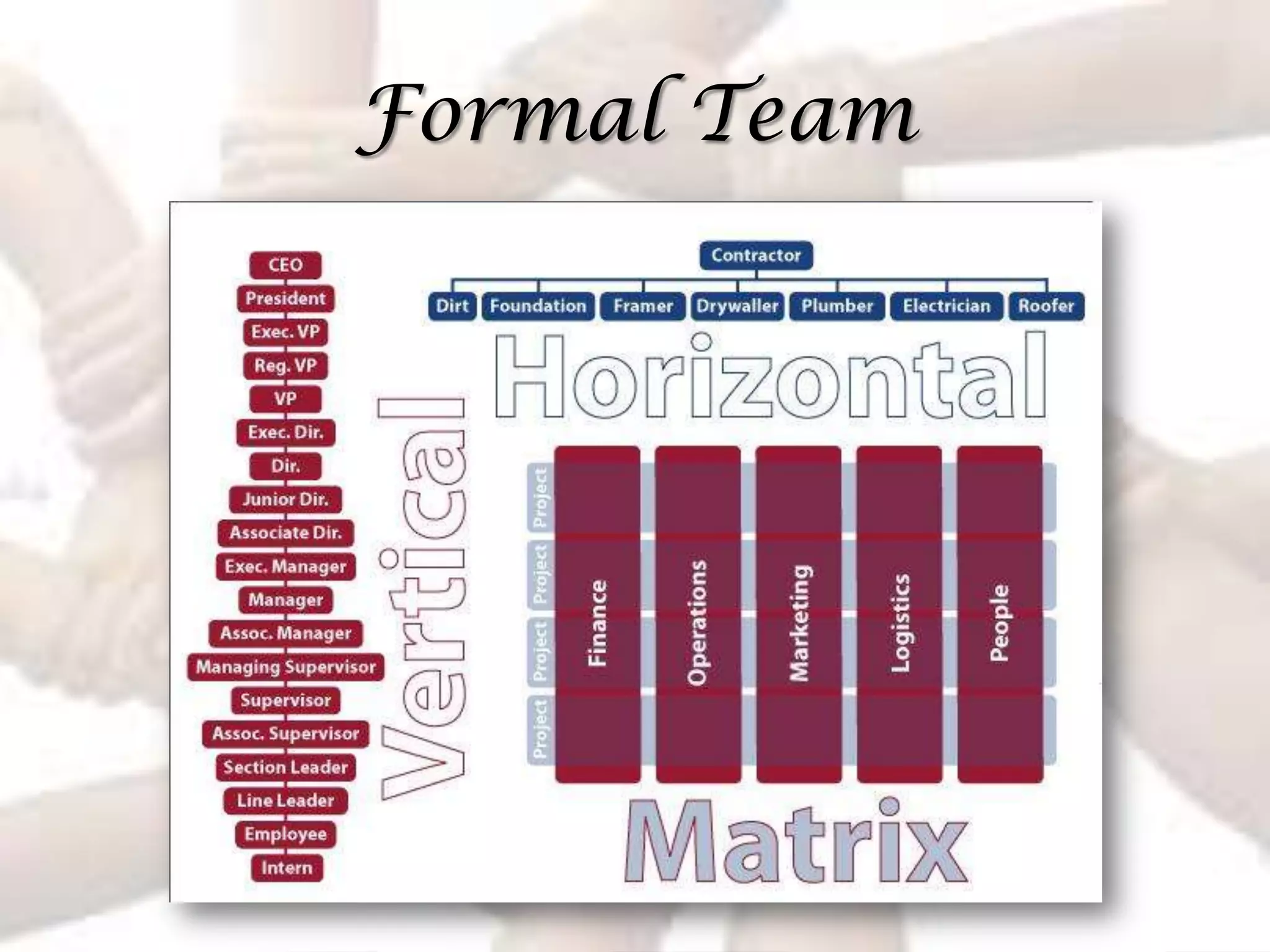
Formal Team
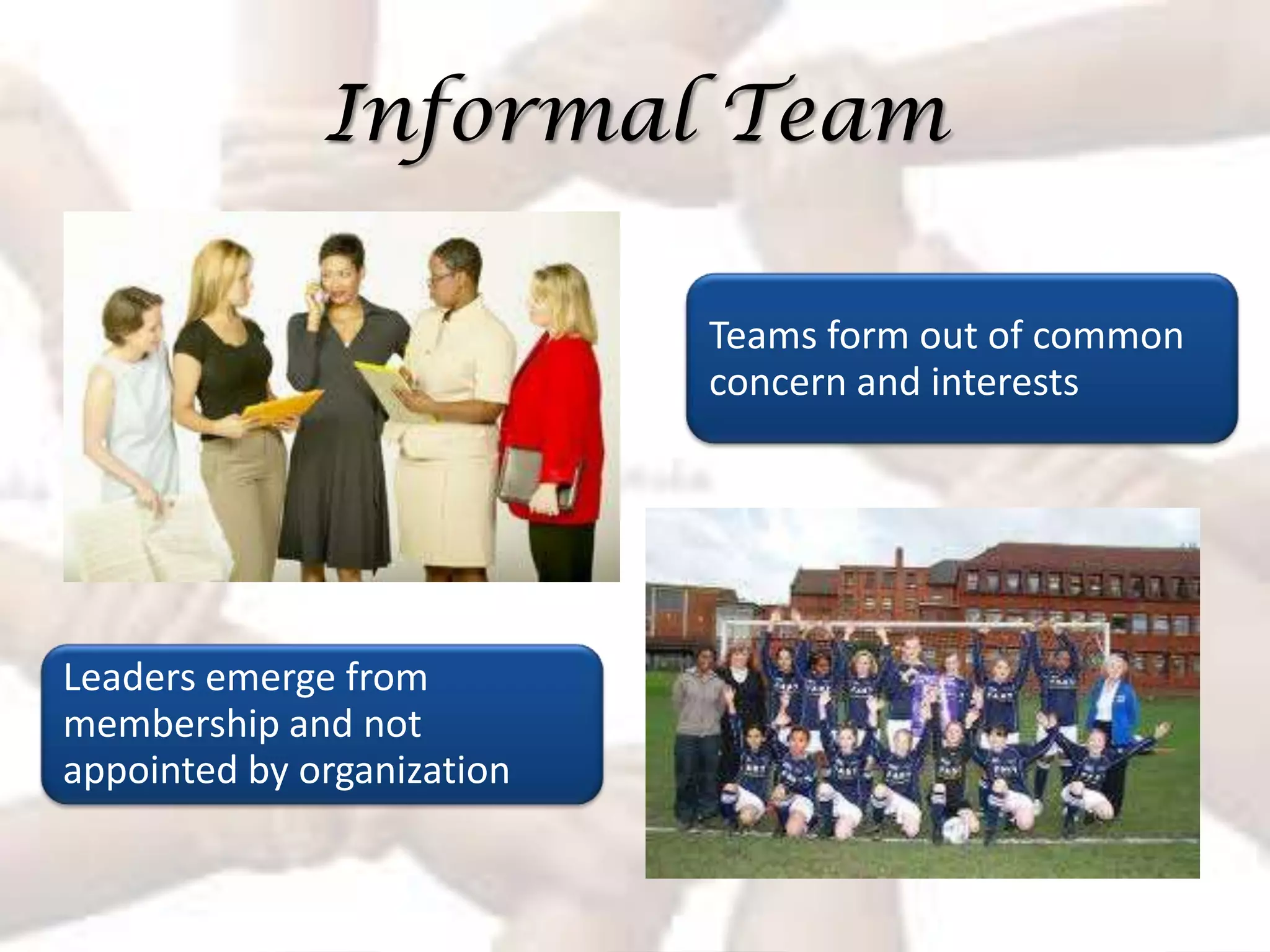
Informal Team

                            Teams form out of common
                            concern and interests


Leaders emerge from
membership and not
appointed by organization
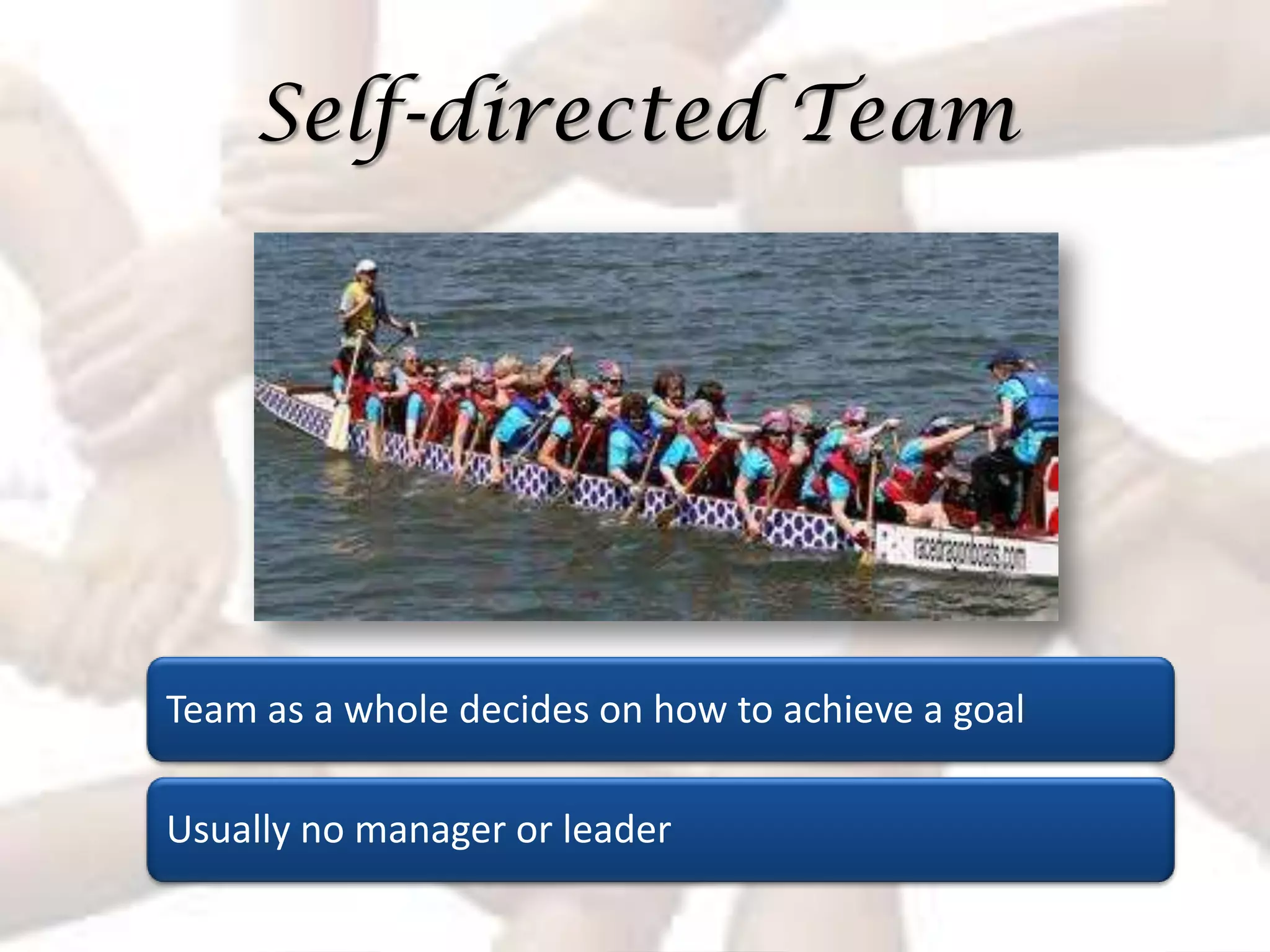
Self-directed Team


Team as a whole decides on how to achieve a goal

Usually no manager or leader
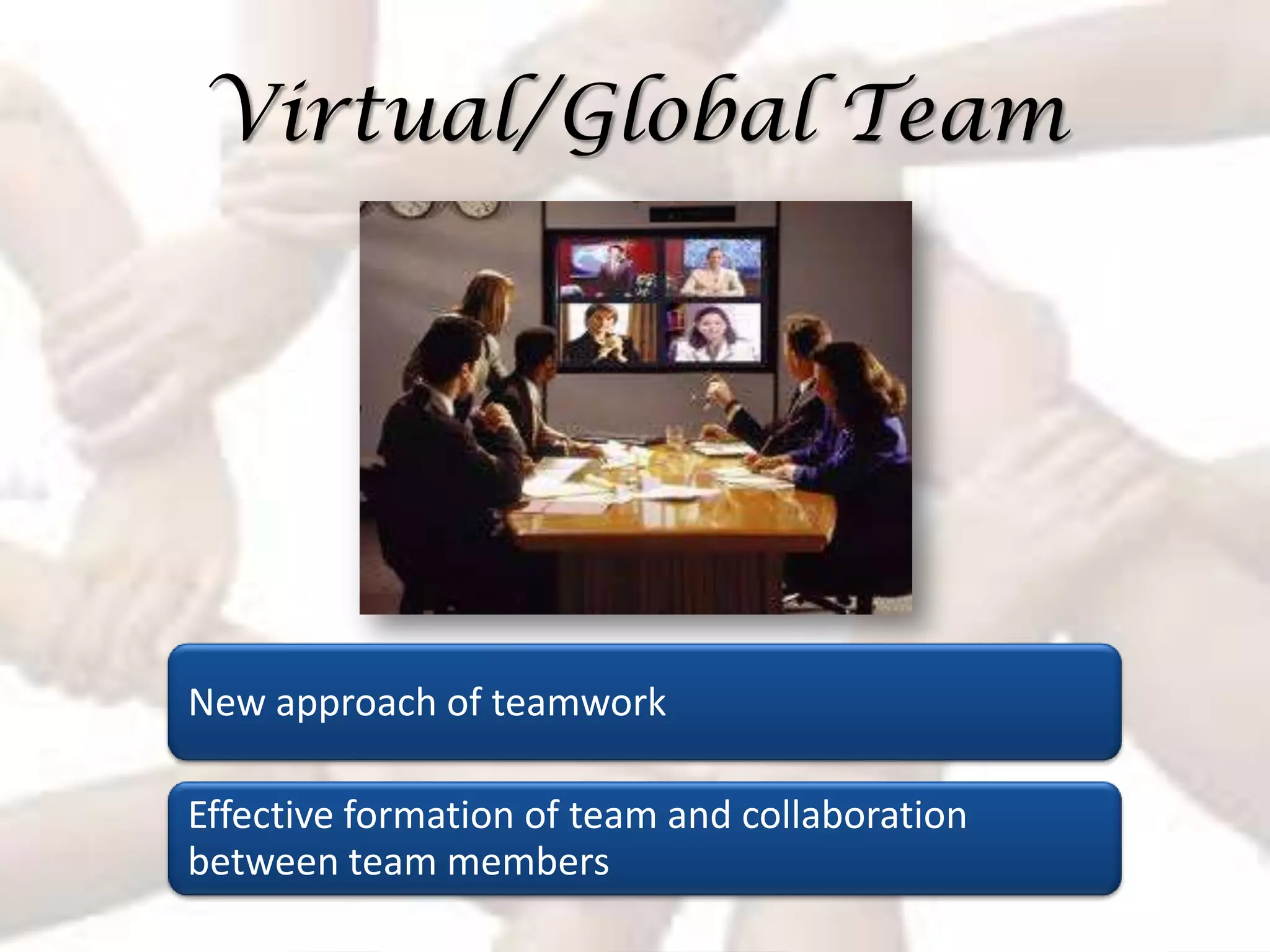
Virtual/Global Team


New approach of teamwork

Effective formation of team and collaboration
between team members
Team Characteristics

 Size

 Diversity

 Member Roles
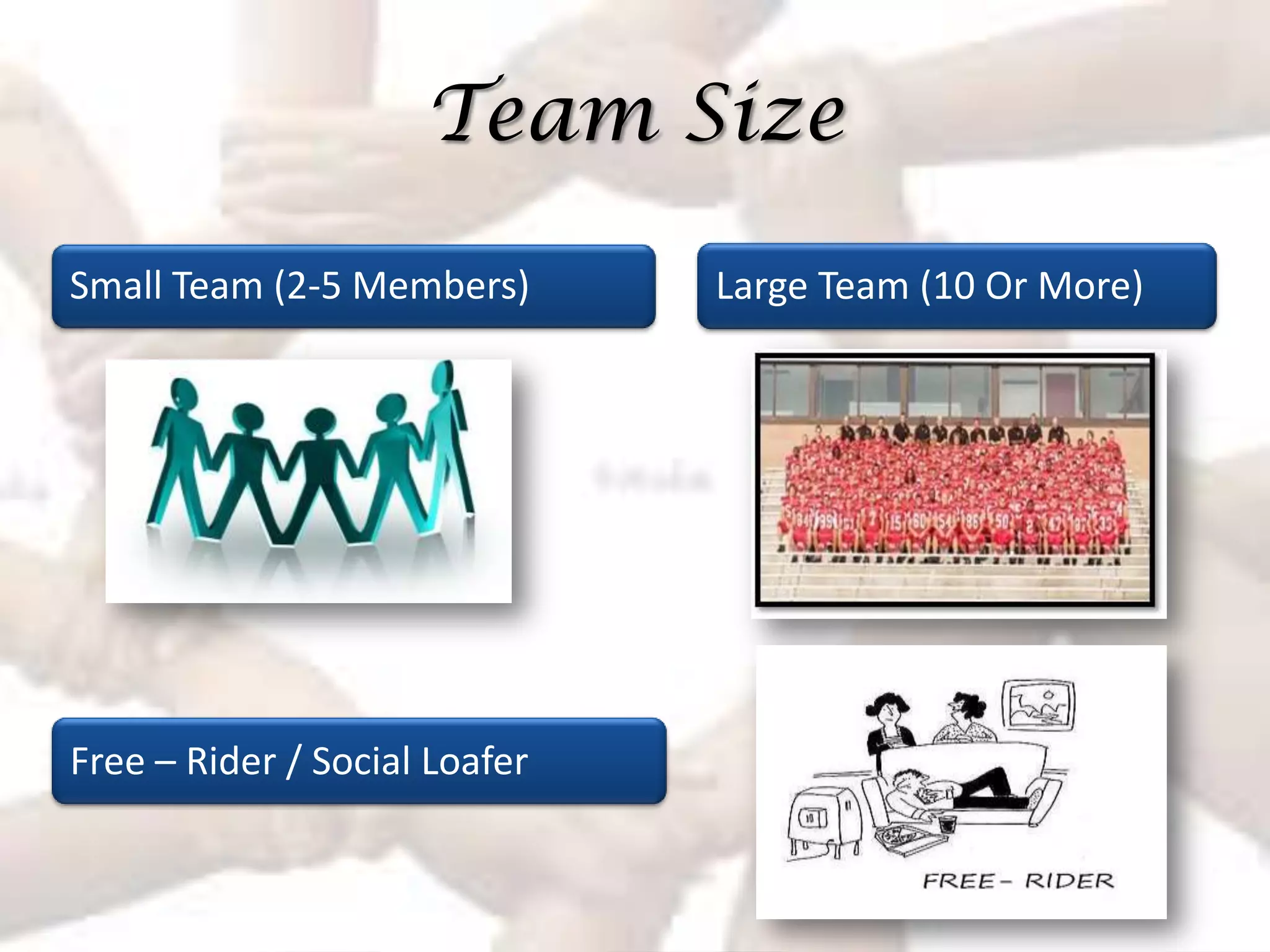
Team Size

Small Team (2-5 Members)       Large Team (10 Or More)


Free – Rider / Social Loafer
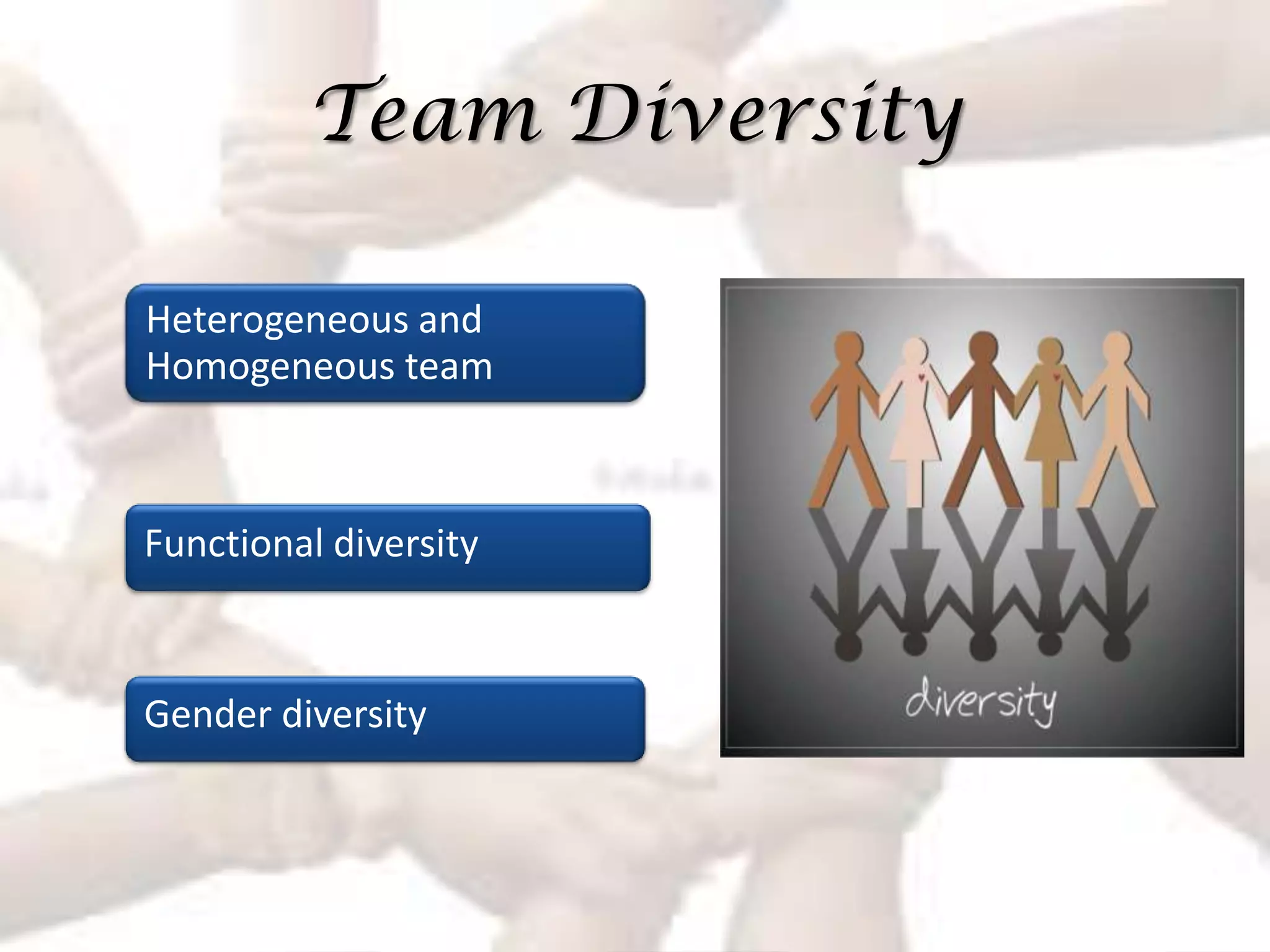
Team Diversity

Heterogeneous and
Homogeneous team


Functional diversity


Gender diversity
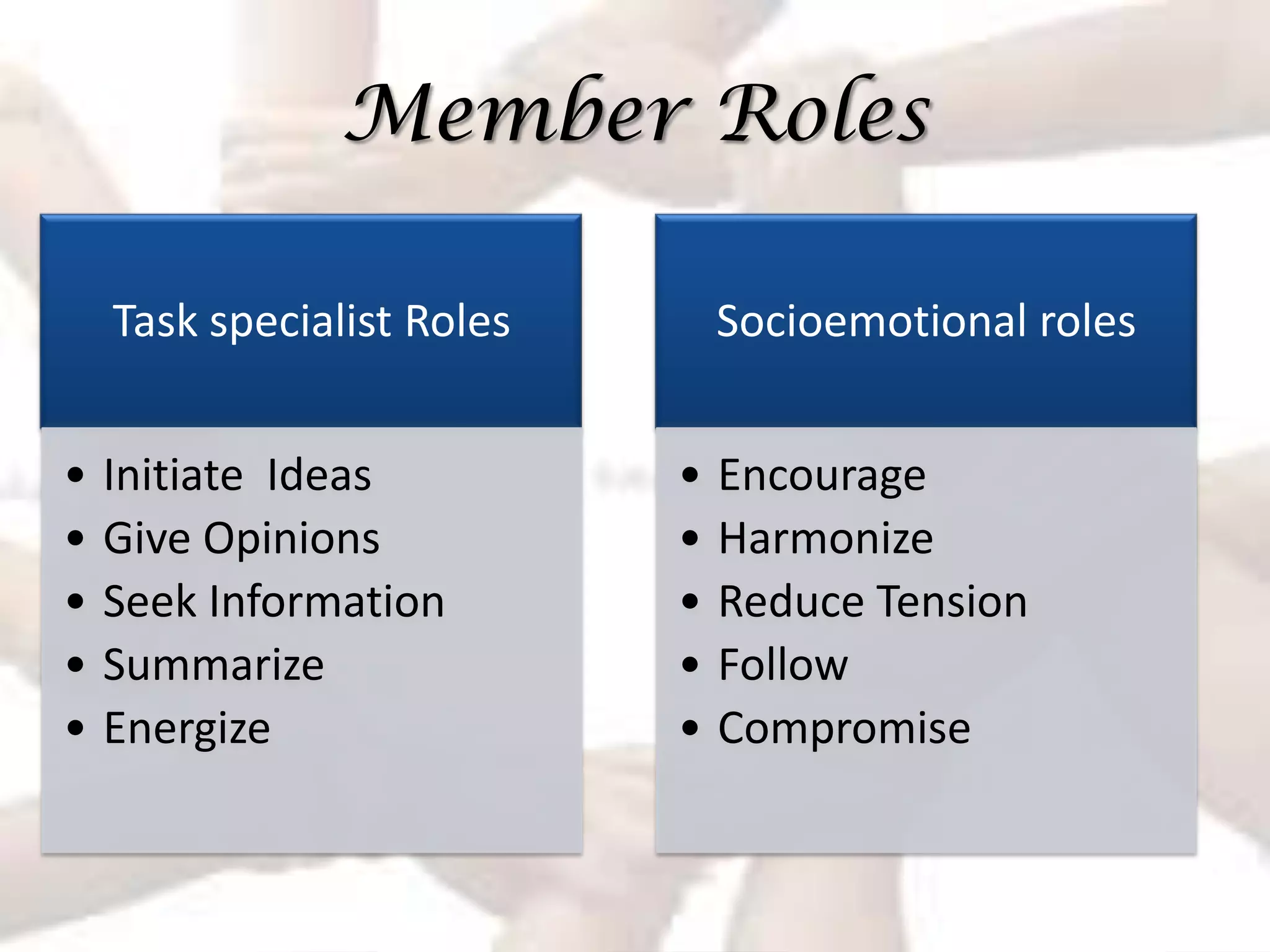
Member Roles

    Task specialist Roles       Socioemotional roles


•   Initiate Ideas          •   Encourage
•   Give Opinions           •   Harmonize
•   Seek Information        •   Reduce Tension
•   Summarize               •   Follow
•   Energize                •   Compromise
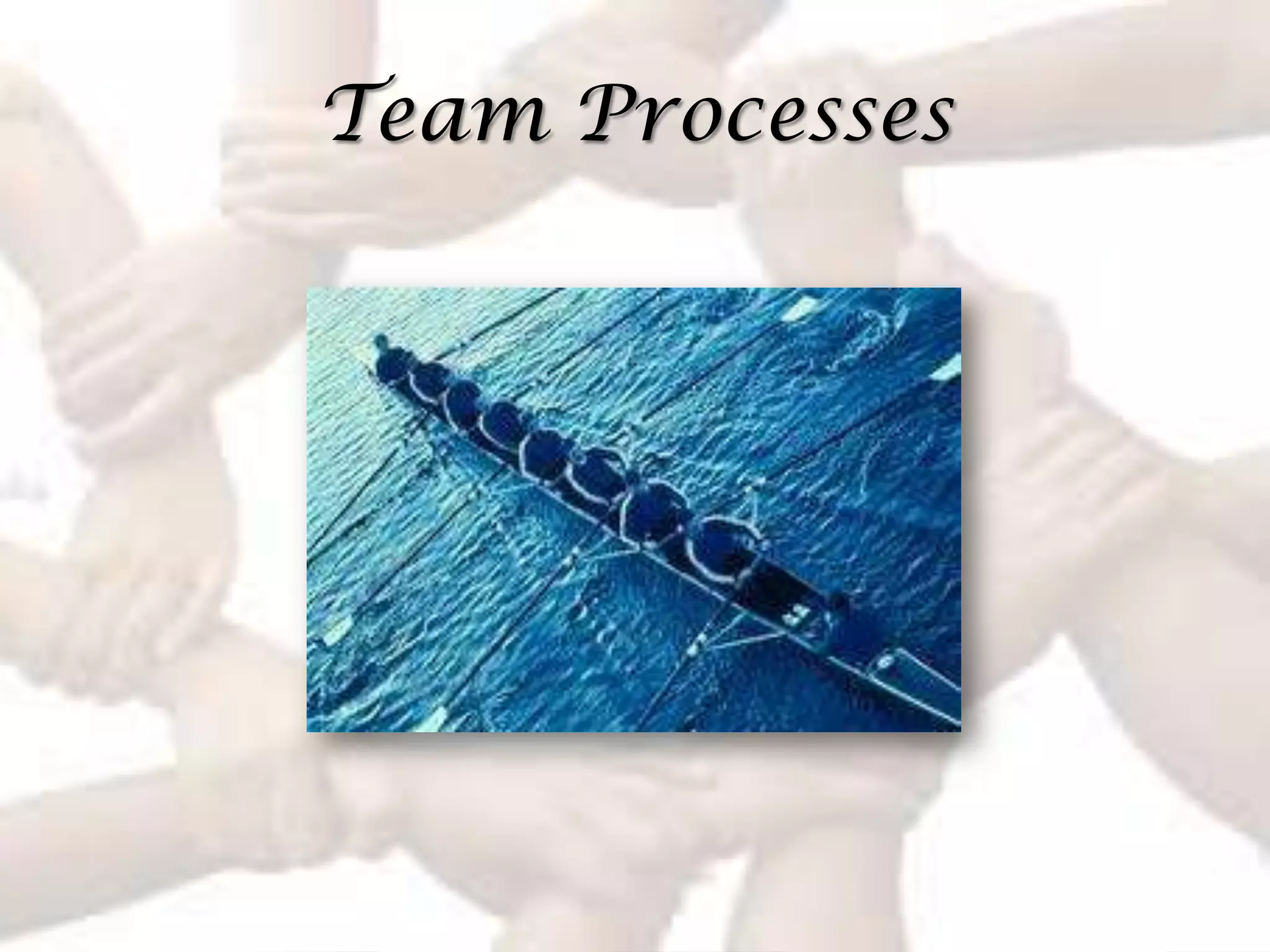
Team Processes
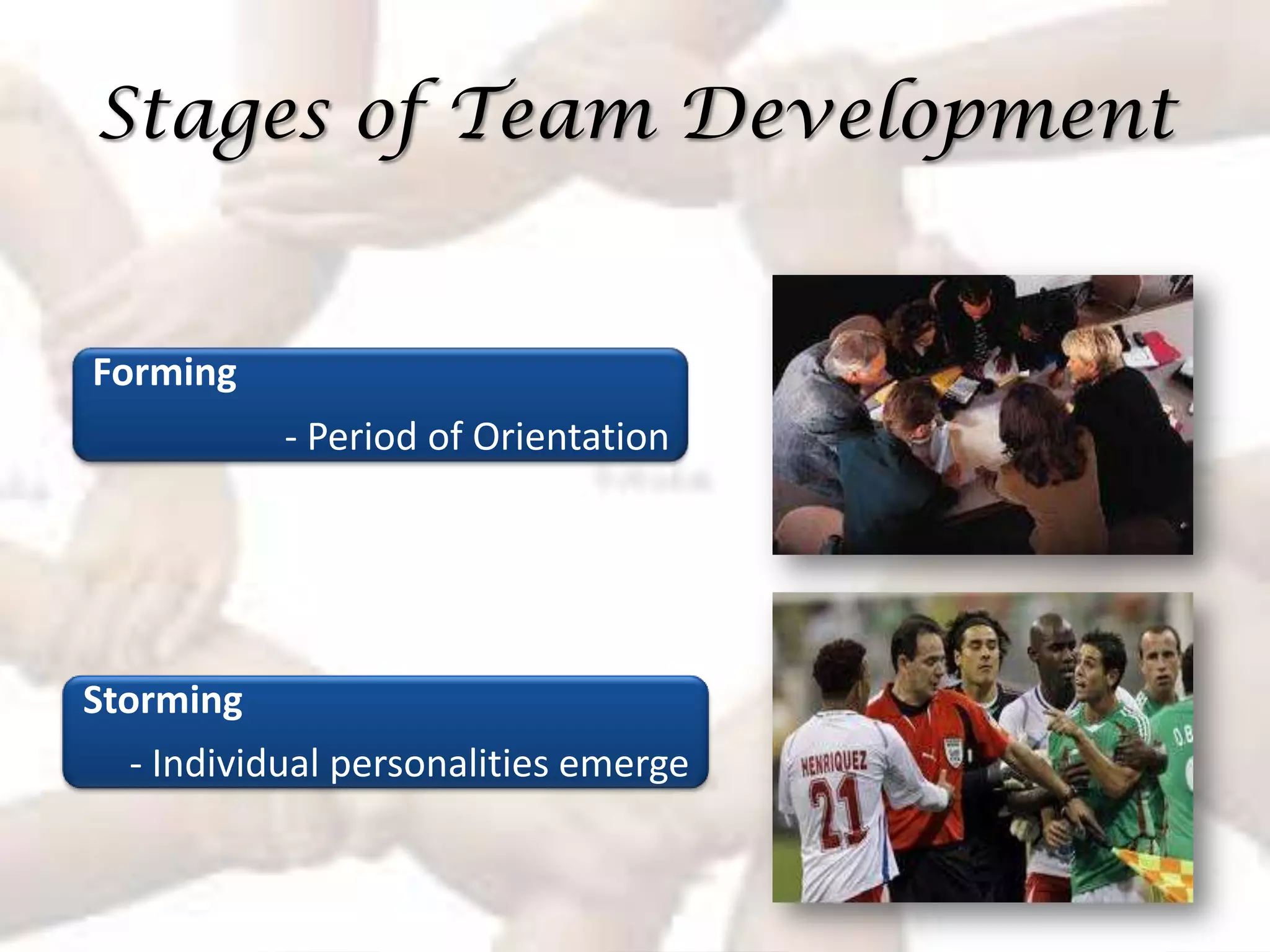
Stages of Team Development


Forming
           - Period of Orientation


Storming
   - Individual personalities emerge
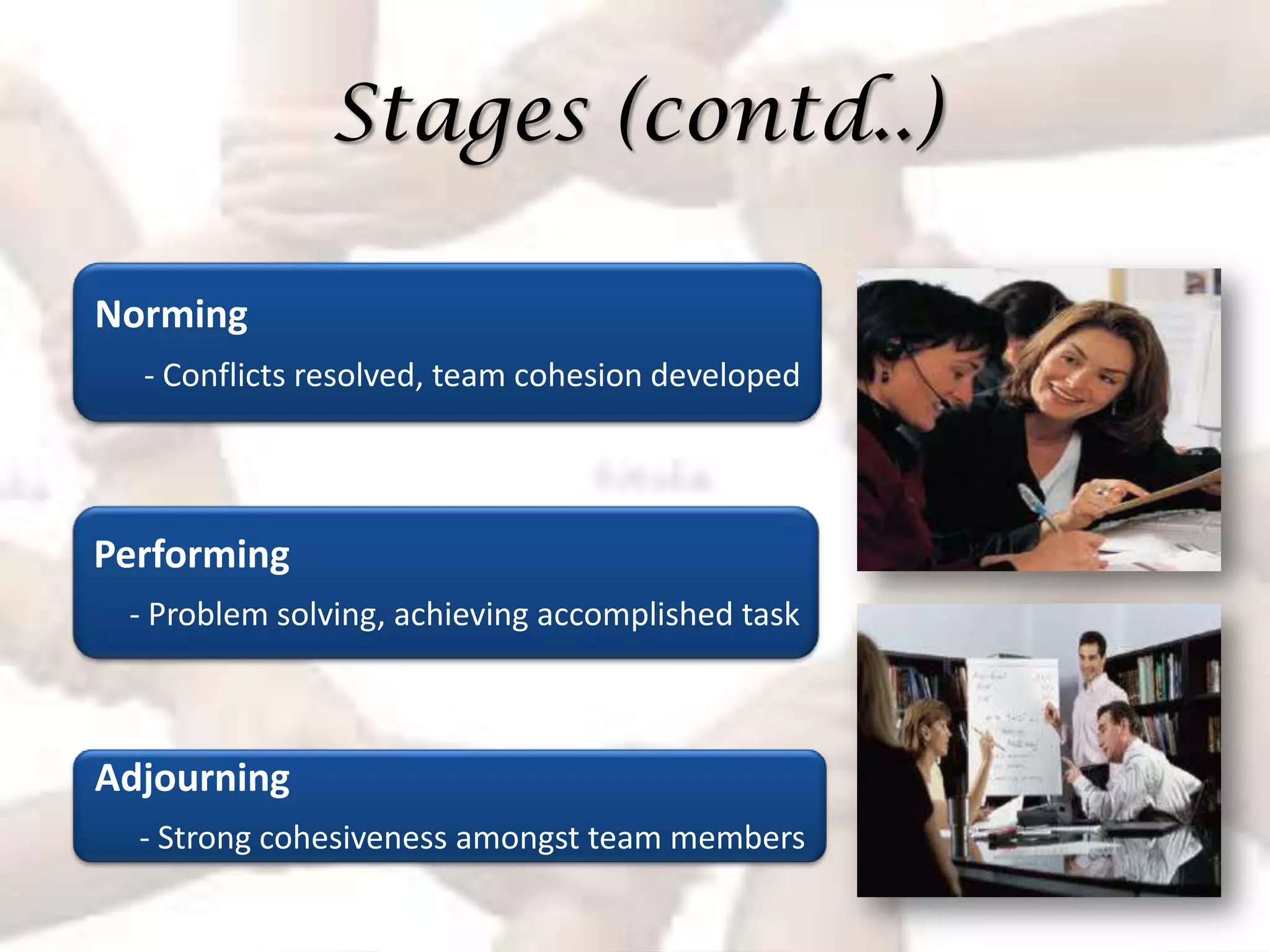
Stages (contd..)

Norming
  - Conflicts resolved, team cohesion developed


Performing
 - Problem solving, achieving accomplished task


Adjourning
  - Strong cohesiveness amongst team members
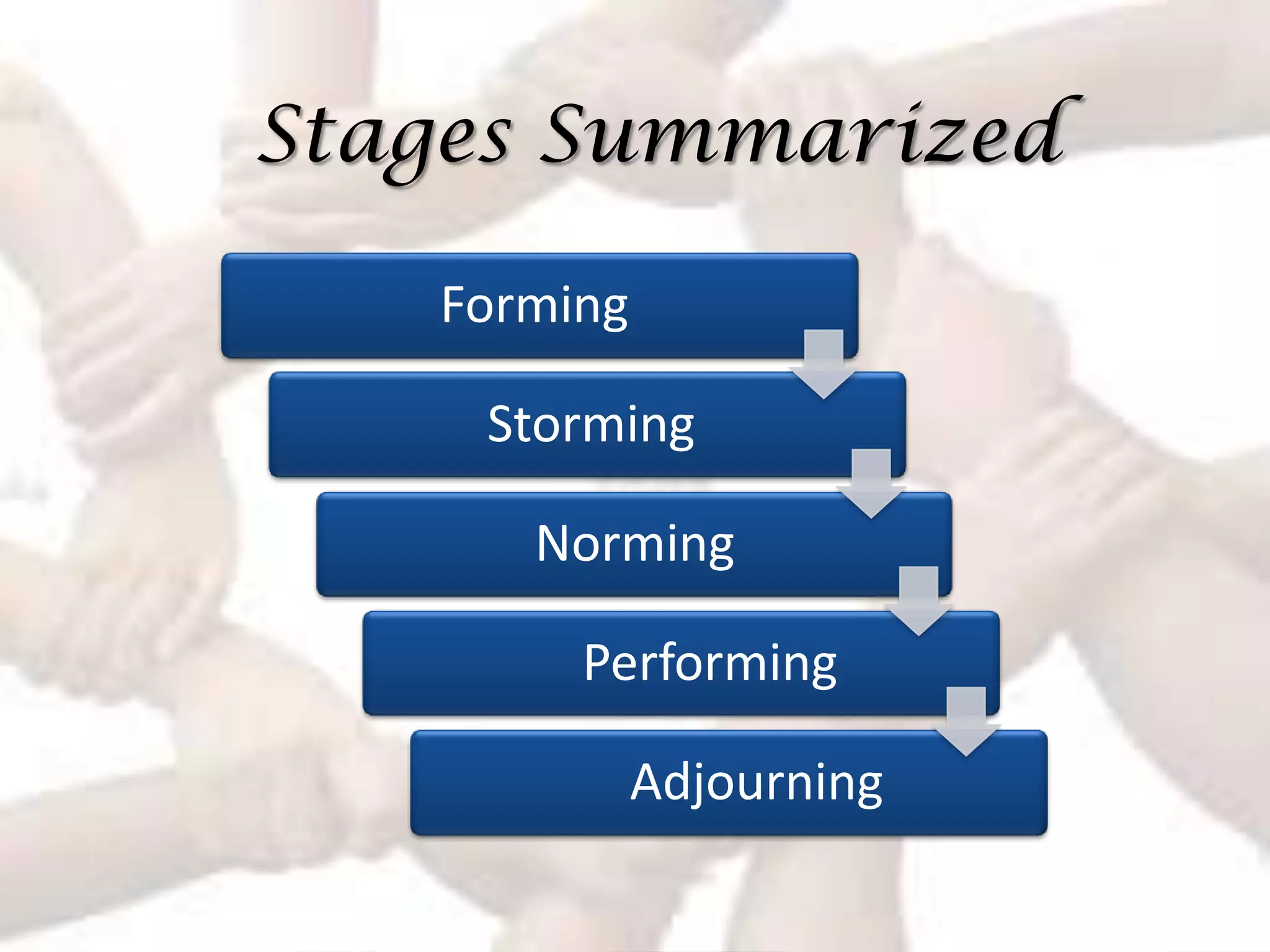
Stages Summarized

   Forming

    Storming

      Norming

        Performing

             Adjourning
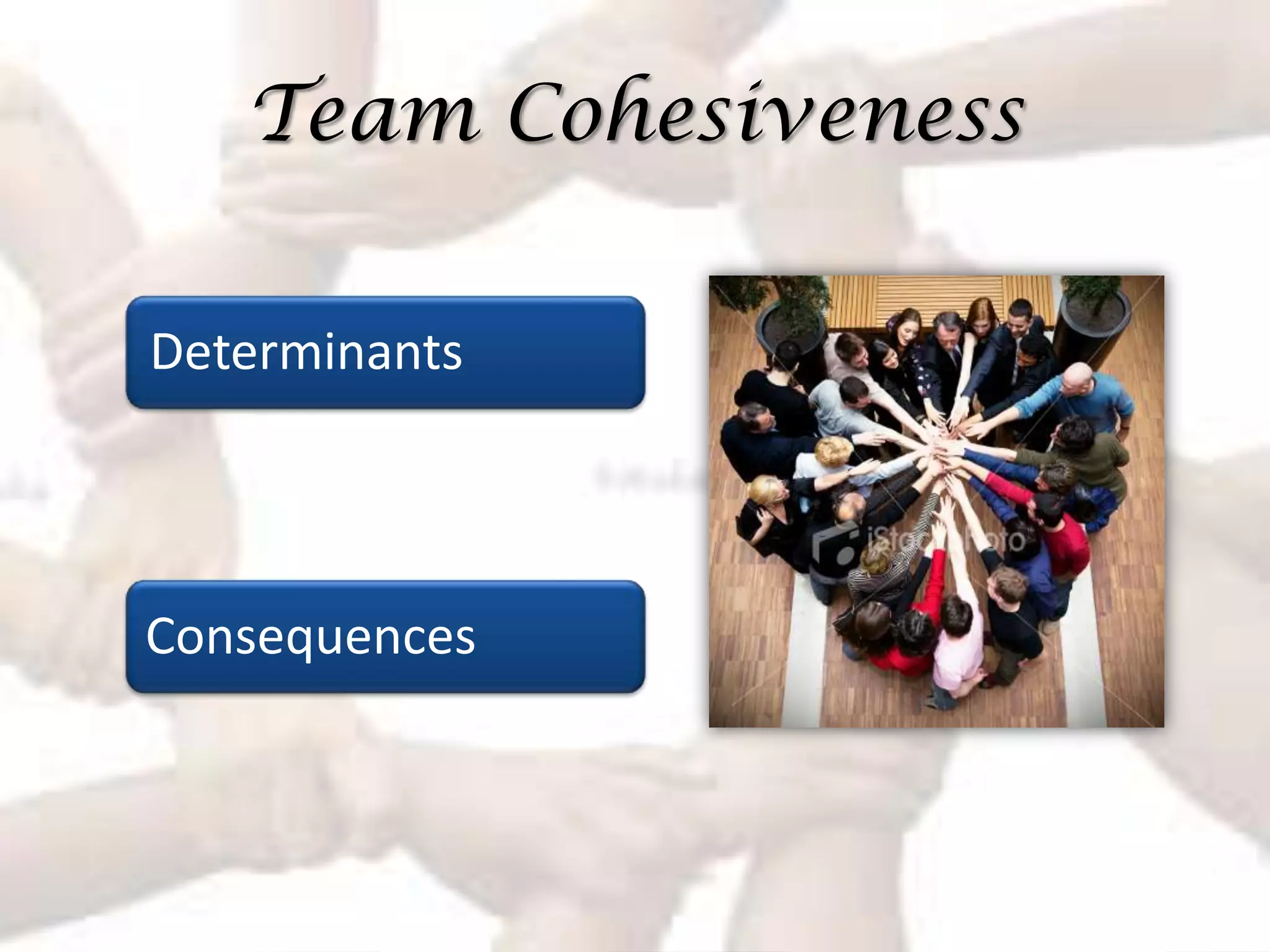
Team Cohesiveness

Determinants


Consequences
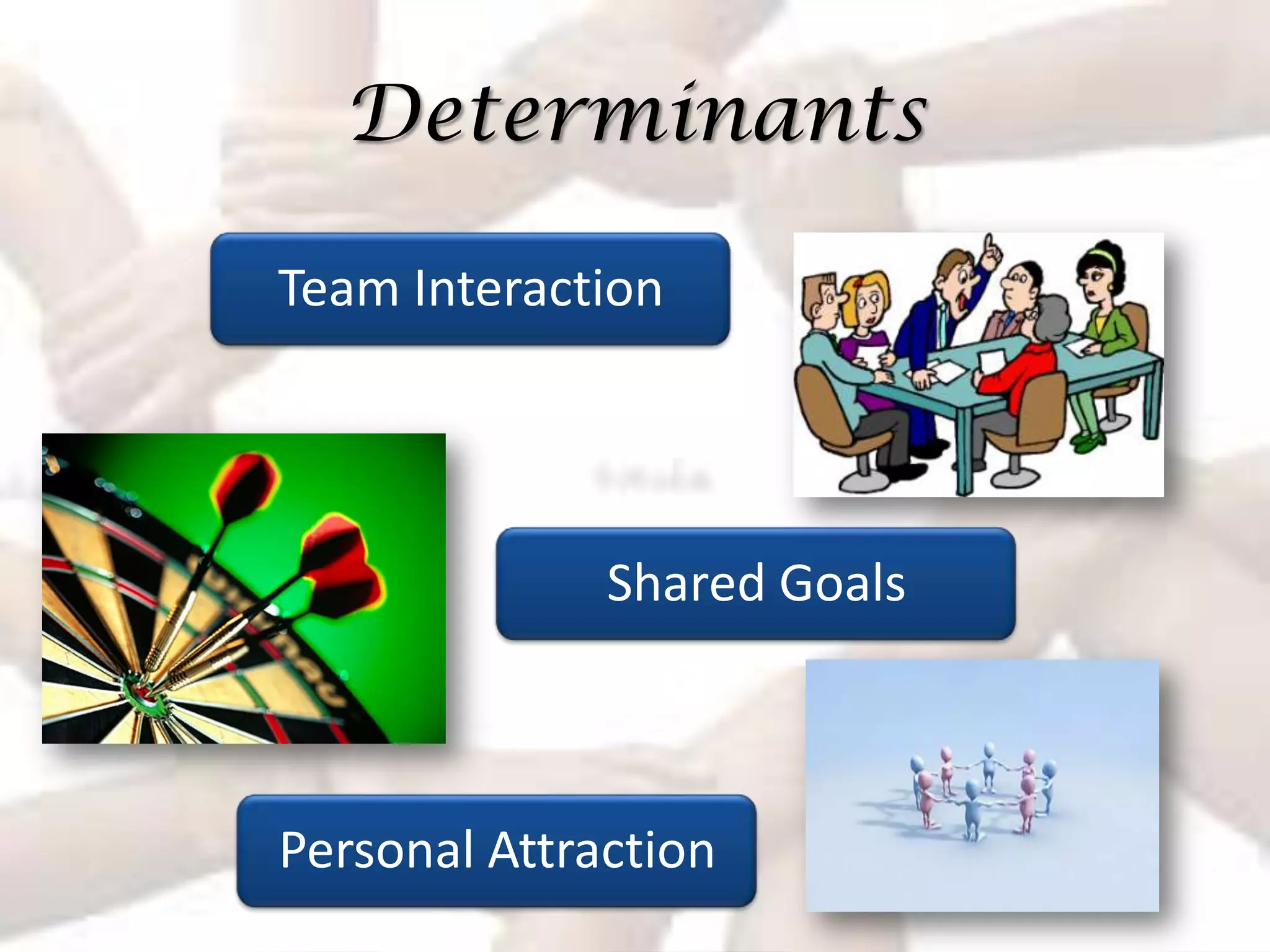
Determinants

Team Interaction


              Shared Goals


Personal Attraction
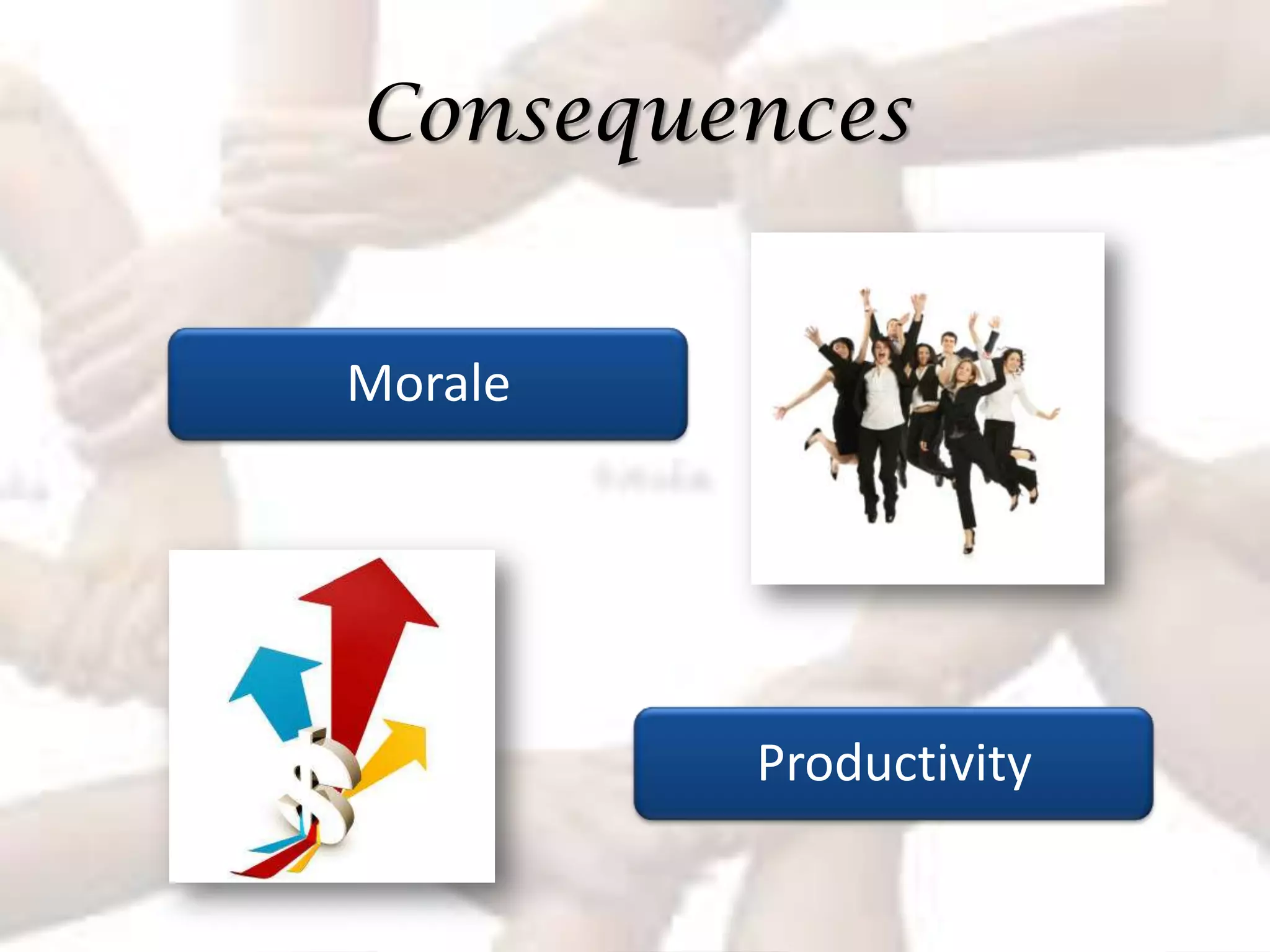
Consequences


Morale


         Productivity
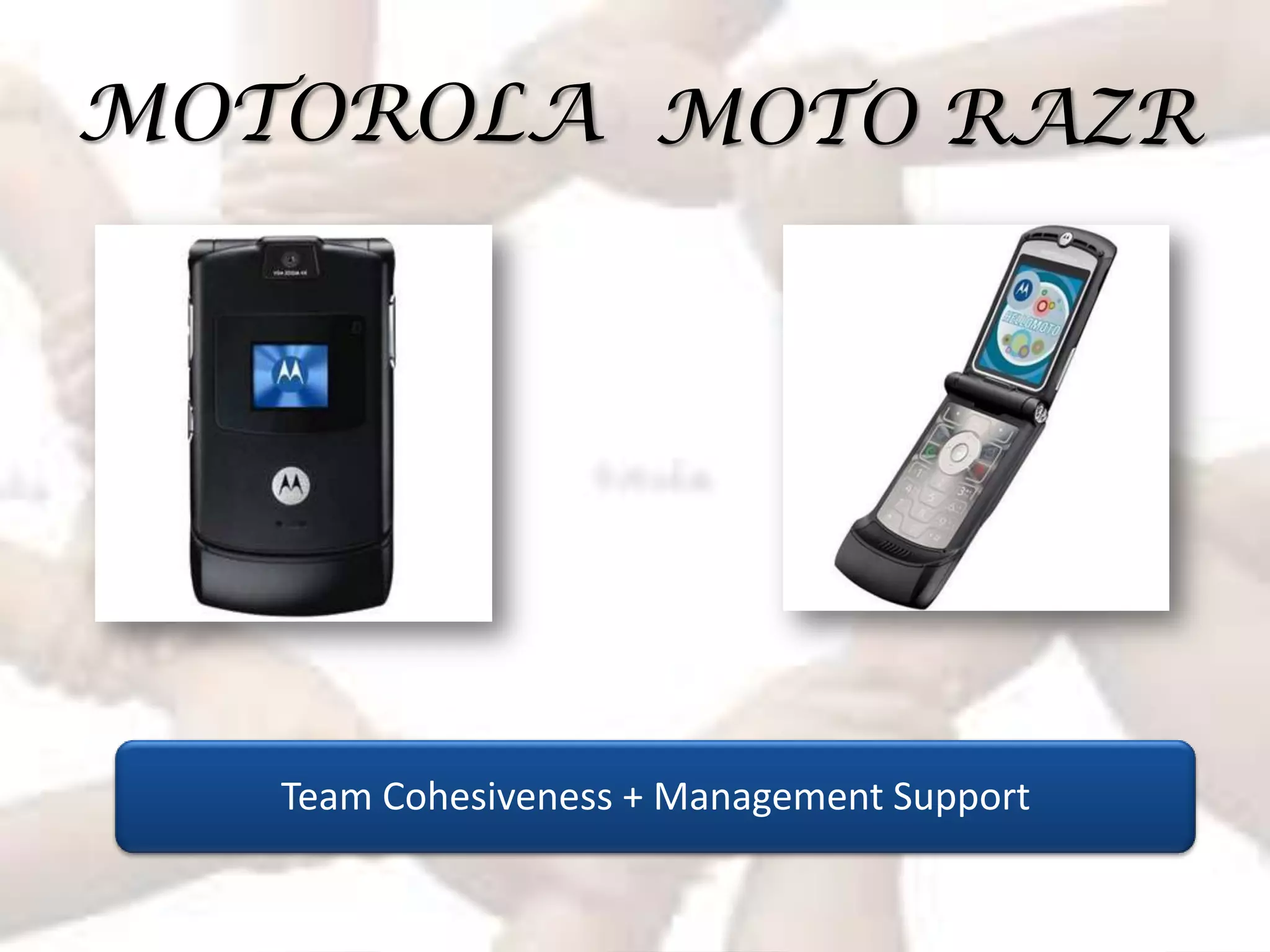
MOTOROLA MOTO RAZR


   Team Cohesiveness + Management Support
Team Norms

 Critical
             Primacy
 Events


Carryover     Explicit
Behaviors   Statements
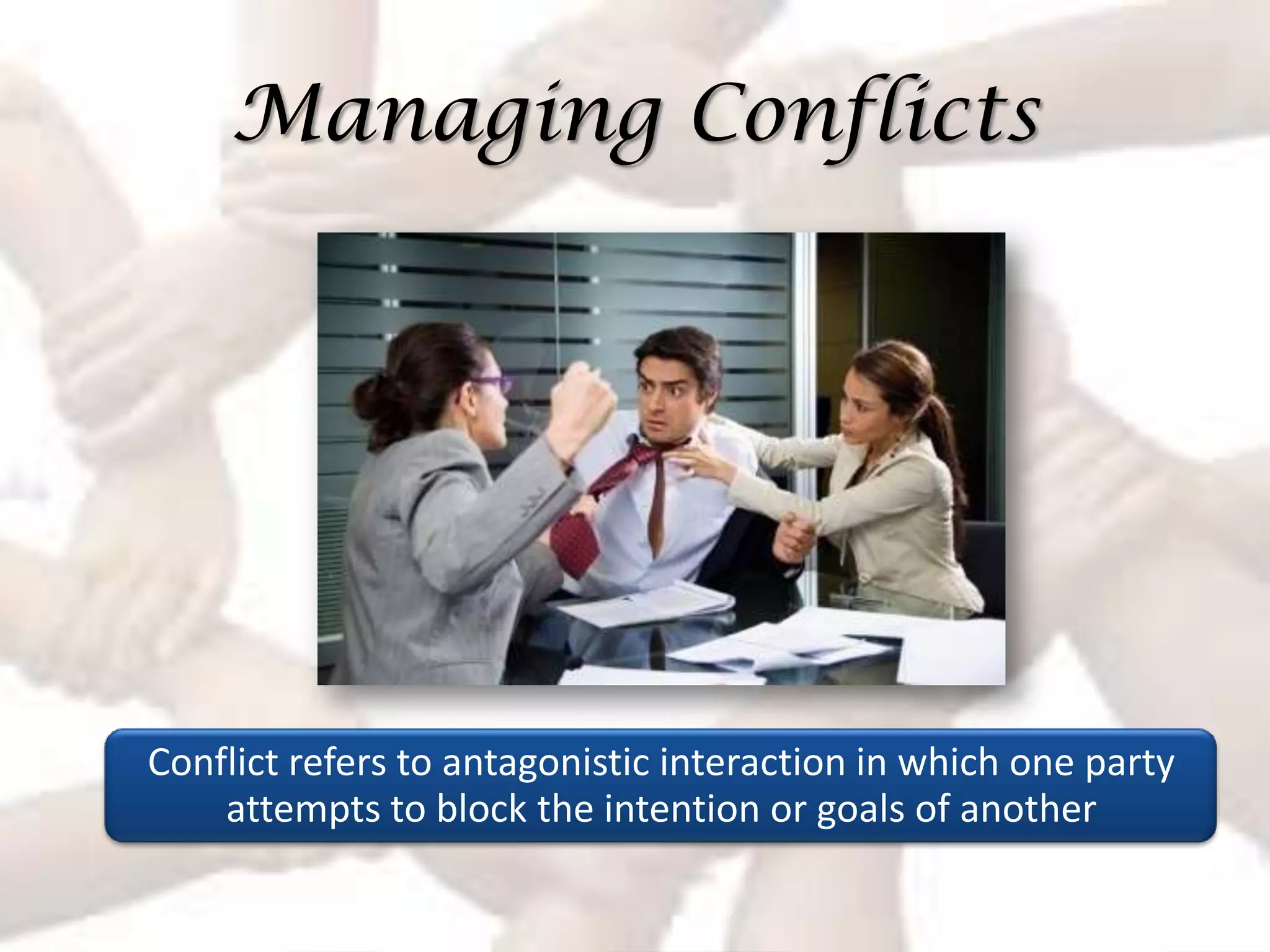
Managing Conflicts


Conflict refers to antagonistic interaction in which one party
    attempts to block the intention or goals of another
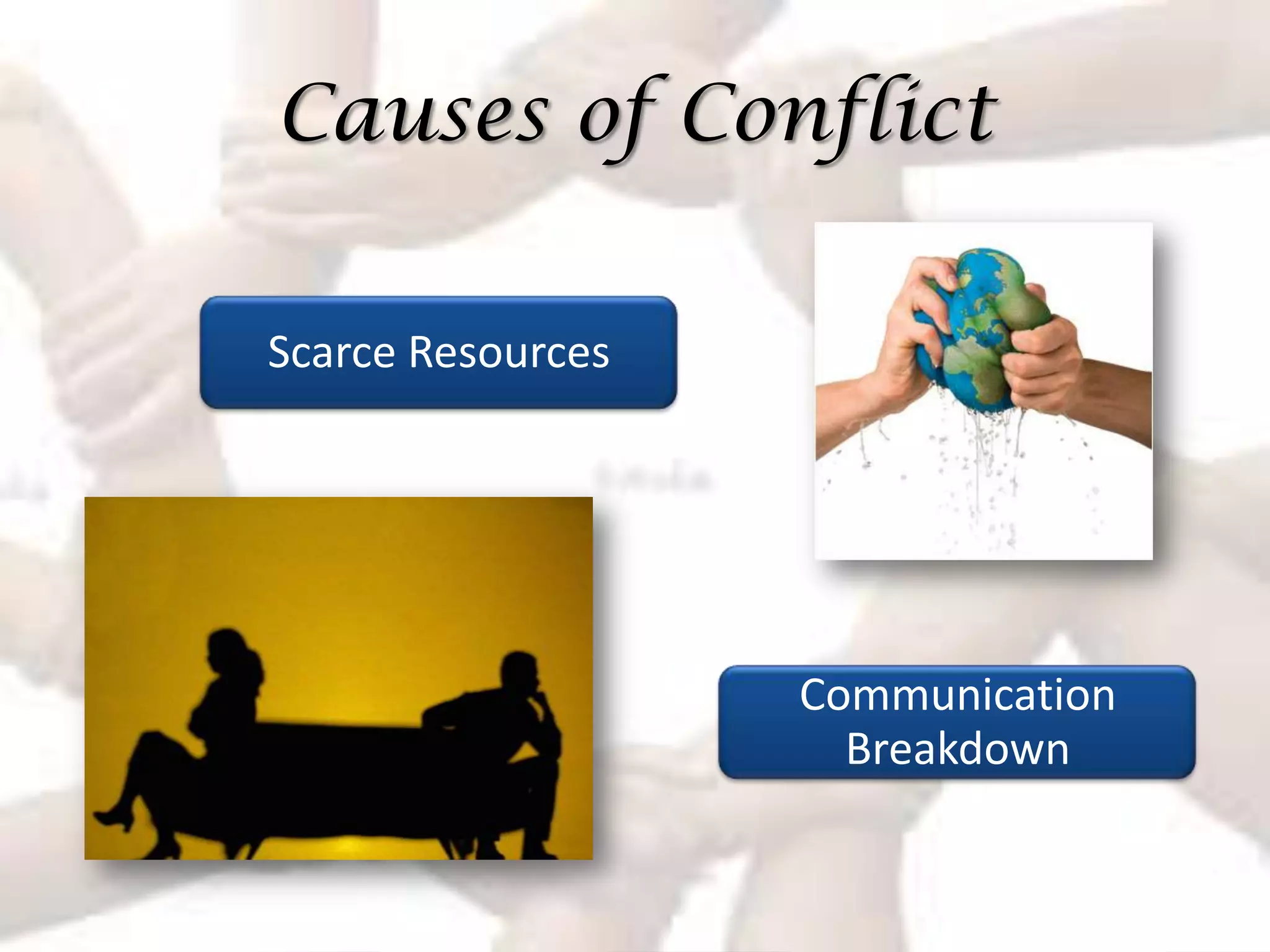
Causes of Conflict

Scarce Resources


                   Communication
                     Breakdown
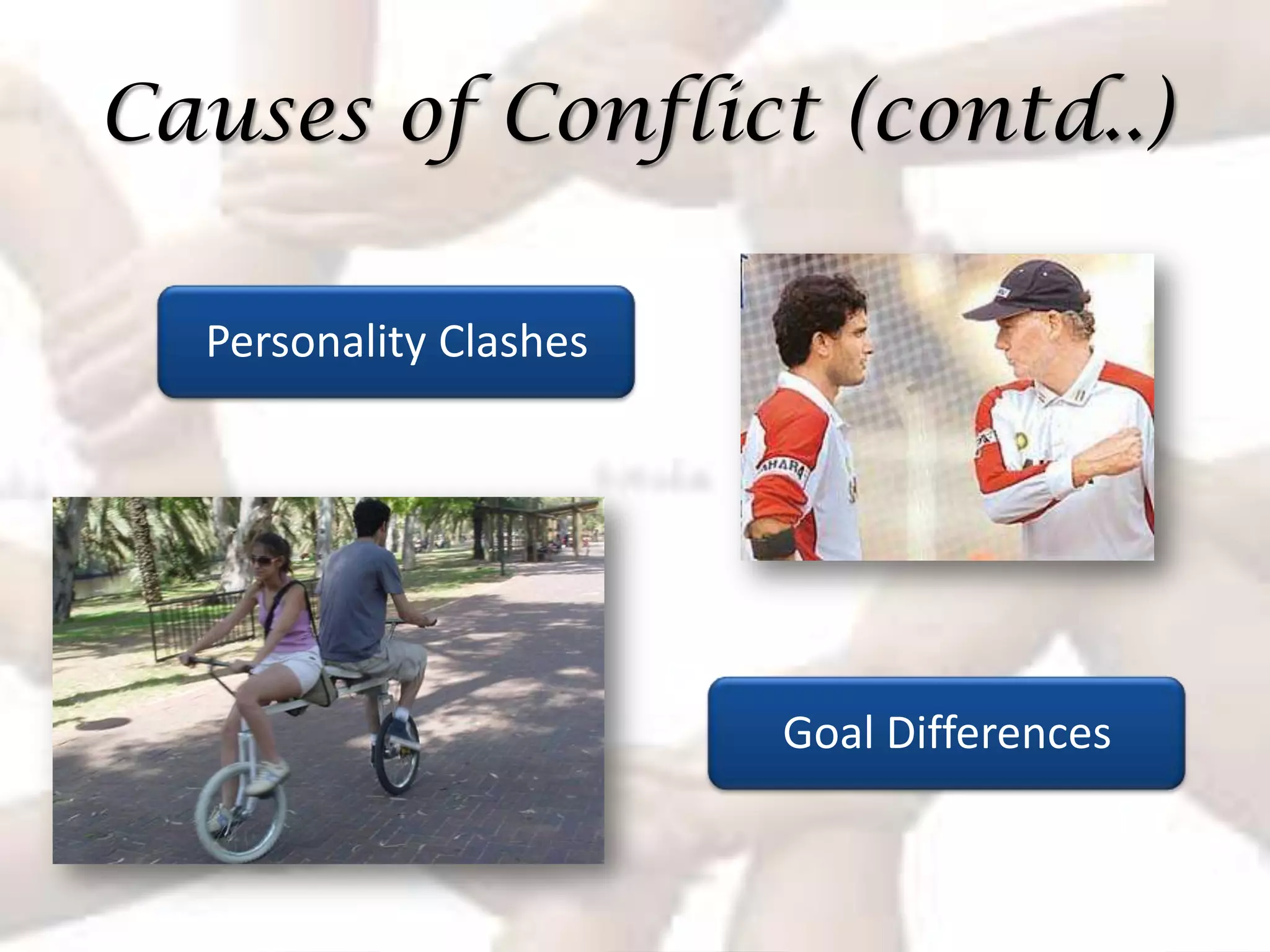
Causes of Conflict (contd..)

  Personality Clashes


                        Goal Differences
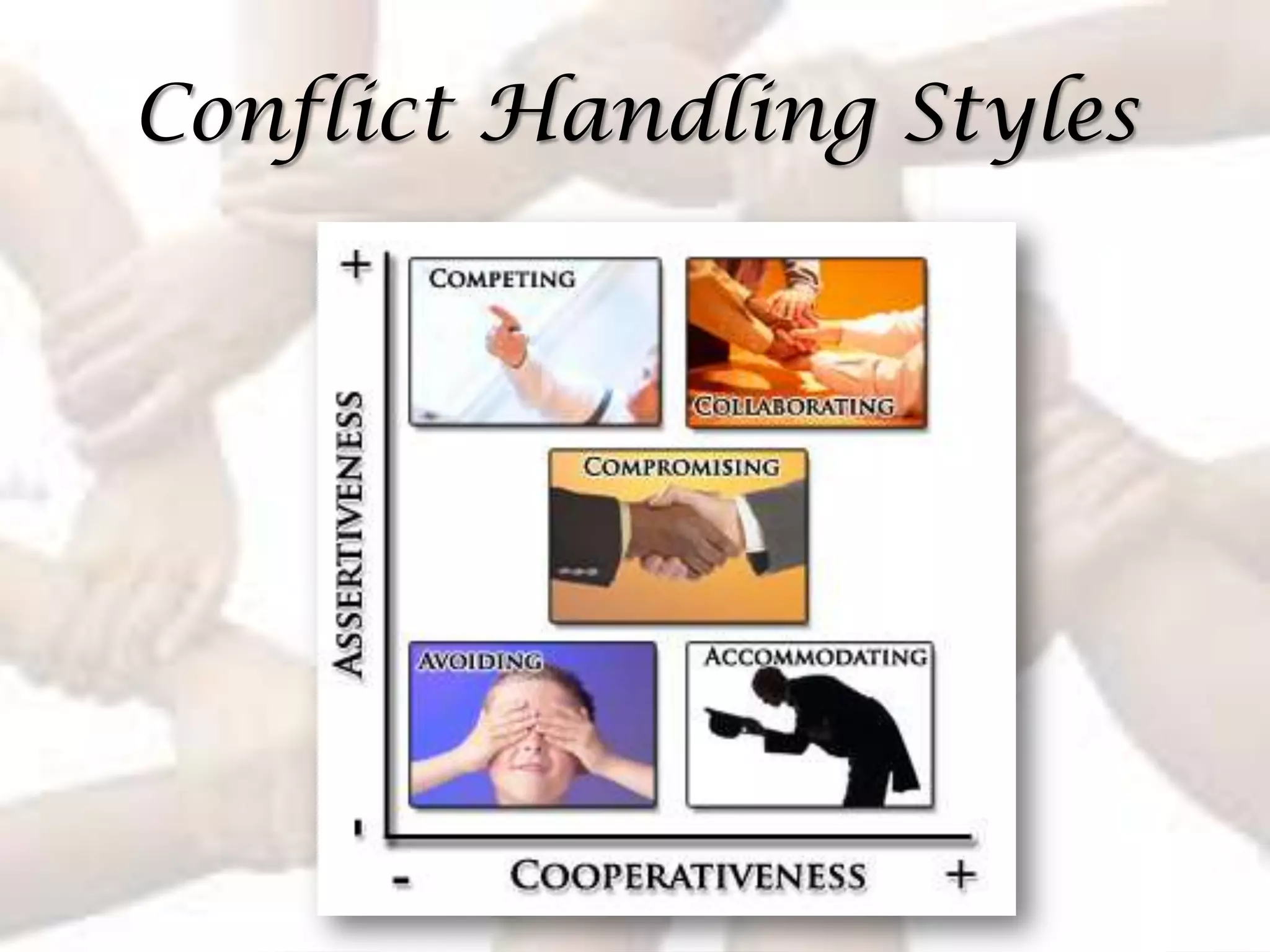
Conflict Handling Styles
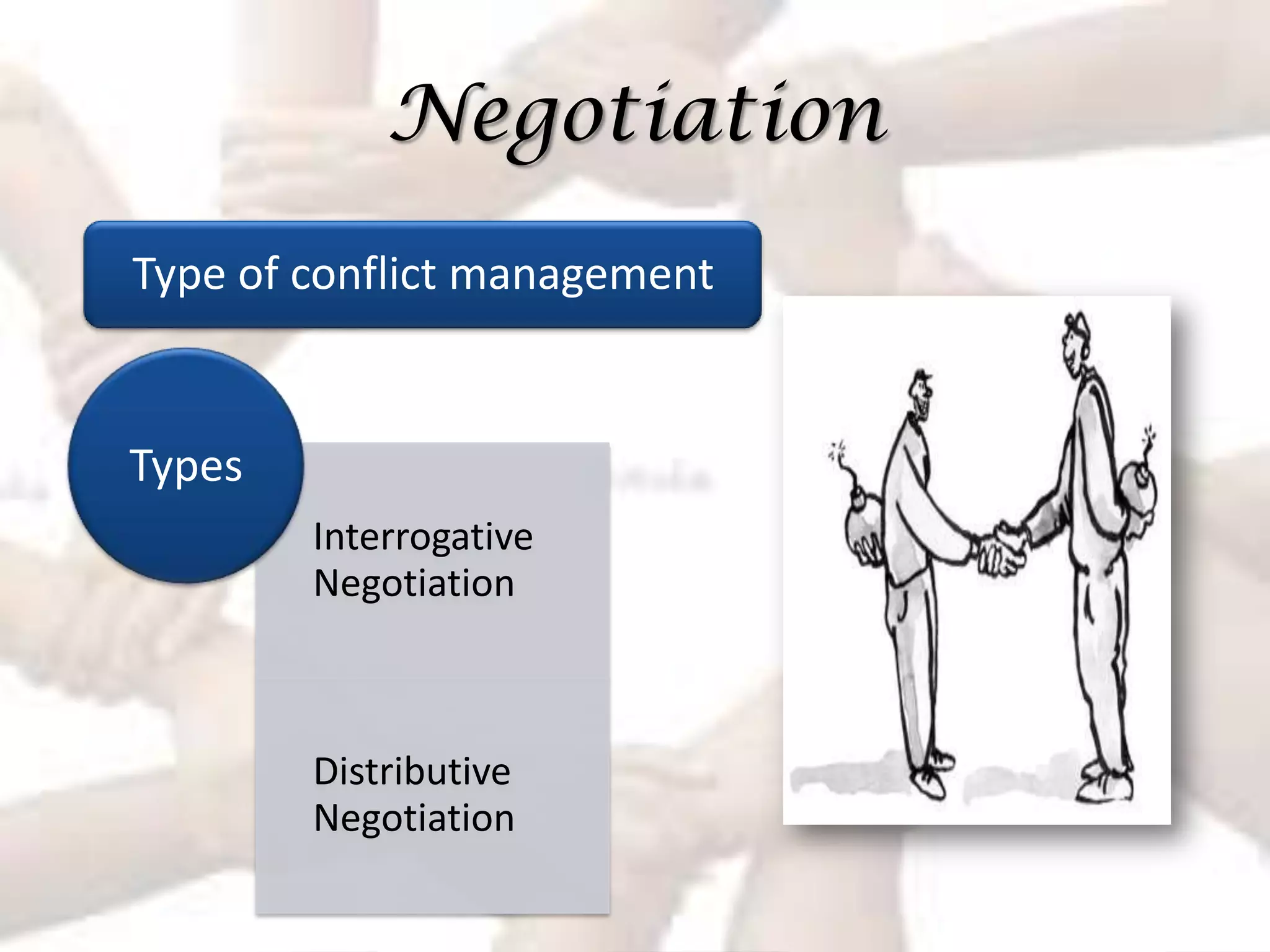
Negotiation
Type of conflict management


Types
        Interrogative
        Negotiation


        Distributive
        Negotiation
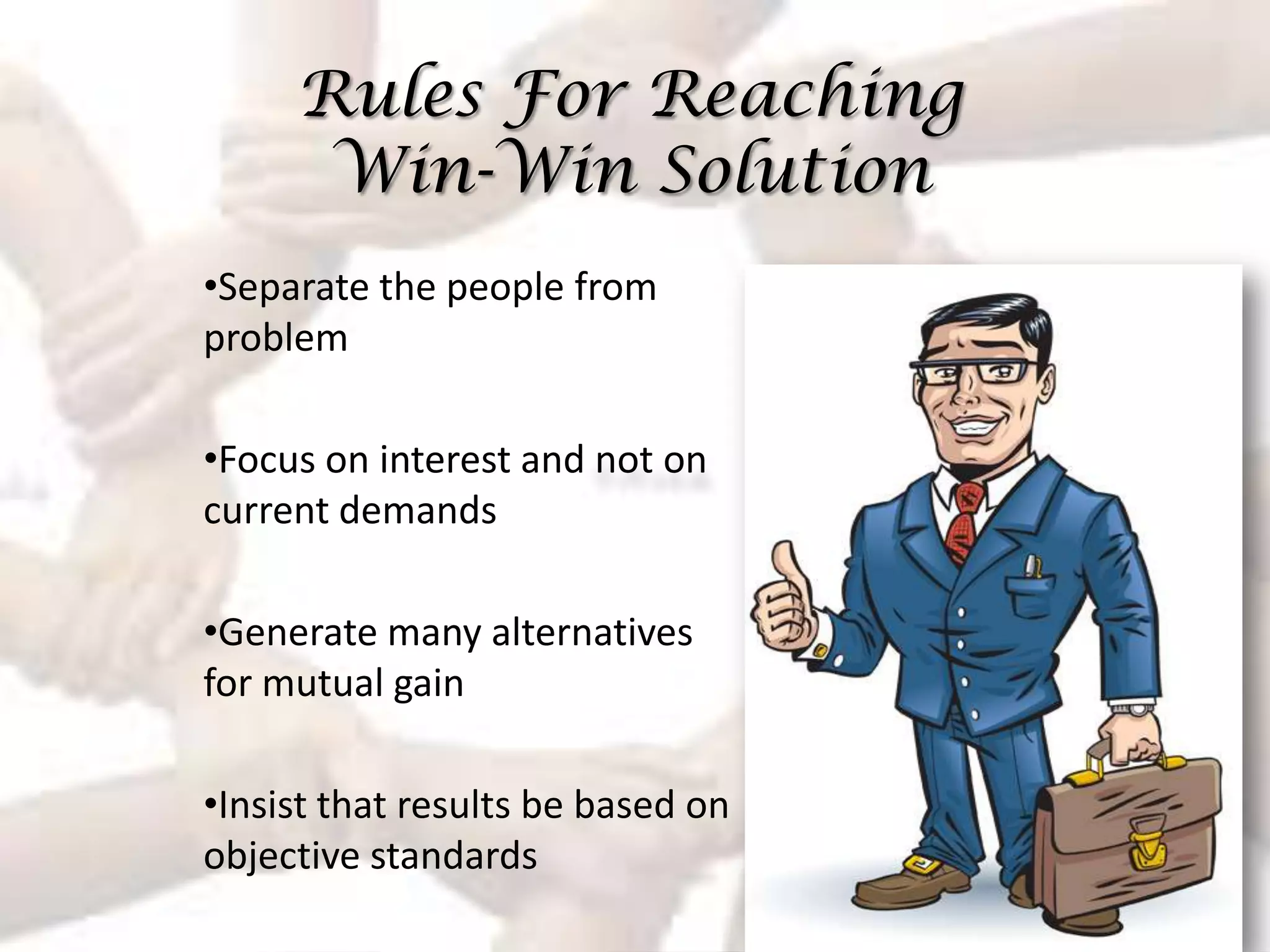
Rules For Reaching
      Win-Win Solution
•Separate the people from
problem

•Focus on interest and not on
current demands

•Generate many alternatives
for mutual gain

•Insist that results be based on
objective standards
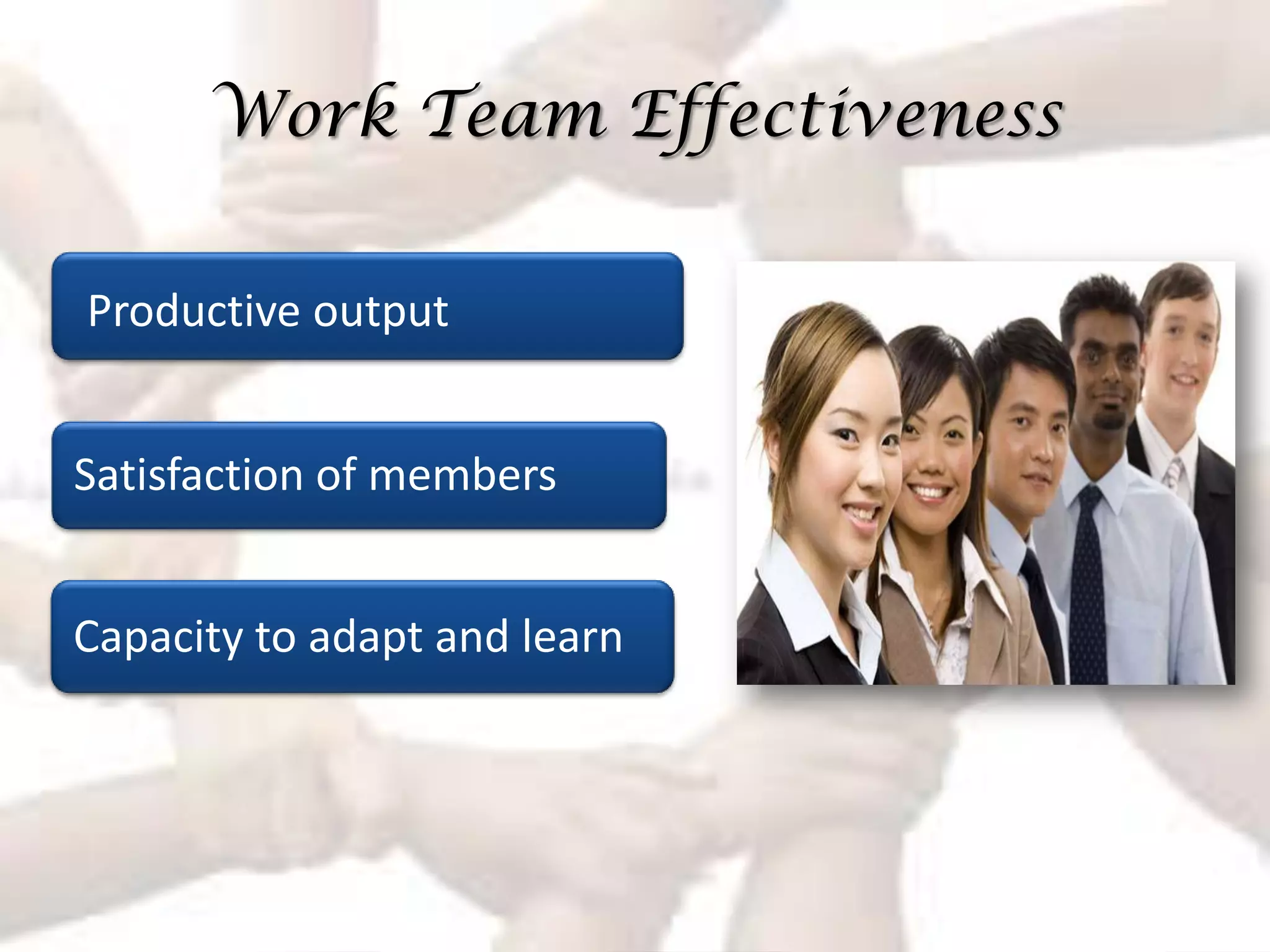
Work Team Effectiveness

Productive output


Satisfaction of members


Capacity to adapt and learn
Teamwork perspective management

Teamwork perspective management

Editor's Notes

  • #7 Informal teams are generally formed for social purposes. They can help to facilitate employee pursuits of common concerns, such as improving work conditions. More frequently however, these teams form out of a set of common concerns and interests, which may or may not be the same as the organization's. Leaders of these teams generally emerge from the membership and are not appointed by anyone in the organization. Informal teams or groups emerge whenever people come together and interact regularly. Such groups develop within the formal organizational structure. Members of informal teams tend to subordinate some of their individual needs to those of the team as a whole. In return, the team supports and protects the individual members. The activities of informal teams may further the interests of the organization – Saturday morning softball games, for example, may strengthen the player’s ties to each other. Or a women’s group may meet to discuss various actions that can make the organization a better place for women to work.
  • #8 Self-directed teams are given autonomy over deciding how a job will be done. These teams are provided with a goal by the organization, and then determine how to achieve that goal. Frequently there is no assigned manager or leader and very few, if any, status differences among the team members. These teams are commonly allowed to choose new team members, decide on work assignments, and may be given responsibility for evaluating team members. They must meet quality standards and interact with both buyers and suppliers, but otherwise have great freedom in determining what the team does. Teams form around a particular project and a leader emerges for that project. The team is responsible for carrying out the project, for recruiting team members, and for evaluating them. Self-directed work teams have a solid track record and many case studies have been developed demonstrated their success. One of the major issues surrounding the use of self-directed teams is empowerment. People are empowered when they are given the authority and responsibility to make decisions affecting their work with a minimum of interference and second guessing by others. When people are empowered they bring their minds to work. They are engaged in making decisions that affect their part of the business. They take responsibility for their actions. They work free from the petty bureaucratic hassles that diminish value and waste time. They add value to the organization by embracing the principles of quality and service. They search for ways to make a difference. The problem is our view of organizations is based on the military model of hierarchy and chain of command. People above make the decisions, people below carry them out. This model is firmly entrenched and difficult to overcome. The problem is many lower and middle level managers have difficulty giving up what they perceive is their hard-earned right to make a decision. Thus they are living in a paradigm that is hard to change. Resistance to change is the result of this paradigm.
  • #9 Technology is impacting how teams meet and function. Collaborative software and conferencing systems have improved the ability for employees to meet, conduct business, share documents, and make decisions without ever being in the same location. While the basic dynamics of other types of teams may still be relevant, the dynamics and management of virtual teams can be very different. Issues can arise with a lack of facial or auditory clues; participants must be taken at their word, even when video-conferencing tools are used. Accountability is impacted by taking a team virtual. Each member is accountable for their tasks and to the team as a whole usually with minimal supervision. Key factors in the success of a virtual team are effective formation of the team, trust and collaboration between members, and excellent communication.