


Group and Teams
Ms. Preeti Bhaskar
Assistant Professor
ICFAI BUSINESS SCHOOL , DEHRADUN
Syllabus
•Types of Groups
•Stages of Group Development: The Five-Stage Model
•The Punctuated Equilibrium Model
•The Dynamics of Informal Groups
•Norms and Roles in Informal Groups
•Group decision-making
•Informal Organizations : Nature, Significance and
Management
•Dynamics of Formal Work Groups
•Teams in the Modern Workplace
•Types of Teams
•Teams vs Groups
•Quality Circles
A group can be defined as several individuals who
come together to accomplish a particular task or
goal.
A group is a collection of people who interact with
one another; accept rights and obligations as
members and who share a common identity.
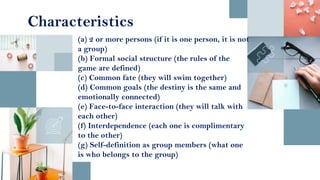
(a) 2 or more persons (if it is one person, it is not
a group)
(b) Formal social structure (the rules of the
game are defined)
(c) Common fate (they will swim together)
(d) Common goals (the destiny is the same and
emotionally connected)
(e) Face-to-face interaction (they will talk with
each other)
(f) Interdependence (each one is complimentary
to the other)
(g) Self-definition as group members (what one
is who belongs to the group)
Characteristics
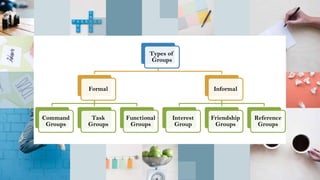
Types of
Groups
Formal
Command
Groups
Task
Groups
Functional
Groups
Informal
Interest
Group
Friendship
Groups
Reference
Groups
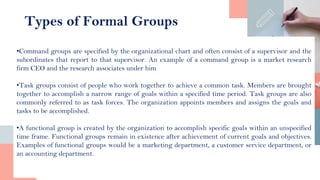
•Command groups are specified by the organizational chart and often consist of a supervisor and the
subordinates that report to that supervisor. An example of a command group is a market research
firm CEO and the research associates under him
•Task groups consist of people who work together to achieve a common task. Members are brought
together to accomplish a narrow range of goals within a specified time period. Task groups are also
commonly referred to as task forces. The organization appoints members and assigns the goals and
tasks to be accomplished.
•A functional group is created by the organization to accomplish specific goals within an unspecified
time frame. Functional groups remain in existence after achievement of current goals and objectives.
Examples of functional groups would be a marketing department, a customer service department, or
an accounting department.
Types of Formal Groups
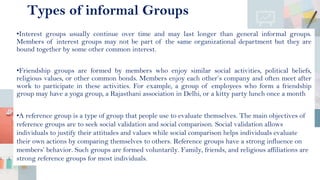
•Interest groups usually continue over time and may last longer than general informal groups.
Members of interest groups may not be part of the same organizational department but they are
bound together by some other common interest.
•Friendship groups are formed by members who enjoy similar social activities, political beliefs,
religious values, or other common bonds. Members enjoy each other’s company and often meet after
work to participate in these activities. For example, a group of employees who form a friendship
group may have a yoga group, a Rajasthani association in Delhi, or a kitty party lunch once a month
•A reference group is a type of group that people use to evaluate themselves. The main objectives of
reference groups are to seek social validation and social comparison. Social validation allows
individuals to justify their attitudes and values while social comparison helps individuals evaluate
their own actions by comparing themselves to others. Reference groups have a strong influence on
members’ behavior. Such groups are formed voluntarily. Family, friends, and religious affiliations are
strong reference groups for most individuals.
Types of informal Groups
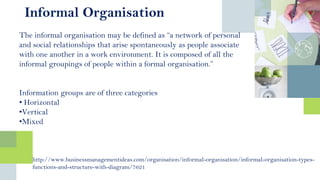
The informal organisation may be defined as “a network of personal
and social relationships that arise spontaneously as people associate
with one another in a work environment. It is composed of all the
informal groupings of people within a formal organisation.”
Information groups are of three categories
• Horizontal
•Vertical
•Mixed
Informal Organisation
http://www.businessmanagementideas.com/organisation/informal-organisation/informal-organisation-types-
functions-and-structure-with-diagram/7621
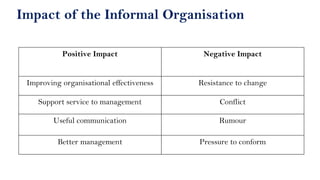
Impact of the Informal Organisation
Positive Impact Negative Impact
Improving organisational effectiveness Resistance to change
Support service to management Conflict
Useful communication Rumour
Better management Pressure to conform
Stages of Group Development
•Stages of Group Development:
The Five-Stage Model
•The Punctuated Equilibrium Model
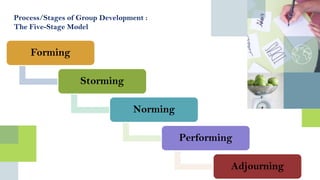
Process/Stages of Group Development :
The Five-Stage Model
Forming
Storming
Norming
Performing
Adjourning
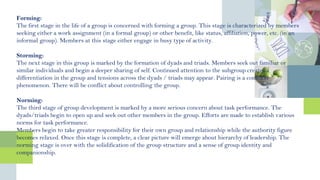
Forming:
The first stage in the life of a group is concerned with forming a group. This stage is characterized by members
seeking either a work assignment (in a formal group) or other benefit, like status, affiliation, power, etc. (in an
informal group). Members at this stage either engage in busy type of activity.
Storming:
The next stage in this group is marked by the formation of dyads and triads. Members seek out familiar or
similar individuals and begin a deeper sharing of self. Continued attention to the subgroup creates a
differentiation in the group and tensions across the dyads / triads may appear. Pairing is a common
phenomenon. There will be conflict about controlling the group.
Norming:
The third stage of group development is marked by a more serious concern about task performance. The
dyads/triads begin to open up and seek out other members in the group. Efforts are made to establish various
norms for task performance.
Members begin to take greater responsibility for their own group and relationship while the authority figure
becomes relaxed. Once this stage is complete, a clear picture will emerge about hierarchy of leadership. The
norming stage is over with the solidification of the group structure and a sense of group identity and
companionship.
Performing:
This is a stage of a fully functional group where members see themselves as a group and get involved in the
task. Each person makes a contribution and the authority figure is also seen as a part of the group. Group
norms are followed and collective pressure is exerted to ensure the Process of Group effectiveness of the
group. The group may redefine its goals Development in the light of information from the outside
environment and show an autonomous will to pursue those goals. The long-term viability of the group is
established and nurtured.
Adjourning:
In the case of temporary groups, like project team, task force, or any other such group, which have a limited
task at hand, also have a fifth stage, This is known as adjourning.
The group decides to disband. Some members may feel happy over the performance, and some may be unhappy
over the stoppage of meeting with group members. Adjourning may also be referred to as mourning, i.e.
mourning the adjournment of the group.
The readers must note that the four stages of group development mentioned above for permanent groups are
merely suggestive. In reality, several stages may go on simultaneously.
Punctuated-Equilibrium Model
Temporary groups go through transitions between
inertia and activity.
Group - Norms
Acceptable standards of behavior within a group
that are shared by the group’s members.
Group decision making is a type of participatory process in which multiple
individuals acting collectively, analyze problems or situations, consider and
evaluate alternative courses of action, and select from among the alternatives a
solution or solutions.
There are several techniques that can be used to increase the efficiency of group
decision making. These are as follows:
•Nominal group Technique
•Delphi Technique
•Brainstorming
•Dialectic Decisions Method
https://businessjargons.com/group-decision-making.html
http://www.referenceforbusiness.com/management/Gr-Int/Group-Decision-Making.html
Group decision making
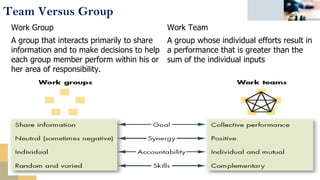
Team Versus Group
Work Group Work Team
A group that interacts primarily to share
information and to make decisions to help
each group member perform within his or
her area of responsibility.
A group whose individual efforts result in
a performance that is greater than the
sum of the individual inputs
Types of Teams
•Problem-Solving Teams
Groups of 5 to 12 employees from the same department who meet for a few hours each week to
discuss ways of improving quality, efficiency, and the work environment.
•Self-Managed Work Teams
Groups of 10 to 15 people who take on the responsibilities of their former supervisors.
•Cross-Functional Teams
Employees from about the same hierarchical level, but from different work areas, who come together
to accomplish a task.( Task forces & Committees )
•Virtual Teams
Teams that use computer technology to tie together physically dispersed members in order to
achieve a common goal.
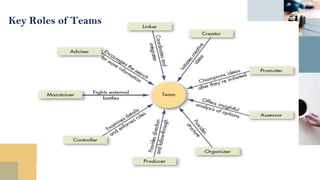
Key Roles of Teams
Quality circle
A quality circle or quality control circle is a group of workers who do the
same or similar work, who meet regularly to identify, analyze and solve
work-related problems.[1] Normally small in size, the group is usually led by
a supervisor or manager and presents its solutions to management; where
possible, workers implement the solutions themselves in order to improve the
performance of the organization and motivate employees.
The most well-known example would be Toyota, which helped to pioneer
the concept decades ago. These circles continue to meet on a regular basis to
identify potential problems and get them resolved as efficiently as possible.
Thank
You

Group and teams

  • 1.
    Group and Teams Ms.Preeti Bhaskar Assistant Professor ICFAI BUSINESS SCHOOL , DEHRADUN
  • 2.
    Syllabus •Types of Groups •Stagesof Group Development: The Five-Stage Model •The Punctuated Equilibrium Model •The Dynamics of Informal Groups •Norms and Roles in Informal Groups •Group decision-making •Informal Organizations : Nature, Significance and Management •Dynamics of Formal Work Groups •Teams in the Modern Workplace •Types of Teams •Teams vs Groups •Quality Circles
  • 3.
    A group canbe defined as several individuals who come together to accomplish a particular task or goal. A group is a collection of people who interact with one another; accept rights and obligations as members and who share a common identity.
  • 4.
    (a) 2 ormore persons (if it is one person, it is not a group) (b) Formal social structure (the rules of the game are defined) (c) Common fate (they will swim together) (d) Common goals (the destiny is the same and emotionally connected) (e) Face-to-face interaction (they will talk with each other) (f) Interdependence (each one is complimentary to the other) (g) Self-definition as group members (what one is who belongs to the group) Characteristics
  • 6.
  • 7.
    •Command groups arespecified by the organizational chart and often consist of a supervisor and the subordinates that report to that supervisor. An example of a command group is a market research firm CEO and the research associates under him •Task groups consist of people who work together to achieve a common task. Members are brought together to accomplish a narrow range of goals within a specified time period. Task groups are also commonly referred to as task forces. The organization appoints members and assigns the goals and tasks to be accomplished. •A functional group is created by the organization to accomplish specific goals within an unspecified time frame. Functional groups remain in existence after achievement of current goals and objectives. Examples of functional groups would be a marketing department, a customer service department, or an accounting department. Types of Formal Groups
  • 8.
    •Interest groups usuallycontinue over time and may last longer than general informal groups. Members of interest groups may not be part of the same organizational department but they are bound together by some other common interest. •Friendship groups are formed by members who enjoy similar social activities, political beliefs, religious values, or other common bonds. Members enjoy each other’s company and often meet after work to participate in these activities. For example, a group of employees who form a friendship group may have a yoga group, a Rajasthani association in Delhi, or a kitty party lunch once a month •A reference group is a type of group that people use to evaluate themselves. The main objectives of reference groups are to seek social validation and social comparison. Social validation allows individuals to justify their attitudes and values while social comparison helps individuals evaluate their own actions by comparing themselves to others. Reference groups have a strong influence on members’ behavior. Such groups are formed voluntarily. Family, friends, and religious affiliations are strong reference groups for most individuals. Types of informal Groups
  • 9.
    The informal organisationmay be defined as “a network of personal and social relationships that arise spontaneously as people associate with one another in a work environment. It is composed of all the informal groupings of people within a formal organisation.” Information groups are of three categories • Horizontal •Vertical •Mixed Informal Organisation http://www.businessmanagementideas.com/organisation/informal-organisation/informal-organisation-types- functions-and-structure-with-diagram/7621
  • 10.
    Impact of theInformal Organisation Positive Impact Negative Impact Improving organisational effectiveness Resistance to change Support service to management Conflict Useful communication Rumour Better management Pressure to conform
  • 11.
    Stages of GroupDevelopment •Stages of Group Development: The Five-Stage Model •The Punctuated Equilibrium Model
  • 12.
    Process/Stages of GroupDevelopment : The Five-Stage Model Forming Storming Norming Performing Adjourning
  • 13.
    Forming: The first stagein the life of a group is concerned with forming a group. This stage is characterized by members seeking either a work assignment (in a formal group) or other benefit, like status, affiliation, power, etc. (in an informal group). Members at this stage either engage in busy type of activity. Storming: The next stage in this group is marked by the formation of dyads and triads. Members seek out familiar or similar individuals and begin a deeper sharing of self. Continued attention to the subgroup creates a differentiation in the group and tensions across the dyads / triads may appear. Pairing is a common phenomenon. There will be conflict about controlling the group. Norming: The third stage of group development is marked by a more serious concern about task performance. The dyads/triads begin to open up and seek out other members in the group. Efforts are made to establish various norms for task performance. Members begin to take greater responsibility for their own group and relationship while the authority figure becomes relaxed. Once this stage is complete, a clear picture will emerge about hierarchy of leadership. The norming stage is over with the solidification of the group structure and a sense of group identity and companionship.
  • 14.
    Performing: This is astage of a fully functional group where members see themselves as a group and get involved in the task. Each person makes a contribution and the authority figure is also seen as a part of the group. Group norms are followed and collective pressure is exerted to ensure the Process of Group effectiveness of the group. The group may redefine its goals Development in the light of information from the outside environment and show an autonomous will to pursue those goals. The long-term viability of the group is established and nurtured. Adjourning: In the case of temporary groups, like project team, task force, or any other such group, which have a limited task at hand, also have a fifth stage, This is known as adjourning. The group decides to disband. Some members may feel happy over the performance, and some may be unhappy over the stoppage of meeting with group members. Adjourning may also be referred to as mourning, i.e. mourning the adjournment of the group. The readers must note that the four stages of group development mentioned above for permanent groups are merely suggestive. In reality, several stages may go on simultaneously.
  • 15.
    Punctuated-Equilibrium Model Temporary groupsgo through transitions between inertia and activity.
  • 16.
    Group - Norms Acceptablestandards of behavior within a group that are shared by the group’s members.
  • 17.
    Group decision makingis a type of participatory process in which multiple individuals acting collectively, analyze problems or situations, consider and evaluate alternative courses of action, and select from among the alternatives a solution or solutions. There are several techniques that can be used to increase the efficiency of group decision making. These are as follows: •Nominal group Technique •Delphi Technique •Brainstorming •Dialectic Decisions Method https://businessjargons.com/group-decision-making.html http://www.referenceforbusiness.com/management/Gr-Int/Group-Decision-Making.html Group decision making
  • 18.
    Team Versus Group WorkGroup Work Team A group that interacts primarily to share information and to make decisions to help each group member perform within his or her area of responsibility. A group whose individual efforts result in a performance that is greater than the sum of the individual inputs
  • 19.
    Types of Teams •Problem-SolvingTeams Groups of 5 to 12 employees from the same department who meet for a few hours each week to discuss ways of improving quality, efficiency, and the work environment. •Self-Managed Work Teams Groups of 10 to 15 people who take on the responsibilities of their former supervisors. •Cross-Functional Teams Employees from about the same hierarchical level, but from different work areas, who come together to accomplish a task.( Task forces & Committees ) •Virtual Teams Teams that use computer technology to tie together physically dispersed members in order to achieve a common goal.
  • 20.
  • 21.
    Quality circle A qualitycircle or quality control circle is a group of workers who do the same or similar work, who meet regularly to identify, analyze and solve work-related problems.[1] Normally small in size, the group is usually led by a supervisor or manager and presents its solutions to management; where possible, workers implement the solutions themselves in order to improve the performance of the organization and motivate employees. The most well-known example would be Toyota, which helped to pioneer the concept decades ago. These circles continue to meet on a regular basis to identify potential problems and get them resolved as efficiently as possible.
  • 22.

Editor's Notes

  • #3 Types of Groups Stages of Group Development: The Five-Stage Model The Punctuated Equilibrium Model The Dynamics of Informal Groups Norms and Roles in Informal Groups Group decision-making Informal Organizations : Nature, Significance and Management Dynamics of Formal Work Groups Teams in the Modern Workplace Types of Teams Teams vs Groups Quality Circles
  • #8 Types of Groups: One way to classify the groups is by way of formality – formal and informal. While formal groups are established by an organization to achieve its goals, informal groups merge spontaneously. Formal groups may take the form of command groups, task groups, and functional groups. 1. Command Groups: Command groups are specified by the organizational chart and often consist of a supervisor and the subordinates that report to that supervisor. An example of a command group is a market research firm CEO and the research associates under him. 2. Task Groups: Task groups consist of people who work together to achieve a common task. Members are brought together to accomplish a narrow range of goals within a specified time period. Task groups are also commonly referred to as task forces. The organization appoints members and assigns the goals and tasks to be accomplished. Examples of assigned tasks are the development of a new product, the improvement of a production process, or designing the syllabus under semester system. Other common task groups are ad hoc committees, project groups, and standing committees. Ad hoc committees are temporary groups created to resolve a specific complaint or develop a process are normally disbanded after the group completes the assigned task. 3. Functional Groups: A functional group is created by the organization to accomplish specific goals within an unspecified time frame. Functional groups remain in existence after achievement of current goals and objectives. Examples of functional groups would be a marketing department, a customer service department, or an accounting department.