TEAMWORK
DEFINITION
• the ability to work efficiently as a team
-dictionary.com-
• The definition of teamwork is the combined
effort of a group of people towards one goal in
mind. When you participate in teamwork, the
work load for everyone is much lighter.
-ask.com-
100%
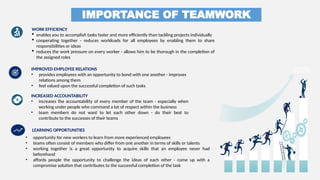
WORK EFFICIENCY
 enables you to accomplish tasks faster and more efficiently than tackling projects individually
 cooperating together - reduces workloads for all employees by enabling them to share
responsibilities or ideas
 reduces the work pressure on every worker - allows him to be thorough in the completion of
the assigned roles
IMPROVED EMPLOYEE RELATIONS
• provides employees with an opportunity to bond with one another - improves
relations among them
• feel valued upon the successful completion of such tasks
IMPORTANCE OF TEAMWORK
INCREASED ACCOUNTABILITY
• increases the accountability of every member of the team - especially when
working under people who command a lot of respect within the business
• team members do not want to let each other down - do their best to
contribute to the successes of their teams
LEARNING OPPORTUNITIES
• opportunity for new workers to learn from more experienced employees
• teams often consist of members who differ from one another in terms of skills or talents
• working together is a great opportunity to acquire skills that an employee never had
beforehand
• affords people the opportunity to challenge the ideas of each other - come up with a
compromise solution that contributes to the successful completion of the task
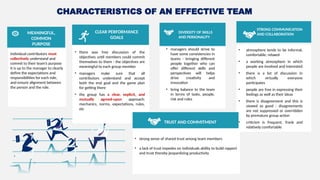
Individual contributors must
collectively understand and
commit to their team’s purpose
it is up to the manager to clearly
define the expectations and
responsibilities for each role,
and ensure alignment between
the person and the role.
MEANINGFUL,
COMMON
PURPOSE
• there was free discussion of the
objectives until members could commit
themselves to them - the objectives are
meaningful to each group member
• managers make sure that all
contributors understand and accept
both the end goal and the game plan
for getting there
• the group has a clear, explicit, and
mutually agreed-upon approach:
mechanics, norms, expectations, rules,
etc
CLEAR PERFORMANCE
GOALS
DIVERSITY OF SKILLS
AND PERSONALITY
• atmosphere tends to be informal,
comfortable, relaxed
• a working atmosphere in which
people are involved and interested
• there is a lot of discussion in
which virtually everyone
participates
• people are free in expressing their
feelings as well as their ideas
• there is disagreement and this is
viewed as good - disagreements
are not suppressed or overridden
by premature group action
• criticism is frequent, frank and
relatively comfortable
STRONG COMMUNICATION
AND COLLABORATION
CHARACTERISTICS OF AN EFFECTIVE TEAM
• managers should strive to
have some consistencies in
teams - bringing different
people together who can
offer different skills and
perspectives will helps
drive creativity and
innovation
• bring balance to the team
in terms of tasks, people,
risk and rules
• strong sense of shared trust among team members
• a lack of trust impedes on individuals ability to build rapport
and trust thereby jeopardizing productivity
TRUST AND COMMITMENT
5 Teamwork
Development
Stages
FORMING
STORMING
NORMING
PERFORMING
ADJOURNING
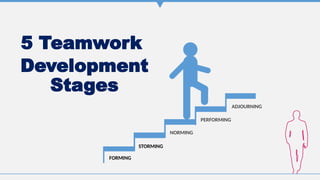
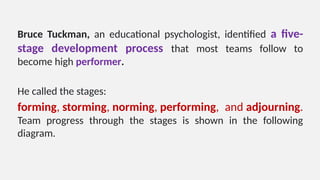
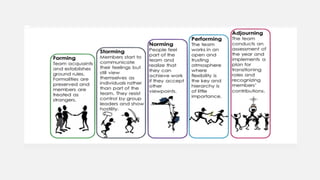
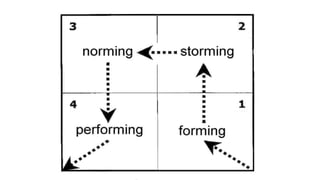
Bruce Tuckman, an educational psychologist, identified a five-
stage development process that most teams follow to
become high performer.
He called the stages:
forming, storming, norming, performing, and adjourning.
Team progress through the stages is shown in the following
diagram.
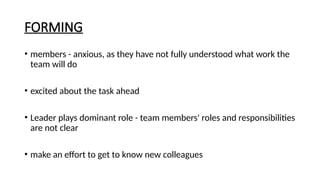
FORMING
• members - anxious, as they have not fully understood what work the
team will do
• excited about the task ahead
• Leader plays dominant role - team members' roles and responsibilities
are not clear
• make an effort to get to know new colleagues
STORMING
• starts where there is a conflict between team members' natural
working styles
• people may work in different ways for all sorts of reasons, but if
differing working styles cause unforeseen problems, they may
become frustrated
• some may question the worth of the team's goal, and they may resist
taking on tasks
NORMING
• people start to resolve their differences, appreciate colleagues'
strengths, and respect your authority as a leader
• they may socialize together, and they are able to ask each other for
help and provide constructive feedback
• develop a stronger commitment to the team goal
PERFORMING
• hard work leads to the achievement of the team's goal
• leader - delegate much of your work, and you can concentrate on
developing team members
• it feels easy to be part of the team at this stage, and people who join
or leave won't disrupt performance
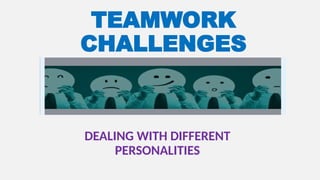
TEAMWORK
CHALLENGES
DEALING WITH DIFFERENT
PERSONALITIES
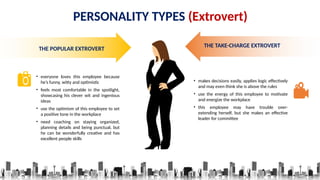
PERSONALITY TYPES (Extrovert)
THE POPULAR EXTROVERT
• everyone loves this employee because
he’s funny, witty and optimistic
• feels most comfortable in the spotlight,
showcasing his clever wit and ingenious
ideas
• use the optimism of this employee to set
a positive tone in the workplace
• need coaching on staying organized,
planning details and being punctual, but
he can be wonderfully creative and has
excellent people skills
THE TAKE-CHARGE EXTROVERT
• makes decisions easily, applies logic effectively
and may even think she is above the rules
• use the energy of this employee to motivate
and energize the workplace
• this employee may have trouble over-
extending herself, but she makes an effective
leader for committee
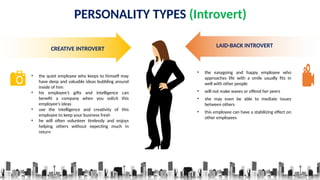
PERSONALITY TYPES (Introvert)
CREATIVE INTROVERT
• the quiet employee who keeps to himself may
have deep and valuable ideas bubbling around
inside of him
• his employee’s gifts and intelligence can
benefit a company when you solicit this
employee's ideas
• use the intelligence and creativity of this
employee to keep your business fresh
• he will often volunteer tirelessly and enjoys
helping others without expecting much in
return
LAID-BACK INTROVERT
• the easygoing and happy employee who
approaches life with a smile usually fits in
well with other people
• will not make waves or offend her peers
• she may even be able to mediate issues
between others
• this employee can have a stabilizing effect on
other employees
The end

5.000000000000000000000000 TEAMWORK.pptx

  • 1.
  • 2.
    DEFINITION • the abilityto work efficiently as a team -dictionary.com- • The definition of teamwork is the combined effort of a group of people towards one goal in mind. When you participate in teamwork, the work load for everyone is much lighter. -ask.com-
  • 3.
    100% WORK EFFICIENCY  enablesyou to accomplish tasks faster and more efficiently than tackling projects individually  cooperating together - reduces workloads for all employees by enabling them to share responsibilities or ideas  reduces the work pressure on every worker - allows him to be thorough in the completion of the assigned roles IMPROVED EMPLOYEE RELATIONS • provides employees with an opportunity to bond with one another - improves relations among them • feel valued upon the successful completion of such tasks IMPORTANCE OF TEAMWORK INCREASED ACCOUNTABILITY • increases the accountability of every member of the team - especially when working under people who command a lot of respect within the business • team members do not want to let each other down - do their best to contribute to the successes of their teams LEARNING OPPORTUNITIES • opportunity for new workers to learn from more experienced employees • teams often consist of members who differ from one another in terms of skills or talents • working together is a great opportunity to acquire skills that an employee never had beforehand • affords people the opportunity to challenge the ideas of each other - come up with a compromise solution that contributes to the successful completion of the task
  • 4.
    Individual contributors must collectivelyunderstand and commit to their team’s purpose it is up to the manager to clearly define the expectations and responsibilities for each role, and ensure alignment between the person and the role. MEANINGFUL, COMMON PURPOSE • there was free discussion of the objectives until members could commit themselves to them - the objectives are meaningful to each group member • managers make sure that all contributors understand and accept both the end goal and the game plan for getting there • the group has a clear, explicit, and mutually agreed-upon approach: mechanics, norms, expectations, rules, etc CLEAR PERFORMANCE GOALS DIVERSITY OF SKILLS AND PERSONALITY • atmosphere tends to be informal, comfortable, relaxed • a working atmosphere in which people are involved and interested • there is a lot of discussion in which virtually everyone participates • people are free in expressing their feelings as well as their ideas • there is disagreement and this is viewed as good - disagreements are not suppressed or overridden by premature group action • criticism is frequent, frank and relatively comfortable STRONG COMMUNICATION AND COLLABORATION CHARACTERISTICS OF AN EFFECTIVE TEAM • managers should strive to have some consistencies in teams - bringing different people together who can offer different skills and perspectives will helps drive creativity and innovation • bring balance to the team in terms of tasks, people, risk and rules • strong sense of shared trust among team members • a lack of trust impedes on individuals ability to build rapport and trust thereby jeopardizing productivity TRUST AND COMMITMENT
  • 5.
  • 6.
    Bruce Tuckman, aneducational psychologist, identified a five- stage development process that most teams follow to become high performer. He called the stages: forming, storming, norming, performing, and adjourning. Team progress through the stages is shown in the following diagram.
  • 9.
    FORMING • members -anxious, as they have not fully understood what work the team will do • excited about the task ahead • Leader plays dominant role - team members' roles and responsibilities are not clear • make an effort to get to know new colleagues
  • 10.
    STORMING • starts wherethere is a conflict between team members' natural working styles • people may work in different ways for all sorts of reasons, but if differing working styles cause unforeseen problems, they may become frustrated • some may question the worth of the team's goal, and they may resist taking on tasks
  • 11.
    NORMING • people startto resolve their differences, appreciate colleagues' strengths, and respect your authority as a leader • they may socialize together, and they are able to ask each other for help and provide constructive feedback • develop a stronger commitment to the team goal
  • 12.
    PERFORMING • hard workleads to the achievement of the team's goal • leader - delegate much of your work, and you can concentrate on developing team members • it feels easy to be part of the team at this stage, and people who join or leave won't disrupt performance
  • 13.
  • 14.
    PERSONALITY TYPES (Extrovert) THEPOPULAR EXTROVERT • everyone loves this employee because he’s funny, witty and optimistic • feels most comfortable in the spotlight, showcasing his clever wit and ingenious ideas • use the optimism of this employee to set a positive tone in the workplace • need coaching on staying organized, planning details and being punctual, but he can be wonderfully creative and has excellent people skills THE TAKE-CHARGE EXTROVERT • makes decisions easily, applies logic effectively and may even think she is above the rules • use the energy of this employee to motivate and energize the workplace • this employee may have trouble over- extending herself, but she makes an effective leader for committee
  • 15.
    PERSONALITY TYPES (Introvert) CREATIVEINTROVERT • the quiet employee who keeps to himself may have deep and valuable ideas bubbling around inside of him • his employee’s gifts and intelligence can benefit a company when you solicit this employee's ideas • use the intelligence and creativity of this employee to keep your business fresh • he will often volunteer tirelessly and enjoys helping others without expecting much in return LAID-BACK INTROVERT • the easygoing and happy employee who approaches life with a smile usually fits in well with other people • will not make waves or offend her peers • she may even be able to mediate issues between others • this employee can have a stabilizing effect on other employees
  • 17.