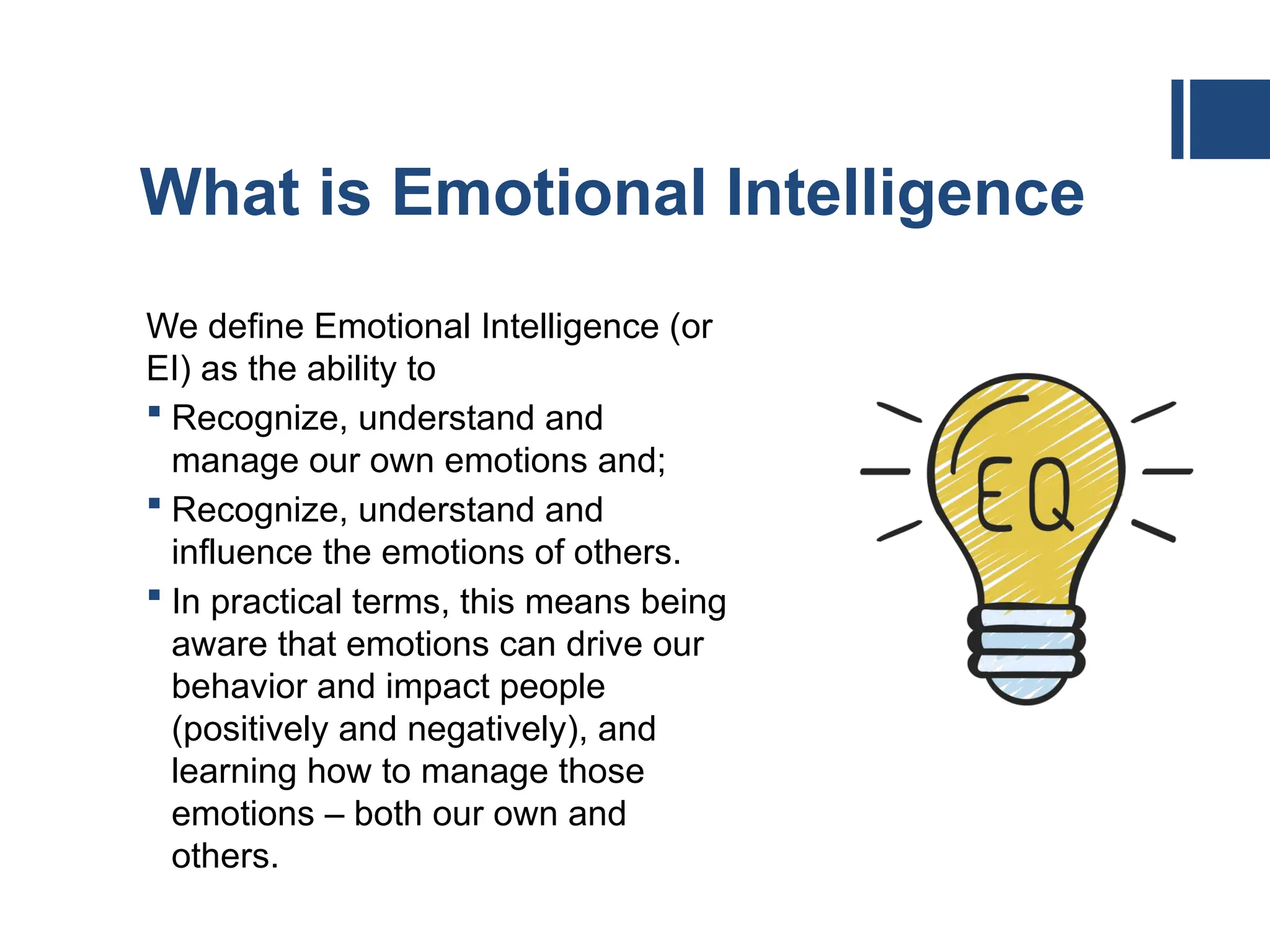
What is Emotional Intelligence
We define Emotional Intelligence (or
EI) as the ability to
 Recognize, understand and
manage our own emotions and;
 Recognize, understand and
influence the emotions of others.
 In practical terms, this means being
aware that emotions can drive our
behavior and impact people
(positively and negatively), and
learning how to manage those
emotions – both our own and
others.
Why Emotional Intelligence is
Important
At a personal level, emotional intelligence helps us:
 Have uncomfortable conversations without hurting feelings
 Manage our emotions when stressed or feeling overwhelmed
 Improve relationships with the people we care about
At work, emotional intelligence can help us:
 Resolve conflicts
 Coach and motivate others
 Create a culture of collaboration
 Build psychological safety within teams
What are the components of
emotional intelligence?
According to Daniel Goleman, an American psychologist who
helped to popularize emotional intelligence, there are five key
elements to it:
1. Self-awareness.
2. Self-regulation.
3. Motivation.
4. Empathy.
5. Social skills.
The more that you, as a leader, manage each of these areas,
the higher your emotional intelligence. So, let's look at each
element in more detail and examine how you can grow as a
leader.
Self-awareness
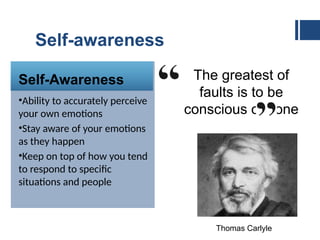
Self-Awareness
•Ability to accurately perceive
your own emotions
•Stay aware of your emotions
as they happen
•Keep on top of how you tend
to respond to specific
situations and people
The greatest of
faults is to be
conscious of none
Thomas Carlyle
Self-regulation
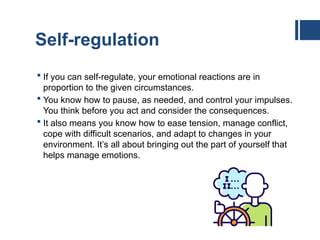
 If you can self-regulate, your emotional reactions are in
proportion to the given circumstances.
 You know how to pause, as needed, and control your impulses.
You think before you act and consider the consequences.
 It also means you know how to ease tension, manage conflict,
cope with difficult scenarios, and adapt to changes in your
environment. It’s all about bringing out the part of yourself that
helps manage emotions.
Motivation
 If you’re intrinsically motivated, you have a thirst for personal
development. You’re highly driven to succeed, whatever your
version of success looks like.
 You’re inspired to accomplish goals because it helps you
grow as a person, rather than doing it for outside rewards
like money, fame, status, or recognition.
Empathy
 If you’re empathic, you’re a healthy level of self-interested — but
not self-centered.
 In conversations, you can understand where someone is coming
from. You can “walk a mile in their shoes,” so to speak. Even if
the exact scenario hasn’t happened to you, you can draw on
your life experience to imagine how it may feel and be
compassionate about what they’re going through.
 You’re slow to judge others and possess the awareness that
we’re all just doing the best we can with the circumstances we’ve
been given. When we know better, we do better.
Social skills
 If you’ve developed your social skills, you’re adept at working
in teams. You’re aware of others and their needs in a
conversation or conflict resolution.
 You’re welcoming in conversation, using active listening, eye
contact, verbal communication skills, and open body
language. You know how to develop a rapport with others or
express leadership, if the occasion calls for it.
Examples of emotional
intelligence
Self-regulation
 Scenario: You’re in a meeting and a boss criticizes you in
front of other co-workers.
 Higher EQ: You maintain composure, then politely excuse
yourself to process your emotions in a safe environment.
 Lower EQ: You may become defensive and storm out of the
office.
Examples of emotional
intelligence….
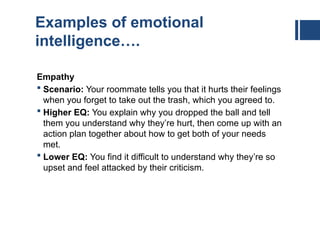
Empathy
 Scenario: Your roommate tells you that it hurts their feelings
when you forget to take out the trash, which you agreed to.
 Higher EQ: You explain why you dropped the ball and tell
them you understand why they’re hurt, then come up with an
action plan together about how to get both of your needs
met.
 Lower EQ: You find it difficult to understand why they’re so
upset and feel attacked by their criticism.
Examples of emotional
intelligence…
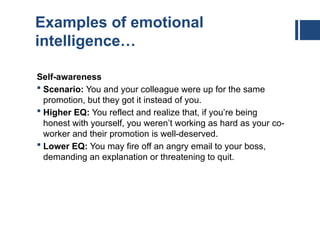
Self-awareness
 Scenario: You and your colleague were up for the same
promotion, but they got it instead of you.
 Higher EQ: You reflect and realize that, if you’re being
honest with yourself, you weren’t working as hard as your co-
worker and their promotion is well-deserved.
 Lower EQ: You may fire off an angry email to your boss,
demanding an explanation or threatening to quit.
Examples of emotional
intelligence…
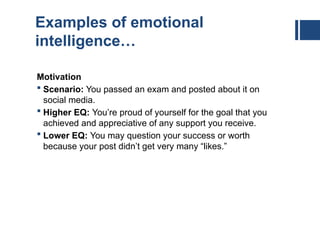
Motivation
 Scenario: You passed an exam and posted about it on
social media.
 Higher EQ: You’re proud of yourself for the goal that you
achieved and appreciative of any support you receive.
 Lower EQ: You may question your success or worth
because your post didn’t get very many “likes.”
Examples of emotional
intelligence…
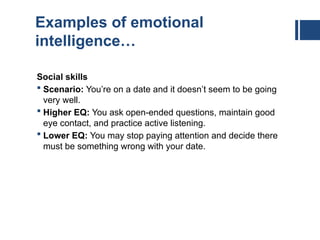
Social skills
 Scenario: You’re on a date and it doesn’t seem to be going
very well.
 Higher EQ: You ask open-ended questions, maintain good
eye contact, and practice active listening.
 Lower EQ: You may stop paying attention and decide there
must be something wrong with your date.
Impact of Emotional Intelligence
Thinking Before Reacting
 Emotionally intelligent people know that emotions can be
powerful, but also temporary. When a highly charged
emotional event happens, such as becoming angry with a
co-worker, the emotionally intelligent response would be to
take some time before responding. This allows everyone to
calm their emotions and think more rationally about all the
factors surrounding the argument.
Greater Self-Awareness
 Emotionally intelligent people are not only good at thinking
about how other people might feel but they are also adept at
understanding their own feelings. Self-awareness allows
people to consider the many different factors that contribute
to their emotions.
Impact of Emotional
Intelligence…
Empathy for Others
 A large part of emotional intelligence is being able to think
about and empathize with how other people are feeling. This
often involves considering how you would respond if you
were in the same situation.
Tips for Improving EI
Listen
 If you want to understand what other people are feeling, the first
step is to pay attention. Take the time to listen to what people
are trying to tell you, both verbally and non-verbally. Body
language can carry a great deal of meaning. When you sense
that someone is feeling a certain way, consider the different
factors that might be contributing to that emotion.
Empathize
 Picking up on emotions is critical, but you also need to be able
to put yourself into someone else's shoes in order to truly
understand their point of view. Practice empathizing with other
people. Imagine how you would feel in their situation. Such
activities can help you build an emotional understanding of a
specific situation as well as develop stronger emotional skills in
the long-term.
Tips for Improving EI…
Reflect
 The ability to reason with emotions is an important part of
emotional intelligence. Consider how your own emotions
influence your decisions and behaviors. When you are thinking
about how other people respond, assess the role that their
emotions play.
 Why is this person feeling this way? Are there any unseen
factors that might be contributing to these feelings? How to your
emotions differ from theirs?

Emotional Intelligence PPT Fish Electronics 2 provided by Nigus Almaw

  • 1.
    What is EmotionalIntelligence We define Emotional Intelligence (or EI) as the ability to  Recognize, understand and manage our own emotions and;  Recognize, understand and influence the emotions of others.  In practical terms, this means being aware that emotions can drive our behavior and impact people (positively and negatively), and learning how to manage those emotions – both our own and others.
  • 2.
    Why Emotional Intelligenceis Important At a personal level, emotional intelligence helps us:  Have uncomfortable conversations without hurting feelings  Manage our emotions when stressed or feeling overwhelmed  Improve relationships with the people we care about At work, emotional intelligence can help us:  Resolve conflicts  Coach and motivate others  Create a culture of collaboration  Build psychological safety within teams
  • 3.
    What are thecomponents of emotional intelligence? According to Daniel Goleman, an American psychologist who helped to popularize emotional intelligence, there are five key elements to it: 1. Self-awareness. 2. Self-regulation. 3. Motivation. 4. Empathy. 5. Social skills. The more that you, as a leader, manage each of these areas, the higher your emotional intelligence. So, let's look at each element in more detail and examine how you can grow as a leader.
  • 4.
    Self-awareness Self-Awareness •Ability to accuratelyperceive your own emotions •Stay aware of your emotions as they happen •Keep on top of how you tend to respond to specific situations and people The greatest of faults is to be conscious of none Thomas Carlyle
  • 5.
    Self-regulation  If youcan self-regulate, your emotional reactions are in proportion to the given circumstances.  You know how to pause, as needed, and control your impulses. You think before you act and consider the consequences.  It also means you know how to ease tension, manage conflict, cope with difficult scenarios, and adapt to changes in your environment. It’s all about bringing out the part of yourself that helps manage emotions.
  • 6.
    Motivation  If you’reintrinsically motivated, you have a thirst for personal development. You’re highly driven to succeed, whatever your version of success looks like.  You’re inspired to accomplish goals because it helps you grow as a person, rather than doing it for outside rewards like money, fame, status, or recognition.
  • 7.
    Empathy  If you’reempathic, you’re a healthy level of self-interested — but not self-centered.  In conversations, you can understand where someone is coming from. You can “walk a mile in their shoes,” so to speak. Even if the exact scenario hasn’t happened to you, you can draw on your life experience to imagine how it may feel and be compassionate about what they’re going through.  You’re slow to judge others and possess the awareness that we’re all just doing the best we can with the circumstances we’ve been given. When we know better, we do better.
  • 8.
    Social skills  Ifyou’ve developed your social skills, you’re adept at working in teams. You’re aware of others and their needs in a conversation or conflict resolution.  You’re welcoming in conversation, using active listening, eye contact, verbal communication skills, and open body language. You know how to develop a rapport with others or express leadership, if the occasion calls for it.
  • 9.
    Examples of emotional intelligence Self-regulation Scenario: You’re in a meeting and a boss criticizes you in front of other co-workers.  Higher EQ: You maintain composure, then politely excuse yourself to process your emotions in a safe environment.  Lower EQ: You may become defensive and storm out of the office.
  • 10.
    Examples of emotional intelligence…. Empathy Scenario: Your roommate tells you that it hurts their feelings when you forget to take out the trash, which you agreed to.  Higher EQ: You explain why you dropped the ball and tell them you understand why they’re hurt, then come up with an action plan together about how to get both of your needs met.  Lower EQ: You find it difficult to understand why they’re so upset and feel attacked by their criticism.
  • 11.
    Examples of emotional intelligence… Self-awareness Scenario: You and your colleague were up for the same promotion, but they got it instead of you.  Higher EQ: You reflect and realize that, if you’re being honest with yourself, you weren’t working as hard as your co- worker and their promotion is well-deserved.  Lower EQ: You may fire off an angry email to your boss, demanding an explanation or threatening to quit.
  • 12.
    Examples of emotional intelligence… Motivation Scenario: You passed an exam and posted about it on social media.  Higher EQ: You’re proud of yourself for the goal that you achieved and appreciative of any support you receive.  Lower EQ: You may question your success or worth because your post didn’t get very many “likes.”
  • 13.
    Examples of emotional intelligence… Socialskills  Scenario: You’re on a date and it doesn’t seem to be going very well.  Higher EQ: You ask open-ended questions, maintain good eye contact, and practice active listening.  Lower EQ: You may stop paying attention and decide there must be something wrong with your date.
  • 14.
    Impact of EmotionalIntelligence Thinking Before Reacting  Emotionally intelligent people know that emotions can be powerful, but also temporary. When a highly charged emotional event happens, such as becoming angry with a co-worker, the emotionally intelligent response would be to take some time before responding. This allows everyone to calm their emotions and think more rationally about all the factors surrounding the argument. Greater Self-Awareness  Emotionally intelligent people are not only good at thinking about how other people might feel but they are also adept at understanding their own feelings. Self-awareness allows people to consider the many different factors that contribute to their emotions.
  • 15.
    Impact of Emotional Intelligence… Empathyfor Others  A large part of emotional intelligence is being able to think about and empathize with how other people are feeling. This often involves considering how you would respond if you were in the same situation.
  • 16.
    Tips for ImprovingEI Listen  If you want to understand what other people are feeling, the first step is to pay attention. Take the time to listen to what people are trying to tell you, both verbally and non-verbally. Body language can carry a great deal of meaning. When you sense that someone is feeling a certain way, consider the different factors that might be contributing to that emotion. Empathize  Picking up on emotions is critical, but you also need to be able to put yourself into someone else's shoes in order to truly understand their point of view. Practice empathizing with other people. Imagine how you would feel in their situation. Such activities can help you build an emotional understanding of a specific situation as well as develop stronger emotional skills in the long-term.
  • 17.
    Tips for ImprovingEI… Reflect  The ability to reason with emotions is an important part of emotional intelligence. Consider how your own emotions influence your decisions and behaviors. When you are thinking about how other people respond, assess the role that their emotions play.  Why is this person feeling this way? Are there any unseen factors that might be contributing to these feelings? How to your emotions differ from theirs?