Business Intelligence 
Michael Lamont, ’12 
lamont@post.harvard.edu
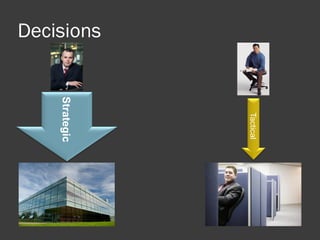
Decisions Strategic Tactical
Decisions
Decisions
Decisions 
Possible to make a good decision without data technology 
Looking at the right data can help you make better decisions 
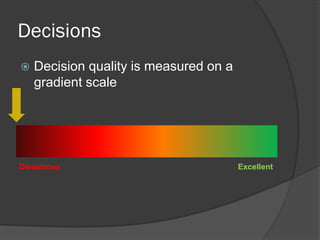
Decisions aren’t judged on a binary “good” or “bad” scale.
Decisions 
Decision quality is measured on a gradient scale 
Disastrous 
Excellent
Decisions 
Decisions drive companies 
Better decisions lead to: 
More efficient operation 
Higher profitability 
Greater customer satisfaction 
Companies that make better decisions are more successful
Business Intelligence 
Business Intelligence (BI): Using data about yesterday and today to make better decisions about tomorrow 
BI makes companies smarter: 
The right criteria to judge success 
Locating and transforming the right data 
Arranging information 
Lets management see things more clearly, and glimpse the future
Limited Resources, Unlimited Decisions 
Every organization has to make do with only what they have, all the time 
You can’t hire only the brightest minds and spend unlimited money on efficiency 
Time is the most precious resource your company has – it has to move quickly, not just correctly
Limited Resources, Unlimited Decisions 
BI is a powerful ally when a decision is required 
Flexible resource that can be used by any level of the organization
Limited Resources, Unlimited Decisions 
Examples of simultaneous BI tasks: 
VP of Sales deciding which markets & accounts to target to meet sales targets 
Product developers deciding which fragrances to use in future products 
Gulf Coast marketing team deciding on holiday weekend promotions
BI Defined 
Lots of very different definitions of business intelligence exist 
BI used to be a marketing buzzword that got tied to not strictly related technologies 
Every vendor invents a definition that skews toward their products 
Researchers, authors, & consultants all have their own pet definitions
BI Defined 
Business Intelligence is timely, accurate, high-value, and actionable business insights, and the work processes and technologies used to obtain them. 
There’s no “magic list” of processes or software that constitute BI 
BI is high tech, and thus always evolving 
Every company’s situation is different
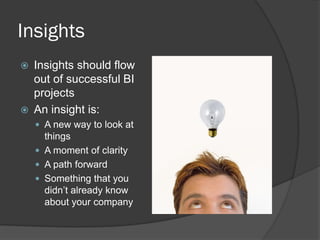
Insights 
Insights should flow out of successful BI projects 
An insight is: 
A new way to look at things 
A moment of clarity 
A path forward 
Something that you didn’t already know about your company
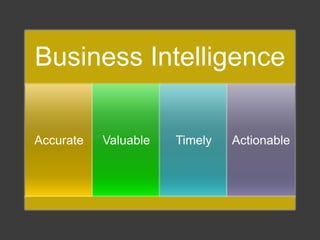
Business Intelligence 
Accurate 
Valuable Timely 
Actionable
Accurate Answers 
Decisions should be: 
Informed by data 
Made by subject matter experts 
Based on hard information 
For BI to be valuable, it has to: 
Reflect objective reality 
Adhere to strict standards of correctness 
Accuracy is a core attribute of BI insights
Accurate Answers 
 BI is subject to “Garbage In, Garbage 
Out” (GIGO) rule 
Business Intelligence Process
Inaccuracy Example 
Sales exec sees a region lagging behind 
Senior executives adjust sales process (and personnel) in that region 
What if the insight was wrong? 
Some sales offices were incorrectly allocated to neighboring region 
Sales volume wasn’t correctly allocated 
Actions taken were less than helpful – may have made things worse
Accurate Answers 
Accuracy is also important from a political perspective 
BI can’t have a real impact unless people trust it 
BI insights can be 
Surprising 
Counterintuitive 
Threatening to some groups/managers
Accurate Answers 
Any error, no matter how small, is going to be used to call into doubt every conclusion pulled from the data 
BI has to be as accurate as possible to protect its reputation from skeptics 
Inaccurate BI insights are worse than useless – they’re damaging 
One bad BI experience will keep it from ever being trusted again
Valuable Insights 
Not all insights are created equal 
Reporting that people who buy peanut butter also buy jelly isn’t much of an insight 
BI should produce information that can have a real impact on a business
Valuable Insights 
Impact of valuable BI insights can be: 
Reduced costs 
Increased sales 
Operational efficiency 
Other positive factors 
High-value insights aren’t usually deducible 
Insights aren’t always obvious, but can have huge impact
Valuable Insight Example 
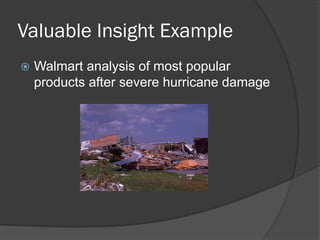
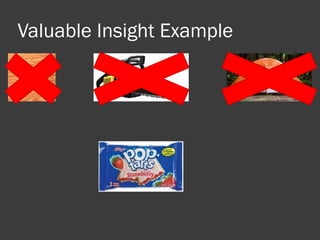
Walmart analysis of most popular products after severe hurricane damage
Valuable Insight Example
Timely Information 
Die Geist der Treppe – the “Spirit of the Staircase” 
Delivering facts late in a debate keeps them from mattering 
Information delays in business can have the same level of impact
Timely Information 
Information delays come in many forms: 
Workflow (not refreshing data frequently enough) 
Technology (lack of computational power and efficiency) 
Unexpected logistics issues 
The time taken for each step in a BI process, added together, has to be short enough to make results useful
Timely Information 
Timeliness is a required part of useful insights 
High quality BI processes need current information 
Analysis products need to be provided to decision makers in time for them to consider all courses of action
Actionable Conclusions 
Insights are worthless if they can’t be acted upon 
Non-actionable insights: 
Major competitors should instantly cease operating 
Factories should be 20 years newer 
Decision support tools will happily find non-actionable insights if you let them
Actionable Conclusions 
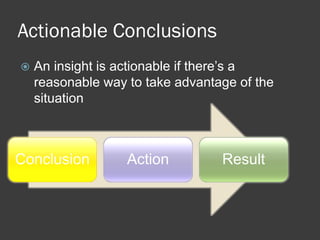
An insight is actionable if there’s a reasonable way to take advantage of the situation Conclusion Action Result
The Value of BI 
Links information with action 
What’s the real value returned from an investment in BI tools and processes? 
Promoting and supporting better decision making habits
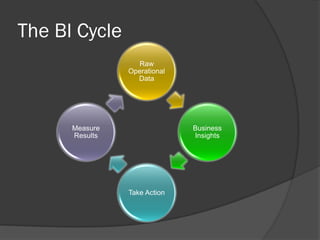
The BI Cycle Raw Operational Data Business Insights Take Action Measure Results
The BI Cycle 
Companies that follow the cycle have a rational decision making process 
Business Intelligence supports the cycle 
Obtain insights from operational data 
Good insights can be applied to decision making process 
Decisions lead to actions, and improved operational results 
Cycle repeats and decisions are refined
Trends 
BI continues to increase in importance to both large enterprises and SMBs 
BI is flexible, and responsive to technological advances
Trends 
BI projects are originating outside IT departments 
IT used to be the only group that knew what data and analyses were available 
Executives and other decision makers have gotten comfortable with BI
Trends 
Delivery of analytics to desktop (and mobile devices) 
Premier vendors can round-trip data to standard Office applications 
Excel includes advanced analytical tools
Trends 
Data access is becoming more dynamic and approaching near-real-time 
BI systems of the future will be able to directly pull data from operational systems 
Computational efficiency of BI systems is constantly increasing
Conclusions 
Business Intelligence isn’t just about computing 
Requires a corporate culture that supports data-driven decision making 
Business managers must promote data- based decision making 
IT has to support the tech behind BI at all levels of the company
Conclusions 
BI gives you new tools and perspectives 
Lets you ponder what-if questions 
Decision makers have to know how to ask the right questions 
No set rules for determining the “right” reports and analytics for a particular company
Conclusions 
The right people have to be in the right positions for BI to work 
BI is a commitment to rational decision making processes 
Must be supported at all levels of the company, by both managers and IT
Michael Lamont, ’12 
lamont@post.harvard.edu

Understanding Business Intelligence

  • 1.
    Business Intelligence MichaelLamont, ’12 lamont@post.harvard.edu
  • 2.
  • 3.
  • 4.
  • 5.
    Decisions Possible tomake a good decision without data technology Looking at the right data can help you make better decisions Decisions aren’t judged on a binary “good” or “bad” scale.
  • 6.
    Decisions Decision qualityis measured on a gradient scale Disastrous Excellent
  • 7.
    Decisions Decisions drivecompanies Better decisions lead to: More efficient operation Higher profitability Greater customer satisfaction Companies that make better decisions are more successful
  • 8.
    Business Intelligence BusinessIntelligence (BI): Using data about yesterday and today to make better decisions about tomorrow BI makes companies smarter: The right criteria to judge success Locating and transforming the right data Arranging information Lets management see things more clearly, and glimpse the future
  • 9.
    Limited Resources, UnlimitedDecisions Every organization has to make do with only what they have, all the time You can’t hire only the brightest minds and spend unlimited money on efficiency Time is the most precious resource your company has – it has to move quickly, not just correctly
  • 10.
    Limited Resources, UnlimitedDecisions BI is a powerful ally when a decision is required Flexible resource that can be used by any level of the organization
  • 11.
    Limited Resources, UnlimitedDecisions Examples of simultaneous BI tasks: VP of Sales deciding which markets & accounts to target to meet sales targets Product developers deciding which fragrances to use in future products Gulf Coast marketing team deciding on holiday weekend promotions
  • 13.
    BI Defined Lotsof very different definitions of business intelligence exist BI used to be a marketing buzzword that got tied to not strictly related technologies Every vendor invents a definition that skews toward their products Researchers, authors, & consultants all have their own pet definitions
  • 16.
    BI Defined BusinessIntelligence is timely, accurate, high-value, and actionable business insights, and the work processes and technologies used to obtain them. There’s no “magic list” of processes or software that constitute BI BI is high tech, and thus always evolving Every company’s situation is different
  • 17.
    Insights Insights shouldflow out of successful BI projects An insight is: A new way to look at things A moment of clarity A path forward Something that you didn’t already know about your company
  • 18.
    Business Intelligence Accurate Valuable Timely Actionable
  • 19.
    Accurate Answers Decisionsshould be: Informed by data Made by subject matter experts Based on hard information For BI to be valuable, it has to: Reflect objective reality Adhere to strict standards of correctness Accuracy is a core attribute of BI insights
  • 20.
    Accurate Answers BI is subject to “Garbage In, Garbage Out” (GIGO) rule Business Intelligence Process
  • 21.
    Inaccuracy Example Salesexec sees a region lagging behind Senior executives adjust sales process (and personnel) in that region What if the insight was wrong? Some sales offices were incorrectly allocated to neighboring region Sales volume wasn’t correctly allocated Actions taken were less than helpful – may have made things worse
  • 22.
    Accurate Answers Accuracyis also important from a political perspective BI can’t have a real impact unless people trust it BI insights can be Surprising Counterintuitive Threatening to some groups/managers
  • 23.
    Accurate Answers Anyerror, no matter how small, is going to be used to call into doubt every conclusion pulled from the data BI has to be as accurate as possible to protect its reputation from skeptics Inaccurate BI insights are worse than useless – they’re damaging One bad BI experience will keep it from ever being trusted again
  • 24.
    Valuable Insights Notall insights are created equal Reporting that people who buy peanut butter also buy jelly isn’t much of an insight BI should produce information that can have a real impact on a business
  • 25.
    Valuable Insights Impactof valuable BI insights can be: Reduced costs Increased sales Operational efficiency Other positive factors High-value insights aren’t usually deducible Insights aren’t always obvious, but can have huge impact
  • 26.
    Valuable Insight Example Walmart analysis of most popular products after severe hurricane damage
  • 27.
  • 28.
    Timely Information DieGeist der Treppe – the “Spirit of the Staircase” Delivering facts late in a debate keeps them from mattering Information delays in business can have the same level of impact
  • 29.
    Timely Information Informationdelays come in many forms: Workflow (not refreshing data frequently enough) Technology (lack of computational power and efficiency) Unexpected logistics issues The time taken for each step in a BI process, added together, has to be short enough to make results useful
  • 30.
    Timely Information Timelinessis a required part of useful insights High quality BI processes need current information Analysis products need to be provided to decision makers in time for them to consider all courses of action
  • 31.
    Actionable Conclusions Insightsare worthless if they can’t be acted upon Non-actionable insights: Major competitors should instantly cease operating Factories should be 20 years newer Decision support tools will happily find non-actionable insights if you let them
  • 32.
    Actionable Conclusions Aninsight is actionable if there’s a reasonable way to take advantage of the situation Conclusion Action Result
  • 33.
    The Value ofBI Links information with action What’s the real value returned from an investment in BI tools and processes? Promoting and supporting better decision making habits
  • 34.
    The BI CycleRaw Operational Data Business Insights Take Action Measure Results
  • 35.
    The BI Cycle Companies that follow the cycle have a rational decision making process Business Intelligence supports the cycle Obtain insights from operational data Good insights can be applied to decision making process Decisions lead to actions, and improved operational results Cycle repeats and decisions are refined
  • 36.
    Trends BI continuesto increase in importance to both large enterprises and SMBs BI is flexible, and responsive to technological advances
  • 37.
    Trends BI projectsare originating outside IT departments IT used to be the only group that knew what data and analyses were available Executives and other decision makers have gotten comfortable with BI
  • 38.
    Trends Delivery ofanalytics to desktop (and mobile devices) Premier vendors can round-trip data to standard Office applications Excel includes advanced analytical tools
  • 39.
    Trends Data accessis becoming more dynamic and approaching near-real-time BI systems of the future will be able to directly pull data from operational systems Computational efficiency of BI systems is constantly increasing
  • 40.
    Conclusions Business Intelligenceisn’t just about computing Requires a corporate culture that supports data-driven decision making Business managers must promote data- based decision making IT has to support the tech behind BI at all levels of the company
  • 41.
    Conclusions BI givesyou new tools and perspectives Lets you ponder what-if questions Decision makers have to know how to ask the right questions No set rules for determining the “right” reports and analytics for a particular company
  • 42.
    Conclusions The rightpeople have to be in the right positions for BI to work BI is a commitment to rational decision making processes Must be supported at all levels of the company, by both managers and IT
  • 43.
    Michael Lamont, ’12 lamont@post.harvard.edu