Intrapersonal Skills
Intrapersonal skills are those skills and
communications that occur within a person's own
mind. Intrapersonal skills initiate an appropriate
reaction and attitude because of positive internal
dialogue, occurring within the mind.
Awareness of your personal inner dialogue is
the first step to improving your intrapersonal
skills.
Visualization
Visualization is an intrapersonal skill used by athletes,
actors and musical performers to prep themselves to
give the best performance they are capable of before
they embark on an event.
Recognizing Negativity
It is quite natural to have occasional negative
thoughts, but an excess of negative thinking can
reproduce negativity in your life.
Skilled intrapersonal communicators can turn around
a negative thought pattern and use it to bring fresh
and inspiring ideas into their day. Attitude is
everything when dealing with negativity and with
practice.
Compassion
Having compassion for others is an intrapersonal skill
that allows you to see things from the perspective of
others, and is important for teachers, team leaders
and anyone working closely with other people.
Positive Decision Making
Positive decision making is a necessary intrapersonal
skill required for many professions as well as for a
healthy, happy personal life. Well-developed
intrapersonal decision-making skills can be achieved
with practice. When faced with the decision-making
process, you
must available
choices
be able to scan
through the in your
mind, consider each
alternative and come to a practical decision
without inner conflict and Confusion.
Intrapersonal skills are the foundations of a successful
career. This is emotional intelligence, the ability to
know, understand and mange your own emotions.
ARE YOU EMOTIONALLY INTELLIGENT?
Before we move ahead please note
that:
IQ means intelligence quotient
EQ means emotional quotient
EI means emotional intelligence
WHAT ARE EMOTIONS ?
Happiness, fear, anger, affection, shame, disgust, surprise, lust,
sadness,
elation, love, frustration, anxiety, failure, achievement etc.
The above are the emotions which directly affect our day-to-day
life.
There are TWO dimensions of emotions:
Physiological side: ‘Emotion’ is a complex state
of human mind, involving bodily changes of
widespread character such as breathing, pounding heart,
The ‘feelings’, are what
one
flushed face, sweating palms, pulse rate,
etc.
Psychological side, a state
of excitement. experiences as the
Examples of some of the emotions:
 She is too sensitive.
 He takes everything too personally.
 He is jealous of his colleagues.
 My boss is always in a hostile mood.
 She does not understand the feelings of others.
 He is always nagging others.
 Nobody understands/listens to me.
 Themanagement is way out of touch with
employee’s emotions.
 Why does it happen with me only in life.
 I am always nice with the people around me.
The above statementsrefer to
various emotions we experience in our day
to day life.
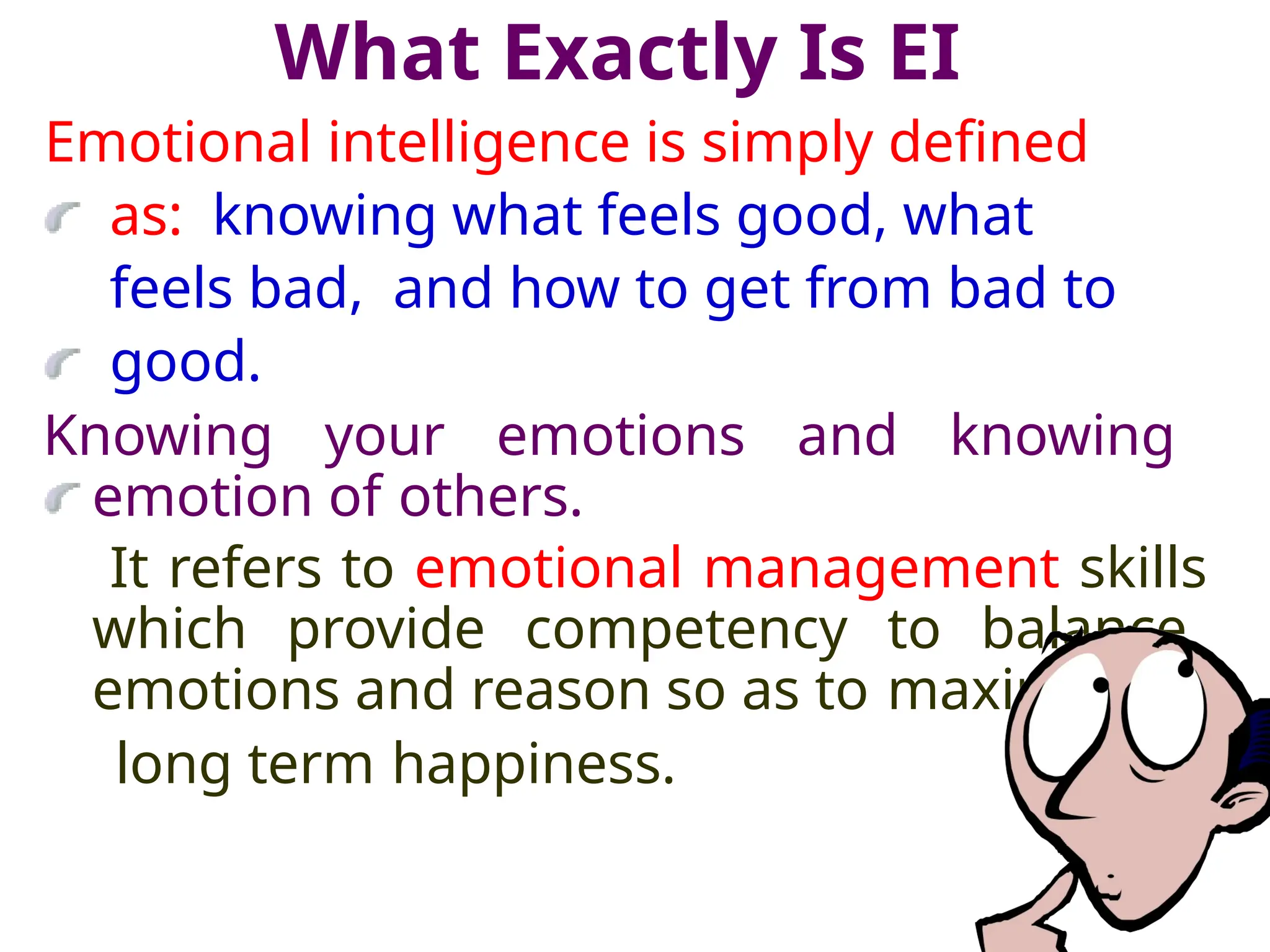
What Exactly Is EI
Emotional intelligence is simply defined
as: knowing what feels good, what
feels bad, and how to get from bad to
good.
Knowing your emotions and knowing
emotion of others.
It refers to emotional management skills
which provide competency to balance
emotions and reason so as to maximize
long term happiness.
Are we giving EI education in schools
/colleges
NO. Our educational system gives stress on IQ and not on EQ. We
are taught History, Hindi, English, Geography, Physics,
anthropology, Botany, Computers, Medicine, Engineering etc.
We are not TAUGHT how to handle frustration, anxieties, stress,
failure, depression, burnout, inferiority complexes, ego problems
We are not told to learn how to manage emotions i.e.; interaction,
coordination, Adjustment, communication
We are expected to learn all these from our parents, peer group of
other role models
At the later stages of our lives we are told to master emotional
competencies to be successful.
IQ v/s EQ
(Intelligence Quotient v/s Emotional Quotient)
The research
shows that IQ can
help you
to be successful
to
the extent of
20 percent only
in life.
The rest of
80
percent
success
depends on your
EQ
80%
EQ
20% IQ
EQ
IQ
THE PERSONALITY
The
HEAD
The
HEART
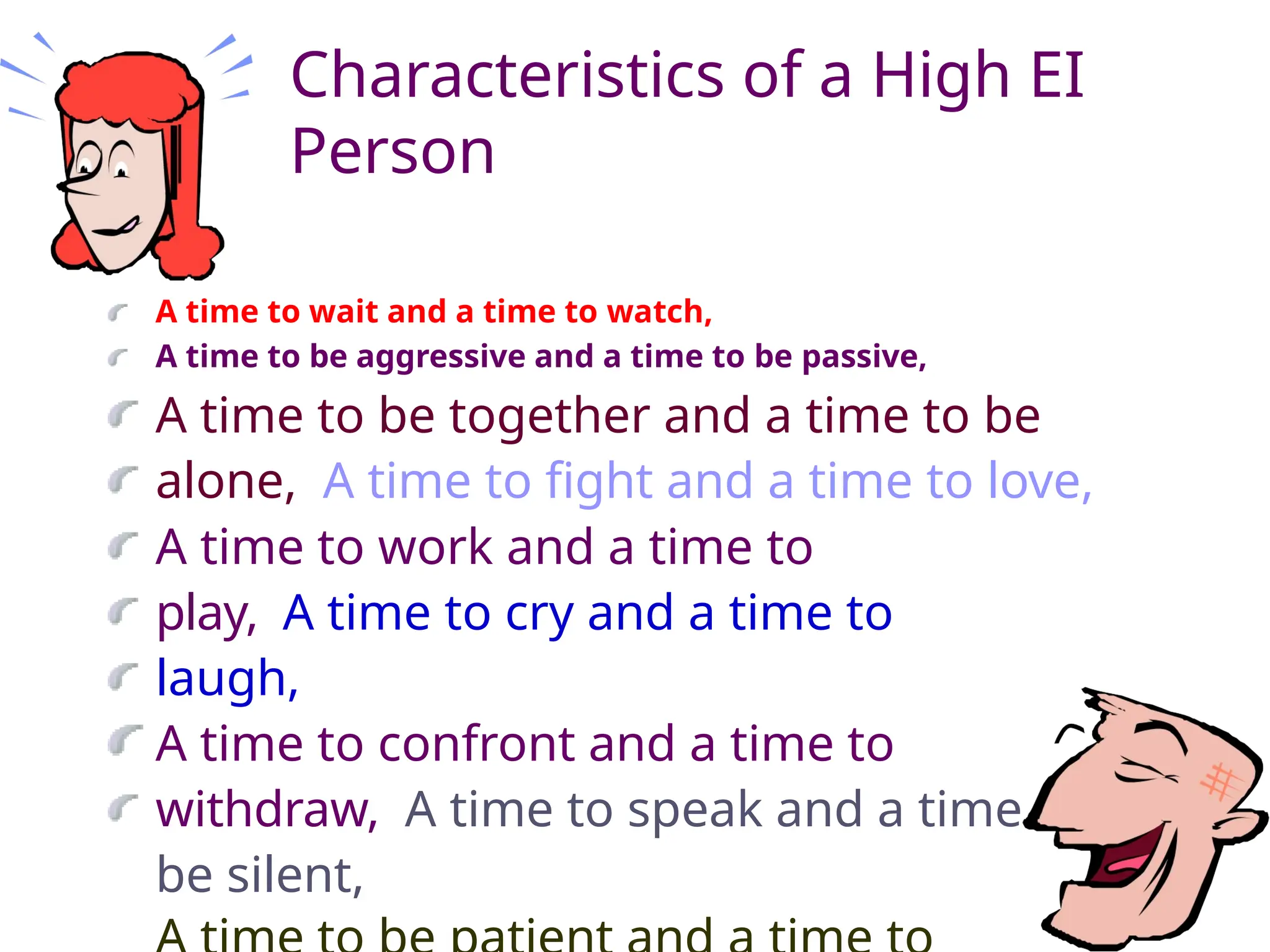
Characteristics of a High EI
Person
A time to wait and a time to watch,
A time to be aggressive and a time to be passive,
A time to be together and a time to be
alone, A time to fight and a time to love,
A time to work and a time to
play, A time to cry and a time to
laugh,
A time to confront and a time to
withdraw, A time to speak and a time to
be silent,
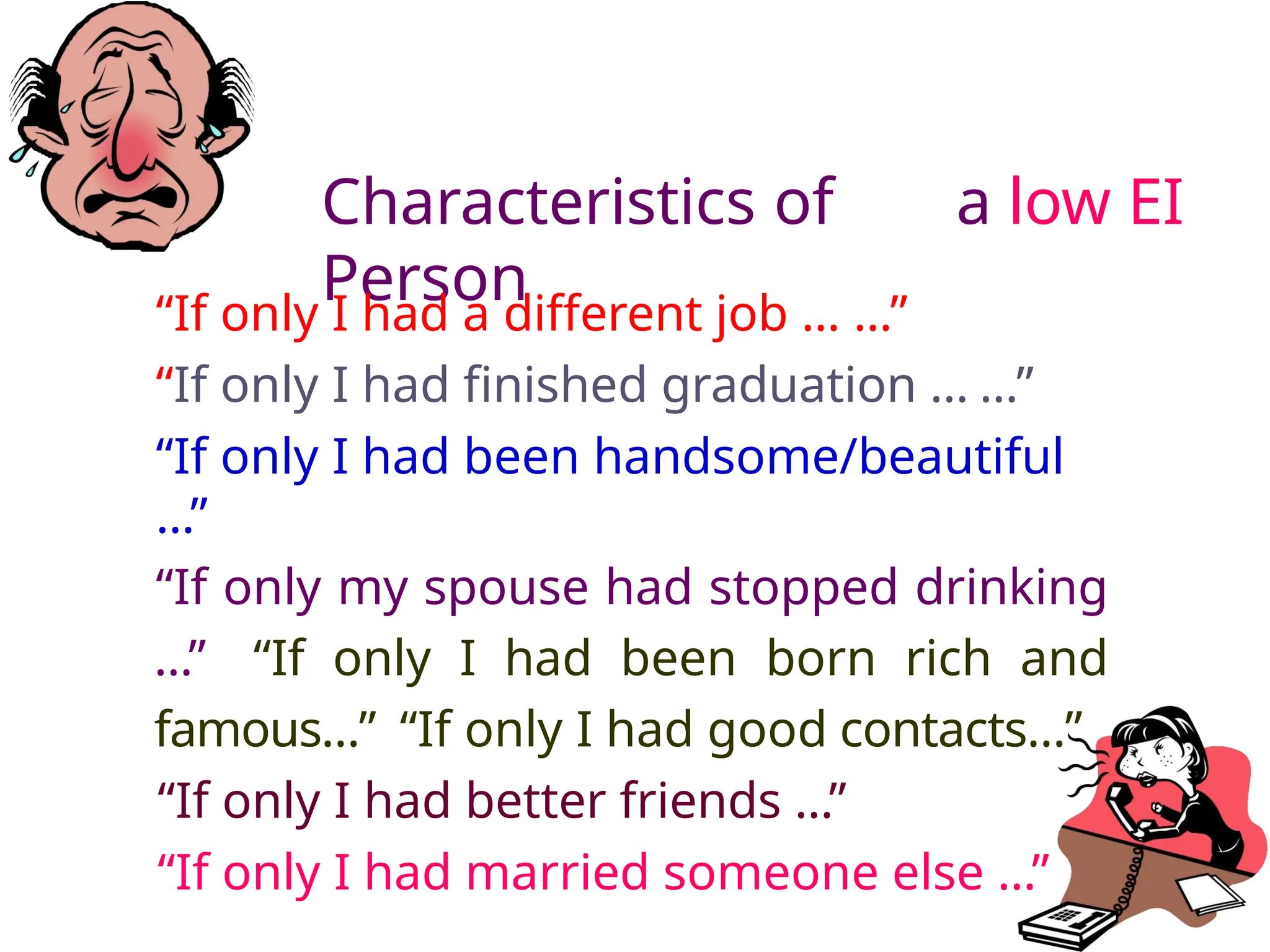
Characteristics of a low EI
Person
“If only I had a different job … …”
“If only I had finished graduation … …”
“If only I had been handsome/beautiful
…”
“If only my spouse had stopped drinking
…” “If only I had been born rich and
famous…” “If only I had good contacts…”
“If only I had better friends …”
“If only I had married someone else …”
CONCLUSION: Applying EI makes you feel
comfortable within your own skin and
with
people around you. Yo
u
can also
understand what makes you incompatible
with certain people or jobs and learn ways
to deal with the emotional difficulties ease.
You can also understand the specific
feelings that cause you stress and learn
ways to become more at peace.

intrapersonalskills.pptx which are important

  • 1.
  • 2.
    Intrapersonal Skills Intrapersonal skillsare those skills and communications that occur within a person's own mind. Intrapersonal skills initiate an appropriate reaction and attitude because of positive internal dialogue, occurring within the mind. Awareness of your personal inner dialogue is the first step to improving your intrapersonal skills.
  • 3.
    Visualization Visualization is anintrapersonal skill used by athletes, actors and musical performers to prep themselves to give the best performance they are capable of before they embark on an event.
  • 4.
    Recognizing Negativity It isquite natural to have occasional negative thoughts, but an excess of negative thinking can reproduce negativity in your life. Skilled intrapersonal communicators can turn around a negative thought pattern and use it to bring fresh and inspiring ideas into their day. Attitude is everything when dealing with negativity and with practice.
  • 5.
    Compassion Having compassion forothers is an intrapersonal skill that allows you to see things from the perspective of others, and is important for teachers, team leaders and anyone working closely with other people.
  • 6.
    Positive Decision Making Positivedecision making is a necessary intrapersonal skill required for many professions as well as for a healthy, happy personal life. Well-developed intrapersonal decision-making skills can be achieved with practice. When faced with the decision-making process, you must available choices be able to scan through the in your mind, consider each alternative and come to a practical decision without inner conflict and Confusion.
  • 7.
    Intrapersonal skills arethe foundations of a successful career. This is emotional intelligence, the ability to know, understand and mange your own emotions. ARE YOU EMOTIONALLY INTELLIGENT?
  • 8.
    Before we moveahead please note that: IQ means intelligence quotient EQ means emotional quotient EI means emotional intelligence
  • 9.
    WHAT ARE EMOTIONS? Happiness, fear, anger, affection, shame, disgust, surprise, lust, sadness, elation, love, frustration, anxiety, failure, achievement etc. The above are the emotions which directly affect our day-to-day life. There are TWO dimensions of emotions: Physiological side: ‘Emotion’ is a complex state of human mind, involving bodily changes of widespread character such as breathing, pounding heart, The ‘feelings’, are what one flushed face, sweating palms, pulse rate, etc. Psychological side, a state of excitement. experiences as the
  • 10.
    Examples of someof the emotions:  She is too sensitive.  He takes everything too personally.  He is jealous of his colleagues.  My boss is always in a hostile mood.  She does not understand the feelings of others.  He is always nagging others.  Nobody understands/listens to me.  Themanagement is way out of touch with employee’s emotions.  Why does it happen with me only in life.  I am always nice with the people around me. The above statementsrefer to various emotions we experience in our day to day life.
  • 11.
    What Exactly IsEI Emotional intelligence is simply defined as: knowing what feels good, what feels bad, and how to get from bad to good. Knowing your emotions and knowing emotion of others. It refers to emotional management skills which provide competency to balance emotions and reason so as to maximize long term happiness.
  • 12.
    Are we givingEI education in schools /colleges NO. Our educational system gives stress on IQ and not on EQ. We are taught History, Hindi, English, Geography, Physics, anthropology, Botany, Computers, Medicine, Engineering etc. We are not TAUGHT how to handle frustration, anxieties, stress, failure, depression, burnout, inferiority complexes, ego problems We are not told to learn how to manage emotions i.e.; interaction, coordination, Adjustment, communication We are expected to learn all these from our parents, peer group of other role models At the later stages of our lives we are told to master emotional competencies to be successful.
  • 13.
    IQ v/s EQ (IntelligenceQuotient v/s Emotional Quotient) The research shows that IQ can help you to be successful to the extent of 20 percent only in life. The rest of 80 percent success depends on your EQ 80% EQ 20% IQ
  • 14.
  • 15.
    Characteristics of aHigh EI Person A time to wait and a time to watch, A time to be aggressive and a time to be passive, A time to be together and a time to be alone, A time to fight and a time to love, A time to work and a time to play, A time to cry and a time to laugh, A time to confront and a time to withdraw, A time to speak and a time to be silent,
  • 16.
    Characteristics of alow EI Person “If only I had a different job … …” “If only I had finished graduation … …” “If only I had been handsome/beautiful …” “If only my spouse had stopped drinking …” “If only I had been born rich and famous…” “If only I had good contacts…” “If only I had better friends …” “If only I had married someone else …”
  • 17.
    CONCLUSION: Applying EImakes you feel comfortable within your own skin and with people around you. Yo u can also understand what makes you incompatible with certain people or jobs and learn ways to deal with the emotional difficulties ease. You can also understand the specific feelings that cause you stress and learn ways to become more at peace.