Cultivation Theory
M.SOHAIB AFZAAL
Definition
 Cultivation theory is a social theory which examines the
long-term effects of television.
 "The primary proposition of cultivation theory states
that the more time people spend "living" in the
television world, the more likely they are to believe
social reality portrayed on television.“
 Cultivation leaves people with a misperception of what
is true in our world.
INTRODUCTION
 Cultivation theory explains that how people’s
conceptions of social reality are influenced according to
exposure to television.
 The cultivation hypothesis states that the more
television people watch, the more likely they are to
hold a view of reality that is closer to television's
depiction of reality.
George Gerbner(1960)
 “Cultivation Theory claims that television promotes us to believe a
view of real life that is inaccurate.”
 Cultivation: Because television portrays the world as more
violent and dangerous than it really is.
 The Power of Synthetic Reality: Where Mean World
Syndrome can play a role. Gerbner claims that by age 6 a child’s
world view has been established by television.
 Mainstreaming: The power of television to insinuate it’s views
into mainstream cultural life.
Cultivation
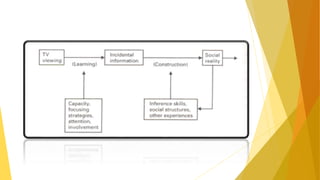
 The word cumulative is important to under-standing cultivation. Watching
television over a long period of time has effects on viewers’ beliefs and
world views
 By age 6 the average child in the United States has watched 5,000 hours of
television; by the age of 18 the average person has watched fully 19,000
hours of television
 According to the Statistical Abstract of the United States (2000), each year
the average person in America spends 3,297 hours engaged with media
and ap-proximately half of that time is spent watching TV about 68 24-
hour days each year
 There is so much violence on TV and because of that vio-lence the viewers
are left perceiving the world to be more violent than it really is.
 The average 18-year old in the United States has viewed 200,000 separate
acts of violence on TV, including 40,000 murders.
 From our perspective the media today is responsible for most of the
violent acts that go on today. A lot of people are drawn to the violent ways
of the media.
The Power of Synthetic Reality
 George Gerbner claims that by age 6 a child’s world view has been
established by television.
 It was proven in a study that it was harder for adults to recall a
time or event that happened in their lives if they watched
television a lot as a child and also if you watched a lot of violent TV
as a child then your reality will be towards more violent when an
adult.
 Children who watched commercial TV had notably more sex-
stereotypical views of women and men than children who didn’t
watch commercial TV.
 We begin to believe that sexual violence and any kind of violence
is normal in any relationship and begin to accept these things
because of TV.
Televisions Ability to Cultivate World
Views
 Mainstreaming: is television’s ability to stabilize and
homogenize views within a society.
 If television programs from Saturday morning cartoons to prime-
time dramas feature extensive violence, then viewers may come to
believe violence is common.
 The media has always given out hidden messages for everything,
but lately the messages have been about violence and victims of
violence.
 Resonance: is something a viewer relates to, a personal
experience.
 If they have been raped, or robbed then they can identify with that
violence.
 What we see on TV can impact how we feel or think and the way
we act.
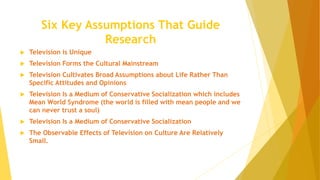
Six Key Assumptions That Guide
Research
 Television is Unique
 Television Forms the Cultural Mainstream
 Television Cultivates Broad Assumptions about Life Rather Than
Specific Attitudes and Opinions
 Television Is a Medium of Conservative Socialization which includes
Mean World Syndrome (the world is filled with mean people and we
can never trust a soul)
 Television Is a Medium of Conservative Socialization
 The Observable Effects of Television on Culture Are Relatively
Small.
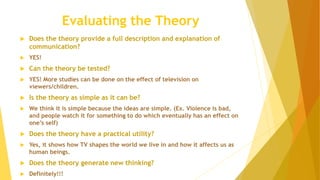
Evaluating the Theory
 Does the theory provide a full description and explanation of
communication?
 YES!
 Can the theory be tested?
 YES! More studies can be done on the effect of television on
viewers/children.
 Is the theory as simple as it can be?
 We think it is simple because the ideas are simple. (Ex. Violence is bad,
and people watch it for something to do which eventually has an effect on
one’s self)
 Does the theory have a practical utility?
 Yes, it shows how TV shapes the world we live in and how it affects us as
human beings.
 Does the theory generate new thinking?
 Definitely!!!
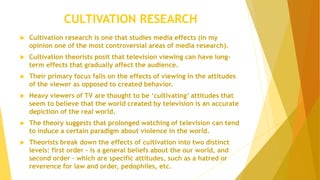
CULTIVATION RESEARCH
 Cultivation research is one that studies media effects (in my
opinion one of the most controversial areas of media research).
 Cultivation theorists posit that television viewing can have long-
term effects that gradually affect the audience.
 Their primary focus falls on the effects of viewing in the attitudes
of the viewer as opposed to created behavior.
 Heavy viewers of TV are thought to be ‘cultivating’ attitudes that
seem to believe that the world created by television is an accurate
depiction of the real world.
 The theory suggests that prolonged watching of television can tend
to induce a certain paradigm about violence in the world.
 Theorists break down the effects of cultivation into two distinct
levels: first order – is a general beliefs about the our world, and
second order – which are specific attitudes, such as a hatred or
reverence for law and order, pedophiles, etc.
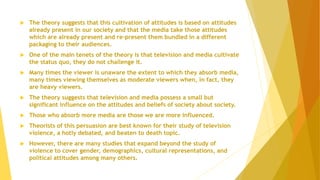
 The theory suggests that this cultivation of attitudes is based on attitudes
already present in our society and that the media take those attitudes
which are already present and re-present them bundled in a different
packaging to their audiences.
 One of the main tenets of the theory is that television and media cultivate
the status quo, they do not challenge it.
 Many times the viewer is unaware the extent to which they absorb media,
many times viewing themselves as moderate viewers when, in fact, they
are heavy viewers.
 The theory suggests that television and media possess a small but
significant influence on the attitudes and beliefs of society about society.
 Those who absorb more media are those we are more influenced.
 Theorists of this persuasion are best known for their study of television
violence, a hotly debated, and beaten to death topic.
 However, there are many studies that expand beyond the study of
violence to cover gender, demographics, cultural representations, and
political attitudes among many others.
 The delta between those considered to be light viewers and heavy
viewers is called the cultivation differential.
 This describes the extent to which an attitude on a particular topic
is shaped by exposure to television.
 On notable and oft discussed piece of the theory is know as the
“mean and scary world syndrome” (or “mean world syndrome”).
 In a nutshell, heavy viewing of television and the associated
violence (think: ID Network, Law and Order, CSI, NCIS, Bones, etc.)
 Leads the viewer to believe that the world is a much more
dangerous place than it actually is, with a serial killer, rapist, or
pedophile lurking around every corner.
SUMMERY
 According to Cultivation Theory, television viewers are cultivated
to view reality similarly to what they watch on television.
 No one tv show gets credit for this effect. Instead, the medium of
television gets the credit.
 Television shows are mainstream entertainment, easy to access,
and generally easy to understand.
 As such, they provide a means by which people are socialized into
the society, albeit with an unrealistic notion of realty at times,
particularly with respect to social dangers.
 Television seeks to show and reinforce commonalities among us, so
those who regularly watch television tend to see the world in the
way television portrays it.
 Compared to actual demographics, women, minorities, upper-class,
and lower-class people are under-represented on television shows.
 At the same time, the percent of people who work in law enforcement and
violent crime are over-represented.
 People who are heavy watchers of television assimilate this information
and believe that the world is a dangerous, scary place where others can't
be trusted. This is known as the "mean world syndrome."
 Further, heavy watchers of tv blur distinctions between social groups such
as the poor and the rich, urban and rural populations, and different racial
groups.
 Those tv watchers also identify themselves as political moderates but
answer surveys similarly to how political conservatives answer the
surveys.
 Not everyone is successfully cultivated by television.
 Those who watch little television are not affected.
 Likewise, people who talk about what they see, especially adolescents
who talk with their parents, are less likely to alter their view of reality to
match what they see on television.

Cultivation theory

  • 1.
  • 2.
    Definition  Cultivation theoryis a social theory which examines the long-term effects of television.  "The primary proposition of cultivation theory states that the more time people spend "living" in the television world, the more likely they are to believe social reality portrayed on television.“  Cultivation leaves people with a misperception of what is true in our world.
  • 3.
    INTRODUCTION  Cultivation theoryexplains that how people’s conceptions of social reality are influenced according to exposure to television.  The cultivation hypothesis states that the more television people watch, the more likely they are to hold a view of reality that is closer to television's depiction of reality.
  • 5.
    George Gerbner(1960)  “CultivationTheory claims that television promotes us to believe a view of real life that is inaccurate.”  Cultivation: Because television portrays the world as more violent and dangerous than it really is.  The Power of Synthetic Reality: Where Mean World Syndrome can play a role. Gerbner claims that by age 6 a child’s world view has been established by television.  Mainstreaming: The power of television to insinuate it’s views into mainstream cultural life.
  • 6.
    Cultivation  The wordcumulative is important to under-standing cultivation. Watching television over a long period of time has effects on viewers’ beliefs and world views  By age 6 the average child in the United States has watched 5,000 hours of television; by the age of 18 the average person has watched fully 19,000 hours of television  According to the Statistical Abstract of the United States (2000), each year the average person in America spends 3,297 hours engaged with media and ap-proximately half of that time is spent watching TV about 68 24- hour days each year  There is so much violence on TV and because of that vio-lence the viewers are left perceiving the world to be more violent than it really is.  The average 18-year old in the United States has viewed 200,000 separate acts of violence on TV, including 40,000 murders.  From our perspective the media today is responsible for most of the violent acts that go on today. A lot of people are drawn to the violent ways of the media.
  • 7.
    The Power ofSynthetic Reality  George Gerbner claims that by age 6 a child’s world view has been established by television.  It was proven in a study that it was harder for adults to recall a time or event that happened in their lives if they watched television a lot as a child and also if you watched a lot of violent TV as a child then your reality will be towards more violent when an adult.  Children who watched commercial TV had notably more sex- stereotypical views of women and men than children who didn’t watch commercial TV.  We begin to believe that sexual violence and any kind of violence is normal in any relationship and begin to accept these things because of TV.
  • 8.
    Televisions Ability toCultivate World Views  Mainstreaming: is television’s ability to stabilize and homogenize views within a society.  If television programs from Saturday morning cartoons to prime- time dramas feature extensive violence, then viewers may come to believe violence is common.  The media has always given out hidden messages for everything, but lately the messages have been about violence and victims of violence.  Resonance: is something a viewer relates to, a personal experience.  If they have been raped, or robbed then they can identify with that violence.  What we see on TV can impact how we feel or think and the way we act.
  • 9.
    Six Key AssumptionsThat Guide Research  Television is Unique  Television Forms the Cultural Mainstream  Television Cultivates Broad Assumptions about Life Rather Than Specific Attitudes and Opinions  Television Is a Medium of Conservative Socialization which includes Mean World Syndrome (the world is filled with mean people and we can never trust a soul)  Television Is a Medium of Conservative Socialization  The Observable Effects of Television on Culture Are Relatively Small.
  • 10.
    Evaluating the Theory Does the theory provide a full description and explanation of communication?  YES!  Can the theory be tested?  YES! More studies can be done on the effect of television on viewers/children.  Is the theory as simple as it can be?  We think it is simple because the ideas are simple. (Ex. Violence is bad, and people watch it for something to do which eventually has an effect on one’s self)  Does the theory have a practical utility?  Yes, it shows how TV shapes the world we live in and how it affects us as human beings.  Does the theory generate new thinking?  Definitely!!!
  • 11.
    CULTIVATION RESEARCH  Cultivationresearch is one that studies media effects (in my opinion one of the most controversial areas of media research).  Cultivation theorists posit that television viewing can have long- term effects that gradually affect the audience.  Their primary focus falls on the effects of viewing in the attitudes of the viewer as opposed to created behavior.  Heavy viewers of TV are thought to be ‘cultivating’ attitudes that seem to believe that the world created by television is an accurate depiction of the real world.  The theory suggests that prolonged watching of television can tend to induce a certain paradigm about violence in the world.  Theorists break down the effects of cultivation into two distinct levels: first order – is a general beliefs about the our world, and second order – which are specific attitudes, such as a hatred or reverence for law and order, pedophiles, etc.
  • 12.
     The theorysuggests that this cultivation of attitudes is based on attitudes already present in our society and that the media take those attitudes which are already present and re-present them bundled in a different packaging to their audiences.  One of the main tenets of the theory is that television and media cultivate the status quo, they do not challenge it.  Many times the viewer is unaware the extent to which they absorb media, many times viewing themselves as moderate viewers when, in fact, they are heavy viewers.  The theory suggests that television and media possess a small but significant influence on the attitudes and beliefs of society about society.  Those who absorb more media are those we are more influenced.  Theorists of this persuasion are best known for their study of television violence, a hotly debated, and beaten to death topic.  However, there are many studies that expand beyond the study of violence to cover gender, demographics, cultural representations, and political attitudes among many others.
  • 13.
     The deltabetween those considered to be light viewers and heavy viewers is called the cultivation differential.  This describes the extent to which an attitude on a particular topic is shaped by exposure to television.  On notable and oft discussed piece of the theory is know as the “mean and scary world syndrome” (or “mean world syndrome”).  In a nutshell, heavy viewing of television and the associated violence (think: ID Network, Law and Order, CSI, NCIS, Bones, etc.)  Leads the viewer to believe that the world is a much more dangerous place than it actually is, with a serial killer, rapist, or pedophile lurking around every corner.
  • 14.
    SUMMERY  According toCultivation Theory, television viewers are cultivated to view reality similarly to what they watch on television.  No one tv show gets credit for this effect. Instead, the medium of television gets the credit.  Television shows are mainstream entertainment, easy to access, and generally easy to understand.  As such, they provide a means by which people are socialized into the society, albeit with an unrealistic notion of realty at times, particularly with respect to social dangers.  Television seeks to show and reinforce commonalities among us, so those who regularly watch television tend to see the world in the way television portrays it.  Compared to actual demographics, women, minorities, upper-class, and lower-class people are under-represented on television shows.
  • 15.
     At thesame time, the percent of people who work in law enforcement and violent crime are over-represented.  People who are heavy watchers of television assimilate this information and believe that the world is a dangerous, scary place where others can't be trusted. This is known as the "mean world syndrome."  Further, heavy watchers of tv blur distinctions between social groups such as the poor and the rich, urban and rural populations, and different racial groups.  Those tv watchers also identify themselves as political moderates but answer surveys similarly to how political conservatives answer the surveys.  Not everyone is successfully cultivated by television.  Those who watch little television are not affected.  Likewise, people who talk about what they see, especially adolescents who talk with their parents, are less likely to alter their view of reality to match what they see on television.