Dr. Marquita Byrd
marquita.byrd@sjsu.edu
2013 copyright Dr. Marquita Byrd 1
 Definition of
Standpoint: An
achieved position
based on social
location that lends
an interpretative
aspect to a person’s
life.
 Standpoint Theory:
Provides framework
for understanding
systems of power
Everyday people, not
the elite, provide
the framework for
Standpoint Theory
2013 copyright Dr. Marquita Byrd 2
 Born is 1943
 Feminist Philosopher
 Currently a professor
of Political Science at
the University of
Washington.
Known for her work in:
 Feminist epistemology
 Stanpoint Theory
 Feminist Standpoint
Theory
 Her Standpoint Theory
derives from Marxism
2013 copyright Dr. Marquita Byrd 3
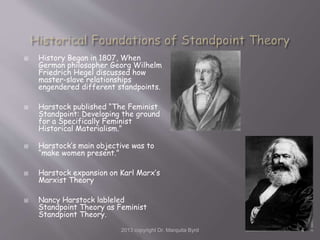
 History Began in 1807, When
German philosopher Georg Wilhelm
Friedrich Hegel discussed how
master-slave relationships
engendered different standpoints.
 Harstock published “The Feminist
Standpoint: Developing the ground
for a Specifically Feminist
Historical Materialism.”
 Harstock’s main objective was to
“make women present.”
 Harstock expansion on Karl Marx’s
Marxist Theory
 Nancy Harstock lableled
Standpoint Theory as Feminist
Standpiont Theory.
2013 copyright Dr. Marquita Byrd 4
 All Knowledge is a product of social
activity, and thus knowledge can be
truly objective. (objectivity of
knowledge is questionable)
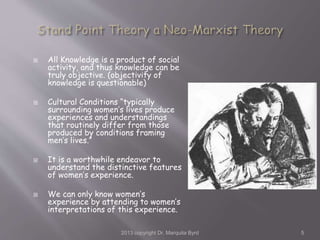
 Cultural Conditions “typically
surrounding women’s lives produce
experiences and understandings
that routinely differ from those
produced by conditions framing
men’s lives.”
 It is a worthwhile endeavor to
understand the distinctive features
of women’s experience.
 We can only know women’s
experience by attending to women’s
interpretations of this experience.
2013 copyright Dr. Marquita Byrd 5
First Assumption: Individuals location in the class structure
shapes and limits their understandings of social relations.
Second Assumption: Feminist Standpoint Theory assumes that all
standpoints are partial, but those of the ruling class can
actually harm those of the subordinate group.
Third Assumption: The ruling group structures life in such a way
as remove some choices from the subordinate group.
Fourth Assumption: The subordinate group has to struggle for
their vision of social life.
The final Assumption: The struggle results in a clearer, more
accurate vision for the subordinate group than that
possessed by the ruling class.
2013 copyright Dr. Marquita Byrd 6
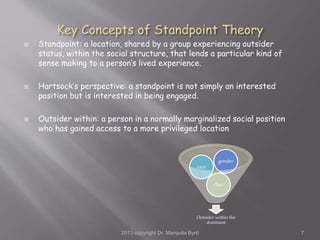
 Standpoint: a location, shared by a group experiencing outsider
status, within the social structure, that lends a particular kind of
sense making to a person’s lived experience.
 Hartsock’s perspective: a standpoint is not simply an interested
position but is interested in being engaged.
 Outsider within: a person in a normally marginalized social position
who has gained access to a more privileged location
Outsider within the
dominant
class
race
gender
2013 copyright Dr. Marquita Byrd 7
 Partial: a recognition that no one has a complete
view of the social hierarchy.
Accuracy: the ability to see more than what’s
available to one’s own specific social location.
 Situated Knowledge's: What anyone knows is
grounded in context and circumstance.
 Sexual division of labor- allocation of work on the
basis of sex
2013 copyright Dr. Marquita Byrd 8
According to this approach:
 A standpoint is a place from which human beings view the world.
 A standpoint influences how the people adopting it social
construct the world.
 A standpoint is a mental position from which life is viewed
 A standpoint is a position from which objects or principles are
viewed and according to which they are compared and judged
 The inequalities of different social groups create differences in
their standpoints.
 All standpoints are partial; so (for example) Feminist standpoint
coexists with other standpoints.
2013 copyright Dr. Marquita Byrd 9
2013 copyright Dr. Marquita Byrd 10
Female
Senior Citizen
African American
Educated
College
Professor
MidwesternerMinister
Middle Class [according to the federal
government] (But this is what my house looks
like!!!)
 Understanding the relationship between the dominant (status quo)
standpoint and communication is important. It makes us aware of how
the dominant tell us which concepts are understandable, which claims are
heard and understood by whom, which features of the world are
perceptually important, and which reasons are understood to be relevant
and forceful, as well as which conclusions are credible.[1]
 Understanding allows us to resist those interpretations
Oppressive
interpretations
Resistance
2013 copyright Dr. Marquita Byrd 11
 Too narrow: In recent years theorists have expanded
the Standpoint theory to include all oppressed people,
marginalized people, people who live in the
borderlands.
 I don’t think oppressed people necessarily have a more
accurate picture of what is going on than the dominant.
The oppressed know more about the negatives in the
system because they see from the bottom up.
 Dominant and oppressed live in different realties and
both have partial views of the system.
2013 copyright Dr. Marquita Byrd 12
 Gender___________
 Race_______
 Age___________
 Class__________
 Ability__________
 Religion__________
 Occupation___________
 Nationality_____________
 Which three are your most important standpoints?
Being Your _____ means………
2013 copyright Dr. Marquita Byrd 13

Chapter29 standpoint theory (1)

  • 1.
    Dr. Marquita Byrd marquita.byrd@sjsu.edu 2013copyright Dr. Marquita Byrd 1
  • 2.
     Definition of Standpoint:An achieved position based on social location that lends an interpretative aspect to a person’s life.  Standpoint Theory: Provides framework for understanding systems of power Everyday people, not the elite, provide the framework for Standpoint Theory 2013 copyright Dr. Marquita Byrd 2
  • 3.
     Born is1943  Feminist Philosopher  Currently a professor of Political Science at the University of Washington. Known for her work in:  Feminist epistemology  Stanpoint Theory  Feminist Standpoint Theory  Her Standpoint Theory derives from Marxism 2013 copyright Dr. Marquita Byrd 3
  • 4.
     History Beganin 1807, When German philosopher Georg Wilhelm Friedrich Hegel discussed how master-slave relationships engendered different standpoints.  Harstock published “The Feminist Standpoint: Developing the ground for a Specifically Feminist Historical Materialism.”  Harstock’s main objective was to “make women present.”  Harstock expansion on Karl Marx’s Marxist Theory  Nancy Harstock lableled Standpoint Theory as Feminist Standpiont Theory. 2013 copyright Dr. Marquita Byrd 4
  • 5.
     All Knowledgeis a product of social activity, and thus knowledge can be truly objective. (objectivity of knowledge is questionable)  Cultural Conditions “typically surrounding women’s lives produce experiences and understandings that routinely differ from those produced by conditions framing men’s lives.”  It is a worthwhile endeavor to understand the distinctive features of women’s experience.  We can only know women’s experience by attending to women’s interpretations of this experience. 2013 copyright Dr. Marquita Byrd 5
  • 6.
    First Assumption: Individualslocation in the class structure shapes and limits their understandings of social relations. Second Assumption: Feminist Standpoint Theory assumes that all standpoints are partial, but those of the ruling class can actually harm those of the subordinate group. Third Assumption: The ruling group structures life in such a way as remove some choices from the subordinate group. Fourth Assumption: The subordinate group has to struggle for their vision of social life. The final Assumption: The struggle results in a clearer, more accurate vision for the subordinate group than that possessed by the ruling class. 2013 copyright Dr. Marquita Byrd 6
  • 7.
     Standpoint: alocation, shared by a group experiencing outsider status, within the social structure, that lends a particular kind of sense making to a person’s lived experience.  Hartsock’s perspective: a standpoint is not simply an interested position but is interested in being engaged.  Outsider within: a person in a normally marginalized social position who has gained access to a more privileged location Outsider within the dominant class race gender 2013 copyright Dr. Marquita Byrd 7
  • 8.
     Partial: arecognition that no one has a complete view of the social hierarchy. Accuracy: the ability to see more than what’s available to one’s own specific social location.  Situated Knowledge's: What anyone knows is grounded in context and circumstance.  Sexual division of labor- allocation of work on the basis of sex 2013 copyright Dr. Marquita Byrd 8
  • 9.
    According to thisapproach:  A standpoint is a place from which human beings view the world.  A standpoint influences how the people adopting it social construct the world.  A standpoint is a mental position from which life is viewed  A standpoint is a position from which objects or principles are viewed and according to which they are compared and judged  The inequalities of different social groups create differences in their standpoints.  All standpoints are partial; so (for example) Feminist standpoint coexists with other standpoints. 2013 copyright Dr. Marquita Byrd 9
  • 10.
    2013 copyright Dr.Marquita Byrd 10 Female Senior Citizen African American Educated College Professor MidwesternerMinister Middle Class [according to the federal government] (But this is what my house looks like!!!)
  • 11.
     Understanding therelationship between the dominant (status quo) standpoint and communication is important. It makes us aware of how the dominant tell us which concepts are understandable, which claims are heard and understood by whom, which features of the world are perceptually important, and which reasons are understood to be relevant and forceful, as well as which conclusions are credible.[1]  Understanding allows us to resist those interpretations Oppressive interpretations Resistance 2013 copyright Dr. Marquita Byrd 11
  • 12.
     Too narrow:In recent years theorists have expanded the Standpoint theory to include all oppressed people, marginalized people, people who live in the borderlands.  I don’t think oppressed people necessarily have a more accurate picture of what is going on than the dominant. The oppressed know more about the negatives in the system because they see from the bottom up.  Dominant and oppressed live in different realties and both have partial views of the system. 2013 copyright Dr. Marquita Byrd 12
  • 13.
     Gender___________  Race_______ Age___________  Class__________  Ability__________  Religion__________  Occupation___________  Nationality_____________  Which three are your most important standpoints? Being Your _____ means……… 2013 copyright Dr. Marquita Byrd 13