THEORIES OF INTERPERSONAL RELATIONSHIP
INTRODUCTION Theories of Interpersonal Relationships :- Attachment Theory Social Exchange Theory Equity Theory Uncertainty Reduction Theory
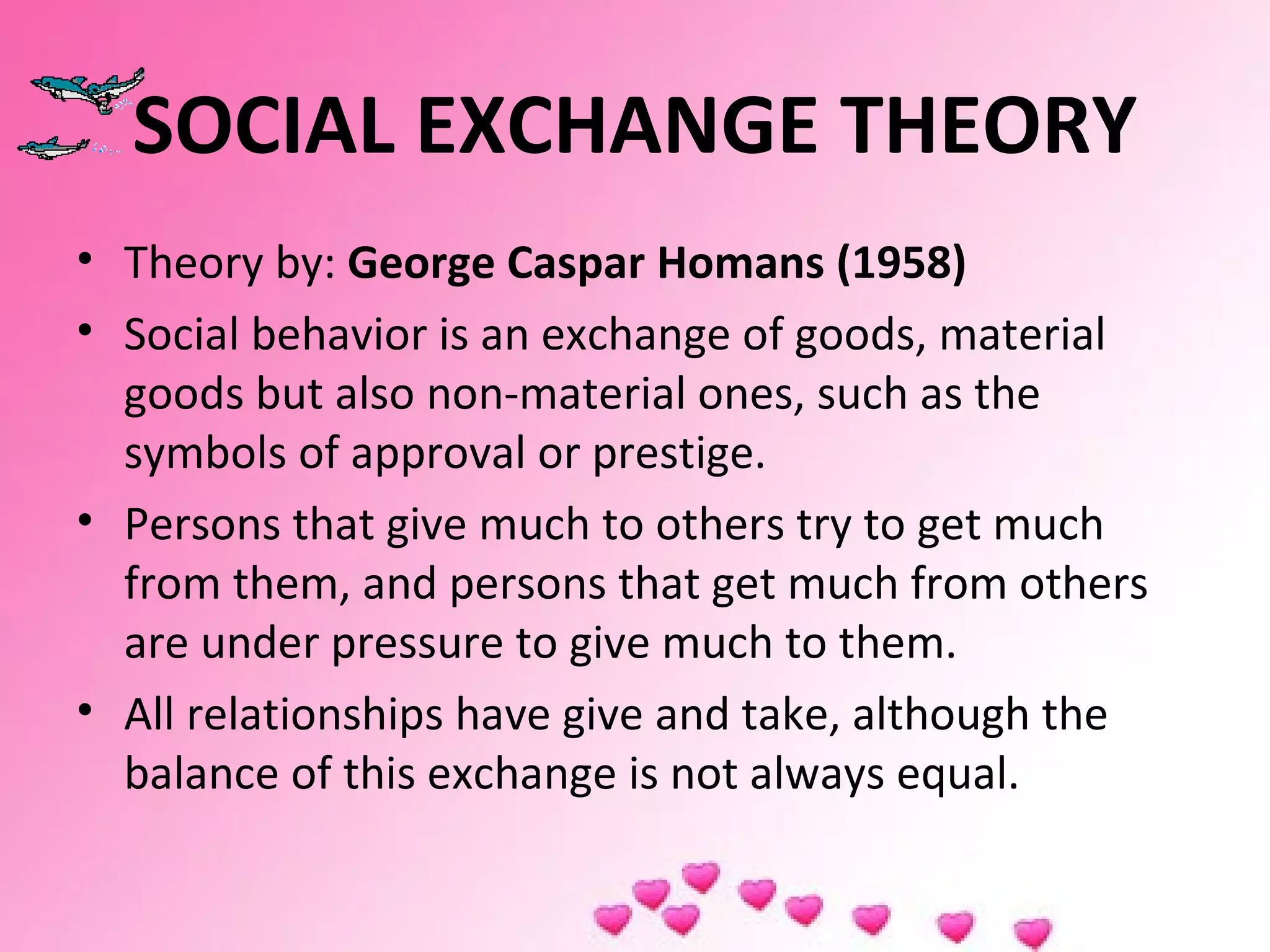
SOCIAL EXCHANGE THEORY Theory by:  George Caspar Homans (1958) Social behavior is an exchange of goods, material goods but also non-material ones, such as the symbols of approval or prestige. Persons that give much to others try to get much from them, and persons that get much from others are under pressure to give much to them.  All relationships have give and take, although the balance of this exchange is not always equal.
SOCIAL EXCHANGE THEORY Social Exchange theory explains how we feel about a relationship with another person as depending on our perceptions of: The balance between what we put into the relationship and what we get out of it. The kind of relationship we deserve. The chances of having a better relationship with someone else.
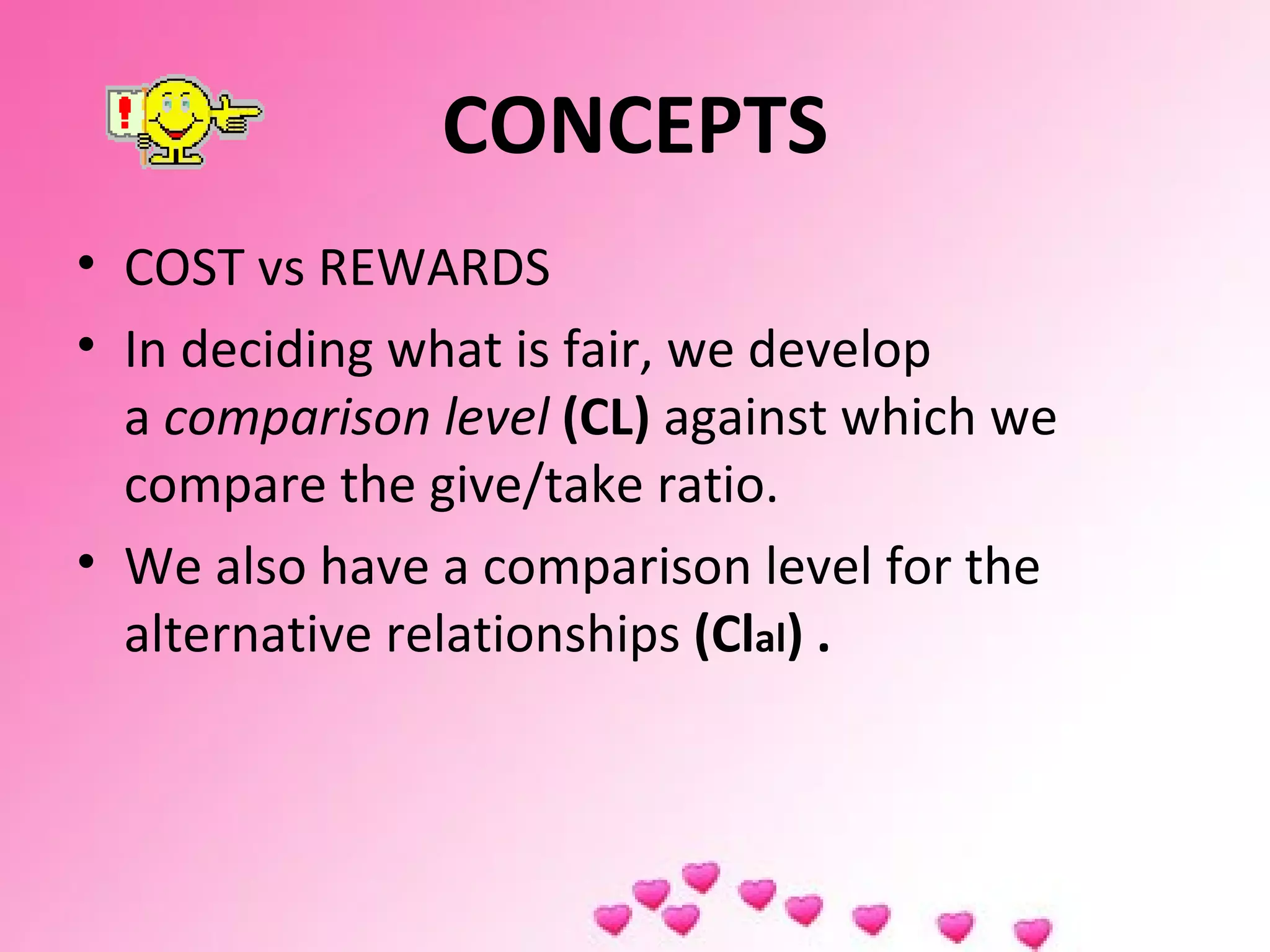
CONCEPTS COST vs REWARDS In deciding what is fair, we develop a  comparison level   (CL)  against which we compare the give/take ratio. We also have a comparison level for the alternative relationships  (Cl al ) .
CONCEPTS OUTCOME LEVEL  (OL) OL = Rewards - Costs COMPARISON LEVEL  (CL) Subjective standard COMPARISON LEVLE OF ALTERNATIVES  (CL ALT ) CL of Next-Best Alternative
CONCEPTS OL > CL  Satisfied with the group OL < CL  Dissatisfied with the group OL > CL ALT   Remain in the group OL < CL ALT   Leave the group
PROPOSITIONS Actors in a situation will choose whichever behavior maximizes profit. Actors in situations where there are no rewards will seek to minimize costs. When immediate profits are equal, actors look at long term profits When long term profits are equal, actors look at short term profits
UNCERTAINTY REDUCTION THEORY 7 Axioms & 21 Theorems Theory By:  Charles R. Berger and Richard J. Calabrese (1975)   It was proposed to predict and explain relational development (or lack thereof) between strangers.  Strangers, upon meeting, go through certain steps and checkpoints in order to reduce uncertainty about each other and form an idea of whether one likes or dislikes the other.
STAGES OF RELATIONAL DEVELOPMENT ENTRY PHASE Characterized by use of Behavioral Norms Contents are Demographic & Transactional PERSONAL PHASE Strangers explore Attitude & Belief of the other Values, Morals & Personal issues Emotional Involvement tends to increase EXIT PHASE Future Interaction decided Relationship Negotiation
AXIOMS OF URT AXIOM 1:  As strangers begin to talk to one another, the level of uncertainty decreases. In turn, as the uncertainty decreases, the interactants will talk more.  AXIOM 2:  As nonverbal expressive communication increases, uncertainty levels decrease, and vice versa.
AXIOMS OF URT AXIOM 3:  High levels of uncertainty prompt strangers to ask more questions of the other. As uncertainty decreases, so does the posing of questions. AXIOM 4:  High levels of uncertainty in a relationship lead to less sharing and emotional intimacy. Low levels of uncertainty allow for more sharing and emotional intimacy.
AXIOMS OF URT AXIOM 5:  High levels of uncertainty lead to more symmetrical question exchanges in interaction. As uncertainty decreases, so does the need for an equal exchange of talk. AXIOM 6:  Personal similarity will decrease uncertainty about another, while dissimilarity will produce higher levels of uncertainty.
AXIOMS OF URT AXIOM 7:  An increase in uncertainty will lead to a decrease in liking. A decrease in uncertainty will lead to an increase in liking. Berger and Calabrese formulated  21 theorems deductively from their axioms…
MATERIALIZED BY:- Subhasis Hazra Surabhi Bharti Suraj Singh Swabhi  Singh Swati Kasera Tushar Bahl Umesh Kr. Gupta Varun Agrawal Varun Baisawar Vivek Singh

Theories Of Interpersonal Relationship

  • 1.
  • 2.
    INTRODUCTION Theories ofInterpersonal Relationships :- Attachment Theory Social Exchange Theory Equity Theory Uncertainty Reduction Theory
  • 3.
    SOCIAL EXCHANGE THEORYTheory by: George Caspar Homans (1958) Social behavior is an exchange of goods, material goods but also non-material ones, such as the symbols of approval or prestige. Persons that give much to others try to get much from them, and persons that get much from others are under pressure to give much to them.  All relationships have give and take, although the balance of this exchange is not always equal.
  • 4.
    SOCIAL EXCHANGE THEORYSocial Exchange theory explains how we feel about a relationship with another person as depending on our perceptions of: The balance between what we put into the relationship and what we get out of it. The kind of relationship we deserve. The chances of having a better relationship with someone else.
  • 5.
    CONCEPTS COST vsREWARDS In deciding what is fair, we develop a  comparison level   (CL) against which we compare the give/take ratio. We also have a comparison level for the alternative relationships (Cl al ) .
  • 6.
    CONCEPTS OUTCOME LEVEL (OL) OL = Rewards - Costs COMPARISON LEVEL (CL) Subjective standard COMPARISON LEVLE OF ALTERNATIVES (CL ALT ) CL of Next-Best Alternative
  • 7.
    CONCEPTS OL >CL Satisfied with the group OL < CL Dissatisfied with the group OL > CL ALT Remain in the group OL < CL ALT Leave the group
  • 8.
    PROPOSITIONS Actors ina situation will choose whichever behavior maximizes profit. Actors in situations where there are no rewards will seek to minimize costs. When immediate profits are equal, actors look at long term profits When long term profits are equal, actors look at short term profits
  • 9.
    UNCERTAINTY REDUCTION THEORY7 Axioms & 21 Theorems Theory By: Charles R. Berger and Richard J. Calabrese (1975)   It was proposed to predict and explain relational development (or lack thereof) between strangers. Strangers, upon meeting, go through certain steps and checkpoints in order to reduce uncertainty about each other and form an idea of whether one likes or dislikes the other.
  • 10.
    STAGES OF RELATIONALDEVELOPMENT ENTRY PHASE Characterized by use of Behavioral Norms Contents are Demographic & Transactional PERSONAL PHASE Strangers explore Attitude & Belief of the other Values, Morals & Personal issues Emotional Involvement tends to increase EXIT PHASE Future Interaction decided Relationship Negotiation
  • 11.
    AXIOMS OF URTAXIOM 1: As strangers begin to talk to one another, the level of uncertainty decreases. In turn, as the uncertainty decreases, the interactants will talk more. AXIOM 2: As nonverbal expressive communication increases, uncertainty levels decrease, and vice versa.
  • 12.
    AXIOMS OF URTAXIOM 3: High levels of uncertainty prompt strangers to ask more questions of the other. As uncertainty decreases, so does the posing of questions. AXIOM 4: High levels of uncertainty in a relationship lead to less sharing and emotional intimacy. Low levels of uncertainty allow for more sharing and emotional intimacy.
  • 13.
    AXIOMS OF URTAXIOM 5: High levels of uncertainty lead to more symmetrical question exchanges in interaction. As uncertainty decreases, so does the need for an equal exchange of talk. AXIOM 6: Personal similarity will decrease uncertainty about another, while dissimilarity will produce higher levels of uncertainty.
  • 14.
    AXIOMS OF URTAXIOM 7: An increase in uncertainty will lead to a decrease in liking. A decrease in uncertainty will lead to an increase in liking. Berger and Calabrese formulated 21 theorems deductively from their axioms…
  • 15.
    MATERIALIZED BY:- SubhasisHazra Surabhi Bharti Suraj Singh Swabhi Singh Swati Kasera Tushar Bahl Umesh Kr. Gupta Varun Agrawal Varun Baisawar Vivek Singh