COMM 2378Theories of Communication and PersuasionSocial Judgment TheoryLe Thanh Phuong 	s3298842Le Vu Thuy Linh 	s3274932
AGENDASocial Judgment TheoryCreationThe cognitive structure of a person’s attitudeJudgment ProcessCritics
SOCIAL JUDGMENT THEORY
SOCIAL JUDGMENT THEORYCREATIONMuzafer Sherif & Carl HovlandThe National Academies Press n.d.The National Academies Press n.d.Carolyn SherifOklahoma State University n.d.
SOCIAL JUDGMENT THEORYCREATIONThere were no absolute truths. Man is the measure of all things. (Schiappa 1991, cited in Benoit & Benoit 2008)Attitude change will be influenced by cognitive judgment processes in which a proposed position is compared with a person’s existing system of attitudes.(Sherif & Hovland 1961, cited in Miller 2005)
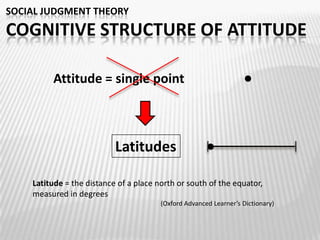
SOCIAL JUDGMENT THEORYCOGNITIVE STRUCTURE OF ATTITUDEAttitude = single pointLatitudesLatitude = the distance of a place north or south of the equator, measured in degrees(Oxford Advanced Learner’s Dictionary)
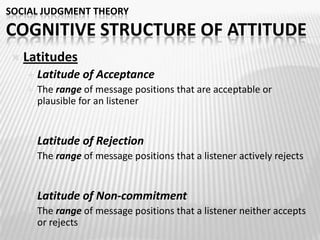
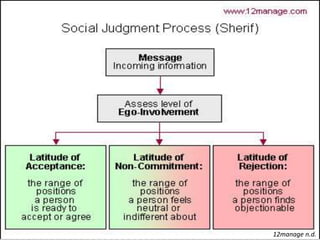
SOCIAL JUDGMENT THEORYCOGNITIVE STRUCTURE OF ATTITUDELatitudesLatitude of AcceptanceThe range of message positions that are acceptable or plausible for an listenerLatitude of RejectionThe range of message positions that a listener actively rejectsLatitude of Non-commitmentThe range of message positions that a listener neither accepts or rejects
SOCIAL JUDGMENT THEORYCOGNITIVE STRUCTURE OF ATTITUDEAnchorThe position that most closely represents a person’s point of viewIn the center of Latitude of Acceptance
Comparison point when we hear discrepant message
Cultural and social formationVideo example
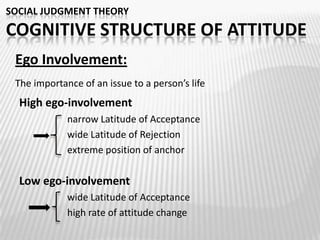
SOCIAL JUDGMENT THEORYCOGNITIVE STRUCTURE OF ATTITUDEEgo Involvement:The importance of an issue to a person’s lifeHigh ego-involvement	narrow Latitude of Acceptance		  	wide Latitude of Rejection 			extreme position of anchorLow ego-involvement 	  		wide Latitude of Acceptance						high rate of attitude change
12manage n.d.
SOCIAL JUDGMENT THEORYJUDGMENT PROCESS1. Judgment PhaseComparing the message to our anchorLocating the message into the latitude zones
SOCIAL JUDGMENT THEORYJUDGMENT PROCESS*Perceptual distortion errorsContrast:A perceptual error whereby people judge messages that fall within their latitudes of rejection as even further from their anchor than they really are Assimilation:A perceptual error whereby people judge messages that fall within their latitudes of acceptance as even nearer from their anchor than they really are
SOCIAL JUDGMENT THEORYJUDGMENT PROCESS2. Responding phaseShifting our anchor Latitude of Acceptance shifting along with it Latitude of Rejection and Non-commitment shifting along with itHow much movement?
SOCIAL JUDGMENT THEORYJUDGMENT PROCESSDiscrepancy = the difference between the position of a message and the listener’s attitudeThe greater the discrepancy, the more listeners will adjust their attitudes.(Griffin 2008)The relationship between discrepancy and attitude change is curvilinear.
SOCIAL JUDMENT THEORYJUDGMENT PROCESSTo change a person’s attitudeDisagree ENOUGH to change the audience’s attitude, without going so far that you offend themAvoid boomerang effect: Attitude change in the opposite direction of what the message advocatedKeep in mind!Persuasion process is: Gradual: The only way to get large-scale change is through a series of small, successive movementsSocial: Influence from friends and family
SOCIAL JUDGMENT THEORYAPPLICATIONVietnam’s Government decides to run an anti-smoking campaign to change smokers’ attitude. You are hired to create a commercial for the campaign Your task:Draft the idea using Social Judgment Theory.Video example 1Video example 2
SOCIAL JUDMENT THEORYCRITICSStrengths:SJT helps explain why two different people may perceive a single message differently.SJT notices the curvilinear relationship between discrepancy and persuasion.SJT includes involvement as an important factor in persuasion.
SOCIAL JUDMENT THEORYCRITICSWeaknessesAssimilation/Contrast is not likely to happen with clear message.Eg: “No texting in class under any circumstances” would be difficult to misinterpretSJT ignores other factors that can affect persuasion.The message content & variablesSource credibility

TCP - Social Judgement Theory

  • 1.
    COMM 2378Theories ofCommunication and PersuasionSocial Judgment TheoryLe Thanh Phuong s3298842Le Vu Thuy Linh s3274932
  • 2.
    AGENDASocial Judgment TheoryCreationThecognitive structure of a person’s attitudeJudgment ProcessCritics
  • 3.
  • 4.
    SOCIAL JUDGMENT THEORYCREATIONMuzaferSherif & Carl HovlandThe National Academies Press n.d.The National Academies Press n.d.Carolyn SherifOklahoma State University n.d.
  • 5.
    SOCIAL JUDGMENT THEORYCREATIONTherewere no absolute truths. Man is the measure of all things. (Schiappa 1991, cited in Benoit & Benoit 2008)Attitude change will be influenced by cognitive judgment processes in which a proposed position is compared with a person’s existing system of attitudes.(Sherif & Hovland 1961, cited in Miller 2005)
  • 6.
    SOCIAL JUDGMENT THEORYCOGNITIVESTRUCTURE OF ATTITUDEAttitude = single pointLatitudesLatitude = the distance of a place north or south of the equator, measured in degrees(Oxford Advanced Learner’s Dictionary)
  • 7.
    SOCIAL JUDGMENT THEORYCOGNITIVESTRUCTURE OF ATTITUDELatitudesLatitude of AcceptanceThe range of message positions that are acceptable or plausible for an listenerLatitude of RejectionThe range of message positions that a listener actively rejectsLatitude of Non-commitmentThe range of message positions that a listener neither accepts or rejects
  • 8.
    SOCIAL JUDGMENT THEORYCOGNITIVESTRUCTURE OF ATTITUDEAnchorThe position that most closely represents a person’s point of viewIn the center of Latitude of Acceptance
  • 9.
    Comparison point whenwe hear discrepant message
  • 10.
    Cultural and socialformationVideo example
  • 11.
    SOCIAL JUDGMENT THEORYCOGNITIVESTRUCTURE OF ATTITUDEEgo Involvement:The importance of an issue to a person’s lifeHigh ego-involvement narrow Latitude of Acceptance wide Latitude of Rejection extreme position of anchorLow ego-involvement wide Latitude of Acceptance high rate of attitude change
  • 12.
  • 13.
    SOCIAL JUDGMENT THEORYJUDGMENTPROCESS1. Judgment PhaseComparing the message to our anchorLocating the message into the latitude zones
  • 14.
    SOCIAL JUDGMENT THEORYJUDGMENTPROCESS*Perceptual distortion errorsContrast:A perceptual error whereby people judge messages that fall within their latitudes of rejection as even further from their anchor than they really are Assimilation:A perceptual error whereby people judge messages that fall within their latitudes of acceptance as even nearer from their anchor than they really are
  • 15.
    SOCIAL JUDGMENT THEORYJUDGMENTPROCESS2. Responding phaseShifting our anchor Latitude of Acceptance shifting along with it Latitude of Rejection and Non-commitment shifting along with itHow much movement?
  • 16.
    SOCIAL JUDGMENT THEORYJUDGMENTPROCESSDiscrepancy = the difference between the position of a message and the listener’s attitudeThe greater the discrepancy, the more listeners will adjust their attitudes.(Griffin 2008)The relationship between discrepancy and attitude change is curvilinear.
  • 17.
    SOCIAL JUDMENT THEORYJUDGMENTPROCESSTo change a person’s attitudeDisagree ENOUGH to change the audience’s attitude, without going so far that you offend themAvoid boomerang effect: Attitude change in the opposite direction of what the message advocatedKeep in mind!Persuasion process is: Gradual: The only way to get large-scale change is through a series of small, successive movementsSocial: Influence from friends and family
  • 18.
    SOCIAL JUDGMENT THEORYAPPLICATIONVietnam’sGovernment decides to run an anti-smoking campaign to change smokers’ attitude. You are hired to create a commercial for the campaign Your task:Draft the idea using Social Judgment Theory.Video example 1Video example 2
  • 19.
    SOCIAL JUDMENT THEORYCRITICSStrengths:SJThelps explain why two different people may perceive a single message differently.SJT notices the curvilinear relationship between discrepancy and persuasion.SJT includes involvement as an important factor in persuasion.
  • 20.
    SOCIAL JUDMENT THEORYCRITICSWeaknessesAssimilation/Contrastis not likely to happen with clear message.Eg: “No texting in class under any circumstances” would be difficult to misinterpretSJT ignores other factors that can affect persuasion.The message content & variablesSource credibility

Editor's Notes

  • #3 (Phuong)
  • #4 Activity: BUS TRANSPORTATION (Linh)Instructions
  • #6 The theory arose from social psychologyan explanatory method designed to detail when persuasive messages are most likely to succeedwhen people receive messages (verbal or nonverbal) ,they immediately judge where the message should be placed on a scale in their mind through comparing the message with currently held views.
  • #7 You circled a range of statements that seemed reasonable to you and crossed out a number of opinions you couldn’t accept Sherif would see your attitude as a latitude rather than as any single statementThe ZONE/RANGE
  • #8 (Linh)Example: Obama – first black president of the US => 3 latitudesMap 1: OBAMA 3 LATITUDESChoose 1 student with 1 idea Draw 3 latitudes based on this ideaMap 2, Map 3: PUBLIC TRANSPORTATION 3 LATITUDESTwo students draw accordingly
  • #9 Video example
  • #10 High rate of attitude change:We may have to settle for smaller levels of persuasion with highly-involved people
  • #11 (Phuong)We’ve just have a look at the basic concepts of SJT. Before continuing on, just to make sure, are we’all clear what is latitude, what is anchor and what is ego-involvement?Good, so now moving on to the Social Judgment Process. You can see in the diagram here, the process starts with the message coming to the listener. And then the listener access the message with a certain level of ego-involvement.
  • #12 What happens next is the judgment phase. In this stage, you will compare the message to your own anchor. This comparison will help you locate the message into one of the three latitudes, which are Acceptance, Rejection, Non-commitment
  • #13 When we try to locate the message into the scale, there’re some perceptual distortion errors affecting usMap (reuse map 1)Contrast:For example, on the scale of 100, we think we refuse abortion 100%. But what if the mother is a rape victim? In that case, we realize that we actually refuse abortion only around 80% or 90% not 100%Assimilation: Examples from students (Back-up: Lady Gaga) Why are they problems to our persuasion effort?Let me give you one example, in the case of assimilation, the listener will think like this: ““Hey, this message is almost exactly the same as my own attitude, so I DON’T really have to change my attitude to be consistent”, so he has no reason to make attitude change. It means that we failed in our persuasion effort. In the case of contrast, when the message falls into the latitude of rejection, the listener contrasts it, and then it becomes even less persuasive.
  • #14 Once we have judged a new message to be within out latitude of acceptance, we will adjust our attitude somewhat to fit with that new inputMap (reuse map 1)The latitude of acceptance is always centered around the listener’s attitude/anchor. So if the attitude changes, the latitude of acceptance will shift along with it. Consequently, the latitude of non-commitment and rejection also shift along with the latitude of acceptance.The question here is HOW MUCH MOVEMENT IS MADE?
  • #15 Discrepancy = the difference between the position of a message and the listener’s attitudeThe greater the discrepancy, the more listeners will adjust their attitudesHowever, too much difference will move the message into the listener’s latitude of rejectionCurvilinear Relationship: (U map)Discrepancy increases, attitude change first increases because greater discrepancy provides more reason to changeBut then discrepancy becomes too large, the message falls into the listener’s latitude of rejection, which destroys persuasion. So, in conclusion, the most persuasive message is the one that is most DISCREPANT from the receiver’s position yet falls within latitude of ACCEPTANCE.
  • #16 Boomerang effect: Listeners driven away from rather than drawn to an idea
  • #19 Message variables: evidence, argument qualityIt is possible for a message which falls in the latitude of rejection might not be rejected if it has strong evidence for its position