Dr. Shirish Silwal
Paediatric Surgery
Phase B year-1

Content
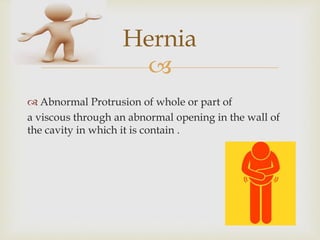
 Hernia
 Umbilical Hernia
 Para umbilical hernia
 Incisional Hernia
 Epigastric Hernia
 Spigelian Hernia
 Lumbar Hernia

Hernia
 Abnormal Protrusion of whole or part of
a viscous through an abnormal opening in the wall of
the cavity in which it is contain .

 The term ‘HERNIA’ derived from the Greek word
meaning an offshoot or a bulge.
 In Latin the word ‘HERNIA’ means to tear or to
rupture.
 Egyptians (1500 BC), Phoenicians (900 BC) and
Ancient Greeks (400 BC) all describe the diagnosis of
hernia and various methods of treatment.
History

 In 1987 Dr Irving Lichtenstein published the results
of 6,321 patients followed for 2-14 years after
inguinal hernias repair with Marlex (polypropylene)
mesh.
 Lichtenstein reported a recurrence rate of 0.7 %.
 The technique bearing his name called for a
“tensionless” repair and over time this has become a
pillar of hernia surgery.

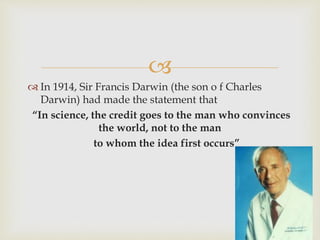
 In 1914, Sir Francis Darwin (the son o f Charles
Darwin) had made the statement that
“In science, the credit goes to the man who convinces
the world, not to the man
to whom the idea first occurs”

 By the 1960s, Dr Richard Newman had
performed over 1600 inguinal hernia repairs
using polypropylene.
Mayo recommended transverse fascial closure in
1901 and his technique remains most frequently
utilized today.

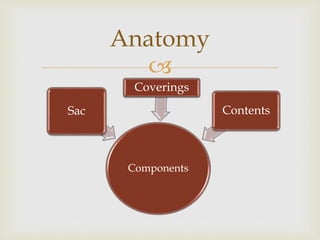
Anatomy
Components
Sac
Coverings
Contents

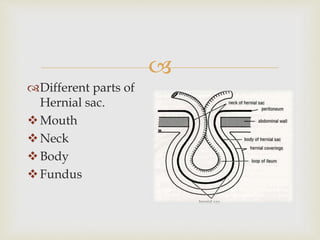
Different parts of
Hernial sac.
Mouth
Neck
Body
Fundus

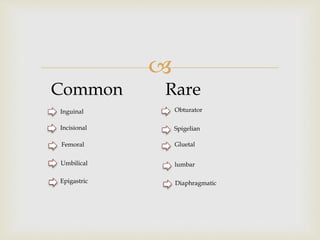
Common
Inguinal
Incisional
Femoral
Umbilical
Epigastric
Rare
Obturator
Spigelian
Gluetal
lumbar
Diaphragmatic

Umbilical Hernia
 Common disorder in children.
 Most undergo spontaneous closure during the first 3
years of life.
 Umbilical hernias are commonly found in low-birth-
weight infants (75% of infants weighing < 1500 g),
most will resolve.

 Various theories has been kept forward regarding
the surgical intervention.
 Some theories conclude that even large defects will
spontaneously resolve without operation.
 Typical umbilical hernias should be observed at least
until age 2 yrs. If there is no improvement in the size
of the umbilical fascial ring, consider repair.

 PRESENTATION:
 May be symptomless.
 It may increase in size during crying which may
cause pain & thus more crying.
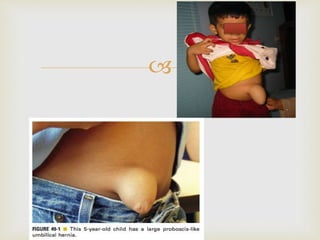
 Small hernias are Spherical; Large hernias are
Conical.

 COMPLICATION:
 Cosmetic disfigurement.
 Intermittent obstruction.
 Strangulation.


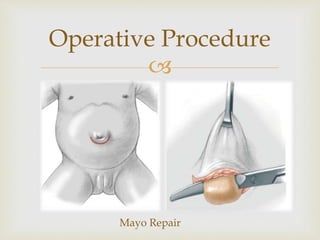
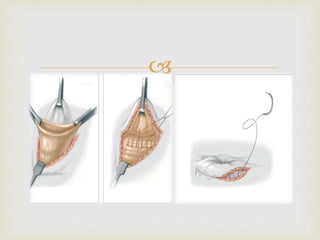
Operative Procedure
Mayo Repair


 Large defect >4cm
 Multiple defect
 Lax abdominal wall
 Recurrent cases
Indication Of Mesh Repair

PARAUMBILICAL HERNIA
 It is a protrusion through the linea alba just above or
just below umbilicus.
 Local dragging pain by its weight if large.
 Gastrointestinal symptoms due to traction on
stomach and transverse colon.
 Obstruction.
 Strangulation

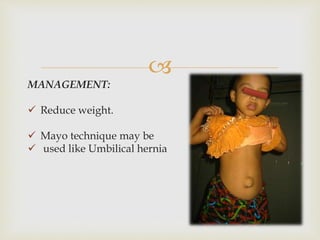
MANAGEMENT:
 Reduce weight.
 Mayo technique may be
 used like Umbilical hernia

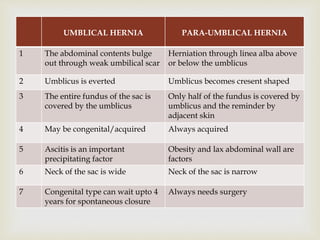
UMBLICAL HERNIA PARA-UMBLICAL HERNIA
1 The abdominal contents bulge
out through weak umbilical scar
Herniation through linea alba above
or below the umblicus
2 Umblicus is everted Umblicus becomes cresent shaped
3 The entire fundus of the sac is
covered by the umblicus
Only half of the fundus is covered by
umblicus and the reminder by
adjacent skin
4 May be congenital/acquired Always acquired
5 Ascitis is an important
precipitating factor
Obesity and lax abdominal wall are
factors
6 Neck of the sac is wide Neck of the sac is narrow
7 Congenital type can wait upto 4
years for spontaneous closure
Always needs surgery

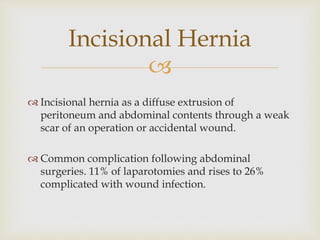
 Incisional hernia as a diffuse extrusion of
peritoneum and abdominal contents through a weak
scar of an operation or accidental wound.
 Common complication following abdominal
surgeries. 11% of laparotomies and rises to 26%
complicated with wound infection.
Incisional Hernia

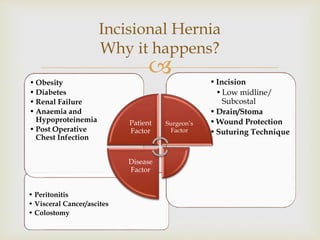
Incisional Hernia
Why it happens?
• Peritonitis
• Visceral Cancer/ascites
• Colostomy
•Incision
•Low midline/
Subcostal
•Drain/Stoma
•Wound Protection
•Suturing Technique
• Obesity
• Diabetes
• Renal Failure
• Anaemia and
Hypoproteinemia
• Post Operative
Chest Infection
Patient
Factor
Surgeon’s
Factor
Disease
Factor

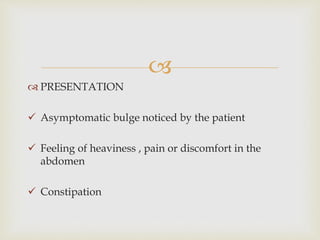
 PRESENTATION
 Asymptomatic bulge noticed by the patient
 Feeling of heaviness , pain or discomfort in the
abdomen
 Constipation

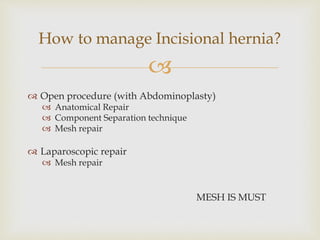
 Open procedure (with Abdominoplasty)
 Anatomical Repair
 Component Separation technique
 Mesh repair
 Laparoscopic repair
 Mesh repair
MESH IS MUST
How to manage Incisional hernia?

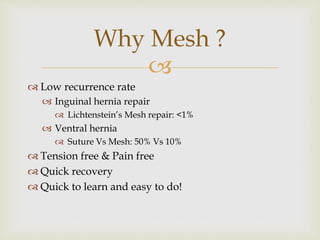
 Low recurrence rate
 Inguinal hernia repair
 Lichtenstein’s Mesh repair: <1%
 Ventral hernia
 Suture Vs Mesh: 50% Vs 10%
 Tension free & Pain free
 Quick recovery
 Quick to learn and easy to do!
Why Mesh ?

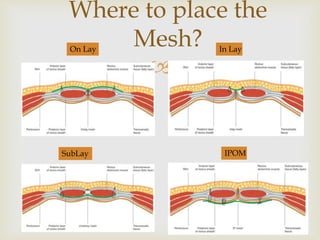
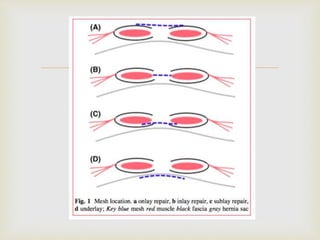
Where to place the
Mesh?On Lay In Lay
SubLay IPOM


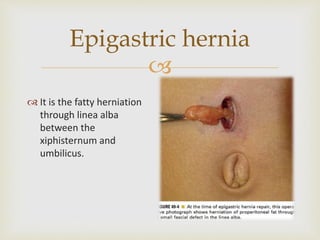
Epigastric hernia
 It is the fatty herniation
through linea alba
between the
xiphisternum and
umbilicus.

 Epigastric hernias were initially labeled as such in
1812 by Leveille .
 They occur through the opening for the para-midline
nerves and vessels
 It usually sacless, with only the pre-peritoneal fat content.
 The mouth of the hernia is rarely large to permit a
portion of hollow viscus to enter it

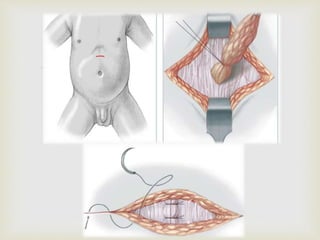
Management
 Epigastric hernias are repaired when they are prom-
inent or when they are symptomatic.
 It is important to mark the location of the defect
before anaesthesia, because in the recumbent
position they are often impossible to palpate along
the widened linea alba


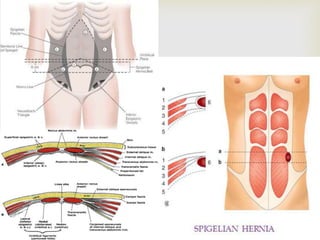
 It is a rare variety of hernia occurring at the level of
arcuate line.
 Spigelian hernia (SH) is a ventral hernia that occurs
through slit-like defects in the anterior abdominal
wall adjacent to the semilunar line.
Spigelian hernia

 Adriaan van der Spieghel, he only described the
semilunar line (linea Spigeli) in 1645.
 Josef Klinkosch in 1764 first defined the spigelian
hernia as a defect in the semilunar line.
 Pain in the area with a feeling of fullness or an actual
mass are the most common symptoms.

 Defects in the aponeurosis of transverse abdominal
muscle (mainly under the arcuate line and more
often in obese individuals) have been considered as
the principal etiologic factor.
 It easily gets strangulated.

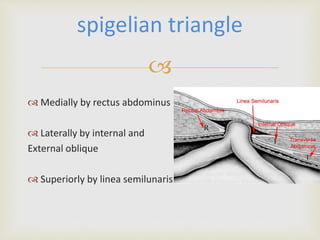
 Medially by rectus abdominus
 Laterally by internal and
External oblique
 Superiorly by linea semilunaris
spigelian triangle


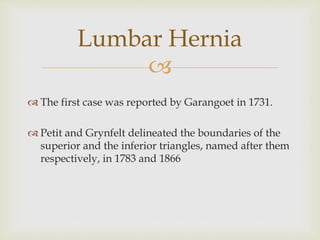
 Repair consists of a transverse incision over the
defect with excision of the sac and closure of the
defect.
 Frequently, the sac is found below the external
oblique muscle and may require mesh if the defect is
large.
 A tension-free closure is important to prevent
recurrence.
Management

 The first case was reported by Garangoet in 1731.
 Petit and Grynfelt delineated the boundaries of the
superior and the inferior triangles, named after them
respectively, in 1783 and 1866
Lumbar Hernia

 Rare type of hernia. Over the last four centuries
about 300 cases of primary lumbar hernias have been
reported making it the rarest form of abdominal wall
hernias.
 Content is usually properitoneal fat .

 PRESENTATION
 Common in males
 Low back ache or a specific point of pain over the
region of the hernia.
 A palpatory finding of a swelling with cough
impulse that reduces in prone position clinches the
diagnosis.

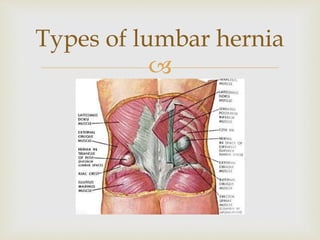
Types of lumbar hernia

 Absorbable mesh is Prefered in the growing child
that will not cause scoliosis later.

 ASHCRAFT’S PEDIATRIC SURGERY
 Paediatric surgery Arnold G. Coran, MD
 Paediatric surgery P. Puri · M. E. Höllwarth (Eds.)
 https://www.ncbi.nlm.nih.gov/pmc/articles/PMC2699222/
 https://www.ncbi.nlm.nih.gov/pmc/articles/PMC3992605/
 http://shodhganga.inflibnet.ac.in/bitstream/10603/48842/6/06_chapter
%201.pdf
 https://www.ncbi.nlm.nih.gov/pmc/articles/PMC4818285/
 https://www.ncbi.nlm.nih.gov/pmc/articles/PMC4336063/
 https://www.ncbi.nlm.nih.gov/pmc/articles/PMC3066721/
 http://www.ijsurgery.com/index.php/isj/article/viewFile/112/112
 http://case.edu/medicine/uhsurgery/media/school-of-medicine/uh-
surgery/documents/pdfs/journal-club-articles/2015/october/Holihan-
2015.-Mesh-location-in-open-VHR_-systematic-review-and-network-meta-
analysis.pdf
Reference

Thank You

Umbilical & Other Abdominal Hernia

  • 1.
    Dr. Shirish Silwal PaediatricSurgery Phase B year-1
  • 2.
     Content  Hernia  UmbilicalHernia  Para umbilical hernia  Incisional Hernia  Epigastric Hernia  Spigelian Hernia  Lumbar Hernia
  • 3.
     Hernia  Abnormal Protrusionof whole or part of a viscous through an abnormal opening in the wall of the cavity in which it is contain .
  • 4.
      The term‘HERNIA’ derived from the Greek word meaning an offshoot or a bulge.  In Latin the word ‘HERNIA’ means to tear or to rupture.  Egyptians (1500 BC), Phoenicians (900 BC) and Ancient Greeks (400 BC) all describe the diagnosis of hernia and various methods of treatment. History
  • 5.
      In 1987Dr Irving Lichtenstein published the results of 6,321 patients followed for 2-14 years after inguinal hernias repair with Marlex (polypropylene) mesh.  Lichtenstein reported a recurrence rate of 0.7 %.  The technique bearing his name called for a “tensionless” repair and over time this has become a pillar of hernia surgery.
  • 6.
      In 1914,Sir Francis Darwin (the son o f Charles Darwin) had made the statement that “In science, the credit goes to the man who convinces the world, not to the man to whom the idea first occurs”
  • 7.
      By the1960s, Dr Richard Newman had performed over 1600 inguinal hernia repairs using polypropylene. Mayo recommended transverse fascial closure in 1901 and his technique remains most frequently utilized today.
  • 8.
  • 9.
     Different parts of Hernialsac. Mouth Neck Body Fundus
  • 10.
  • 11.
     Umbilical Hernia  Commondisorder in children.  Most undergo spontaneous closure during the first 3 years of life.  Umbilical hernias are commonly found in low-birth- weight infants (75% of infants weighing < 1500 g), most will resolve.
  • 12.
      Various theorieshas been kept forward regarding the surgical intervention.  Some theories conclude that even large defects will spontaneously resolve without operation.  Typical umbilical hernias should be observed at least until age 2 yrs. If there is no improvement in the size of the umbilical fascial ring, consider repair.
  • 13.
      PRESENTATION:  Maybe symptomless.  It may increase in size during crying which may cause pain & thus more crying.  Small hernias are Spherical; Large hernias are Conical.
  • 14.
      COMPLICATION:  Cosmeticdisfigurement.  Intermittent obstruction.  Strangulation.
  • 15.
  • 16.
  • 17.
  • 18.
      Large defect>4cm  Multiple defect  Lax abdominal wall  Recurrent cases Indication Of Mesh Repair
  • 19.
     PARAUMBILICAL HERNIA  Itis a protrusion through the linea alba just above or just below umbilicus.  Local dragging pain by its weight if large.  Gastrointestinal symptoms due to traction on stomach and transverse colon.  Obstruction.  Strangulation
  • 20.
     MANAGEMENT:  Reduce weight. Mayo technique may be  used like Umbilical hernia
  • 21.
     UMBLICAL HERNIA PARA-UMBLICALHERNIA 1 The abdominal contents bulge out through weak umbilical scar Herniation through linea alba above or below the umblicus 2 Umblicus is everted Umblicus becomes cresent shaped 3 The entire fundus of the sac is covered by the umblicus Only half of the fundus is covered by umblicus and the reminder by adjacent skin 4 May be congenital/acquired Always acquired 5 Ascitis is an important precipitating factor Obesity and lax abdominal wall are factors 6 Neck of the sac is wide Neck of the sac is narrow 7 Congenital type can wait upto 4 years for spontaneous closure Always needs surgery
  • 22.
      Incisional herniaas a diffuse extrusion of peritoneum and abdominal contents through a weak scar of an operation or accidental wound.  Common complication following abdominal surgeries. 11% of laparotomies and rises to 26% complicated with wound infection. Incisional Hernia
  • 23.
     Incisional Hernia Why ithappens? • Peritonitis • Visceral Cancer/ascites • Colostomy •Incision •Low midline/ Subcostal •Drain/Stoma •Wound Protection •Suturing Technique • Obesity • Diabetes • Renal Failure • Anaemia and Hypoproteinemia • Post Operative Chest Infection Patient Factor Surgeon’s Factor Disease Factor
  • 24.
      PRESENTATION  Asymptomaticbulge noticed by the patient  Feeling of heaviness , pain or discomfort in the abdomen  Constipation
  • 25.
      Open procedure(with Abdominoplasty)  Anatomical Repair  Component Separation technique  Mesh repair  Laparoscopic repair  Mesh repair MESH IS MUST How to manage Incisional hernia?
  • 26.
      Low recurrencerate  Inguinal hernia repair  Lichtenstein’s Mesh repair: <1%  Ventral hernia  Suture Vs Mesh: 50% Vs 10%  Tension free & Pain free  Quick recovery  Quick to learn and easy to do! Why Mesh ?
  • 27.
     Where to placethe Mesh?On Lay In Lay SubLay IPOM
  • 28.
  • 29.
     Epigastric hernia  Itis the fatty herniation through linea alba between the xiphisternum and umbilicus.
  • 30.
      Epigastric herniaswere initially labeled as such in 1812 by Leveille .  They occur through the opening for the para-midline nerves and vessels  It usually sacless, with only the pre-peritoneal fat content.  The mouth of the hernia is rarely large to permit a portion of hollow viscus to enter it
  • 31.
     Management  Epigastric herniasare repaired when they are prom- inent or when they are symptomatic.  It is important to mark the location of the defect before anaesthesia, because in the recumbent position they are often impossible to palpate along the widened linea alba
  • 32.
  • 33.
      It isa rare variety of hernia occurring at the level of arcuate line.  Spigelian hernia (SH) is a ventral hernia that occurs through slit-like defects in the anterior abdominal wall adjacent to the semilunar line. Spigelian hernia
  • 34.
      Adriaan vander Spieghel, he only described the semilunar line (linea Spigeli) in 1645.  Josef Klinkosch in 1764 first defined the spigelian hernia as a defect in the semilunar line.  Pain in the area with a feeling of fullness or an actual mass are the most common symptoms.
  • 35.
      Defects inthe aponeurosis of transverse abdominal muscle (mainly under the arcuate line and more often in obese individuals) have been considered as the principal etiologic factor.  It easily gets strangulated.
  • 36.
      Medially byrectus abdominus  Laterally by internal and External oblique  Superiorly by linea semilunaris spigelian triangle
  • 37.
  • 38.
      Repair consistsof a transverse incision over the defect with excision of the sac and closure of the defect.  Frequently, the sac is found below the external oblique muscle and may require mesh if the defect is large.  A tension-free closure is important to prevent recurrence. Management
  • 39.
      The firstcase was reported by Garangoet in 1731.  Petit and Grynfelt delineated the boundaries of the superior and the inferior triangles, named after them respectively, in 1783 and 1866 Lumbar Hernia
  • 40.
      Rare typeof hernia. Over the last four centuries about 300 cases of primary lumbar hernias have been reported making it the rarest form of abdominal wall hernias.  Content is usually properitoneal fat .
  • 41.
      PRESENTATION  Commonin males  Low back ache or a specific point of pain over the region of the hernia.  A palpatory finding of a swelling with cough impulse that reduces in prone position clinches the diagnosis.
  • 42.
  • 43.
      Absorbable meshis Prefered in the growing child that will not cause scoliosis later.
  • 44.
      ASHCRAFT’S PEDIATRICSURGERY  Paediatric surgery Arnold G. Coran, MD  Paediatric surgery P. Puri · M. E. Höllwarth (Eds.)  https://www.ncbi.nlm.nih.gov/pmc/articles/PMC2699222/  https://www.ncbi.nlm.nih.gov/pmc/articles/PMC3992605/  http://shodhganga.inflibnet.ac.in/bitstream/10603/48842/6/06_chapter %201.pdf  https://www.ncbi.nlm.nih.gov/pmc/articles/PMC4818285/  https://www.ncbi.nlm.nih.gov/pmc/articles/PMC4336063/  https://www.ncbi.nlm.nih.gov/pmc/articles/PMC3066721/  http://www.ijsurgery.com/index.php/isj/article/viewFile/112/112  http://case.edu/medicine/uhsurgery/media/school-of-medicine/uh- surgery/documents/pdfs/journal-club-articles/2015/october/Holihan- 2015.-Mesh-location-in-open-VHR_-systematic-review-and-network-meta- analysis.pdf Reference
  • 45.

Editor's Notes

  • #12 After birth, closure of the umbilical ring is the result of complex interactions of lateral body wall folding in a medial direction, fusion of the rectus abdominis muscles into the linea alba, and umbilical orifice contraction which is aided by elastic fibers from the obliterated umbilical arteries. Fibrous proliferation of surrounding lateral connective tissue plates and mechanical stress from rectus muscle tension may also help with natural closure