INTERPRETATION OF
INFRARED SPECTRA
GUIDED BY: PRESENTEDBY:
Dr.Sk.Abdul Rehman R.Keerthi
M.Pharm, Ph D M.Pharm 1st
year
DEPARTMENT: PhARMACEuTICAl ANAlySIS
Outline…
Features of an ideal IR Spectrum
Information could be obtained
Requirements for the interpretation
General rules of interpretation
Illustration
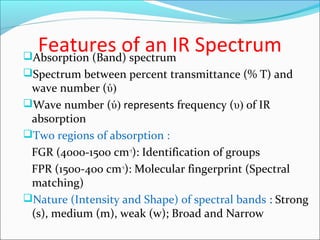
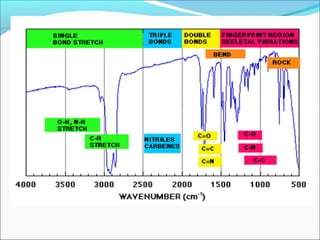
Features of an IR SpectrumAbsorption (Band) spectrum
Spectrum between percent transmittance (% T) and
wave number (ύ)
Wave number (ύ) represents frequency (υ) of IR
absorption
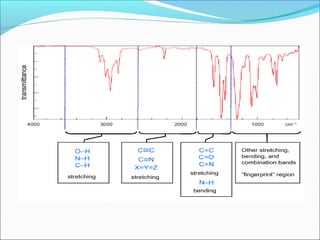
Two regions of absorption :
FGR (4000-1500 cm-1
): Identification of groups
FPR (1500-400 cm-1
): Molecular fingerprint (Spectral
matching)
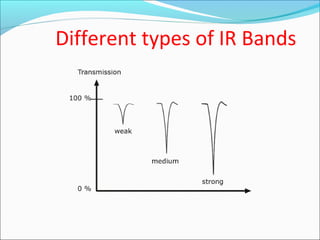
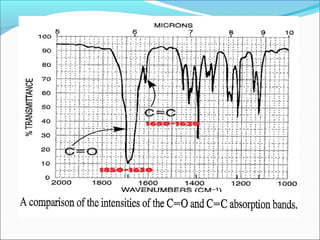
Nature (Intensity and Shape) of spectral bands : Strong
(s), medium (m), weak (w); Broad and Narrow
Different types of IR Bands
Information Obtained from an Unknown
IR Spectra
 IR is most useful in providing information
about the presence or absence of specific
functional groups (FGR)
 IR can provide a molecular fingerprint that
can be used for the identification of samples (FPR)
Interpretation of Spectra
Spectral Requirements
The spectrum must be adequately resolved and of
adequate intensity.
The spectrum should be of a pure compound.
The spectrophotometer should be calibrated so that the
bands are observed at their proper frequencies or
wavelength.
The method of sample handling must be specified. If a
solvent is employed, the solvent concentration, and the
cell thickness should be indicated.
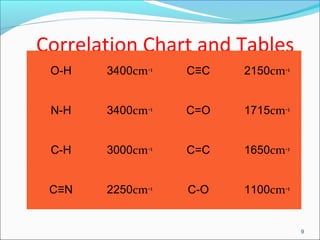
Correlation Chart and Tables
9
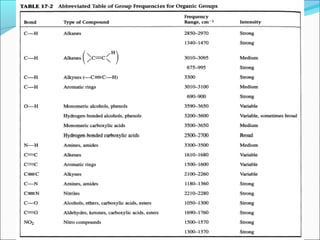
O-H 3400cm-1 C≡C 2150cm-1
N-H 3400cm-1 C=O 1715cm-1
C-H 3000cm-1 C=C 1650cm-1
C≡N 2250cm-1 C-O 1100cm-1
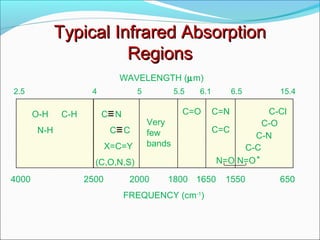
Typical Infrared AbsorptionTypical Infrared Absorption
RegionsRegions
2.5 4 5 5.5 6.1 6.5 15.4
4000 2500 2000 1800 1650 1550 650
FREQUENCY (cm-1
)
WAVELENGTH (Âľm)
O-H C-H
N-H
C=O C=N
Very
few
bands
C=C
C-Cl
C-O
C-N
C-CX=C=Y
(C,O,N,S)
C N
C C
N=O N=O*
Absorption Regions
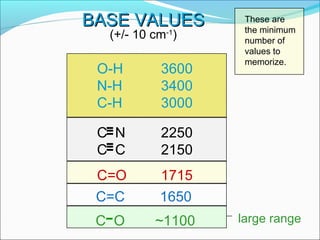
BASE VALUESBASE VALUES
(+/- 10 cm-1
)
These are
the minimum
number of
values to
memorize.
O-H 3600
N-H 3400
C-H 3000
C N 2250
C C 2150
C=O 1715
C=C 1650
C O ~1100 large range
Simple Approach to the Analysis of Spectrum at a Glance
( General Rules)
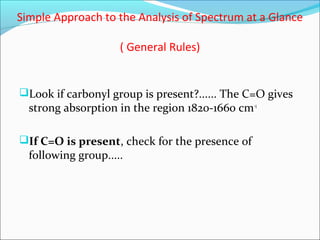
Look if carbonyl group is present?...... The C=O gives
strong absorption in the region 1820-1660 cm-1
If C=O is present, check for the presence of
following group.....
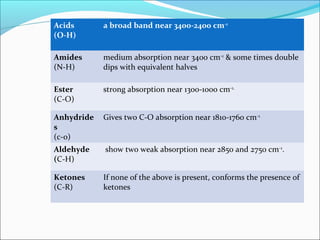
Acids
(O-H)
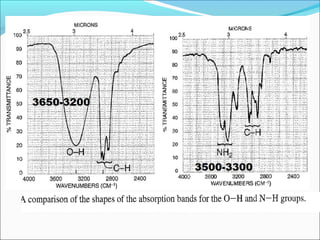
a broad band near 3400-2400 cm-1
Amides
(N-H)
medium absorption near 3400 cm-1
& some times double
dips with equivalent halves
Ester
(C-O)
strong absorption near 1300-1000 cm-1.
Anhydride
s
(c-o)
Gives two C-O absorption near 1810-1760 cm-1
Aldehyde
(C-H)
show two weak absorption near 2850 and 2750 cm-1
.
Ketones
(C-R)
If none of the above is present, conforms the presence of
ketones
If C=O is absent,
 Alcohols and Phenols: Check for O-H, show broad
absorption near 3400-3300 cm-1. confirm this by
finding C-O near 1300-1000cm-1.
 Amines: N-H stretch, show medium absorption
near 3400 cm-1 (1O
– 2 bands, 2O
-1 band)
 Ethers: C-O near 1300-1
000cm-1
,and also absence of
O-H near 3400cm-1
 Double bonds and / or Aromatic ring:
 C=C is a weak absorption near 1650 cm-1
 Medium to strong absorption 1600-1450 cm-1
 Aromatic C-H occurs to left of the 3000 cm-1
 Aliphatic C-H occurs to right of 3000 cm-1
 Triple bonds:
 C≡N medium, sharp absorption near 2250 cm-1
 C≡C weak sharp absorption near 2150 cm-1
Nitro groups
 Two absorptions at 1600-1530 cm-1 & 1390-1300 cm-1
Hydrocarbons
 None of the preceding is found
 Major absorptions are in C-H region near 3000 cm-1
Very simple spectrum
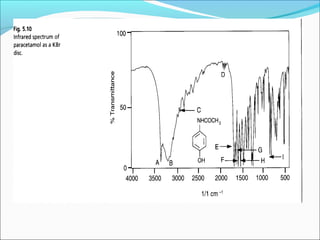
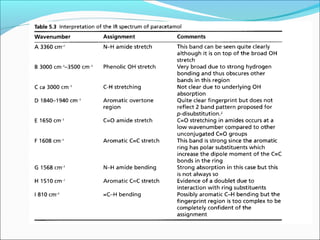
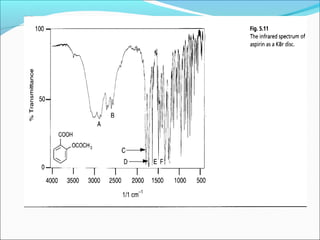
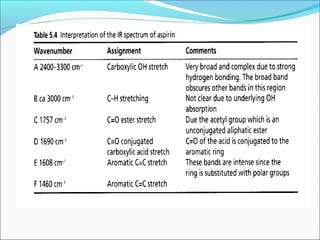
Illustrations
Taking example of drugs
References :
www2.ups.edu/faculty/hanson/Spectroscopy/IR/IRInt
erpretation.htm
chemwiki.ucdavis.edu › ... › Infrared Spectroscopy
chemistry.oregonstate.edu/courses/ch361-
464/ch362/irinterp.htm
infrared.als.lbl.gov/BLManual/IR_Interpretation.pd
f
Interpretation of IR spectra

Interpretation of IR spectra

  • 1.
    INTERPRETATION OF INFRARED SPECTRA GUIDEDBY: PRESENTEDBY: Dr.Sk.Abdul Rehman R.Keerthi M.Pharm, Ph D M.Pharm 1st year DEPARTMENT: PhARMACEuTICAl ANAlySIS
  • 2.
    Outline… Features of anideal IR Spectrum Information could be obtained Requirements for the interpretation General rules of interpretation Illustration
  • 3.
    Features of anIR SpectrumAbsorption (Band) spectrum Spectrum between percent transmittance (% T) and wave number (ύ) Wave number (ύ) represents frequency (υ) of IR absorption Two regions of absorption : FGR (4000-1500 cm-1 ): Identification of groups FPR (1500-400 cm-1 ): Molecular fingerprint (Spectral matching) Nature (Intensity and Shape) of spectral bands : Strong (s), medium (m), weak (w); Broad and Narrow
  • 4.
  • 7.
    Information Obtained froman Unknown IR Spectra  IR is most useful in providing information about the presence or absence of specific functional groups (FGR)  IR can provide a molecular fingerprint that can be used for the identification of samples (FPR)
  • 8.
    Interpretation of Spectra SpectralRequirements The spectrum must be adequately resolved and of adequate intensity. The spectrum should be of a pure compound. The spectrophotometer should be calibrated so that the bands are observed at their proper frequencies or wavelength. The method of sample handling must be specified. If a solvent is employed, the solvent concentration, and the cell thickness should be indicated.
  • 9.
    Correlation Chart andTables 9 O-H 3400cm-1 C≡C 2150cm-1 N-H 3400cm-1 C=O 1715cm-1 C-H 3000cm-1 C=C 1650cm-1 C≡N 2250cm-1 C-O 1100cm-1
  • 11.
    Typical Infrared AbsorptionTypicalInfrared Absorption RegionsRegions 2.5 4 5 5.5 6.1 6.5 15.4 4000 2500 2000 1800 1650 1550 650 FREQUENCY (cm-1 ) WAVELENGTH (Âľm) O-H C-H N-H C=O C=N Very few bands C=C C-Cl C-O C-N C-CX=C=Y (C,O,N,S) C N C C N=O N=O*
  • 12.
  • 14.
    BASE VALUESBASE VALUES (+/-10 cm-1 ) These are the minimum number of values to memorize. O-H 3600 N-H 3400 C-H 3000 C N 2250 C C 2150 C=O 1715 C=C 1650 C O ~1100 large range
  • 15.
    Simple Approach tothe Analysis of Spectrum at a Glance ( General Rules) Look if carbonyl group is present?...... The C=O gives strong absorption in the region 1820-1660 cm-1 If C=O is present, check for the presence of following group.....
  • 16.
    Acids (O-H) a broad bandnear 3400-2400 cm-1 Amides (N-H) medium absorption near 3400 cm-1 & some times double dips with equivalent halves Ester (C-O) strong absorption near 1300-1000 cm-1. Anhydride s (c-o) Gives two C-O absorption near 1810-1760 cm-1 Aldehyde (C-H) show two weak absorption near 2850 and 2750 cm-1 . Ketones (C-R) If none of the above is present, conforms the presence of ketones
  • 17.
    If C=O isabsent,  Alcohols and Phenols: Check for O-H, show broad absorption near 3400-3300 cm-1. confirm this by finding C-O near 1300-1000cm-1.  Amines: N-H stretch, show medium absorption near 3400 cm-1 (1O – 2 bands, 2O -1 band)  Ethers: C-O near 1300-1 000cm-1 ,and also absence of O-H near 3400cm-1
  • 18.
     Double bondsand / or Aromatic ring:  C=C is a weak absorption near 1650 cm-1  Medium to strong absorption 1600-1450 cm-1  Aromatic C-H occurs to left of the 3000 cm-1  Aliphatic C-H occurs to right of 3000 cm-1  Triple bonds:  C≡N medium, sharp absorption near 2250 cm-1  C≡C weak sharp absorption near 2150 cm-1
  • 19.
    Nitro groups  Twoabsorptions at 1600-1530 cm-1 & 1390-1300 cm-1 Hydrocarbons  None of the preceding is found  Major absorptions are in C-H region near 3000 cm-1 Very simple spectrum
  • 20.
  • 25.
    References : www2.ups.edu/faculty/hanson/Spectroscopy/IR/IRInt erpretation.htm chemwiki.ucdavis.edu ›... › Infrared Spectroscopy chemistry.oregonstate.edu/courses/ch361- 464/ch362/irinterp.htm infrared.als.lbl.gov/BLManual/IR_Interpretation.pd f