M. Pharm- Department of Pharmaceutical Analysis
5. Spin-spin Coupling:-
• Spin-Spin coupling:- Also known as spin-spin splitting, It is a
phenomenon in which multiple peaks are obtained (multiplicity)
corresponding to the NMR signal of a group of chemically equivalent
protons.
• The multiplicity observed in 1
H NMR spectra is governed by the N+1 rule,
where N is total number of chemically equivalent protons on adjacent
(neighbouring) carbon atoms. Thus if a proton has one proton (n=1) on its
neighbouring carbon, its peak will be split into 1+1 = 2 peaks.
1
Cont…
• The N+1 rule is actually a specialized application of a more general
formula to the proton system. The actual formula applicable to all
nuclei is 2nl+1, where l is the spin quantum number of the nucleus.
• In case of proton, l is ½, so the formula simplifies to N+1 is case of
proton NMR.
• Ex. CH3CH2OH give 3 peaks for CH3 and give 4 peak for CH2 but
give only 1 peak for OH because the H on –OH group doesn’t interact
with the H of Neighbouring carbon. This is due to the rapid exchange
of hydrogen atoms on the –OH group with water molecule or other
alcohol molecules.
2
3
M. Pharm- Department of Pharmaceutical Analysis
Cont…
M. Pharm- Department of Pharmaceutical Analysis
Theory of Spin-spin splitting:-
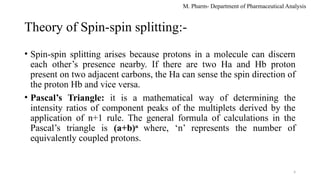
• Spin-spin splitting arises because protons in a molecule can discern
each other’s presence nearby. If there are two Ha and Hb proton
present on two adjacent carbons, the Ha can sense the spin direction of
the proton Hb and vice versa.
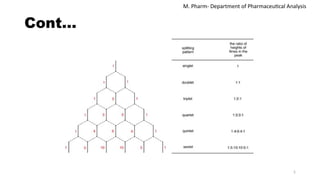
• Pascal’s Triangle: it is a mathematical way of determining the
intensity ratios of component peaks of the multiplets derived by the
application of n+1 rule. The general formula of calculations in the
Pascal’s triangle is (a+b)n
where, ‘n’ represents the number of
equivalently coupled protons.
4
5
M. Pharm- Department of Pharmaceutical Analysis
Cont…
M. Pharm- Department of Pharmaceutical Analysis
6. Coupling constant (J):-
• Coupling constant J is a measure of interaction between two
chemically inequivalent nuclei or sets of nuclei.
• Values of the coupling is indicative of how strongly, one nucleus is
affected by the spin state of another nucleus.
• Coupling constant is determines from the distance between the
individual peaks in a multiplet.
• Spacing between the component peaks of a multiplet is measured on
the frequency scale of the chemical shift and is always expressed in
Hertz (Hz)
6
Types of Coupling
• Geminal Coupling
• Vicinal Coupling
• Long Range Coupling
1. Allylic coupling
2. Alkynes coupling
3. Aromatic coupling
7
M. Pharm- Department of Pharmaceutical Analysis
8
Cont…
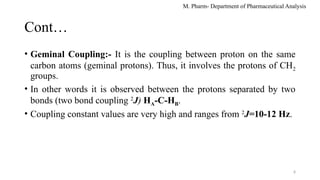
• Geminal Coupling:- It is the coupling between proton on the same
carbon atoms (geminal protons). Thus, it involves the protons of CH2
groups.
• In other words it is observed between the protons separated by two
bonds (two bond coupling 2
J) HA-C-HB.
• Coupling constant values are very high and ranges from 2
J=10-12 Hz.
M. Pharm- Department of Pharmaceutical Analysis
9
Cont…
• Vicinal Coupling:- It is the coupling between proton on vicinal
(adjacent) carbon atoms. In other words it is observed between proton
separated by three bonds (three bonds coupling 3
J): HA-C-C-HB.
• Coupling constant value ranges from 3
J = 0-12 Hz.
• Long Range Coupling:- It refers to proton coupling extending
beyond three bonds 4
J or longer. It is extremely small( 1 Hz) but in
˂
rigid systems link alkenes, alkynes, aromatic and heteroatomic
compounds, small strained ring structures, it may become significant
to observed in the spectrum.
M. Pharm- Department of Pharmaceutical Analysis
10
Cont…
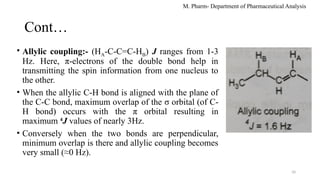
• Allylic coupling:- (HA-C-C=C-HB) J ranges from 1-3
Hz. Here, π-electrons of the double bond help in
transmitting the spin information from one nucleus to
the other.
• When the allylic C-H bond is aligned with the plane of
the C-C bond, maximum overlap of the σ orbital (of C-
H bond) occurs with the π orbital resulting in
maximum 4
J values of nearly 3Hz.
• Conversely when the two bonds are perpendicular,
minimum overlap is there and allylic coupling becomes
very small (≈0 Hz).
M. Pharm- Department of Pharmaceutical Analysis
11
Cont…
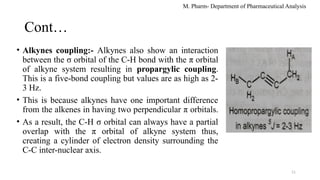
• Alkynes coupling:- Alkynes also show an interaction
between the σ orbital of the C-H bond with the π orbital
of alkyne system resulting in propargylic coupling.
This is a five-bond coupling but values are as high as 2-
3 Hz.
• This is because alkynes have one important difference
from the alkenes in having two perpendicular π orbitals.
• As a result, the C-H σ orbital can always have a partial
overlap with the π orbital of alkyne system thus,
creating a cylinder of electron density surrounding the
C-C inter-nuclear axis.
M. Pharm- Department of Pharmaceutical Analysis
12
Cont…
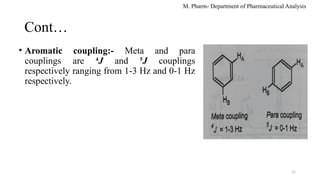
• Aromatic coupling:- Meta and para
couplings are 4
J and 5
J couplings
respectively ranging from 1-3 Hz and 0-1 Hz
respectively.
M. Pharm- Department of Pharmaceutical Analysis
13
8. REFRENCE
1. Book S.Suzanne Nielsen Food Analysis, Fifth Edection
2. Book Introduction to Spectroscopy- Pavia, Lampan, Kriz
3. MPAT Volume 1 – A. Bali, G.K. Bansal, A. Tiwari
4. https://www.jeol.com/solutions/applications/details/NM200002E.php
5. https://u-of-o-nmr-facility.blogspot.com/2008/03/what-is-difference-between-broadband.html?m=1
6. https://www.sciencedirect.com/topics/chemistry/radiofrequency-coil
7. https://www.labmate-online.com/news/news-and-views/5/breaking-news/nmr-basics-101-mdash-what-is-shimming/31
487
8. https://scs.illinois.edu/system/files/inline-files/ShimmingNMR_Magnet.pdf
9. https://www.ncbi.nlm.nih.gov/pmc/articles/PMC5591082/
10.DONALD L. PAVIA, INTRODUCTION TO SPECTROSCOPY, Page no 327-329
M. Pharm- Department of Pharmaceutical Analysis
14
THANK YOU
M. Pharm- Department of Pharmaceutical Analysis

Spin-Spin Coupling and Coupling constant.pptx

  • 1.
    M. Pharm- Departmentof Pharmaceutical Analysis 5. Spin-spin Coupling:- • Spin-Spin coupling:- Also known as spin-spin splitting, It is a phenomenon in which multiple peaks are obtained (multiplicity) corresponding to the NMR signal of a group of chemically equivalent protons. • The multiplicity observed in 1 H NMR spectra is governed by the N+1 rule, where N is total number of chemically equivalent protons on adjacent (neighbouring) carbon atoms. Thus if a proton has one proton (n=1) on its neighbouring carbon, its peak will be split into 1+1 = 2 peaks. 1
  • 2.
    Cont… • The N+1rule is actually a specialized application of a more general formula to the proton system. The actual formula applicable to all nuclei is 2nl+1, where l is the spin quantum number of the nucleus. • In case of proton, l is ½, so the formula simplifies to N+1 is case of proton NMR. • Ex. CH3CH2OH give 3 peaks for CH3 and give 4 peak for CH2 but give only 1 peak for OH because the H on –OH group doesn’t interact with the H of Neighbouring carbon. This is due to the rapid exchange of hydrogen atoms on the –OH group with water molecule or other alcohol molecules. 2
  • 3.
    3 M. Pharm- Departmentof Pharmaceutical Analysis Cont…
  • 4.
    M. Pharm- Departmentof Pharmaceutical Analysis Theory of Spin-spin splitting:- • Spin-spin splitting arises because protons in a molecule can discern each other’s presence nearby. If there are two Ha and Hb proton present on two adjacent carbons, the Ha can sense the spin direction of the proton Hb and vice versa. • Pascal’s Triangle: it is a mathematical way of determining the intensity ratios of component peaks of the multiplets derived by the application of n+1 rule. The general formula of calculations in the Pascal’s triangle is (a+b)n where, ‘n’ represents the number of equivalently coupled protons. 4
  • 5.
    5 M. Pharm- Departmentof Pharmaceutical Analysis Cont…
  • 6.
    M. Pharm- Departmentof Pharmaceutical Analysis 6. Coupling constant (J):- • Coupling constant J is a measure of interaction between two chemically inequivalent nuclei or sets of nuclei. • Values of the coupling is indicative of how strongly, one nucleus is affected by the spin state of another nucleus. • Coupling constant is determines from the distance between the individual peaks in a multiplet. • Spacing between the component peaks of a multiplet is measured on the frequency scale of the chemical shift and is always expressed in Hertz (Hz) 6
  • 7.
    Types of Coupling •Geminal Coupling • Vicinal Coupling • Long Range Coupling 1. Allylic coupling 2. Alkynes coupling 3. Aromatic coupling 7 M. Pharm- Department of Pharmaceutical Analysis
  • 8.
    8 Cont… • Geminal Coupling:-It is the coupling between proton on the same carbon atoms (geminal protons). Thus, it involves the protons of CH2 groups. • In other words it is observed between the protons separated by two bonds (two bond coupling 2 J) HA-C-HB. • Coupling constant values are very high and ranges from 2 J=10-12 Hz. M. Pharm- Department of Pharmaceutical Analysis
  • 9.
    9 Cont… • Vicinal Coupling:-It is the coupling between proton on vicinal (adjacent) carbon atoms. In other words it is observed between proton separated by three bonds (three bonds coupling 3 J): HA-C-C-HB. • Coupling constant value ranges from 3 J = 0-12 Hz. • Long Range Coupling:- It refers to proton coupling extending beyond three bonds 4 J or longer. It is extremely small( 1 Hz) but in ˂ rigid systems link alkenes, alkynes, aromatic and heteroatomic compounds, small strained ring structures, it may become significant to observed in the spectrum. M. Pharm- Department of Pharmaceutical Analysis
  • 10.
    10 Cont… • Allylic coupling:-(HA-C-C=C-HB) J ranges from 1-3 Hz. Here, π-electrons of the double bond help in transmitting the spin information from one nucleus to the other. • When the allylic C-H bond is aligned with the plane of the C-C bond, maximum overlap of the σ orbital (of C- H bond) occurs with the π orbital resulting in maximum 4 J values of nearly 3Hz. • Conversely when the two bonds are perpendicular, minimum overlap is there and allylic coupling becomes very small (≈0 Hz). M. Pharm- Department of Pharmaceutical Analysis
  • 11.
    11 Cont… • Alkynes coupling:-Alkynes also show an interaction between the σ orbital of the C-H bond with the π orbital of alkyne system resulting in propargylic coupling. This is a five-bond coupling but values are as high as 2- 3 Hz. • This is because alkynes have one important difference from the alkenes in having two perpendicular π orbitals. • As a result, the C-H σ orbital can always have a partial overlap with the π orbital of alkyne system thus, creating a cylinder of electron density surrounding the C-C inter-nuclear axis. M. Pharm- Department of Pharmaceutical Analysis
  • 12.
    12 Cont… • Aromatic coupling:-Meta and para couplings are 4 J and 5 J couplings respectively ranging from 1-3 Hz and 0-1 Hz respectively. M. Pharm- Department of Pharmaceutical Analysis
  • 13.
    13 8. REFRENCE 1. BookS.Suzanne Nielsen Food Analysis, Fifth Edection 2. Book Introduction to Spectroscopy- Pavia, Lampan, Kriz 3. MPAT Volume 1 – A. Bali, G.K. Bansal, A. Tiwari 4. https://www.jeol.com/solutions/applications/details/NM200002E.php 5. https://u-of-o-nmr-facility.blogspot.com/2008/03/what-is-difference-between-broadband.html?m=1 6. https://www.sciencedirect.com/topics/chemistry/radiofrequency-coil 7. https://www.labmate-online.com/news/news-and-views/5/breaking-news/nmr-basics-101-mdash-what-is-shimming/31 487 8. https://scs.illinois.edu/system/files/inline-files/ShimmingNMR_Magnet.pdf 9. https://www.ncbi.nlm.nih.gov/pmc/articles/PMC5591082/ 10.DONALD L. PAVIA, INTRODUCTION TO SPECTROSCOPY, Page no 327-329 M. Pharm- Department of Pharmaceutical Analysis
  • 14.
    14 THANK YOU M. Pharm-Department of Pharmaceutical Analysis