Ultimate Analysis – Constituents of coal
Fossil Fuel Engineering – ERG 252 (1+1)
S.Vignesh – BTG-12-037
Introduction
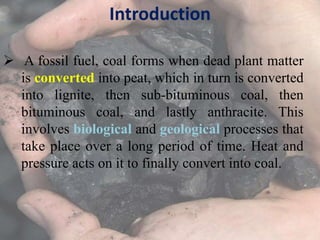
 A fossil fuel, coal forms when dead plant matter
is converted into peat, which in turn is converted
into lignite, then sub-bituminous coal, then
bituminous coal, and lastly anthracite. This
involves biological and geological processes that
take place over a long period of time. Heat and
pressure acts on it to finally convert into coal.
Ultimate Analysis
• Coal is composed primarily of carbon along
with variable quantities of other elements,
chiefly hydrogen, sulphur, oxygen, nitrogen.
• Ultimate analysis is also known as elemental
analysis, it is the method to determine the
Carbon,Hydrogen,Nitrogen,Sulphur and
Oxygen content present in solid fuel.
Need For Analysis
• It is essential to understand the properties of
biomass materials to evaluate their utility
• As chemical feedstock's and also design suitable
gasifies systems. The analysis is carried out to
find the oxygen required for combustion for
efficient production of energy.
• Two types-proximate and ultimate analysis
• Proximate-it determines moisture content,
volatile matter, ash and fixed carbon content of a
fuel. It is reported as dry weight.
Determination of carbon & hydrogen
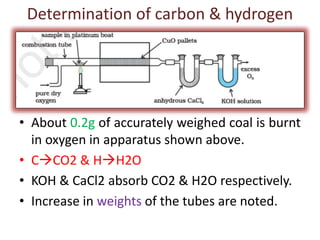
• About 0.2g of accurately weighed coal is burnt
in oxygen in apparatus shown above.
• CCO2 & HH2O
• KOH & CaCl2 absorb CO2 & H2O respectively.
• Increase in weights of the tubes are noted.
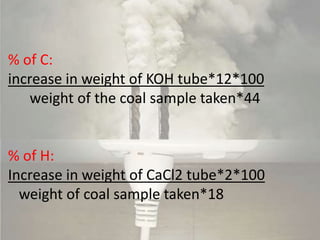
% of C:
increase in weight of KOH tube*12*100
weight of the coal sample taken*44
% of H:
Increase in weight of CaCl2 tube*2*100
weight of coal sample taken*18
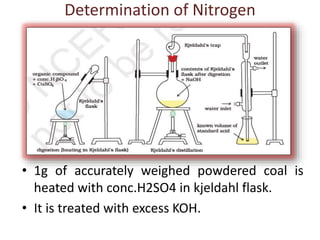
Determination of Nitrogen
• 1g of accurately weighed powdered coal is
heated with conc.H2SO4 in kjeldahl flask.
• It is treated with excess KOH.
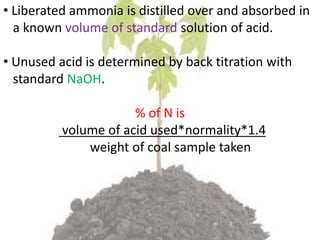
• Liberated ammonia is distilled over and absorbed in
a known volume of standard solution of acid.
• Unused acid is determined by back titration with
standard NaOH.
% of N is
volume of acid used*normality*1.4
weight of coal sample taken
Determination of sulphur
• Sulphur is converted into sulphate.
• The washings are treated with BaCl.
• BaSO4 is precipitated.
• Precipitate is filtered, washed and heated to
constant weight.
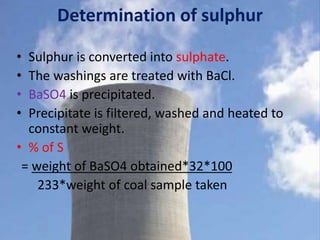
• % of S
= weight of BaSO4 obtained*32*100
233*weight of coal sample taken
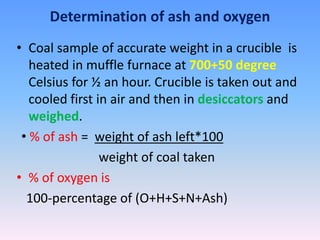
Determination of ash and oxygen
• Coal sample of accurate weight in a crucible is
heated in muffle furnace at 700+50 degree
Celsius for ½ an hour. Crucible is taken out and
cooled first in air and then in desiccators and
weighed.
• % of ash = weight of ash left*100
weight of coal taken
• % of oxygen is
100-percentage of (O+H+S+N+Ash)
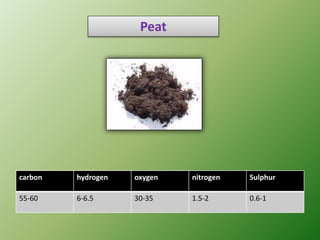
carbon hydrogen oxygen nitrogen Sulphur
55-60 6-6.5 30-35 1.5-2 0.6-1
Peat
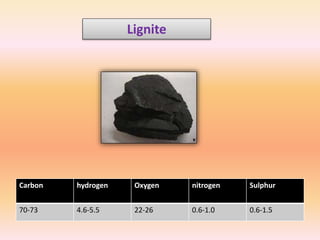
Carbon hydrogen Oxygen nitrogen Sulphur
70-73 4.6-5.5 22-26 0.6-1.0 0.6-1.5
Lignite
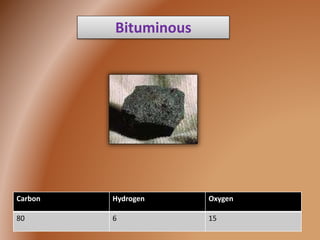
Carbon Hydrogen Oxygen
80 6 15
Bituminous
Carbon Hydrogen Oxygen
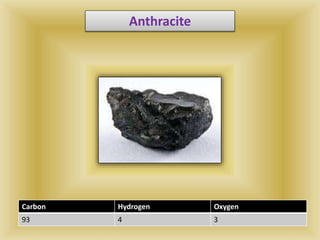
93 4 3
Anthracite
Total carbon
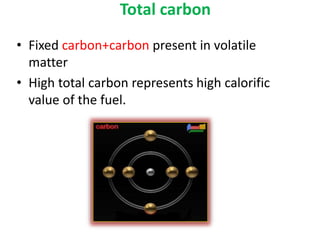
• Fixed carbon+carbon present in volatile
matter
• High total carbon represents high calorific
value of the fuel.
Hydrogen
• It increases calorific value-H2 remains as coke
oven gas
• Associated with volatile matter of coal
• Peat to bituminous contains 4.5-6% H2
• Anthracite contains only 1-2%
Nitrogen
• Present up to 1-3%
• Comes from protein us matter in vegetable matter.
• Inert nitrogen decreases calorific value.
• As coal matures, extractable nitrogen decreases.
• Its proportion does not depend on rank.
• It varies from 1-2% in all.
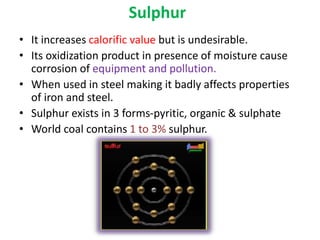
Sulphur
• It increases calorific value but is undesirable.
• Its oxidization product in presence of moisture cause
corrosion of equipment and pollution.
• When used in steel making it badly affects properties
of iron and steel.
• Sulphur exists in 3 forms-pyritic, organic & sulphate
• World coal contains 1 to 3% sulphur.
Oxygen
• Less the oxygen-better is the coal.
• Decreases from lignite to anthracite.
• As oxygen content increases, moisture holding
capacity increases and caking power
decreases.
Phosphorus
• Undesirable in metallurgical as it badly affects
properties of metals.
• Indian coking coals have less than 0.15%
phosphorus.
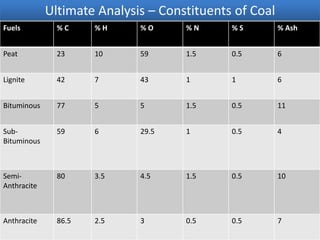
Fuels % C % H % O % N % S % Ash
Peat 23 10 59 1.5 0.5 6
Lignite 42 7 43 1 1 6
Bituminous 77 5 5 1.5 0.5 11
Sub-
Bituminous
59 6 29.5 1 0.5 4
Semi-
Anthracite
80 3.5 4.5 1.5 0.5 10
Anthracite 86.5 2.5 3 0.5 0.5 7
Ultimate Analysis – Constituents of Coal
Thank You

Ultimate Analysis of Coal

  • 1.
    Ultimate Analysis –Constituents of coal Fossil Fuel Engineering – ERG 252 (1+1) S.Vignesh – BTG-12-037
  • 2.
    Introduction  A fossilfuel, coal forms when dead plant matter is converted into peat, which in turn is converted into lignite, then sub-bituminous coal, then bituminous coal, and lastly anthracite. This involves biological and geological processes that take place over a long period of time. Heat and pressure acts on it to finally convert into coal.
  • 3.
    Ultimate Analysis • Coalis composed primarily of carbon along with variable quantities of other elements, chiefly hydrogen, sulphur, oxygen, nitrogen. • Ultimate analysis is also known as elemental analysis, it is the method to determine the Carbon,Hydrogen,Nitrogen,Sulphur and Oxygen content present in solid fuel.
  • 4.
    Need For Analysis •It is essential to understand the properties of biomass materials to evaluate their utility • As chemical feedstock's and also design suitable gasifies systems. The analysis is carried out to find the oxygen required for combustion for efficient production of energy. • Two types-proximate and ultimate analysis • Proximate-it determines moisture content, volatile matter, ash and fixed carbon content of a fuel. It is reported as dry weight.
  • 5.
    Determination of carbon& hydrogen • About 0.2g of accurately weighed coal is burnt in oxygen in apparatus shown above. • CCO2 & HH2O • KOH & CaCl2 absorb CO2 & H2O respectively. • Increase in weights of the tubes are noted.
  • 6.
    % of C: increasein weight of KOH tube*12*100 weight of the coal sample taken*44 % of H: Increase in weight of CaCl2 tube*2*100 weight of coal sample taken*18
  • 7.
    Determination of Nitrogen •1g of accurately weighed powdered coal is heated with conc.H2SO4 in kjeldahl flask. • It is treated with excess KOH.
  • 8.
    • Liberated ammoniais distilled over and absorbed in a known volume of standard solution of acid. • Unused acid is determined by back titration with standard NaOH. % of N is volume of acid used*normality*1.4 weight of coal sample taken
  • 9.
    Determination of sulphur •Sulphur is converted into sulphate. • The washings are treated with BaCl. • BaSO4 is precipitated. • Precipitate is filtered, washed and heated to constant weight. • % of S = weight of BaSO4 obtained*32*100 233*weight of coal sample taken
  • 10.
    Determination of ashand oxygen • Coal sample of accurate weight in a crucible is heated in muffle furnace at 700+50 degree Celsius for ½ an hour. Crucible is taken out and cooled first in air and then in desiccators and weighed. • % of ash = weight of ash left*100 weight of coal taken • % of oxygen is 100-percentage of (O+H+S+N+Ash)
  • 11.
    carbon hydrogen oxygennitrogen Sulphur 55-60 6-6.5 30-35 1.5-2 0.6-1 Peat
  • 12.
    Carbon hydrogen Oxygennitrogen Sulphur 70-73 4.6-5.5 22-26 0.6-1.0 0.6-1.5 Lignite
  • 13.
  • 14.
  • 15.
    Total carbon • Fixedcarbon+carbon present in volatile matter • High total carbon represents high calorific value of the fuel.
  • 16.
    Hydrogen • It increasescalorific value-H2 remains as coke oven gas • Associated with volatile matter of coal • Peat to bituminous contains 4.5-6% H2 • Anthracite contains only 1-2%
  • 17.
    Nitrogen • Present upto 1-3% • Comes from protein us matter in vegetable matter. • Inert nitrogen decreases calorific value. • As coal matures, extractable nitrogen decreases. • Its proportion does not depend on rank. • It varies from 1-2% in all.
  • 18.
    Sulphur • It increasescalorific value but is undesirable. • Its oxidization product in presence of moisture cause corrosion of equipment and pollution. • When used in steel making it badly affects properties of iron and steel. • Sulphur exists in 3 forms-pyritic, organic & sulphate • World coal contains 1 to 3% sulphur.
  • 19.
    Oxygen • Less theoxygen-better is the coal. • Decreases from lignite to anthracite. • As oxygen content increases, moisture holding capacity increases and caking power decreases.
  • 20.
    Phosphorus • Undesirable inmetallurgical as it badly affects properties of metals. • Indian coking coals have less than 0.15% phosphorus.
  • 21.
    Fuels % C% H % O % N % S % Ash Peat 23 10 59 1.5 0.5 6 Lignite 42 7 43 1 1 6 Bituminous 77 5 5 1.5 0.5 11 Sub- Bituminous 59 6 29.5 1 0.5 4 Semi- Anthracite 80 3.5 4.5 1.5 0.5 10 Anthracite 86.5 2.5 3 0.5 0.5 7 Ultimate Analysis – Constituents of Coal
  • 22.