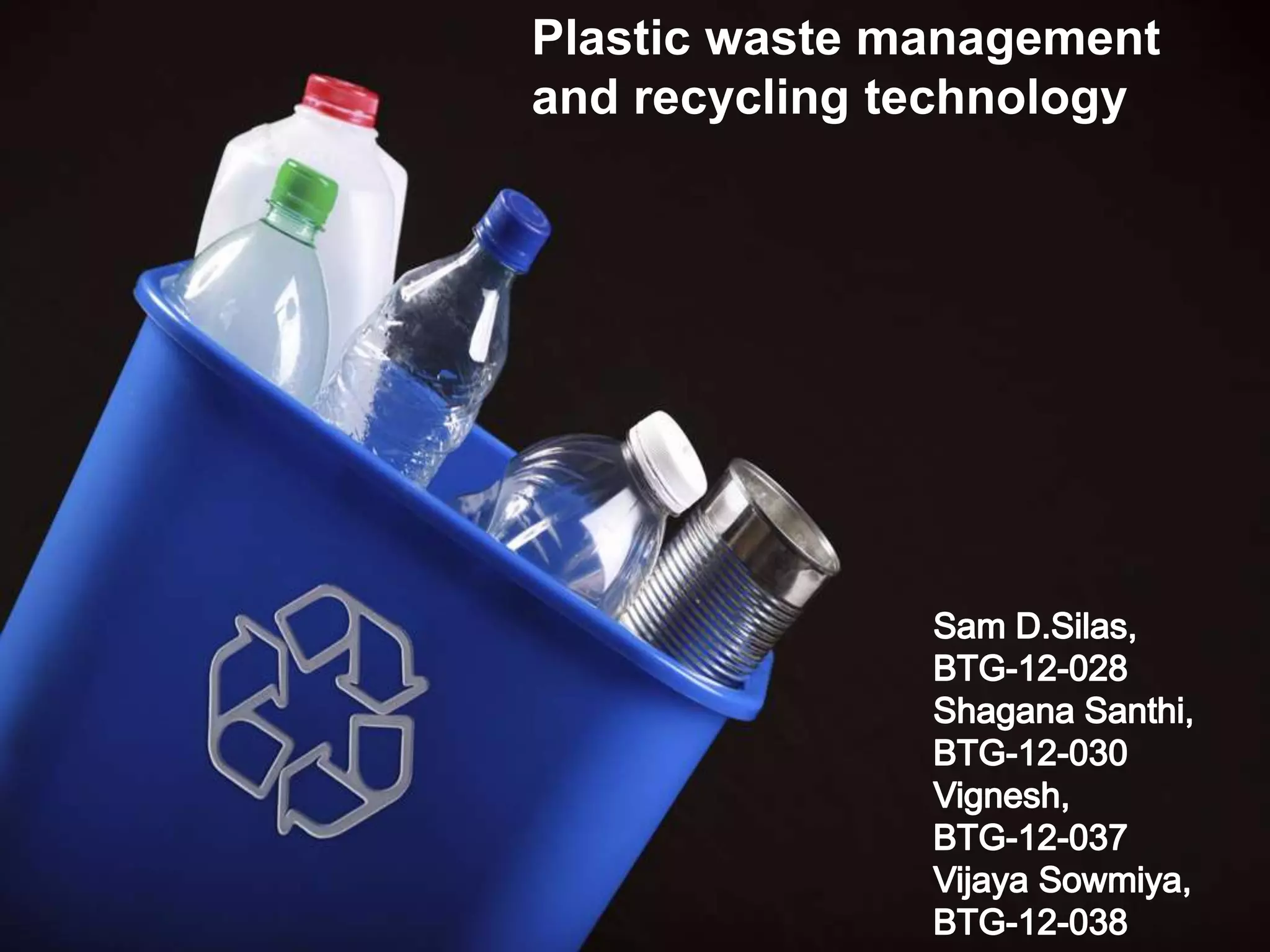
Plastic waste management
and recycling technology
PLASTIC WASTE MANAGEMENT AND RECYCLING
TECHNOLOGY
INTRODUCTION
OBJECTIVES INVOLVED
CASE STUDY
EXISTING PROBLEMS
REMEDIAL MEASURES
CONCLUSION
REFERENCE
INTRODUCTION
Waste is now a global problem, and one that must be addressed in
order to solve the world's resource and energy challenges.
Plastic is a material in any of a wide range of
synthetic or semi synthetic that are moldable. These are made from
limited sources of a petroleum. Huge advances are being made in
the development of technologies to recycle plastic waste among
other resources.
 It gives to energy savings and the reduction of greenhouse gas
emissions. It also saves non renewable sources like oil and gas. In
addition to that, recycling provides livelihood for millions of
people and families in developing countries, employment or
informal economic activities.
Why recycle plastics ?
OBJECTIVES
 The main objective of this project is to emphasize the
reduced use of plastic and the beneficial management of
plastic waste. This also includes alternative measures for the
substitution of the synthetic polymers.
 Efficient transformation of plastic into energy and fuel.
 Controlling the impact of plastic waste on the environment.
 Making our environment an eco friendly zone.
CASE STUDY
 Plastic is a form of synthetic or semi synthetic organic polymer.
Plastic can be manufactured through various processes and by
combination of various compounds. The variety of plastics are
discussed as follows.
PET HDPE PVC LDPE PP PS
OTHE
RS
DESCRIPTION
 PET : Poly Ethylene Terephthalate-fizzy drink bottles and oven
trays manufacturing
 HDPE : High Density Poly Ethylene-bottles for milk and washing
up liquids
 PVC : Polyvinyl chloride, Pipes and fittings
 LDPE : Carrier bags and garbage bin liners
 PP : Poly propylene, Medicine bottles
 PS : Poly Styrene, Packaging pellets, Fast food trays etc.
DISTRIBUTION OF PLASTIC IN
MANUFACTURING SECTOR
18.60%11.90%
10%
7.40%
7%
6.70%
6.70%
5.20%
4.00%
3.40%
2.60% 2.20%
1.70%
1.60%
1.40%
1.20%
8.50%
0.166
Usage
chips and conf bags bottles/caps and lids PET bottles supermarket retail bags
straws garbage bags packaging food bags
cling wrap fruit juice bottles softdrinks/water cups/utensils
food containers milk bottles pack rings cigarette lighters
PLASTIC WASTE SOURCES
Source
Municipal
source
Residential
markets
Hotels,
hospitals
Distribution &
industry
sector
Food,
chemical
Packaging
firms
Othersources
Automotive,
agricultural
waste etc..
ENVIRONMENTAL IMPACT ASSESSMENT
 Plastic manufacturing consumes significant amount of resources.
(4% of worlds annual oil production)
 Littered plastic spoils the beauty of the environment
 Affects human health due to toxic release into atmosphere.
 Non bio degradable nature arrests recharge of ground water
aquifers.
 Garbage mixed with plastic may cause problems in landfill
operations.
Processing
Segregation
Selection
METHODOLOGY
Methodology
 Selection - The recyclers have to select the waste
suitable for recycling.
 Segregation - The plastic waste must be separated
according to its nature corresponding to BIS guidelines
 Processing - After segregation pre consumer waste
can be directly recycled whereas post consumer
waste has to be washed ,shredded ,agglomerated and
granulated.
 Primary recycling - Involves processing of waste
into a product of similar characteristics.
 Secondary recycling - Involves processing of waste
plastic into materials having different characteristics.
 Tertiary recycling - Involves production of basic
chemicals and fuel from segregated municipal waste.
 quaternary recycling - Involves energy extraction
by burning and incineration.
Recycling technology
Three forms of recycling
Category Method of recycling Recycling
Category
DISADVANTAGES
 High Initial cost.
 Recycled products may not last for long.
 Unsafe and unhygienic recycling sites.
 May create more pollution.
 Not wide spread on large scale.
ALTERNATIVES TO BE CONSIDERED
 Plastic waste disposal through Plasma Pyrolysis
Technology - incineration of waste by plasma torches
leaving minute or no residues.
 Conversion of plastic waste into Liquid fuel using
Dehydrochlorination units. By extracting hydrogen and
chlorine separately oil and hydrochloric acid can be
obtained.
 Bio degradable plastics - manufacture of plastics that are
eco-friendly. They have a decomposing nature.
ADVANTAGES
 Plasma Pyrolysis - Clean destruction of hazardous
waste Preventing waste from entering landfills
No harmful emission of toxic waste.
 De-hydro chlorination – Extraction of clean energy and
Hydrochloric acid.
 Bio Degradable plastic – Takes less time to break down
Bio plastics are renewable.
REVIEW OF LITERATURES
 Javeriya Siddiqui and Govind Pandey - M.M.M. Engineering College, Gorakhpur
Conversion of Plastics Waste into Liquid Fuel
 Dr. R.K. Khandal, SRI, Chairman their groups – PWM in India
 National Recovery Technologies, Nashville, TN - High-Speed Plastic Recycling
SUCCESS STORIES BEHIND THAT PWM
Woman of the waste recycling project,
Galle, Sri Lanka. Ragbags
A LENOVO ENVIRONMENTAL SUCCESS STORY
“USING RECYCLED CONTENT PLASTICS”
 To demonstrate “engineered” recycled content plastics could
successfully be used in computer applications and satisfy the
demanding requirements, Lenovo’s team first worked with post
industrial content (PIC) recycled plastics.
 To prove to the computer industry using recycled plastics is not
only the right environmental thing to do, but makes good
business sense.
REFERENCE
 Solid waste management by V.K.Prabhakar
 Plastic Waste Management - Dr.A.B.Harapanahalli, Mini.of
Envi & Forests.
 Solid waste management - Coimbatore city municipal
corporation
 Article published by Plastic Waste Management Institute
 Information handbook under right to information act -TNPCB
 The Hindu – ‘Envi minister wants plastic free
Coimbatore’. Feb 12 2010, ‘Plastic bags with a ‘ban’g’-
Jan 18 2012.
CONCLUSION
 Even though plastic recycling and its management
has gained momentum nowadays, the best possible
way of protecting our environment is to alter the
root cause of the problem by reducing the usage at
the preliminary level.
Place to be visited
CIPET,
CHENNAI
Thank you

Plastic Waste Management and Recycling Technology : P1

  • 1.
    Plastic waste management andrecycling technology
  • 2.
    PLASTIC WASTE MANAGEMENTAND RECYCLING TECHNOLOGY INTRODUCTION OBJECTIVES INVOLVED CASE STUDY EXISTING PROBLEMS REMEDIAL MEASURES CONCLUSION REFERENCE
  • 3.
    INTRODUCTION Waste is nowa global problem, and one that must be addressed in order to solve the world's resource and energy challenges. Plastic is a material in any of a wide range of synthetic or semi synthetic that are moldable. These are made from limited sources of a petroleum. Huge advances are being made in the development of technologies to recycle plastic waste among other resources.
  • 4.
     It givesto energy savings and the reduction of greenhouse gas emissions. It also saves non renewable sources like oil and gas. In addition to that, recycling provides livelihood for millions of people and families in developing countries, employment or informal economic activities. Why recycle plastics ?
  • 5.
    OBJECTIVES  The mainobjective of this project is to emphasize the reduced use of plastic and the beneficial management of plastic waste. This also includes alternative measures for the substitution of the synthetic polymers.  Efficient transformation of plastic into energy and fuel.  Controlling the impact of plastic waste on the environment.  Making our environment an eco friendly zone.
  • 6.
    CASE STUDY  Plasticis a form of synthetic or semi synthetic organic polymer. Plastic can be manufactured through various processes and by combination of various compounds. The variety of plastics are discussed as follows. PET HDPE PVC LDPE PP PS OTHE RS
  • 7.
    DESCRIPTION  PET :Poly Ethylene Terephthalate-fizzy drink bottles and oven trays manufacturing  HDPE : High Density Poly Ethylene-bottles for milk and washing up liquids  PVC : Polyvinyl chloride, Pipes and fittings  LDPE : Carrier bags and garbage bin liners  PP : Poly propylene, Medicine bottles  PS : Poly Styrene, Packaging pellets, Fast food trays etc.
  • 8.
    DISTRIBUTION OF PLASTICIN MANUFACTURING SECTOR 18.60%11.90% 10% 7.40% 7% 6.70% 6.70% 5.20% 4.00% 3.40% 2.60% 2.20% 1.70% 1.60% 1.40% 1.20% 8.50% 0.166 Usage chips and conf bags bottles/caps and lids PET bottles supermarket retail bags straws garbage bags packaging food bags cling wrap fruit juice bottles softdrinks/water cups/utensils food containers milk bottles pack rings cigarette lighters
  • 9.
    PLASTIC WASTE SOURCES Source Municipal source Residential markets Hotels, hospitals Distribution& industry sector Food, chemical Packaging firms Othersources Automotive, agricultural waste etc..
  • 10.
    ENVIRONMENTAL IMPACT ASSESSMENT Plastic manufacturing consumes significant amount of resources. (4% of worlds annual oil production)  Littered plastic spoils the beauty of the environment  Affects human health due to toxic release into atmosphere.  Non bio degradable nature arrests recharge of ground water aquifers.  Garbage mixed with plastic may cause problems in landfill operations.
  • 11.
  • 12.
    Methodology  Selection -The recyclers have to select the waste suitable for recycling.  Segregation - The plastic waste must be separated according to its nature corresponding to BIS guidelines  Processing - After segregation pre consumer waste can be directly recycled whereas post consumer waste has to be washed ,shredded ,agglomerated and granulated.
  • 13.
     Primary recycling- Involves processing of waste into a product of similar characteristics.  Secondary recycling - Involves processing of waste plastic into materials having different characteristics.  Tertiary recycling - Involves production of basic chemicals and fuel from segregated municipal waste.  quaternary recycling - Involves energy extraction by burning and incineration. Recycling technology
  • 14.
    Three forms ofrecycling Category Method of recycling Recycling Category
  • 15.
    DISADVANTAGES  High Initialcost.  Recycled products may not last for long.  Unsafe and unhygienic recycling sites.  May create more pollution.  Not wide spread on large scale.
  • 16.
    ALTERNATIVES TO BECONSIDERED  Plastic waste disposal through Plasma Pyrolysis Technology - incineration of waste by plasma torches leaving minute or no residues.  Conversion of plastic waste into Liquid fuel using Dehydrochlorination units. By extracting hydrogen and chlorine separately oil and hydrochloric acid can be obtained.  Bio degradable plastics - manufacture of plastics that are eco-friendly. They have a decomposing nature.
  • 17.
    ADVANTAGES  Plasma Pyrolysis- Clean destruction of hazardous waste Preventing waste from entering landfills No harmful emission of toxic waste.  De-hydro chlorination – Extraction of clean energy and Hydrochloric acid.  Bio Degradable plastic – Takes less time to break down Bio plastics are renewable.
  • 18.
    REVIEW OF LITERATURES Javeriya Siddiqui and Govind Pandey - M.M.M. Engineering College, Gorakhpur Conversion of Plastics Waste into Liquid Fuel  Dr. R.K. Khandal, SRI, Chairman their groups – PWM in India  National Recovery Technologies, Nashville, TN - High-Speed Plastic Recycling SUCCESS STORIES BEHIND THAT PWM Woman of the waste recycling project, Galle, Sri Lanka. Ragbags
  • 19.
    A LENOVO ENVIRONMENTALSUCCESS STORY “USING RECYCLED CONTENT PLASTICS”  To demonstrate “engineered” recycled content plastics could successfully be used in computer applications and satisfy the demanding requirements, Lenovo’s team first worked with post industrial content (PIC) recycled plastics.  To prove to the computer industry using recycled plastics is not only the right environmental thing to do, but makes good business sense.
  • 20.
    REFERENCE  Solid wastemanagement by V.K.Prabhakar  Plastic Waste Management - Dr.A.B.Harapanahalli, Mini.of Envi & Forests.  Solid waste management - Coimbatore city municipal corporation  Article published by Plastic Waste Management Institute  Information handbook under right to information act -TNPCB  The Hindu – ‘Envi minister wants plastic free Coimbatore’. Feb 12 2010, ‘Plastic bags with a ‘ban’g’- Jan 18 2012.
  • 21.
    CONCLUSION  Even thoughplastic recycling and its management has gained momentum nowadays, the best possible way of protecting our environment is to alter the root cause of the problem by reducing the usage at the preliminary level.
  • 22.
    Place to bevisited CIPET, CHENNAI
  • 23.