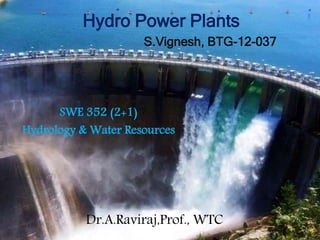
Hydro Power Plants
SWE 352 (2+1)
Hydrology & Water Resources
S.Vignesh, BTG-12-037
Dr.A.Raviraj,Prof., WTC
Introduction
Hydro Power
 Water power is one of the major sources of energy, form
of energy renewable source. Hydro power generates from
flowing water.
Hydro Power Plants
 Most efficient means of producing electric energy & do not
create the air- pollution, the fuel falling water is not
consumed. This favorable conditions to make
hydroelectric projects attractive sources of electric power.
Water cycle
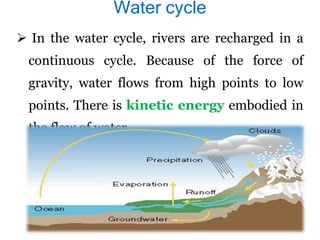
 In the water cycle, rivers are recharged in a
continuous cycle. Because of the force of
gravity, water flows from high points to low
points. There is kinetic energy embodied in
the flow of water.
Because the water cycle is continuous,
hydropower is a renewable energy source.
Recycle
Components
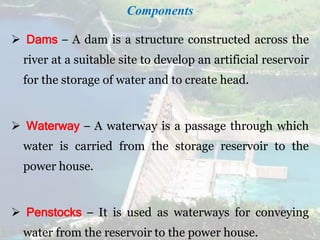
 Dams – A dam is a structure constructed across the
river at a suitable site to develop an artificial reservoir
for the storage of water and to create head.
 Waterway – A waterway is a passage through which
water is carried from the storage reservoir to the
power house.
 Penstocks – It is used as waterways for conveying
water from the reservoir to the power house.
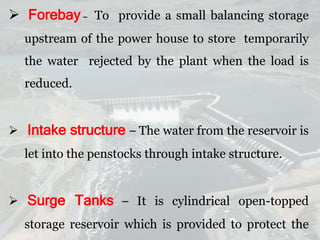
 Forebay – To provide a small balancing storage
upstream of the power house to store temporarily
the water rejected by the plant when the load is
reduced.
 Intake structure – The water from the reservoir is
let into the penstocks through intake structure.
 Surge Tanks – It is cylindrical open-topped
storage reservoir which is provided to protect the
Power House
A power house of a hydroelectric scheme
houses the
various tools. The various tools are
turbines, gates, governors, electrical
equipment's include generators, transformers,
switching equipment, transmission lines and
structures, auxiliary electrical tools etc.
Types
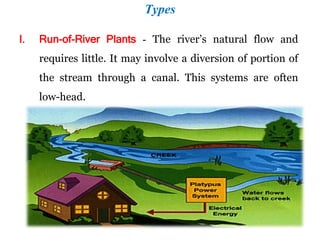
I. Run-of-River Plants - The river’s natural flow and
requires little. It may involve a diversion of portion of
the stream through a canal. This systems are often
low-head.
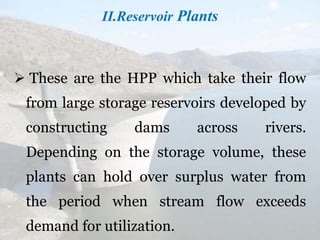
II.Reservoir Plants
 These are the HPP which take their flow
from large storage reservoirs developed by
constructing dams across rivers.
Depending on the storage volume, these
plants can hold over surplus water from
the period when stream flow exceeds
demand for utilization.
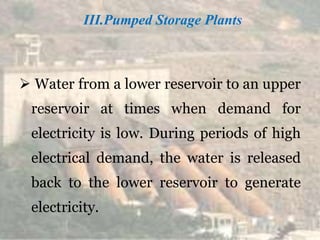
III.Pumped Storage Plants
 Water from a lower reservoir to an upper
reservoir at times when demand for
electricity is low. During periods of high
electrical demand, the water is released
back to the lower reservoir to generate
electricity.
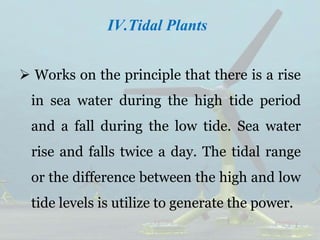
IV.Tidal Plants
 Works on the principle that there is a rise
in sea water during the high tide period
and a fall during the low tide. Sea water
rise and falls twice a day. The tidal range
or the difference between the high and low
tide levels is utilize to generate the power.
Functional basis as,
I. Base load Plants – Which are capable of substantially
continuous operation in the base of load curve throughout
the year
II. Peak load Plants – One designed and constructed primarily
for taking care of the peak-load of a power system.
Basis of head water as,
I. Low head Plants – Operating under a head of less than
about 30m - 100 kW or less
II. Medium head Plants – Operating under a head between 30
to 250m - 100 to 30,000 kW of electricity
III. High head Plants - Operating under a head of more than
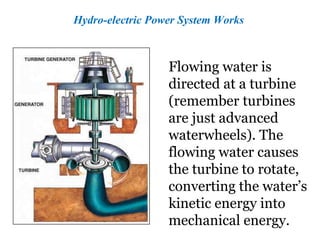
Hydro-electric Power System Works
Flowing water is
directed at a turbine
(remember turbines
are just advanced
waterwheels). The
flowing water causes
the turbine to rotate,
converting the water’s
kinetic energy into
mechanical energy.
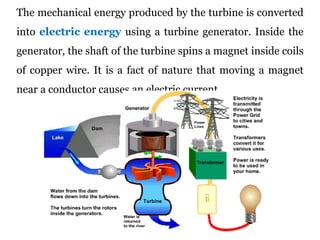
The mechanical energy produced by the turbine is converted
into electric energy using a turbine generator. Inside the
generator, the shaft of the turbine spins a magnet inside coils
of copper wire. It is a fact of nature that moving a magnet
near a conductor causes an electric current.
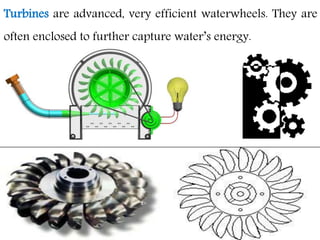
Turbines are advanced, very efficient waterwheels. They are
often enclosed to further capture water’s energy.
Site Selection
 Large catchment area,
 High average rain fall a favorable place for
constructing the reservoir,
 Cheap in cost and rocky in order to
withstand the weight of large building and
heavy machinery,
 Possibility of providing adequate
transportation facilities so that the necessary
equipment and machinery could be easily
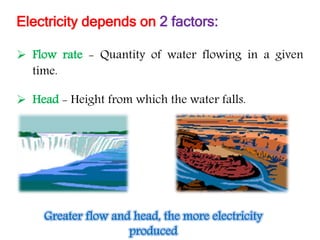
Electricity depends on 2 factors:
 Flow rate - Quantity of water flowing in a given
time.
 Head - Height from which the water falls.
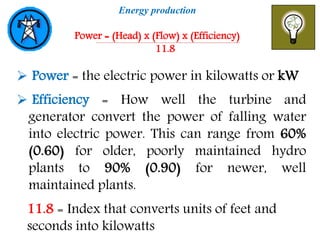
Energy production
Power = (Head) x (Flow) x (Efficiency)
11.8
 Power = the electric power in kilowatts or kW
 Efficiency = How well the turbine and
generator convert the power of falling water
into electric power. This can range from 60%
(0.60) for older, poorly maintained hydro
plants to 90% (0.90) for newer, well
maintained plants.
11.8 = Index that converts units of feet and
seconds into kilowatts
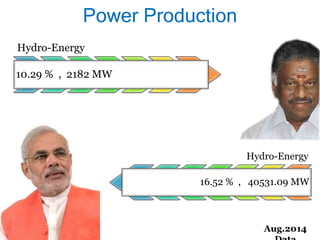
Power Production
Hydro-Energy
10.29 % , 2182 MW
Hydro-Energy
16.52 % , 40531.09 MW
Aug.2014
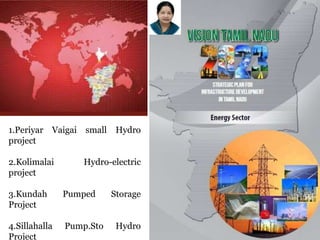
1.Periyar Vaigai small Hydro
project
2.Kolimalai Hydro-electric
project
3.Kundah Pumped Storage
Project
4.Sillahalla Pump.Sto Hydro
Project
Advantages
 Once a dam is constructed, elec.can be produced at a
constant rate.
 If electricity is not needed, the sluice gates can be shut,
stopping electricity generation. The water can be saved for
use another time when electricity demand is high.
 Dams are designed to last many decades and so can
contribute to the generation of electricity for many years.
 The lake's water can be used for irrigation purposes.
When in use, electricity produced by dam systems do not
Disadvantages
 Dams are extremely expensive to build and must be built to a very high
standard.
 The flooding of large areas of land means that the natural environment
is destroyed.
 People living in villages and towns that are in the valley to be flooded,
must move out. This means that they lose their farms and businesses.
 The building of large dams can cause serious geological damage. For,
the building of the Hoover Dam in the USA triggered a number of earth
quakes and has depressed the earth’s surface at its location.
 Dams built blocking the progress of a river in one country usually
means that the water supply from the same river in the following
country is out of their control. This can lead to serious problems
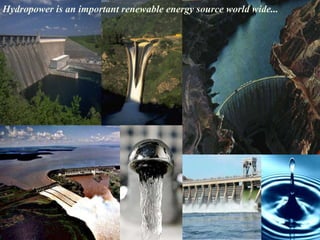
Hydropower is an important renewable energy source world wide...
The Future of Hydropower lies in technologies that are also Eco-
Friendly
Thank You

Hydro Power Plants

  • 1.
    Hydro Power Plants SWE352 (2+1) Hydrology & Water Resources S.Vignesh, BTG-12-037 Dr.A.Raviraj,Prof., WTC
  • 2.
    Introduction Hydro Power  Waterpower is one of the major sources of energy, form of energy renewable source. Hydro power generates from flowing water. Hydro Power Plants  Most efficient means of producing electric energy & do not create the air- pollution, the fuel falling water is not consumed. This favorable conditions to make hydroelectric projects attractive sources of electric power.
  • 3.
    Water cycle  Inthe water cycle, rivers are recharged in a continuous cycle. Because of the force of gravity, water flows from high points to low points. There is kinetic energy embodied in the flow of water.
  • 4.
    Because the watercycle is continuous, hydropower is a renewable energy source. Recycle
  • 5.
    Components  Dams –A dam is a structure constructed across the river at a suitable site to develop an artificial reservoir for the storage of water and to create head.  Waterway – A waterway is a passage through which water is carried from the storage reservoir to the power house.  Penstocks – It is used as waterways for conveying water from the reservoir to the power house.
  • 6.
     Forebay –To provide a small balancing storage upstream of the power house to store temporarily the water rejected by the plant when the load is reduced.  Intake structure – The water from the reservoir is let into the penstocks through intake structure.  Surge Tanks – It is cylindrical open-topped storage reservoir which is provided to protect the
  • 7.
    Power House A powerhouse of a hydroelectric scheme houses the various tools. The various tools are turbines, gates, governors, electrical equipment's include generators, transformers, switching equipment, transmission lines and structures, auxiliary electrical tools etc.
  • 8.
    Types I. Run-of-River Plants- The river’s natural flow and requires little. It may involve a diversion of portion of the stream through a canal. This systems are often low-head.
  • 9.
    II.Reservoir Plants  Theseare the HPP which take their flow from large storage reservoirs developed by constructing dams across rivers. Depending on the storage volume, these plants can hold over surplus water from the period when stream flow exceeds demand for utilization.
  • 10.
    III.Pumped Storage Plants Water from a lower reservoir to an upper reservoir at times when demand for electricity is low. During periods of high electrical demand, the water is released back to the lower reservoir to generate electricity.
  • 11.
    IV.Tidal Plants  Workson the principle that there is a rise in sea water during the high tide period and a fall during the low tide. Sea water rise and falls twice a day. The tidal range or the difference between the high and low tide levels is utilize to generate the power.
  • 12.
    Functional basis as, I.Base load Plants – Which are capable of substantially continuous operation in the base of load curve throughout the year II. Peak load Plants – One designed and constructed primarily for taking care of the peak-load of a power system. Basis of head water as, I. Low head Plants – Operating under a head of less than about 30m - 100 kW or less II. Medium head Plants – Operating under a head between 30 to 250m - 100 to 30,000 kW of electricity III. High head Plants - Operating under a head of more than
  • 13.
    Hydro-electric Power SystemWorks Flowing water is directed at a turbine (remember turbines are just advanced waterwheels). The flowing water causes the turbine to rotate, converting the water’s kinetic energy into mechanical energy.
  • 14.
    The mechanical energyproduced by the turbine is converted into electric energy using a turbine generator. Inside the generator, the shaft of the turbine spins a magnet inside coils of copper wire. It is a fact of nature that moving a magnet near a conductor causes an electric current.
  • 17.
    Turbines are advanced,very efficient waterwheels. They are often enclosed to further capture water’s energy.
  • 18.
    Site Selection  Largecatchment area,  High average rain fall a favorable place for constructing the reservoir,  Cheap in cost and rocky in order to withstand the weight of large building and heavy machinery,  Possibility of providing adequate transportation facilities so that the necessary equipment and machinery could be easily
  • 19.
    Electricity depends on2 factors:  Flow rate - Quantity of water flowing in a given time.  Head - Height from which the water falls.
  • 20.
    Energy production Power =(Head) x (Flow) x (Efficiency) 11.8  Power = the electric power in kilowatts or kW  Efficiency = How well the turbine and generator convert the power of falling water into electric power. This can range from 60% (0.60) for older, poorly maintained hydro plants to 90% (0.90) for newer, well maintained plants. 11.8 = Index that converts units of feet and seconds into kilowatts
  • 21.
    Power Production Hydro-Energy 10.29 %, 2182 MW Hydro-Energy 16.52 % , 40531.09 MW Aug.2014
  • 22.
    1.Periyar Vaigai smallHydro project 2.Kolimalai Hydro-electric project 3.Kundah Pumped Storage Project 4.Sillahalla Pump.Sto Hydro Project
  • 23.
    Advantages  Once adam is constructed, elec.can be produced at a constant rate.  If electricity is not needed, the sluice gates can be shut, stopping electricity generation. The water can be saved for use another time when electricity demand is high.  Dams are designed to last many decades and so can contribute to the generation of electricity for many years.  The lake's water can be used for irrigation purposes. When in use, electricity produced by dam systems do not
  • 24.
    Disadvantages  Dams areextremely expensive to build and must be built to a very high standard.  The flooding of large areas of land means that the natural environment is destroyed.  People living in villages and towns that are in the valley to be flooded, must move out. This means that they lose their farms and businesses.  The building of large dams can cause serious geological damage. For, the building of the Hoover Dam in the USA triggered a number of earth quakes and has depressed the earth’s surface at its location.  Dams built blocking the progress of a river in one country usually means that the water supply from the same river in the following country is out of their control. This can lead to serious problems
  • 25.
    Hydropower is animportant renewable energy source world wide...
  • 26.
    The Future ofHydropower lies in technologies that are also Eco- Friendly
  • 27.