COAL GASIFICATION
GUIDED BY SUBMITTED BY
Asst. Prof. - T.S BARIK SIMANCHAL SABAT
Although underground coal gasification is still in
development, it is also supposed to be a very perspective technology.
Be a very perspective technology. applied to many branches of
industry such as chemistry, metallurgy and energy production,
provided that different requirements about its parameters will be
fulfilled. Many characteristics of product gas are strongly connected
with its composition. Therefore, problem of optimization of UCG
technology becomes an especially important issue. In context of using
syngas for particular aims, earlier mentioned optimization could be
understood as a choice of the best scope of input parameters and
appropriate proceeding of process.
The work presented was concentrated on application of
product gas in energeticprocesses, where substrates should be as
caloric as possible. Therefore thesis about possibilityof maximization
of syngas heating value via appropriate choice of proportions of
convertingmedium components was postulated.
What is Gasification
 Gasification is a process that converts
carbonaceous material, Such as fossil fuels and
biomass in to a mixture of mostly hydrogen and
carbon monoxide( called Synthesis gas & Syngas)
 The syngas can be burned as a fuel or
processed to produced chemical and other fuels
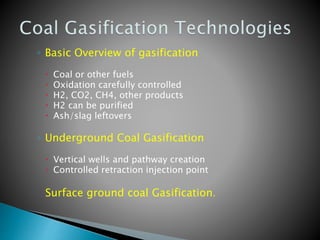
◦ Basic Overview of gasification
 Coal or other fuels
 Oxidation carefully controlled
 H2, CO2, CH4, other products
 H2 can be purified
 Ash/slag leftovers
◦ Underground Coal Gasification
 Vertical wells and pathway creation
 Controlled retraction injection point
Surface ground coal Gasification.
COAL GASIFICATION
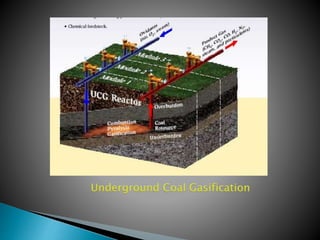
UNDERGROUND COAL GASIFICATION (UCG) -PROCESS
• Under the process of UCG, gasification of coal happens insitu by controlled
burning.
• About 350 m3 gas can be produced per tonne of coal.
• Bye products of significant commercial value will be hydrocarbons, phenols,
anhydrous NH3and clean water
• UCG overcomes hazards of underground and open cast mining operations.
• In UCG process, ash/ slug removal is not required as they remain in the
cavities.
• Cost of production for this energy resource could be as low as US$ 1.0-1.5
per MM.
ADVANTAGES OF UGC
• Tapping energy from vast coal reserves which are not
commercially viable to mine.
• Back of the envelope calculations indicate huge energy
potential of about 1000 MW power generation from a small
block of 25 sq.kms, having 10 m thick coal seam.
• Increases worker safety as no mining operations involved.
• Low environmental impact.
 No atmospheric pollution. Coal mines involves coal dust
pollution.
 No appreciable change in landscape .
 Less subsidence than conventional mining
 Less Resettlement and Rehabilitation (R&R) issues
 No surface disposal of ash and coal tailings
POTENTIAL END USE MARKETS FOR UCG
RESOURCES INSITU
UCG
AIR INJECTION
STEAM / OXYGEN
INJECTION
Nitrogen50% CO, H2, CH4,
CO2100-180 BTU/ SCF
COAL
100% CO, H2, CH4, CO2200-
300 BTU/ SCF
Electrical power generation
&Industrial Fuel100-180 BTU / SCF
CO2Removal CO shift and
Methanation
Synthesis
Gas(Chemical
Feedstock)300-400
BTU / SCF
]
Synthetic Pipeline
Gas900 -1000 BTU /
SCF50
SURFACE GASIFICATION
 Developed in 1800s to produce town gas and city lighting.
 Renewed interest due to rise in oil prices, depleting oil &gas reserves
and IGCC technology
 Coal is exposed to hot steam and controlled amounts of air or oxygen
under high temperatures (250°-900°C) and pressures.
 Produces Syngas, hydrocarbons, water vapours, anhydrous ammonia
and phenols. The gas comprises of N2, CO2, CO, H2, CH4, O2, etc•
 Environmental friendly
 Reduced greenhouse gases
e.g. CO2 can be captured easily and at lower costs.
End Uses
 Substitute for natural gas
 Power generation using low Btu gas as fuel
 Manufacture of chemicals and fertilizers
 Conversion to Liquids (CTL)
After cleanup and removal of impurities, Syngas can be
used for :
 Electric Power Generation
 Steam Generation
 Heating process
 Chemical Production
 Liquid fuels Production
CRITICAL ISSUES
•Technology Sourcing for UCG
•Policy & Regulation for UCG/SCG
 Under active consideration by the
(Ministry of Coal)
TECHNOLOGY SOURCING FOR UCG
UCG Technology development in USA
 USA witnessed major UCG testing activity in the 1960’s 70’s and
80’s
 Number of UCG pilot tests were undertaken through the joint efforts
of the industry, research institutes and government agencies to
study the economic viability and environmental acceptability of UCG
 The latest field experiment was a joint industry –DoE UCG test
conducted near Hanna, Wyoming in 1987-88, known as Rocky
Mountain 1 (RM 1). Based on results of this pilot demonstration:
 Cost for the UCG gas produced via directionally drilled wells, developed (US $
2.20/MMBtu)
 UCG projects can be undertaken in an environmentally acceptable manner
 The characteristics of Hanna coals that have been gasified,
havesimilarity to the low rank Indian lignites
 UCG interest has been renewed . Pilot projects are being plannedin
the next 2 yearsCOAL
POLICY & REGULATION
 Regulatory frame work: In India, present regulatory
framework does not cover grant of Prospecting Licenses
(PL) or Mining Leases (ML) for the purposes of
underground or surface gasification of coal
 Area overlap: Some of coal/lignite areas suitable for UCG,
overlap the deeper oil & gas PELs (Barmer basin Rajasthan
and Cambay basin in Gujarat)
Coverage under the existing coal mining laws•
 Under the existing Coal Mines (Nationalisation) Act 1973, as amended till
date, grant of areas to companies other than PSUs is allowed for captive
consumption of coal, for
 the production of iron and steel
 generation of power
 washing of coal obtained from a mine
 production of cement,
ADVANTAGES
 One of the most abundant energy sources
 it can be burned directly, transformed into liquid, gas, or feedstock
 Inexpensive compared to other energy sources
 Good for recreational use (charcoal for barbequing, drawing)
 Can be used to produce ultra-clean fuel
 Can lower overall amount of greenhouse gases ( liquification or
gasification)
 Leading source of electricity today
 Reduces dependence on foreign oil
 By-product of burning (ash) can be used for concrete and roadways
DIS ADVANTAGES
 Source of pollution emits waste, SO2 , Nitrogen Oxide, ash
 Coal mining mars the landscape
 Liquidification , gasification require large amounts of water
 Physical transport is difficult
 Technology to process to liquid or gas is not fully developed
 Solid is more difficult to burn than liquid or gases
 Not renewable in this millennium
 High water content reduces heating value
 Dirty industry—leads to health problems
 Dirty coal creates more pollution and emissions
CONCLUSIONS
 Both Underground and Surface gasification are proven
technologies.
 Technologies can be sourced for both underground and
surface gasification of coal with the joint efforts of Indo-
US working group on coal.
 According to coal mineing act the captive plant are can
produced syngas .
THANK YOU
Presented By
SIMANCHAL SABAT
13ME86
1301301162
JULY/AUG--2016

Coal gasification

  • 1.
    COAL GASIFICATION GUIDED BYSUBMITTED BY Asst. Prof. - T.S BARIK SIMANCHAL SABAT
  • 2.
    Although underground coalgasification is still in development, it is also supposed to be a very perspective technology. Be a very perspective technology. applied to many branches of industry such as chemistry, metallurgy and energy production, provided that different requirements about its parameters will be fulfilled. Many characteristics of product gas are strongly connected with its composition. Therefore, problem of optimization of UCG technology becomes an especially important issue. In context of using syngas for particular aims, earlier mentioned optimization could be understood as a choice of the best scope of input parameters and appropriate proceeding of process. The work presented was concentrated on application of product gas in energeticprocesses, where substrates should be as caloric as possible. Therefore thesis about possibilityof maximization of syngas heating value via appropriate choice of proportions of convertingmedium components was postulated.
  • 4.
    What is Gasification Gasification is a process that converts carbonaceous material, Such as fossil fuels and biomass in to a mixture of mostly hydrogen and carbon monoxide( called Synthesis gas & Syngas)  The syngas can be burned as a fuel or processed to produced chemical and other fuels
  • 5.
    ◦ Basic Overviewof gasification  Coal or other fuels  Oxidation carefully controlled  H2, CO2, CH4, other products  H2 can be purified  Ash/slag leftovers ◦ Underground Coal Gasification  Vertical wells and pathway creation  Controlled retraction injection point Surface ground coal Gasification.
  • 6.
    COAL GASIFICATION UNDERGROUND COALGASIFICATION (UCG) -PROCESS • Under the process of UCG, gasification of coal happens insitu by controlled burning. • About 350 m3 gas can be produced per tonne of coal. • Bye products of significant commercial value will be hydrocarbons, phenols, anhydrous NH3and clean water • UCG overcomes hazards of underground and open cast mining operations. • In UCG process, ash/ slug removal is not required as they remain in the cavities. • Cost of production for this energy resource could be as low as US$ 1.0-1.5 per MM.
  • 8.
    ADVANTAGES OF UGC •Tapping energy from vast coal reserves which are not commercially viable to mine. • Back of the envelope calculations indicate huge energy potential of about 1000 MW power generation from a small block of 25 sq.kms, having 10 m thick coal seam. • Increases worker safety as no mining operations involved. • Low environmental impact.  No atmospheric pollution. Coal mines involves coal dust pollution.  No appreciable change in landscape .  Less subsidence than conventional mining  Less Resettlement and Rehabilitation (R&R) issues  No surface disposal of ash and coal tailings
  • 9.
    POTENTIAL END USEMARKETS FOR UCG RESOURCES INSITU UCG AIR INJECTION STEAM / OXYGEN INJECTION Nitrogen50% CO, H2, CH4, CO2100-180 BTU/ SCF COAL 100% CO, H2, CH4, CO2200- 300 BTU/ SCF Electrical power generation &Industrial Fuel100-180 BTU / SCF CO2Removal CO shift and Methanation Synthesis Gas(Chemical Feedstock)300-400 BTU / SCF ] Synthetic Pipeline Gas900 -1000 BTU / SCF50
  • 10.
    SURFACE GASIFICATION  Developedin 1800s to produce town gas and city lighting.  Renewed interest due to rise in oil prices, depleting oil &gas reserves and IGCC technology  Coal is exposed to hot steam and controlled amounts of air or oxygen under high temperatures (250°-900°C) and pressures.  Produces Syngas, hydrocarbons, water vapours, anhydrous ammonia and phenols. The gas comprises of N2, CO2, CO, H2, CH4, O2, etc•  Environmental friendly  Reduced greenhouse gases e.g. CO2 can be captured easily and at lower costs. End Uses  Substitute for natural gas  Power generation using low Btu gas as fuel  Manufacture of chemicals and fertilizers  Conversion to Liquids (CTL)
  • 11.
    After cleanup andremoval of impurities, Syngas can be used for :  Electric Power Generation  Steam Generation  Heating process  Chemical Production  Liquid fuels Production
  • 13.
    CRITICAL ISSUES •Technology Sourcingfor UCG •Policy & Regulation for UCG/SCG  Under active consideration by the (Ministry of Coal)
  • 14.
    TECHNOLOGY SOURCING FORUCG UCG Technology development in USA  USA witnessed major UCG testing activity in the 1960’s 70’s and 80’s  Number of UCG pilot tests were undertaken through the joint efforts of the industry, research institutes and government agencies to study the economic viability and environmental acceptability of UCG  The latest field experiment was a joint industry –DoE UCG test conducted near Hanna, Wyoming in 1987-88, known as Rocky Mountain 1 (RM 1). Based on results of this pilot demonstration:  Cost for the UCG gas produced via directionally drilled wells, developed (US $ 2.20/MMBtu)  UCG projects can be undertaken in an environmentally acceptable manner  The characteristics of Hanna coals that have been gasified, havesimilarity to the low rank Indian lignites  UCG interest has been renewed . Pilot projects are being plannedin the next 2 yearsCOAL
  • 15.
    POLICY & REGULATION Regulatory frame work: In India, present regulatory framework does not cover grant of Prospecting Licenses (PL) or Mining Leases (ML) for the purposes of underground or surface gasification of coal  Area overlap: Some of coal/lignite areas suitable for UCG, overlap the deeper oil & gas PELs (Barmer basin Rajasthan and Cambay basin in Gujarat) Coverage under the existing coal mining laws•  Under the existing Coal Mines (Nationalisation) Act 1973, as amended till date, grant of areas to companies other than PSUs is allowed for captive consumption of coal, for  the production of iron and steel  generation of power  washing of coal obtained from a mine  production of cement,
  • 16.
    ADVANTAGES  One ofthe most abundant energy sources  it can be burned directly, transformed into liquid, gas, or feedstock  Inexpensive compared to other energy sources  Good for recreational use (charcoal for barbequing, drawing)  Can be used to produce ultra-clean fuel  Can lower overall amount of greenhouse gases ( liquification or gasification)  Leading source of electricity today  Reduces dependence on foreign oil  By-product of burning (ash) can be used for concrete and roadways
  • 17.
    DIS ADVANTAGES  Sourceof pollution emits waste, SO2 , Nitrogen Oxide, ash  Coal mining mars the landscape  Liquidification , gasification require large amounts of water  Physical transport is difficult  Technology to process to liquid or gas is not fully developed  Solid is more difficult to burn than liquid or gases  Not renewable in this millennium  High water content reduces heating value  Dirty industry—leads to health problems  Dirty coal creates more pollution and emissions
  • 18.
    CONCLUSIONS  Both Undergroundand Surface gasification are proven technologies.  Technologies can be sourced for both underground and surface gasification of coal with the joint efforts of Indo- US working group on coal.  According to coal mineing act the captive plant are can produced syngas .
  • 19.
    THANK YOU Presented By SIMANCHALSABAT 13ME86 1301301162 JULY/AUG--2016