Direct and Bending stresses
Strength of Materials - AST 201 (2+1)
Introduction
Whenever a body is subjected to an axial tension or
compression, a direct stress comes into play at every
section of body. We also know that whenever a body
is subjected to a bending moment a bending moment
a bending stress comes into play .
A little consideration will show that
since both these stresses act normal to a cross
section, therefore the two stresses may be
algebraically added into a single resultant stress.
Stress
• Every material is elastic in nature. That is why,
whenever some external system of forces acts on a
body, it undergoes some deformation. As the body
undergoes deformation, its molecules set up some
resistance to deformation. This resistance per unit
area to deformation is known as stress.
• σ = P/A
• Where, P - load or force acting on the body, and
A - Cross-sectional area of the body.
• In S.I system, the unit of stress is Pascal (Pa) which
is equal to 1 N/m2
Combined Stress
• We have studied a number of separate situations
(tension, compression, direct, bending, torsion,
pressure in cylinders and spheres.)
• In order to find the combined effect we have to look
at an element of material at particular locations,
where both effects determine the stresses. We
calculate the stresses as though they occurred
separately, and then combine them to find the
overall effect expressed as Principle stresses.
 Torsion and Bending
Tension and Compression
Structures Lab
Applying Loads
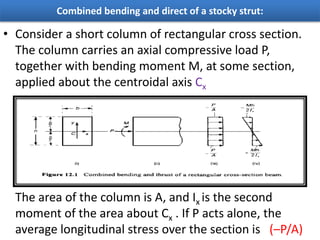
Combined bending and direct of a stocky strut:
• Consider a short column of rectangular cross section.
The column carries an axial compressive load P,
together with bending moment M, at some section,
applied about the centroidal axis Cx
The area of the column is A, and Ix is the second
moment of the area about Cx . If P acts alone, the
average longitudinal stress over the section is (–P/A)
The stress being compressive. If the couple M acts alone, and if the
material remains elastic, the longitudinal stress in any fiber a distance
from Cx is (-My/Iy)
Clearly the greatest compressive stress occurs in the upper extreme
fibers, and has the value,
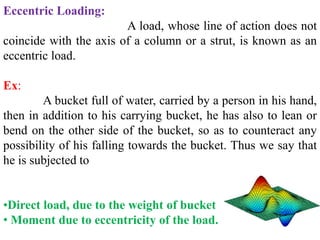
Eccentric Loading:
A load, whose line of action does not
coincide with the axis of a column or a strut, is known as an
eccentric load.
Ex:
A bucket full of water, carried by a person in his hand,
then in addition to his carrying bucket, he has also to lean or
bend on the other side of the bucket, so as to counteract any
possibility of his falling towards the bucket. Thus we say that
he is subjected to
•Direct load, due to the weight of bucket
• Moment due to eccentricity of the load.
Beam Mode
•
Limit of Eccentricity
• When an eccentric load is acting on a column, it
produces direct stress as well as bending stress. On
one side of the neutral axis there is maximum stress
and on the other side of the neutral axis there is a
minimum stress.
• A little consideration will show that so long as the
bending stress remains less than direct stress, the
resultant stress is compressive. If the bending stress
is equal to the direct stress, then there will be a
tensile stress on one side.
….continue
• Though cement concrete can take up a small tensile
stress, yet it is desirable that no tensile stress
should come into play
e ≤ Z/A
• It means that for tensile condition, the eccentricity
should be less than (Z/A) or equal to (Z/A). Now we
shall discuss the limit for eccentricity in the
following cases,
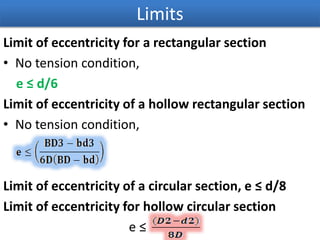
Limits
Limit of eccentricity for a rectangular section
• No tension condition,
e ≤ d/6
Limit of eccentricity of a hollow rectangular section
• No tension condition,
Limit of eccentricity of a circular section, e ≤ d/8
Limit of eccentricity for hollow circular section
e ≤
E - References:
• www.cenfile.com
• www.ebookee.com/Mechanics-and-strengh-of-
materials_67103.html
• www.typesofstresses.com
THANK YOU
Submitted By,
S.Vignesh
BTG-12-0-37

Direct and Bending stresses

  • 1.
    Direct and Bendingstresses Strength of Materials - AST 201 (2+1)
  • 2.
    Introduction Whenever a bodyis subjected to an axial tension or compression, a direct stress comes into play at every section of body. We also know that whenever a body is subjected to a bending moment a bending moment a bending stress comes into play . A little consideration will show that since both these stresses act normal to a cross section, therefore the two stresses may be algebraically added into a single resultant stress.
  • 3.
    Stress • Every materialis elastic in nature. That is why, whenever some external system of forces acts on a body, it undergoes some deformation. As the body undergoes deformation, its molecules set up some resistance to deformation. This resistance per unit area to deformation is known as stress. • σ = P/A • Where, P - load or force acting on the body, and A - Cross-sectional area of the body. • In S.I system, the unit of stress is Pascal (Pa) which is equal to 1 N/m2
  • 4.
    Combined Stress • Wehave studied a number of separate situations (tension, compression, direct, bending, torsion, pressure in cylinders and spheres.) • In order to find the combined effect we have to look at an element of material at particular locations, where both effects determine the stresses. We calculate the stresses as though they occurred separately, and then combine them to find the overall effect expressed as Principle stresses.
  • 5.
  • 6.
  • 7.
  • 8.
    Combined bending anddirect of a stocky strut: • Consider a short column of rectangular cross section. The column carries an axial compressive load P, together with bending moment M, at some section, applied about the centroidal axis Cx The area of the column is A, and Ix is the second moment of the area about Cx . If P acts alone, the average longitudinal stress over the section is (–P/A)
  • 9.
    The stress beingcompressive. If the couple M acts alone, and if the material remains elastic, the longitudinal stress in any fiber a distance from Cx is (-My/Iy) Clearly the greatest compressive stress occurs in the upper extreme fibers, and has the value,
  • 10.
    Eccentric Loading: A load,whose line of action does not coincide with the axis of a column or a strut, is known as an eccentric load. Ex: A bucket full of water, carried by a person in his hand, then in addition to his carrying bucket, he has also to lean or bend on the other side of the bucket, so as to counteract any possibility of his falling towards the bucket. Thus we say that he is subjected to •Direct load, due to the weight of bucket • Moment due to eccentricity of the load.
  • 11.
  • 12.
    Limit of Eccentricity •When an eccentric load is acting on a column, it produces direct stress as well as bending stress. On one side of the neutral axis there is maximum stress and on the other side of the neutral axis there is a minimum stress. • A little consideration will show that so long as the bending stress remains less than direct stress, the resultant stress is compressive. If the bending stress is equal to the direct stress, then there will be a tensile stress on one side.
  • 13.
    ….continue • Though cementconcrete can take up a small tensile stress, yet it is desirable that no tensile stress should come into play e ≤ Z/A • It means that for tensile condition, the eccentricity should be less than (Z/A) or equal to (Z/A). Now we shall discuss the limit for eccentricity in the following cases,
  • 14.
    Limits Limit of eccentricityfor a rectangular section • No tension condition, e ≤ d/6 Limit of eccentricity of a hollow rectangular section • No tension condition, Limit of eccentricity of a circular section, e ≤ d/8 Limit of eccentricity for hollow circular section e ≤
  • 15.
    E - References: •www.cenfile.com • www.ebookee.com/Mechanics-and-strengh-of- materials_67103.html • www.typesofstresses.com
  • 16.