CONTENTS
What is Coal? Origin of Coal
Reservoir of Coal
in Pakistan
Classification on the
basis of rank of Coal
Classification on
the basis of
Proximate
Analysis
Classification
involving both
Proximate
analysis and
Calorific value
Basis for Coal Conclusion
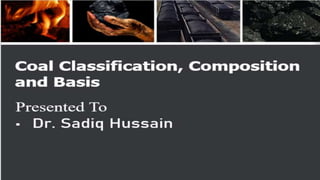
WHAT IS COAL?
Coal is a non-renewable solid fossil fuel comprising
of black to brownish sedimentary rock with a high
amount of carbon and hydrocarbons.
ORIGIN OF COAL
 Coal is called fossil fuel because it was formed from the remains of
vegetation that grew on as long as 400 million years ago.
 Most of our Coal was formed 300 million years ago. As plants and
trees died, physical and chemical alteration of plant material started.
 The plant debris accumulated in various wet environments and buried
by sand, silt and mud.
 As a result of temperature and pressure, metamorphosis occurs to
produce various types of coal.
RESERVOIR OF COAL IN
PAKISTAN
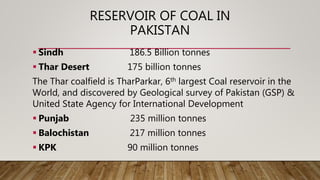
 Sindh 186.5 Billion tonnes
 Thar Desert 175 billion tonnes
The Thar coalfield is TharParkar, 6th largest Coal reservoir in the
World, and discovered by Geological survey of Pakistan (GSP) &
United State Agency for International Development
 Punjab 235 million tonnes
 Balochistan 217 million tonnes
 KPK 90 million tonnes
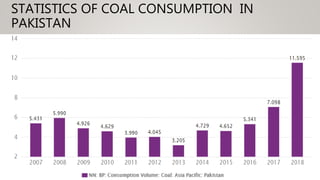
STATISTICS OF COAL CONSUMPTION IN
PAKISTAN
CLASSICATION ON THE BASIS OF
BURNING CHARACTERISTICS OF COAL
This is the oldest classification based on the visual observations
and the burning characteristics of Coal.
According to this Coal is classified into;
1. Peat
2. Lignite
3. Bituminous
4. Sub-Bituminous
5. Anthracite
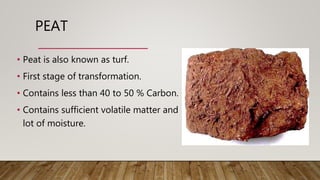
PEAT
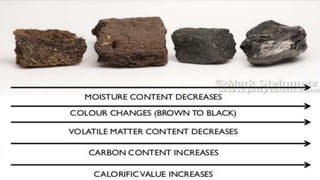
• Peat is also known as turf.
• First stage of transformation.
• Contains less than 40 to 50 % Carbon.
• Contains sufficient volatile matter and
lot of moisture.
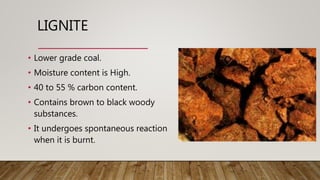
LIGNITE
• Lower grade coal.
• Moisture content is High.
• 40 to 55 % carbon content.
• Contains brown to black woody
substances.
• It undergoes spontaneous reaction
when it is burnt.
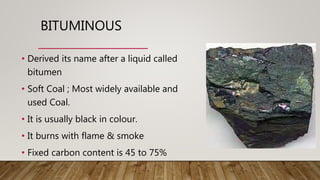
BITUMINOUS
• Derived its name after a liquid called
bitumen
• Soft Coal ; Most widely available and
used Coal.
• It is usually black in colour.
• It burns with flame & smoke
• Fixed carbon content is 45 to 75%
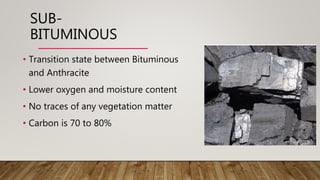
SUB-
BITUMINOUS
• Transition state between Bituminous
and Anthracite
• Lower oxygen and moisture content
• No traces of any vegetation matter
• Carbon is 70 to 80%
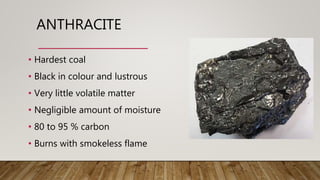
ANTHRACITE
• Hardest coal
• Black in colour and lustrous
• Very little volatile matter
• Negligible amount of moisture
• 80 to 95 % carbon
• Burns with smokeless flame
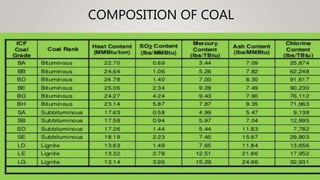
COMPOSITION OF COAL
CLASSIFICATION BASED ON PROXIMATE
ANALYSIS
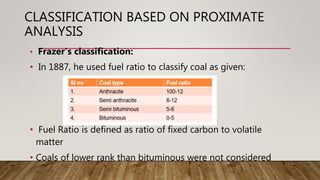
• Frazer’s classification:
• In 1887, he used fuel ratio to classify coal as given:
• Fuel Ratio is defined as ratio of fixed carbon to volatile
matter
• Coals of lower rank than bituminous were not considered
CLASSIFICATION INVOLVING BOTH PROXIMATE
ANALYSIS AND CALORIFIC VALUE
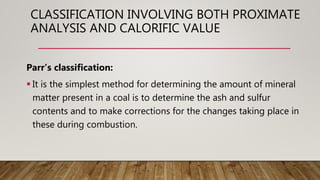
Parr’s classification:
 It is the simplest method for determining the amount of mineral
matter present in a coal is to determine the ash and sulfur
contents and to make corrections for the changes taking place in
these during combustion.
CLASSIFICATION INVOLVING BOTH PROXIMATE
ANALYSIS AND CALORIFIC VALUE
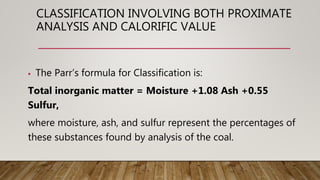
 The Parr’s formula for Classification is:
Total inorganic matter = Moisture +1.08 Ash +0.55
Sulfur,
where moisture, ash, and sulfur represent the percentages of
these substances found by analysis of the coal.
BASIS FOR COAL
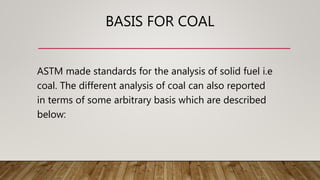
ASTM made standards for the analysis of solid fuel i.e
coal. The different analysis of coal can also reported
in terms of some arbitrary basis which are described
below:
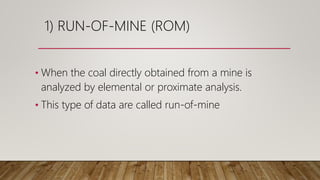
1) RUN-OF-MINE (ROM)
• When the coal directly obtained from a mine is
analyzed by elemental or proximate analysis.
• This type of data are called run-of-mine
2) AS-RECEIVED
• After extraction from mine, coal is transported to the
receiver.
• The analysis data obtained at this point is called as-
received.
3) AIR-DRIED
• When analytical data are collected after air drying the
coal at a standard condition of 400oC and 60% relative
humidity,
• The data are called at air-dried basis.
4) DRY
• When the effect of moisture content is removed
from the analytical data.
• After this step coal is said as dry basis.
5) DRY AND ASH-FREE (D.A.F)
• When the data are reported excluding the effect of
ash content, then it is said d.a.f basis
6) DRY AND MINERAL MATTER
FREE (D.M.M.F)
• When effects of both moisture and mineral matter are
removed from the analytical data, then it is reported as
d.m.m.f basis. This is the data of pure coal only.
7) MOIST-MINERAL-MATTER-FREE
• This is the basis where the effect of mineral matter is
excluded, only pure coal and moisture are taken to
report the data.
CONCLUSION
From the above discussion, it is concluded that
coal is an economical solid fuel which can be
classified into many types and composition.
Moreover, we can decide after that which basis
is used for Coal.
Coal Classification,composition & basis

Coal Classification,composition & basis

  • 4.
    CONTENTS What is Coal?Origin of Coal Reservoir of Coal in Pakistan Classification on the basis of rank of Coal Classification on the basis of Proximate Analysis Classification involving both Proximate analysis and Calorific value Basis for Coal Conclusion
  • 5.
    WHAT IS COAL? Coalis a non-renewable solid fossil fuel comprising of black to brownish sedimentary rock with a high amount of carbon and hydrocarbons.
  • 6.
    ORIGIN OF COAL Coal is called fossil fuel because it was formed from the remains of vegetation that grew on as long as 400 million years ago.  Most of our Coal was formed 300 million years ago. As plants and trees died, physical and chemical alteration of plant material started.  The plant debris accumulated in various wet environments and buried by sand, silt and mud.  As a result of temperature and pressure, metamorphosis occurs to produce various types of coal.
  • 8.
    RESERVOIR OF COALIN PAKISTAN  Sindh 186.5 Billion tonnes  Thar Desert 175 billion tonnes The Thar coalfield is TharParkar, 6th largest Coal reservoir in the World, and discovered by Geological survey of Pakistan (GSP) & United State Agency for International Development  Punjab 235 million tonnes  Balochistan 217 million tonnes  KPK 90 million tonnes
  • 10.
    STATISTICS OF COALCONSUMPTION IN PAKISTAN
  • 11.
    CLASSICATION ON THEBASIS OF BURNING CHARACTERISTICS OF COAL This is the oldest classification based on the visual observations and the burning characteristics of Coal. According to this Coal is classified into; 1. Peat 2. Lignite 3. Bituminous 4. Sub-Bituminous 5. Anthracite
  • 12.
    PEAT • Peat isalso known as turf. • First stage of transformation. • Contains less than 40 to 50 % Carbon. • Contains sufficient volatile matter and lot of moisture.
  • 13.
    LIGNITE • Lower gradecoal. • Moisture content is High. • 40 to 55 % carbon content. • Contains brown to black woody substances. • It undergoes spontaneous reaction when it is burnt.
  • 14.
    BITUMINOUS • Derived itsname after a liquid called bitumen • Soft Coal ; Most widely available and used Coal. • It is usually black in colour. • It burns with flame & smoke • Fixed carbon content is 45 to 75%
  • 15.
    SUB- BITUMINOUS • Transition statebetween Bituminous and Anthracite • Lower oxygen and moisture content • No traces of any vegetation matter • Carbon is 70 to 80%
  • 16.
    ANTHRACITE • Hardest coal •Black in colour and lustrous • Very little volatile matter • Negligible amount of moisture • 80 to 95 % carbon • Burns with smokeless flame
  • 18.
  • 19.
    CLASSIFICATION BASED ONPROXIMATE ANALYSIS • Frazer’s classification: • In 1887, he used fuel ratio to classify coal as given: • Fuel Ratio is defined as ratio of fixed carbon to volatile matter • Coals of lower rank than bituminous were not considered
  • 20.
    CLASSIFICATION INVOLVING BOTHPROXIMATE ANALYSIS AND CALORIFIC VALUE Parr’s classification:  It is the simplest method for determining the amount of mineral matter present in a coal is to determine the ash and sulfur contents and to make corrections for the changes taking place in these during combustion.
  • 21.
    CLASSIFICATION INVOLVING BOTHPROXIMATE ANALYSIS AND CALORIFIC VALUE  The Parr’s formula for Classification is: Total inorganic matter = Moisture +1.08 Ash +0.55 Sulfur, where moisture, ash, and sulfur represent the percentages of these substances found by analysis of the coal.
  • 22.
    BASIS FOR COAL ASTMmade standards for the analysis of solid fuel i.e coal. The different analysis of coal can also reported in terms of some arbitrary basis which are described below:
  • 23.
    1) RUN-OF-MINE (ROM) •When the coal directly obtained from a mine is analyzed by elemental or proximate analysis. • This type of data are called run-of-mine
  • 24.
    2) AS-RECEIVED • Afterextraction from mine, coal is transported to the receiver. • The analysis data obtained at this point is called as- received.
  • 25.
    3) AIR-DRIED • Whenanalytical data are collected after air drying the coal at a standard condition of 400oC and 60% relative humidity, • The data are called at air-dried basis.
  • 26.
    4) DRY • Whenthe effect of moisture content is removed from the analytical data. • After this step coal is said as dry basis.
  • 27.
    5) DRY ANDASH-FREE (D.A.F) • When the data are reported excluding the effect of ash content, then it is said d.a.f basis
  • 28.
    6) DRY ANDMINERAL MATTER FREE (D.M.M.F) • When effects of both moisture and mineral matter are removed from the analytical data, then it is reported as d.m.m.f basis. This is the data of pure coal only.
  • 29.
    7) MOIST-MINERAL-MATTER-FREE • Thisis the basis where the effect of mineral matter is excluded, only pure coal and moisture are taken to report the data.
  • 30.
    CONCLUSION From the abovediscussion, it is concluded that coal is an economical solid fuel which can be classified into many types and composition. Moreover, we can decide after that which basis is used for Coal.