Digital disruption is the change that occurs when new digital
technologies and business models affect the value proposition of
existing goods and services.
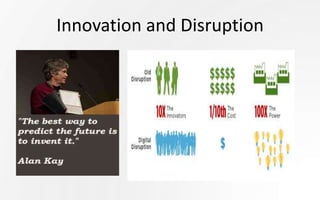
Innovation and Disruption
The worlds most popular media
owner creates no content
The most valuable retailer has no
inventory
The world’s largest accommodation
provider owns no real estate.
Largest telecommunication company
owns no infrastructure
Fastest growing banks have no actual
money
Independent Software vendors do
not write any code 3
4
IN 2015, THE WORLD’S
LARGEST TAXI COMPANY
OWNS NO VEHICLES?
[Personal Transportation Industry - TAXI]
License Fare
Taxi supply Regulations
Protective! Costly! No invest!
Gov. Taxi Firm
Low customer satisfaction
A study on modern age Business
strategy
Dhruvajyoti Roy
What is the
concept behind
Uber?
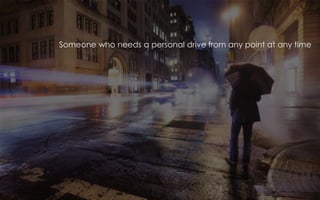
Someone who needs a personal drive from any point at any time
Someone who wants to have a side business, or a full-time business,
or a revenue generation hobby by driving people for money
UBER connects these two needs
in simple, fast, and predictable way
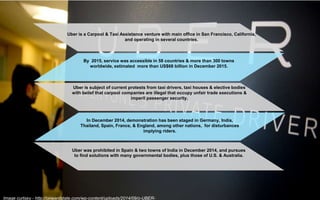
Uber is a Carpool & Taxi Assistance venture with main office in San Francisco, California,
and operating in several countries.
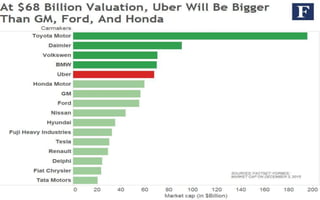
By 2015, service was accessible in 58 countries & more than 300 towns
worldwide, estimated more than US$68 billion in December 2015.
Uber is subject of current protests from taxi drivers, taxi houses & elective bodies
with belief that carpool companies are illegal that occupy unfair trade executions &
imperil passenger security.
In December 2014, demonstration has been staged in Germany, India,
Thailand, Spain, France, & England, among other nations, for disturbances
implying riders.
Uber was prohibited in Spain & two towns of India in December 2014, and pursues
to find solutions with many governmental bodies, plus those of U.S. & Australia.
Image curtsey - http://onwardstate.com/wp-content/uploads/2014/09/o-UBER-
UBER
Marketing Strategy
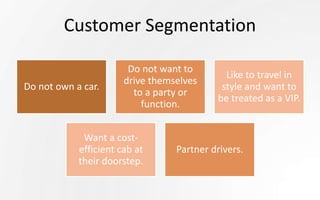
Customer Segmentation
Do not own a car.
Do not want to
drive themselves
to a party or
function.
Like to travel in
style and want to
be treated as a VIP.
Want a cost-
efficient cab at
their doorstep.
Partner drivers.
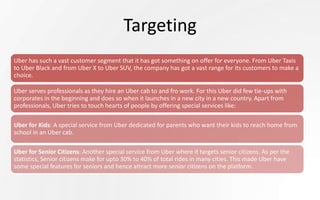
Targeting
Uber has such a vast customer segment that it has got something on offer for everyone. From Uber Taxis
to Uber Black and from Uber X to Uber SUV, the company has got a vast range for its customers to make a
choice.
Uber serves professionals as they hire an Uber cab to and fro work. For this Uber did few tie-ups with
corporates in the beginning and does so when it launches in a new city in a new country. Apart from
professionals, Uber tries to touch hearts of people by offering special services like:
Uber for Kids: A special service from Uber dedicated for parents who want their kids to reach home from
school in an Uber cab.
Uber for Senior Citizens: Another special service from Uber where it targets senior citizens. As per the
statistics, Senior citizens make for upto 30% to 40% of total rides in many cities. This made Uber have
some special features for seniors and hence attract more senior citizens on the platform.
UBER existing product lines
Positioning
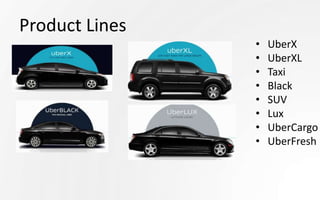
• UberX
• UberXL
• Taxi
• Black
• SUV
• Lux
• UberCargo
• UberFresh
Product Lines
Uber product lines
UberX, the low-budget option.
UberBLACK is for consumers who desire to have their own private driver in a high-end sedan.
UberSUV connects users with SUVs
UberLUX is the most expensive service with luxury vehicles
UberXL is similar to UberSUV but is 50 percent less
Other low-cost options include UberPool, which allows passengers to share rides and split the costs, and UberPOP, a service costing
less than UberX because it utilizes non-professional drivers and smaller cars. Despite the opportunities UberPOP provides, its use of
non-professional drivers have led to regulatory issues in different countries.
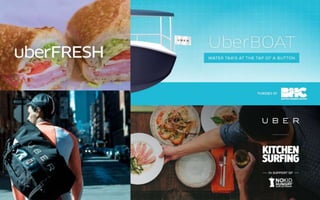
UberFRESH and UberEATS are meal delivery apps that partner with local restaurants to offer meals to consumers within 10 minutes.
These new services are allowing Uber to branch out and expand its services into different businesses.
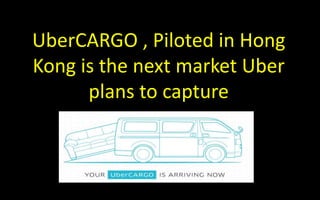
UberCARGO , Piloted in Hong
Kong is the next market Uber
plans to capture
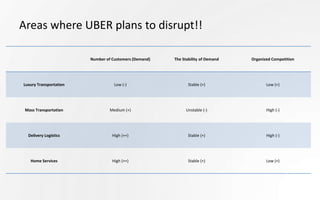
Areas where UBER plans to disrupt!!
Number of Customers (Demand) The Stability of Demand Organized Competition
Luxury Transportation Low (-) Stable (+) Low (+)
Mass Transportation Medium (+) Unstable (-) High (-)
Delivery Logistics High (++) Stable (+) High (-)
Home Services High (++) Stable (+) Low (+)
How UBER works?
Operations Strategy
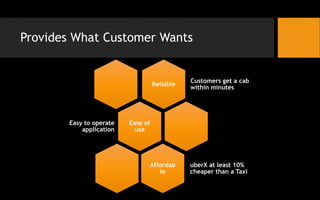
Provides What Customer Wants
Reliable
Customers get a cab
within minutes
Ease of
use
Easy to operate
application
Affordab
le
uberX at least 10%
cheaper than a Taxi
How it works
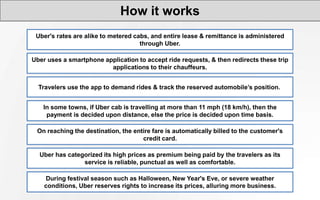
Uber's rates are alike to metered cabs, and entire lease & remittance is administered
through Uber.
Uber uses a smartphone application to accept ride requests, & then redirects these trip
applications to their chauffeurs.
Travelers use the app to demand rides & track the reserved automobile’s position.
In some towns, if Uber cab is travelling at more than 11 mph (18 km/h), then the
payment is decided upon distance, else the price is decided upon time basis.
On reaching the destination, the entire fare is automatically billed to the customer's
credit card.
Uber has categorized its high prices as premium being paid by the travelers as its
service is reliable, punctual as well as comfortable.
During festival season such as Halloween, New Year's Eve, or severe weather
conditions, Uber reserves rights to increase its prices, alluring more business.
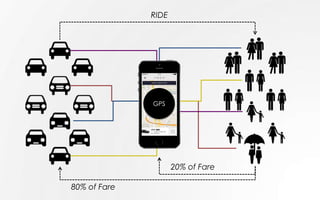
GPS
RIDE
80% of Fare
20% of Fare
• Easy to start
(no license)
• Individual business
(have full control)
• Earn more than taxi
(simple cost structure)
[Incentive to join the network]
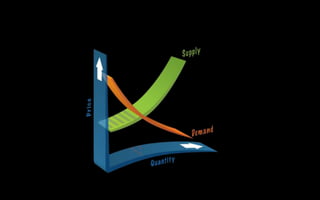
Dynamic Pricing Model
(stably balancing quantity of
demand & supply)
• Easy to use
(thru smartphone app)
• Reliable
(arrival time & Fare)
• Cheaper than taxi
(simple cost structure)
• Better quality
(ratings & feedback)
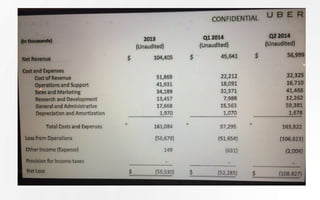
UBER’s Financial Strategy
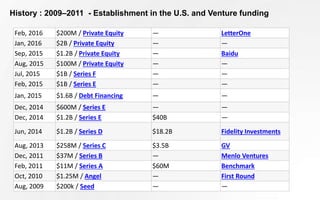
Feb, 2016 $200M / Private Equity — LetterOne
Jan, 2016 $2B / Private Equity — —
Sep, 2015 $1.2B / Private Equity — Baidu
Aug, 2015 $100M / Private Equity — —
Jul, 2015 $1B / Series F — —
Feb, 2015 $1B / Series E — —
Jan, 2015 $1.6B / Debt Financing — —
Dec, 2014 $600M / Series E — —
Dec, 2014 $1.2B / Series E $40B —
Jun, 2014 $1.2B / Series D $18.2B Fidelity Investments
Aug, 2013 $258M / Series C $3.5B GV
Dec, 2011 $37M / Series B — Menlo Ventures
Feb, 2011 $11M / Series A $60M Benchmark
Oct, 2010 $1.25M / Angel — First Round
Aug, 2009 $200k / Seed — —
History : 2009–2011 - Establishment in the U.S. and Venture funding
4. UBER’s International Strategy
Global Multi Domestic
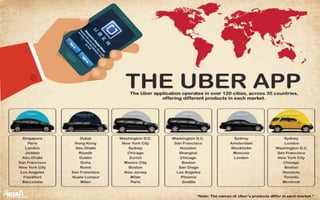
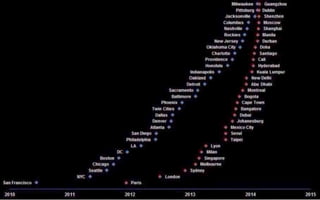
UBER services are available in 58+ countries and 300+ cities around the world
• Govt. regulations
• Communication infrastructure
• Cultural adaptation
• Organizational structure
• The transferability and sustainability of
the technology & information systems
(Navigation system, apps, telematics)
• A very well positioned and easy-to-
recognize brand
UBER
Five Forces Analysis
Threat of new entrants
Threat of substitutes
Suppliers’ power Buyers’ power
Intensity of rivalry
BARRIERS TO ENTRY: MEDIUM-HIGH
Government policy
UBER’s strong brand identity
UBER first mover advantage
RIVALRY DETERMINANTS:HIGH
Large number of firms
Fast market growth
(industry in apps segment)
Similar cost structure
Low switching cost
Low diversity within rivals
DETERMINANTS OF BUYER POWER: HIGH
Many substitute available
Switching cost is cheap
DETERMINANTS OF SUBSTITUTES THREAT : HIGH
High buyer inclination to substitute
(Strong public transportation system/taxi/car-sharing…)
Price elasticity is high
[DRIVER] DETERMINANTS of SUPPLIER POWER: LOW
Many competitive suppliers
Low bargaining power
Low impact of input on cost
[Others] DETERMINANTS of SUPPLIER POWER: MED
Navigation or Background check companies
[Porter’s five forces analysis]
• Lyft
• Gett
• Taxi drivers
• Sabotage
Global Competition
Challenges
[Three big challenges & Group suggestions]
Regulations1 Imitators2 New Technology3
Challenges
• Current law systems says
UBER is illegal in most
cities (No licensed drivers)
• Total or partial prohibition
of the services and
advertising, fines,
confiscations of cars and
other penalties
• Basically anyone with a
car and a driver’s license
could be a competitor
• There are many
companies operating in
very similar ways as UBER
(e.g. LYFT and Sidecar)
• New disruptive
technology
• New business model
• Driverless cars
Suggestions
• Establishing better and
earlier relationships with
government
• Pushing drivers to obtain
such permits by
themselves
• “Too big to fail” strategy
• Reinforce safety system
& Improve PR
• Lock-in strategy through
Google synergy (e.g.
maps)
& UBER brand synergy
• Retain critical mass and
achieve economy of
scale
• Leverage big data
• Partnership/Acquisition
of technology
companies
(Leverage Google)
• Invest R&D
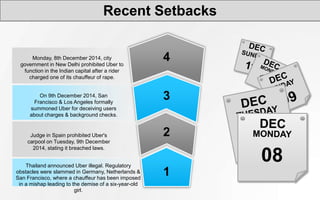
Recent Setbacks
4
3
2
1
Thailand announced Uber illegal. Regulatory
obstacles were slammed in Germany, Netherlands &
San Francisco, where a chauffeur has been imposed
in a mishap leading to the demise of a six-year-old
girl.
Judge in Spain prohibited Uber's
carpool on Tuesday, 9th December
2014, stating it breached laws.
On 9th December 2014, San
Francisco & Los Angeles formally
summoned Uber for deceiving users
about charges & background checks.
Monday, 8th December 2014, city
government in New Delhi prohibited Uber to
function in the Indian capital after a rider
charged one of its chauffeur of rape.
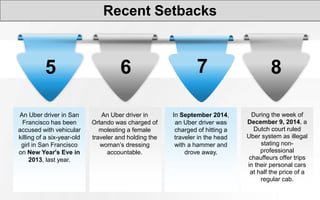
Recent Setbacks
An Uber driver in San
Francisco has been
accused with vehicular
killing of a six-year-old
girl in San Francisco
on New Year's Eve in
2013, last year.
An Uber driver in
Orlando was charged of
molesting a female
traveler and holding the
woman’s dressing
accountable.
In September 2014,
an Uber driver was
charged of hitting a
traveler in the head
with a hammer and
drove away.
During the week of
December 9, 2014, a
Dutch court ruled
Uber system as illegal
stating non-
professional
chauffeurs offer trips
in their personal cars
at half the price of a
regular cab.
5 6 87
Uber   a modern age business strategy

Uber a modern age business strategy

  • 1.
    Digital disruption isthe change that occurs when new digital technologies and business models affect the value proposition of existing goods and services.
  • 2.
  • 3.
    The worlds mostpopular media owner creates no content The most valuable retailer has no inventory The world’s largest accommodation provider owns no real estate. Largest telecommunication company owns no infrastructure Fastest growing banks have no actual money Independent Software vendors do not write any code 3
  • 4.
    4 IN 2015, THEWORLD’S LARGEST TAXI COMPANY OWNS NO VEHICLES?
  • 5.
    [Personal Transportation Industry- TAXI] License Fare Taxi supply Regulations Protective! Costly! No invest! Gov. Taxi Firm Low customer satisfaction
  • 6.
    A study onmodern age Business strategy Dhruvajyoti Roy
  • 7.
    What is the conceptbehind Uber?
  • 9.
    Someone who needsa personal drive from any point at any time
  • 10.
    Someone who wantsto have a side business, or a full-time business, or a revenue generation hobby by driving people for money
  • 11.
    UBER connects thesetwo needs in simple, fast, and predictable way
  • 12.
    Uber is aCarpool & Taxi Assistance venture with main office in San Francisco, California, and operating in several countries. By 2015, service was accessible in 58 countries & more than 300 towns worldwide, estimated more than US$68 billion in December 2015. Uber is subject of current protests from taxi drivers, taxi houses & elective bodies with belief that carpool companies are illegal that occupy unfair trade executions & imperil passenger security. In December 2014, demonstration has been staged in Germany, India, Thailand, Spain, France, & England, among other nations, for disturbances implying riders. Uber was prohibited in Spain & two towns of India in December 2014, and pursues to find solutions with many governmental bodies, plus those of U.S. & Australia. Image curtsey - http://onwardstate.com/wp-content/uploads/2014/09/o-UBER-
  • 14.
  • 15.
    Customer Segmentation Do notown a car. Do not want to drive themselves to a party or function. Like to travel in style and want to be treated as a VIP. Want a cost- efficient cab at their doorstep. Partner drivers.
  • 16.
    Targeting Uber has sucha vast customer segment that it has got something on offer for everyone. From Uber Taxis to Uber Black and from Uber X to Uber SUV, the company has got a vast range for its customers to make a choice. Uber serves professionals as they hire an Uber cab to and fro work. For this Uber did few tie-ups with corporates in the beginning and does so when it launches in a new city in a new country. Apart from professionals, Uber tries to touch hearts of people by offering special services like: Uber for Kids: A special service from Uber dedicated for parents who want their kids to reach home from school in an Uber cab. Uber for Senior Citizens: Another special service from Uber where it targets senior citizens. As per the statistics, Senior citizens make for upto 30% to 40% of total rides in many cities. This made Uber have some special features for seniors and hence attract more senior citizens on the platform.
  • 17.
    UBER existing productlines Positioning
  • 18.
    • UberX • UberXL •Taxi • Black • SUV • Lux • UberCargo • UberFresh Product Lines
  • 19.
    Uber product lines UberX,the low-budget option. UberBLACK is for consumers who desire to have their own private driver in a high-end sedan. UberSUV connects users with SUVs UberLUX is the most expensive service with luxury vehicles UberXL is similar to UberSUV but is 50 percent less Other low-cost options include UberPool, which allows passengers to share rides and split the costs, and UberPOP, a service costing less than UberX because it utilizes non-professional drivers and smaller cars. Despite the opportunities UberPOP provides, its use of non-professional drivers have led to regulatory issues in different countries. UberFRESH and UberEATS are meal delivery apps that partner with local restaurants to offer meals to consumers within 10 minutes. These new services are allowing Uber to branch out and expand its services into different businesses.
  • 21.
    UberCARGO , Pilotedin Hong Kong is the next market Uber plans to capture
  • 24.
    Areas where UBERplans to disrupt!! Number of Customers (Demand) The Stability of Demand Organized Competition Luxury Transportation Low (-) Stable (+) Low (+) Mass Transportation Medium (+) Unstable (-) High (-) Delivery Logistics High (++) Stable (+) High (-) Home Services High (++) Stable (+) Low (+)
  • 25.
  • 26.
    Provides What CustomerWants Reliable Customers get a cab within minutes Ease of use Easy to operate application Affordab le uberX at least 10% cheaper than a Taxi
  • 27.
    How it works Uber'srates are alike to metered cabs, and entire lease & remittance is administered through Uber. Uber uses a smartphone application to accept ride requests, & then redirects these trip applications to their chauffeurs. Travelers use the app to demand rides & track the reserved automobile’s position. In some towns, if Uber cab is travelling at more than 11 mph (18 km/h), then the payment is decided upon distance, else the price is decided upon time basis. On reaching the destination, the entire fare is automatically billed to the customer's credit card. Uber has categorized its high prices as premium being paid by the travelers as its service is reliable, punctual as well as comfortable. During festival season such as Halloween, New Year's Eve, or severe weather conditions, Uber reserves rights to increase its prices, alluring more business.
  • 28.
  • 29.
    • Easy tostart (no license) • Individual business (have full control) • Earn more than taxi (simple cost structure) [Incentive to join the network] Dynamic Pricing Model (stably balancing quantity of demand & supply) • Easy to use (thru smartphone app) • Reliable (arrival time & Fare) • Cheaper than taxi (simple cost structure) • Better quality (ratings & feedback)
  • 30.
  • 31.
    Feb, 2016 $200M/ Private Equity — LetterOne Jan, 2016 $2B / Private Equity — — Sep, 2015 $1.2B / Private Equity — Baidu Aug, 2015 $100M / Private Equity — — Jul, 2015 $1B / Series F — — Feb, 2015 $1B / Series E — — Jan, 2015 $1.6B / Debt Financing — — Dec, 2014 $600M / Series E — — Dec, 2014 $1.2B / Series E $40B — Jun, 2014 $1.2B / Series D $18.2B Fidelity Investments Aug, 2013 $258M / Series C $3.5B GV Dec, 2011 $37M / Series B — Menlo Ventures Feb, 2011 $11M / Series A $60M Benchmark Oct, 2010 $1.25M / Angel — First Round Aug, 2009 $200k / Seed — — History : 2009–2011 - Establishment in the U.S. and Venture funding
  • 33.
  • 34.
    Global Multi Domestic UBERservices are available in 58+ countries and 300+ cities around the world • Govt. regulations • Communication infrastructure • Cultural adaptation • Organizational structure • The transferability and sustainability of the technology & information systems (Navigation system, apps, telematics) • A very well positioned and easy-to- recognize brand UBER
  • 36.
  • 37.
    Threat of newentrants Threat of substitutes Suppliers’ power Buyers’ power Intensity of rivalry BARRIERS TO ENTRY: MEDIUM-HIGH Government policy UBER’s strong brand identity UBER first mover advantage RIVALRY DETERMINANTS:HIGH Large number of firms Fast market growth (industry in apps segment) Similar cost structure Low switching cost Low diversity within rivals DETERMINANTS OF BUYER POWER: HIGH Many substitute available Switching cost is cheap DETERMINANTS OF SUBSTITUTES THREAT : HIGH High buyer inclination to substitute (Strong public transportation system/taxi/car-sharing…) Price elasticity is high [DRIVER] DETERMINANTS of SUPPLIER POWER: LOW Many competitive suppliers Low bargaining power Low impact of input on cost [Others] DETERMINANTS of SUPPLIER POWER: MED Navigation or Background check companies [Porter’s five forces analysis]
  • 38.
    • Lyft • Gett •Taxi drivers • Sabotage Global Competition
  • 39.
  • 40.
    [Three big challenges& Group suggestions] Regulations1 Imitators2 New Technology3 Challenges • Current law systems says UBER is illegal in most cities (No licensed drivers) • Total or partial prohibition of the services and advertising, fines, confiscations of cars and other penalties • Basically anyone with a car and a driver’s license could be a competitor • There are many companies operating in very similar ways as UBER (e.g. LYFT and Sidecar) • New disruptive technology • New business model • Driverless cars Suggestions • Establishing better and earlier relationships with government • Pushing drivers to obtain such permits by themselves • “Too big to fail” strategy • Reinforce safety system & Improve PR • Lock-in strategy through Google synergy (e.g. maps) & UBER brand synergy • Retain critical mass and achieve economy of scale • Leverage big data • Partnership/Acquisition of technology companies (Leverage Google) • Invest R&D
  • 41.
    Recent Setbacks 4 3 2 1 Thailand announcedUber illegal. Regulatory obstacles were slammed in Germany, Netherlands & San Francisco, where a chauffeur has been imposed in a mishap leading to the demise of a six-year-old girl. Judge in Spain prohibited Uber's carpool on Tuesday, 9th December 2014, stating it breached laws. On 9th December 2014, San Francisco & Los Angeles formally summoned Uber for deceiving users about charges & background checks. Monday, 8th December 2014, city government in New Delhi prohibited Uber to function in the Indian capital after a rider charged one of its chauffeur of rape.
  • 42.
    Recent Setbacks An Uberdriver in San Francisco has been accused with vehicular killing of a six-year-old girl in San Francisco on New Year's Eve in 2013, last year. An Uber driver in Orlando was charged of molesting a female traveler and holding the woman’s dressing accountable. In September 2014, an Uber driver was charged of hitting a traveler in the head with a hammer and drove away. During the week of December 9, 2014, a Dutch court ruled Uber system as illegal stating non- professional chauffeurs offer trips in their personal cars at half the price of a regular cab. 5 6 87