UBER	
  Goes	
  Global:	
  Heading	
  for	
  expansion	
  
in	
  China	


Company	
  Background	
  
Uber	
  is	
  a	
  startup	
  founded	
  in	
  2009,	
  officially	
  launched	
  in	
  2010	
  in	
  San	
  Francisco	
  as	
  a	
  
mobile	
  app	
  platform	
  for	
  both	
  iPhone	
  and	
  Android	
  cellphones.	
  Its	
  value	
  proposition	
  is	
  
a	
  solution	
  to	
  the	
  pain	
  that	
  conventional	
  taxi	
  users	
  have	
  been	
  experiencing	
  through	
  the	
  
years,	
   such	
   as:	
   steep	
   prices,	
   insufficient	
   cabs	
   supply	
  for	
   an	
   increasing	
   demand,	
   and	
  
others	
   issues	
   linked	
   to	
   a	
   poor	
   service.	
   The	
   core	
   application	
   functionality	
   is	
   a	
  
matchmaker	
  that	
  allows	
  users	
  to	
  enter	
  a	
  pickup	
  location	
  on	
  their	
  cellphones.	
  Then,	
  an	
  
Uber’s	
  driver	
  will	
  accept	
  the	
  request	
  to	
  pick	
  them	
  up	
  and	
  after	
  that,	
  they	
  drive	
  to	
  the	
  
users	
  destinations	
  request.	
  
Since	
  its	
  start	
  in	
  2009,	
  Uber	
  had	
  grown	
  over	
  68	
  countries	
  and	
  more	
  than	
  300	
  cities	
  
around	
  the	
  world1.	
  In	
  August	
  2015,	
  it	
  reached	
  the	
  title	
  of	
  the	
  most	
  valuable	
  startup	
  in	
  
the	
  world,	
  valued	
  at	
  $50.0	
  billion	
  as	
  is	
  showed	
  in	
  Exhibit	
  1.	
  As	
  an	
  example	
  of	
  its	
  rapid	
  
growth,	
  Uber	
  announced	
  in	
  January	
  2015	
  that	
  it	
  had	
  more	
  than	
  160,000	
  active	
  drivers	
  
in	
   the	
   US	
   who	
   provided	
   more	
   than	
   a	
   million	
   rides	
   a	
   day,	
   covering	
   75%	
   of	
   US	
  
population	
  and	
  it	
  was	
  expected	
  that	
  the	
  startup	
  would	
  have	
  a	
  yearly	
  revenue	
  of	
  $10.84	
  
billion	
  in	
  2015	
  and	
  $26.12	
  billion	
  in	
  20162.	
  
Uber	
   has	
   come,	
   as	
   a	
   disruptive	
   innovation	
   in	
   an	
   industry	
   that	
   long	
   ago	
   showed	
   no	
  
efforts	
  to	
  improve	
  its	
  services	
  in	
  order	
  to	
  attend	
  their	
  costumers	
  needs.	
  That	
  is	
  the	
  
main	
   reason	
   because	
   this	
   application	
   service	
   has	
   been	
   extremely	
   popular	
   with	
  
consumers.	
  
The	
  great	
  success	
  of	
  the	
  company	
  has	
  not	
  been	
  deployed	
  without	
  problems	
  in	
  each	
  
country	
  where	
  Uber	
  has	
  been	
  implemented,	
  and	
  it	
  has	
  been	
  criticized	
  from	
  several	
  
sides	
  of	
  the	
  incumbents.	
  On	
  one	
  hand,	
  in	
  each	
  city	
  it	
  has	
  received	
  a	
  hostile	
  reception	
  
from	
  unions	
  taxi	
  drivers,	
  who	
  are	
  at	
  risk	
  in	
  its	
  operation	
  and	
  market	
  share	
  with	
  the	
  
entry	
  of	
  this	
  type	
  of	
  competitors;	
  on	
  the	
  other	
  hand,	
  state	
  regulators	
  have	
  put	
  barriers	
  
to	
   normal	
   operation	
   of	
   this	
   new	
   type	
   of	
   transportation	
   service,	
   since	
   they	
   do	
   not	
  
receive	
  incomes	
  for	
  taxi	
  licenses	
  and	
  other	
  taxes,	
  as	
  they	
  do	
  with	
  conventional	
  taxi	
  
industry.	
   Finally,	
   from	
   consumer	
   side,	
   Uber	
   has	
   been	
   criticized	
   by	
   one	
   of	
   the	
  
cornerstones	
  of	
  its	
  business	
  model	
  based	
  on	
  the	
  surge	
  pricing,	
  which	
  varies	
  according	
  
to	
   the	
   demand.	
   This	
   last	
   issue	
   had	
   also	
   the	
   potential	
   to	
   raise	
   ethical	
   concerns	
   in	
  
society,	
  for	
  example,	
  during	
  the	
  2014	
  hostage	
  crisis	
  in	
  Sydney,	
  Australia,	
  the	
  minimum	
  
fare	
  for	
  a	
  Uber`s	
  ride	
  in	
  that	
  city	
  was	
  more	
  than	
  AU$100,	
  which	
  means	
  four	
  times	
  the	
  
regular	
  price.	
  The	
  company	
  apologized	
  for	
  this	
  situation	
  and	
  refund	
  all	
  who	
  had	
  paid	
  
rides	
  during	
  that	
  occasion3.	
  
There	
  have	
  been	
  other	
  concerns	
  such	
  as	
  those	
  related	
  to	
  passenger	
  safety,	
  like	
  in	
  India	
  
where	
  a	
  driver	
  has	
  been	
  accused	
  to	
  rape	
  a	
  female	
  passenger4	


Uber	
  Business	
  Model	
  
Uber	
   has	
   a	
   unique	
   business	
   model	
   that	
   gives	
   it	
   comparative	
   advantages	
   over	
   their	
  
competition,	
  which	
  are	
  the	
  taxi	
  &	
  limousine	
  industry.	
  It	
  owns	
  no	
  taxi	
  and	
  has	
  no	
  cab	
  
driver	
   as	
   employees,	
   clearly	
   an	
   advantage	
   in	
   the	
   company	
   cost	
   structure	
   over	
   its	
  
competitors.	
  
Its	
  role	
  or	
  function	
  is	
  to	
  match	
  a	
  driver	
  with	
  its	
  passengers	
  who	
  are	
  looking	
  for	
  a	
  ride	
  
in	
  a	
  timely	
  efficient	
  manner,	
  and	
  for	
  this	
  service	
  Uber	
  will	
  take	
  an	
  average	
  of	
  20%	
  of	
  
the	
  total	
  payment	
  made	
  it	
  to	
  the	
  driver.	
  There	
  are	
  no	
  cash	
  transactions	
  between	
  driver	
  
and	
   passenger,	
   because	
   prior	
   to	
   the	
   first	
   use	
   of	
   the	
   app,	
   the	
   user	
   needs	
   to	
   enter	
   a	
  
credit	
   card	
   account	
   or	
   other	
   electronic	
   mode	
   of	
   payment	
   (e.g.	
   Paypal),	
   with	
   the	
  
advantage	
  to	
  give	
  a	
  secure	
  mode	
  of	
  payment	
  for	
  both	
  parts.	
  
One	
  of	
  the	
  core	
  features	
  of	
  its	
  business	
  model	
  is	
  the	
  surge	
  pricing	
  strategy,	
  based	
  on	
  a	
  
patented	
  technology	
  built-­‐in	
  algorithm	
  that	
  automatically	
  adjust	
  the	
  rate	
  for	
  a	
  journey	
  
based	
  on	
  the	
  current	
  supply-­‐demand	
  ratio5	
  
Uber	
   has	
   a	
   variety	
   of	
   services	
   as	
   a	
   strategy	
   to	
   capture	
   value	
   in	
   a	
   wide	
   range	
   of	
  
segments	
  in	
  people	
  transportation:	
  
• UberX:	
  the	
  low-­‐cost	
  uber	
  
• UberTaxi:	
   regular	
   taxi	
   provided	
   with	
   a	
   more	
   accessible	
   method	
   of	
  
getting	
  a	
  cab,	
  in	
  addition	
  to	
  a	
  convenient	
  method	
  of	
  payment.	
  
• UberBlack:	
  a	
  private	
  driver	
  operating	
  a	
  high-­‐end	
  sedan.	
  
• UberSUV:	
  seats	
  up	
  to	
  six	
  people	
  in	
  style.	
  
• UberLUX:	
  the	
  finest	
  cars	
  selection.	


Taxi	
  &	
  Limousine	
  Global	
  Industry	
  
Uber	
  operates	
  in	
  the	
  taxi	
  &	
  limousine	
  service	
  industry,	
  which	
  has	
  total	
  revenues	
  of	
  
$11	
   billion	
   in	
   the	
   US,	
   $14	
   billion	
   in	
   the	
   UK	
   and	
   $25	
   billion	
   in	
   Japan6.	
   A	
   variety	
   of	
  
products	
  and	
  services	
  are	
  offered	
  within	
  this	
  industry,	
  such	
  as:	
  taxi	
  services,	
  leasing	
  to	
  
taxi	
  operators,	
  “special	
  needs”	
  transportation	
  services,	
  limousine	
  services,	
  and	
  luxury	
  
and	
  corporate	
  sedan	
  services.	
  
In	
   recent	
   years,	
   a	
   bunch	
   of	
   new	
   app-­‐based	
   rides	
   have	
   entered	
   to	
   this	
   industry,	
  
representing	
  direct	
  competitors	
  to	
  Uber.	
  Examples	
  of	
  these	
  new	
  apps	
  are:	
  Lyft,	
  Hailo,	
  
GetTaxi,	
  LeCab,	
  Didi	
  –	
  Kuadi,	
  Yidao,	
  among	
  others.	
  
Despite	
  these	
  new	
  competitors	
  compete	
  for	
  the	
  same	
  customers	
  that	
  Uber	
  does,	
  Uber	
  
enjoys	
  an	
  important	
  brand	
  positioning,	
  because	
  of	
  its	
  quality	
  and	
  for	
  being	
  one	
  of	
  the	
  
first	
  movers	
  in	
  this	
  relatively	
  new	
  type	
  of	
  service.	


Porter`s	
  Five	
  Forces	
  Analysis	
  (in	
  a	
  macro-­‐level	
  perspective)	
  
Threat	
  of	
  new	
  entrants	
  (High):	
  
• Uber	
  has	
  34	
  US	
  patent	
  applications	
  pending7,	
  this	
  means	
  that	
  it	
  doesn´t	
  have	
  
any	
   protection	
   over	
   these	
   processes	
   or	
   key	
   activities.	
   This	
   could	
   be	
   a	
   time	
  
opportunity	
   to	
   the	
   new	
   entrants	
   to	
   compete	
   and	
   do	
   reverse	
   engineering	
   in	
  
order	
  to	
  get	
  the	
  technologies	
  that	
  Uber	
  has	
  been	
  trying	
  to	
  protect.	
  
• Uber	
  started	
  with	
  a	
  low	
  initial	
  capital	
  investment	
  of	
  $200,000,	
  an	
  amount	
  that	
  
is	
  easy	
  to	
  gather	
  for	
  a	
  new	
  competitor.	
  
Buyer	
  Power	
  (High):	
  
• Customers	
   have	
   a	
   variety	
   of	
   substitutes	
   and	
   the	
   switching	
   costs	
   are	
   low	
   for	
  
Uber	
  users	
  (the	
  app	
  is	
  free).	
  
• Most	
  of	
  the	
  customers	
  are	
  price	
  sensitive.	
  
Threat	
  of	
  Substitute	
  (High)	
  
• Within	
  the	
  industry	
  of	
  network	
  transportation,	
  Uber	
  has	
  quite	
  a	
  few	
  substitutes	
  
that	
  can	
  be	
  utilized	
  by	
  customers	
  for	
  transportation	
  (such	
  as	
  another	
  app`s	
  like	
  
Uber,	
  taxis,	
  train,	
  subway,	
  buses,	
  etc.)	
  
Supplier	
  Power	
  (Moderate)	
  
• Uber	
  drivers	
  and	
  their	
  vehicles	
  can	
  choose	
  to	
  operate	
  with	
  rivals	
  such	
  as	
  Lyft	
  
or	
  to	
  become	
  a	
  conventional	
  taxi	
  operator.	
  
• Uber	
  drivers	
  are	
  not	
  affected	
  by	
  significant	
  switching	
  costs.	
  
• Despite	
  this	
  situation,	
  Uber	
  has	
  the	
  power	
  to	
  set	
  their	
  rates,	
  and	
  as	
  they	
  reach	
  
more	
  and	
  more	
  Uber`s	
  drivers,	
  they	
  will	
  be	
  enabled	
  to	
  control	
  supply	
  power.	
  
Competitors	
  (High):	
  
• Many	
  competitors	
  in	
  this	
  industry.	
  
• Low	
  switching	
  costs.	
  
• Fierce	
  competition	
  for	
  space	
  (cities),	
  and	
  drivers	
  and	
  their	
  cars.	
  
Based	
  on	
  this	
  analysis	
  we	
  can	
  say	
  that	
  Uber	
  is	
  in	
  a	
  very	
  competitive	
  industry,	
  where	
  
prices	
  and	
  profit	
  will	
  be	
  kept	
  relatively	
  low	
  in	
  the	
  future.	
  But,	
  since	
  is	
  an	
  immature	
  
industry	
   so	
   far,	
   there	
   is	
   a	
   huge	
   potential	
   for	
   growth	
   that	
   this	
   company	
   can	
   take	
  
advantage	
  of.	


UBER	
  Goes	
  Global:	
  Heading	
  for	
  expansion	
  in	
  China	
  
Uber	
   did	
   its	
   first	
   entry	
   to	
   China	
   in	
   2013	
   under	
   the	
   name	
   of	
   “Youbu”.	
   This	
   country	
  
offers	
  interesting	
  business	
  opportunities	
  within	
  the	
  taxi	
  market,	
  and	
  specifically	
  for	
  
new	
  ventures	
  as	
  the	
  app	
  based	
  companies	
  like	
  Uber.	
  Chinese	
  taxi	
  &	
  limousine	
  industry	
  
still	
  have	
  several	
  pains	
  that	
  are	
  not	
  completely	
  solved	
  by	
  local	
  companies,	
  such	
  as:	
  
expensive	
   rates	
   in	
   large	
   cities,	
   distressing	
   experiences	
   during	
   busy	
   hours	
   (traffic	
  
jams),	
   cab	
   drivers	
   refuse	
   to	
   transport	
   a	
   passenger	
   if	
   the	
   distance	
   between	
   the	
   two	
  
points	
  of	
  the	
  ride	
  is	
  short,	
  the	
  car	
  conditions	
  and	
  quality	
  service	
  are	
  inconsistent,	
  etc.	
  
The	
  number	
  of	
  taxis	
  was	
  growing	
  every	
  year	
  in	
  this	
  country	
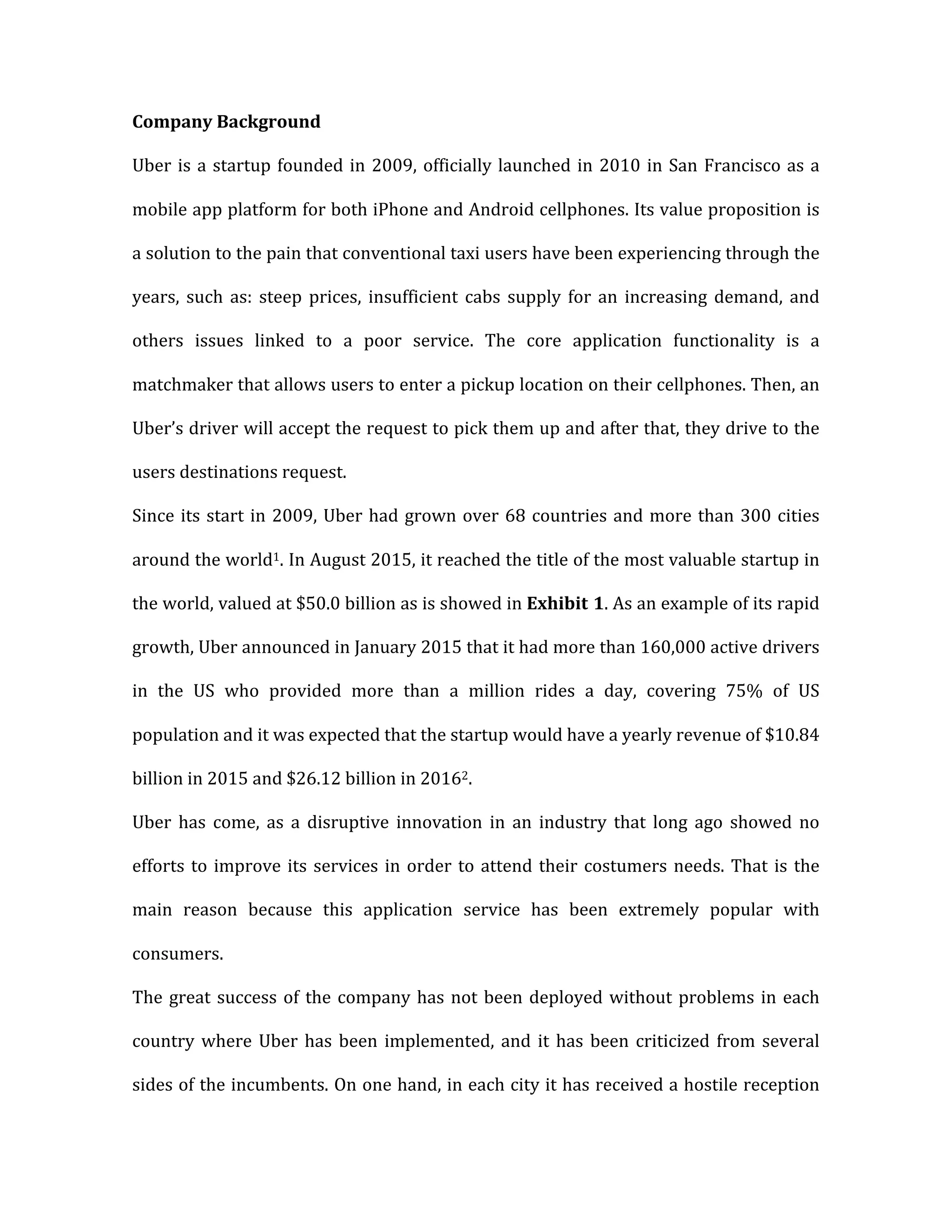
  (see	
  Exhibit	
  2)	
  alongside	
  
with	
  a	
  rapid	
  growth	
  in	
  online-­‐to-­‐offline	
  commerce	
  (see	
  Exhibit	
   3),	
  which	
  offered	
  a	
  
perfect	
  scenario	
  to	
  develop	
  mobile	
  application-­‐based	
  initiatives.	
  
 
Chinese	
  Market,	
  a	
  Big	
  Opportunity	
  
By	
  June	
  2015,	
  Uber	
  had	
  covered	
  11	
  major	
  Chinese	
  mainland	
  cities	
  and	
  reported	
  to	
  
have	
  one	
  million	
  rides	
  per	
  day,	
  fact	
  that	
  is	
  comparable	
  to	
  all	
  rides	
  in	
  Uber	
  markets	
  
outside	
  United	
  States,	
  as	
  reported	
  in	
  December	
  20148.	
  
Uber	
  first	
  entry	
  was	
  in	
  Shanghai	
  trough	
  the	
  UberBlack	
  implementation	
  as	
  a	
  premium	
  
chauffeur	
  service,	
  but	
  it	
  did	
  not	
  have	
  a	
  great	
  reception	
  from	
  passengers,	
  given	
  its	
  high	
  
cost	
   compared	
   to	
   a	
   conventional	
   cab	
   service	
   or	
   the	
   other	
   competitor’s	
   rates.	
   In	
  
response,	
  Uber	
  announced	
  a	
  dramatic	
  price	
  reduction	
  in	
  Shangai	
  (50%	
  off)	
  in	
  order	
  to	
  
gain	
  market	
  share	
  and	
  be	
  more	
  competitive.	
  	
  
In	
   addition	
   to	
   this	
   practice,	
   Uber	
   announced	
   the	
   introduction	
   of	
   “People´s	
   Uber”	
   in	
  
October	
   2014,	
   which	
   led	
   to	
   an	
   extraordinary	
   growth.	
   This	
   initiative	
   existed	
   only	
   in	
  
China	
  and	
  it	
  was	
  a	
  “non-­‐profit	
  ride	
  sharing”	
  program	
  that	
  was	
  to	
  believe	
  stimulated	
  by	
  
a	
  government	
  document	
  issued	
  by	
  Beijing	
  in	
  early	
  2014.	
  The	
  intention	
  to	
  implement	
  
this	
  program	
  was	
  a	
  part	
  of	
  a	
  promotion	
  and	
  marketing	
  plan	
  of	
  Uber	
  in	
  order	
  to	
  engage	
  
more	
  users	
  and	
  prepare	
  it	
  for-­‐profit	
  products9	


Local	
  Deals	
  
In	
  order	
  to	
  get	
  a	
  closer	
  relation	
  with	
  its	
  costumers	
  and	
  gain	
  visibility	
  in	
  the	
  Chinese	
  
market,	
  Uber	
  linked	
  its	
  service	
  to	
  Alipay,	
  China`s	
  most	
  popular	
  payment	
  solution.	
  In	
  
December	
  2014,	
  Uber	
  partnered	
  Baidu	
  Inc.,	
  a	
  Chinese	
  giant	
  web,	
  for	
  mapping	
  support.	
  
These	
  strategic	
  commercial	
  associations	
  were	
  seen	
  as	
  real	
  intentions	
  of	
  Uber	
  to	
  build	
  
good	
   relationships	
   with	
   local	
   government,	
   leveraging	
   support	
   from	
   the	
   regulation	
  
point	
  of	
  view.	


CAGE	
  Analysis	
  for	
  Chinese	
  Uber	
  Expansion	
  Opportunities	
  
Cultural	
  Distance:	
  
• Language	
  could	
  be	
  a	
  problem	
  but	
  the	
  application	
  could	
  be	
  easily	
  translated	
  to	
  
the	
  target	
  language	
  market.	
  
• Chinese	
  business	
  culture	
  is	
  based	
  on	
  personal	
  connection	
  rather	
  than	
  a	
  pure	
  
transactional	
  act,	
  which	
  is	
  the	
  service	
  that	
  Uber	
  offers.	
  But	
  since	
  Uber	
  is	
  only	
  a	
  
digital	
   platform,	
   they	
   can	
   encourage	
   Chinese	
   driver	
   to	
   be	
   kind	
   to	
   their	
  
customers	
  in	
  order	
  to	
  avoid	
  this	
  distance.	
  
Administrative	
  (or	
  Political)	
  Distance:	
  
• China	
  and	
  US	
  economic	
  trade	
  relationship	
  has	
  been	
  developed	
  over	
  the	
  years	
  
as	
   a	
   solid	
   partnership,	
   giving	
   a	
   perfect	
   scenario	
   for	
   American	
   companies	
   to	
  
deploy	
  their	
  businesses	
  in	
  this	
  country.	
  	
  
• The	
  involvement	
  level	
  of	
  the	
  Chinese	
  government	
  in	
  commercial	
  activities,	
  and	
  
specifically	
  web-­‐based	
  initiative,	
  is	
  known	
  to	
  be	
  high.	
  This	
  could	
  be	
  a	
  threat	
  for	
  
a	
   company	
   that	
   operates	
   in	
   a	
   service	
   100%	
   Internet	
   dependent,	
   because	
  
Chinese	
  government	
  has	
  the	
  power	
  to	
  block	
  this	
  kind	
  of	
  apps,	
  with	
  the	
  huge	
  
cost	
  of	
  an	
  action	
  like	
  this	
  could	
  mean	
  to	
  a	
  company	
  like	
  Uber.	
  
Geographic	
  Distance	
  
• Since	
  Uber	
  is	
  an	
  app,	
  geographical	
  distance	
  it	
  has	
  been	
  reduced	
  with	
  the	
  use	
  of	
  
this	
  technology,	
  and	
  because	
  the	
  business	
  model	
  of	
  this	
  company	
  doesn’t	
  own	
  
cars	
  or	
  other	
  physical	
  assets,	
  there	
  is	
  no	
  need	
  to	
  export	
  this	
  kind	
  of	
  goods.	
  
• Technological	
  distance	
  is	
  not	
  a	
  problem,	
  since	
  Chinese	
  use	
  of	
  mobile	
  platforms	
  
is	
  currently	
  updated	
  and	
  experiencing	
  significant	
  growing	
  rates.	
  
Economic	
  Distance	
  
• China	
  had	
  a	
  GDP	
  per	
  capita	
  of	
  $15,184	
  (PPP	
  in	
  2015)10,	
  and	
  this	
  index	
  has	
  been	
  
growing	
  over	
  the	
  years.	
  This	
  fact	
  is	
  reducing	
  distance	
  in	
  order	
  to	
  implement	
  
new	
  investments	
  in	
  the	
  country.	
  
• Growing	
  rates	
  of	
  taxi	
  industry	
  activity	
  is	
  a	
  good	
  signal	
  to	
  develop	
  businesses	
  
like	
  the	
  Uber	
  proposal.	
  
From	
  this	
  analysis	
  we	
  can	
  conclude	
  that	
  the	
  expansion	
  plan	
  of	
  Uber	
  within	
  the	
  Chinese	
  
market	
  is	
  a	
  viable	
  strategy	
  given	
  the	
  conditions	
  offered	
  by	
  this	
  country	
  to	
  the	
  claims	
  of	
  
the	
   company.	
   China	
   offers	
   great	
   growth	
   opportunities	
   in	
   niche	
   applications	
   for	
   the	
  
transport	
  of	
  people,	
  despite	
  the	
  current	
  scenario	
  where	
  Uber	
  is	
  distant	
  third	
  player	
  
with	
  a	
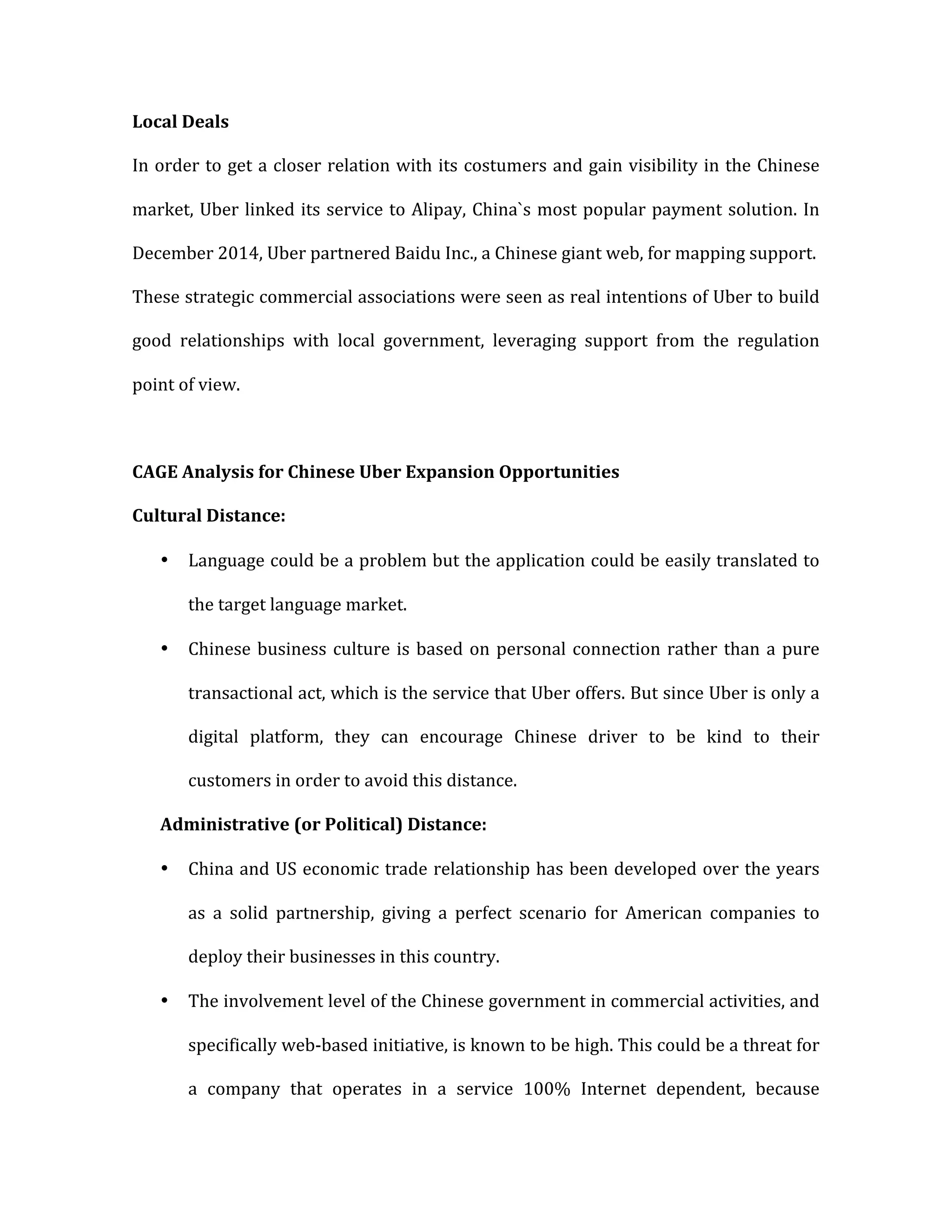
  8,4%	
  of	
  market	
  share,	
  following	
  to	
  Yidao	
  with	
  10,9%	
  in	
  a	
  second	
  place	
  and	
  Didi	
  
Kuaidi	
  with	
  78,3%	
  in	
  first	
  place	
  as	
  the	
  largest	
  Chinese	
  online	
  chauffeur	
  player	
  (See	
  
Exhibit	
  4)	


What`s	
  Next?	
  
In	
  order	
  to	
  be	
  a	
  success	
  competitor	
  in	
  China,	
  it	
  should	
  implement	
  various	
  strategies	
  to	
  
gain	
  market	
  share	
  to	
  its	
  competitors	
  such	
  as	
  Didi	
  Kuadi	
  and	
  Yidao.	
  Some	
  of	
  them	
  are:	
  
• In	
  order	
  gain	
  confidence	
  from	
  the	
  government,	
  Uber	
  should	
  partner	
  with	
  local	
  
government	
   and	
   local	
   companies	
   trough	
   joint	
   ventures	
   or	
   commercial	
  
agreements.	
  
• Uber	
   needs	
   to	
   better	
   understand	
   local	
   demand	
   for	
   transportation	
   methods.	
  
This	
   can	
   result	
   in	
   adding	
   more	
   services	
   or	
   products	
   to	
   the	
   actual	
   mix.	
   For	
  
example,	
  it	
  can	
  add	
  compact	
  city	
  cars	
  in	
  large	
  cities	
  and	
  motorcycles	
  in	
  rural	
  
areas	
  with	
  cheap	
  fares,	
  or	
  can	
  be	
  extended	
  to	
  another	
  dimension	
  like	
  delivery	
  
services	
  as	
  Fedex,	
  but	
  with	
  private	
  cars.	
  
• More	
   investment	
   in	
   marketing	
   and	
   promotions,	
   in	
   order	
   to	
   get	
   customers	
  
attention	
  and	
  loyalty.	
  Through	
  this	
  strategy	
  Uber	
  also	
  can	
  gain	
  public	
  support	
  
and	
   reduce	
   the	
   public	
   negative	
   concerns	
   of	
   possible	
   future	
   problems	
   with	
  
regulators.	
   This	
   last	
   topic	
   is	
   one	
   of	
   the	
   main	
   reasons	
   why	
   Uber	
   is	
   having	
  
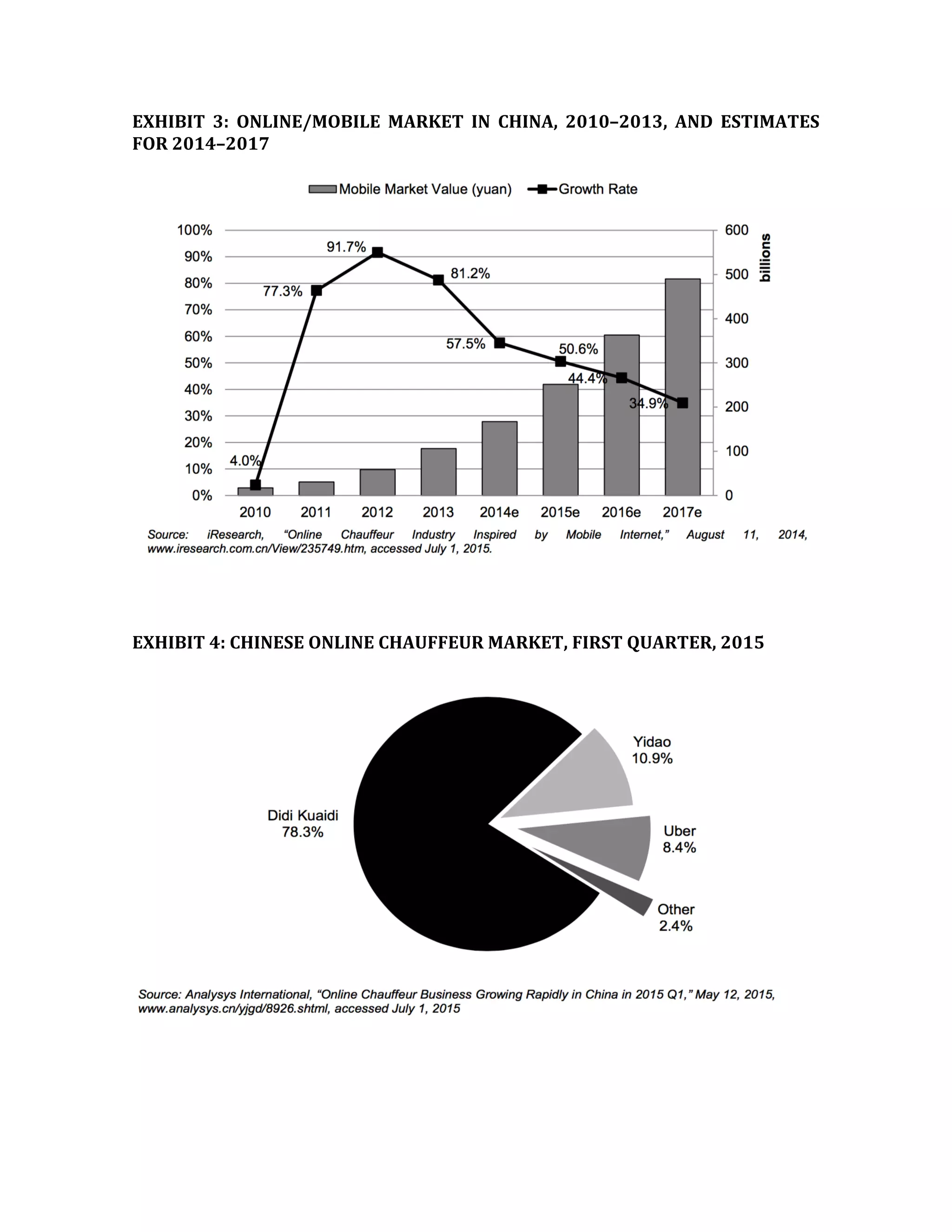
troubles	
  in	
  its	
  international	
  expansion	
  strategy	
  (see	
  Exhibit	
  5).	
  
• Finally,	
  Uber	
  needs	
  to	
  implement	
  innovative	
  strategies	
  to	
  improve	
  profitability	
  
in	
   Chinese	
   market	
   in	
   order	
   to	
   get	
   a	
   sustainable	
   operation	
   in	
   that	
   country,	
  
because	
   it	
   has	
   been	
   investing	
   considerable	
   amount	
   resources	
   in	
   projects	
   to	
  
gain	
  visibility	
  within	
  customers	
  that	
  are	
  causing	
  reduction	
  in	
  profit	
  margins	
  in	
  
the	
  short	
  term.	
  To	
  solve	
  this	
  issue,	
  they	
  need	
  to	
  find	
  a	
  well-­‐balanced	
  strategy	
  
that	
  allows	
  them	
  on	
  the	
  one	
  hand	
  to	
  gain	
  market	
  share	
  and	
  awareness	
  from	
  
customer,	
  and	
  on	
  the	
  other	
  hand	
  to	
  improve	
  their	
  profit	
  margins.	
  
EXHIBIT	
  1:	
  THE	
  WORLD`S	
  TOP	
  10	
  STARTUPS	


EXHIBIT	
  2:	
  TAXIS	
  IN	
  CHINA,	
  2005–2013	


EXHIBIT	
   3:	
   ONLINE/MOBILE	
   MARKET	
   IN	
   CHINA,	
   2010–2013,	
   AND	
   ESTIMATES	
  
FOR	
  2014–2017


EXHIBIT	
  4:	
  CHINESE	
  ONLINE	
  CHAUFFEUR	
  MARKET,	
  FIRST	
  QUARTER,	
  2015	


EXHIBIT	
  5:	
  UBER`S	
  TROUBLE	
  SPOT	


Source:	
  http://mashable.com/2014/12/17/uber-­‐map/#4jbWnMHwLGqu	
  
ENDNOTES	


1	
  Uber	
  official	
  site,	
  Our	
  Cities	
  -­‐	
  Uber	
  
https://www.uber.com/cities	


2	
  “Uber	
  seen	
  reaching	
  $10.8	
  billion	
  in	
  bookings	
  in	
  2015:	
  fundraising	
  presentation”	
  
http://www.reuters.com/article/us-­‐uber-­‐tech-­‐fundraising-­‐idUSKCN0QQ0G320150821	


3	
  “Uber	
   Charged	
   4	
   Times	
   Its	
   Usual	
   Rate	
   During	
   Sydney	
   Hostage	
   Siege,”	
   Time	
   Inc.	
  
http://time.com/3633304/uber-­‐sydney-­‐hostage-­‐surge-­‐pricing/
4	
  “Uber	
  cab	
  service	
  banned	
  in	
  Delhi,	
  accused	
  sent	
  to	
  3-­‐day	
  police	
  custody”	
  
http://indianexpress.com/article/cities/delhi/uber-­‐cab-­‐driver-­‐a-­‐repeat-­‐offender-­‐
jailed-­‐earlier-­‐in-­‐a-­‐rape-­‐case/	


5	
  Xiaoke Xu, Xin Wang and Neil Bendle. UBER: MANAGING A RIDE IN CHINA Case
Study. Richard Ivey School of Business Foundation.
https://hbr.org/product/uber-­‐managing-­‐a-­‐ride-­‐in-­‐china/W15425-­‐PDF-­‐ENG	
  
6	
  “Waiting	
  on	
  the	
  Uber	
  IPO”	
  
http://www.techinvestingdaily.com/articles/waiting-­‐on-­‐the-­‐uber-­‐ipo/463	


7	
  “UBER	
  TECHNOLOGIES,	
  INC.	
  Patent	
  Owner”	
  
http://www.patentbuddy.com/Company/Profile/UBER-­‐TECHNOLOGIES-­‐
INC./1957650	


8	
  “Uber Is Logging 1 Million Daily Rides in China — as Many as the Rest of the World,
Combined”
http://qz.com/426561/uber-is-logging-1-million-daily-rides-in-china-as-many-as-the-rest-of-
the-world-combined/
	
  
9 	
  “Behind the Price Cut,” Sohu News,
http://auto.sohu.com/20150324/n410251796.shtml
10	
  “Economy	
  of	
  China”	
  
https://en.wikipedia.org/wiki/Economy_of_China	


Uber and its expansion strategy in China

  • 1.
                                                                                    UBER  Goes  Global:  Heading  for  expansion   in  China                        
  • 2.
    Company  Background   Uber  is  a  startup  founded  in  2009,  officially  launched  in  2010  in  San  Francisco  as  a   mobile  app  platform  for  both  iPhone  and  Android  cellphones.  Its  value  proposition  is   a  solution  to  the  pain  that  conventional  taxi  users  have  been  experiencing  through  the   years,   such   as:   steep   prices,   insufficient   cabs   supply  for   an   increasing   demand,   and   others   issues   linked   to   a   poor   service.   The   core   application   functionality   is   a   matchmaker  that  allows  users  to  enter  a  pickup  location  on  their  cellphones.  Then,  an   Uber’s  driver  will  accept  the  request  to  pick  them  up  and  after  that,  they  drive  to  the   users  destinations  request.   Since  its  start  in  2009,  Uber  had  grown  over  68  countries  and  more  than  300  cities   around  the  world1.  In  August  2015,  it  reached  the  title  of  the  most  valuable  startup  in   the  world,  valued  at  $50.0  billion  as  is  showed  in  Exhibit  1.  As  an  example  of  its  rapid   growth,  Uber  announced  in  January  2015  that  it  had  more  than  160,000  active  drivers   in   the   US   who   provided   more   than   a   million   rides   a   day,   covering   75%   of   US   population  and  it  was  expected  that  the  startup  would  have  a  yearly  revenue  of  $10.84   billion  in  2015  and  $26.12  billion  in  20162.   Uber   has   come,   as   a   disruptive   innovation   in   an   industry   that   long   ago   showed   no   efforts  to  improve  its  services  in  order  to  attend  their  costumers  needs.  That  is  the   main   reason   because   this   application   service   has   been   extremely   popular   with   consumers.   The  great  success  of  the  company  has  not  been  deployed  without  problems  in  each   country  where  Uber  has  been  implemented,  and  it  has  been  criticized  from  several   sides  of  the  incumbents.  On  one  hand,  in  each  city  it  has  received  a  hostile  reception  
  • 3.
    from  unions  taxi  drivers,  who  are  at  risk  in  its  operation  and  market  share  with  the   entry  of  this  type  of  competitors;  on  the  other  hand,  state  regulators  have  put  barriers   to   normal   operation   of   this   new   type   of   transportation   service,   since   they   do   not   receive  incomes  for  taxi  licenses  and  other  taxes,  as  they  do  with  conventional  taxi   industry.   Finally,   from   consumer   side,   Uber   has   been   criticized   by   one   of   the   cornerstones  of  its  business  model  based  on  the  surge  pricing,  which  varies  according   to   the   demand.   This   last   issue   had   also   the   potential   to   raise   ethical   concerns   in   society,  for  example,  during  the  2014  hostage  crisis  in  Sydney,  Australia,  the  minimum   fare  for  a  Uber`s  ride  in  that  city  was  more  than  AU$100,  which  means  four  times  the   regular  price.  The  company  apologized  for  this  situation  and  refund  all  who  had  paid   rides  during  that  occasion3.   There  have  been  other  concerns  such  as  those  related  to  passenger  safety,  like  in  India   where  a  driver  has  been  accused  to  rape  a  female  passenger4     Uber  Business  Model   Uber   has   a   unique   business   model   that   gives   it   comparative   advantages   over   their   competition,  which  are  the  taxi  &  limousine  industry.  It  owns  no  taxi  and  has  no  cab   driver   as   employees,   clearly   an   advantage   in   the   company   cost   structure   over   its   competitors.   Its  role  or  function  is  to  match  a  driver  with  its  passengers  who  are  looking  for  a  ride   in  a  timely  efficient  manner,  and  for  this  service  Uber  will  take  an  average  of  20%  of   the  total  payment  made  it  to  the  driver.  There  are  no  cash  transactions  between  driver   and   passenger,   because   prior   to   the   first   use   of   the   app,   the   user   needs   to   enter   a  
  • 4.
    credit   card   account   or   other   electronic   mode   of   payment   (e.g.   Paypal),   with   the   advantage  to  give  a  secure  mode  of  payment  for  both  parts.   One  of  the  core  features  of  its  business  model  is  the  surge  pricing  strategy,  based  on  a   patented  technology  built-­‐in  algorithm  that  automatically  adjust  the  rate  for  a  journey   based  on  the  current  supply-­‐demand  ratio5   Uber   has   a   variety   of   services   as   a   strategy   to   capture   value   in   a   wide   range   of   segments  in  people  transportation:   • UberX:  the  low-­‐cost  uber   • UberTaxi:   regular   taxi   provided   with   a   more   accessible   method   of   getting  a  cab,  in  addition  to  a  convenient  method  of  payment.   • UberBlack:  a  private  driver  operating  a  high-­‐end  sedan.   • UberSUV:  seats  up  to  six  people  in  style.   • UberLUX:  the  finest  cars  selection.     Taxi  &  Limousine  Global  Industry   Uber  operates  in  the  taxi  &  limousine  service  industry,  which  has  total  revenues  of   $11   billion   in   the   US,   $14   billion   in   the   UK   and   $25   billion   in   Japan6.   A   variety   of   products  and  services  are  offered  within  this  industry,  such  as:  taxi  services,  leasing  to   taxi  operators,  “special  needs”  transportation  services,  limousine  services,  and  luxury   and  corporate  sedan  services.   In   recent   years,   a   bunch   of   new   app-­‐based   rides   have   entered   to   this   industry,   representing  direct  competitors  to  Uber.  Examples  of  these  new  apps  are:  Lyft,  Hailo,   GetTaxi,  LeCab,  Didi  –  Kuadi,  Yidao,  among  others.  
  • 5.
    Despite  these  new  competitors  compete  for  the  same  customers  that  Uber  does,  Uber   enjoys  an  important  brand  positioning,  because  of  its  quality  and  for  being  one  of  the   first  movers  in  this  relatively  new  type  of  service.     Porter`s  Five  Forces  Analysis  (in  a  macro-­‐level  perspective)   Threat  of  new  entrants  (High):   • Uber  has  34  US  patent  applications  pending7,  this  means  that  it  doesn´t  have   any   protection   over   these   processes   or   key   activities.   This   could   be   a   time   opportunity   to   the   new   entrants   to   compete   and   do   reverse   engineering   in   order  to  get  the  technologies  that  Uber  has  been  trying  to  protect.   • Uber  started  with  a  low  initial  capital  investment  of  $200,000,  an  amount  that   is  easy  to  gather  for  a  new  competitor.   Buyer  Power  (High):   • Customers   have   a   variety   of   substitutes   and   the   switching   costs   are   low   for   Uber  users  (the  app  is  free).   • Most  of  the  customers  are  price  sensitive.   Threat  of  Substitute  (High)   • Within  the  industry  of  network  transportation,  Uber  has  quite  a  few  substitutes   that  can  be  utilized  by  customers  for  transportation  (such  as  another  app`s  like   Uber,  taxis,  train,  subway,  buses,  etc.)   Supplier  Power  (Moderate)   • Uber  drivers  and  their  vehicles  can  choose  to  operate  with  rivals  such  as  Lyft   or  to  become  a  conventional  taxi  operator.  
  • 6.
    • Uber  drivers  are  not  affected  by  significant  switching  costs.   • Despite  this  situation,  Uber  has  the  power  to  set  their  rates,  and  as  they  reach   more  and  more  Uber`s  drivers,  they  will  be  enabled  to  control  supply  power.   Competitors  (High):   • Many  competitors  in  this  industry.   • Low  switching  costs.   • Fierce  competition  for  space  (cities),  and  drivers  and  their  cars.   Based  on  this  analysis  we  can  say  that  Uber  is  in  a  very  competitive  industry,  where   prices  and  profit  will  be  kept  relatively  low  in  the  future.  But,  since  is  an  immature   industry   so   far,   there   is   a   huge   potential   for   growth   that   this   company   can   take   advantage  of.     UBER  Goes  Global:  Heading  for  expansion  in  China   Uber   did   its   first   entry   to   China   in   2013   under   the   name   of   “Youbu”.   This   country   offers  interesting  business  opportunities  within  the  taxi  market,  and  specifically  for   new  ventures  as  the  app  based  companies  like  Uber.  Chinese  taxi  &  limousine  industry   still  have  several  pains  that  are  not  completely  solved  by  local  companies,  such  as:   expensive   rates   in   large   cities,   distressing   experiences   during   busy   hours   (traffic   jams),   cab   drivers   refuse   to   transport   a   passenger   if   the   distance   between   the   two   points  of  the  ride  is  short,  the  car  conditions  and  quality  service  are  inconsistent,  etc.   The  number  of  taxis  was  growing  every  year  in  this  country  (see  Exhibit  2)  alongside   with  a  rapid  growth  in  online-­‐to-­‐offline  commerce  (see  Exhibit   3),  which  offered  a   perfect  scenario  to  develop  mobile  application-­‐based  initiatives.  
  • 7.
      Chinese  Market,  a  Big  Opportunity   By  June  2015,  Uber  had  covered  11  major  Chinese  mainland  cities  and  reported  to   have  one  million  rides  per  day,  fact  that  is  comparable  to  all  rides  in  Uber  markets   outside  United  States,  as  reported  in  December  20148.   Uber  first  entry  was  in  Shanghai  trough  the  UberBlack  implementation  as  a  premium   chauffeur  service,  but  it  did  not  have  a  great  reception  from  passengers,  given  its  high   cost   compared   to   a   conventional   cab   service   or   the   other   competitor’s   rates.   In   response,  Uber  announced  a  dramatic  price  reduction  in  Shangai  (50%  off)  in  order  to   gain  market  share  and  be  more  competitive.     In   addition   to   this   practice,   Uber   announced   the   introduction   of   “People´s   Uber”   in   October   2014,   which   led   to   an   extraordinary   growth.   This   initiative   existed   only   in   China  and  it  was  a  “non-­‐profit  ride  sharing”  program  that  was  to  believe  stimulated  by   a  government  document  issued  by  Beijing  in  early  2014.  The  intention  to  implement   this  program  was  a  part  of  a  promotion  and  marketing  plan  of  Uber  in  order  to  engage   more  users  and  prepare  it  for-­‐profit  products9                
  • 8.
    Local  Deals   In  order  to  get  a  closer  relation  with  its  costumers  and  gain  visibility  in  the  Chinese   market,  Uber  linked  its  service  to  Alipay,  China`s  most  popular  payment  solution.  In   December  2014,  Uber  partnered  Baidu  Inc.,  a  Chinese  giant  web,  for  mapping  support.   These  strategic  commercial  associations  were  seen  as  real  intentions  of  Uber  to  build   good   relationships   with   local   government,   leveraging   support   from   the   regulation   point  of  view.     CAGE  Analysis  for  Chinese  Uber  Expansion  Opportunities   Cultural  Distance:   • Language  could  be  a  problem  but  the  application  could  be  easily  translated  to   the  target  language  market.   • Chinese  business  culture  is  based  on  personal  connection  rather  than  a  pure   transactional  act,  which  is  the  service  that  Uber  offers.  But  since  Uber  is  only  a   digital   platform,   they   can   encourage   Chinese   driver   to   be   kind   to   their   customers  in  order  to  avoid  this  distance.   Administrative  (or  Political)  Distance:   • China  and  US  economic  trade  relationship  has  been  developed  over  the  years   as   a   solid   partnership,   giving   a   perfect   scenario   for   American   companies   to   deploy  their  businesses  in  this  country.     • The  involvement  level  of  the  Chinese  government  in  commercial  activities,  and   specifically  web-­‐based  initiative,  is  known  to  be  high.  This  could  be  a  threat  for   a   company   that   operates   in   a   service   100%   Internet   dependent,   because  
  • 9.
    Chinese  government  has  the  power  to  block  this  kind  of  apps,  with  the  huge   cost  of  an  action  like  this  could  mean  to  a  company  like  Uber.   Geographic  Distance   • Since  Uber  is  an  app,  geographical  distance  it  has  been  reduced  with  the  use  of   this  technology,  and  because  the  business  model  of  this  company  doesn’t  own   cars  or  other  physical  assets,  there  is  no  need  to  export  this  kind  of  goods.   • Technological  distance  is  not  a  problem,  since  Chinese  use  of  mobile  platforms   is  currently  updated  and  experiencing  significant  growing  rates.   Economic  Distance   • China  had  a  GDP  per  capita  of  $15,184  (PPP  in  2015)10,  and  this  index  has  been   growing  over  the  years.  This  fact  is  reducing  distance  in  order  to  implement   new  investments  in  the  country.   • Growing  rates  of  taxi  industry  activity  is  a  good  signal  to  develop  businesses   like  the  Uber  proposal.   From  this  analysis  we  can  conclude  that  the  expansion  plan  of  Uber  within  the  Chinese   market  is  a  viable  strategy  given  the  conditions  offered  by  this  country  to  the  claims  of   the   company.   China   offers   great   growth   opportunities   in   niche   applications   for   the   transport  of  people,  despite  the  current  scenario  where  Uber  is  distant  third  player   with  a  8,4%  of  market  share,  following  to  Yidao  with  10,9%  in  a  second  place  and  Didi   Kuaidi  with  78,3%  in  first  place  as  the  largest  Chinese  online  chauffeur  player  (See   Exhibit  4)      
  • 10.
    What`s  Next?   In  order  to  be  a  success  competitor  in  China,  it  should  implement  various  strategies  to   gain  market  share  to  its  competitors  such  as  Didi  Kuadi  and  Yidao.  Some  of  them  are:   • In  order  gain  confidence  from  the  government,  Uber  should  partner  with  local   government   and   local   companies   trough   joint   ventures   or   commercial   agreements.   • Uber   needs   to   better   understand   local   demand   for   transportation   methods.   This   can   result   in   adding   more   services   or   products   to   the   actual   mix.   For   example,  it  can  add  compact  city  cars  in  large  cities  and  motorcycles  in  rural   areas  with  cheap  fares,  or  can  be  extended  to  another  dimension  like  delivery   services  as  Fedex,  but  with  private  cars.   • More   investment   in   marketing   and   promotions,   in   order   to   get   customers   attention  and  loyalty.  Through  this  strategy  Uber  also  can  gain  public  support   and   reduce   the   public   negative   concerns   of   possible   future   problems   with   regulators.   This   last   topic   is   one   of   the   main   reasons   why   Uber   is   having   troubles  in  its  international  expansion  strategy  (see  Exhibit  5).   • Finally,  Uber  needs  to  implement  innovative  strategies  to  improve  profitability   in   Chinese   market   in   order   to   get   a   sustainable   operation   in   that   country,   because   it   has   been   investing   considerable   amount   resources   in   projects   to   gain  visibility  within  customers  that  are  causing  reduction  in  profit  margins  in   the  short  term.  To  solve  this  issue,  they  need  to  find  a  well-­‐balanced  strategy   that  allows  them  on  the  one  hand  to  gain  market  share  and  awareness  from   customer,  and  on  the  other  hand  to  improve  their  profit  margins.  
  • 11.
    EXHIBIT  1:  THE  WORLD`S  TOP  10  STARTUPS       EXHIBIT  2:  TAXIS  IN  CHINA,  2005–2013          
  • 12.
    EXHIBIT   3:   ONLINE/MOBILE   MARKET   IN   CHINA,   2010–2013,   AND   ESTIMATES   FOR  2014–2017     EXHIBIT  4:  CHINESE  ONLINE  CHAUFFEUR  MARKET,  FIRST  QUARTER,  2015          
  • 13.
    EXHIBIT  5:  UBER`S  TROUBLE  SPOT       Source:  http://mashable.com/2014/12/17/uber-­‐map/#4jbWnMHwLGqu  
  • 14.
    ENDNOTES                                                                                                                   1  Uber  official  site,  Our  Cities  -­‐  Uber   https://www.uber.com/cities     2  “Uber  seen  reaching  $10.8  billion  in  bookings  in  2015:  fundraising  presentation”   http://www.reuters.com/article/us-­‐uber-­‐tech-­‐fundraising-­‐idUSKCN0QQ0G320150821     3  “Uber   Charged   4   Times   Its   Usual   Rate   During   Sydney   Hostage   Siege,”   Time   Inc.   http://time.com/3633304/uber-­‐sydney-­‐hostage-­‐surge-­‐pricing/ 4  “Uber  cab  service  banned  in  Delhi,  accused  sent  to  3-­‐day  police  custody”   http://indianexpress.com/article/cities/delhi/uber-­‐cab-­‐driver-­‐a-­‐repeat-­‐offender-­‐ jailed-­‐earlier-­‐in-­‐a-­‐rape-­‐case/     5  Xiaoke Xu, Xin Wang and Neil Bendle. UBER: MANAGING A RIDE IN CHINA Case Study. Richard Ivey School of Business Foundation. https://hbr.org/product/uber-­‐managing-­‐a-­‐ride-­‐in-­‐china/W15425-­‐PDF-­‐ENG   6  “Waiting  on  the  Uber  IPO”   http://www.techinvestingdaily.com/articles/waiting-­‐on-­‐the-­‐uber-­‐ipo/463     7  “UBER  TECHNOLOGIES,  INC.  Patent  Owner”   http://www.patentbuddy.com/Company/Profile/UBER-­‐TECHNOLOGIES-­‐ INC./1957650     8  “Uber Is Logging 1 Million Daily Rides in China — as Many as the Rest of the World, Combined” http://qz.com/426561/uber-is-logging-1-million-daily-rides-in-china-as-many-as-the-rest-of- the-world-combined/   9  “Behind the Price Cut,” Sohu News, http://auto.sohu.com/20150324/n410251796.shtml 10  “Economy  of  China”   https://en.wikipedia.org/wiki/Economy_of_China