INTERNSHALA BUSINESS CASE
CONTEST
ON
SUBMITTED BY-
ARINDAM CHOWDHURY
PGDM (MARKETING)
BIMTECH, GREATER NOIDA
KEY FACTOR FOR UBER’S SUCCESS:
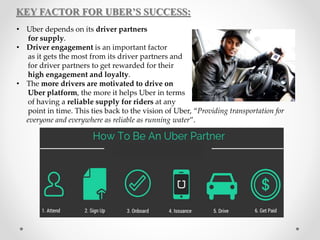
• Uber depends on its driver partners
for supply.
• Driver engagement is an important factor
as it gets the most from its driver partners and
for driver partners to get rewarded for their
high engagement and loyalty.
• The more drivers are motivated to drive on
Uber platform, the more it helps Uber in terms
of having a reliable supply for riders at any
point in time. This ties back to the vision of Uber, “Providing transportation for
everyone and everywhere as reliable as running water”.
EMPLOYEE TREATMENT IN UBER:
 Uber hires private drivers on the basis of –
• Skills & Experience
• Checking Personal Profile (Driving license & Criminal Record, if any)
 They work independently
 Organization’s behaviour with employee depends on review by customer –
• Bonus for positive reviews
• Strict Action for negative reviews
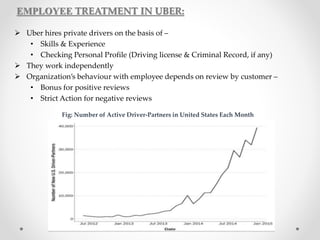
Fig: Number of Active Driver-Partners in United States Each Month
REASONS FOR INCREASE IN ACTIVE DRIVER PARTNERS:
Most drivers don’t schedule themselves, they drive when they have time.
Flexibility is a big motivating factor.
People are using the app both as drivers and passengers.
• 88% started driving with Uber because it fits their life well, not because it was
their only option.
• More than 1 in 4 drivers take Uber (as a passenger) at least once a month.
Increasingly, people do not talk about “becoming an Uber driver-partner.”
It’s a much simpler decision – do I want to make money using my car?
• 50% drive fewer than 10 hours per week on average; 40% say when they drive,
it just depends what else is on their schedule, 38% set an earnings goal, 16%
drive a set amount of time.
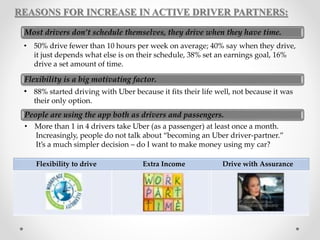
Flexibility to drive Extra Income Drive with Assurance
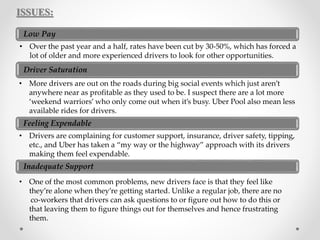
ISSUES:
Low Pay
Driver Saturation
Feeling Expendable
Inadequate Support
• Over the past year and a half, rates have been cut by 30-50%, which has forced a
lot of older and more experienced drivers to look for other opportunities.
• More drivers are out on the roads during big social events which just aren’t
anywhere near as profitable as they used to be. I suspect there are a lot more
‘weekend warriors’ who only come out when it’s busy. Uber Pool also mean less
available rides for drivers.
• Drivers are complaining for customer support, insurance, driver safety, tipping,
etc., and Uber has taken a “my way or the highway” approach with its drivers
making them feel expendable.
• One of the most common problems, new drivers face is that they feel like
they’re alone when they’re getting started. Unlike a regular job, there are no
co-workers that drivers can ask questions to or figure out how to do this or
that leaving them to figure things out for themselves and hence frustrating
them.
SOLUTION TO THE ISSUES:
Execution and implementation of a Comprehensive Engagement Strategy which
focuses on the following four factors:
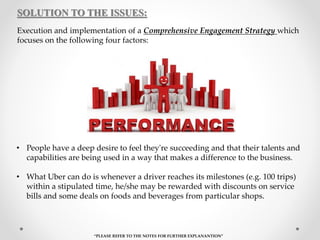
• People have a deep desire to feel they're succeeding and that their talents and
capabilities are being used in a way that makes a difference to the business.
• What Uber can do is whenever a driver reaches its milestones (e.g. 100 trips)
within a stipulated time, he/she may be rewarded with discounts on service
bills and some deals on foods and beverages from particular shops.
“PLEASE REFER TO THE NOTES FOR FURTHER EXPLANANTION”
• A communication process should be structured to inform, emphasize and
reaffirm to employees that their workplace contributions are having an
impact.
• Properly done, communication with staff will provide you with the insights
you need in order to know how your employees feel about working for your
business.
• What Uber can do is have a transparent business system and follow the
above to see a positive change within their employees.
“PLEASE REFER TO THE NOTES FOR FURTHER EXPLANANTION”
• True loyalty is not an enforced requirement but an earned response.
• It’s like a give and take situation. When you demonstrate loyalty to your
employees, they'll reciprocate with commitment and loyalty to your
business.
• People don't begin their employment with you as loyal employees, but will
develop gradually.
• What Uber can do is, they should encourage their employees for their
success and contributions to the company which in turn will form a
loyalty.
“PLEASE REFER TO THE NOTES FOR FURTHER EXPLANANTION”
• While this may seem odd at first but think about it: People want to work for
a winner.
• Take the time to identify and inform your clients and your employees about
your unique competitive advantage.
• May be the product is similar to others in the marketplace, but the service
can be what distinguishes you.
• Uber being a global platform operating in more than 527 cities has a
competitive edge over other companies.
• Together, these four elements can provide a company with a retention
strategy capable of producing amazing results.
• The key is to make sure the company has integrated all four elements into a
strategy for retaining employees that's grounded in a genuine commitment
to serving its customers and employees well over the long haul.
“PLEASE REFER TO THE NOTES FOR FURTHER EXPLANANTION”
CONCLUSION:
MEASURING THE EFFECTIVENESS OF THE PROGRAM:
• A meta-analysis research (a statistical technique that pools multiple studies) can
be conducted.
• By conducting this research regularly over time and increasing the number of
work units analysed, we can get a cutting edge of how well employee
engagement predicts key performance outcomes.
• We can conduct this research on the basis of eight iterates:
customer ratings
profitability
productivity
turnover
safety incidents
shrinkage (theft)
absenteeism
patient safety incidents
quality (defects)
“PLEASE REFER TO THE NOTES FOR FURTHER EXPLANANTION”
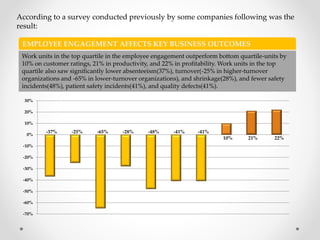
According to a survey conducted previously by some companies following was the
result:
-70%
-60%
-50%
-40%
-30%
-20%
-10%
0%
10%
20%
30%
-37% -25% -65% -28% -48% -41% -41%
10% 21% 22%
Work units in the top quartile in the employee engagement outperform bottom quartile-units by
10% on customer ratings, 21% in productivity, and 22% in profitability. Work units in the top
quartile also saw significantly lower absenteeism(37%), turnover(-25% in higher-turnover
organizations and -65% in lower-turnover organizations), and shrinkage(28%), and fewer safety
incidents(48%), patient safety incidents(41%), and quality defects(41%).
EMPLOYEE ENGAGEMENT AFFECTS KEY BUSINESS OUTCOMES
Everyone’s private driver