ANALYSING
Abii-Ndoh, Godwin Tunmise
BY
Deepika Sethia
Hnuna RK
Balaji K
Salman KP
Saravana kumar
Vinodh Kanna
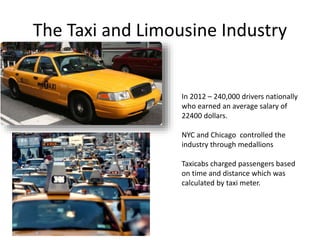
The Taxi and Limousine Industry
In 2012 – 240,000 drivers nationally
who earned an average salary of
22400 dollars.
NYC and Chicago controlled the
industry through medallions
Taxicabs charged passengers based
on time and distance which was
calculated by taxi meter.
AN OVERVIEW OF THE COMPANY
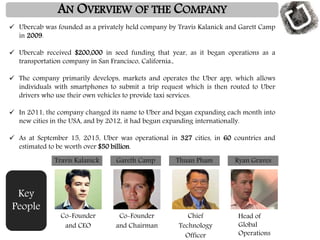
Key
People
Head of
Global
Operations
Co-Founder
and CEO
Travis Kalanick
Co-Founder
and Chairman
Gareth Camp
Chief
Technology
Officer
Thuan Pham Ryan Graves
 Ubercab was founded as a privately held company by Travis Kalanick and Garett Camp
in 2009.
 Ubercab received $200,000 in seed funding that year, as it began operations as a
transportation company in San Francisco, California.,
 The company primarily develops, markets and operates the Uber app, which allows
individuals with smartphones to submit a trip request which is then routed to Uber
drivers who use their own vehicles to provide taxi services.
 In 2011, the company changed its name to Uber and began expanding each month into
new cities in the USA, and by 2012, it had begun expanding internationally.
 As at September 15, 2015, Uber was operational in 327 cities, in 60 countries and
estimated to be worth over $50 billion.
WHAT DOES UBER DO?
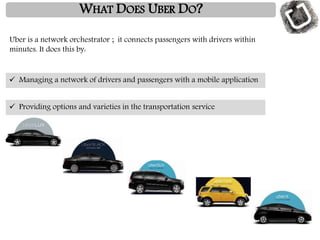
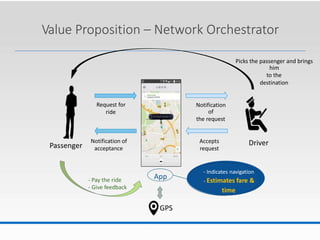
Uber is a network orchestrator ; it connects passengers with drivers within
minutes. It does this by:
 Providing options and varieties in the transportation service
 Managing a network of drivers and passengers with a mobile application
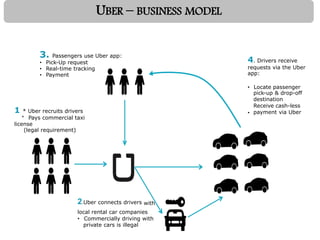
The business model in an explanation
3. Passengers use Uber app:
• Pick-Up request
• Real-time tracking
• Payment
4. Drivers receive
requests via the Uber
app:
• Locate passenger
pick-up & drop-off
destination
Receive cash-less
payment via Uber1 * Uber recruits drivers
* Pays commercial taxi
license
(legal requirement)
•
2.Uber connects drivers with
local rental car companies
• Commercially driving with
private cars is illegal
UBER – BUSINESS MODEL
Value Proposition – Network Orchestrator
Picks the passenger and brings
him
to the
destination
Request for
ride
Notification
of
the request
Notification of
acceptance
Accepts
request
DriverPassenger
- Indicates navigation
- Estimates fare &
time
App- Pay the ride
- Give feedback
GPS
1
0
UBER
TECHNOLOGIES
UBER’S OPERATIONAL FRAMEWORK
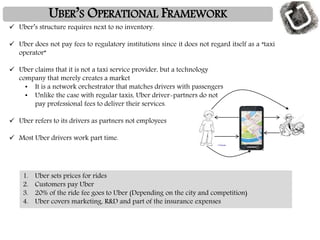
 Uber’s structure requires next to no inventory.
 Uber does not pay fees to regulatory institutions since it does not regard itself as a “taxi
operator”
 Uber claims that it is not a taxi service provider, but a technology
company that merely creates a market
• It is a network orchestrator that matches drivers with passengers
• Unlike the case with regular taxis, Uber driver-partners do not
pay professional fees to deliver their services.
 Uber refers to its drivers as partners not employees
 Most Uber drivers work part time.
1. Uber sets prices for rides
2. Customers pay Uber
3. 20% of the ride fee goes to Uber (Depending on the city and competition)
4. Uber covers marketing, R&D and part of the insurance expenses
PROMOTION AND BRANDING
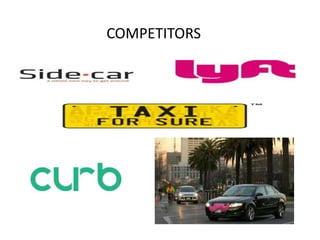
COMPETITORS
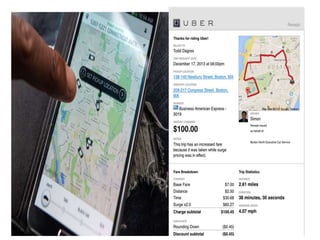
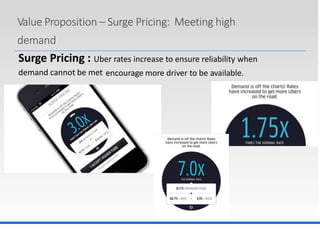
Value Proposition – Surge Pricing: Meeting high
demand
Surge Pricing : Uber rates increase to ensure reliability when
demand cannot be met encourage more driver to be available.
1
2
UBER
TECHNOLOGIES
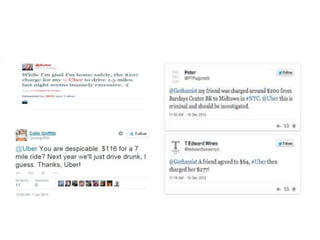
SURGE PRICING : CEO’S RESPONSE
- Without Surge pricing, there will be no cars available.
- Shorter wait times.
- More time spent on comfort of the riders home as opposed to on a windy,
rainy or a bitterly cold street.
- Surge Pricing was designed to maximise number of rides, not revenue.
Incentivized drives to work even after their given target was achieved.
Encouraged drivers to be available during high demands.
Q & A
Is it time to change models or Uber should stay the course?
Would emergence of more competition affect Uber’s choice?
THANK YOU……!!!!

Uber -MBA Pondicherry

  • 1.
    ANALYSING Abii-Ndoh, Godwin Tunmise BY DeepikaSethia Hnuna RK Balaji K Salman KP Saravana kumar Vinodh Kanna
  • 2.
    The Taxi andLimousine Industry In 2012 – 240,000 drivers nationally who earned an average salary of 22400 dollars. NYC and Chicago controlled the industry through medallions Taxicabs charged passengers based on time and distance which was calculated by taxi meter.
  • 3.
    AN OVERVIEW OFTHE COMPANY Key People Head of Global Operations Co-Founder and CEO Travis Kalanick Co-Founder and Chairman Gareth Camp Chief Technology Officer Thuan Pham Ryan Graves  Ubercab was founded as a privately held company by Travis Kalanick and Garett Camp in 2009.  Ubercab received $200,000 in seed funding that year, as it began operations as a transportation company in San Francisco, California.,  The company primarily develops, markets and operates the Uber app, which allows individuals with smartphones to submit a trip request which is then routed to Uber drivers who use their own vehicles to provide taxi services.  In 2011, the company changed its name to Uber and began expanding each month into new cities in the USA, and by 2012, it had begun expanding internationally.  As at September 15, 2015, Uber was operational in 327 cities, in 60 countries and estimated to be worth over $50 billion.
  • 4.
    WHAT DOES UBERDO? Uber is a network orchestrator ; it connects passengers with drivers within minutes. It does this by:  Providing options and varieties in the transportation service  Managing a network of drivers and passengers with a mobile application
  • 5.
    The business modelin an explanation 3. Passengers use Uber app: • Pick-Up request • Real-time tracking • Payment 4. Drivers receive requests via the Uber app: • Locate passenger pick-up & drop-off destination Receive cash-less payment via Uber1 * Uber recruits drivers * Pays commercial taxi license (legal requirement) • 2.Uber connects drivers with local rental car companies • Commercially driving with private cars is illegal UBER – BUSINESS MODEL
  • 7.
    Value Proposition –Network Orchestrator Picks the passenger and brings him to the destination Request for ride Notification of the request Notification of acceptance Accepts request DriverPassenger - Indicates navigation - Estimates fare & time App- Pay the ride - Give feedback GPS 1 0 UBER TECHNOLOGIES
  • 8.
    UBER’S OPERATIONAL FRAMEWORK Uber’s structure requires next to no inventory.  Uber does not pay fees to regulatory institutions since it does not regard itself as a “taxi operator”  Uber claims that it is not a taxi service provider, but a technology company that merely creates a market • It is a network orchestrator that matches drivers with passengers • Unlike the case with regular taxis, Uber driver-partners do not pay professional fees to deliver their services.  Uber refers to its drivers as partners not employees  Most Uber drivers work part time. 1. Uber sets prices for rides 2. Customers pay Uber 3. 20% of the ride fee goes to Uber (Depending on the city and competition) 4. Uber covers marketing, R&D and part of the insurance expenses
  • 9.
  • 10.
  • 11.
    Value Proposition –Surge Pricing: Meeting high demand Surge Pricing : Uber rates increase to ensure reliability when demand cannot be met encourage more driver to be available. 1 2 UBER TECHNOLOGIES
  • 13.
    SURGE PRICING :CEO’S RESPONSE - Without Surge pricing, there will be no cars available. - Shorter wait times. - More time spent on comfort of the riders home as opposed to on a windy, rainy or a bitterly cold street. - Surge Pricing was designed to maximise number of rides, not revenue. Incentivized drives to work even after their given target was achieved. Encouraged drivers to be available during high demands.
  • 14.
    Q & A Isit time to change models or Uber should stay the course? Would emergence of more competition affect Uber’s choice?
  • 15.