“We just wanted to push a button and get a ride. That’s all it was about”
-Trent Kalanick
BUSINESS MODEL & CUSTOMER VALUE PROPOSITION
Strengths
• Labor based cost advantage: Less liability of drivers, unionization &
employee benefits
• Lifestyle: Services catering to upper class customers
• Sharing economy: Strengthen communities, decreased barrier of entries
& environmental impact
• Technology: Providing platforms for connections between drivers and
riders
• Profits: Non payment of minimum wages, car registration fees & surge
pricing
Weakness
• Labor based cost advantage: Law suits from competitors
• Lifestyle: Pool of average earning customers avoided
• Sharing economy: Avoidance of tax payments, insurance &
government regulations
• Technology: Non availability of licenses and registered drivers when
compared with cab services
• Profits: Decreased due to regulations and smaller rivalries
Bargaining power of suppliers:
• Surge pricing according to demand and supply
• Minimum pricing and margins for drivers
• Non payment of taxes & car registration fees,
avoiding insurance and following government
regulations
• Drivers classified as contractors to get labor based
cost advantage
• Less liability of drivers hence free from unions and
need not provide benefits to drivers
Bargaining power of buyers:
• Fall in the price of medallion benefiting the drivers
• Splitting cost and cashless transaction for customers
• Work permits obtained due to consumer demands
• Drivers accept & cancel bookings during surge prices
• Common rules and regulations for sharing economy
• As drivers were independent contractors they were not limited
to just uber
Threat of new entrants
• Relaunch of “Curb” providing entertainment and
payment services in green & yellow taxis
• “Lyft” based in San Francisco the most significant
competitor nationally along with “Didi Kuaidi” in
China & “Olacabs” from India
• Other smaller rivals like HopSkipDrive,
CareDrivers, Zum, Fasten etc.
• Other ridesharing apps like Fare, Fasten, Wingz,
zTrip, RideAustin & InstaRyde
Threat Of Substitutes
• China & India proposed a draft forcing ridesharing apps to
operate more like taxi fleets
• “Lyft” offered multiple levels of service such as “Lyft Line”,
“Lyft Plus” etc.
• Surging Price difference between Lyft and Uber was about 4
times different
• Difference in ride experience with Uber providing business
feel and Lyft providing “buddy” feel
• Had to suspend operations in Austin due to stringent
regulations to create fair playing field with traditional taxis
Rivalry among existing competition
• “Operation SLOG” used by Uber for poaching competitor (Lyft) drivers
• Canceling rides by creating fake accounts from both Uber & Lyft
• Olacabs creating fake accounts and fraudulent ride requests to block
competition
• Uber’s International rivals joining forces such as “Olacabs” & “Didi Kuaidi”
with the ability to book and pay within each others apps
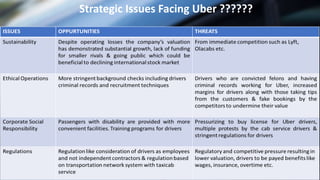
Strategic Issues Facing Uber ??????
THANK YOU

Uber case study

  • 1.
    “We just wantedto push a button and get a ride. That’s all it was about” -Trent Kalanick
  • 2.
    BUSINESS MODEL &CUSTOMER VALUE PROPOSITION Strengths • Labor based cost advantage: Less liability of drivers, unionization & employee benefits • Lifestyle: Services catering to upper class customers • Sharing economy: Strengthen communities, decreased barrier of entries & environmental impact • Technology: Providing platforms for connections between drivers and riders • Profits: Non payment of minimum wages, car registration fees & surge pricing Weakness • Labor based cost advantage: Law suits from competitors • Lifestyle: Pool of average earning customers avoided • Sharing economy: Avoidance of tax payments, insurance & government regulations • Technology: Non availability of licenses and registered drivers when compared with cab services • Profits: Decreased due to regulations and smaller rivalries
  • 3.
    Bargaining power ofsuppliers: • Surge pricing according to demand and supply • Minimum pricing and margins for drivers • Non payment of taxes & car registration fees, avoiding insurance and following government regulations • Drivers classified as contractors to get labor based cost advantage • Less liability of drivers hence free from unions and need not provide benefits to drivers Bargaining power of buyers: • Fall in the price of medallion benefiting the drivers • Splitting cost and cashless transaction for customers • Work permits obtained due to consumer demands • Drivers accept & cancel bookings during surge prices • Common rules and regulations for sharing economy • As drivers were independent contractors they were not limited to just uber Threat of new entrants • Relaunch of “Curb” providing entertainment and payment services in green & yellow taxis • “Lyft” based in San Francisco the most significant competitor nationally along with “Didi Kuaidi” in China & “Olacabs” from India • Other smaller rivals like HopSkipDrive, CareDrivers, Zum, Fasten etc. • Other ridesharing apps like Fare, Fasten, Wingz, zTrip, RideAustin & InstaRyde Threat Of Substitutes • China & India proposed a draft forcing ridesharing apps to operate more like taxi fleets • “Lyft” offered multiple levels of service such as “Lyft Line”, “Lyft Plus” etc. • Surging Price difference between Lyft and Uber was about 4 times different • Difference in ride experience with Uber providing business feel and Lyft providing “buddy” feel • Had to suspend operations in Austin due to stringent regulations to create fair playing field with traditional taxis
  • 4.
    Rivalry among existingcompetition • “Operation SLOG” used by Uber for poaching competitor (Lyft) drivers • Canceling rides by creating fake accounts from both Uber & Lyft • Olacabs creating fake accounts and fraudulent ride requests to block competition • Uber’s International rivals joining forces such as “Olacabs” & “Didi Kuaidi” with the ability to book and pay within each others apps
  • 5.
  • 6.