FY15 – FY17 IPO preparation timeline
Corporate governance
process
24-months before IPO
21-months before IPO
Compliance with laws
and regulations
18-months before IPO
Preparation of
financial history
15-months before IPO
Does IPO still makes most sense
for future of business?
12-months before IPO
Make changes as necessary to
Board of Directors & executive
management
9-months before IPO
Mitigate risk and
address the issues
IPO
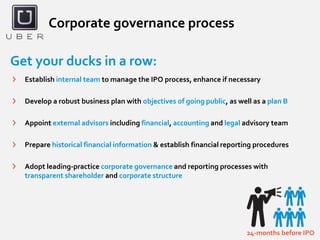
Corporate governance process
24-months before IPO
Establish internal team to manage the IPO process, enhance if necessary
Develop a robust business plan with objectives of going public, as well as a plan B
Appoint external advisors including financial, accounting and legal advisory team
Prepare historical financial information & establish financial reporting procedures
Adopt leading-practice corporate governance and reporting processes with
transparent shareholder and corporate structure
Get your ducks in a row:
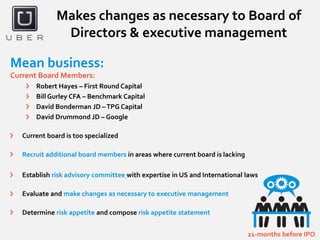
Makes changes as necessary to Board of
Directors & executive management
21-months before IPO
Current Board Members:
Robert Hayes – First Round Capital
Bill Gurley CFA – Benchmark Capital
David Bonderman JD –TPG Capital
David Drummond JD – Google
Current board is too specialized
Recruit additional board members in areas where current board is lacking
Establish risk advisory committee with expertise in US and International laws
Evaluate and make changes as necessary to executive management
Determine risk appetite and compose risk appetite statement
Mean business:
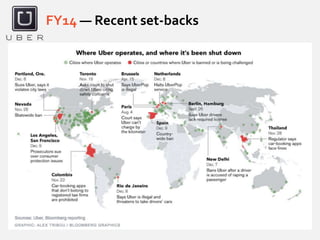
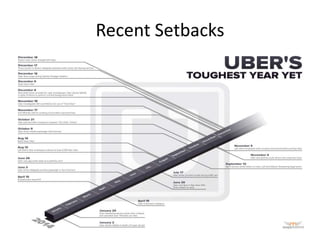
FY14 ― Recent set-backs
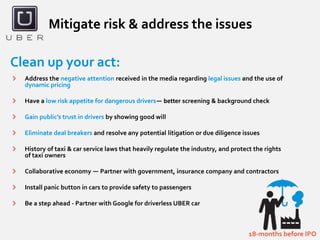
Mitigate risk & address the issues
18-months before IPO
Address the negative attention received in the media regarding legal issues and the use of
dynamic pricing
Have a low risk appetite for dangerous drivers― better screening & background check
Gain public’s trust in drivers by showing good will
Eliminate deal breakers and resolve any potential litigation or due diligence issues
History of taxi & car service laws that heavily regulate the industry, and protect the rights
of taxi owners
Collaborative economy ― Partner with government, insurance company and contractors
Install panic button in cars to provide safety to passengers
Be a step ahead - Partner with Google for driverless UBER car
Clean up your act:
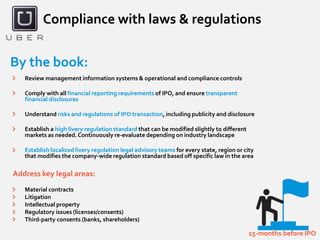
Compliance with laws & regulations
15-months before IPO
Review management information systems & operational and compliance controls
Comply with all financial reporting requirements of IPO, and ensure transparent
financial disclosures
Understand risks and regulations of IPO transaction, including publicity and disclosure
Establish a high livery regulation standard that can be modified slightly to different
markets as needed.Continuously re-evaluate depending on industry landscape
Establish localized livery regulation legal advisory teams for every state, region or city
that modifies the company-wide regulation standard based off specific law in the area
Address key legal areas:
Material contracts
Litigation
Intellectual property
Regulatory issues (licenses/consents)
Third-party consents (banks, shareholders)
By the book:
One month analysis
12 - months before IPO
0
0
0
0
0
1
1
1
1
1
1
LULU ADDYY GPS NKE
LULU
ADDYY
GPS
NKE
One month analysis
12 - months before IPO
0
0
0
0
0
1
1
1
1
1
1
LULU ADDYY GPS NKE
LULU
ADDYY
GPS
NKE
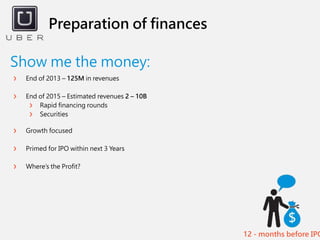
Preparation of finances
12 - months before IPO
End of 2013 – 125M in revenues
End of 2015 – Estimated revenues 2 – 10B
Rapid financing rounds
Securities
Growth focused
Primed for IPO within next 3 Years
Where’s the Profit?
Show me the money:
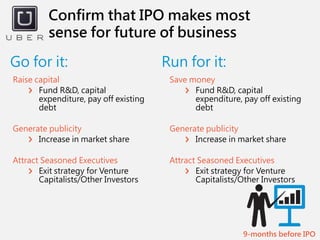
Confirm that IPO makes most
sense for future of business
Raise capital
Fund R&D, capital
expenditure, pay off existing
debt
Generate publicity
Increase in market share
Attract Seasoned Executives
Exit strategy for Venture
Capitalists/Other Investors
9-months before IPO
Save money
Fund R&D, capital
expenditure, pay off existing
debt
Generate publicity
Increase in market share
Attract Seasoned Executives
Exit strategy for Venture
Capitalists/Other Investors
Go for it: Run for it:
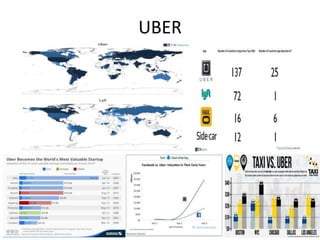
UBER
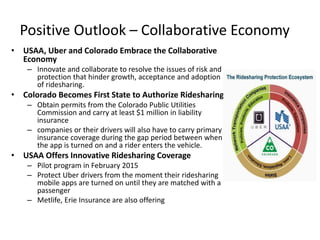
Positive Outlook – Collaborative Economy
• USAA, Uber and Colorado Embrace the Collaborative
Economy
– Innovate and collaborate to resolve the issues of risk and
protection that hinder growth, acceptance and adoption
of ridesharing.
• Colorado Becomes First State to Authorize Ridesharing
– Obtain permits from the Colorado Public Utilities
Commission and carry at least $1 million in liability
insurance
– companies or their drivers will also have to carry primary
insurance coverage during the gap period between when
the app is turned on and a rider enters the vehicle.
• USAA Offers Innovative Ridesharing Coverage
– Pilot program in February 2015
– Protect Uber drivers from the moment their ridesharing
mobile apps are turned on until they are matched with a
passenger
– Metlife, Erie Insurance are also offering
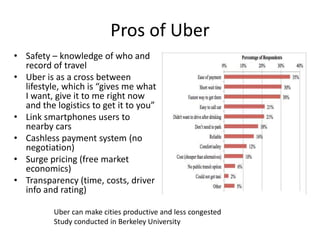
Pros of Uber
• Safety – knowledge of who and
record of travel
• Uber is as a cross between
lifestyle, which is “gives me what
I want, give it to me right now
and the logistics to get it to you”
• Link smartphones users to
nearby cars
• Cashless payment system (no
negotiation)
• Surge pricing (free market
economics)
• Transparency (time, costs, driver
info and rating)
Uber can make cities productive and less congested
Study conducted in Berkeley University
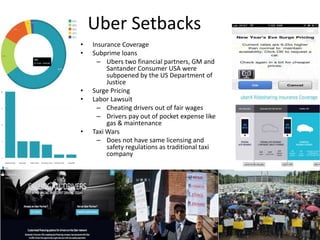
Uber Setbacks
• Insurance Coverage
• Subprime loans
– Ubers two financial partners, GM and
Santander Consumer USA were
subpoened by the US Department of
Justice
• Surge Pricing
• Labor Lawsuit
– Cheating drivers out of fair wages
– Drivers pay out of pocket expense like
gas & maintenance
• Taxi Wars
– Does not have same licensing and
safety regulations as traditional taxi
company
Recent Setbacks
Risks and Challenges
• Uber will need to address the negative attention
it has received in the media regarding legal issues
and the use of dynamic pricing
• Better drivers screening and background check
• Facing Uber is a potential ubiquitous history of
taxi and car service laws that heavily regulate the
industry, and protect the rights of taxi owners
• Drivers can acquire new customers and implore
them to call directly instead of using the app
Risks and Challenges
• Drivers can work for multiple companies
therefore it might be difficult to know when
they use the app and when they don’t
• Be a step ahead and make sure Uber doesn’t
miss any opportunity
• Uber relies heavily on social media for its
promotions, so any controversial negative
experience comments could affect the
popularity