TYPES OF SPILLWAYS
TYPES OF SPILLWAYS
Spillways
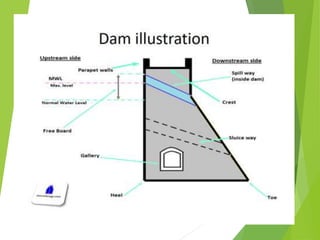
 A spillways is a structure constructed at or near
the dam site to dispose of surplus water from the
reservoir to the channel downstream.
 Spillways are provided for all dams as a safety
measure against overtopping and the consequent
damages and failure.
Types of spillway based on utility :
 Main spillways :
A main spillway is the one which is the to come into
operation and is designed to pass the entire spillway design
flood. This spillway is necessary for all dams and in most of
the dams , it is the only spillway.
 Auxillary spillway :
In some cases, where site condition are favourable it may
be economical to provide an auxillary spillway in conjunction
with a smaller main spillway. The total capacity is then
equal to the sum of the capacities of the main and the
auxillary spillways.
 Emergency spillway :
An emergency spillway is one which is provided in addition
to the main spillway but it comes into operation only during
emergency which may arise at any time and the same might
not have been considered in the normal design of the main
spillway.
Types of spillway based on most prominent features
 Straight drop spillway
 Overflow spillway
 Side channel spillway
 Open channel spillway
 Tunnel spillway
 Shaft spillway
 Siphon spillway
Free overflow spillway or Straight drop spillway
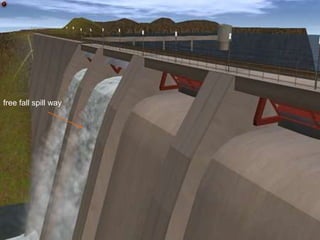
 The overflowing water may discharge as a free jet clearly
away from the d/s face crest of the spillway.
Free overflow spillway or Straight drop spillway
1. It should be consists of lower height.
2. Narrow crested weir at the downstream side.
3. The overflow of water pass though free nappe or
crest weir
4. It should be consists of lower dams and rock fill
and earthen dams
5. It is not suitable for weak type of foundations
free fall spill way
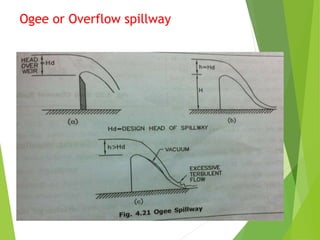
Ogee or Overflow spillway
 An overflow spillway is the most commonly used spillway.
 It is widely used with gravity dams, arch dams and
buttress dams.
 An overflow spillway is an improvement upon the free
overflow spillway.
 The profile of the spillway is ‘ogee’ or ‘s’.
 The overflowing water is guided smoothly over the crest.
 The profile of the spillway so that overflow water does not
break contact with the spillway surface.
Ogee or Overflow spillway
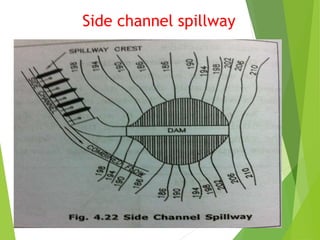
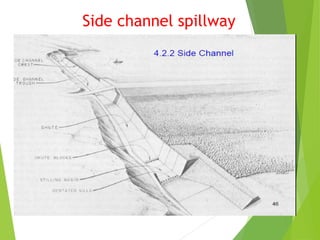
Side channel spillway
 A side channel spillway is the one in which the flow, after
passing over a weir, is carried away by the channel running
essentially parallel to the crest.
 Flow may be directed into an open channel, or a closed
conduit or in an inclined tunnel.
 It may be used as principal spillway or emergency spillway.
 Lining of the side channel spillway with concrete is
required.
 If a sufficient crest length is not available for an over flow
spillways in narrow valleys, excess water is removed from
the reservoir through a side channel spillway.
Side channel spillway
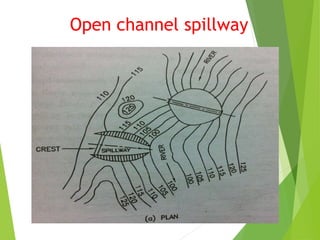
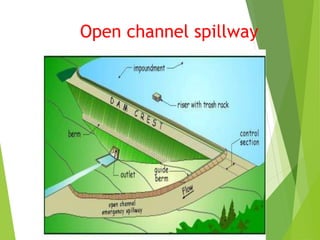
Open channel spillway
 Open channel spillway is provided in the following
situation :
(a) when it is not possible to provide overflow spillway.
(b) when valley is narrow.
(c) when separate site for spillway is not available.
 Generally this type of spillway is provided on earth or
rock fill dam, and is isolated from the main dam.
 The open channel is sometimes of constant width , but
usually narrowed for economy.
Open channel spillway
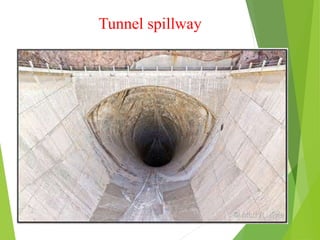
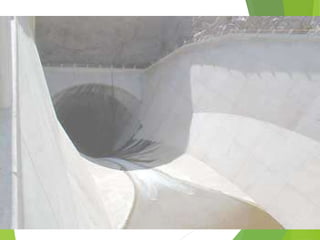
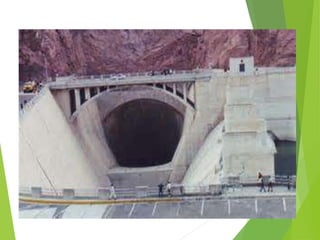
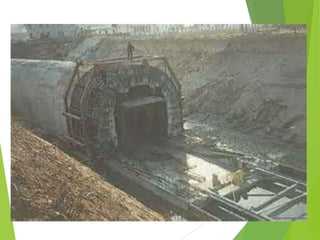
Tunnel spillway
 A tunnel spillway is the one in which a closed
channel is used to convey the discharge around or
near a dam.
 The control structure for this spillway may be in the
form of an overflow crest, vertical or inclined orifice
entrance and side channel crest.
 The tunnel is designed to flow partly full and it is not
allowed to flow full because siphonic action may
develop due to negative pressure being developed in
the tunnel.
Tunnel spillway
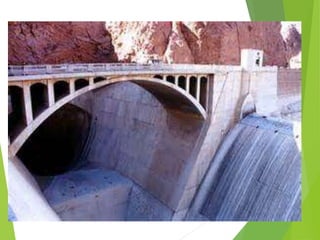
Shaft spillway
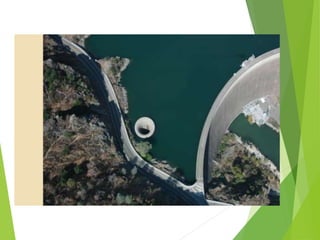
 Shaft spillway is the one which has horizontally positioned
lip through which water enters and then drops through a
vertical shaft and then to a horizontal tunnel which convey
water past the dam.
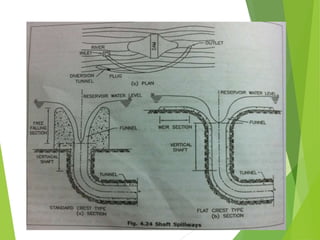
 A shaft spillway consists of three main elements :
(a) overflow control weir
(b) vertical control
(c) closed discharge channel
 The vertical shaft of large structures is usually made of
reinforced concrete and the horizontal tunnel is tunnelled in
rock.
 There are two general types of shaft spillway :
(a) standard crest type
(b) flat crest type
SIPHON SPILLWAYS
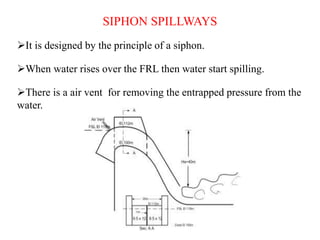
It is designed by the principle of a siphon.
When water rises over the FRL then water start spilling.
There is a air vent for removing the entrapped pressure from the
water.
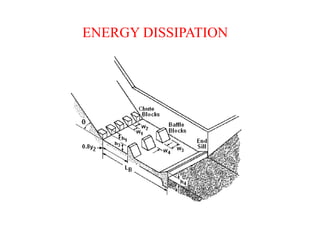
ENERGY DISSIPATION
 As water passes over a spillway and down the
chute, potential energy converts into
increasing kinetic energy capacity of its power
plant.
 The energy can be dissipated by addressing one
or more parts of a spillway's design
ENERGY DISSIPATION

Types of spillways

  • 1.
  • 2.
  • 3.
    Spillways  A spillwaysis a structure constructed at or near the dam site to dispose of surplus water from the reservoir to the channel downstream.  Spillways are provided for all dams as a safety measure against overtopping and the consequent damages and failure.
  • 4.
    Types of spillwaybased on utility :  Main spillways : A main spillway is the one which is the to come into operation and is designed to pass the entire spillway design flood. This spillway is necessary for all dams and in most of the dams , it is the only spillway.  Auxillary spillway : In some cases, where site condition are favourable it may be economical to provide an auxillary spillway in conjunction with a smaller main spillway. The total capacity is then equal to the sum of the capacities of the main and the auxillary spillways.  Emergency spillway : An emergency spillway is one which is provided in addition to the main spillway but it comes into operation only during emergency which may arise at any time and the same might not have been considered in the normal design of the main spillway.
  • 5.
    Types of spillwaybased on most prominent features  Straight drop spillway  Overflow spillway  Side channel spillway  Open channel spillway  Tunnel spillway  Shaft spillway  Siphon spillway
  • 6.
    Free overflow spillwayor Straight drop spillway  The overflowing water may discharge as a free jet clearly away from the d/s face crest of the spillway.
  • 7.
    Free overflow spillwayor Straight drop spillway 1. It should be consists of lower height. 2. Narrow crested weir at the downstream side. 3. The overflow of water pass though free nappe or crest weir 4. It should be consists of lower dams and rock fill and earthen dams 5. It is not suitable for weak type of foundations
  • 8.
  • 9.
    Ogee or Overflowspillway  An overflow spillway is the most commonly used spillway.  It is widely used with gravity dams, arch dams and buttress dams.  An overflow spillway is an improvement upon the free overflow spillway.  The profile of the spillway is ‘ogee’ or ‘s’.  The overflowing water is guided smoothly over the crest.  The profile of the spillway so that overflow water does not break contact with the spillway surface.
  • 10.
  • 12.
    Side channel spillway A side channel spillway is the one in which the flow, after passing over a weir, is carried away by the channel running essentially parallel to the crest.  Flow may be directed into an open channel, or a closed conduit or in an inclined tunnel.  It may be used as principal spillway or emergency spillway.  Lining of the side channel spillway with concrete is required.  If a sufficient crest length is not available for an over flow spillways in narrow valleys, excess water is removed from the reservoir through a side channel spillway.
  • 13.
  • 14.
  • 15.
    Open channel spillway Open channel spillway is provided in the following situation : (a) when it is not possible to provide overflow spillway. (b) when valley is narrow. (c) when separate site for spillway is not available.  Generally this type of spillway is provided on earth or rock fill dam, and is isolated from the main dam.  The open channel is sometimes of constant width , but usually narrowed for economy.
  • 16.
  • 17.
  • 18.
    Tunnel spillway  Atunnel spillway is the one in which a closed channel is used to convey the discharge around or near a dam.  The control structure for this spillway may be in the form of an overflow crest, vertical or inclined orifice entrance and side channel crest.  The tunnel is designed to flow partly full and it is not allowed to flow full because siphonic action may develop due to negative pressure being developed in the tunnel.
  • 19.
  • 24.
    Shaft spillway  Shaftspillway is the one which has horizontally positioned lip through which water enters and then drops through a vertical shaft and then to a horizontal tunnel which convey water past the dam.  A shaft spillway consists of three main elements : (a) overflow control weir (b) vertical control (c) closed discharge channel  The vertical shaft of large structures is usually made of reinforced concrete and the horizontal tunnel is tunnelled in rock.  There are two general types of shaft spillway : (a) standard crest type (b) flat crest type
  • 27.
    SIPHON SPILLWAYS It isdesigned by the principle of a siphon. When water rises over the FRL then water start spilling. There is a air vent for removing the entrapped pressure from the water.
  • 28.
    ENERGY DISSIPATION  Aswater passes over a spillway and down the chute, potential energy converts into increasing kinetic energy capacity of its power plant.  The energy can be dissipated by addressing one or more parts of a spillway's design
  • 29.