WEIRS
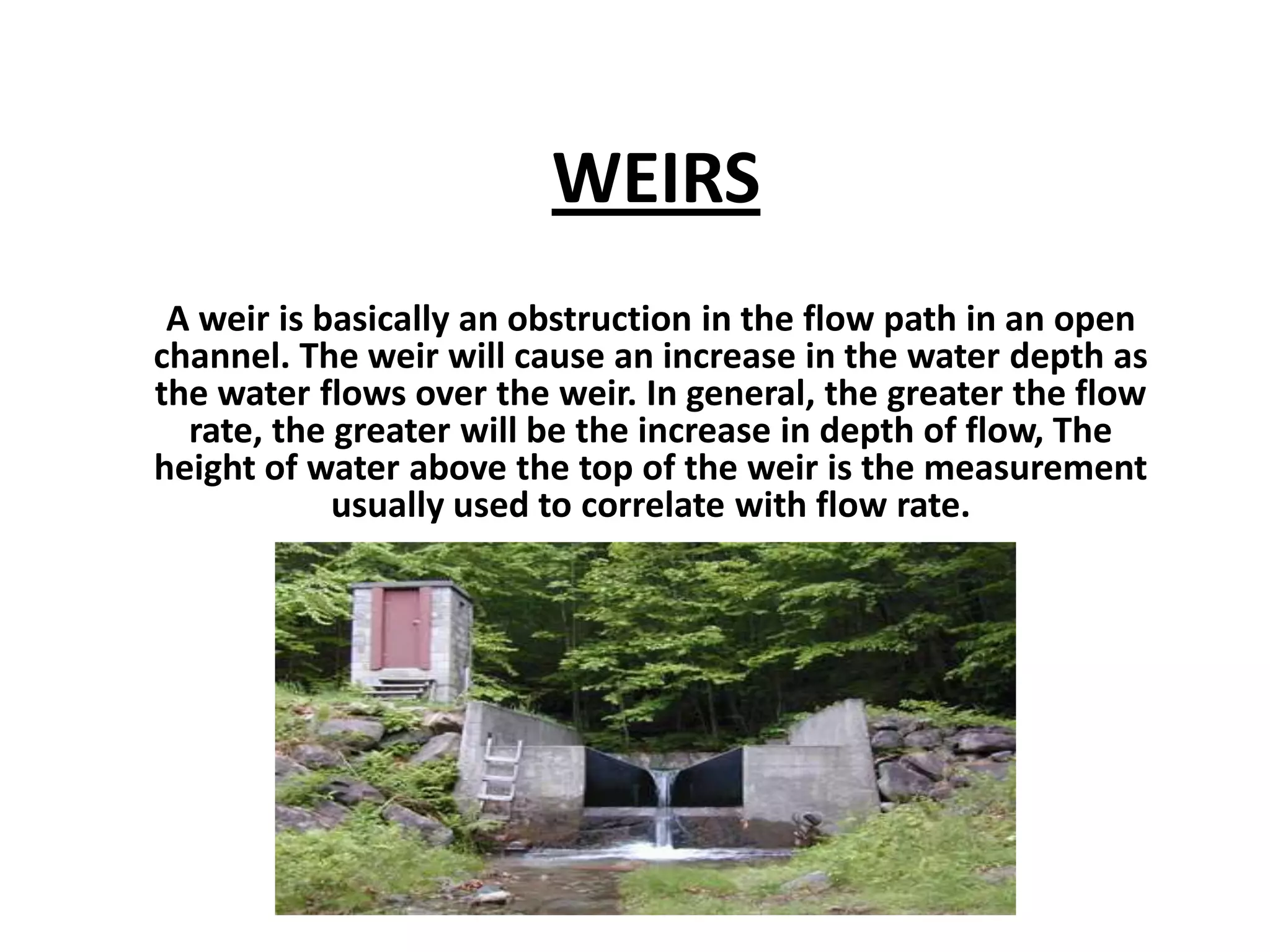
A weir is basically an obstruction in the flow path in an open
channel. The weir will cause an increase in the water depth as
the water flows over the weir. In general, the greater the flow
rate, the greater will be the increase in depth of flow, The
height of water above the top of the weir is the measurement
usually used to correlate with flow rate.
TYPES OF WEIRS
SHARP CRESTED WEIR:
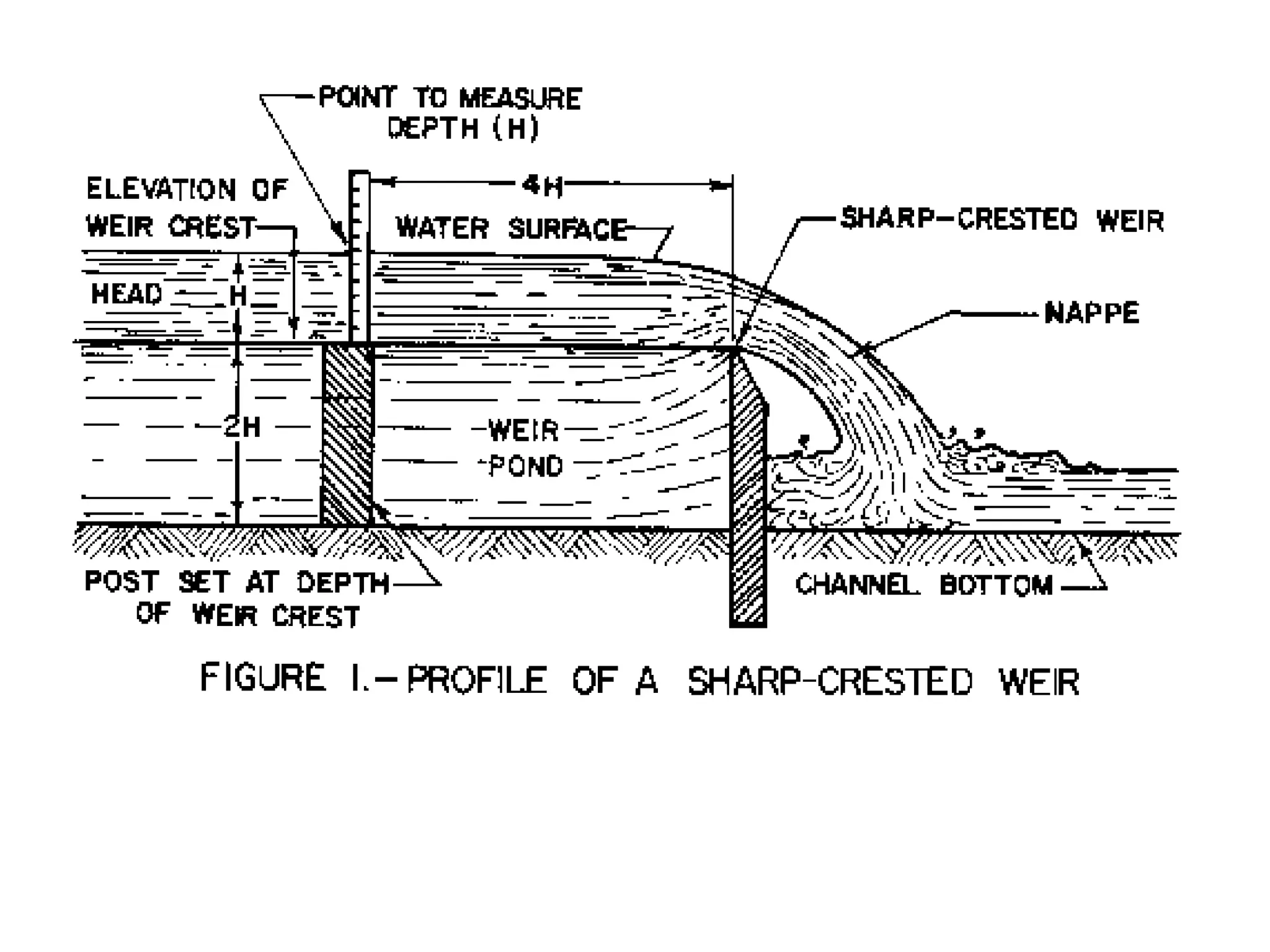
• A weir with a sharp upstream corner or edge such
that the water springs clear of the crest is a sharp-
crested weir.
Sharp-crested weirs are classified according to the
shape of the weir opening, such as rectangular weirs,
triangular or V-notch weirs, trapezoidal weirs, and
parabolic weirs. Weirs not sharp crested are classified
according to the shape of their cross section, such as
broad-crested weirs, triangular weirs, and trapezoidal
weirs.
BROAD CRESTED WEIR
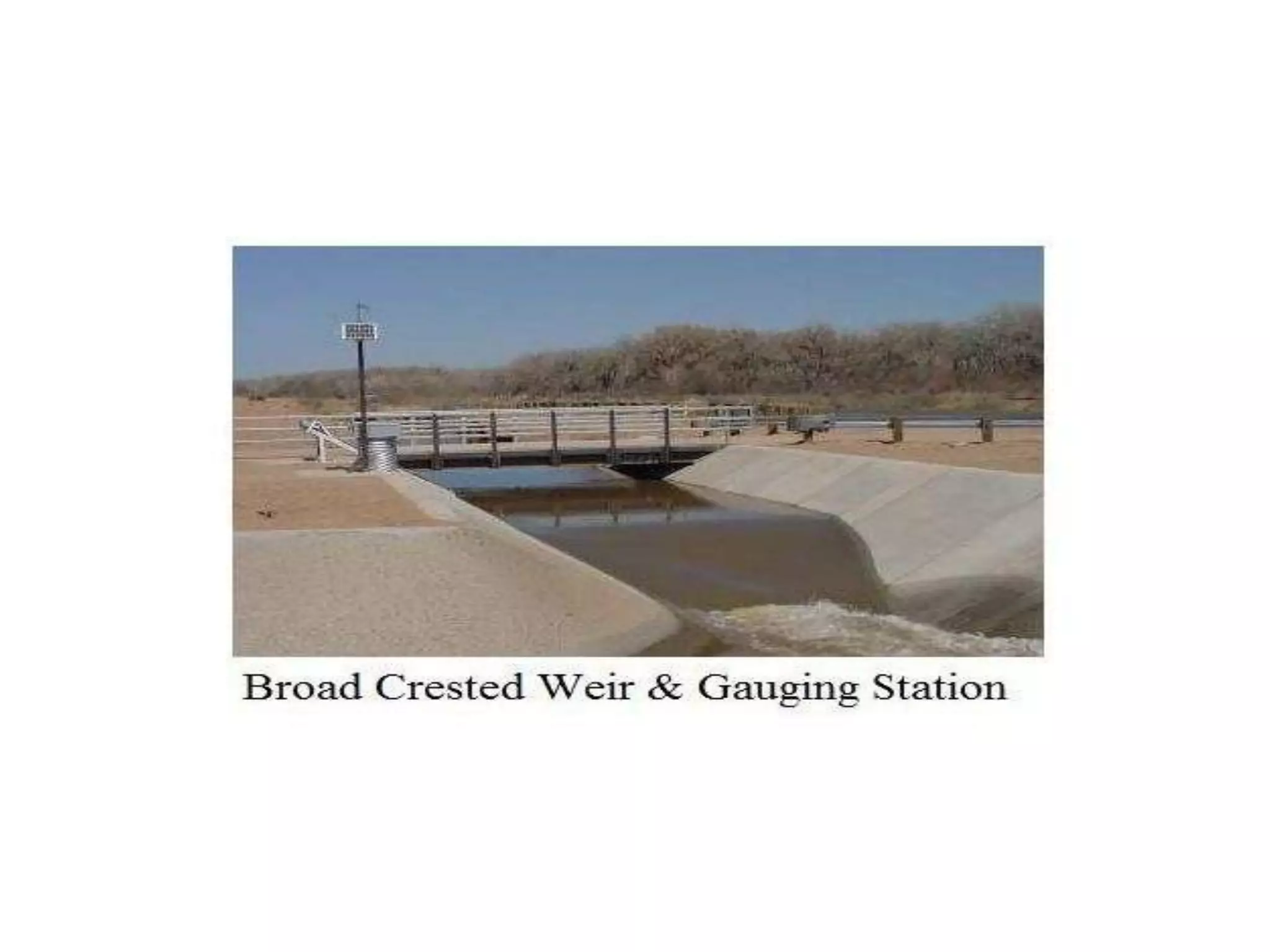
• Broad crested weirs are robust structures that are
generally constructed from reinforced concrete and
which usually span the full width of the
channel. They are used to measure the discharge of
rivers, and are much more suited for this purpose
than the relatively flimsy sharp crested
weirs. Additionally, by virtue of being a critical depth
meter, the broad crested weir has the advantage that
it operates effectively with higher downstream water
levels than a sharp crested weir.
TYPES OF SHARP CRESTED WEIR
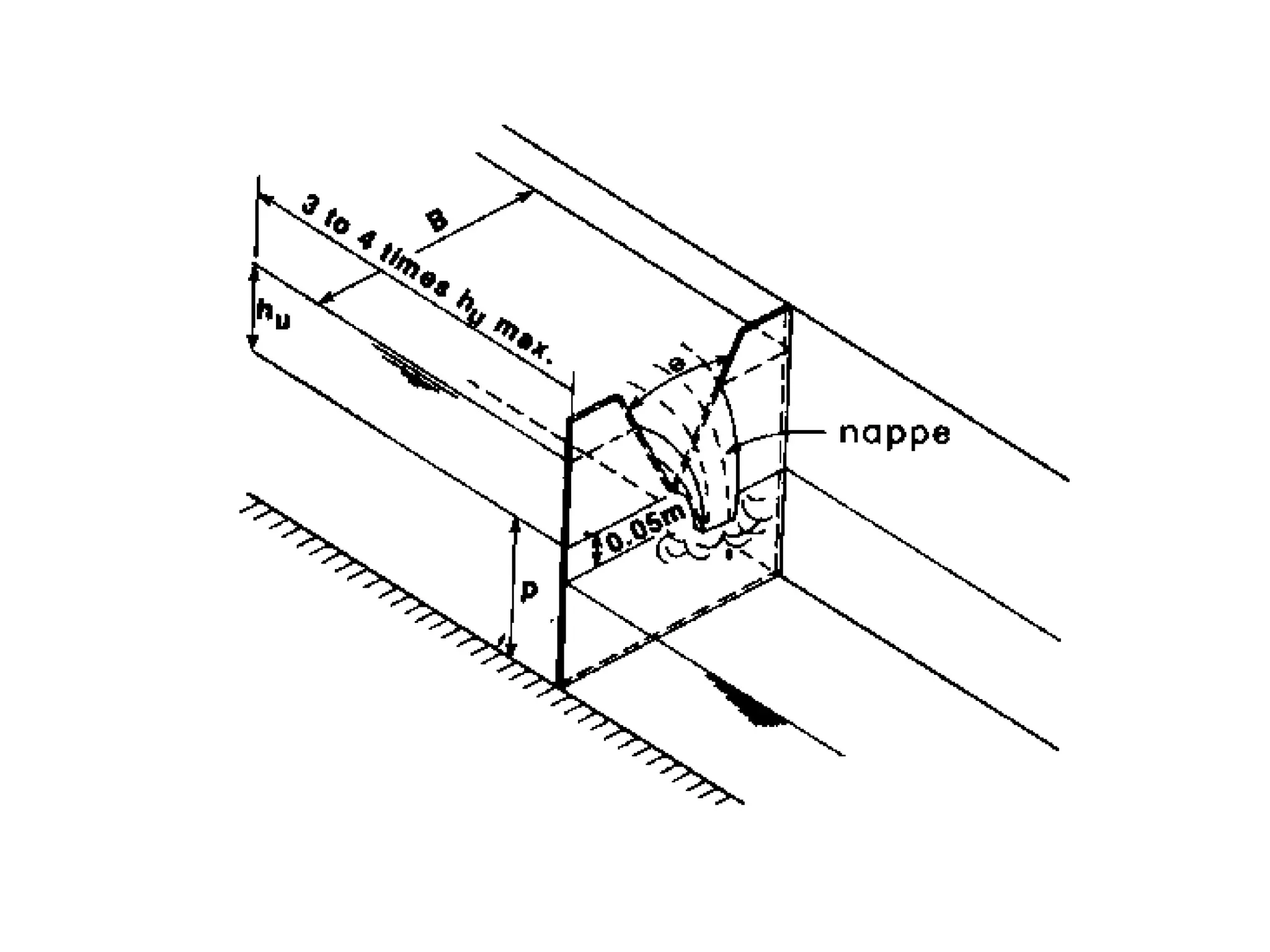
RECTANULAR WEIR NOTCH
• A rectangular notch, symmetrically located in
a vertical thin (metal) plate which is placed
perpendicular to the sides and bottom of a
straight channel, is defined as a rectangular
sharp-crested weir.
SUB DIVISIONS OF RECTANGULAR
WEIR NOTCH
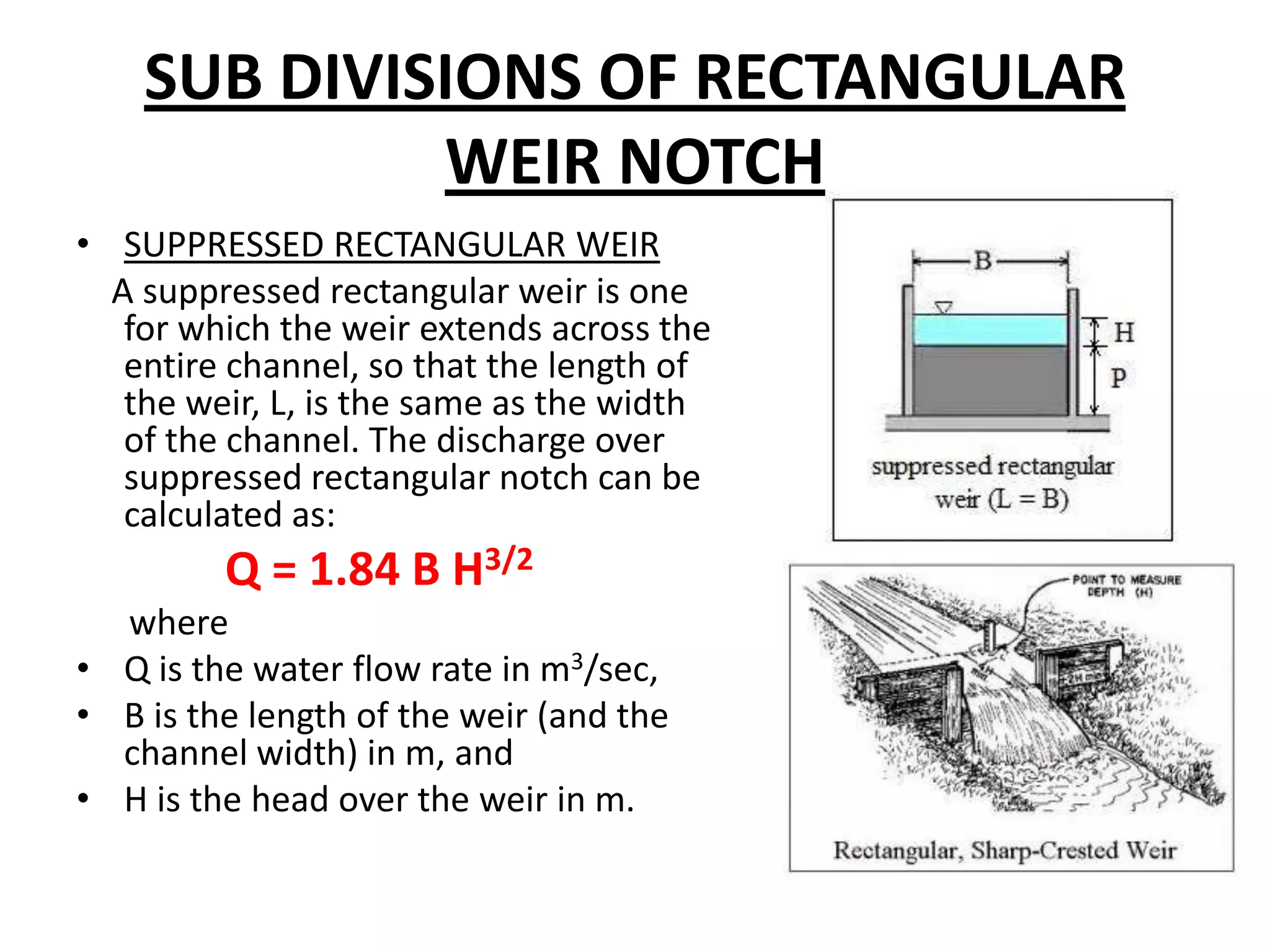
• SUPPRESSED RECTANGULAR WEIR
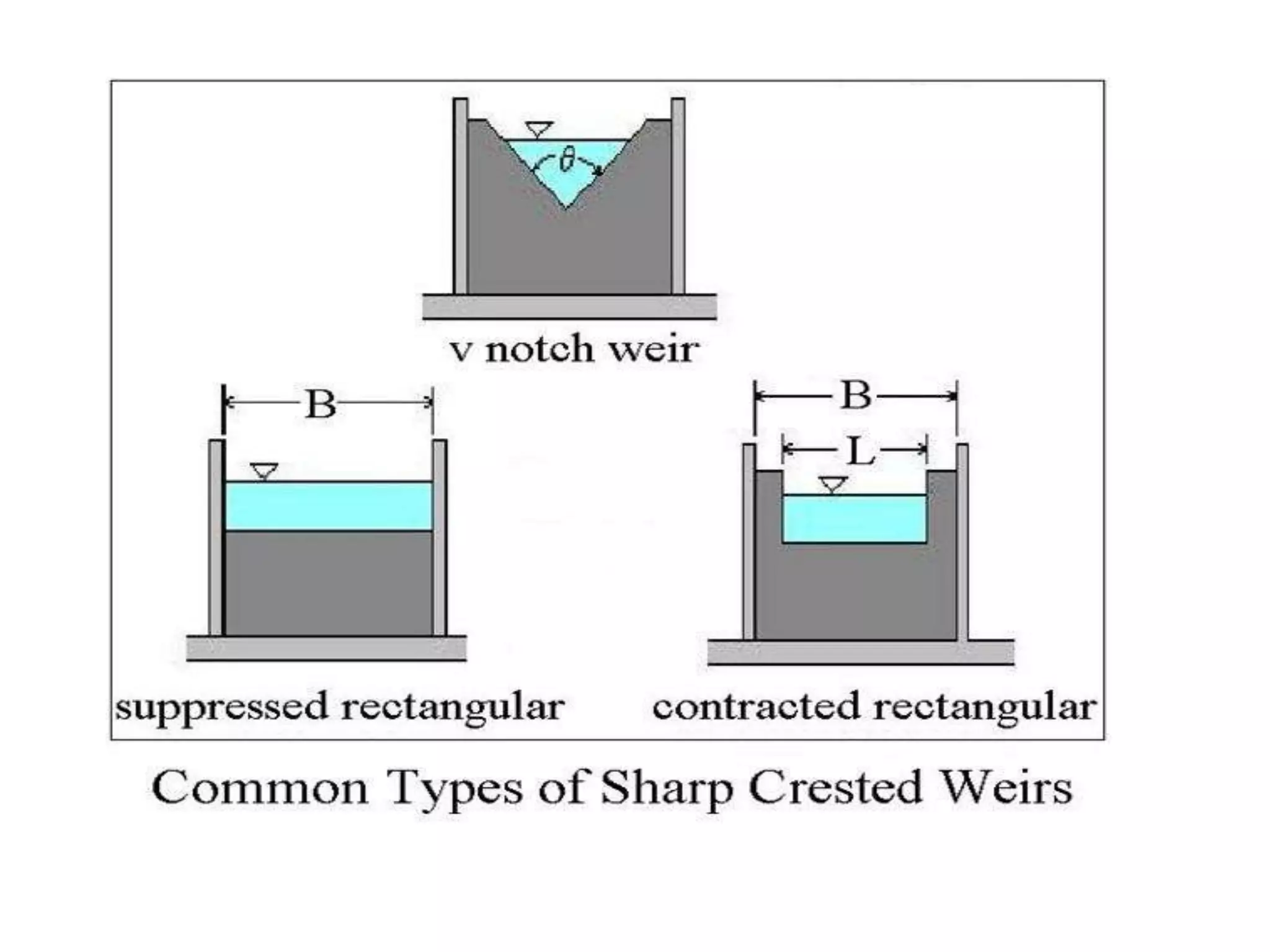
A suppressed rectangular weir is one
for which the weir extends across the
entire channel, so that the length of
the weir, L, is the same as the width
of the channel. The discharge over
suppressed rectangular notch can be
calculated as:
Q = 1.84 B H3/2
where
• Q is the water flow rate in m3/sec,
• B is the length of the weir (and the
channel width) in m, and
• H is the head over the weir in m.
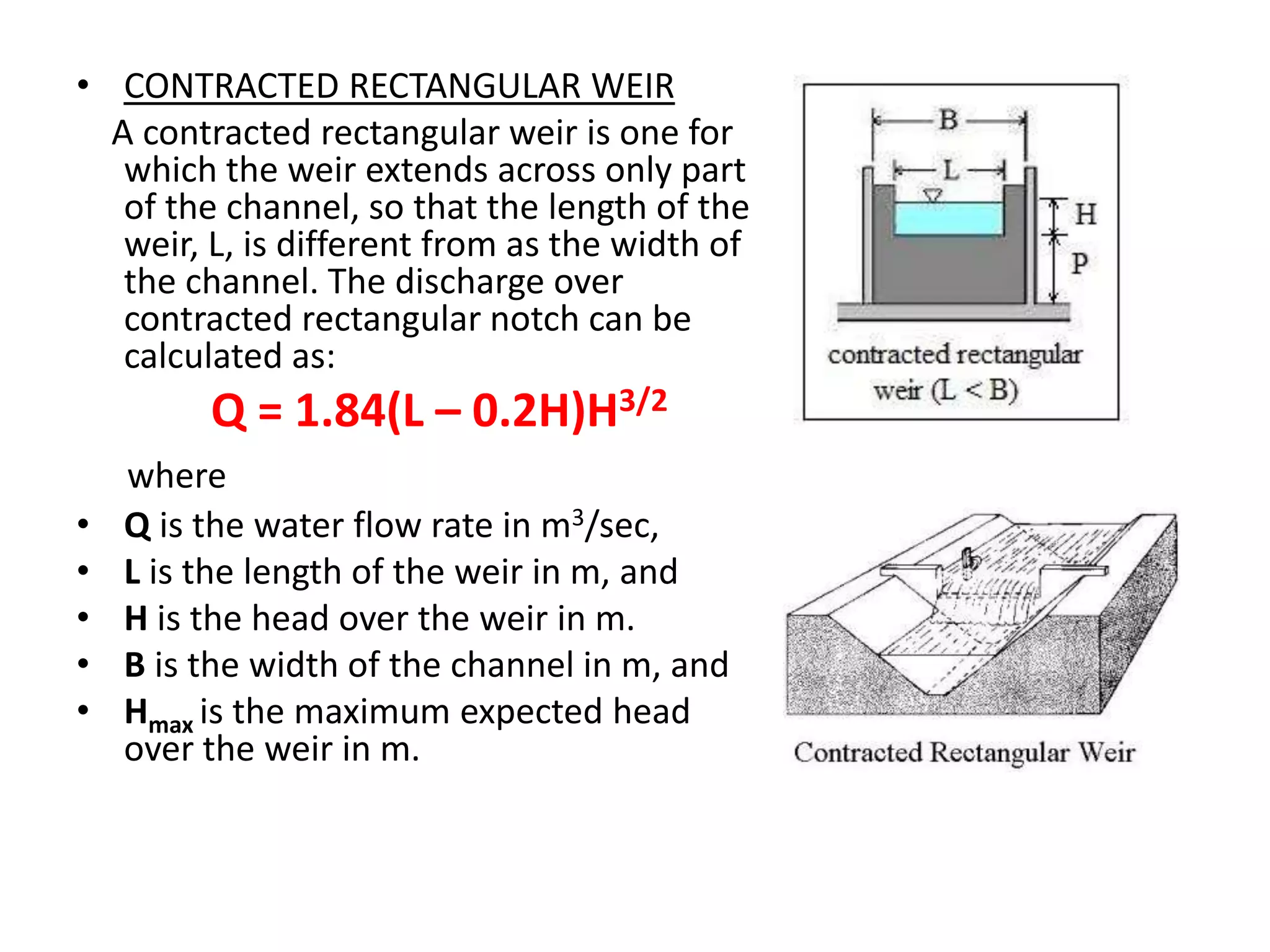
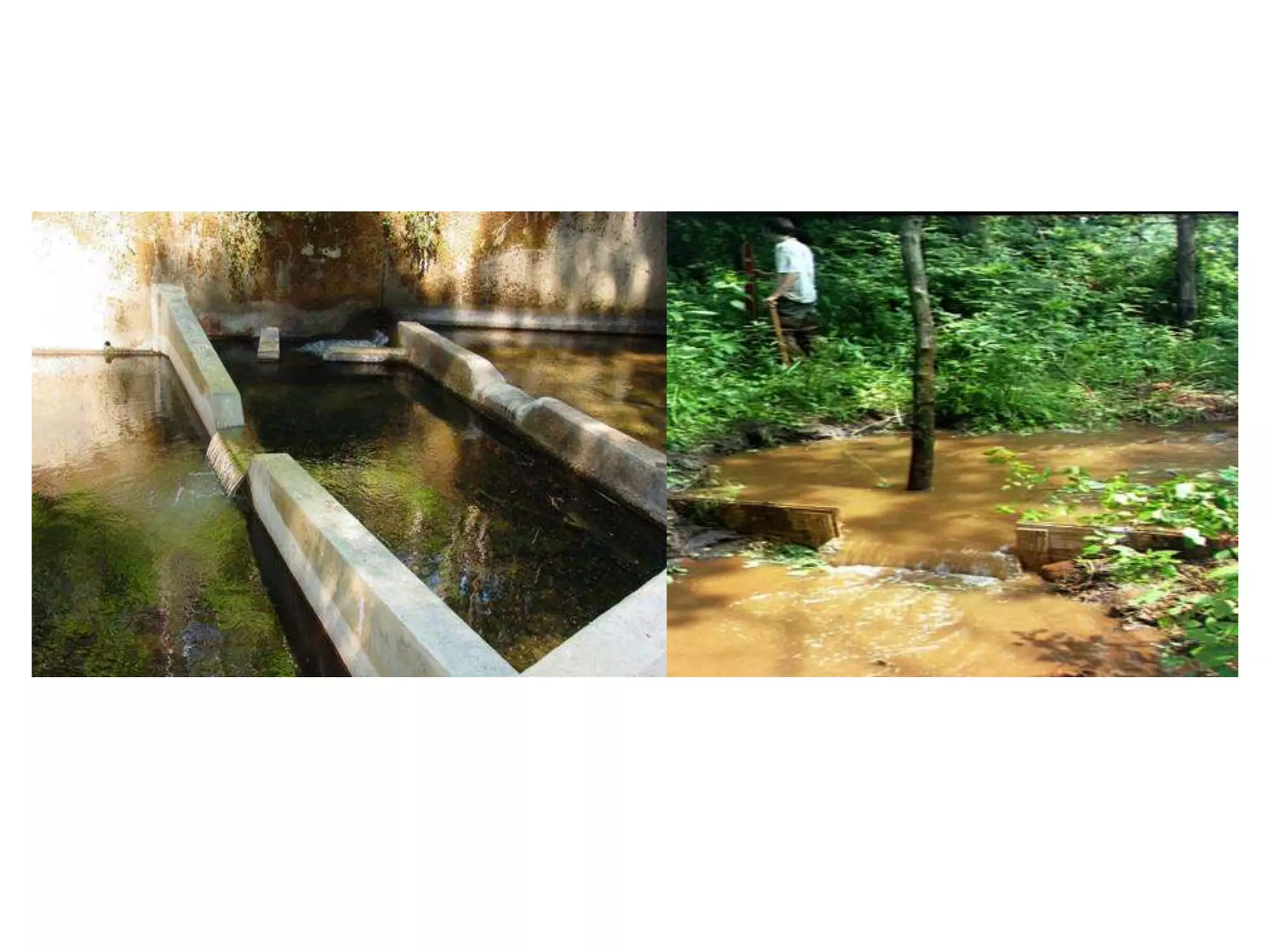
• CONTRACTED RECTANGULAR WEIR
A contracted rectangular weir is one for
which the weir extends across only part
of the channel, so that the length of the
weir, L, is different from as the width of
the channel. The discharge over
contracted rectangular notch can be
calculated as:
Q = 1.84(L – 0.2H)H3/2
where
• Q is the water flow rate in m3/sec,
• L is the length of the weir in m, and
• H is the head over the weir in m.
• B is the width of the channel in m, and
• Hmax is the maximum expected head
over the weir in m.
APPLICATION
• The data gained from flow rate calculations over a
rectangular weir can be used in a number of ways.
Flood control and general water management policies
and practices are often designed around such data. The
flow data can be used to determine if a hydroelectric
project would be possible or profitable. Water flow
data can also be useful for environmental impact
studies, specifically in determining how the weir or
other structures would affect the ecosystem of a
stream or river. Irrigation and other water use needs
programs also benefit from this kind of data
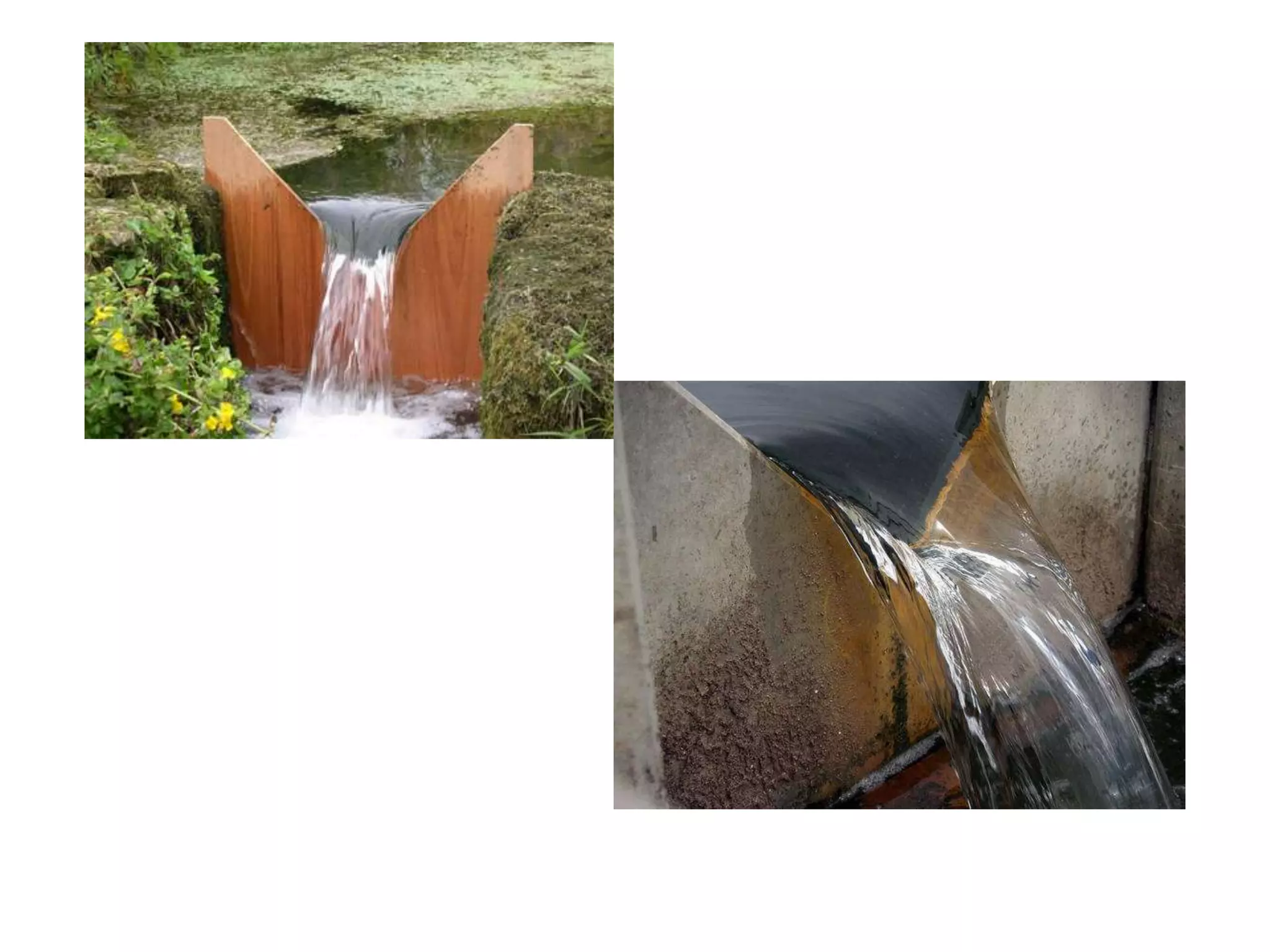
TRIANGLE OR V-NOTCH WEIR
A V-shaped notch is a vertical thin plate which is
placed perpendicular to the sides and bottom of
a straight channel is defined as a V-notch sharp-
crested weir. The line which bisects the angle of
the notch should be vertical and at the same
distance from both sides of the channel . The V-
notch sharp-crested weir is one of the most
precise discharge measuring devices suitable for
a wide range of flow. In international literature,
the V-notch sharp-crested-weir is frequently
referred to as the ‘Thomson weir’.
Triangular or V-Notch Weir
Triangular or V-notched weirs measure low discharges more
accurately than horizontal weirs. The V-notch is most
commonly a 90° opening with the sides of the notch inclined
45° with the vertical. Since the V-notch weir has no crest
length, much smaller flows are represented by a given head
than for a rectangular weir
For a triangular or v-notch weir the flow rate can be expressed as:
q = 8/15 cd (2 g)1/2 tan(θ/2) h5/2
where
• θ = v-notch angle
• h= head of weir
• cd= discharge constant for the weir
• - must be determined
• g = 9.81 (m/s2) - gravity
Application
The V-Notch Weir system uses the principle of
gravitational discharge of water over a triangular or
rectangular notched weir plate.
• Typical applications include:
• Long-term monitoring of dams
• Drainage systems in dams and tunnels
• Springs and artesian wells
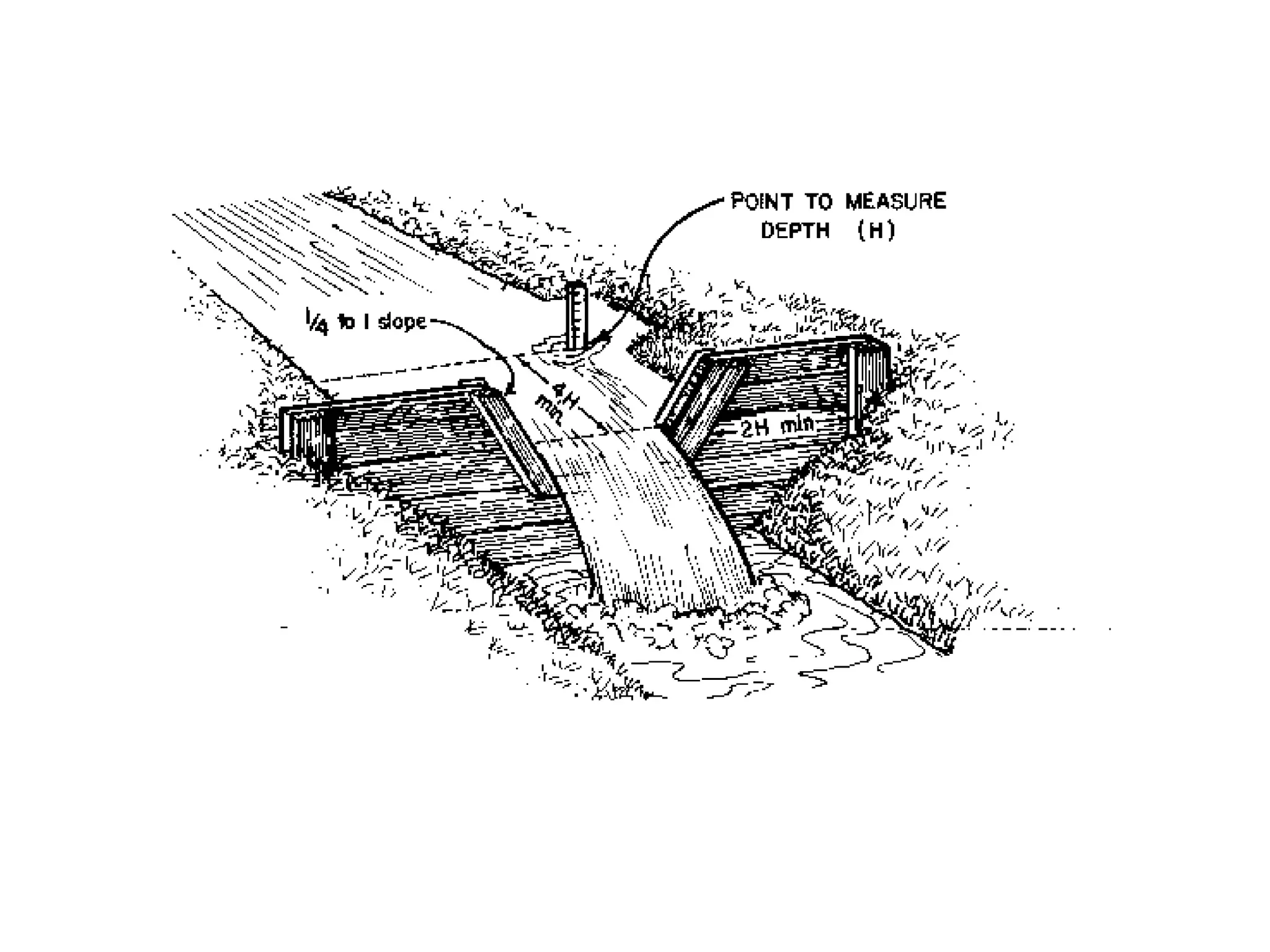
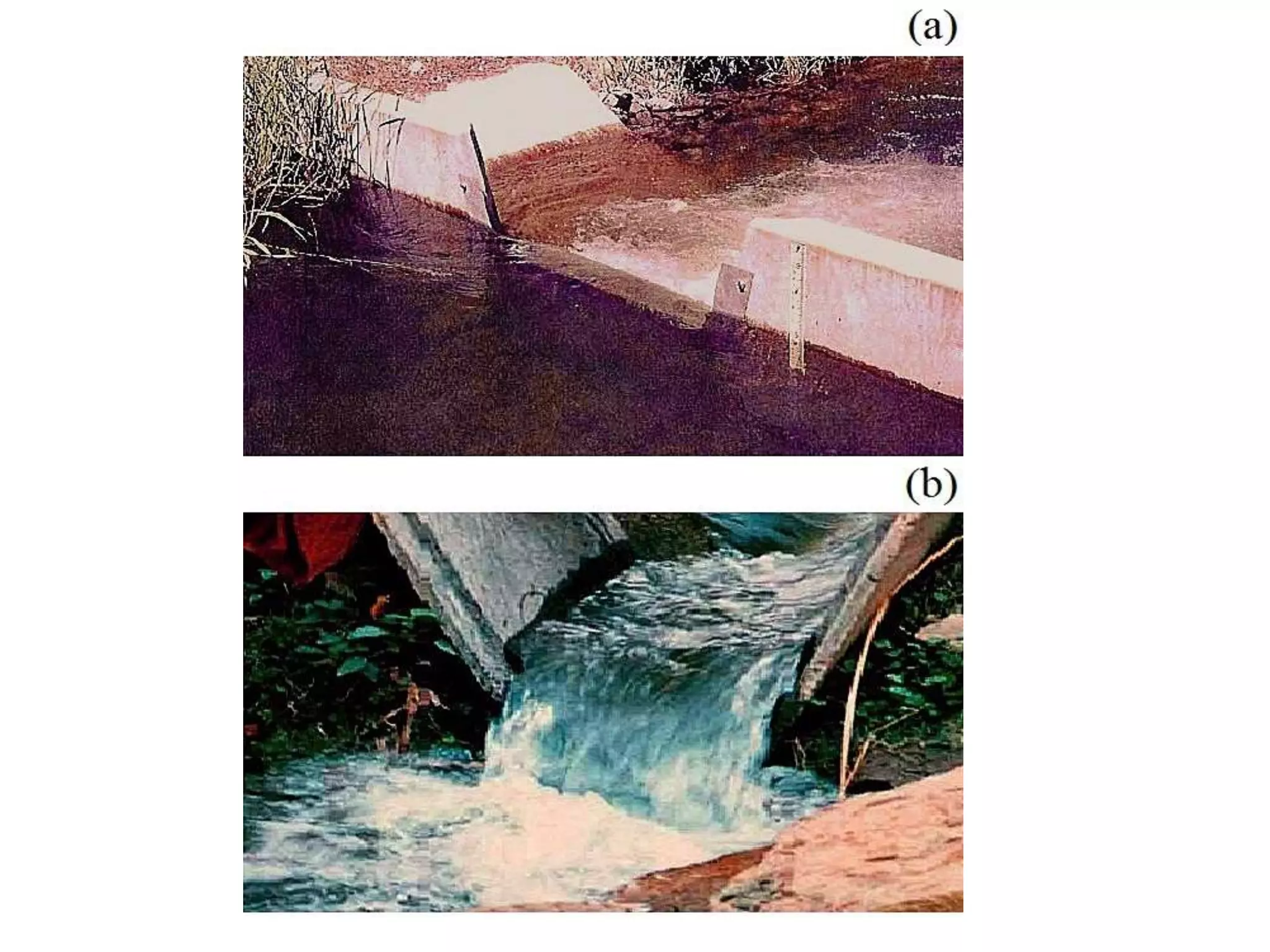
TRAPOZOIDAL SHARP-EDGE WEIR
• The Cipolletti or Trapezoidal Sharp-edge Weir is similar to a
rectangular weir with end contractions except that the sides incline
outwardly at a slope of 1 horizontal to 4 vertical. This slope causes
the discharge to occur essentially as though it were without end
contraction. The advantage of this weir is that no correction for end
contraction is required. A disadvantage is that measurement
accuracy is inherently less than that obtainable with a rectangular
suppressed or V-notch weir. The Cipolletti Weir is commonly used in
irrigation systems. The formula generally accepted for computing
the discharge through Cipolletti weirs is :
Q = 3.367 L h1
3/2
• where:
• L = length of weir crest in ft
h1 = head on weir crest in ft
Weirs
Weirs

Weirs

  • 1.
    WEIRS A weir isbasically an obstruction in the flow path in an open channel. The weir will cause an increase in the water depth as the water flows over the weir. In general, the greater the flow rate, the greater will be the increase in depth of flow, The height of water above the top of the weir is the measurement usually used to correlate with flow rate.
  • 3.
    TYPES OF WEIRS SHARPCRESTED WEIR: • A weir with a sharp upstream corner or edge such that the water springs clear of the crest is a sharp- crested weir. Sharp-crested weirs are classified according to the shape of the weir opening, such as rectangular weirs, triangular or V-notch weirs, trapezoidal weirs, and parabolic weirs. Weirs not sharp crested are classified according to the shape of their cross section, such as broad-crested weirs, triangular weirs, and trapezoidal weirs.
  • 5.
    BROAD CRESTED WEIR •Broad crested weirs are robust structures that are generally constructed from reinforced concrete and which usually span the full width of the channel. They are used to measure the discharge of rivers, and are much more suited for this purpose than the relatively flimsy sharp crested weirs. Additionally, by virtue of being a critical depth meter, the broad crested weir has the advantage that it operates effectively with higher downstream water levels than a sharp crested weir.
  • 8.
    TYPES OF SHARPCRESTED WEIR RECTANULAR WEIR NOTCH • A rectangular notch, symmetrically located in a vertical thin (metal) plate which is placed perpendicular to the sides and bottom of a straight channel, is defined as a rectangular sharp-crested weir.
  • 9.
    SUB DIVISIONS OFRECTANGULAR WEIR NOTCH • SUPPRESSED RECTANGULAR WEIR A suppressed rectangular weir is one for which the weir extends across the entire channel, so that the length of the weir, L, is the same as the width of the channel. The discharge over suppressed rectangular notch can be calculated as: Q = 1.84 B H3/2 where • Q is the water flow rate in m3/sec, • B is the length of the weir (and the channel width) in m, and • H is the head over the weir in m.
  • 10.
    • CONTRACTED RECTANGULARWEIR A contracted rectangular weir is one for which the weir extends across only part of the channel, so that the length of the weir, L, is different from as the width of the channel. The discharge over contracted rectangular notch can be calculated as: Q = 1.84(L – 0.2H)H3/2 where • Q is the water flow rate in m3/sec, • L is the length of the weir in m, and • H is the head over the weir in m. • B is the width of the channel in m, and • Hmax is the maximum expected head over the weir in m.
  • 11.
    APPLICATION • The datagained from flow rate calculations over a rectangular weir can be used in a number of ways. Flood control and general water management policies and practices are often designed around such data. The flow data can be used to determine if a hydroelectric project would be possible or profitable. Water flow data can also be useful for environmental impact studies, specifically in determining how the weir or other structures would affect the ecosystem of a stream or river. Irrigation and other water use needs programs also benefit from this kind of data
  • 14.
    TRIANGLE OR V-NOTCHWEIR A V-shaped notch is a vertical thin plate which is placed perpendicular to the sides and bottom of a straight channel is defined as a V-notch sharp- crested weir. The line which bisects the angle of the notch should be vertical and at the same distance from both sides of the channel . The V- notch sharp-crested weir is one of the most precise discharge measuring devices suitable for a wide range of flow. In international literature, the V-notch sharp-crested-weir is frequently referred to as the ‘Thomson weir’.
  • 15.
    Triangular or V-NotchWeir Triangular or V-notched weirs measure low discharges more accurately than horizontal weirs. The V-notch is most commonly a 90° opening with the sides of the notch inclined 45° with the vertical. Since the V-notch weir has no crest length, much smaller flows are represented by a given head than for a rectangular weir For a triangular or v-notch weir the flow rate can be expressed as: q = 8/15 cd (2 g)1/2 tan(θ/2) h5/2 where • θ = v-notch angle • h= head of weir • cd= discharge constant for the weir • - must be determined • g = 9.81 (m/s2) - gravity
  • 16.
    Application The V-Notch Weirsystem uses the principle of gravitational discharge of water over a triangular or rectangular notched weir plate. • Typical applications include: • Long-term monitoring of dams • Drainage systems in dams and tunnels • Springs and artesian wells
  • 19.
    TRAPOZOIDAL SHARP-EDGE WEIR •The Cipolletti or Trapezoidal Sharp-edge Weir is similar to a rectangular weir with end contractions except that the sides incline outwardly at a slope of 1 horizontal to 4 vertical. This slope causes the discharge to occur essentially as though it were without end contraction. The advantage of this weir is that no correction for end contraction is required. A disadvantage is that measurement accuracy is inherently less than that obtainable with a rectangular suppressed or V-notch weir. The Cipolletti Weir is commonly used in irrigation systems. The formula generally accepted for computing the discharge through Cipolletti weirs is : Q = 3.367 L h1 3/2 • where: • L = length of weir crest in ft h1 = head on weir crest in ft