REPORT
SUB:-GREEN BUILDING
2016
Tirath prajapati
[Type the company name]
11/25/2016
1
Submitted by
Name:-PRAJAPATI.TIRATH.Ashokbhai
college:-
SARDAR PATEL COLLEGE OF
ENGINEERING, BAKROL
Branch civil-B
Enrollment No:-151240106066
Year:-2016-2017
Submitted To:-
Prof.:-GAURAV GOHIL
Sub:-BUILDING CONSTRUCTION(2130607)
2
INTRODUCTION:
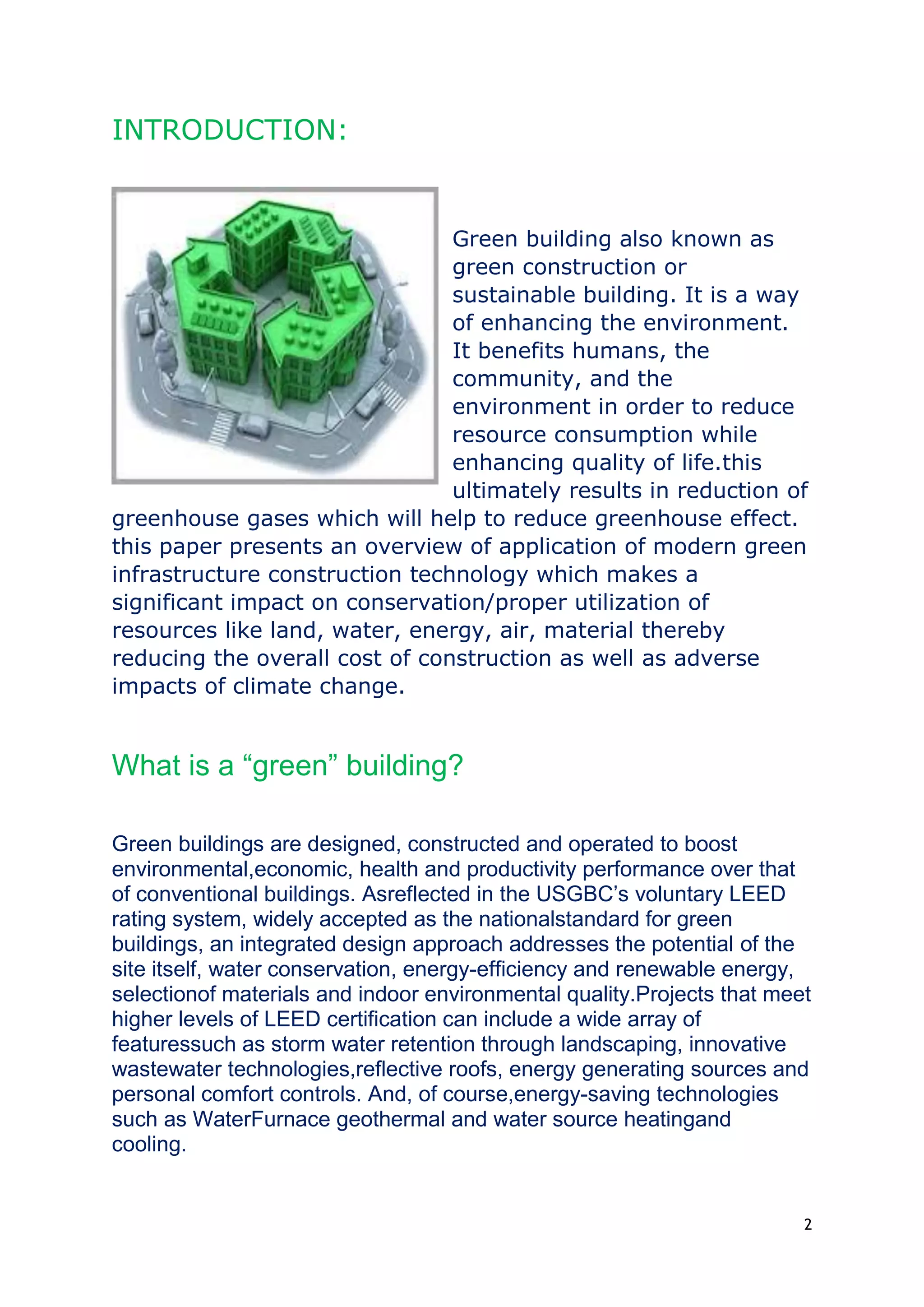
Green building also known as
green construction or
sustainable building. It is a way
of enhancing the environment.
It benefits humans, the
community, and the
environment in order to reduce
resource consumption while
enhancing quality of life.this
ultimately results in reduction of
greenhouse gases which will help to reduce greenhouse effect.
this paper presents an overview of application of modern green
infrastructure construction technology which makes a
significant impact on conservation/proper utilization of
resources like land, water, energy, air, material thereby
reducing the overall cost of construction as well as adverse
impacts of climate change.
What is a “green” building?
Green buildings are designed, constructed and operated to boost
environmental,economic, health and productivity performance over that
of conventional buildings. Asreflected in the USGBC’s voluntary LEED
rating system, widely accepted as the nationalstandard for green
buildings, an integrated design approach addresses the potential of the
site itself, water conservation, energy-efficiency and renewable energy,
selectionof materials and indoor environmental quality.Projects that meet
higher levels of LEED certification can include a wide array of
featuressuch as storm water retention through landscaping, innovative
wastewater technologies,reflective roofs, energy generating sources and
personal comfort controls. And, of course,energy-saving technologies
such as WaterFurnace geothermal and water source heatingand
cooling.
3
GREEN BUILDING FEATURES
Eco-Friendly-by least disturbance to eco system. Energy
efficient-through the
natural lighting
ventilation and solar
passive designs
efficient use of water-
through recycling and
water harvesting use
of renewable energy-
through photo voltaic
systems and solar
system etc.non toxic
material in door
environment, use of recycle/recyclable materials , efficient waste
utilization and disposal
WHY IT IS NECESSARY TO MAKE THE BUILDINGS
GREEN?
4
What are some of the benefits of a “green” building?
Many of the benefits of green building technologies and practices for
occupants, owners and the environment and society at large are
quantifiable and well documented.
These include energy savings, measurable reduction of waste,
decreased water use, and improved indoor air quality. Other benefits are
less tangible and harder to demonstrate statistically while highly
desirable.
These include improvements in occupants’ health, employee morale,
productivity, recruitment, employee retention and improved public image
for organizations and businesses that build green.
Many building and health experts agree that the social benefits of green
building technologies and practices can produce financial returns for
employers and building owners that overshadow the savings associated
with more measurable building performance gains
Here are some financial, economic and environmental benefits of green
building technologies and practices
5
No increase in first cost.
Many green buildings cost no more to build or may even cost less than
conventional building alternatives because resource-efficient strategies
and integrated design often allow downsizing of more costly mechanical,
electrical and structural systems.
High-performance green buildings are cost-effective.
Even for projects loaded with high value
features, higher first costs often are
recovered within three to five years through
lower operating expenses and utility
rebates for energy-saving equipment.
Savings in energy of 20-50 percent are
common through energy-saving
technologies, integrated planning and
downsized equipment.
6
Facility owners can reduce their financial risk by making investments in
energy-efficiency that earn a higher rate of return than the stock market
or bonds.
INDIAN GREEN BUILDING COUNCIL
The Indian Green Building Council (IGBC) was formed in the
year 2001 by Confederation of Indian Industry (CII).The aim of
the council is to bring green building movement in India and
facilitate India to become one of the global leaders in green
buildings by 2015
IGBC RATING SYSTEM
IGBC has developed green building rating programmers’ to
cover commercial, residential, factory buildings, etc
Each rating system divided into different levels of certification
is as follows:
1. Certified? to recognize best practice
2. Gold to recognize national excellence
3. Platinum to recognize global leadership
7
INCREASING GREEN BUILDINGS IN INDIA
Today more than 1053 green buildings (as on April2011) are
being constructed all over India. Of which 147 green buildings
are certified and fully functional
BENEFITS OF GREEN BUILDING
Buildings have a large effect
on the environment, human
health and the economy. The
successful adoption of GREEN
BUILDING developed can
maximize both the economic
and environmental
performance of the buildings.
ENVIRONMENTAL BENEFITS
Protect bio diversity and eco systems, improve air and water
quality, reduce waste streams, conserve natural resources.
8
ECONOMIC BENEFITS
Reduce operating cost, create, expand, and shape markets for
green product and services, improve occupant productivity.
SOCIAL BENEFITS
Enhance occupant
comfort and health,
heighten aesthetic
qualities, minimize
strain on local
infrastructure,
Improve overall
quality life.
9
GREENBUILDING PROJECT IN INDIA
• Suzlon Energy Limited-Pune
• Biodiversity Conservation India-Bangalore
10
• Rain tree Hotels-Chennai
• Olympia Technology Park-Chennai
11
• Rajiv Gandhi International Airport-Hyderabad
• Hiranandini-BG House, Powai
12
• Punjab Forest Complex, Mohali
• Palais Royale at Worli, Mumbai
13
CONCLUSION
This research identified the exciting developments taking place
on the technology front and analyzes their implications for
intelligent and green buildings, highlighting examples of “best in
class” buildings employing green and intelligent technologies.
These buildings are dynamic environments that respond to their
occupants? changing needs and lifestyles. This research
provided documented evidence to educate and influence end-
users, building owners, architects, and contractors that a
“greener building” can be achieved using intelligent technology
and that this “greening” will provide a tangible and significant
return on investment .to all of the above going ‘GREEN’ IS THE
ONLY.

Green building report

  • 1.
  • 2.
    1 Submitted by Name:-PRAJAPATI.TIRATH.Ashokbhai college:- SARDAR PATELCOLLEGE OF ENGINEERING, BAKROL Branch civil-B Enrollment No:-151240106066 Year:-2016-2017 Submitted To:- Prof.:-GAURAV GOHIL Sub:-BUILDING CONSTRUCTION(2130607)
  • 3.
    2 INTRODUCTION: Green building alsoknown as green construction or sustainable building. It is a way of enhancing the environment. It benefits humans, the community, and the environment in order to reduce resource consumption while enhancing quality of life.this ultimately results in reduction of greenhouse gases which will help to reduce greenhouse effect. this paper presents an overview of application of modern green infrastructure construction technology which makes a significant impact on conservation/proper utilization of resources like land, water, energy, air, material thereby reducing the overall cost of construction as well as adverse impacts of climate change. What is a “green” building? Green buildings are designed, constructed and operated to boost environmental,economic, health and productivity performance over that of conventional buildings. Asreflected in the USGBC’s voluntary LEED rating system, widely accepted as the nationalstandard for green buildings, an integrated design approach addresses the potential of the site itself, water conservation, energy-efficiency and renewable energy, selectionof materials and indoor environmental quality.Projects that meet higher levels of LEED certification can include a wide array of featuressuch as storm water retention through landscaping, innovative wastewater technologies,reflective roofs, energy generating sources and personal comfort controls. And, of course,energy-saving technologies such as WaterFurnace geothermal and water source heatingand cooling.
  • 4.
    3 GREEN BUILDING FEATURES Eco-Friendly-byleast disturbance to eco system. Energy efficient-through the natural lighting ventilation and solar passive designs efficient use of water- through recycling and water harvesting use of renewable energy- through photo voltaic systems and solar system etc.non toxic material in door environment, use of recycle/recyclable materials , efficient waste utilization and disposal WHY IT IS NECESSARY TO MAKE THE BUILDINGS GREEN?
  • 5.
    4 What are someof the benefits of a “green” building? Many of the benefits of green building technologies and practices for occupants, owners and the environment and society at large are quantifiable and well documented. These include energy savings, measurable reduction of waste, decreased water use, and improved indoor air quality. Other benefits are less tangible and harder to demonstrate statistically while highly desirable. These include improvements in occupants’ health, employee morale, productivity, recruitment, employee retention and improved public image for organizations and businesses that build green. Many building and health experts agree that the social benefits of green building technologies and practices can produce financial returns for employers and building owners that overshadow the savings associated with more measurable building performance gains Here are some financial, economic and environmental benefits of green building technologies and practices
  • 6.
    5 No increase infirst cost. Many green buildings cost no more to build or may even cost less than conventional building alternatives because resource-efficient strategies and integrated design often allow downsizing of more costly mechanical, electrical and structural systems. High-performance green buildings are cost-effective. Even for projects loaded with high value features, higher first costs often are recovered within three to five years through lower operating expenses and utility rebates for energy-saving equipment. Savings in energy of 20-50 percent are common through energy-saving technologies, integrated planning and downsized equipment.
  • 7.
    6 Facility owners canreduce their financial risk by making investments in energy-efficiency that earn a higher rate of return than the stock market or bonds. INDIAN GREEN BUILDING COUNCIL The Indian Green Building Council (IGBC) was formed in the year 2001 by Confederation of Indian Industry (CII).The aim of the council is to bring green building movement in India and facilitate India to become one of the global leaders in green buildings by 2015 IGBC RATING SYSTEM IGBC has developed green building rating programmers’ to cover commercial, residential, factory buildings, etc Each rating system divided into different levels of certification is as follows: 1. Certified? to recognize best practice 2. Gold to recognize national excellence 3. Platinum to recognize global leadership
  • 8.
    7 INCREASING GREEN BUILDINGSIN INDIA Today more than 1053 green buildings (as on April2011) are being constructed all over India. Of which 147 green buildings are certified and fully functional BENEFITS OF GREEN BUILDING Buildings have a large effect on the environment, human health and the economy. The successful adoption of GREEN BUILDING developed can maximize both the economic and environmental performance of the buildings. ENVIRONMENTAL BENEFITS Protect bio diversity and eco systems, improve air and water quality, reduce waste streams, conserve natural resources.
  • 9.
    8 ECONOMIC BENEFITS Reduce operatingcost, create, expand, and shape markets for green product and services, improve occupant productivity. SOCIAL BENEFITS Enhance occupant comfort and health, heighten aesthetic qualities, minimize strain on local infrastructure, Improve overall quality life.
  • 10.
    9 GREENBUILDING PROJECT ININDIA • Suzlon Energy Limited-Pune • Biodiversity Conservation India-Bangalore
  • 11.
    10 • Rain treeHotels-Chennai • Olympia Technology Park-Chennai
  • 12.
    11 • Rajiv GandhiInternational Airport-Hyderabad • Hiranandini-BG House, Powai
  • 13.
    12 • Punjab ForestComplex, Mohali • Palais Royale at Worli, Mumbai
  • 14.
    13 CONCLUSION This research identifiedthe exciting developments taking place on the technology front and analyzes their implications for intelligent and green buildings, highlighting examples of “best in class” buildings employing green and intelligent technologies. These buildings are dynamic environments that respond to their occupants? changing needs and lifestyles. This research provided documented evidence to educate and influence end- users, building owners, architects, and contractors that a “greener building” can be achieved using intelligent technology and that this “greening” will provide a tangible and significant return on investment .to all of the above going ‘GREEN’ IS THE ONLY.