Orifice Assembly
………let the restriction do measurement
Compiled by
Mr. Harshal Revandkar
(harshal.revandkar@chemtrols.com)
Engineer (Metering and Measurement)
Chemtrols Industries Ltd.
Under the guidance of
Mr. R. C. Ramchandran
Manager (Flow Elements)
Chemtrols Samil (I) Pvt Ltd.
Principles of Fluid Flow in Pipes
laminar flow : the fluid travels as parallel layers
(known as streamlines)
Turbulent flow: The fluid does not travel in
parallel layers, but moves in a haphazard
manner
NR < 2000 – laminar flow
NR > 4000 – Turbulent flow
2000 < NR < 4000 – transition region
Why to measure flow ????
Control
Billing
Alarm and indication
Techniques used in flow measurement
Variable area
Magnetic
Vortex
Pressure difference
Ultrasonic
Principle of pressure difference method
Pressure difference type flow elements
Orifice plate
Flow nozzle
Venturi tube
Orifice plate
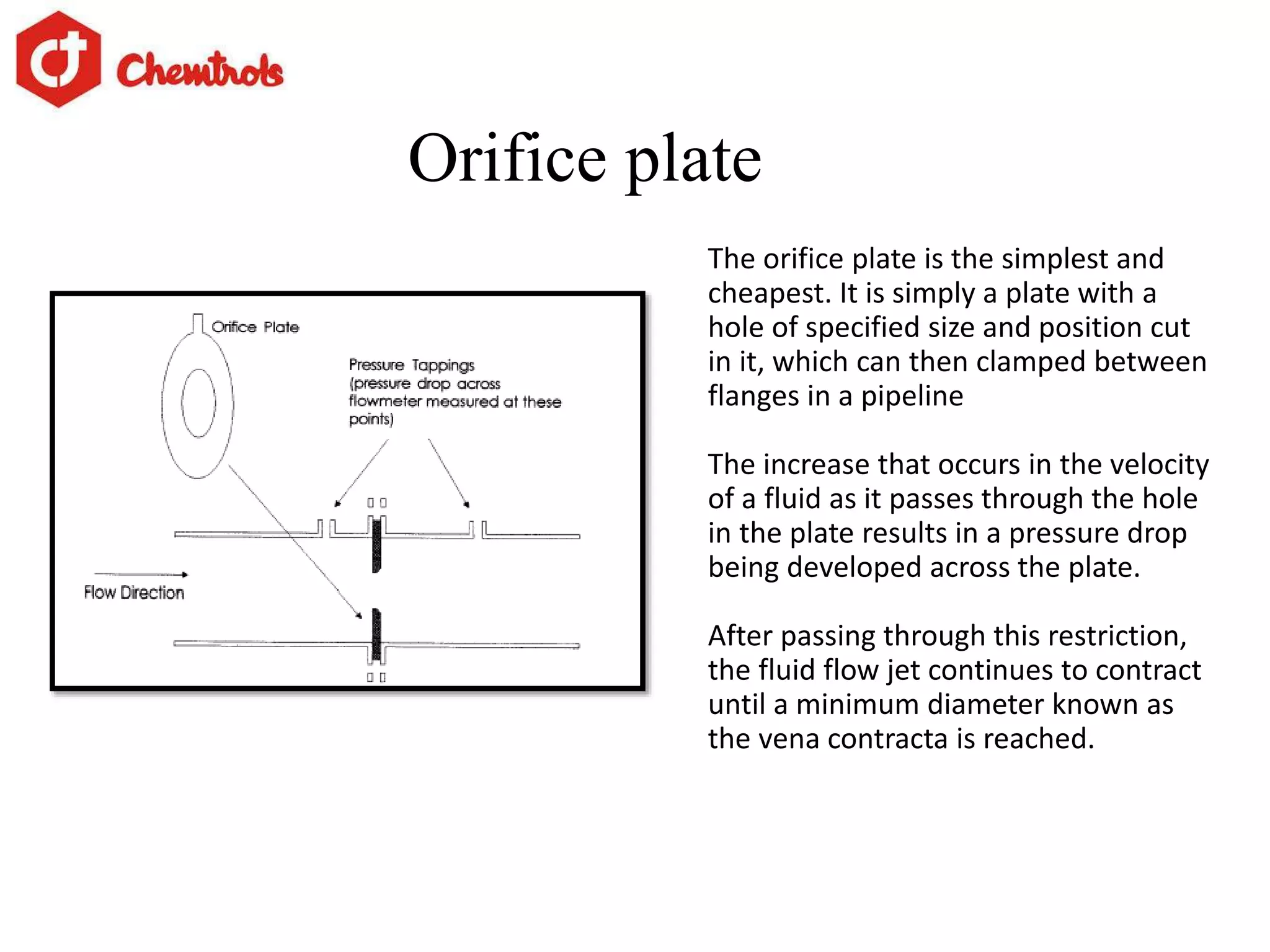
The orifice plate is the simplest and
cheapest. It is simply a plate with a
hole of specified size and position cut
in it, which can then clamped between
flanges in a pipeline
The increase that occurs in the velocity
of a fluid as it passes through the hole
in the plate results in a pressure drop
being developed across the plate.
After passing through this restriction,
the fluid flow jet continues to contract
until a minimum diameter known as
the vena contracta is reached.
Principle of working
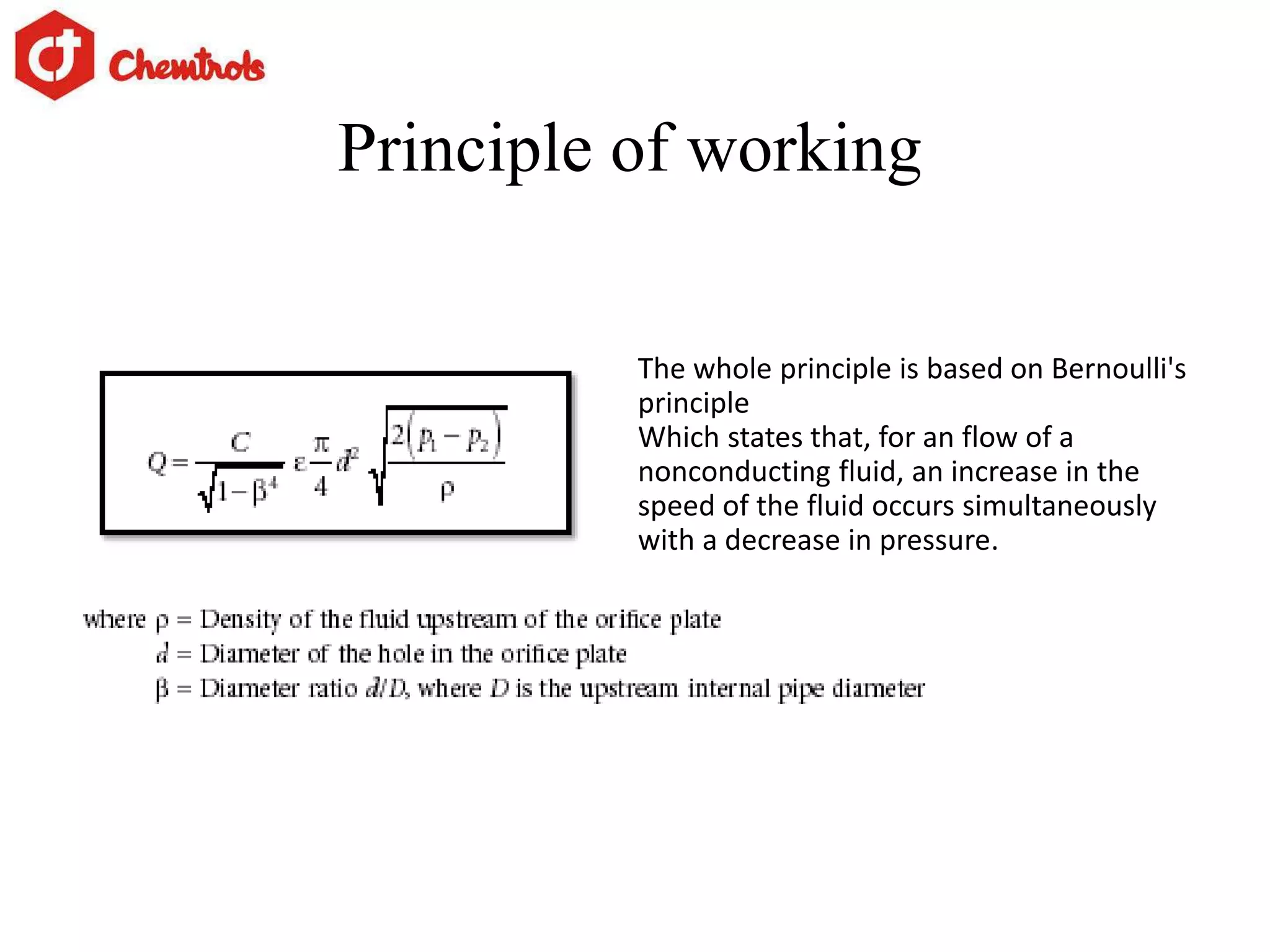
The whole principle is based on Bernoulli's
principle
Which states that, for an flow of a
nonconducting fluid, an increase in the
speed of the fluid occurs simultaneously
with a decrease in pressure.
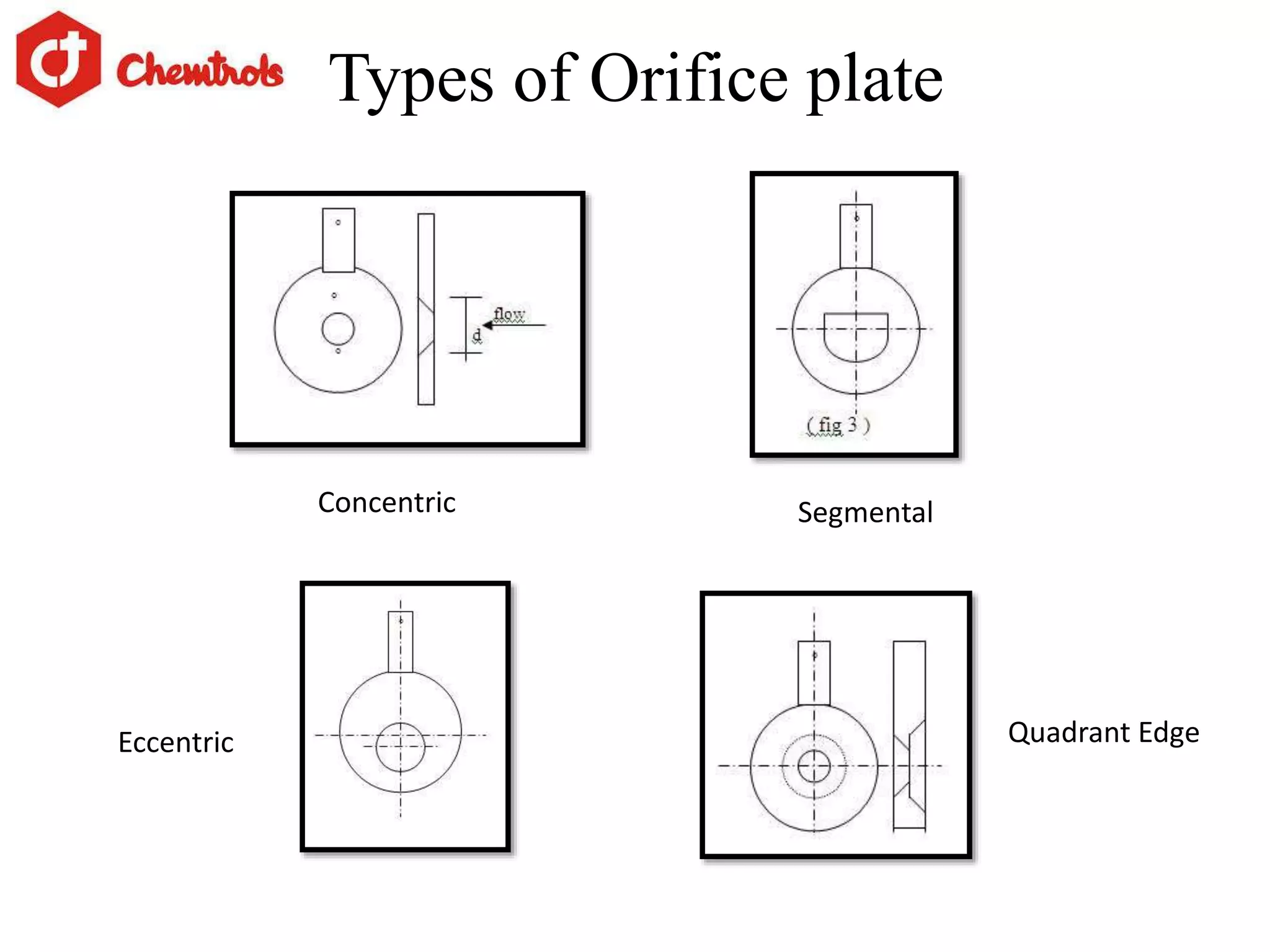
Types of Orifice plate
Concentric
Eccentric
Segmental
Quadrant Edge
Concentric
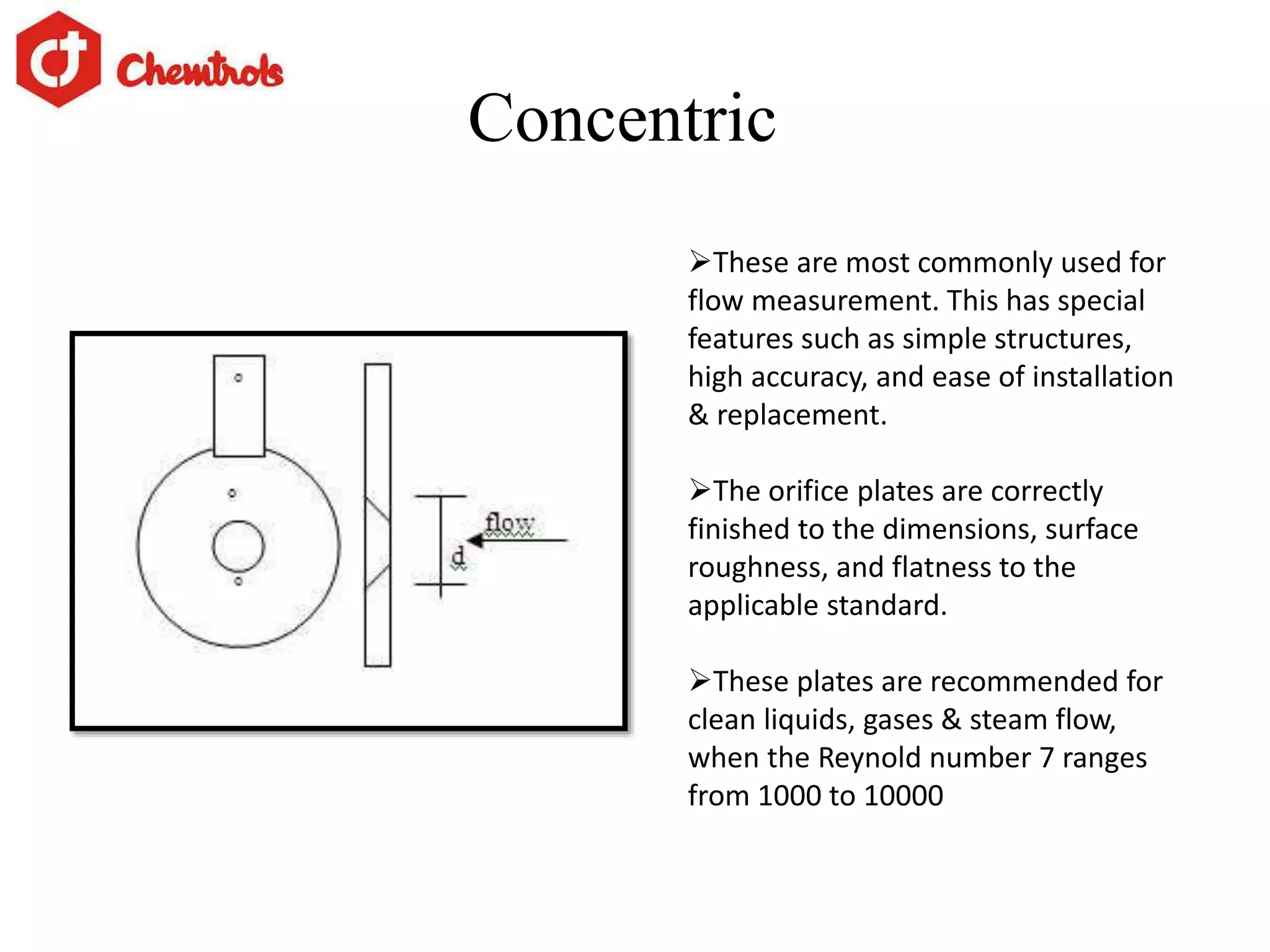
These are most commonly used for
flow measurement. This has special
features such as simple structures,
high accuracy, and ease of installation
& replacement.
The orifice plates are correctly
finished to the dimensions, surface
roughness, and flatness to the
applicable standard.
These plates are recommended for
clean liquids, gases & steam flow,
when the Reynold number 7 ranges
from 1000 to 10000
Eccentric
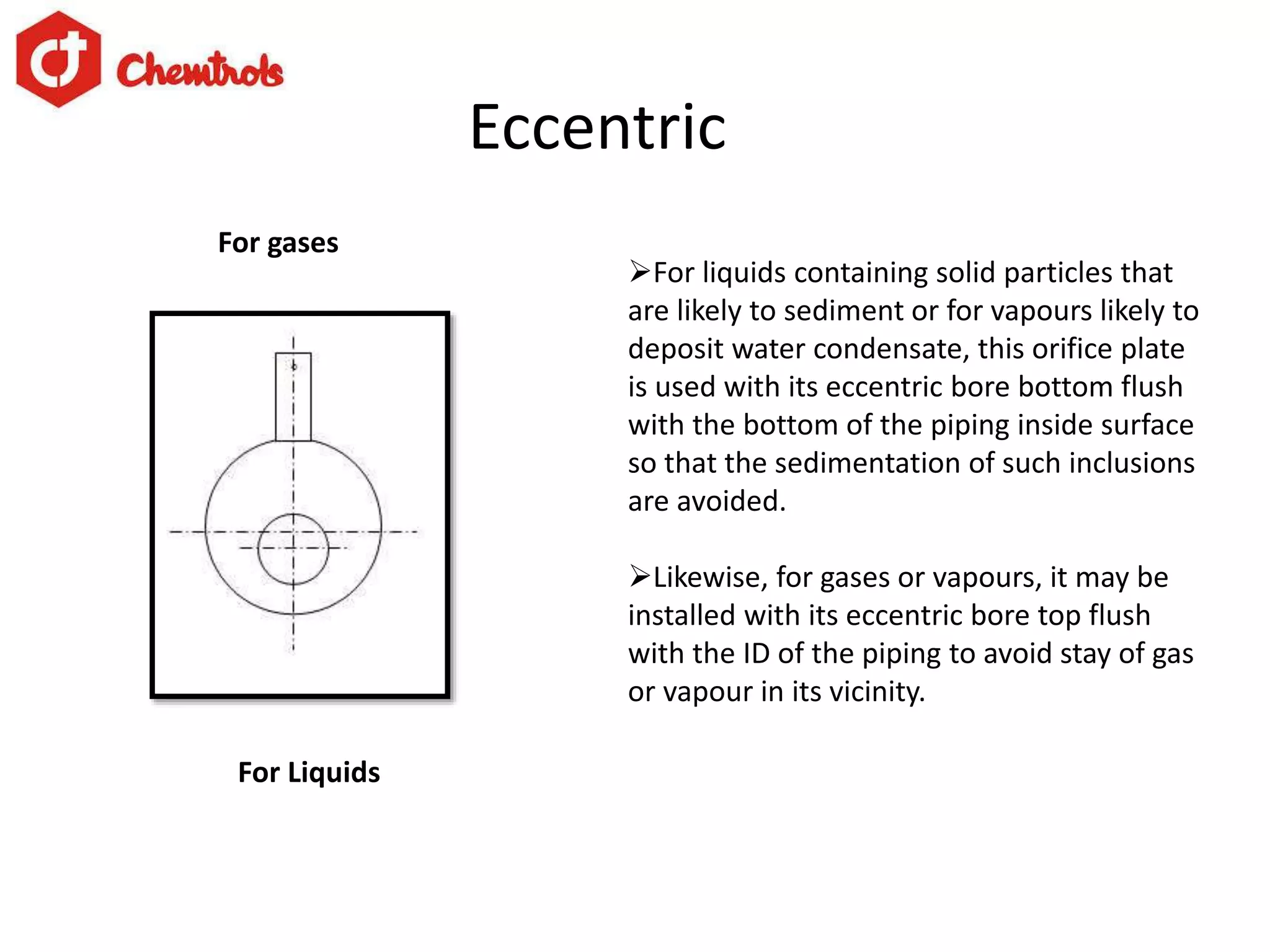
For liquids containing solid particles that
are likely to sediment or for vapours likely to
deposit water condensate, this orifice plate
is used with its eccentric bore bottom flush
with the bottom of the piping inside surface
so that the sedimentation of such inclusions
are avoided.
Likewise, for gases or vapours, it may be
installed with its eccentric bore top flush
with the ID of the piping to avoid stay of gas
or vapour in its vicinity.
For Liquids
For gases
Segmental
Segmental orifice plates are most
useful where there are impurities and
also if there are suspension in the
fluids.
This avoids build up in front of the
orifice plate. The orifice hole is placed
at the bottom for gas service and top
for liquids.
The inlet edge of the bore of this
orifice plate is rounded to a quarter
circle.
This orifice plate is usually used for
viscous fluids & Reynolds number
between 2000 to 10000.
Quadrant Edge
Conical Entrance
These conical entrance orifice plates
are used for low Reynolds number in
the range of 80 to 2000 and give more
constant or predictable discharge
coefficient.
At lower Reynolds numbers, the
discharge coefficient of square edge
orifice plate may change by as much as
30%. These are more usable for viscous
service.
Orifice Flanges and support assembly
Two orifice flanges are called an orifice
flange union. Each flange comes with two
pipe taps for measuring the pressure drop
of the flow through an orifice plate
Support assembly consist of
Gasket
Carrier Ring
Stud and bolts
Corner Tap : In this arrangement,
openings for the pressure taps are
located in the upstream and
downstream flanges holding the
orifice plate
Flange Tap : This design places one
pressure tap hole 1 inch upstream
and the other 1 inch down-stream
form the orifice plate. Being closely
located to the face of the flange, they
are accessible for inspection..They
should not be used in pipe sizes less
than 2 inches where the ratio is high,
because the downstream tap is
located in a highly unstable pressure
region.
Orifice Tapings
D and D/2 taps are located in the
pipe wall one pipe diameter
upstream of the face of the plate
and half pipe diameter downstream
from face
These taps are also called as
Radius Taps. The pipe line sizes of
10" and above are recommended
to have these taps
D and D/2 tapings
Tapings at glance
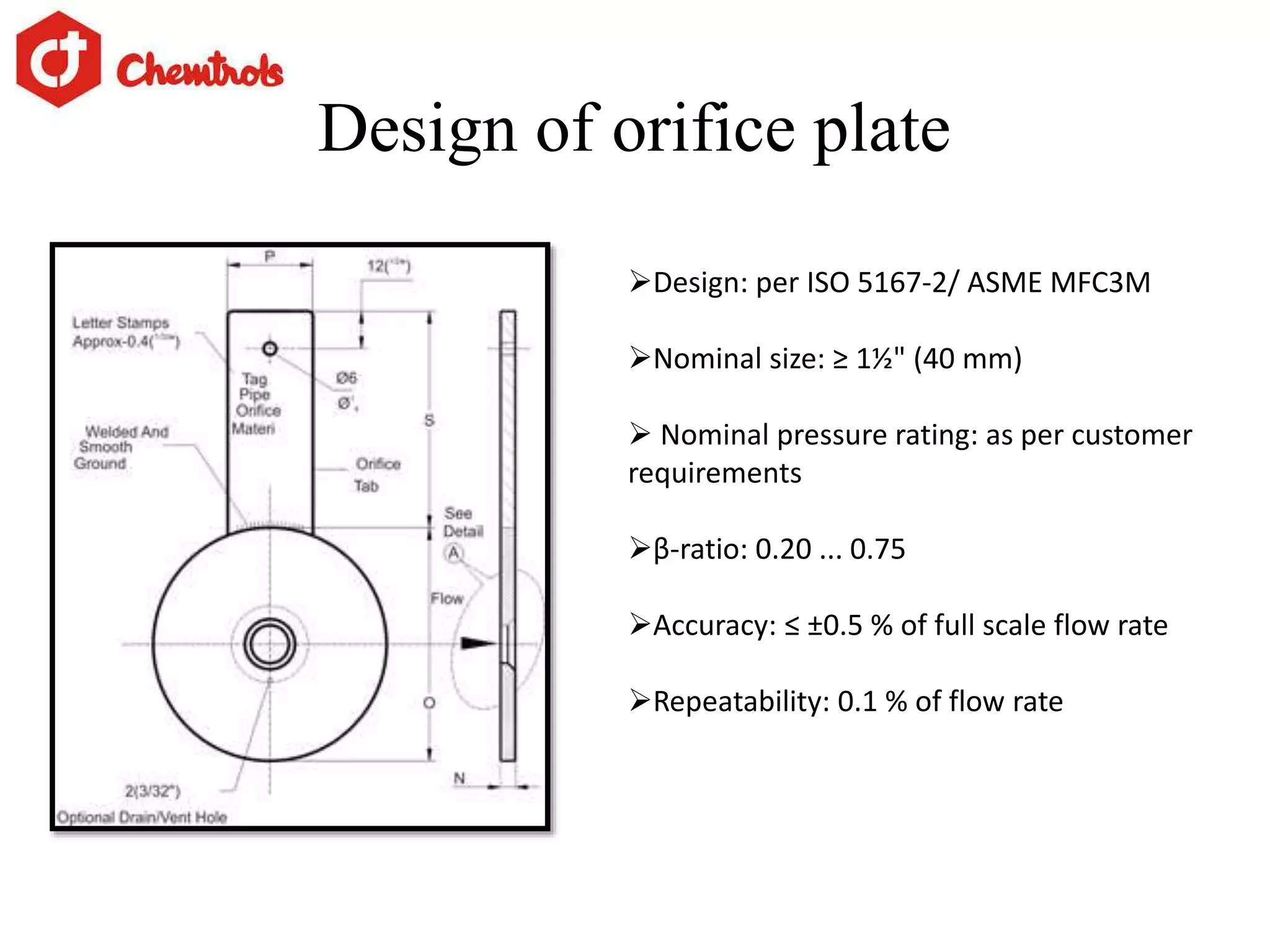
Design of orifice plate
Design: per ISO 5167-2/ ASME MFC3M
Nominal size: ≥ 1½" (40 mm)
 Nominal pressure rating: as per customer
requirements
β-ratio: 0.20 ... 0.75
Accuracy: ≤ ±0.5 % of full scale flow rate
Repeatability: 0.1 % of flow rate
Factors need to be consider while design
1. Pipe Internal Diameter
2. Coefficient of thermal expansion for pipe and orifice
3. Meter range
4. Normal flow
5. Density (operating , NTP)
6. Viscosity
7. Differential pressure
8. Specific heat ratio
9. Operating pressure
10. Operating temperature
11. Pipe ID at operating temperature
12. Distance of tap
13. Reynolds number
14. (Ceβ)^2 , Original
15. Emperical value of β
16. Iterated value of β
17. Pressure ratio
18. Expansion factor
19. Velocity approach factor
20. Discharge coefficient
21. (Ceβ)^2 , iterated
22. Permanent pressure loss
23. Orifice diameter at 20 °C
24. Vent/Drain hole (if required)
25. Corrected orifice diameter (if V/D hole present)
26. Radius of location of vent/ drain hole
27. Yield stress (for thickness calculation)
What we offer our clients…
Maximum operating temperature up to 800 °C
Maximum operating pressure up to 400 bar
Materials (Stainless steel , Hastelloy C276 , Monel 400,Duplex
and Super Duplex, Others on request)
Accuracy ≤ ±0.5 % of actual flow rate
Repeatability of measurement of 0.1 %
Cost Efficient (cheapest as compare to other flow elements)
Advantages of Orifice plate
High-quality
 High accuracy
A wide range
Very reliable
Low cost
low pressure drop across the meter
All mechanical units can be installed in remote
locations
Limitations
Bulky, especially in the larger sizes.
The fluid must be clean for measurement
accuracy
A sudden change in the flow rate can damage
the meter
Only for limited ranges of pressure and
temperature
Require a good maintenance schedule and are
high repair and maintenance meters
Need to be replaced after specific time
Targeted Customers
Water suppliers
Petrochemical industries
Oil industries
Natural gas industries
LPG suppliers
Refineries
Power industries
We did it….
Client : Indian Oil Corporation Ltd ,Bongaigaon
Project : Supply of Orifice plates for liquid flow measurement
Year : march 2015
Client : Indian Oil Corporation Ltd ,Kothari
Project : Supply of Orifice plates for liquid/gas flow measurement
Year : march 2015
Client : Indian petrochemical corporation ltd, Mthura
Project : Supply of Orifice plates for liquid/gas flow measurement
Year : april 2015
Our highly reputed clients
And many more…..
Orifice assembly

Orifice assembly

  • 1.
    Orifice Assembly ………let therestriction do measurement
  • 2.
    Compiled by Mr. HarshalRevandkar (harshal.revandkar@chemtrols.com) Engineer (Metering and Measurement) Chemtrols Industries Ltd. Under the guidance of Mr. R. C. Ramchandran Manager (Flow Elements) Chemtrols Samil (I) Pvt Ltd.
  • 3.
    Principles of FluidFlow in Pipes laminar flow : the fluid travels as parallel layers (known as streamlines) Turbulent flow: The fluid does not travel in parallel layers, but moves in a haphazard manner NR < 2000 – laminar flow NR > 4000 – Turbulent flow 2000 < NR < 4000 – transition region
  • 4.
    Why to measureflow ???? Control Billing Alarm and indication
  • 5.
    Techniques used inflow measurement Variable area Magnetic Vortex Pressure difference Ultrasonic
  • 6.
    Principle of pressuredifference method
  • 7.
    Pressure difference typeflow elements Orifice plate Flow nozzle Venturi tube
  • 8.
    Orifice plate The orificeplate is the simplest and cheapest. It is simply a plate with a hole of specified size and position cut in it, which can then clamped between flanges in a pipeline The increase that occurs in the velocity of a fluid as it passes through the hole in the plate results in a pressure drop being developed across the plate. After passing through this restriction, the fluid flow jet continues to contract until a minimum diameter known as the vena contracta is reached.
  • 9.
    Principle of working Thewhole principle is based on Bernoulli's principle Which states that, for an flow of a nonconducting fluid, an increase in the speed of the fluid occurs simultaneously with a decrease in pressure.
  • 10.
    Types of Orificeplate Concentric Eccentric Segmental Quadrant Edge
  • 11.
    Concentric These are mostcommonly used for flow measurement. This has special features such as simple structures, high accuracy, and ease of installation & replacement. The orifice plates are correctly finished to the dimensions, surface roughness, and flatness to the applicable standard. These plates are recommended for clean liquids, gases & steam flow, when the Reynold number 7 ranges from 1000 to 10000
  • 12.
    Eccentric For liquids containingsolid particles that are likely to sediment or for vapours likely to deposit water condensate, this orifice plate is used with its eccentric bore bottom flush with the bottom of the piping inside surface so that the sedimentation of such inclusions are avoided. Likewise, for gases or vapours, it may be installed with its eccentric bore top flush with the ID of the piping to avoid stay of gas or vapour in its vicinity. For Liquids For gases
  • 13.
    Segmental Segmental orifice platesare most useful where there are impurities and also if there are suspension in the fluids. This avoids build up in front of the orifice plate. The orifice hole is placed at the bottom for gas service and top for liquids.
  • 14.
    The inlet edgeof the bore of this orifice plate is rounded to a quarter circle. This orifice plate is usually used for viscous fluids & Reynolds number between 2000 to 10000. Quadrant Edge
  • 15.
    Conical Entrance These conicalentrance orifice plates are used for low Reynolds number in the range of 80 to 2000 and give more constant or predictable discharge coefficient. At lower Reynolds numbers, the discharge coefficient of square edge orifice plate may change by as much as 30%. These are more usable for viscous service.
  • 16.
    Orifice Flanges andsupport assembly Two orifice flanges are called an orifice flange union. Each flange comes with two pipe taps for measuring the pressure drop of the flow through an orifice plate Support assembly consist of Gasket Carrier Ring Stud and bolts
  • 17.
    Corner Tap :In this arrangement, openings for the pressure taps are located in the upstream and downstream flanges holding the orifice plate Flange Tap : This design places one pressure tap hole 1 inch upstream and the other 1 inch down-stream form the orifice plate. Being closely located to the face of the flange, they are accessible for inspection..They should not be used in pipe sizes less than 2 inches where the ratio is high, because the downstream tap is located in a highly unstable pressure region. Orifice Tapings
  • 18.
    D and D/2taps are located in the pipe wall one pipe diameter upstream of the face of the plate and half pipe diameter downstream from face These taps are also called as Radius Taps. The pipe line sizes of 10" and above are recommended to have these taps D and D/2 tapings
  • 19.
  • 20.
    Design of orificeplate Design: per ISO 5167-2/ ASME MFC3M Nominal size: ≥ 1½" (40 mm)  Nominal pressure rating: as per customer requirements β-ratio: 0.20 ... 0.75 Accuracy: ≤ ±0.5 % of full scale flow rate Repeatability: 0.1 % of flow rate
  • 21.
    Factors need tobe consider while design 1. Pipe Internal Diameter 2. Coefficient of thermal expansion for pipe and orifice 3. Meter range 4. Normal flow 5. Density (operating , NTP) 6. Viscosity 7. Differential pressure 8. Specific heat ratio 9. Operating pressure 10. Operating temperature 11. Pipe ID at operating temperature 12. Distance of tap 13. Reynolds number
  • 22.
    14. (Ceβ)^2 ,Original 15. Emperical value of β 16. Iterated value of β 17. Pressure ratio 18. Expansion factor 19. Velocity approach factor 20. Discharge coefficient 21. (Ceβ)^2 , iterated 22. Permanent pressure loss 23. Orifice diameter at 20 °C 24. Vent/Drain hole (if required) 25. Corrected orifice diameter (if V/D hole present) 26. Radius of location of vent/ drain hole 27. Yield stress (for thickness calculation)
  • 23.
    What we offerour clients… Maximum operating temperature up to 800 °C Maximum operating pressure up to 400 bar Materials (Stainless steel , Hastelloy C276 , Monel 400,Duplex and Super Duplex, Others on request) Accuracy ≤ ±0.5 % of actual flow rate Repeatability of measurement of 0.1 % Cost Efficient (cheapest as compare to other flow elements)
  • 24.
    Advantages of Orificeplate High-quality  High accuracy A wide range Very reliable Low cost low pressure drop across the meter All mechanical units can be installed in remote locations
  • 25.
    Limitations Bulky, especially inthe larger sizes. The fluid must be clean for measurement accuracy A sudden change in the flow rate can damage the meter Only for limited ranges of pressure and temperature Require a good maintenance schedule and are high repair and maintenance meters Need to be replaced after specific time
  • 26.
    Targeted Customers Water suppliers Petrochemicalindustries Oil industries Natural gas industries LPG suppliers Refineries Power industries
  • 27.
    We did it…. Client: Indian Oil Corporation Ltd ,Bongaigaon Project : Supply of Orifice plates for liquid flow measurement Year : march 2015 Client : Indian Oil Corporation Ltd ,Kothari Project : Supply of Orifice plates for liquid/gas flow measurement Year : march 2015 Client : Indian petrochemical corporation ltd, Mthura Project : Supply of Orifice plates for liquid/gas flow measurement Year : april 2015
  • 28.
    Our highly reputedclients And many more…..