Structural adaptations relate to an organism's shape, size or structure. Behavioural adaptations relate to how an organism acts. Functional adaptations relate to an organism's chemical processes.
Types of Adaptations
Structural– relating to an organism’s shape, size or structure
Behavioural – relating to how an organism acts
Functional – relating to an organism’s chemical processes
Animals & Plants
Shirley Boutros
2.
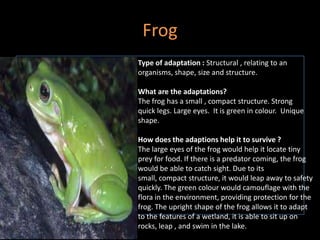
Frog
Type of adaptation: Structural , relating to an
organisms, shape, size and structure.
What are the adaptations?
The frog has a small , compact structure. Strong
quick legs. Large eyes. It is green in colour. Unique
shape.
How does the adaptions help it to survive ?
The large eyes of the frog would help it locate tiny
prey for food. If there is a predator coming, the frog
would be able to catch sight. Due to its
small, compact structure, it would leap away to safety
quickly. The green colour would camouflage with the
flora in the environment, providing protection for the
frog. The upright shape of the frog allows it to adapt
to the features of a wetland, it is able to sit up on
rocks, leap , and swim in the lake.
3.
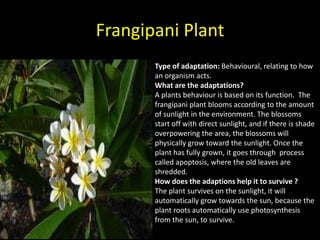
Frangipani Plant
Type of adaptation: Behavioural, relating to how
an organism acts.
What are the adaptations?
A plants behaviour is based on its function. The
frangipani plant blooms according to the amount
of sunlight in the environment. The blossoms
start off with direct sunlight, and if there is shade
overpowering the area, the blossoms will
physically grow toward the sunlight. Once the
plant has fully grown, it goes through process
called apoptosis, where the old leaves are
shredded.
How does the adaptions help it to survive ?
The plant survives on the sunlight, it will
automatically grow towards the sun, because the
plant roots automatically use photosynthesis
from the sun, to survive.


![Lion adaptation 2011[1]-1](https://cdn.slidesharecdn.com/ss_thumbnails/lionadaptation20111-1-110305224616-phpapp01-thumbnail.jpg?width=640&height=640&fit=bounds)


![Getting Started with Apache Spark: Big Data Made Simple [Free Meetup]](https://cdn.slidesharecdn.com/ss_thumbnails/apachesparkgettingstarted-260203175547-8361bcc3-thumbnail.jpg?width=640&height=640&fit=bounds)