Adaptation:
MUST BE DOWNLOADED
TO GET THE CUSTOM
ANIMATIONS
By Moira Whitehouse PhD
•A physical trait or a behavior
•that helps an animal or plant
survive by meeting its needs.
Adaptation:
•A physical trait or behavior that
helps an animal or plant survive by
meeting its needs.
•Sometimes the environment
changes. Plants and animals must
change or adapt to the new
environment in order meet their
needs and survive.
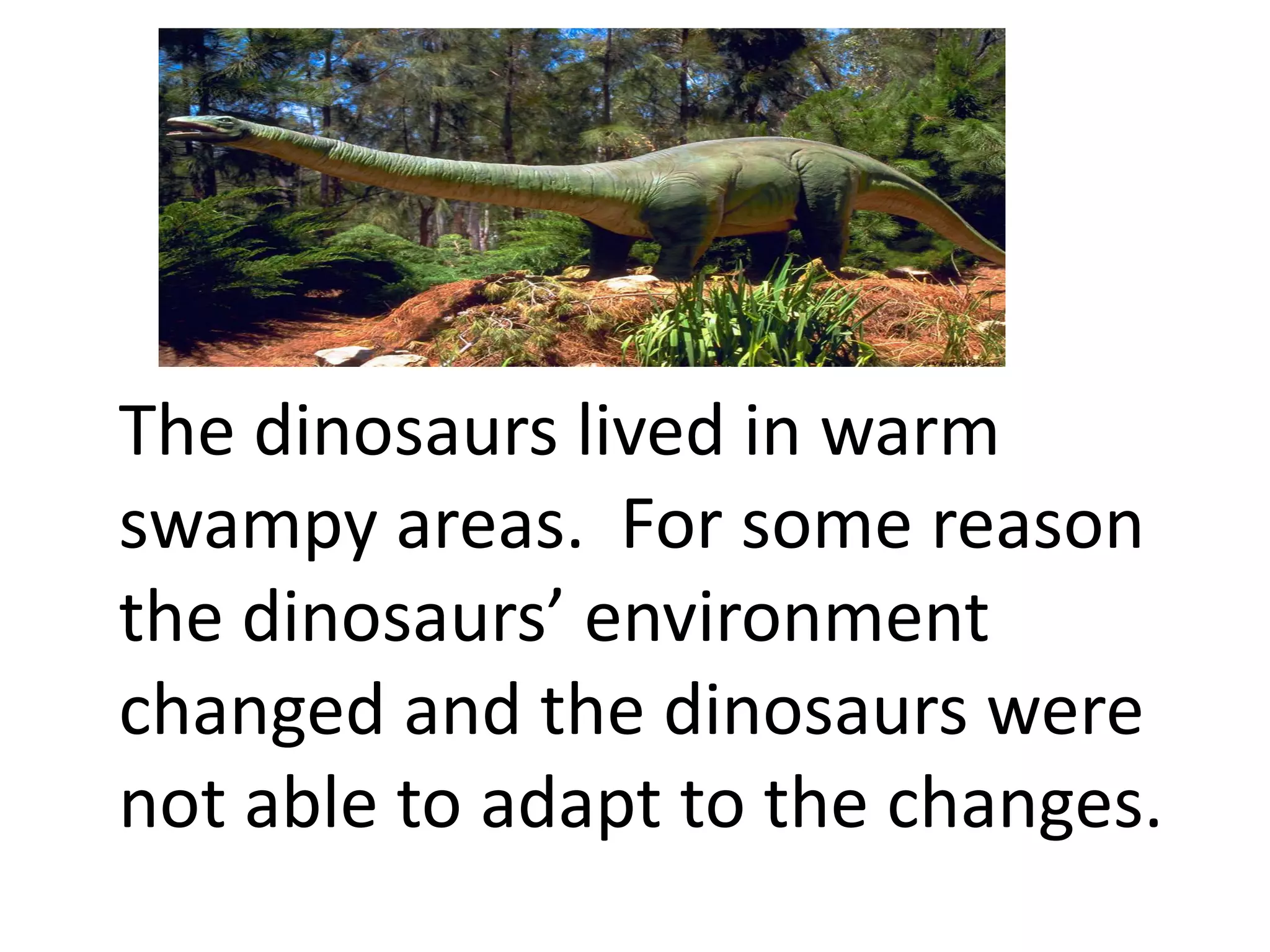
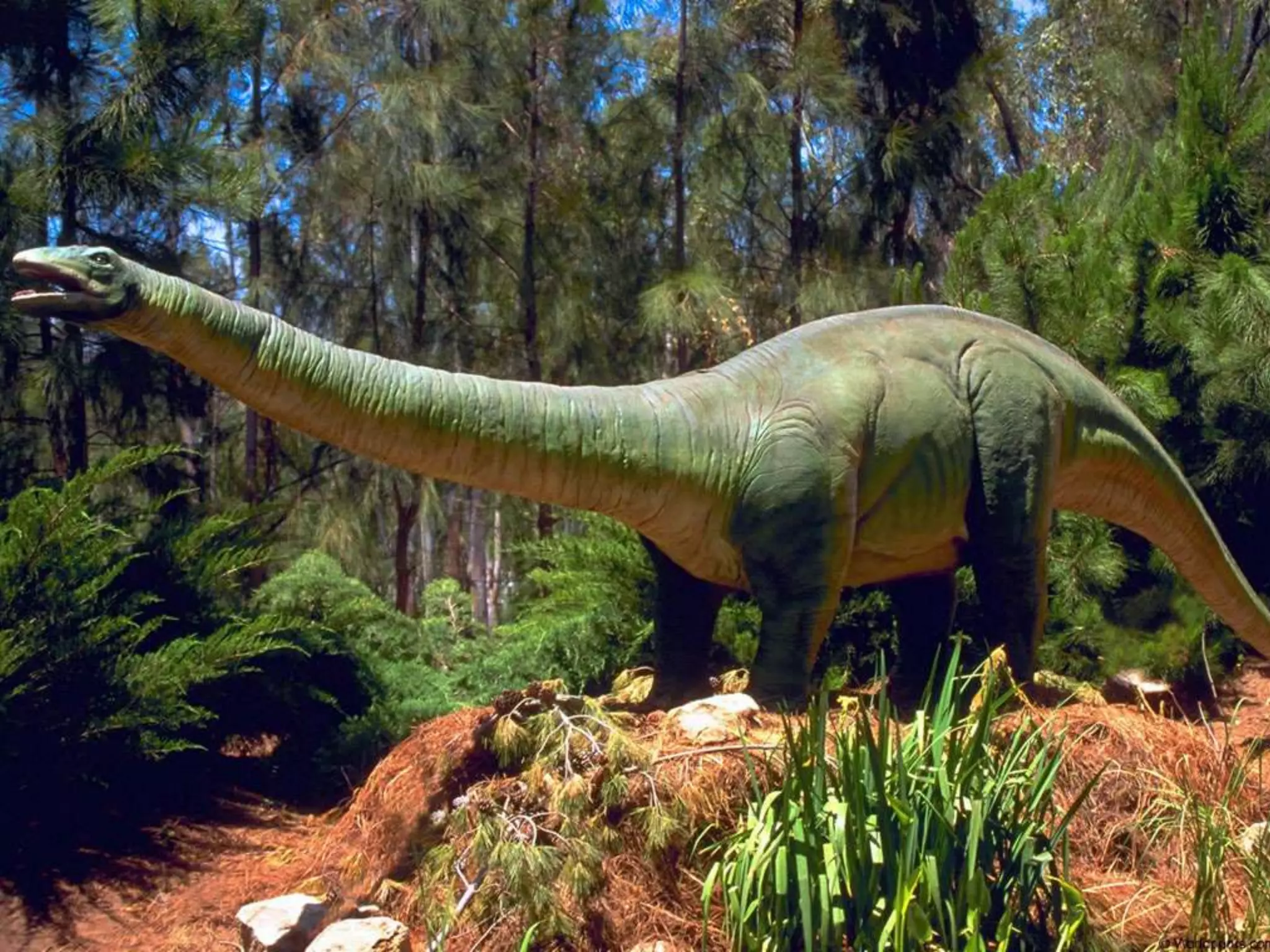
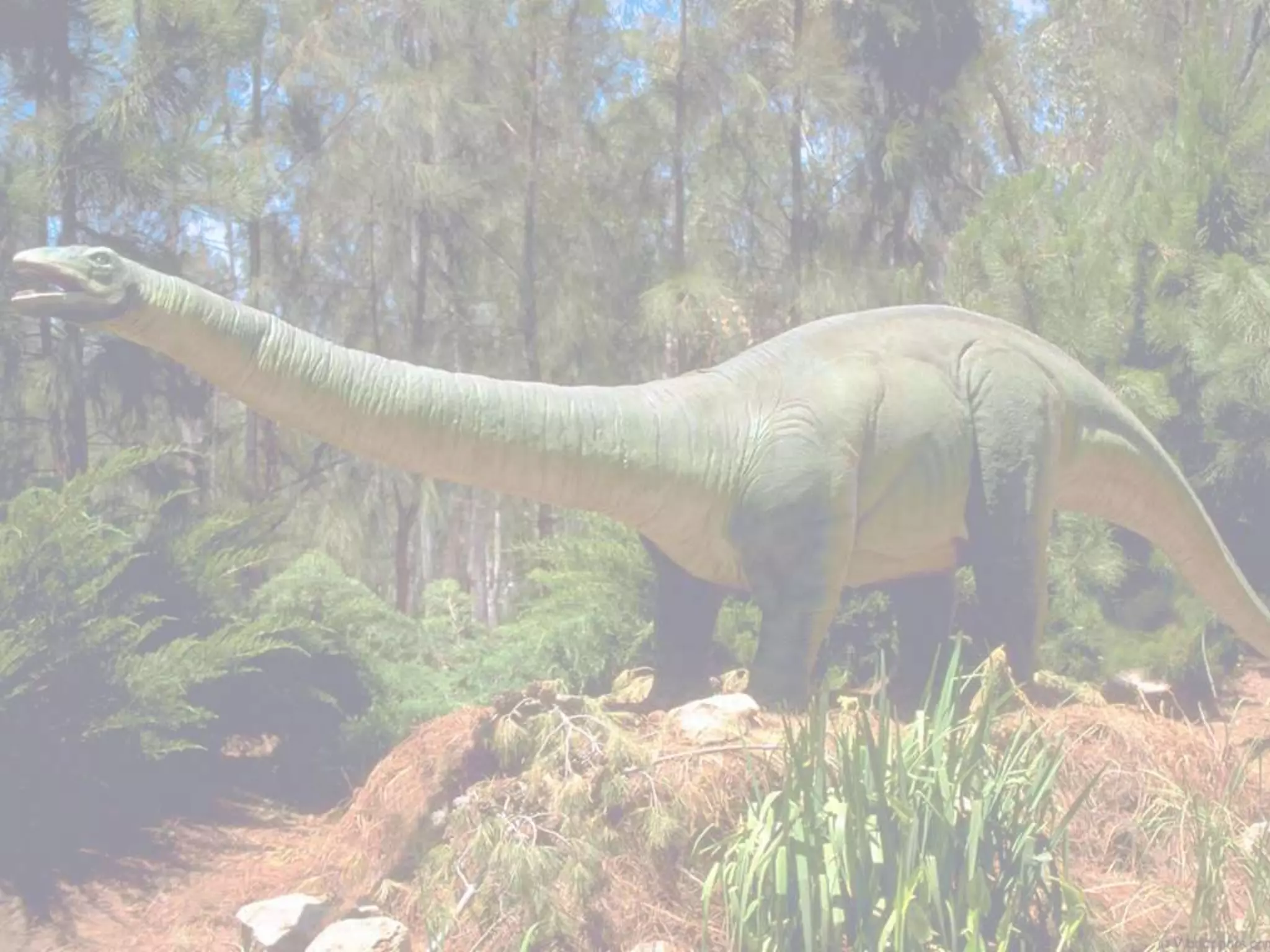
The dinosaurs lived in warm
swampy areas. For some reason
the dinosaurs’ environment
changed and the dinosaurs were
not able to adapt to the changes.
GONE
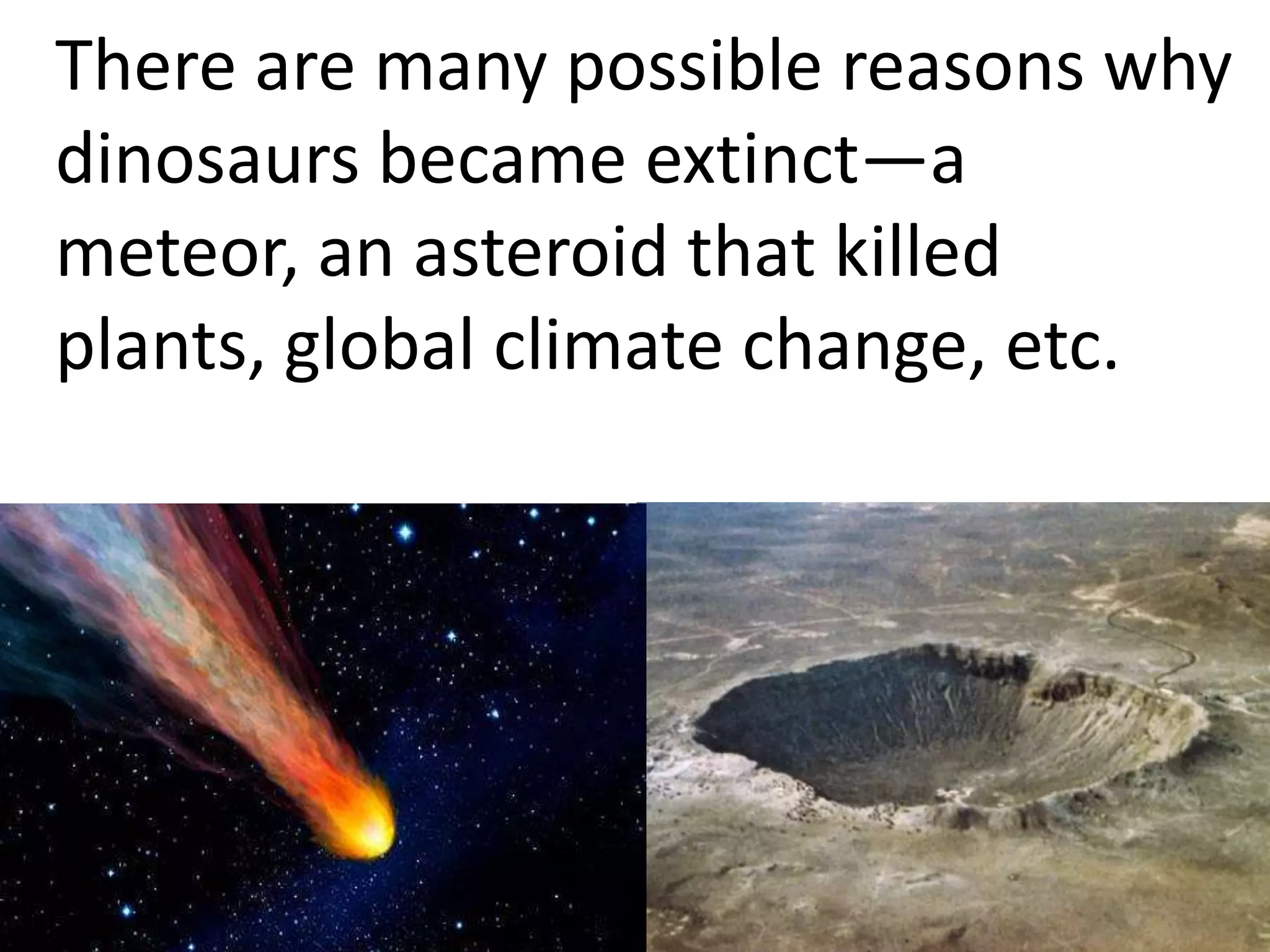
There are many possible reasons why
dinosaurs became extinct—a
meteor, an asteroid that killed
plants, global climate change, etc.
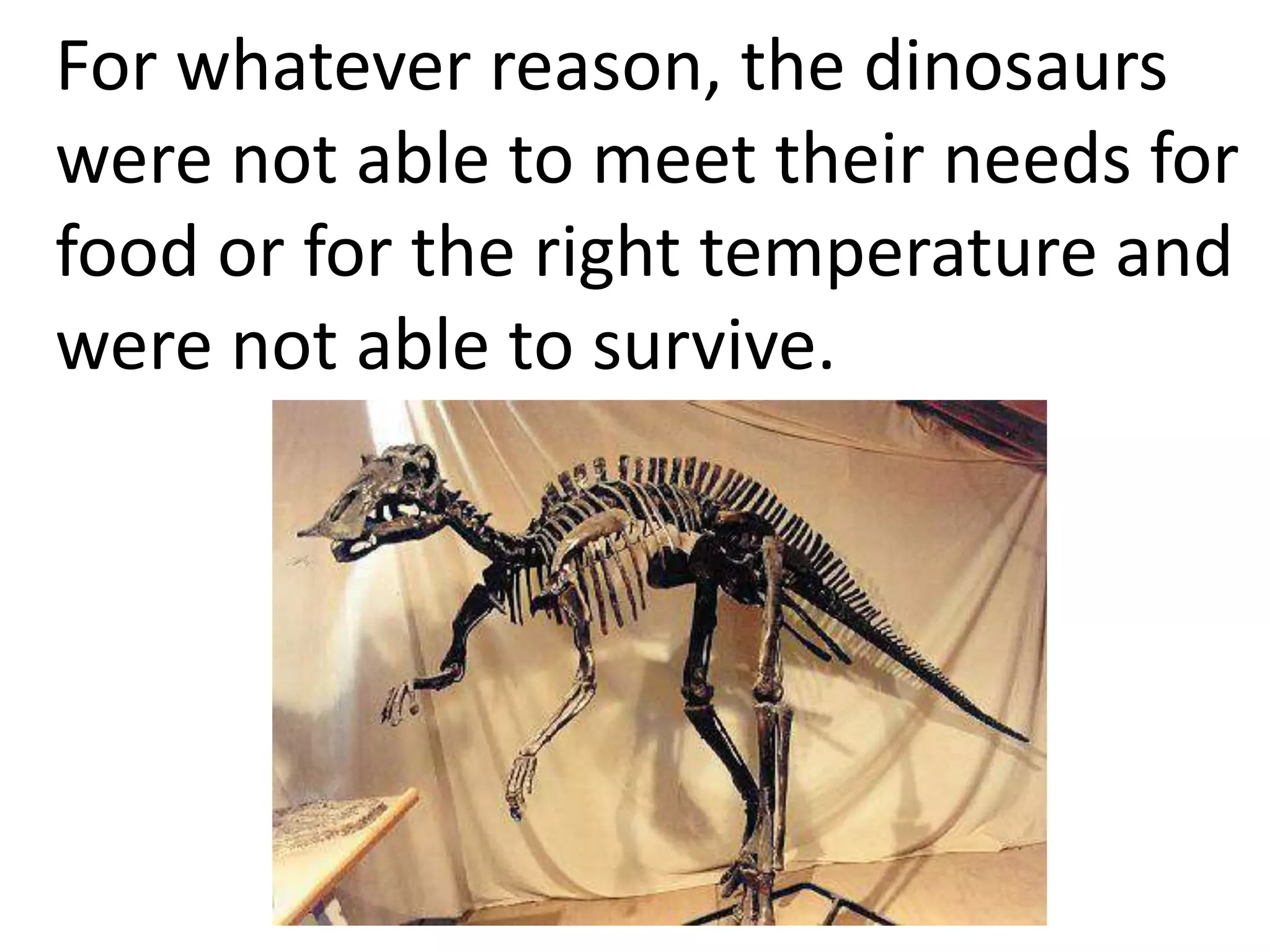
For whatever reason, the dinosaurs
were not able to meet their needs for
food or for the right temperature and
were not able to survive.
They did not make the
adaptations needed to survive in
their new environment.
They did not make the
adaptations needed to survive in
their new environment.
As a result they became extinct.
An adaptation is a physical trait or a
behavior that helps a living thing
survive in its environment.
• A physical trait or an inherited
behavior usually takes a long time to
develop or change.
•Whereas individuals learn many
new behaviors in a lifetime.
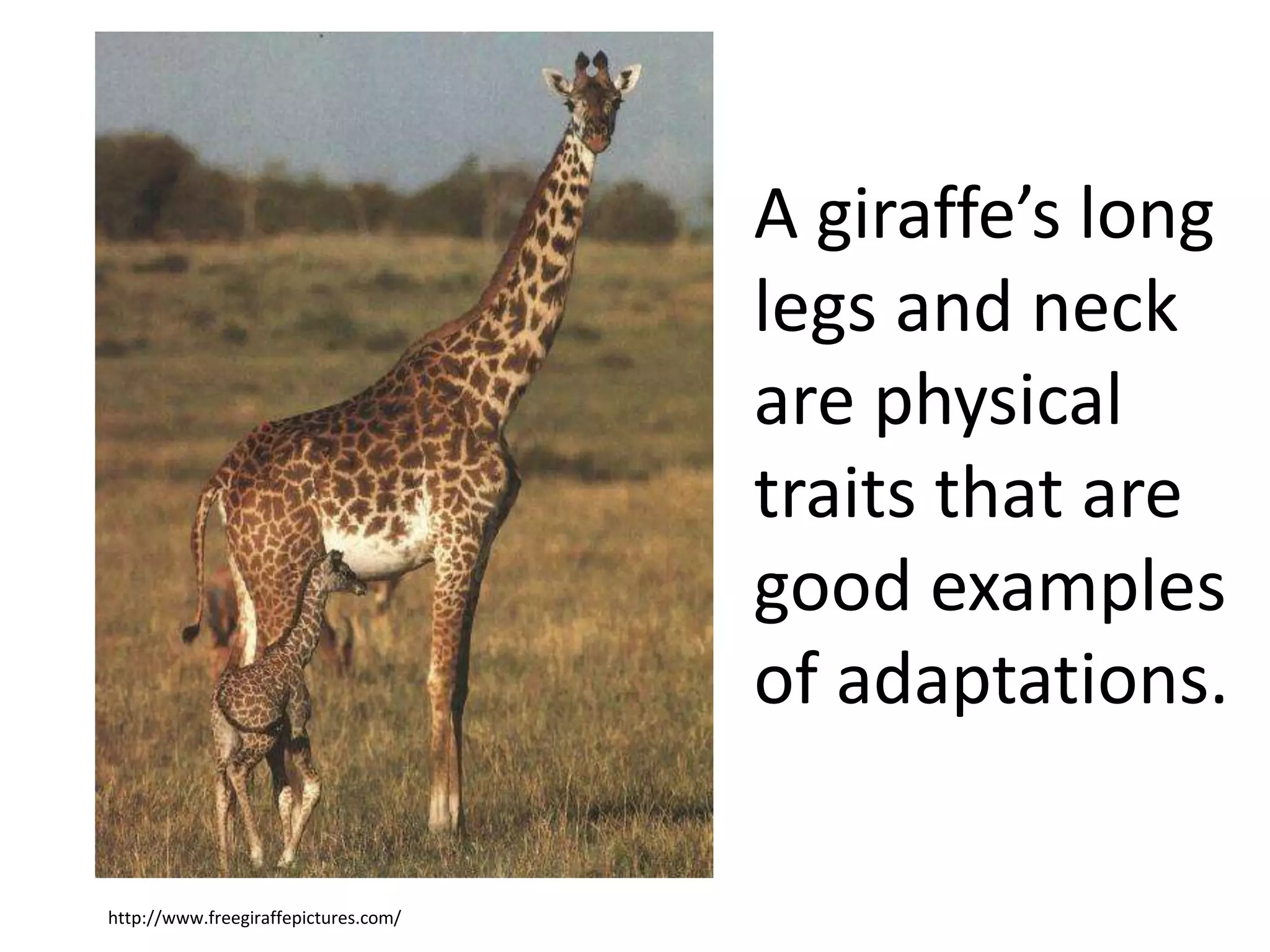
http://www.freegiraffepictures.com/
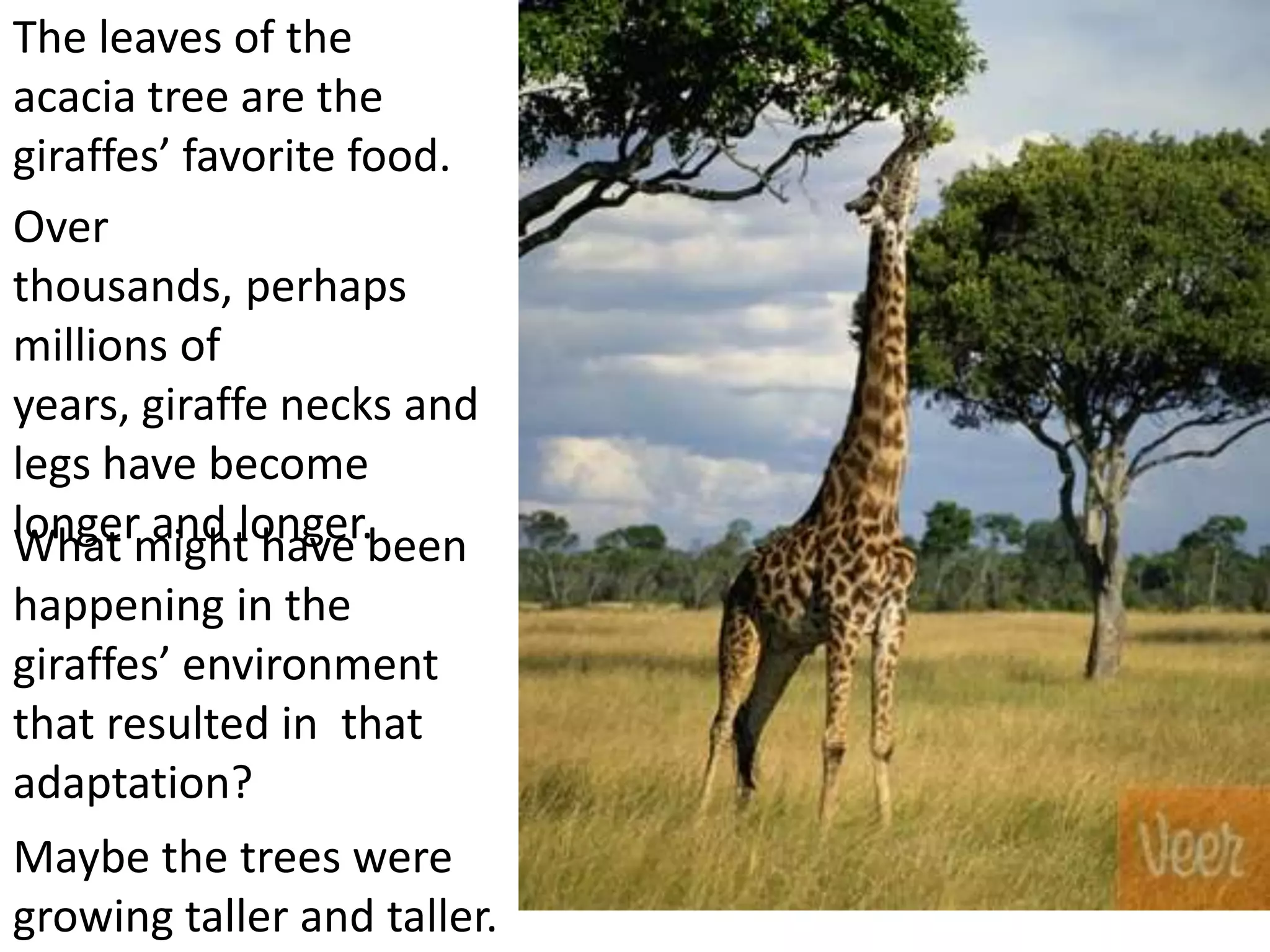
A giraffe’s long
legs and neck
are physical
traits that are
good examples
of adaptations.
The leaves of the
acacia tree are the
giraffes’ favorite food.
Over
thousands, perhaps
millions of
years, giraffe necks and
legs have become
longer and longer.What might have been
happening in the
giraffes’ environment
that resulted in that
adaptation?
Maybe the trees were
growing taller and taller.
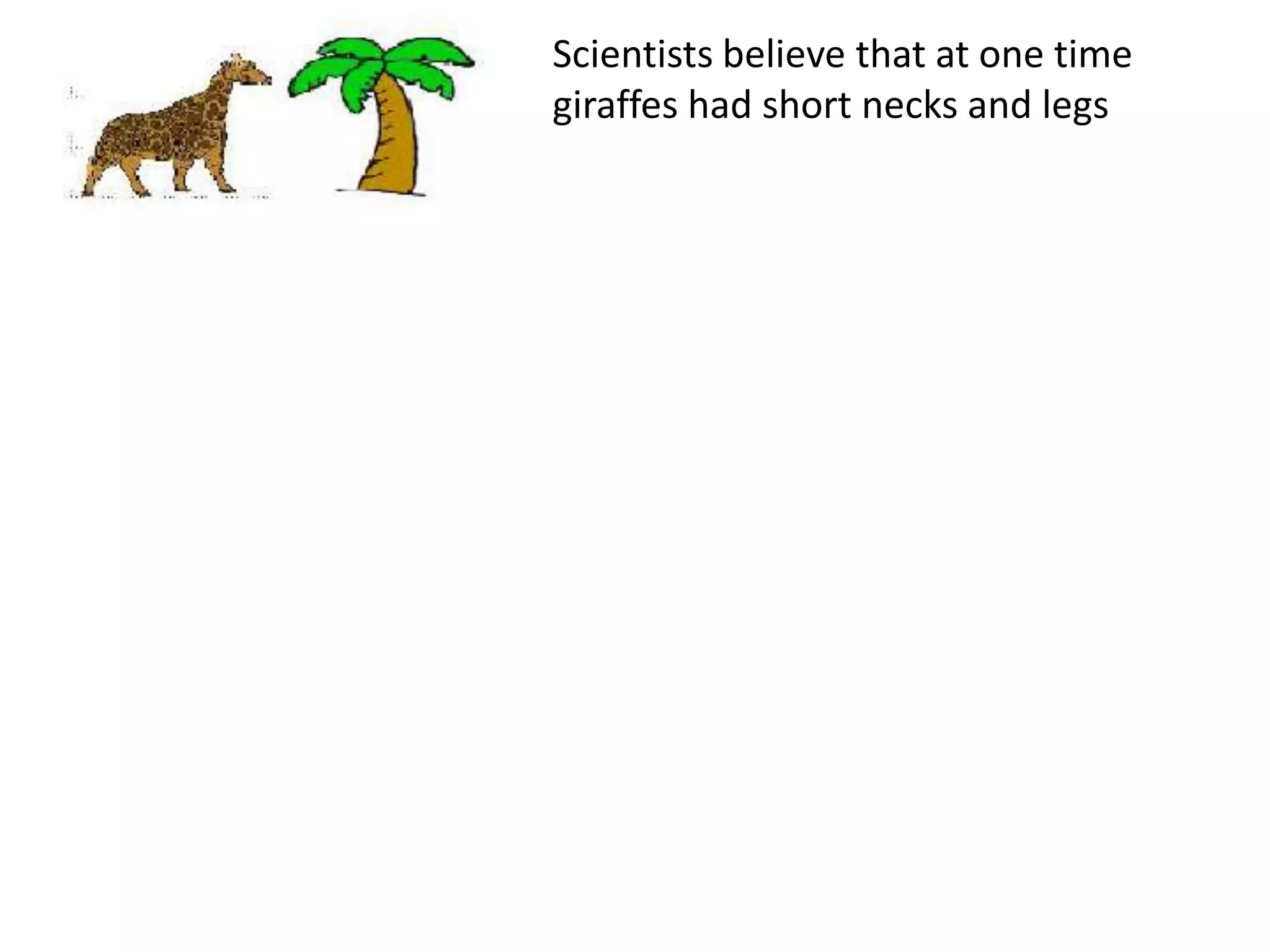
Scientists believe that at one time
giraffes had short necks and legs
Scientists believe that at one time
giraffes had short necks and legs
They think that each generation
of trees in the areas where
giraffes lived, over millions and
millions of years grew taller and
taller.
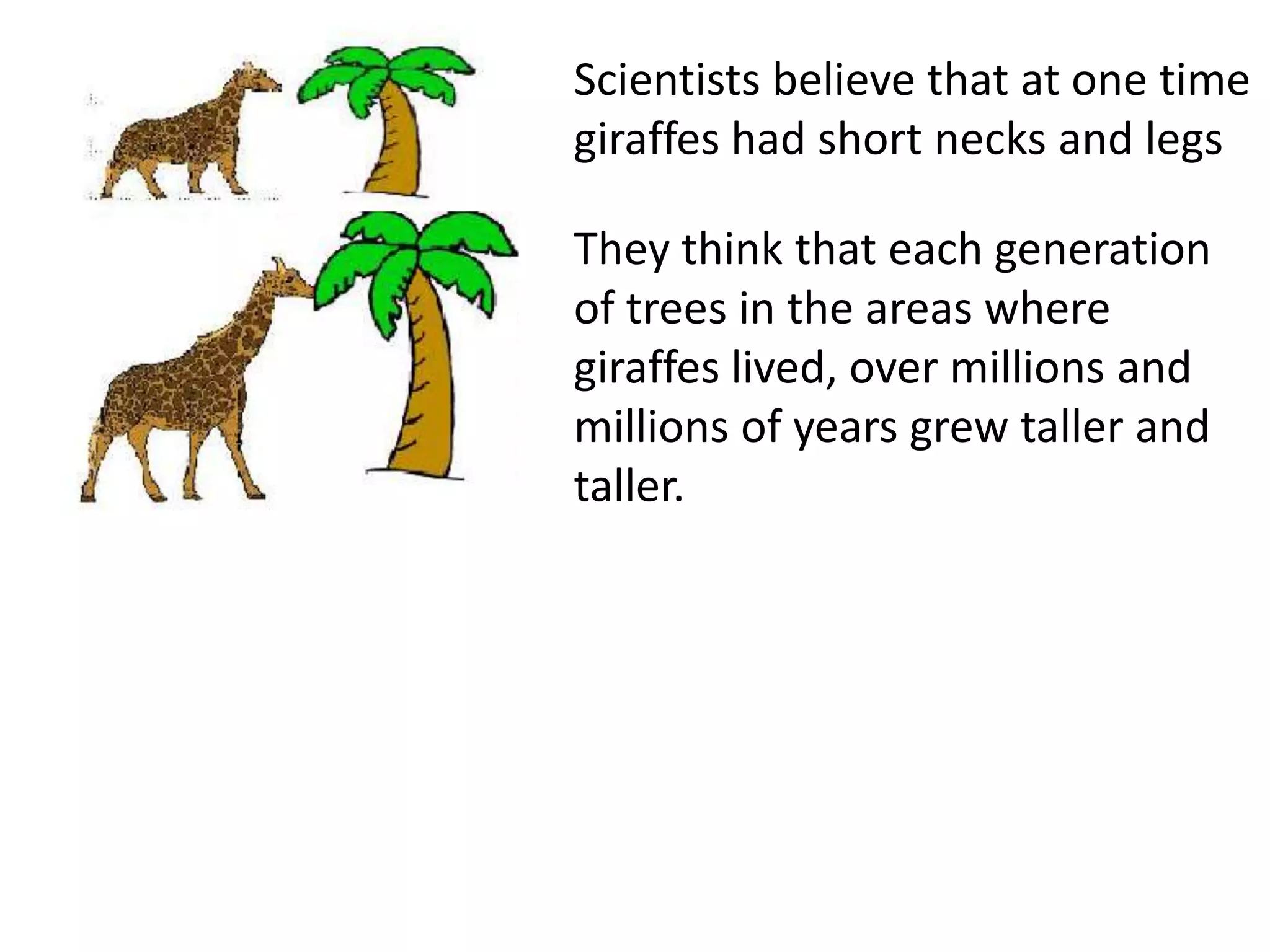
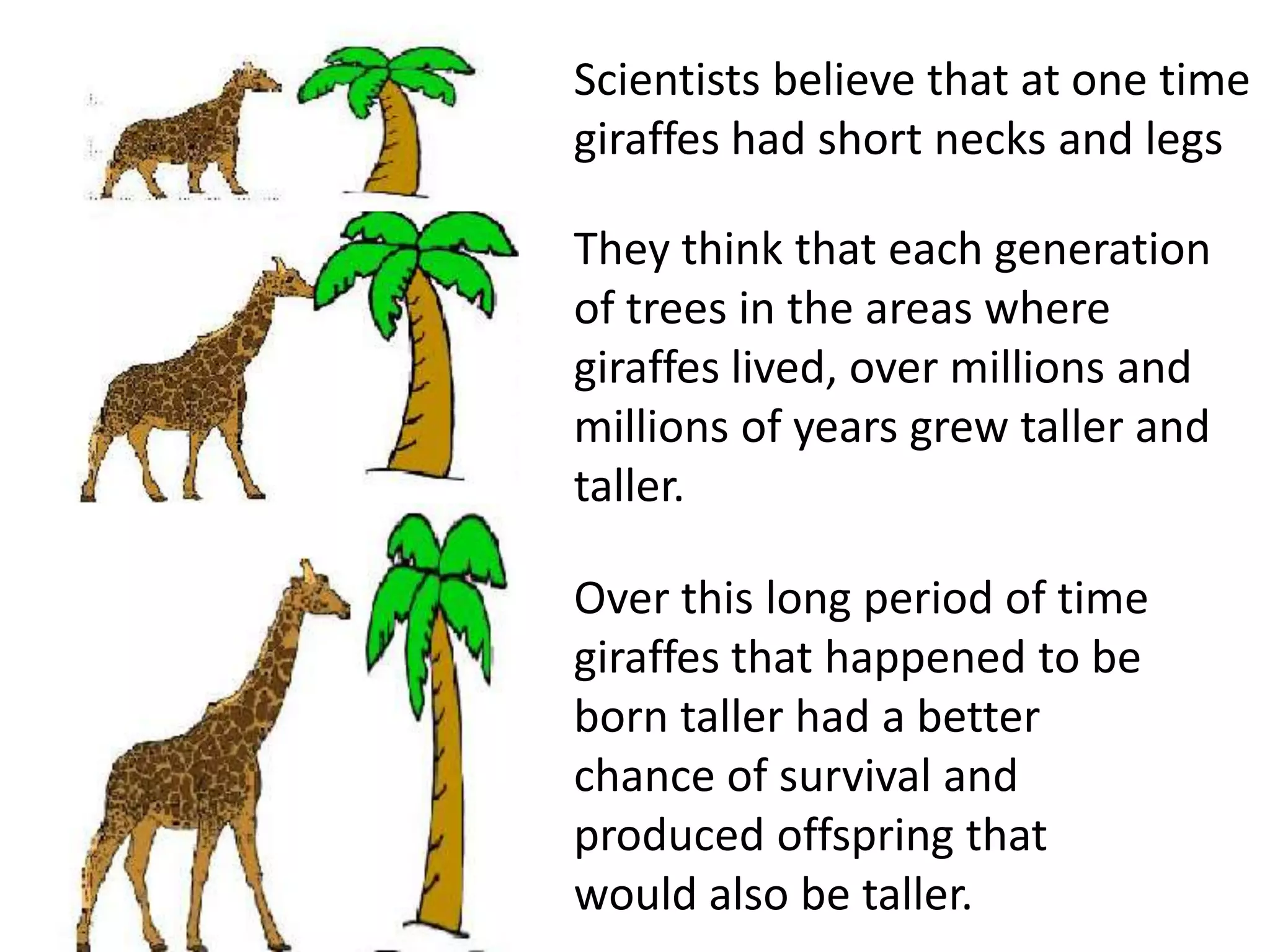
Scientists believe that at one time
giraffes had short necks and legs
They think that each generation
of trees in the areas where
giraffes lived, over millions and
millions of years grew taller and
taller.
Over this long period of time
giraffes that happened to be
born taller had a better
chance of survival and
produced offspring that
would also be taller.
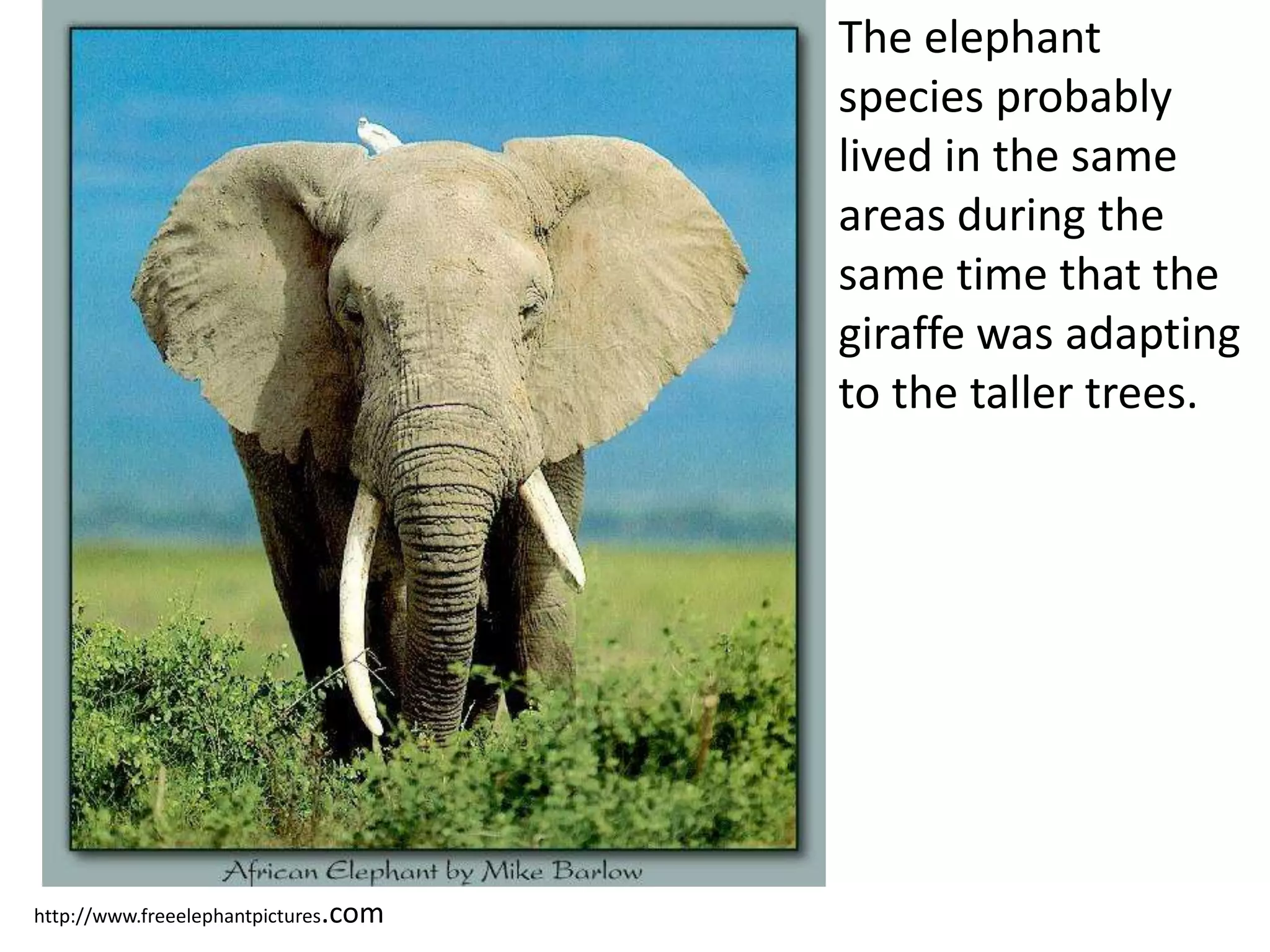
http://www.freeelephantpictures.com
The elephant
species probably
lived in the same
areas during the
same time that the
giraffe was adapting
to the taller trees.
http://www.freeelephantpictures.com
The elephant
species probably
lived in the same
areas during the
same time that the
giraffe was adapting
to the taller trees.
What adaptation
resulted in the
elephant being able
to reach those juicy
leaves high up in the
trees?
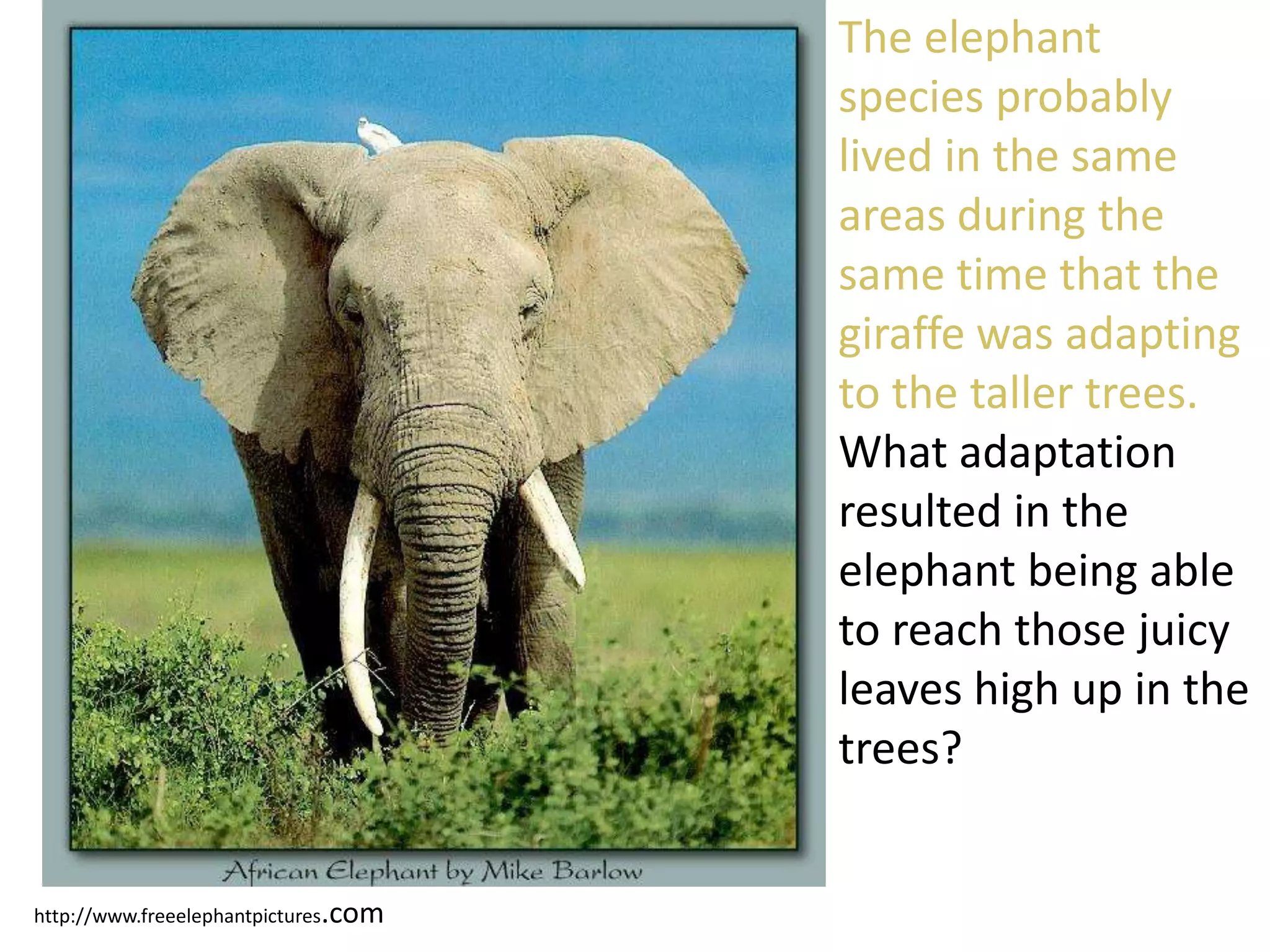
http://www.freeelephantpictures.com
The elephant
species probably
lived in the same
areas during the
same time that the
giraffe was adapting
to the taller trees.
What adaptation did
the elephant come
up with to reach
those juicy leaves
high up in the trees?
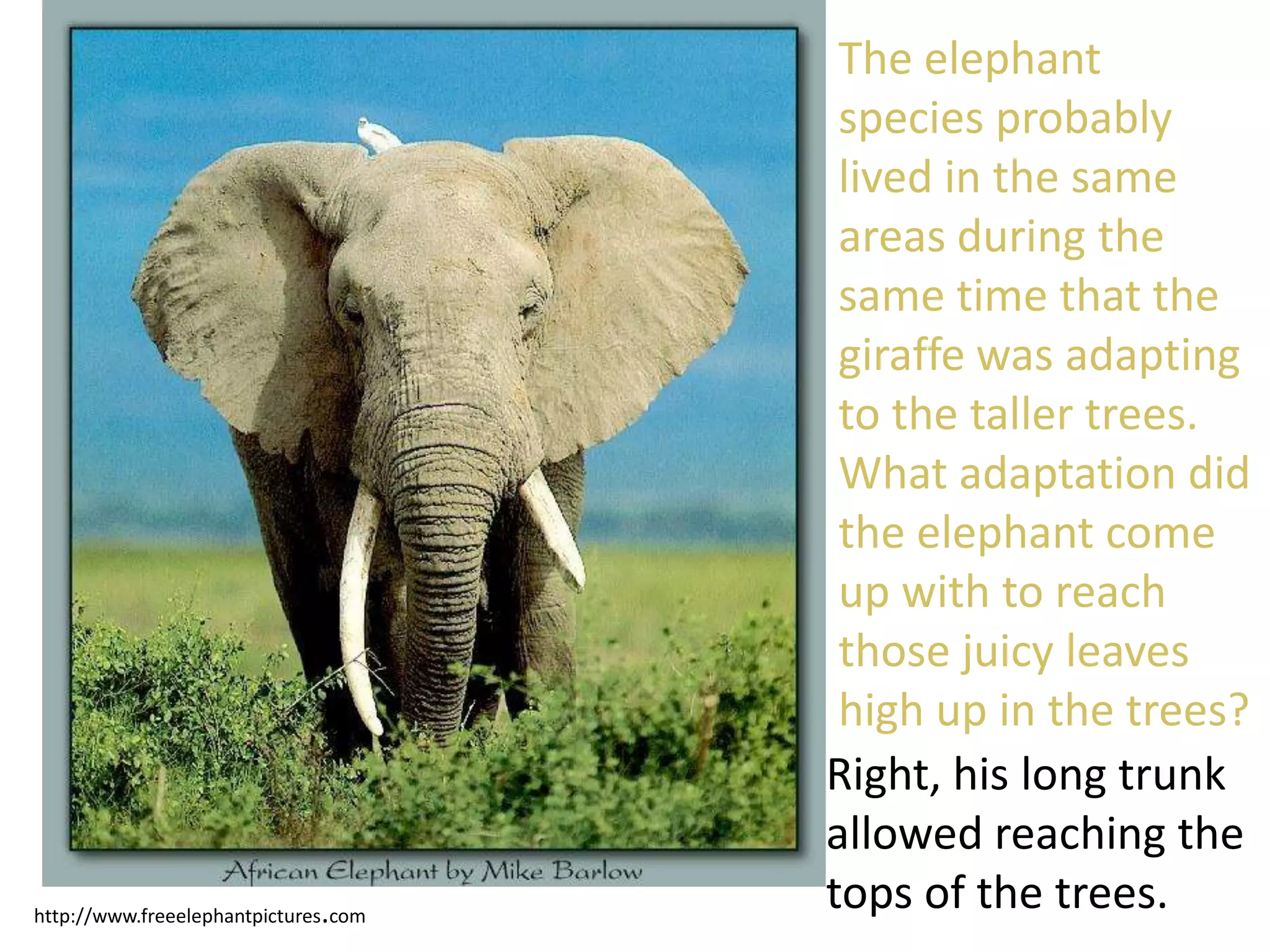
Right, his long trunk
allowed reaching the
tops of the trees.
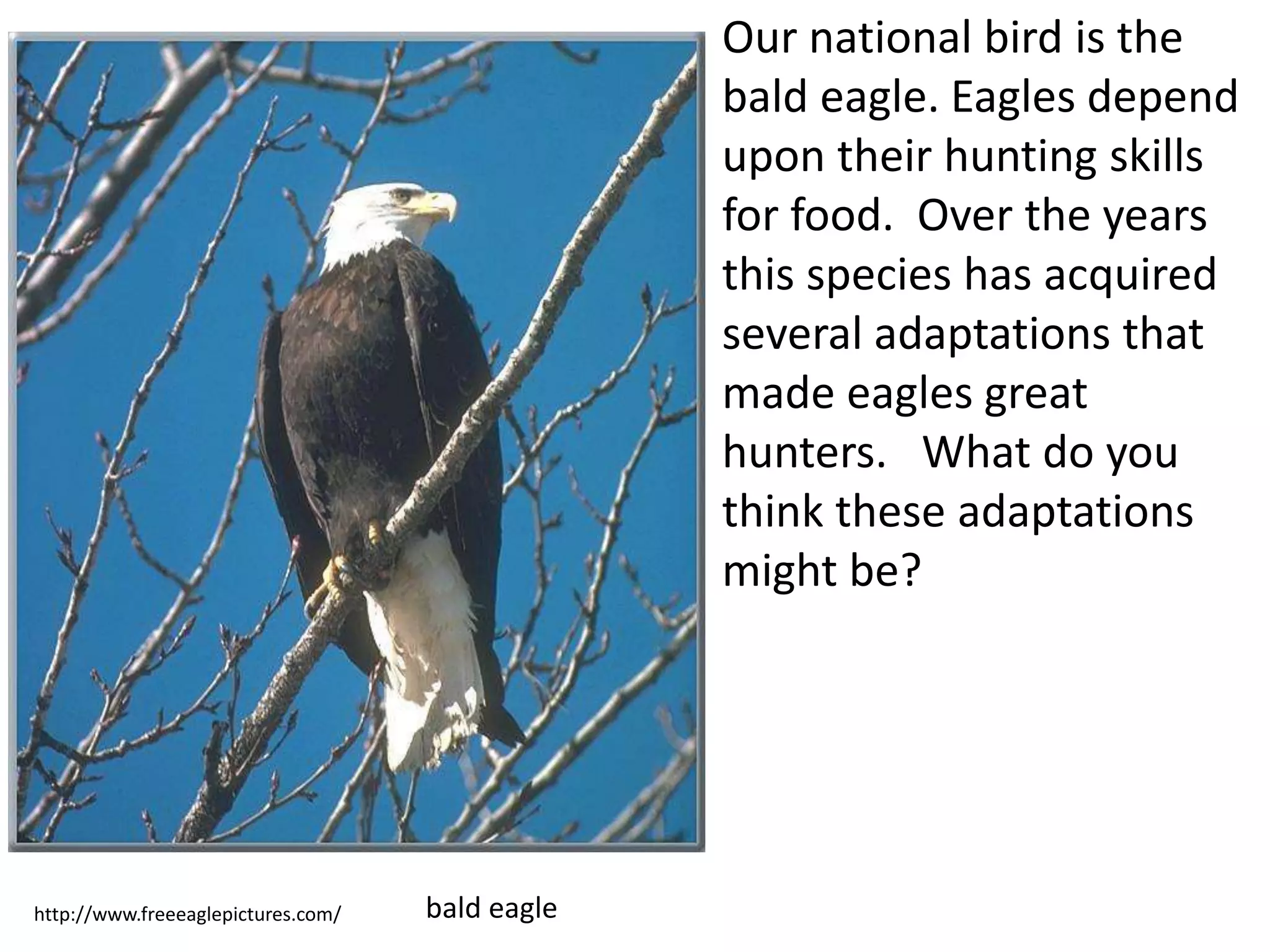
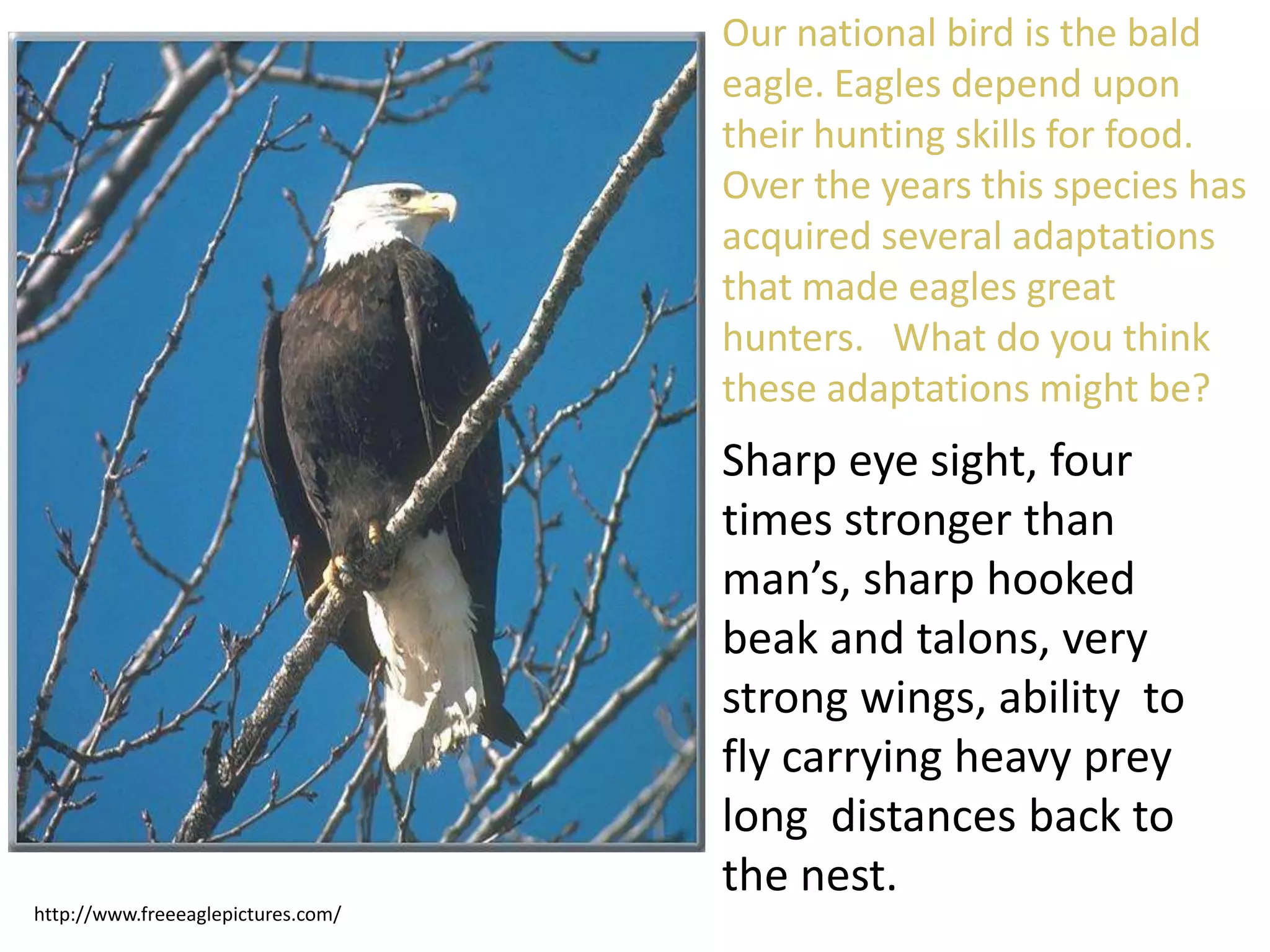
http://www.freeeaglepictures.com/ bald eagle
Our national bird is the
bald eagle. Eagles depend
upon their hunting skills
for food. Over the years
this species has acquired
several adaptations that
made eagles great
hunters. What do you
think these adaptations
might be?
http://www.freeeaglepictures.com/
Our national bird is the bald
eagle. Eagles depend upon
their hunting skills for food.
Over the years this species has
acquired several adaptations
that made eagles great
hunters. What do you think
these adaptations might be?
Sharp eye sight, four
times stronger than
man’s, sharp hooked
beak and talons, very
strong wings, ability to
fly carrying heavy prey
long distances back to
the nest.
http://www.freenaturepictures.
com/ kangaroo
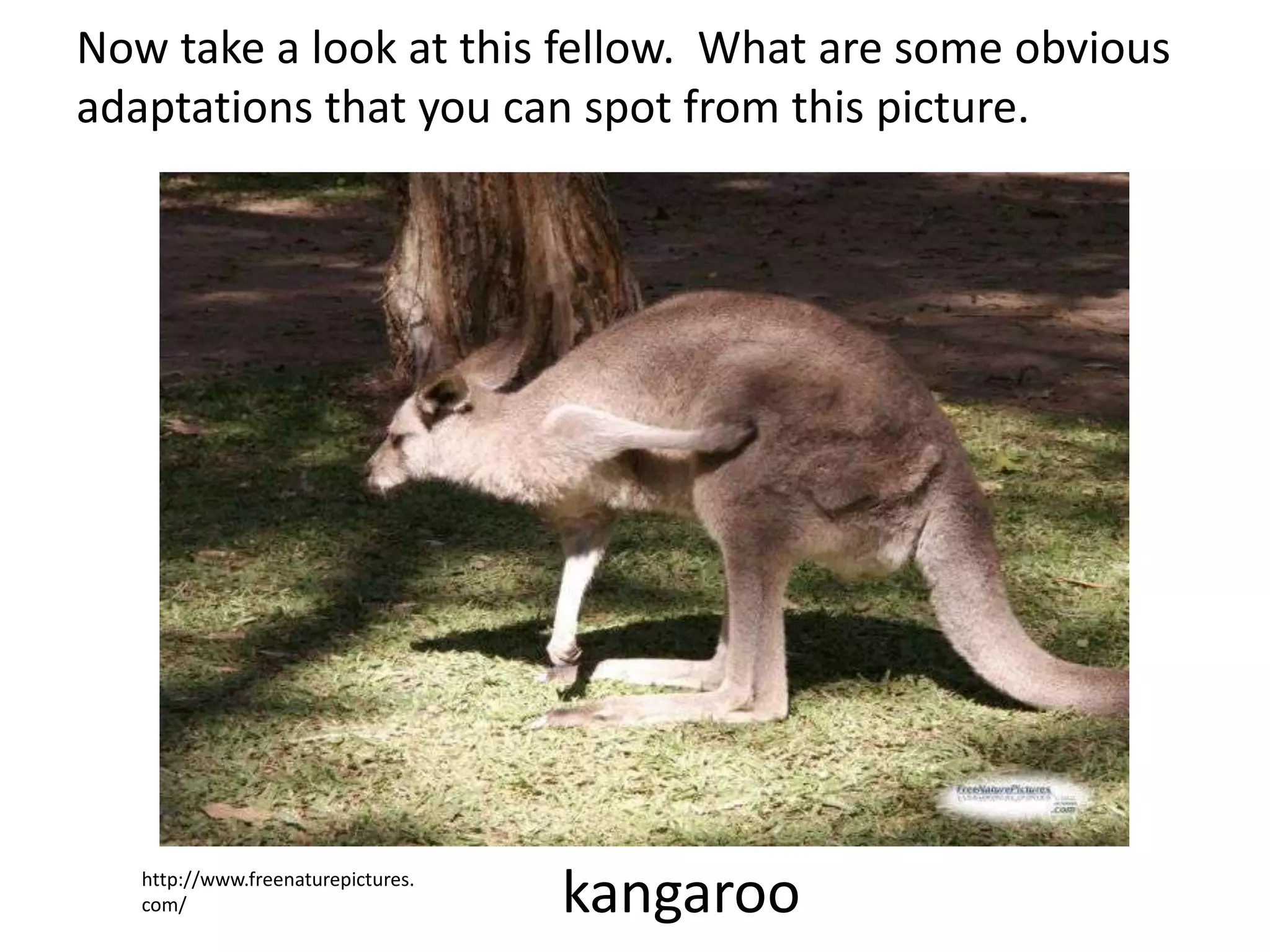
Now take a look at this fellow. What are some obvious
adaptations that you can spot from this picture.
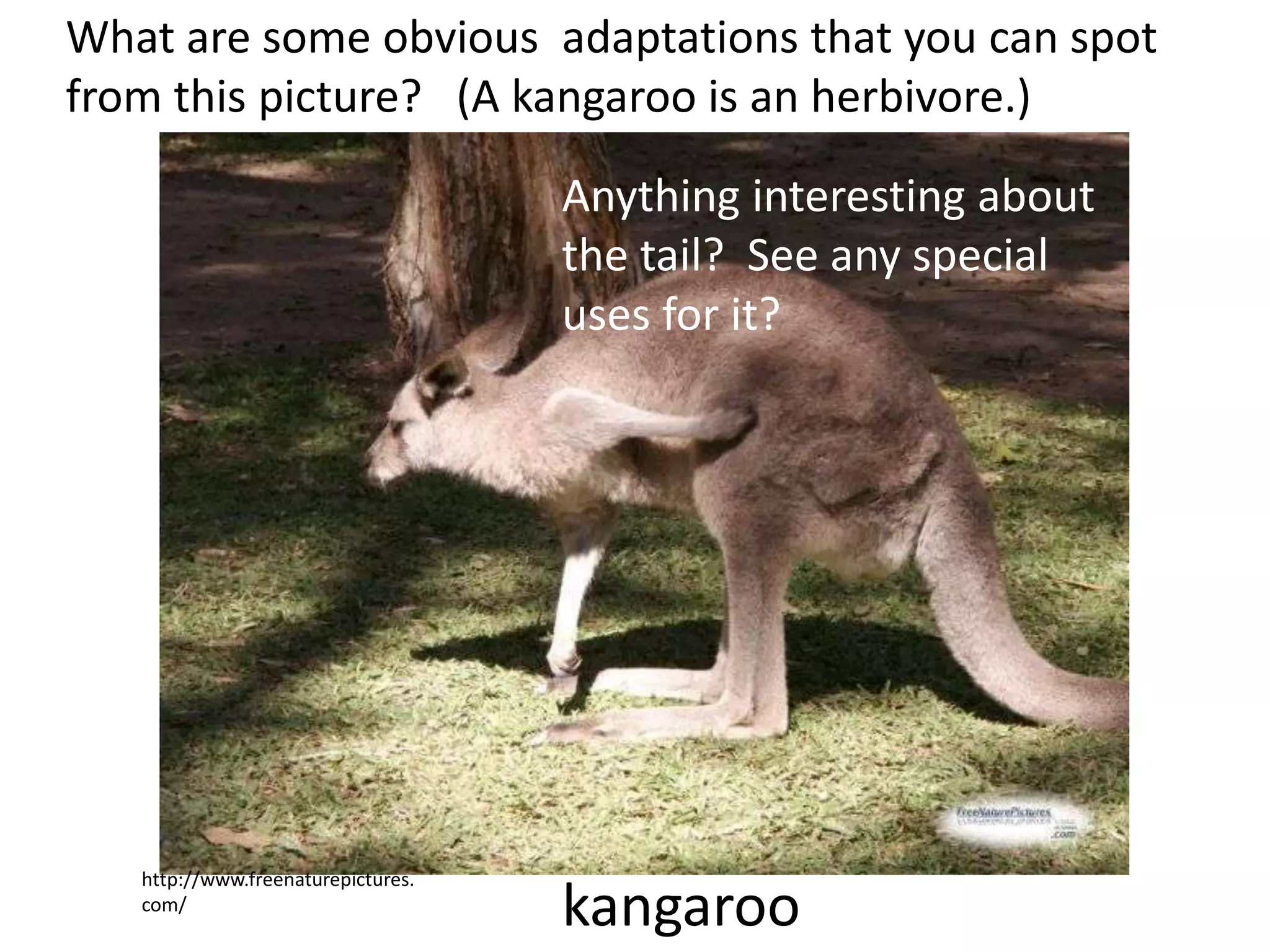
What are some obvious adaptations that you can spot
from this picture? (A kangaroo is an herbivore.)
http://www.freenaturepictures.
com/
kangaroo
Anything interesting about
the tail? See any special
uses for it?
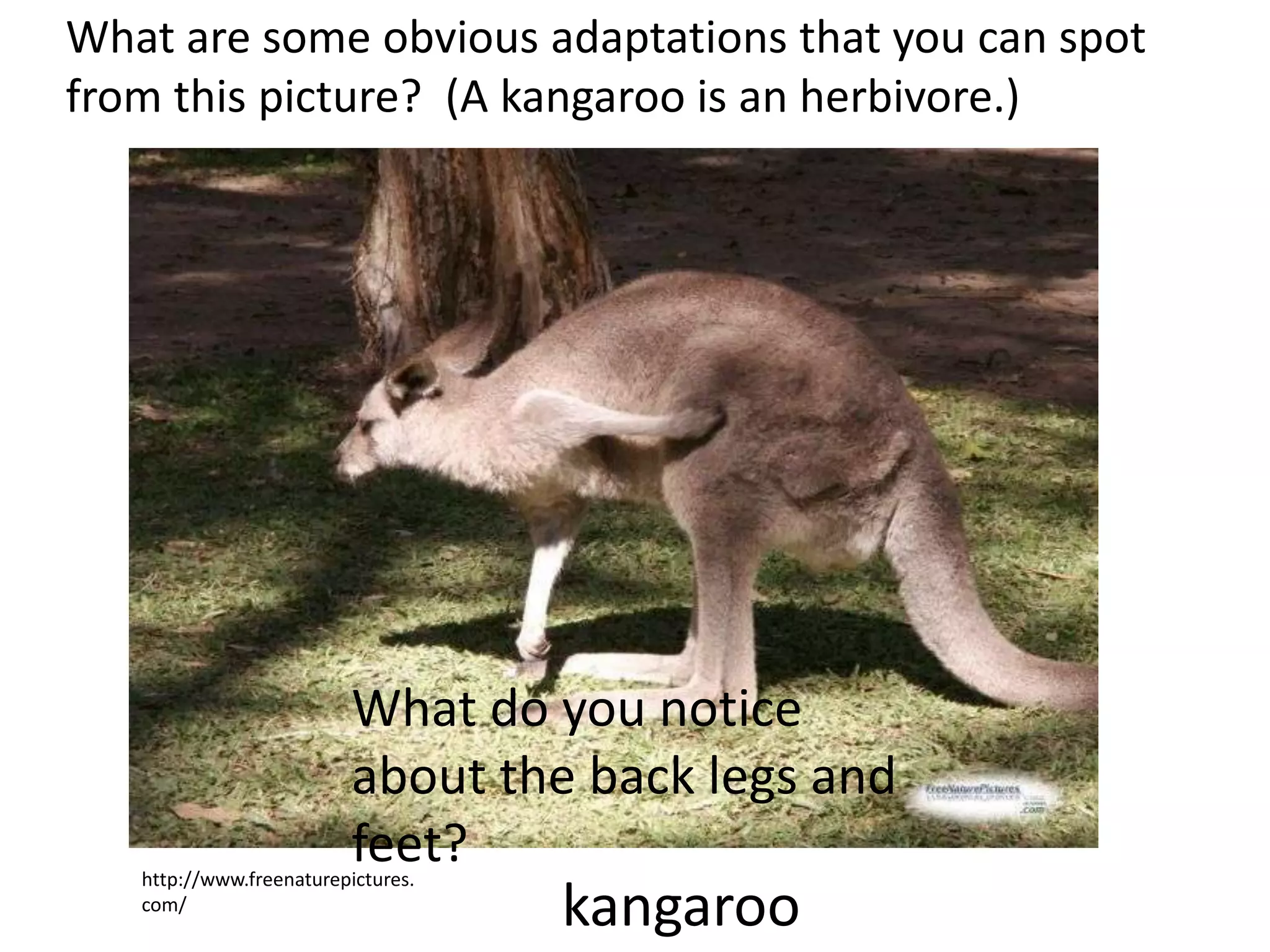
What are some obvious adaptations that you can spot
from this picture? (A kangaroo is an herbivore.)
http://www.freenaturepictures.
com/
kangaroo
What do you notice
about the back legs and
feet?
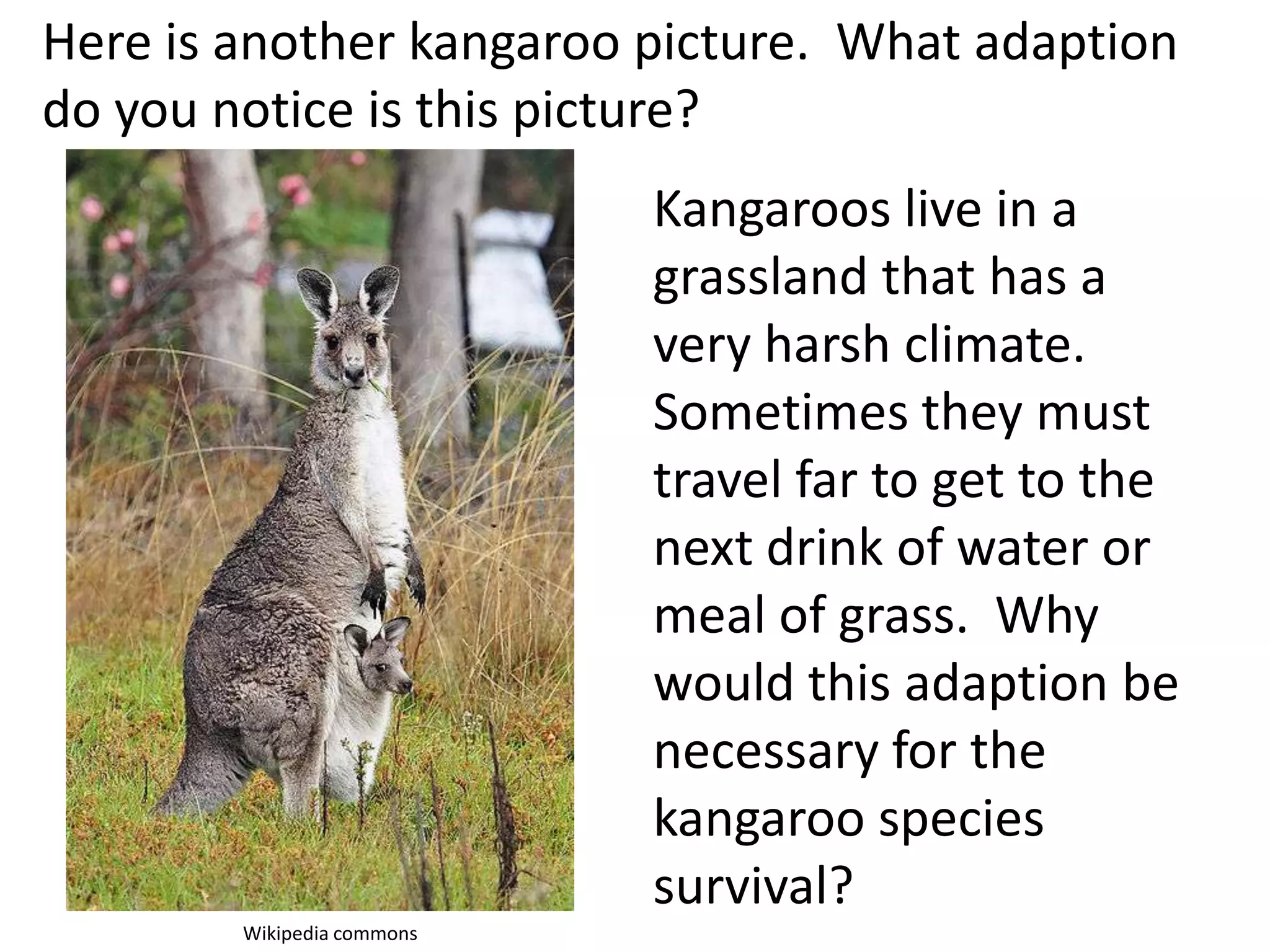
Here is another kangaroo picture. What adaption
do you notice is this picture?
Kangaroos live in a
grassland that has a
very harsh climate.
Sometimes they must
travel far to get to the
next drink of water or
meal of grass. Why
would this adaption be
necessary for the
kangaroo species
survival?
Wikipedia commons
Next we will look at the beaks of two different
kinds of birds. We want to see how the
development of their beaks help them survive
in their environment. The birds are:
•the hummingbird
•the pelican
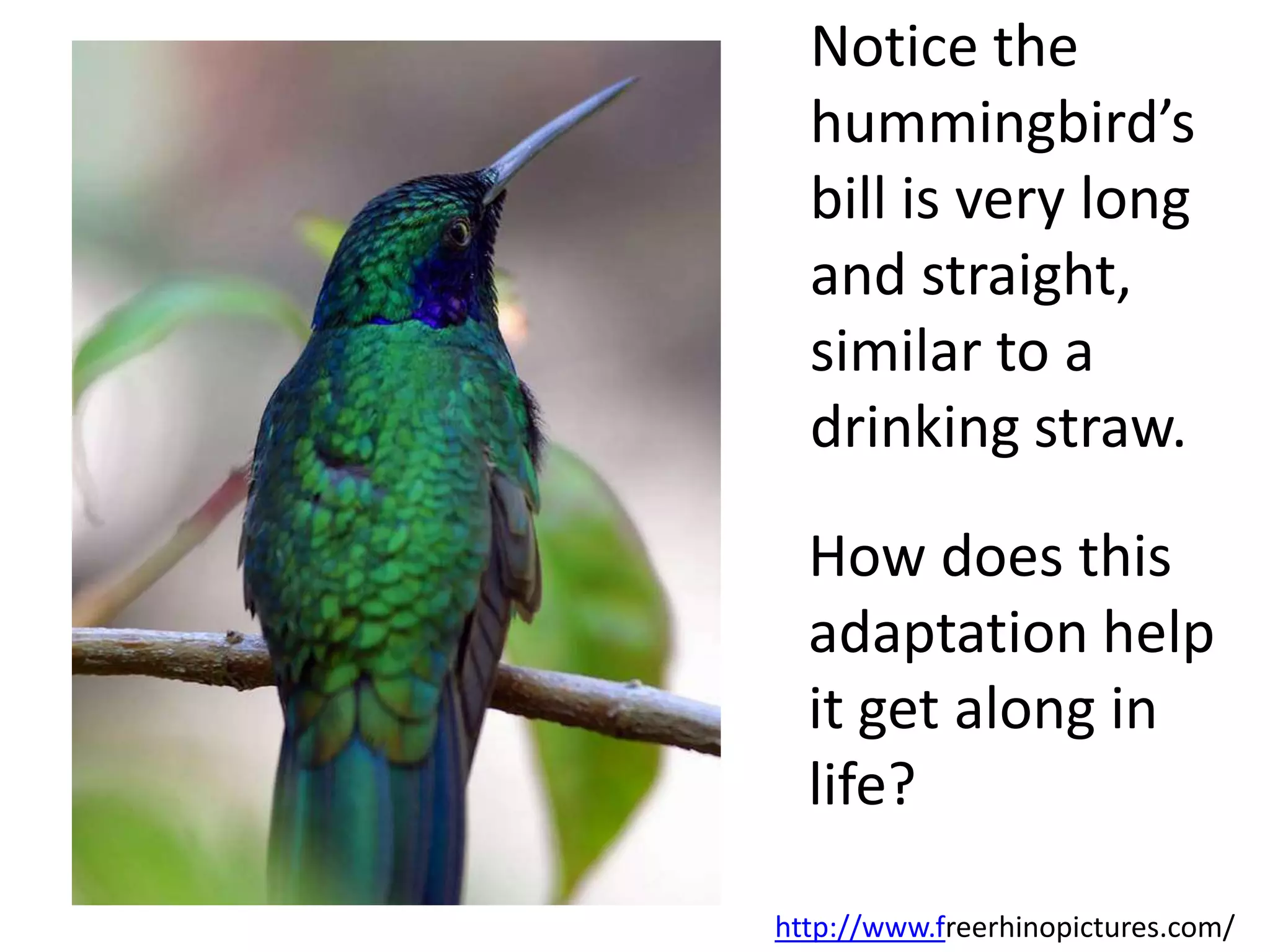
Notice the
hummingbird’s
bill is very long
and straight,
similar to a
drinking straw.
http://www.freerhinopictures.com/
How does this
adaptation help
it get along in
life?
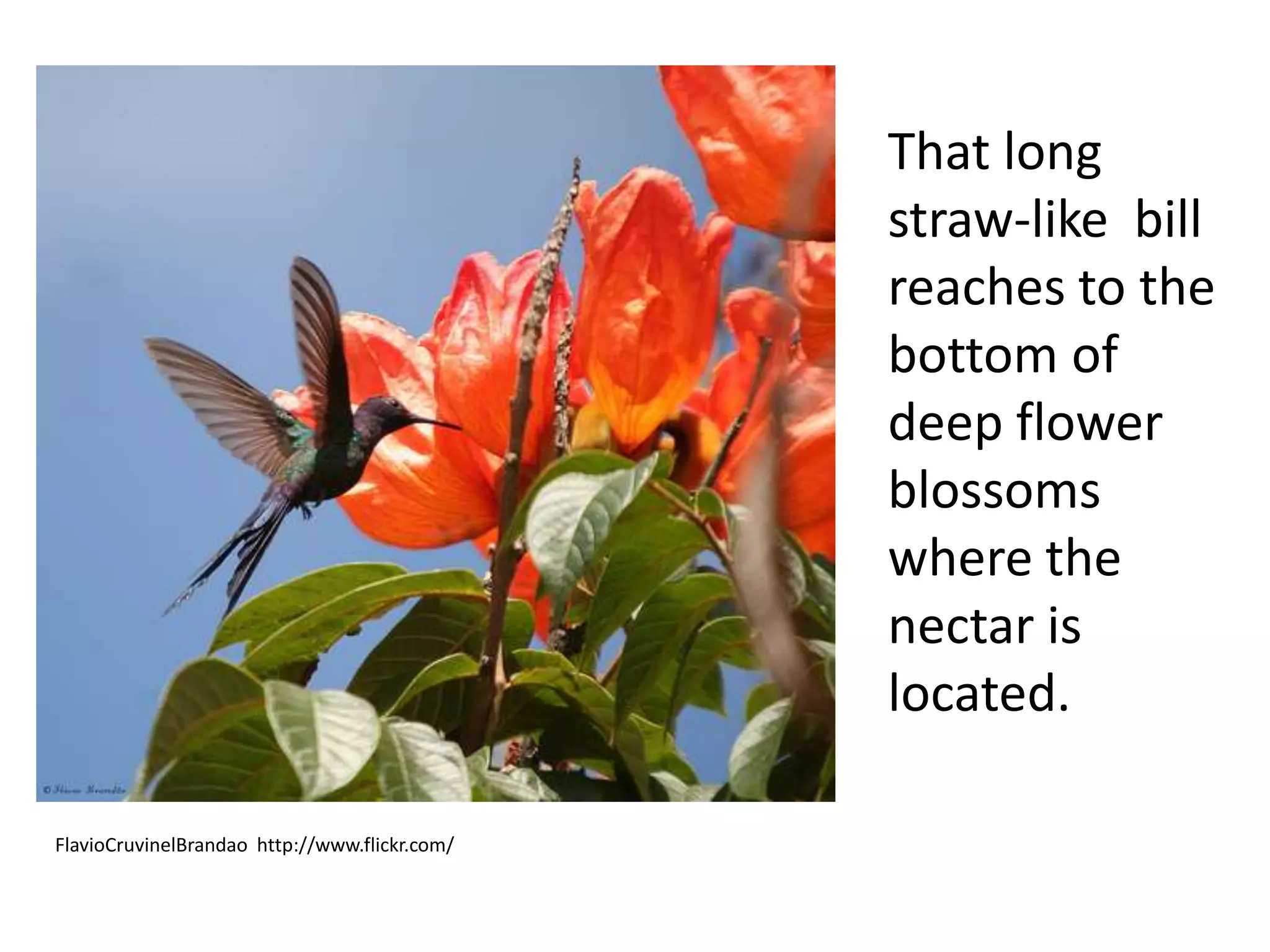
FlavioCruvinelBrandao http://www.flickr.com/
That long
straw-like bill
reaches to the
bottom of
deep flower
blossoms
where the
nectar is
located.
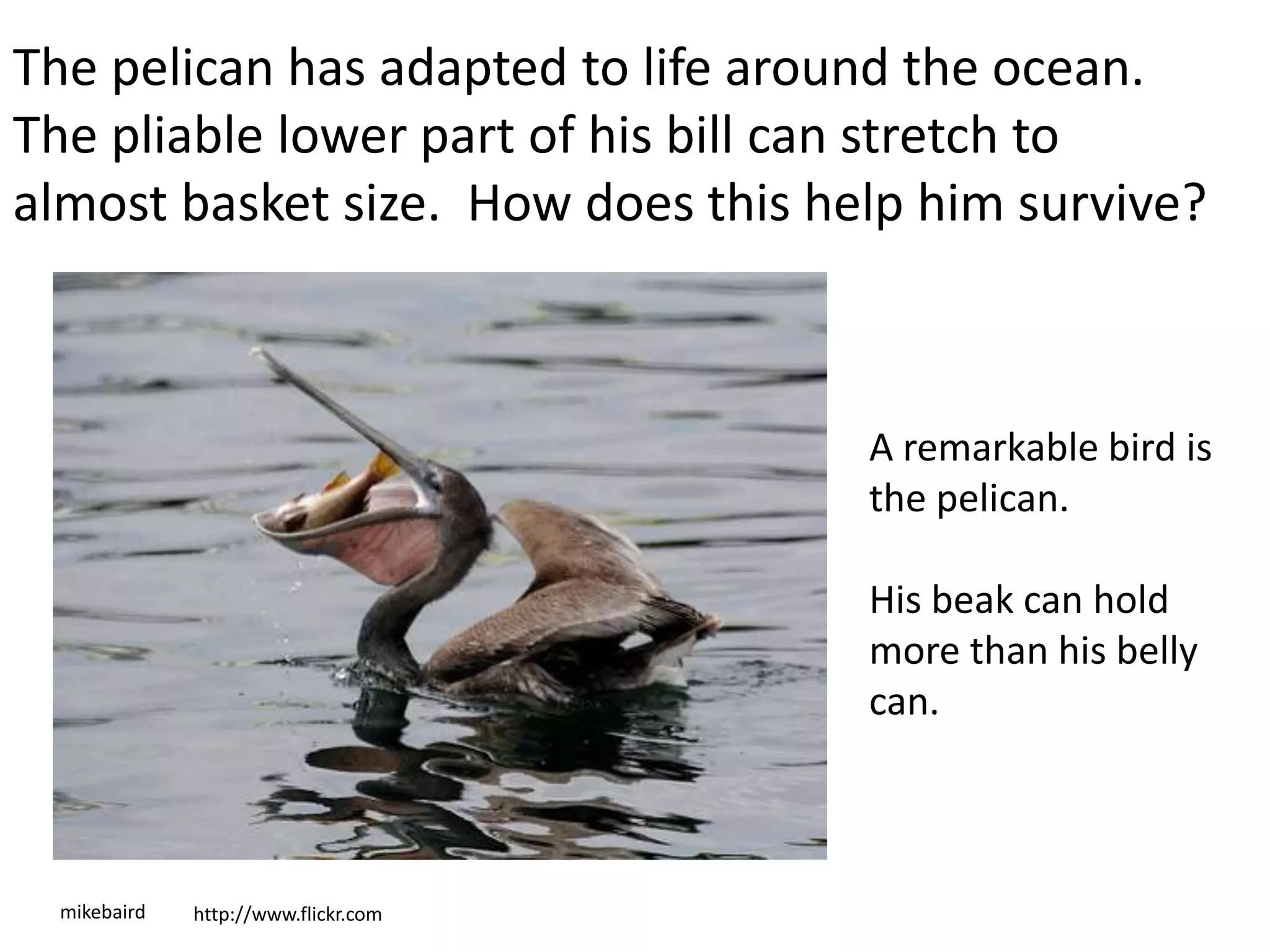
mikebaird http://www.flickr.com
The pelican has adapted to life around the ocean.
The pliable lower part of his bill can stretch to
almost basket size. How does this help him survive?
A remarkable bird is
the pelican.
His beak can hold
more than his belly
can.
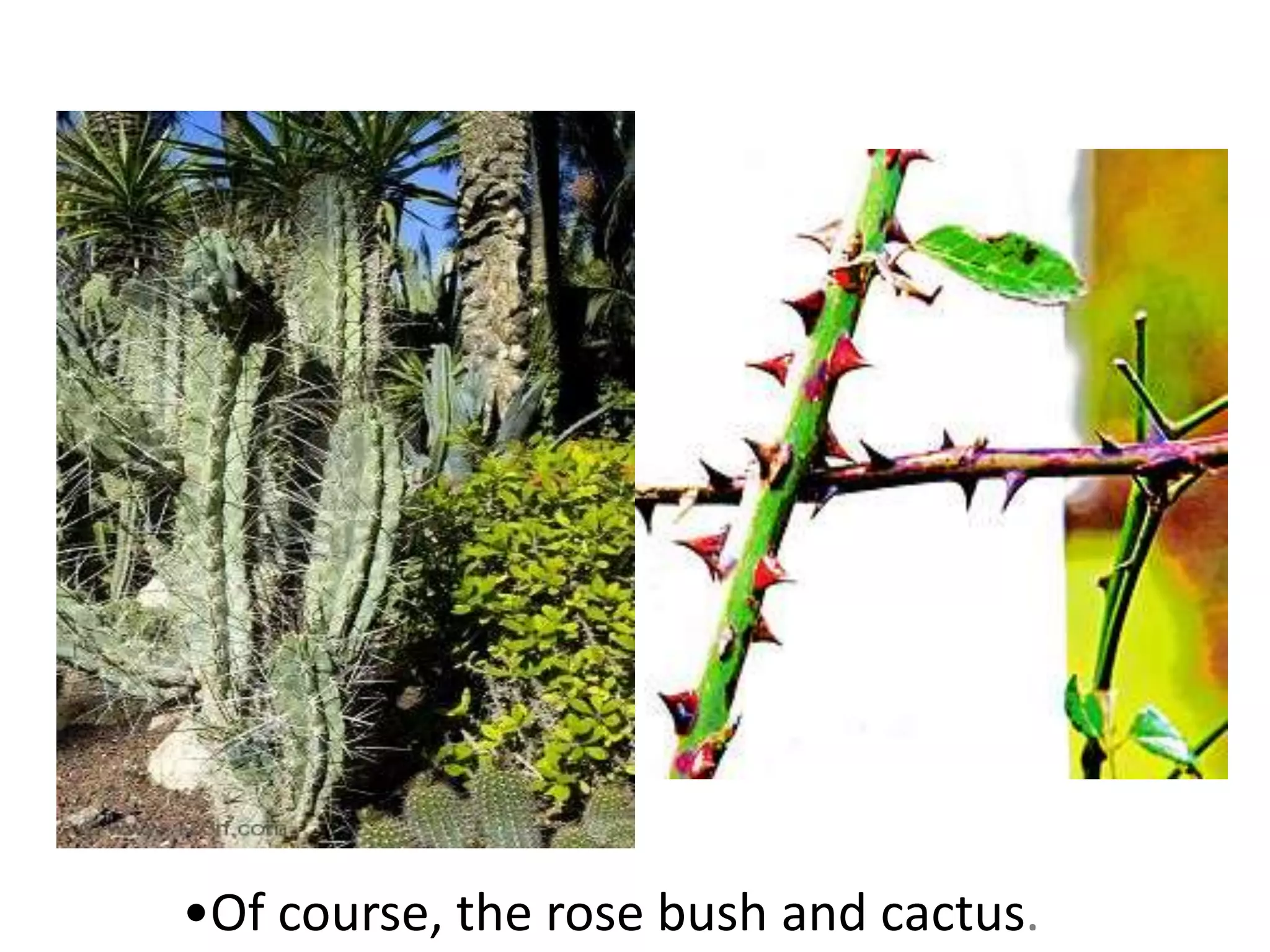
Plants also need adaptations in order to survive.
•An obvious example would be plants that
have developed sharp thorns that stick
out in all directions.
Plants also need adaptations in order to survive.
•An obvious example would be plants that
have developed sharp thorns that stick
out in all directions.
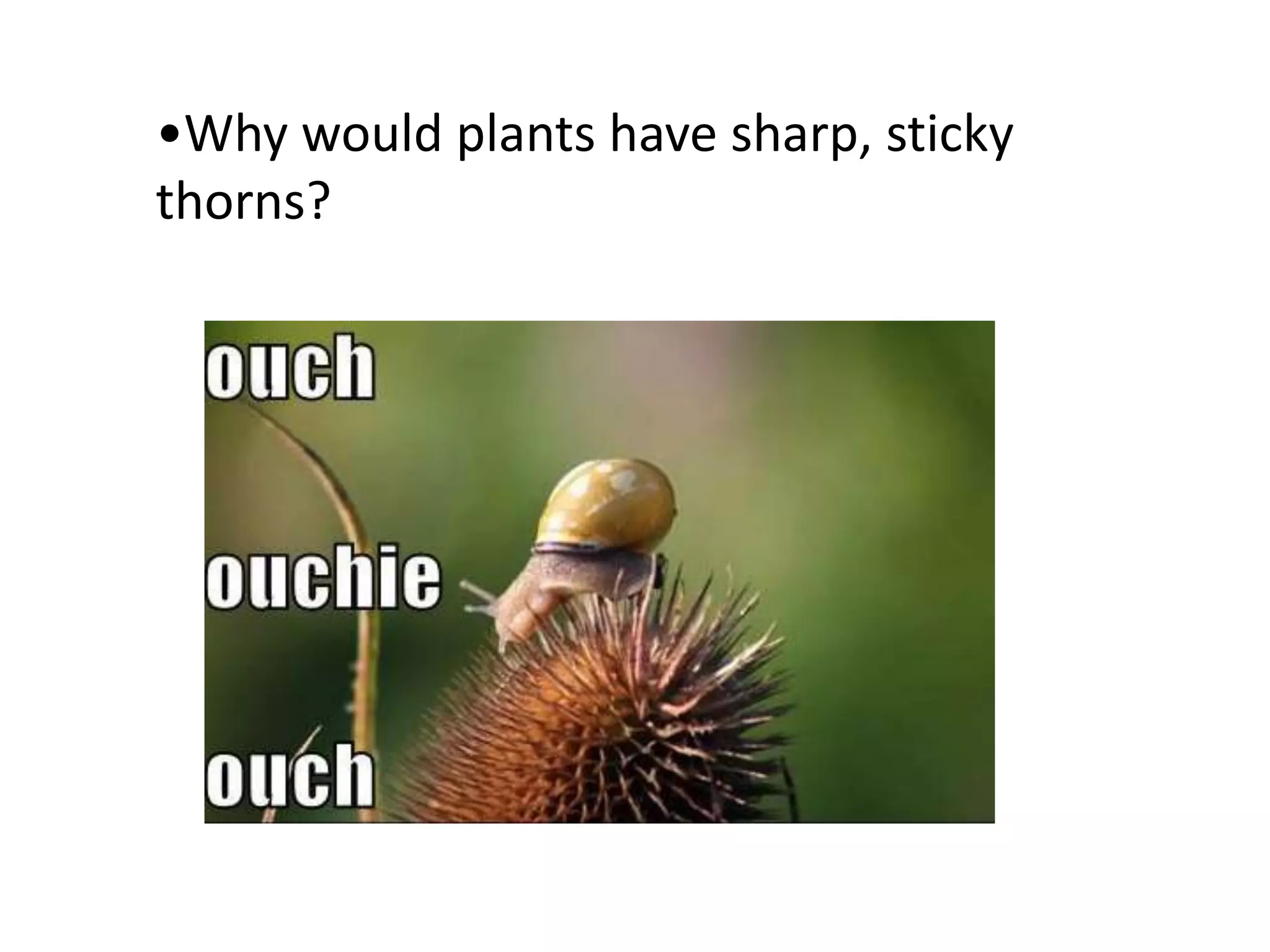
•Can you think of some plants that have
thorns?
Plants also need adaptations in order to survive.
•Of course, the rose bush and cactus.
•Why would plants have sharp, sticky
thorns?
Another example would be the kind of leaves
that plants use to meet their needs.
Another example would be the kind of leaves
that plants use to meet their needs.
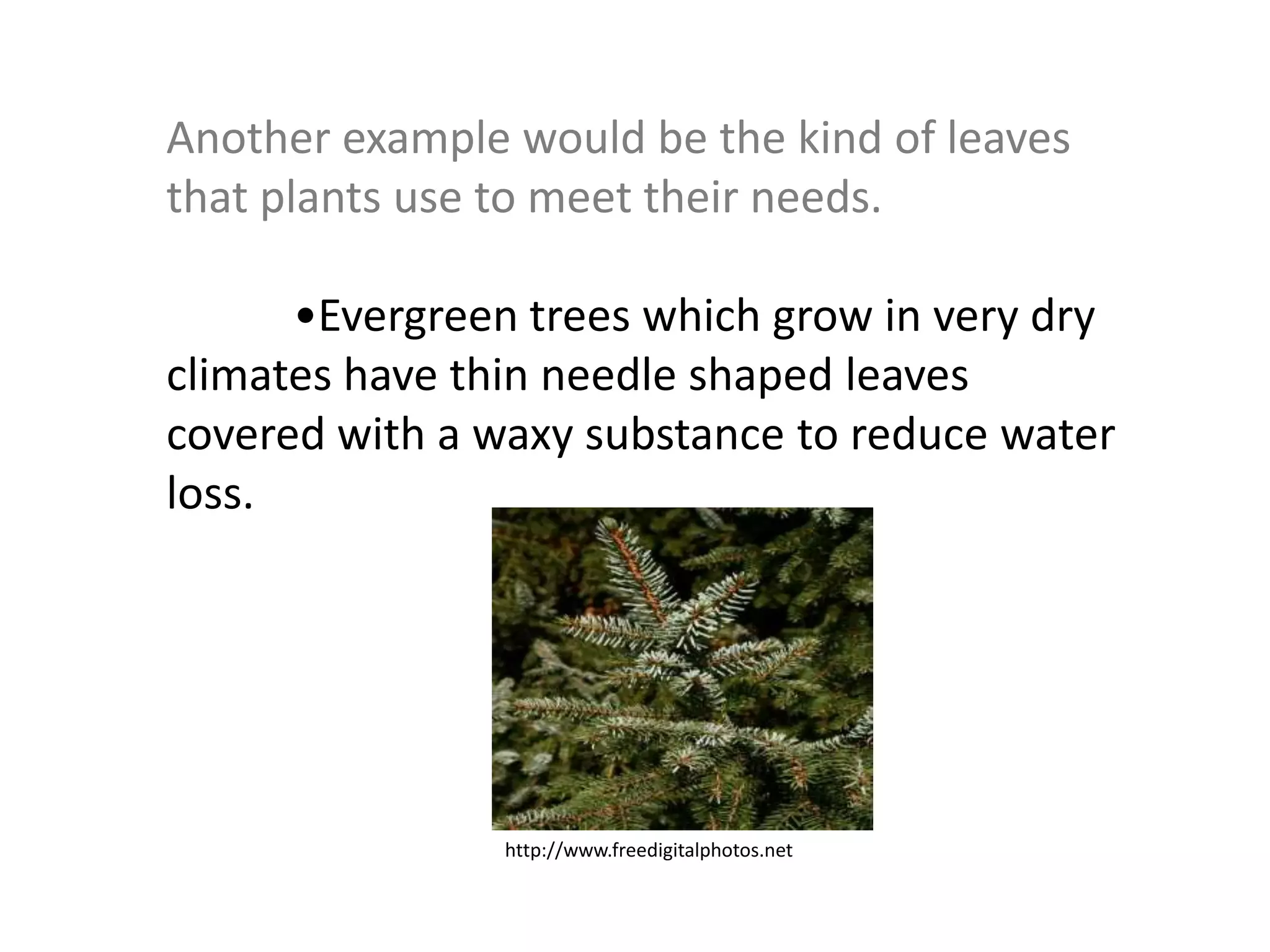
•Evergreen trees which grow in very dry
climates have thin needle shaped leaves
covered with a waxy substance to reduce water
loss.
http://www.freedigitalphotos.net
Another example would be the kind of leaves
that plants use to meet their needs.
•Evergreen trees which grow in very dry
climates have thin needle shaped leaves
covered with a waxy substance to reduce water
loss.
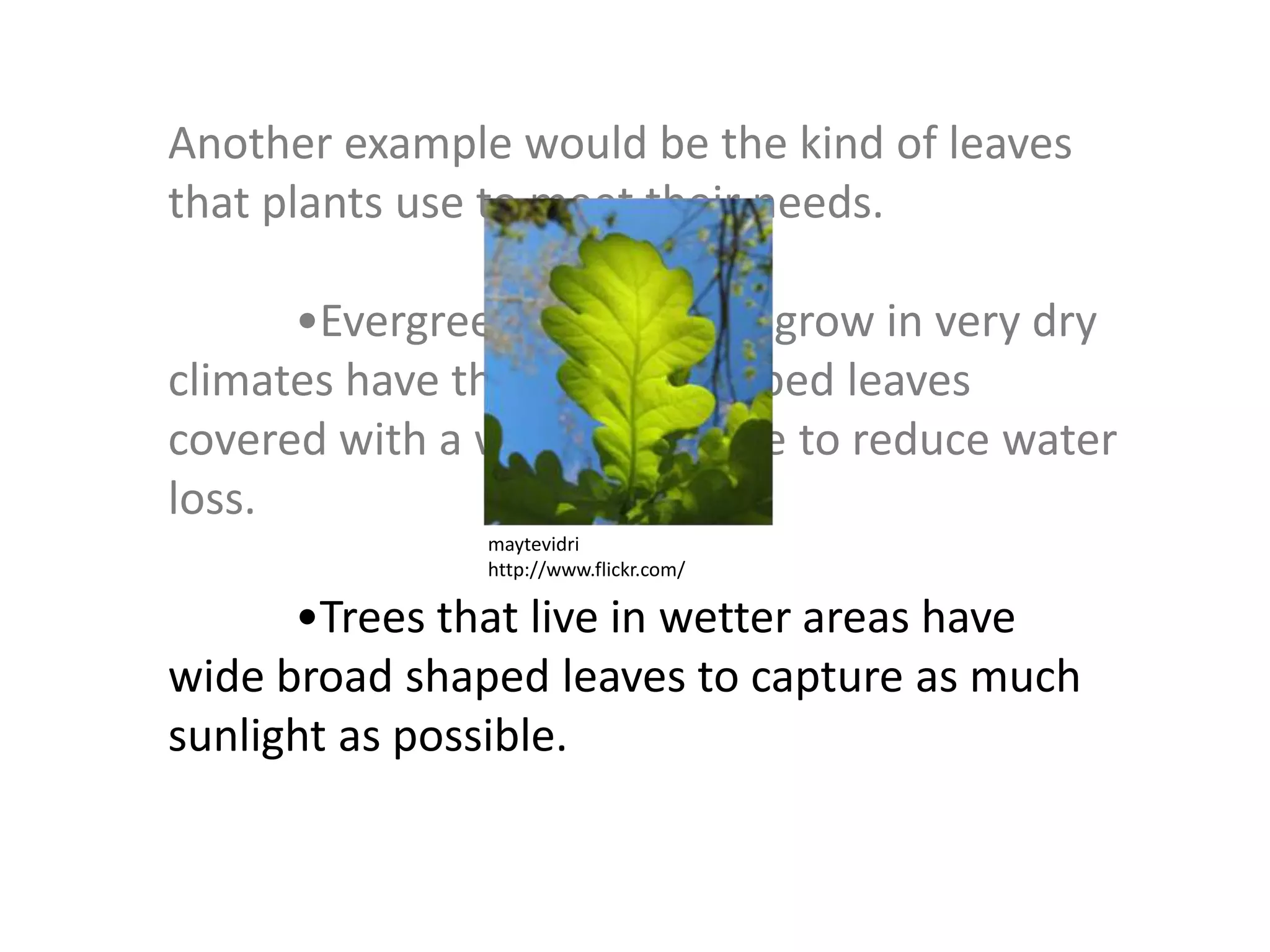
•Trees that live in wetter areas have
wide broad shaped leaves to capture as much
sunlight as possible.
maytevidri
http://www.flickr.com/
Many of the structural traits that we have
studied have taken a very long time to develop,
perhaps thousands or even millions of years.
Many of the structural traits that we have
studied have taken a very long time to
develop, perhaps thousands or even millions of
years.
Now we will look at an adaptation that took
place with the peppered moth in England in less
than 100 years.
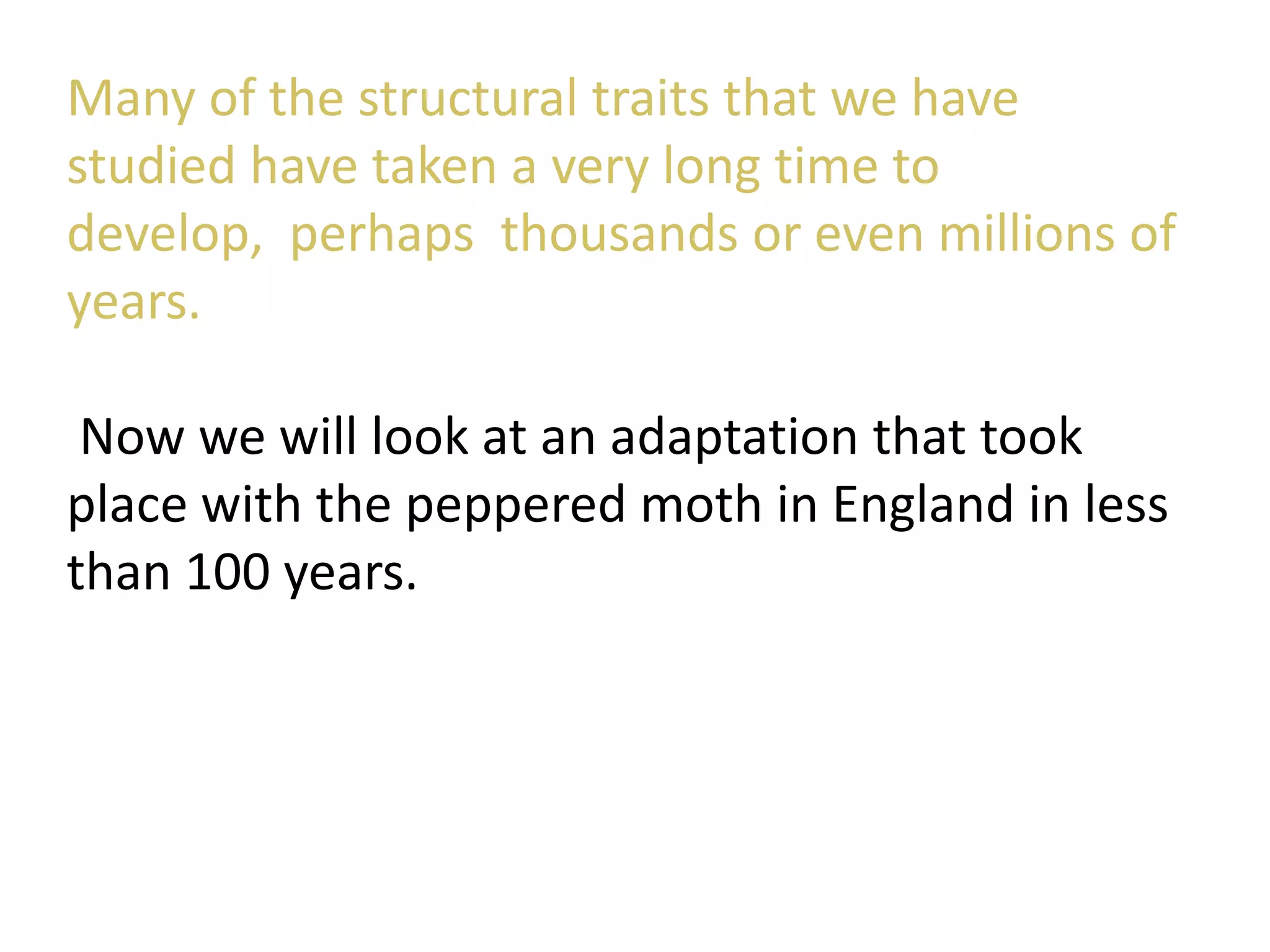
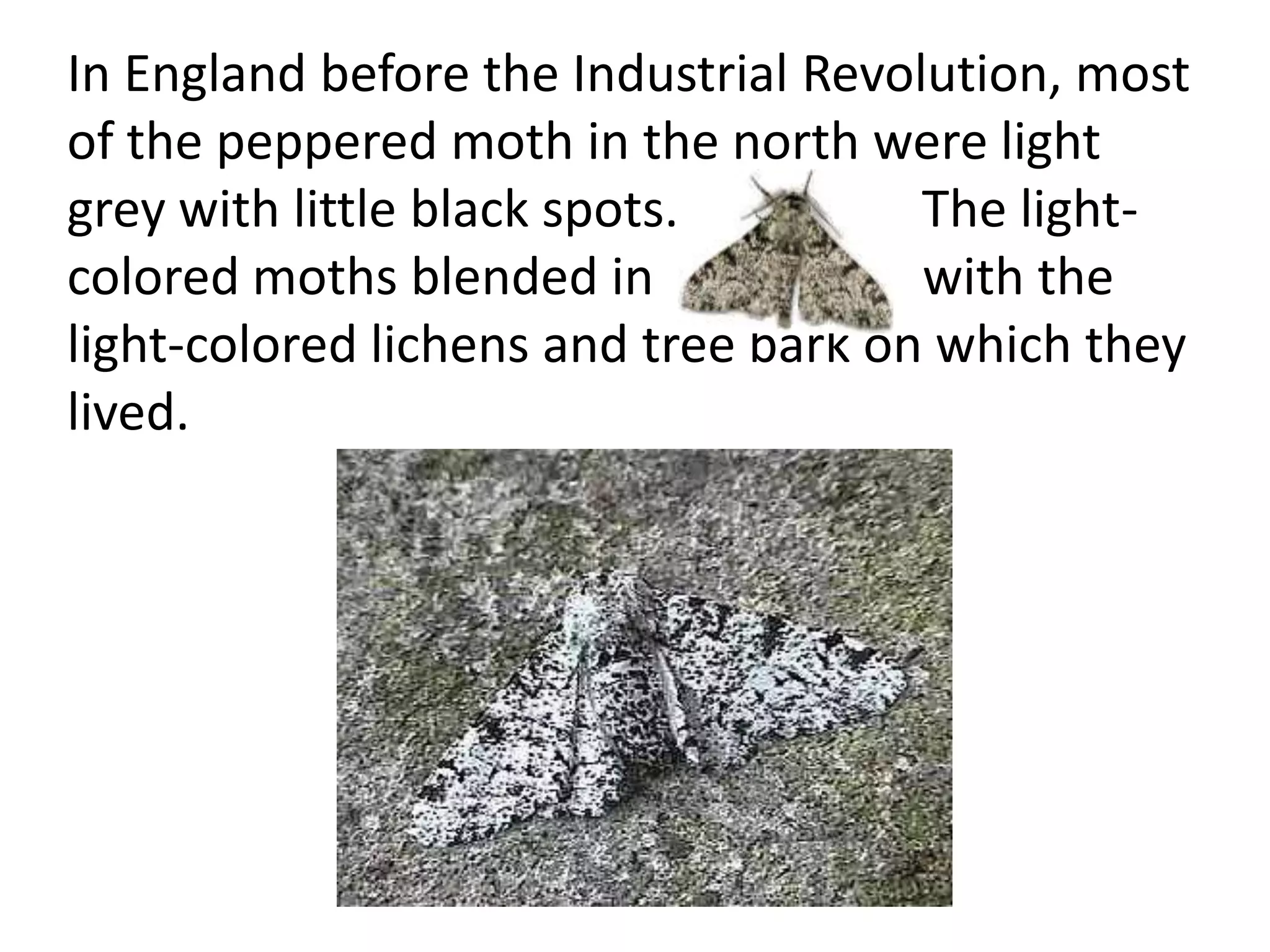
In England before the Industrial Revolution, most
of the peppered moth in the north were light
grey with little black spots. The light-
colored moths blended in with the
light-colored lichens and tree bark on which they
lived.
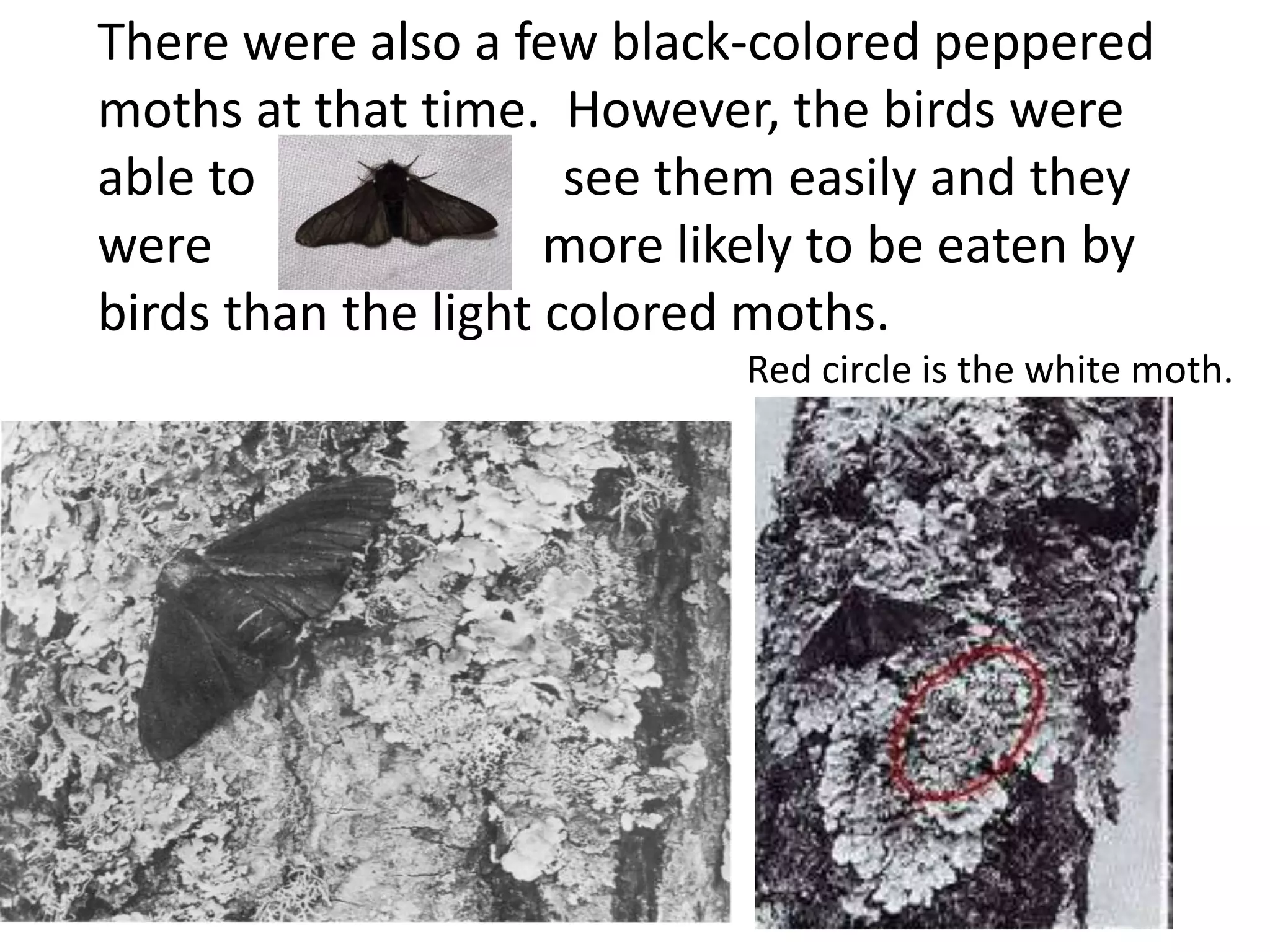
There were also a few black-colored peppered
moths at that time. However, the birds were
able to see them easily and they
were more likely to be eaten by
birds than the light colored moths.
Red circle is the white moth.
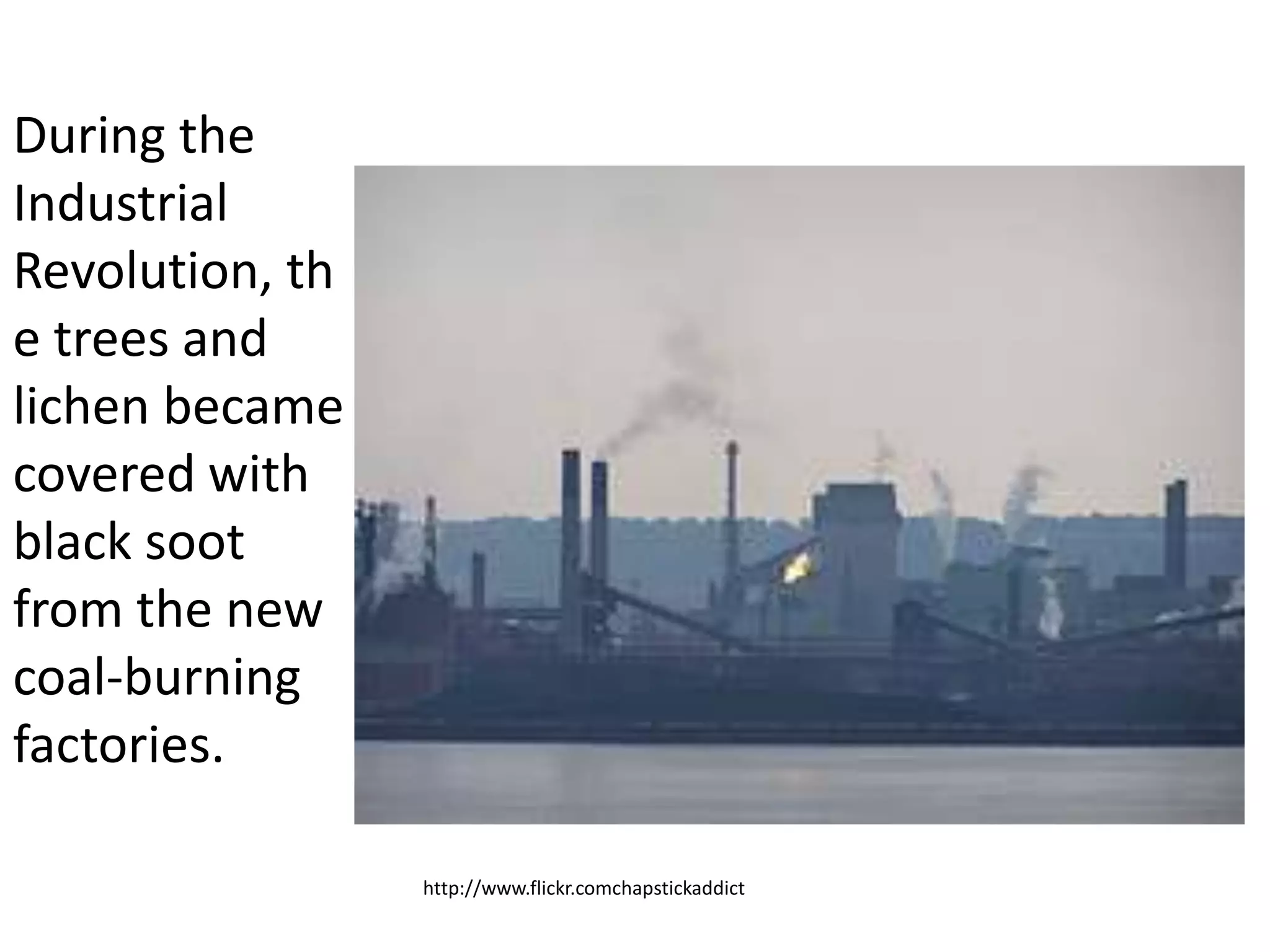
During the
Industrial
Revolution, th
e trees and
lichen became
covered with
black soot
from the new
coal-burning
factories.
http://www.flickr.comchapstickaddict
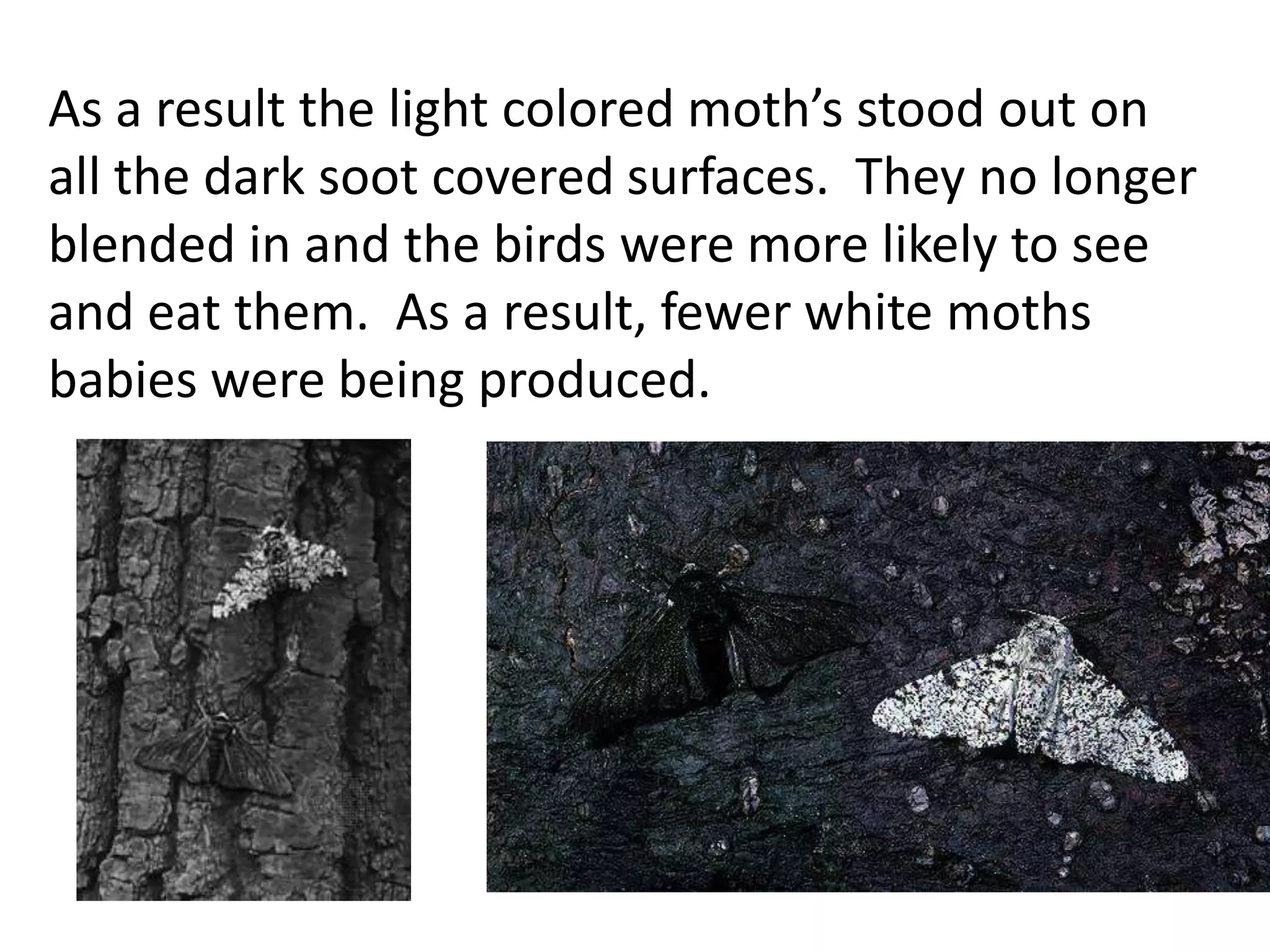
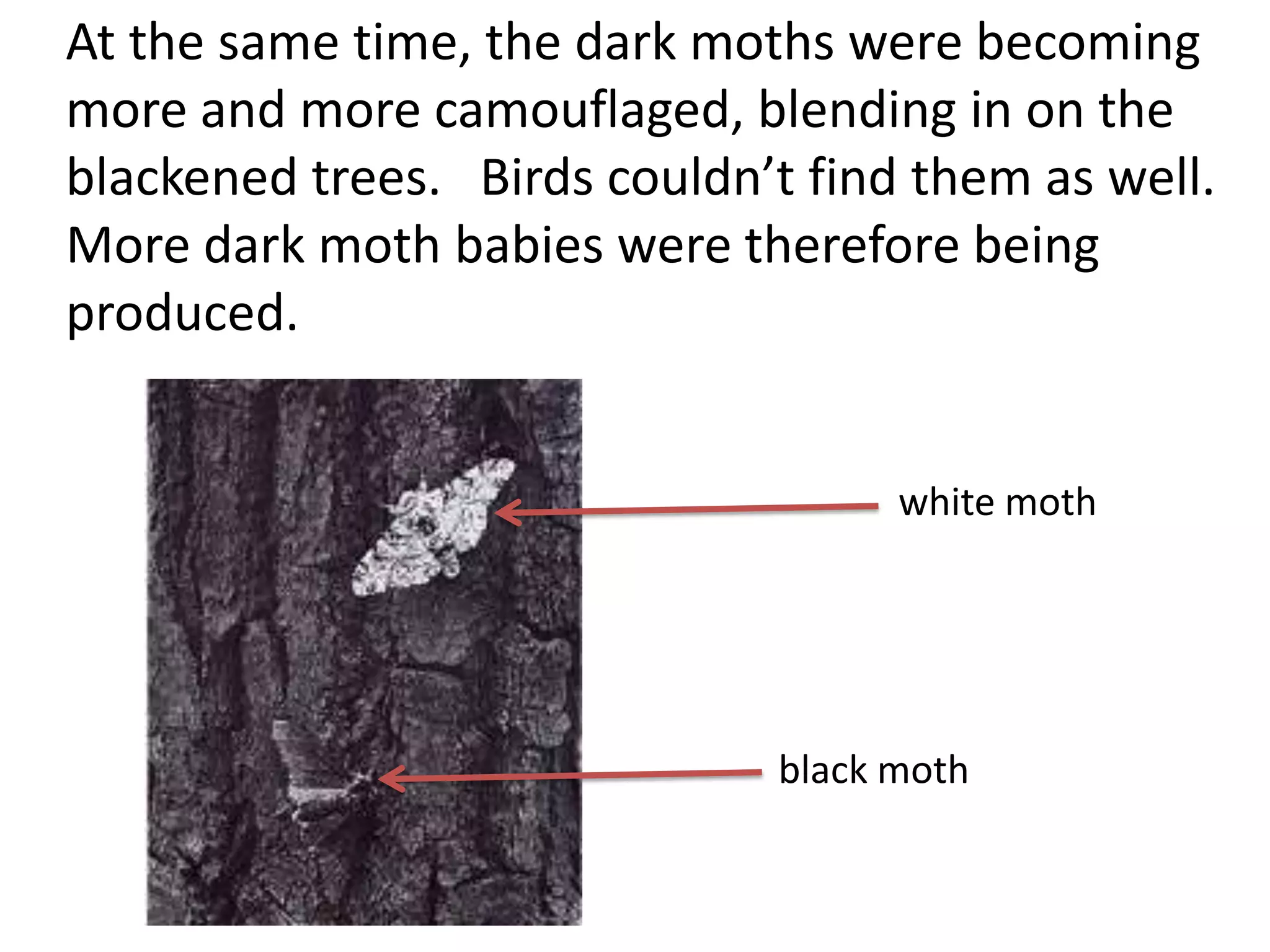
As a result the light colored moth’s stood out on
all the dark soot covered surfaces. They no longer
blended in and the birds were more likely to see
and eat them. As a result, fewer white moths
babies were being produced.
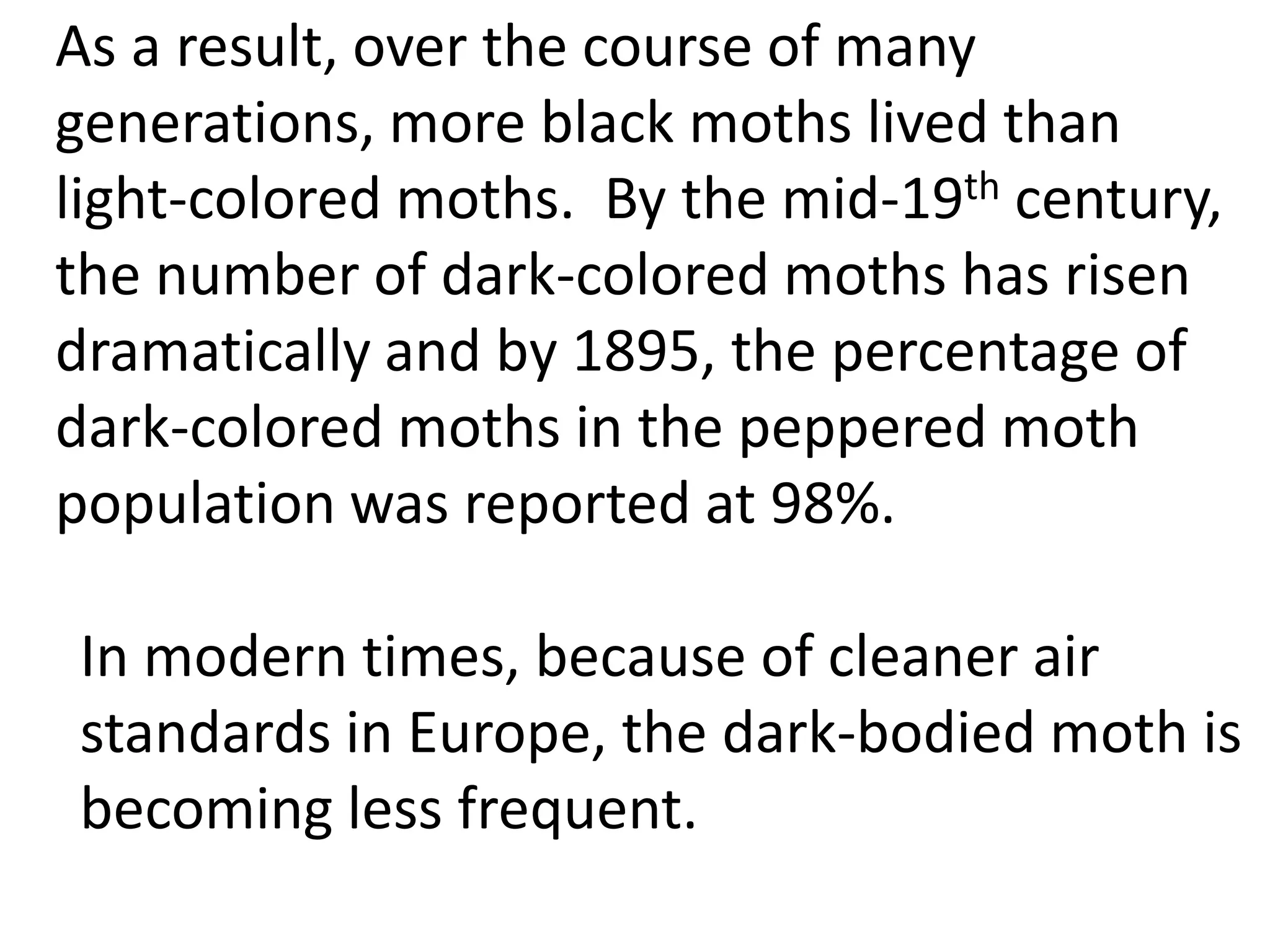
At the same time, the dark moths were becoming
more and more camouflaged, blending in on the
blackened trees. Birds couldn’t find them as well.
More dark moth babies were therefore being
produced.
white moth
black moth
As a result, over the course of many
generations, more black moths lived than
light-colored moths. By the mid-19th century,
the number of dark-colored moths has risen
dramatically and by 1895, the percentage of
dark-colored moths in the peppered moth
population was reported at 98%.
In modern times, because of cleaner air
standards in Europe, the dark-bodied moth is
becoming less frequent.
So far, we have discussed
adaptations that are physical traits
or behaviors that animals have
inherited from their parents.
But what about learning? Can an
animal learn new behaviors that
help them survive in its
environment?
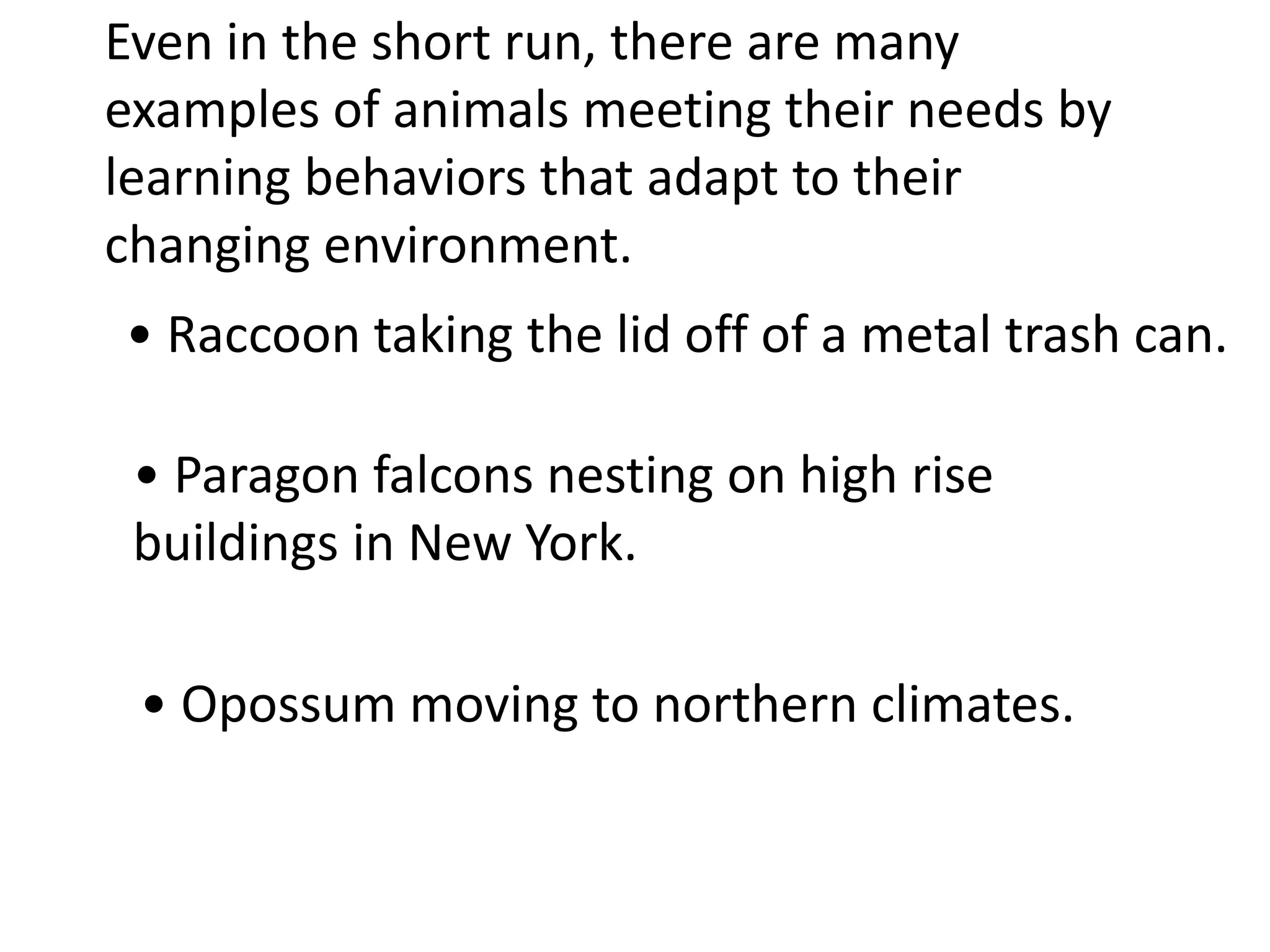
• Paragon falcons nesting on high rise
buildings in New York.
Even in the short run, there are many
examples of animals meeting their needs by
learning behaviors that adapt to their
changing environment.
• Raccoon taking the lid off of a metal trash can.
• Opossum moving to northern climates.
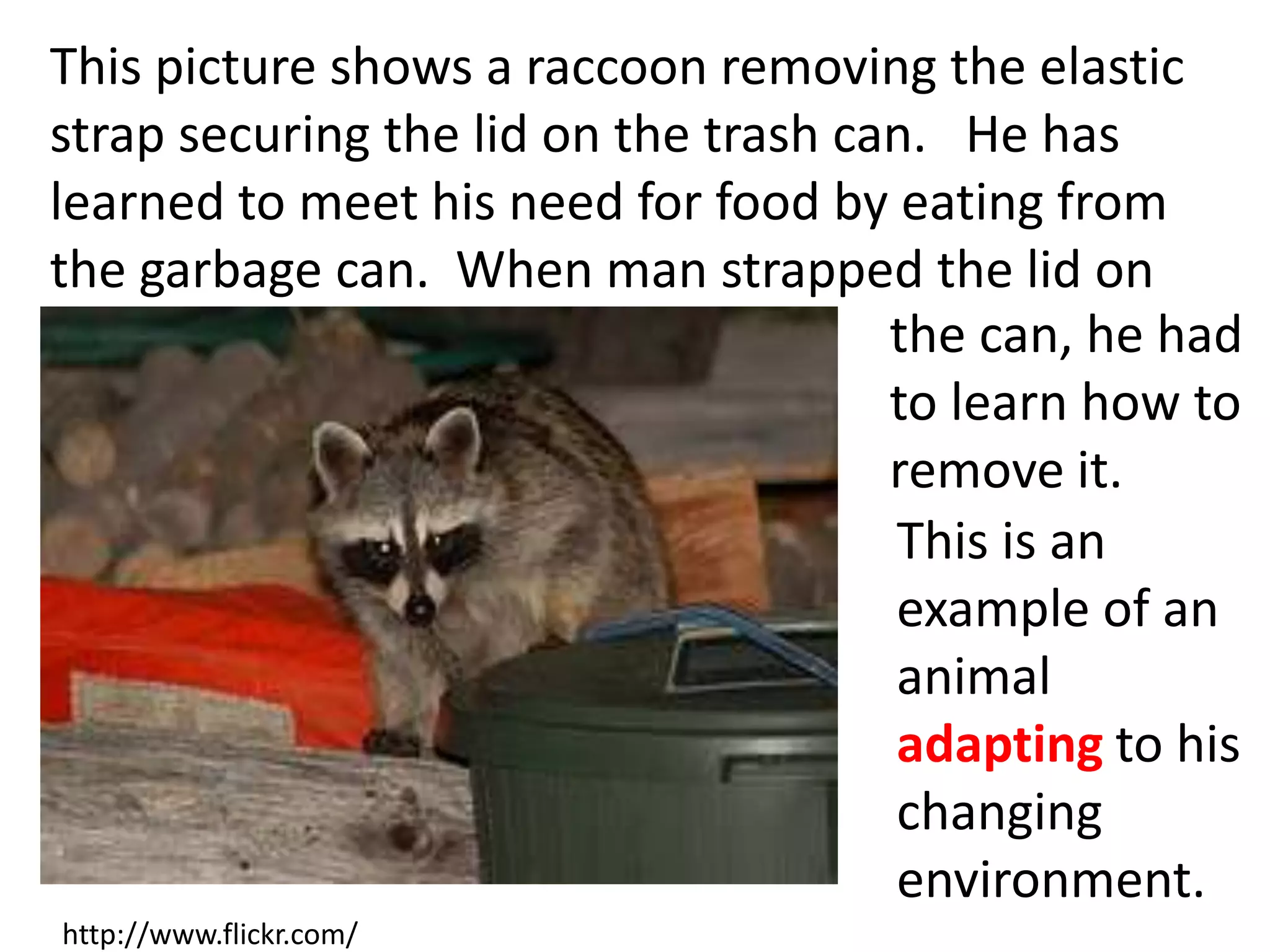
This picture shows a raccoon removing the elastic
strap securing the lid on the trash can. He has
learned to meet his need for food by eating from
the garbage can. When man strapped the lid on
This is an
example of an
animal
adapting to his
changing
environment.
http://www.flickr.com/
the can, he had
to learn how to
remove it.
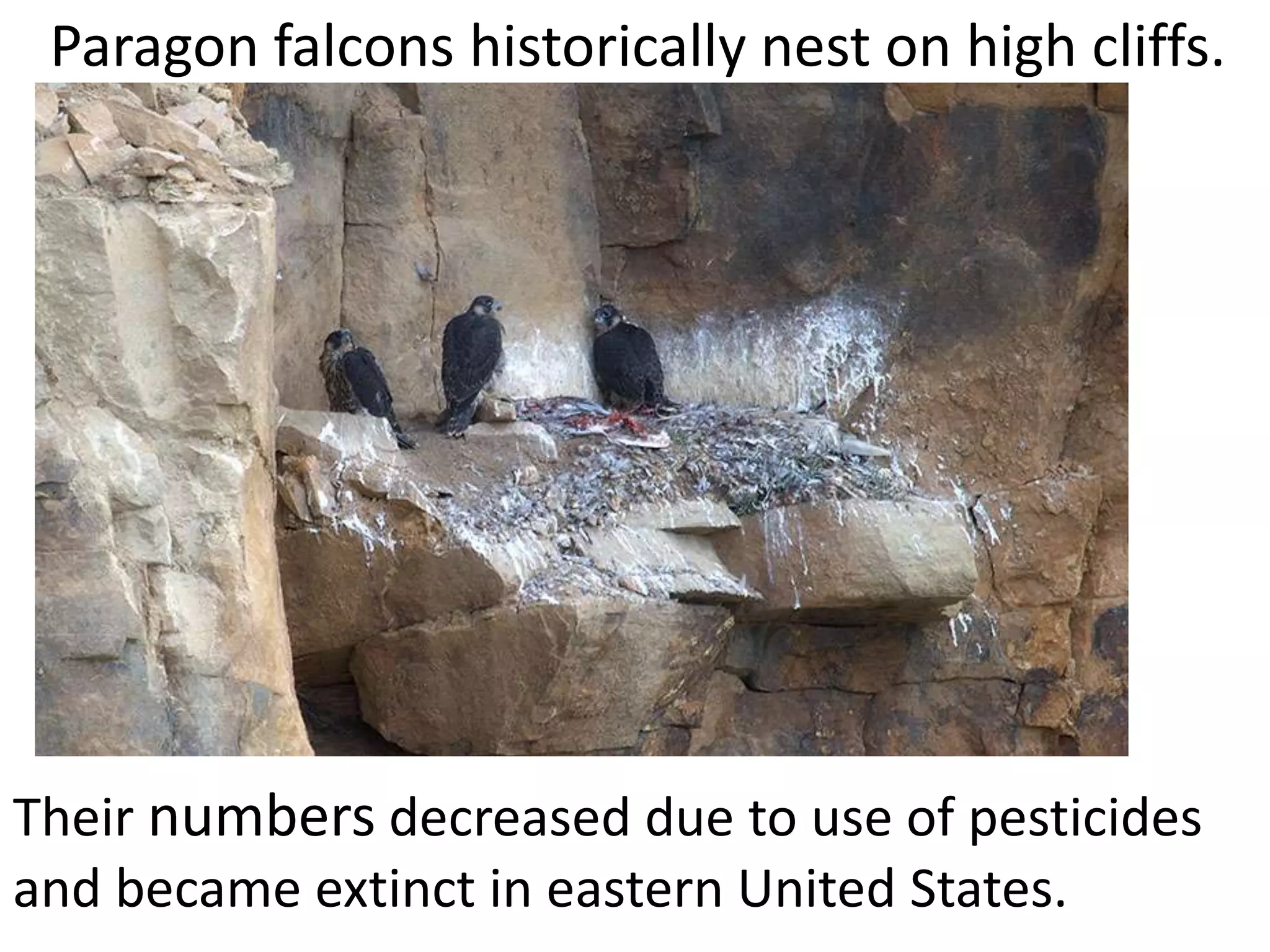
Paragon falcons historically nest on high cliffs.
Their numbers decreased due to use of pesticides
and became extinct in eastern United States.
http://www.lauraerickson.com by Laura Erickson
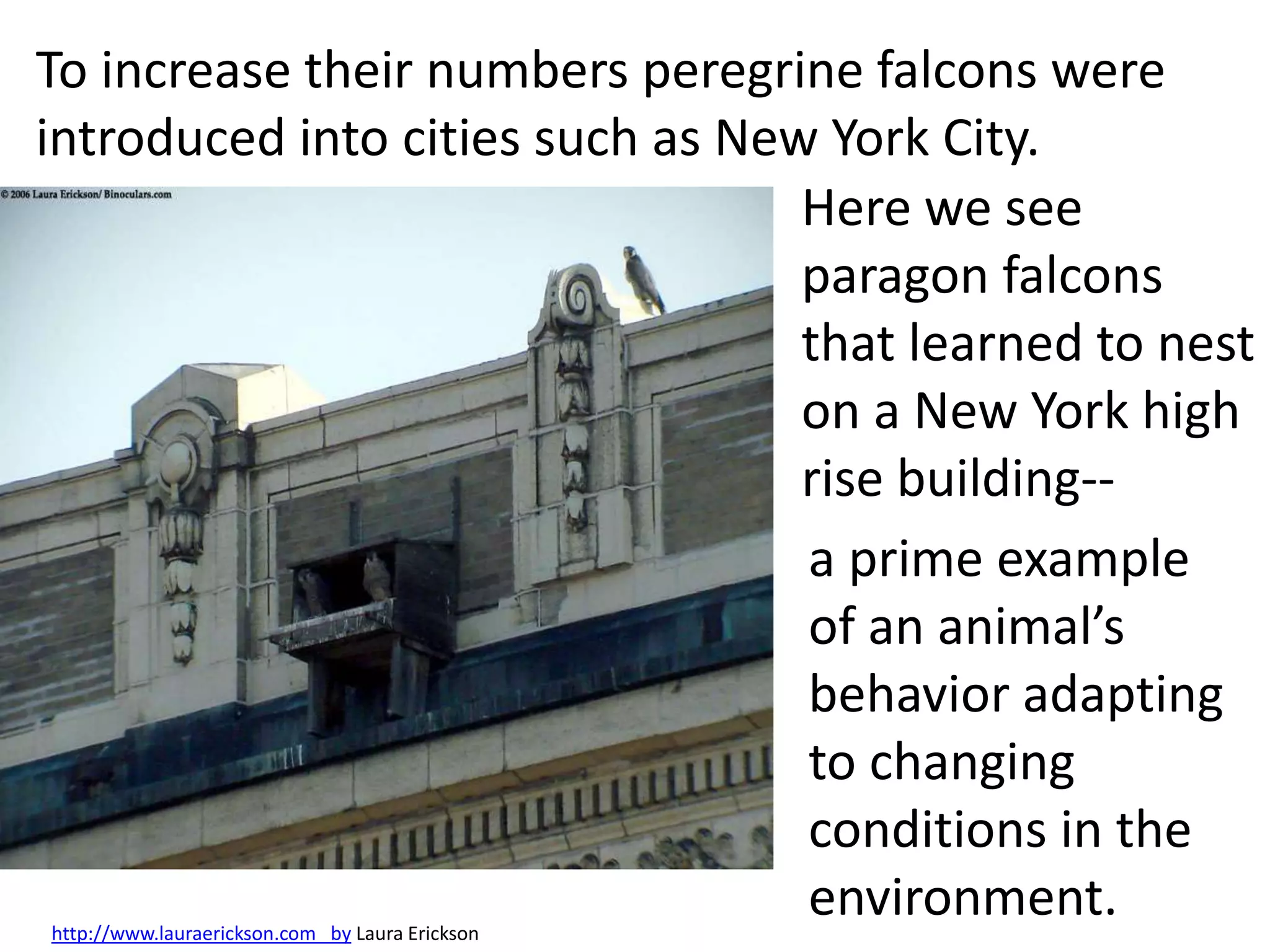
Here we see
paragon falcons
that learned to nest
on a New York high
rise building--
a prime example
of an animal’s
behavior adapting
to changing
conditions in the
environment.
To increase their numbers peregrine falcons were
introduced into cities such as New York City.
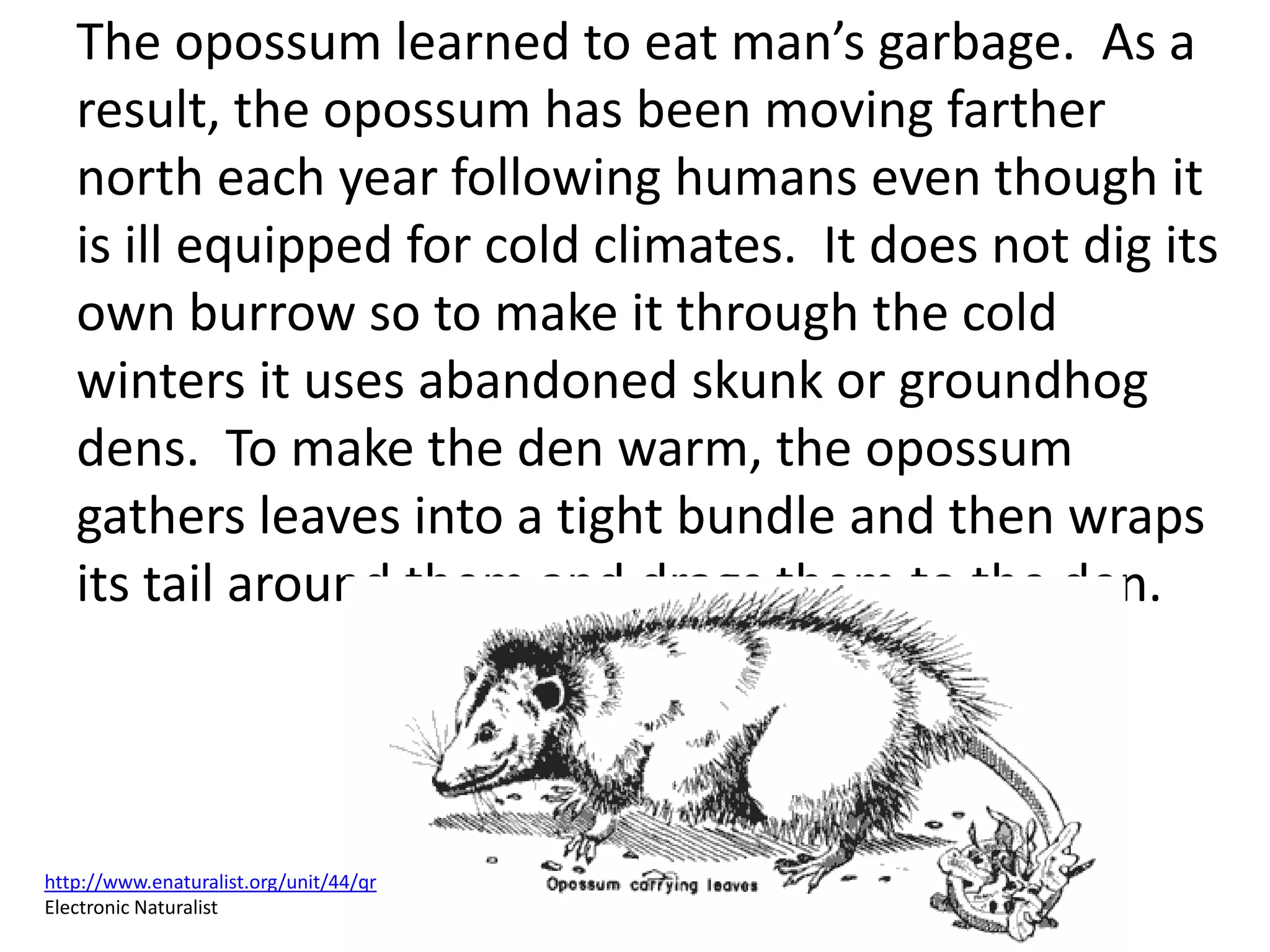
The opossum learned to eat man’s garbage. As a
result, the opossum has been moving farther
north each year following humans even though it
is ill equipped for cold climates. It does not dig its
own burrow so to make it through the cold
winters it uses abandoned skunk or groundhog
dens. To make the den warm, the opossum
gathers leaves into a tight bundle and then wraps
its tail around them and drags them to the den.
http://www.enaturalist.org/unit/44/qr
Electronic Naturalist
•The opossums moving north following food
resulted in a changed environment for them. To
survive in this changed environment, the animal
learned to adapt.
The main point of this lesson is that
animals and plants that are successful
(continue to survive) are those that can
make the necessary adaptations to
meet their needs.
Those that don’t become extinct.

Animal adaptions.. introduction (teach)

  • 1.
    Adaptation: MUST BE DOWNLOADED TOGET THE CUSTOM ANIMATIONS By Moira Whitehouse PhD •A physical trait or a behavior •that helps an animal or plant survive by meeting its needs.
  • 2.
    Adaptation: •A physical traitor behavior that helps an animal or plant survive by meeting its needs. •Sometimes the environment changes. Plants and animals must change or adapt to the new environment in order meet their needs and survive.
  • 3.
    The dinosaurs livedin warm swampy areas. For some reason the dinosaurs’ environment changed and the dinosaurs were not able to adapt to the changes.
  • 7.
  • 8.
    There are manypossible reasons why dinosaurs became extinct—a meteor, an asteroid that killed plants, global climate change, etc.
  • 9.
    For whatever reason,the dinosaurs were not able to meet their needs for food or for the right temperature and were not able to survive.
  • 10.
    They did notmake the adaptations needed to survive in their new environment.
  • 11.
    They did notmake the adaptations needed to survive in their new environment. As a result they became extinct.
  • 12.
    An adaptation isa physical trait or a behavior that helps a living thing survive in its environment. • A physical trait or an inherited behavior usually takes a long time to develop or change. •Whereas individuals learn many new behaviors in a lifetime.
  • 13.
    http://www.freegiraffepictures.com/ A giraffe’s long legsand neck are physical traits that are good examples of adaptations.
  • 14.
    The leaves ofthe acacia tree are the giraffes’ favorite food. Over thousands, perhaps millions of years, giraffe necks and legs have become longer and longer.What might have been happening in the giraffes’ environment that resulted in that adaptation? Maybe the trees were growing taller and taller.
  • 15.
    Scientists believe thatat one time giraffes had short necks and legs
  • 16.
    Scientists believe thatat one time giraffes had short necks and legs They think that each generation of trees in the areas where giraffes lived, over millions and millions of years grew taller and taller.
  • 17.
    Scientists believe thatat one time giraffes had short necks and legs They think that each generation of trees in the areas where giraffes lived, over millions and millions of years grew taller and taller. Over this long period of time giraffes that happened to be born taller had a better chance of survival and produced offspring that would also be taller.
  • 18.
    http://www.freeelephantpictures.com The elephant species probably livedin the same areas during the same time that the giraffe was adapting to the taller trees.
  • 19.
    http://www.freeelephantpictures.com The elephant species probably livedin the same areas during the same time that the giraffe was adapting to the taller trees. What adaptation resulted in the elephant being able to reach those juicy leaves high up in the trees?
  • 20.
    http://www.freeelephantpictures.com The elephant species probably livedin the same areas during the same time that the giraffe was adapting to the taller trees. What adaptation did the elephant come up with to reach those juicy leaves high up in the trees? Right, his long trunk allowed reaching the tops of the trees.
  • 21.
    http://www.freeeaglepictures.com/ bald eagle Ournational bird is the bald eagle. Eagles depend upon their hunting skills for food. Over the years this species has acquired several adaptations that made eagles great hunters. What do you think these adaptations might be?
  • 22.
    http://www.freeeaglepictures.com/ Our national birdis the bald eagle. Eagles depend upon their hunting skills for food. Over the years this species has acquired several adaptations that made eagles great hunters. What do you think these adaptations might be? Sharp eye sight, four times stronger than man’s, sharp hooked beak and talons, very strong wings, ability to fly carrying heavy prey long distances back to the nest.
  • 23.
    http://www.freenaturepictures. com/ kangaroo Now takea look at this fellow. What are some obvious adaptations that you can spot from this picture.
  • 24.
    What are someobvious adaptations that you can spot from this picture? (A kangaroo is an herbivore.) http://www.freenaturepictures. com/ kangaroo Anything interesting about the tail? See any special uses for it?
  • 25.
    What are someobvious adaptations that you can spot from this picture? (A kangaroo is an herbivore.) http://www.freenaturepictures. com/ kangaroo What do you notice about the back legs and feet?
  • 26.
    Here is anotherkangaroo picture. What adaption do you notice is this picture? Kangaroos live in a grassland that has a very harsh climate. Sometimes they must travel far to get to the next drink of water or meal of grass. Why would this adaption be necessary for the kangaroo species survival? Wikipedia commons
  • 27.
    Next we willlook at the beaks of two different kinds of birds. We want to see how the development of their beaks help them survive in their environment. The birds are: •the hummingbird •the pelican
  • 28.
    Notice the hummingbird’s bill isvery long and straight, similar to a drinking straw. http://www.freerhinopictures.com/ How does this adaptation help it get along in life?
  • 29.
    FlavioCruvinelBrandao http://www.flickr.com/ That long straw-likebill reaches to the bottom of deep flower blossoms where the nectar is located.
  • 30.
    mikebaird http://www.flickr.com The pelicanhas adapted to life around the ocean. The pliable lower part of his bill can stretch to almost basket size. How does this help him survive? A remarkable bird is the pelican. His beak can hold more than his belly can.
  • 31.
    Plants also needadaptations in order to survive.
  • 32.
    •An obvious examplewould be plants that have developed sharp thorns that stick out in all directions. Plants also need adaptations in order to survive.
  • 33.
    •An obvious examplewould be plants that have developed sharp thorns that stick out in all directions. •Can you think of some plants that have thorns? Plants also need adaptations in order to survive.
  • 34.
    •Of course, therose bush and cactus.
  • 35.
    •Why would plantshave sharp, sticky thorns?
  • 36.
    Another example wouldbe the kind of leaves that plants use to meet their needs.
  • 37.
    Another example wouldbe the kind of leaves that plants use to meet their needs. •Evergreen trees which grow in very dry climates have thin needle shaped leaves covered with a waxy substance to reduce water loss. http://www.freedigitalphotos.net
  • 38.
    Another example wouldbe the kind of leaves that plants use to meet their needs. •Evergreen trees which grow in very dry climates have thin needle shaped leaves covered with a waxy substance to reduce water loss. •Trees that live in wetter areas have wide broad shaped leaves to capture as much sunlight as possible. maytevidri http://www.flickr.com/
  • 39.
    Many of thestructural traits that we have studied have taken a very long time to develop, perhaps thousands or even millions of years.
  • 40.
    Many of thestructural traits that we have studied have taken a very long time to develop, perhaps thousands or even millions of years. Now we will look at an adaptation that took place with the peppered moth in England in less than 100 years.
  • 41.
    In England beforethe Industrial Revolution, most of the peppered moth in the north were light grey with little black spots. The light- colored moths blended in with the light-colored lichens and tree bark on which they lived.
  • 42.
    There were alsoa few black-colored peppered moths at that time. However, the birds were able to see them easily and they were more likely to be eaten by birds than the light colored moths. Red circle is the white moth.
  • 43.
    During the Industrial Revolution, th etrees and lichen became covered with black soot from the new coal-burning factories. http://www.flickr.comchapstickaddict
  • 44.
    As a resultthe light colored moth’s stood out on all the dark soot covered surfaces. They no longer blended in and the birds were more likely to see and eat them. As a result, fewer white moths babies were being produced.
  • 45.
    At the sametime, the dark moths were becoming more and more camouflaged, blending in on the blackened trees. Birds couldn’t find them as well. More dark moth babies were therefore being produced. white moth black moth
  • 46.
    As a result,over the course of many generations, more black moths lived than light-colored moths. By the mid-19th century, the number of dark-colored moths has risen dramatically and by 1895, the percentage of dark-colored moths in the peppered moth population was reported at 98%. In modern times, because of cleaner air standards in Europe, the dark-bodied moth is becoming less frequent.
  • 47.
    So far, wehave discussed adaptations that are physical traits or behaviors that animals have inherited from their parents. But what about learning? Can an animal learn new behaviors that help them survive in its environment?
  • 48.
    • Paragon falconsnesting on high rise buildings in New York. Even in the short run, there are many examples of animals meeting their needs by learning behaviors that adapt to their changing environment. • Raccoon taking the lid off of a metal trash can. • Opossum moving to northern climates.
  • 49.
    This picture showsa raccoon removing the elastic strap securing the lid on the trash can. He has learned to meet his need for food by eating from the garbage can. When man strapped the lid on This is an example of an animal adapting to his changing environment. http://www.flickr.com/ the can, he had to learn how to remove it.
  • 50.
    Paragon falcons historicallynest on high cliffs. Their numbers decreased due to use of pesticides and became extinct in eastern United States.
  • 51.
    http://www.lauraerickson.com by LauraErickson Here we see paragon falcons that learned to nest on a New York high rise building-- a prime example of an animal’s behavior adapting to changing conditions in the environment. To increase their numbers peregrine falcons were introduced into cities such as New York City.
  • 52.
    The opossum learnedto eat man’s garbage. As a result, the opossum has been moving farther north each year following humans even though it is ill equipped for cold climates. It does not dig its own burrow so to make it through the cold winters it uses abandoned skunk or groundhog dens. To make the den warm, the opossum gathers leaves into a tight bundle and then wraps its tail around them and drags them to the den. http://www.enaturalist.org/unit/44/qr Electronic Naturalist
  • 53.
    •The opossums movingnorth following food resulted in a changed environment for them. To survive in this changed environment, the animal learned to adapt.
  • 54.
    The main pointof this lesson is that animals and plants that are successful (continue to survive) are those that can make the necessary adaptations to meet their needs. Those that don’t become extinct.