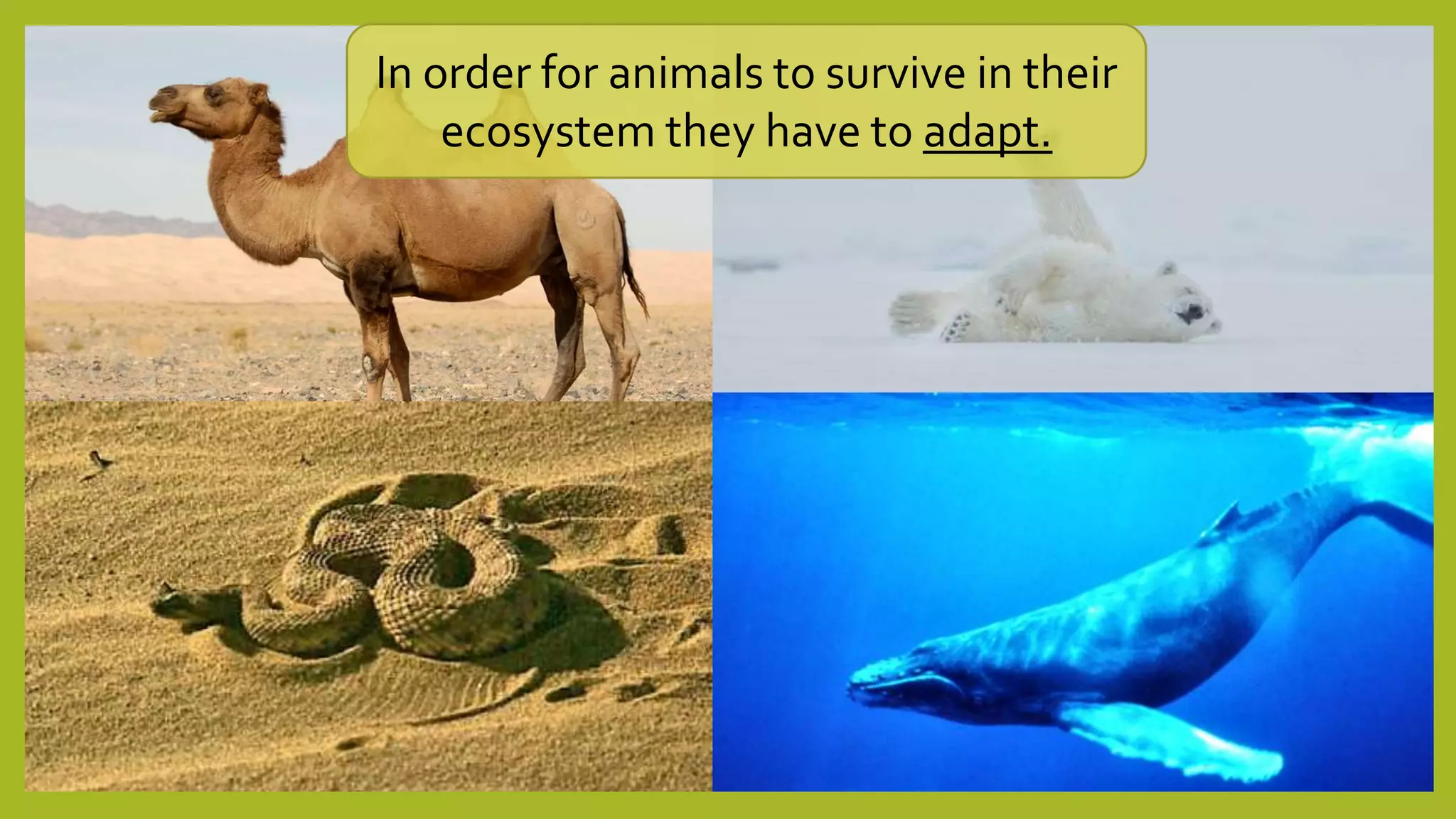
In order for animals to survive in their
ecosystem they have to adapt.
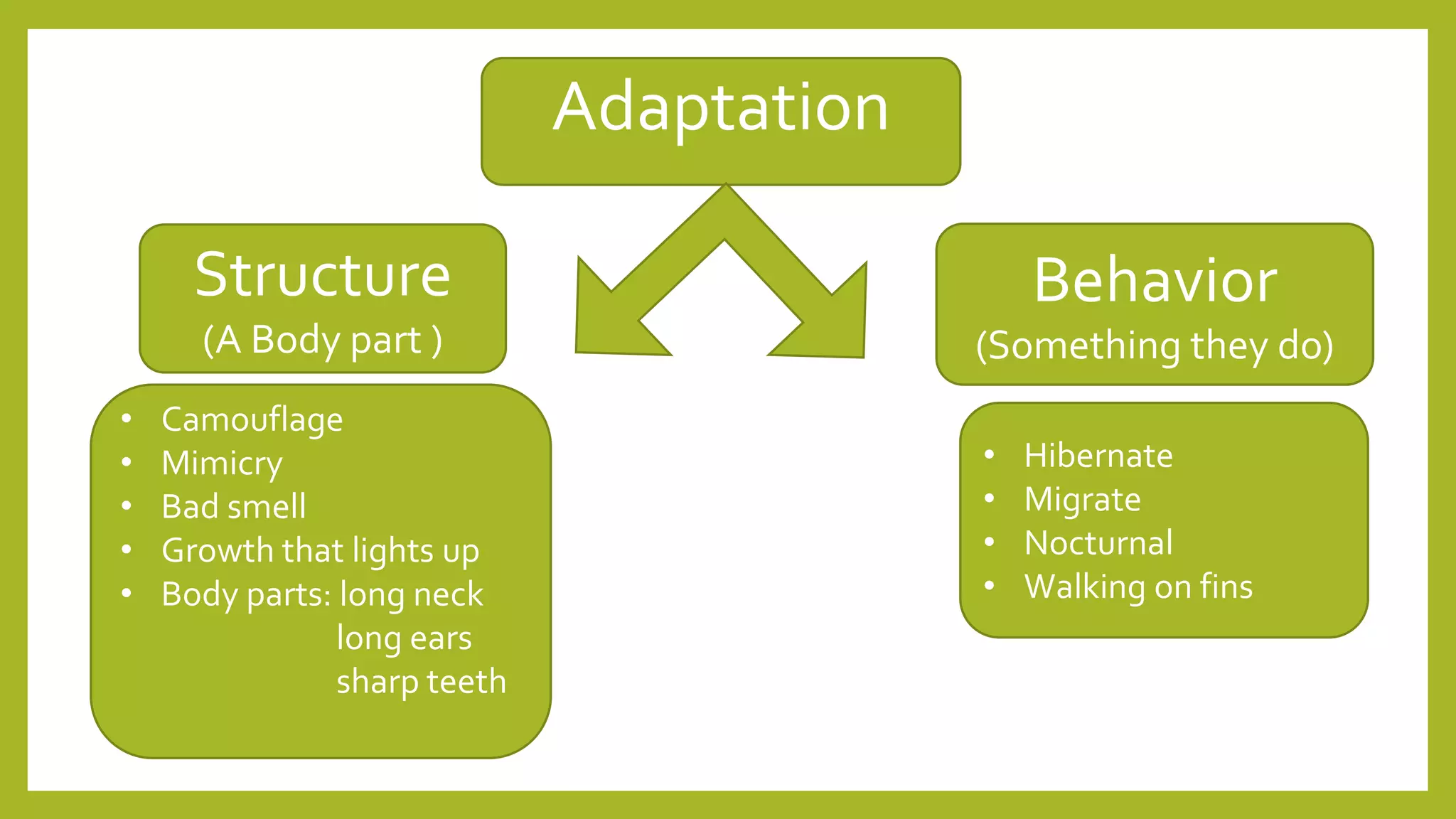
Adaptation
Structure or behavior that helps a living thing “animal”
to survive in its environment
Adaptation
Structure
(A Body part )
Behavior
(Something they do)
• Camouflage
• Mimicry
• Bad smell
• Growth that lights up
• Body parts: long neck
long ears
sharp teeth
• Hibernate
• Migrate
• Nocturnal
• Walking on fins
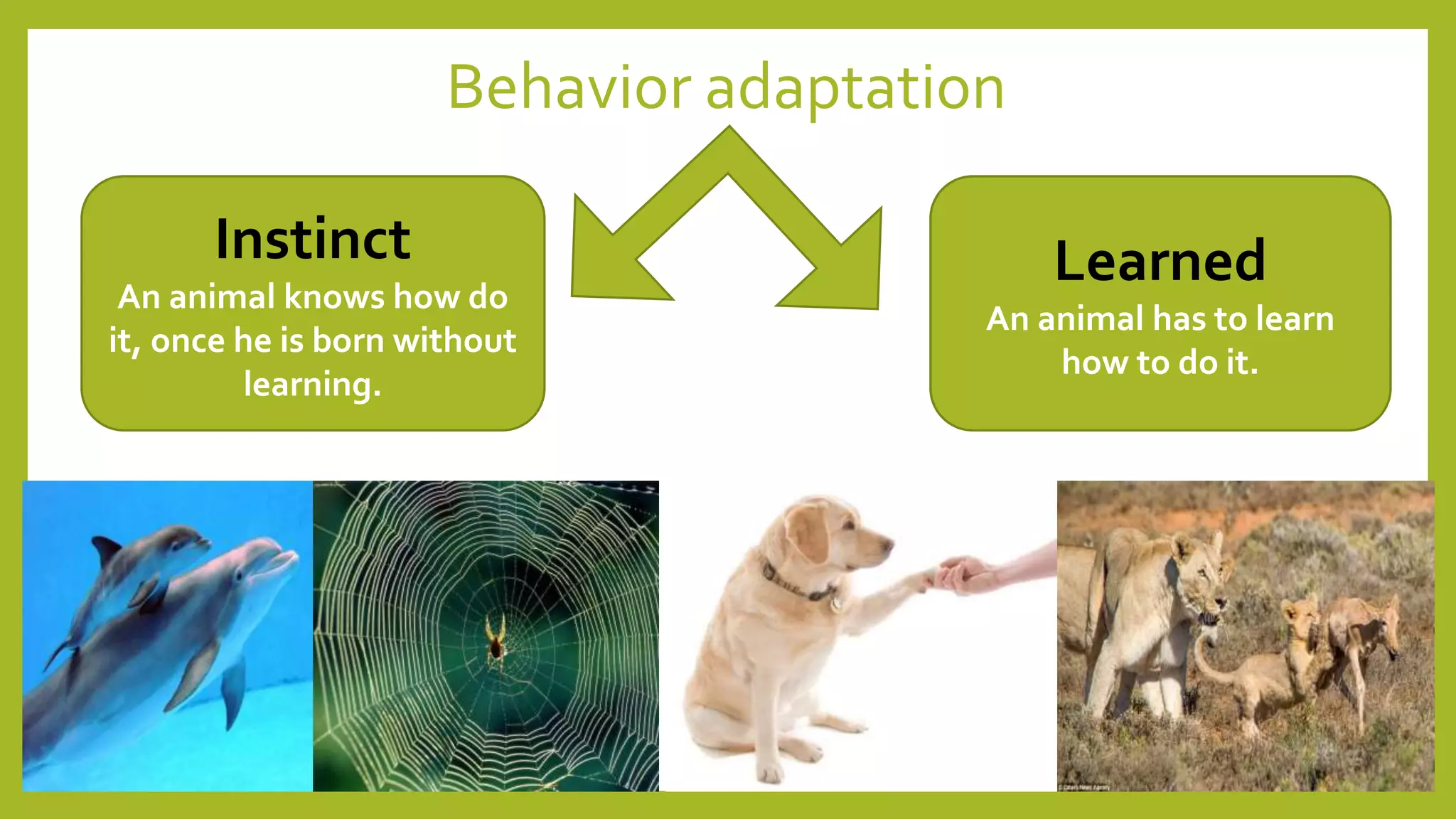
Behavior adaptation
Instinct
An animal knows how do
it, once he is born without
learning.
Learned
An animal has to learn
how to do it.
How did this baby
dolphin know how to
swim once it was born ?
I know it on my own it’s an
Instinct !
How did the dog know all that stuff ?
I only learn these things
if someone taught me.
It’s a Learned behavior.
Camouflage
Camouflage
To hide from preys
when hunting.
To hide from
predators
Chameleons
• They blend in their environment by
Camouflage to hide from their predators.
I can be ANY COLOR I want !!
I color myself with the same color of
the environment so it’s hard to see me !
Polar bears
• Polar bear’s white fur helps it to blend
with the ice & snow to make it easy for
them to hunt the seal without being seen.
• It also has a lot of blubber (FAT) to keep it
warm.
Snakes
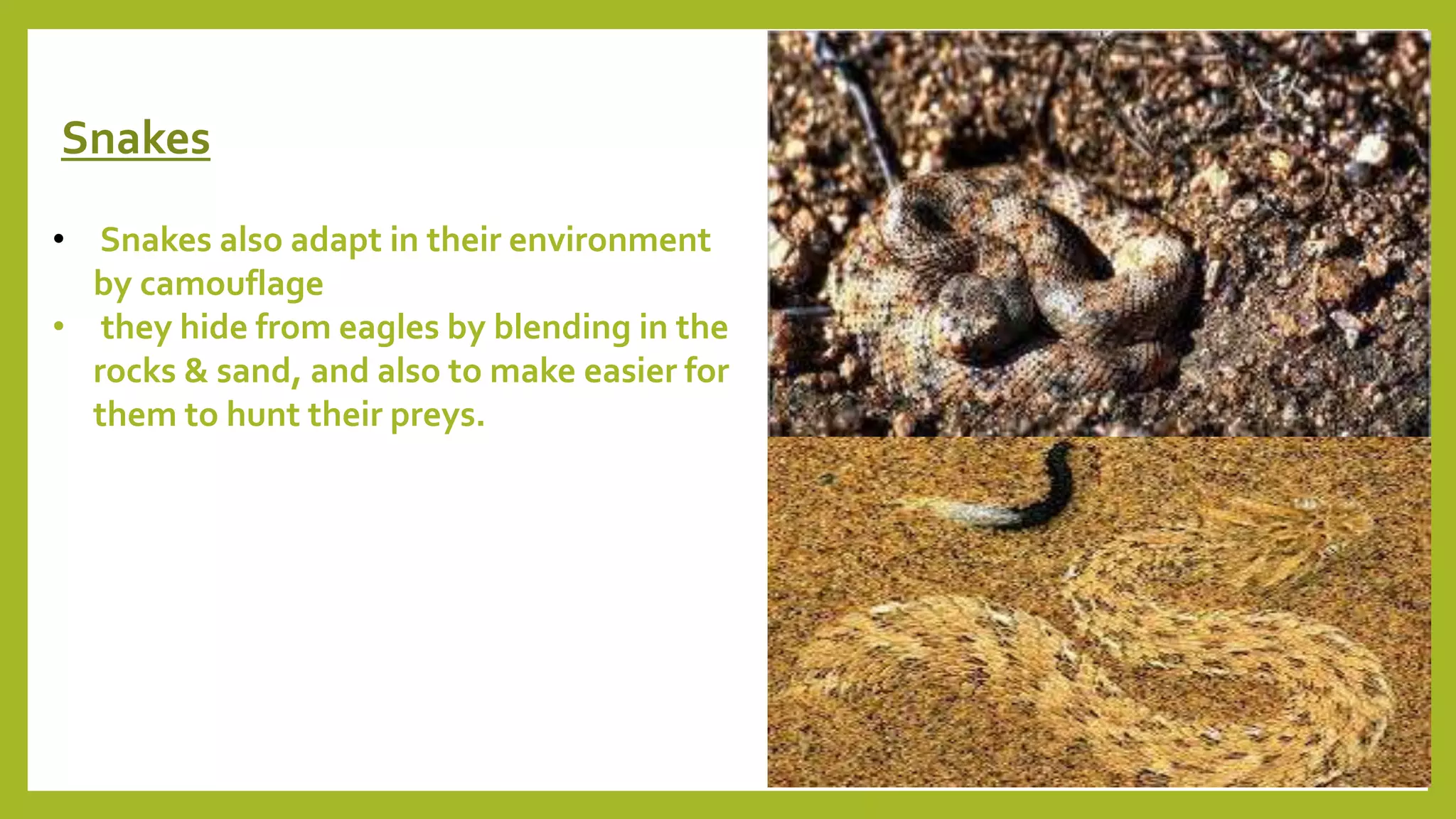
• Snakes also adapt in their environment
by camouflage
• they hide from eagles by blending in the
rocks & sand, and also to make easier for
them to hunt their preys.
Owls
• Owls also can adapt by camouflage
inside the trees.
• It makes it easier for them to hunt
their preys without being seen.
Lions
• Lions also blend in their
environment.
• using camouflage to hunt their
preys without being seen.
Adaptations in the Desert
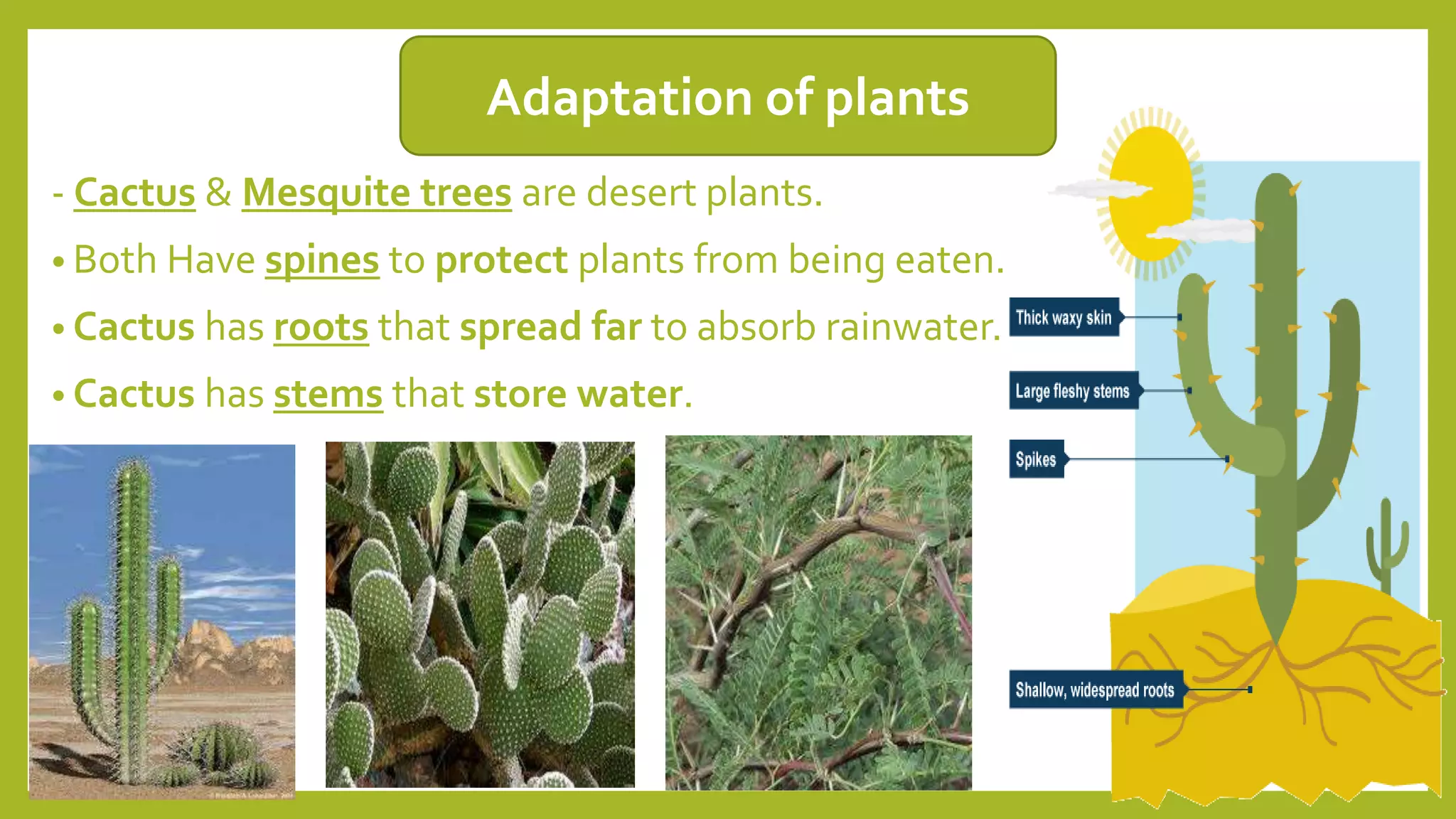
- Cactus & Mesquite trees are desert plants.
• Both Have spines to protect plants from being eaten.
• Cactus has roots that spread far to absorb rainwater.
• Cactus has stems that store water.
Adaptation of plants
- Some animals are Nocturnal they are active only at
night “They sleep during the day”
Adaptation of animals
Bats snakes
Other desert animals adapt to the desert by
having
Long,thin ears to cool themselves in the hot
weather.
Jack rabbits
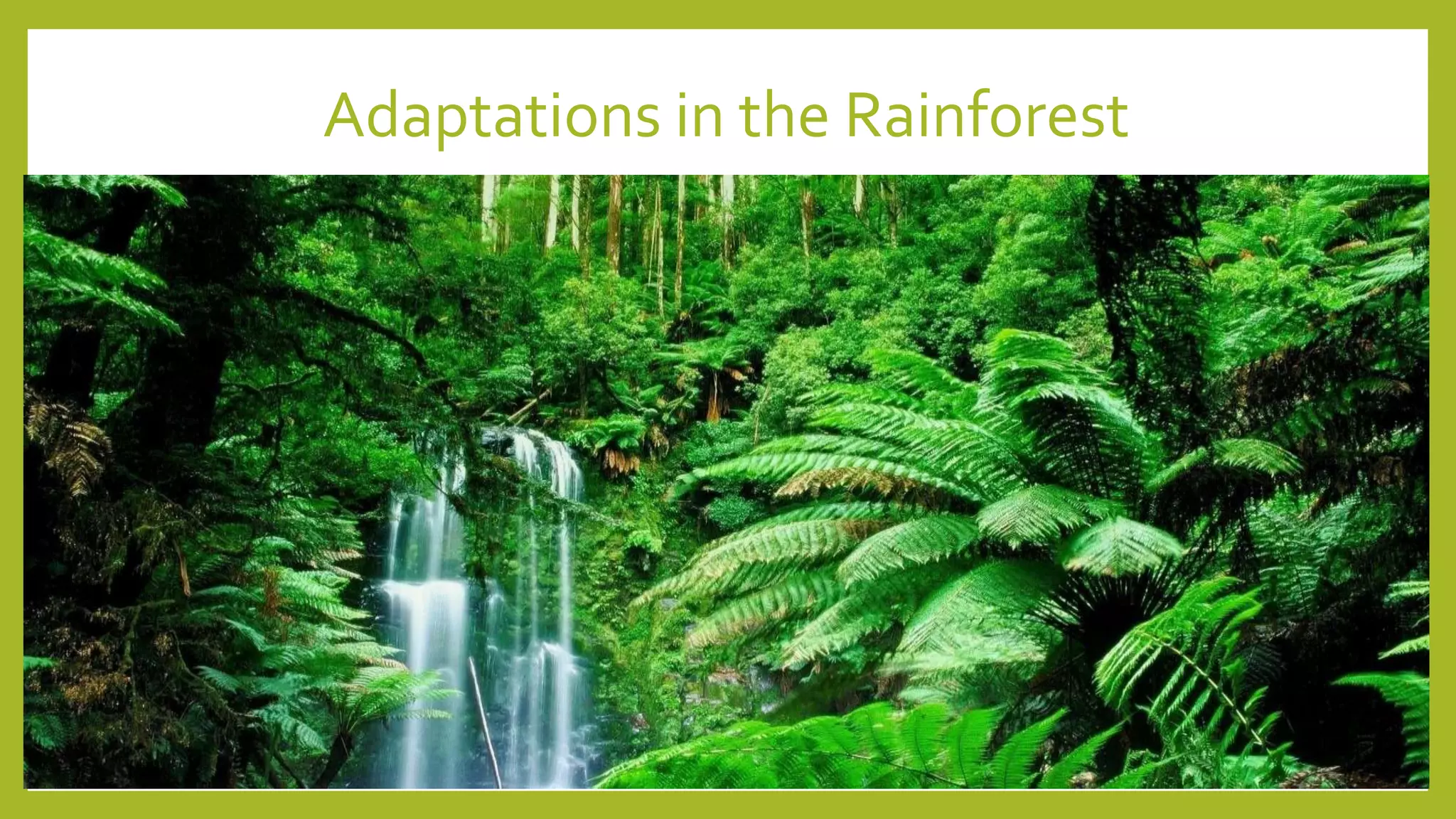
Adaptations in the Rainforest
Plant Adaptations in
theTropical rainforest
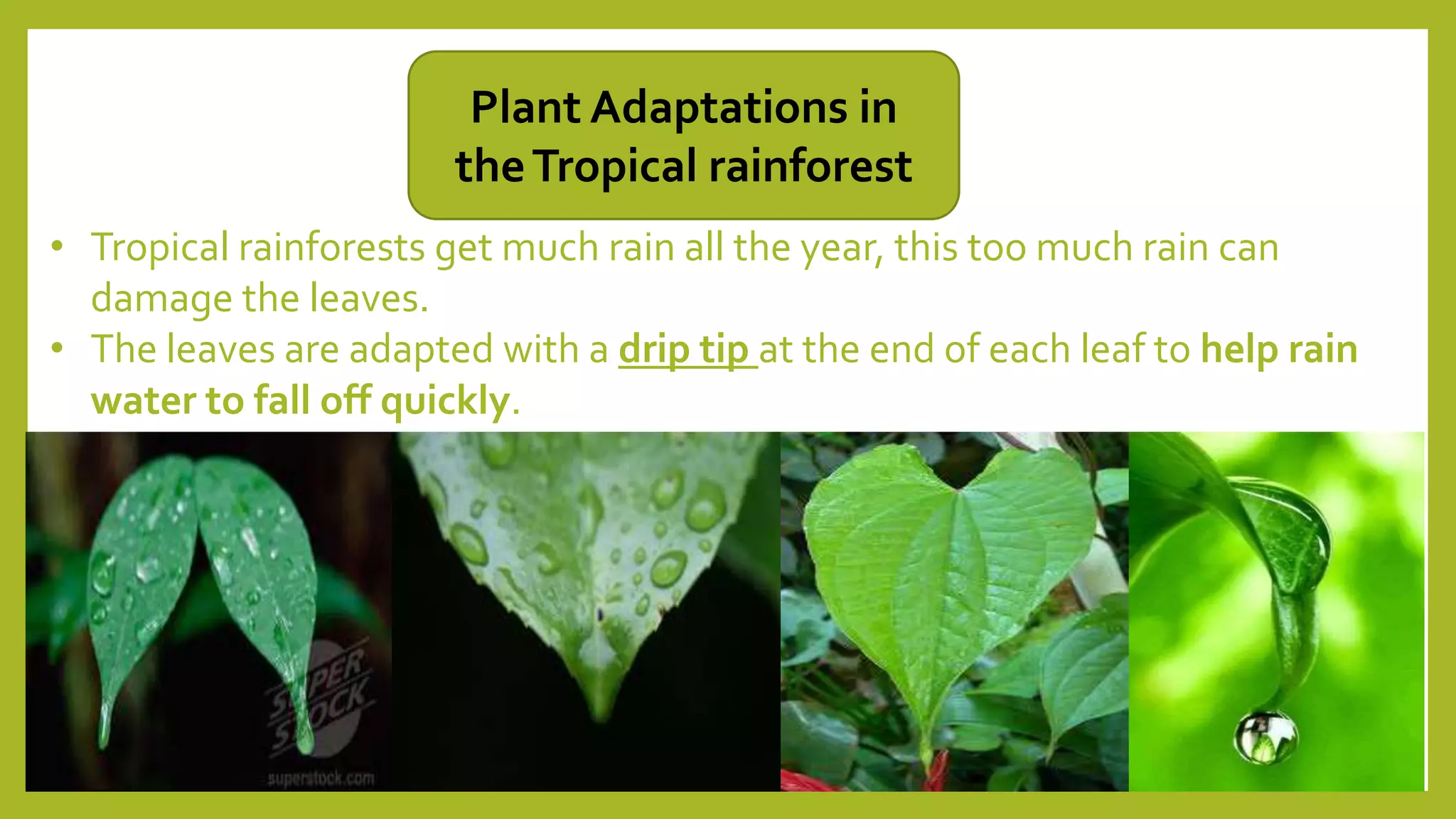
• Tropical rainforests get much rain all the year, this too much rain can
damage the leaves.
• The leaves are adapted with a drip tip at the end of each leaf to help rain
water to fall off quickly.
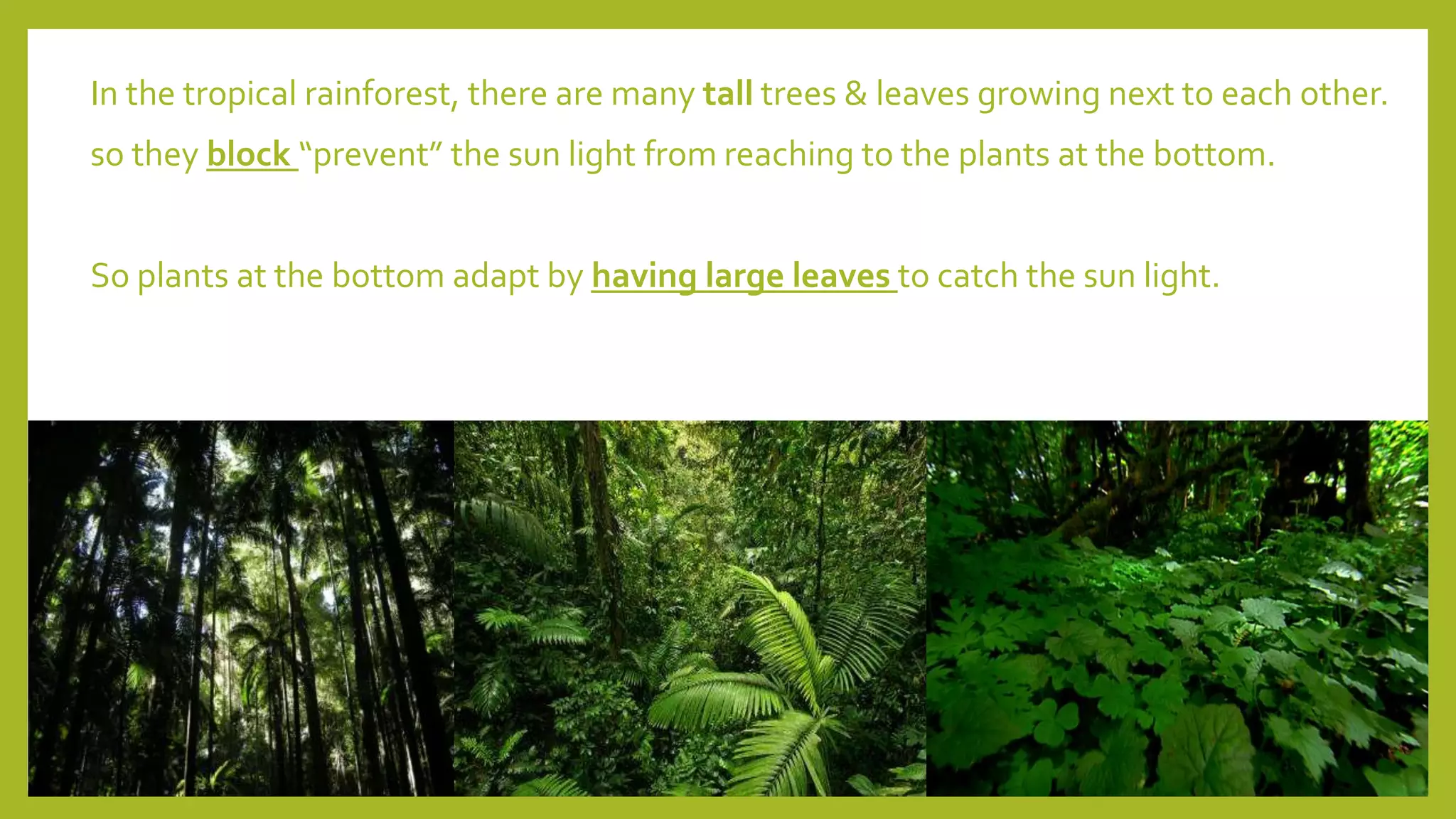
In the tropical rainforest, there are many tall trees & leaves growing next to each other.
so they block “prevent” the sun light from reaching to the plants at the bottom.
So plants at the bottom adapt by having large leaves to catch the sun light.
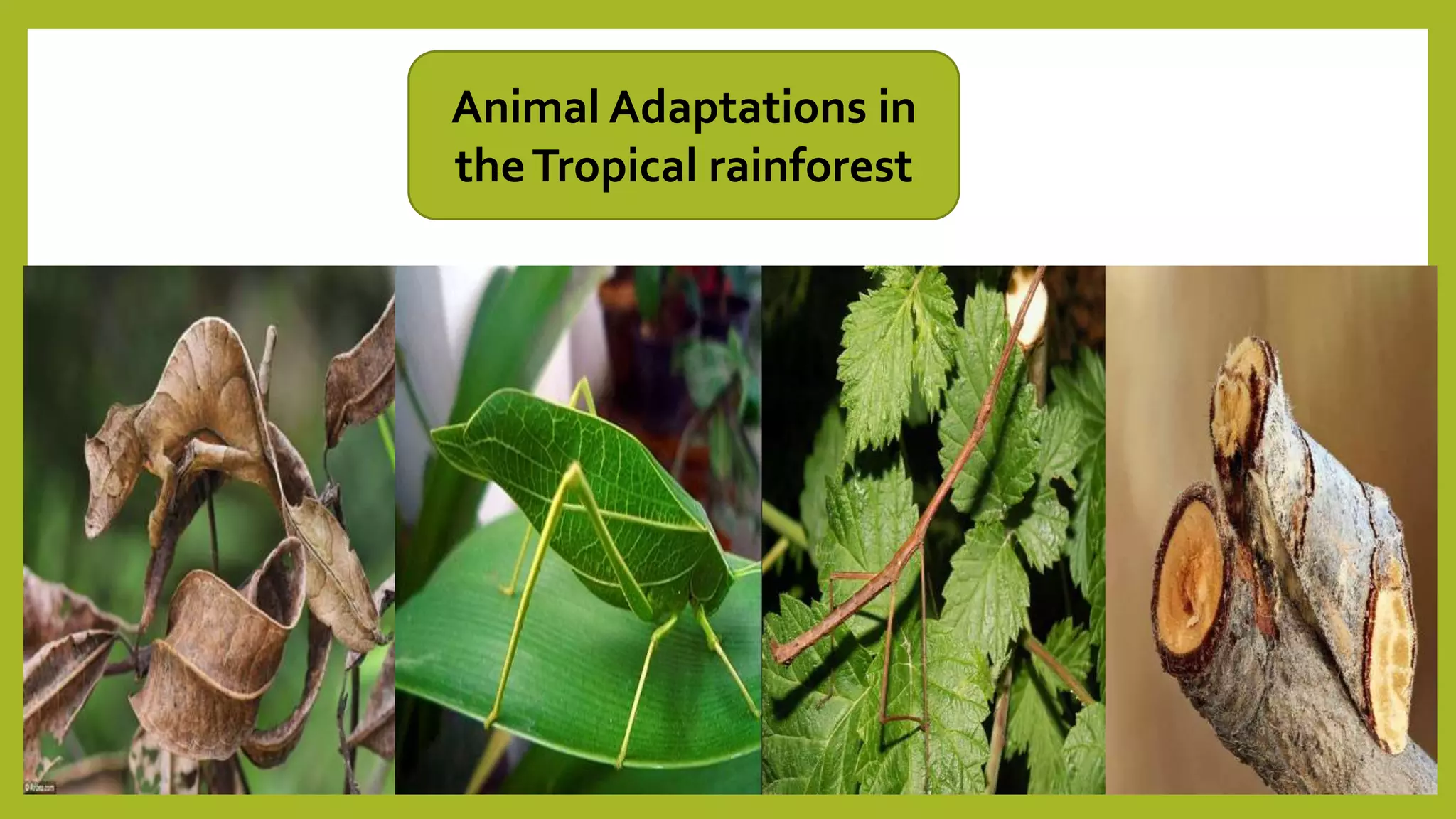
Animal Adaptations in
theTropical rainforest
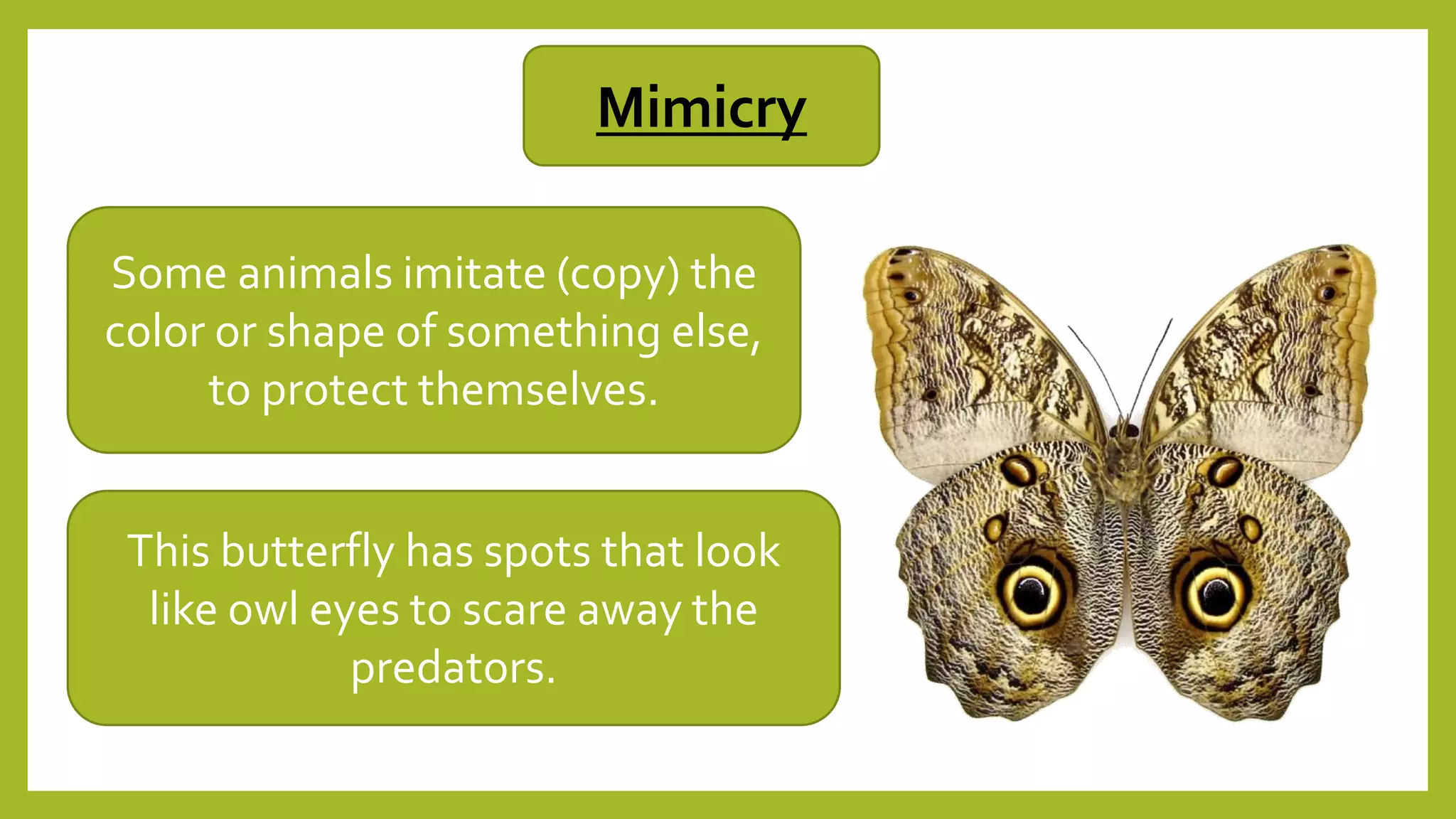
Some animals imitate (copy) the
color or shape of something else,
to protect themselves.
This butterfly has spots that look
like owl eyes to scare away the
predators.
Mimicry
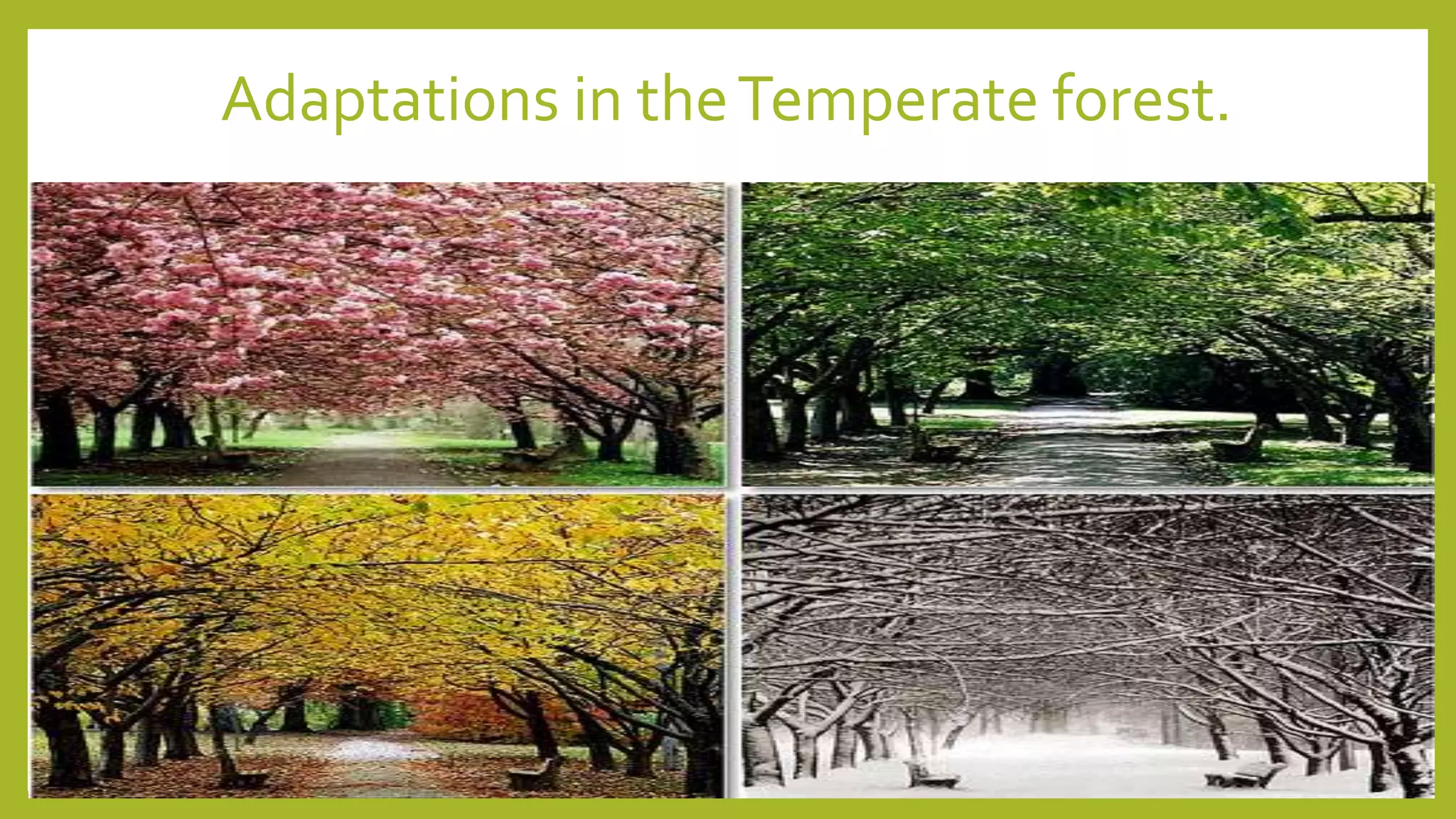
Adaptations in theTemperate forest.
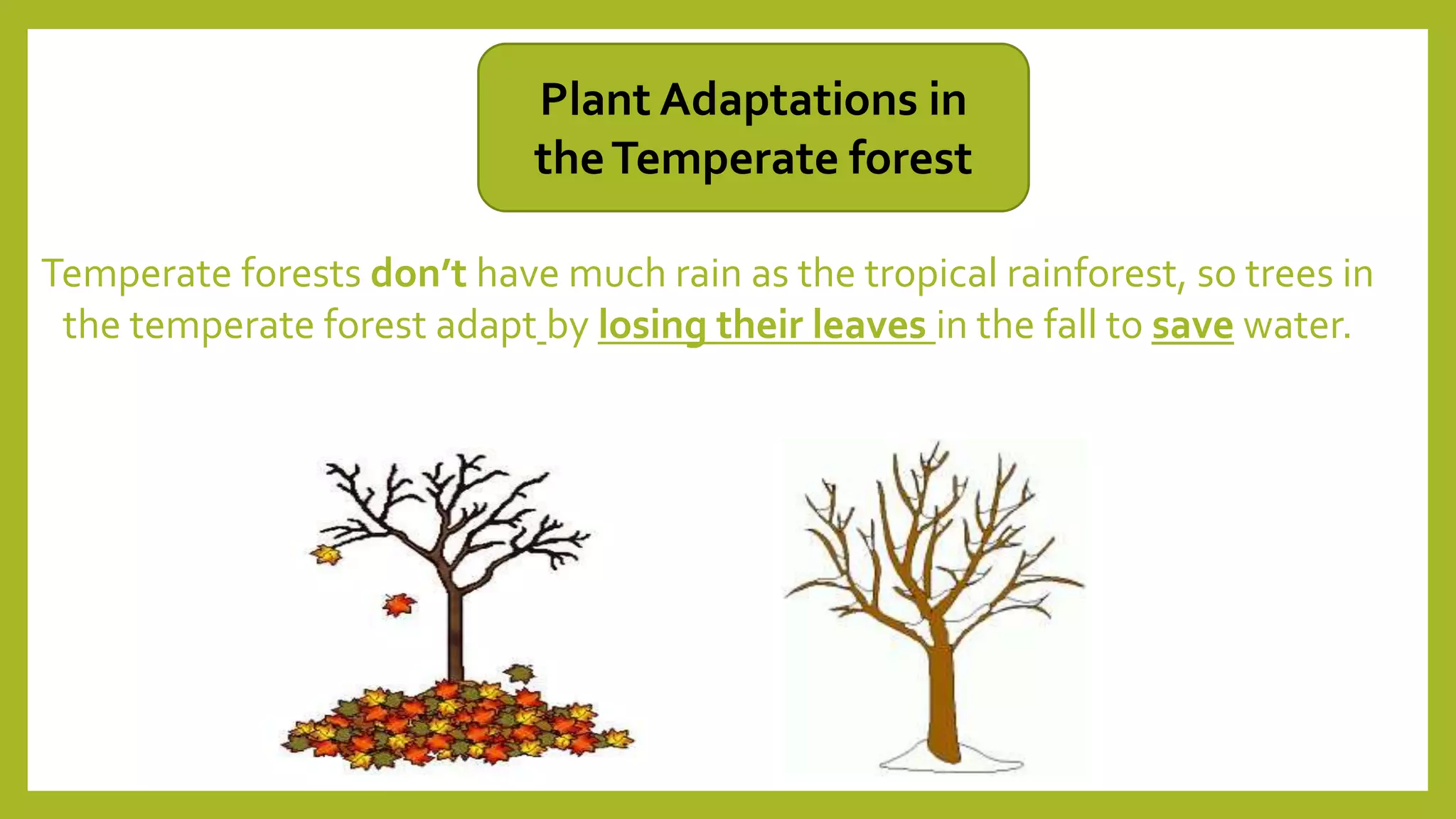
Temperate forests don’t have much rain as the tropical rainforest, so trees in
the temperate forest adapt by losing their leaves in the fall to save water.
Plant Adaptations in
theTemperate forest
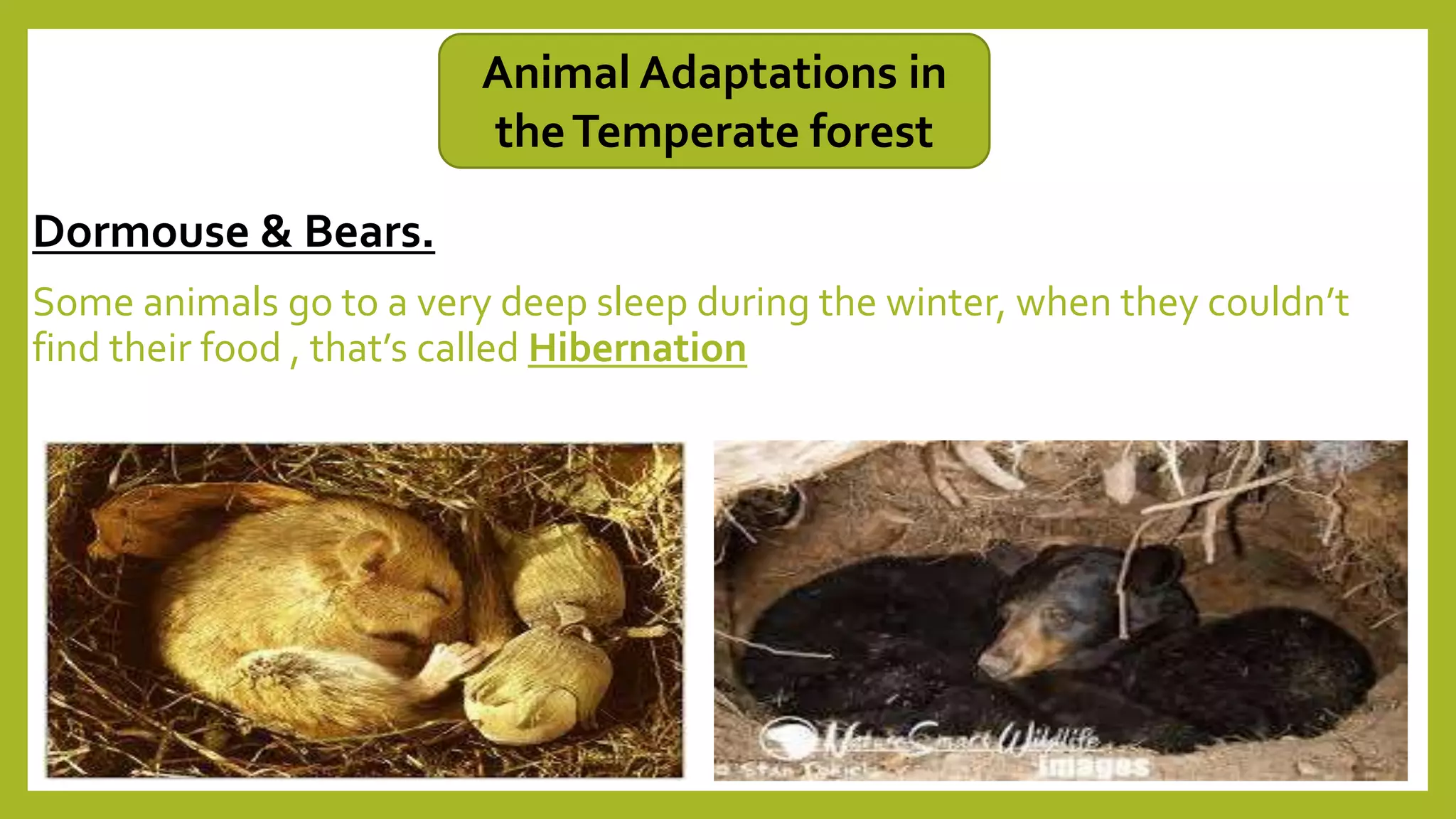
Dormouse & Bears.
Some animals go to a very deep sleep during the winter, when they couldn’t
find their food , that’s called Hibernation
Animal Adaptations in
theTemperate forest
Skunks
Other animals like: Skunks spray a stinky smell when a predator comes close
to them, to drive them away.
Adaptations in the wetland
Adaptation Of Plants in the wetland
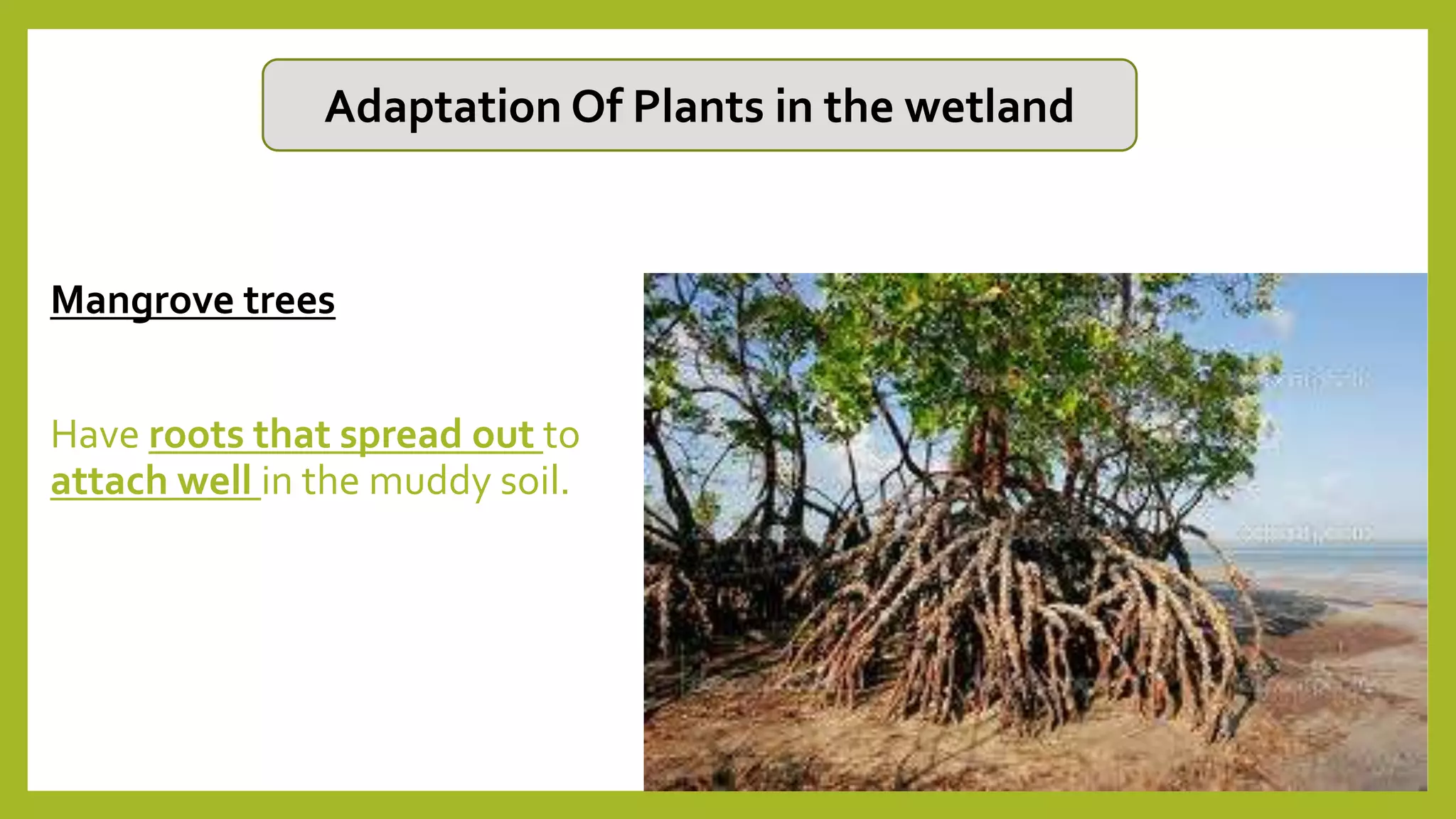
Mangrove trees
Have roots that spread out to
attach well in the muddy soil.
Adaptation Of animals in theWetland
Walking catfish
It uses its fins to move from a dry
land to water again.
This is a Behavioral adaptation.
Adaptations in the Ocean
Adaptation Of Plants in the Ocean
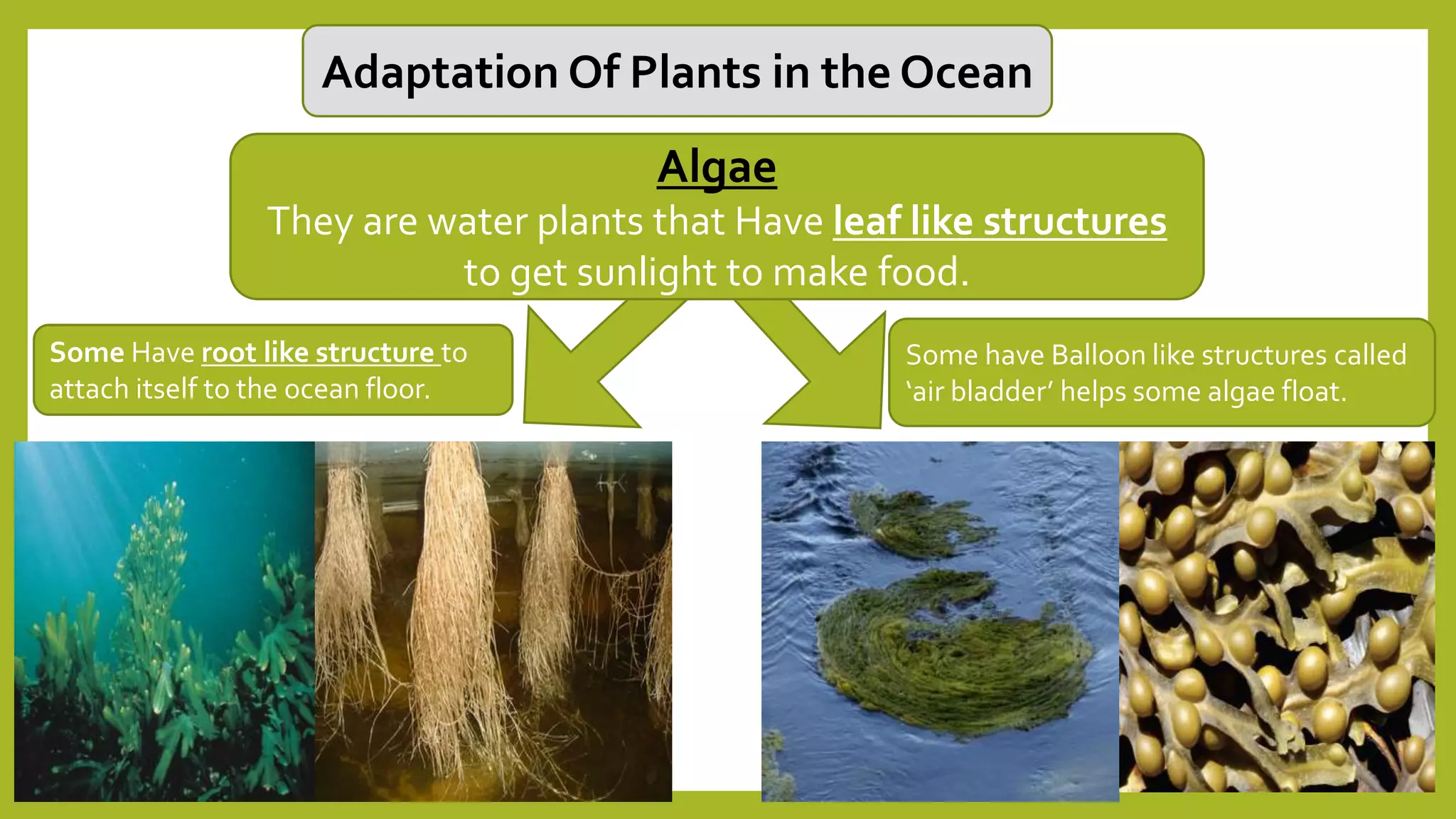
Some have Balloon like structures called
‘air bladder’ helps some algae float.
Some Have root like structure to
attach itself to the ocean floor.
Algae
They are water plants that Have leaf like structures
to get sunlight to make food.
Adaptation Of animals in the Ocean
Migration
Some animals move from their
habitat to another in the winter
When the weather gets very cold.
Example : whales
- Other Ocean animals have different ways of
adaptation like: Angler fish
“Has a growth above its head that lights up”
(Structural adaptation)
Angler fish
Small fish are attracted towards the light in the
dark ocean, when they come close to the
light, the angler fish eats them up.
•It mimics the stones in the ocean.
“It looks exactly like the stones of the Ocean, so it’s hard for
predators & preys to notice it.
Stone fish
Let’s see more behavior and structural
adaptations!!
(The coming slides are Just for further demonstration & Revision )
Remember
Structural adaptation means  a body part that helps the animals survive
Behavioral adaptation means  something an animal does .( How it behaves)
Nocturnal
Behavior
These animals are active at night, they sleep all day when the desert is cooler
and wake up at night.
Hibernation
BehaviorDormouse Bears
These animals go into deep sleep all winter as it’s hard to find food,
& wake up in spring when plants begin to grow .
Migration
Behavior
These animals move to warmer places to find more food.
Structure
Structure
Structure
StructureBehavior
The cheetah is the
FASTEST animal
in the world !!
Structure
Structure
Structure
The lion can camouflage
and hide from it’s prey as
it’s skin color blends with
the environment
The polar bear has white fur to camouflage with the white snow.
It also has a lot of blubber (FAT) to keep it warm.
Structure
Mimicry
Structure
Online games
• https://ecokids.ca/swf-files/gamesPage/adaptations.swf
• https://www.nps.gov/anch/upload/ourWildNeighbors.swf
• http://www.planet-science.com/flash/1831/deploy/missionAdaptationNew.swf

Adaptations FINAL G3

  • 2.
    In order foranimals to survive in their ecosystem they have to adapt.
  • 3.
    Adaptation Structure or behaviorthat helps a living thing “animal” to survive in its environment
  • 4.
    Adaptation Structure (A Body part) Behavior (Something they do) • Camouflage • Mimicry • Bad smell • Growth that lights up • Body parts: long neck long ears sharp teeth • Hibernate • Migrate • Nocturnal • Walking on fins
  • 5.
    Behavior adaptation Instinct An animalknows how do it, once he is born without learning. Learned An animal has to learn how to do it.
  • 6.
    How did thisbaby dolphin know how to swim once it was born ? I know it on my own it’s an Instinct !
  • 7.
    How did thedog know all that stuff ? I only learn these things if someone taught me. It’s a Learned behavior.
  • 8.
  • 9.
    Camouflage To hide frompreys when hunting. To hide from predators
  • 10.
    Chameleons • They blendin their environment by Camouflage to hide from their predators. I can be ANY COLOR I want !! I color myself with the same color of the environment so it’s hard to see me !
  • 11.
    Polar bears • Polarbear’s white fur helps it to blend with the ice & snow to make it easy for them to hunt the seal without being seen. • It also has a lot of blubber (FAT) to keep it warm.
  • 12.
    Snakes • Snakes alsoadapt in their environment by camouflage • they hide from eagles by blending in the rocks & sand, and also to make easier for them to hunt their preys.
  • 13.
    Owls • Owls alsocan adapt by camouflage inside the trees. • It makes it easier for them to hunt their preys without being seen.
  • 14.
    Lions • Lions alsoblend in their environment. • using camouflage to hunt their preys without being seen.
  • 15.
  • 16.
    - Cactus &Mesquite trees are desert plants. • Both Have spines to protect plants from being eaten. • Cactus has roots that spread far to absorb rainwater. • Cactus has stems that store water. Adaptation of plants
  • 17.
    - Some animalsare Nocturnal they are active only at night “They sleep during the day” Adaptation of animals Bats snakes
  • 18.
    Other desert animalsadapt to the desert by having Long,thin ears to cool themselves in the hot weather. Jack rabbits
  • 19.
  • 20.
    Plant Adaptations in theTropicalrainforest • Tropical rainforests get much rain all the year, this too much rain can damage the leaves. • The leaves are adapted with a drip tip at the end of each leaf to help rain water to fall off quickly.
  • 21.
    In the tropicalrainforest, there are many tall trees & leaves growing next to each other. so they block “prevent” the sun light from reaching to the plants at the bottom. So plants at the bottom adapt by having large leaves to catch the sun light.
  • 22.
  • 23.
    Some animals imitate(copy) the color or shape of something else, to protect themselves. This butterfly has spots that look like owl eyes to scare away the predators. Mimicry
  • 24.
  • 25.
    Temperate forests don’thave much rain as the tropical rainforest, so trees in the temperate forest adapt by losing their leaves in the fall to save water. Plant Adaptations in theTemperate forest
  • 26.
    Dormouse & Bears. Someanimals go to a very deep sleep during the winter, when they couldn’t find their food , that’s called Hibernation Animal Adaptations in theTemperate forest
  • 27.
    Skunks Other animals like:Skunks spray a stinky smell when a predator comes close to them, to drive them away.
  • 28.
  • 29.
    Adaptation Of Plantsin the wetland Mangrove trees Have roots that spread out to attach well in the muddy soil.
  • 30.
    Adaptation Of animalsin theWetland Walking catfish It uses its fins to move from a dry land to water again. This is a Behavioral adaptation.
  • 31.
  • 32.
    Adaptation Of Plantsin the Ocean Some have Balloon like structures called ‘air bladder’ helps some algae float. Some Have root like structure to attach itself to the ocean floor. Algae They are water plants that Have leaf like structures to get sunlight to make food.
  • 33.
    Adaptation Of animalsin the Ocean Migration Some animals move from their habitat to another in the winter When the weather gets very cold. Example : whales
  • 34.
    - Other Oceananimals have different ways of adaptation like: Angler fish “Has a growth above its head that lights up” (Structural adaptation) Angler fish Small fish are attracted towards the light in the dark ocean, when they come close to the light, the angler fish eats them up.
  • 35.
    •It mimics thestones in the ocean. “It looks exactly like the stones of the Ocean, so it’s hard for predators & preys to notice it. Stone fish
  • 36.
    Let’s see morebehavior and structural adaptations!! (The coming slides are Just for further demonstration & Revision ) Remember Structural adaptation means  a body part that helps the animals survive Behavioral adaptation means  something an animal does .( How it behaves)
  • 37.
    Nocturnal Behavior These animals areactive at night, they sleep all day when the desert is cooler and wake up at night.
  • 38.
    Hibernation BehaviorDormouse Bears These animalsgo into deep sleep all winter as it’s hard to find food, & wake up in spring when plants begin to grow .
  • 39.
    Migration Behavior These animals moveto warmer places to find more food.
  • 40.
  • 41.
  • 42.
  • 43.
    StructureBehavior The cheetah isthe FASTEST animal in the world !!
  • 44.
    Structure Structure Structure The lion cancamouflage and hide from it’s prey as it’s skin color blends with the environment
  • 45.
    The polar bearhas white fur to camouflage with the white snow. It also has a lot of blubber (FAT) to keep it warm. Structure
  • 46.
  • 47.
    Online games • https://ecokids.ca/swf-files/gamesPage/adaptations.swf •https://www.nps.gov/anch/upload/ourWildNeighbors.swf • http://www.planet-science.com/flash/1831/deploy/missionAdaptationNew.swf